
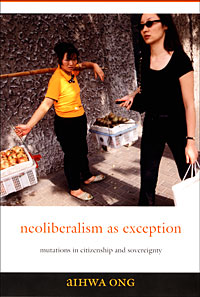
A review of Neoliberalism as Exception: Mutations in Citizenship and Sovereignty, Aihwa Ong, Duke University Press, 2006.
 Carl Schmidt defined sovereignty as ultimately the power to call a state of exception to the normalized condition of the law. Drawing on the German philosopher, Giorgio Agamben uses the exception as a fundamental principle of state rule that is predicated on the division between citizen in a judicial order and outsiders stripped of juridical and political protections. Aihwa Ong, a Berkeley anthropologist, offers a milder version of the state of exception: the sovereign exception she is interested in “is not the negative exception that suspends civil rights for some but rather positive kinds of exception that create opportunities, usually for a minority, who enjoy political accommodations and conditions not granted to the rest of the population.”
The neoliberal state of exception creates threats and opportunities
Aihwa Ong is interested in the spaces and identities opened up by neoliberalism as exception–the market-oriented and calculating technologies of government used by otherwise interventionist states in East Asia–, and by exceptions to neoliberalism–the management of populations who are deliberately excluded from neoliberal considerations, either positively or negatively. She focuses on “the interplay among technologies of governing and of disciplining, of inclusion and exclusion, of giving value or denying value to human conduct.”
The book explores how the market-driven logic of exception is deployed into a variety of ethnographic contexts: the opposition between Islamic judges and theologians and feminist groups who also claim the authority of the Quran to challenge patriarchal norms in the Malaysian context; the tensions between online communities protesting against the persecution of ethnic Chinese in Indonesia and localized struggles for national belonging and an inclusive concept of citizenship; the market- and policy-driven strategies of spatial fragmentation that create a pattern of differently administered spaces in mainland China; the ethnicization of labor market pools and of production networks linking both sides of the Pacific Ocean in the electronics industry; the tension between moral education and technical training in American colleges and universities pursuing global strategies, the outsourcing strategies that undermine the foundations of middle-class American masculine identities; the efforts of Singapore to position itself as a hub for accumulating international expertise in the knowledge-driven economy; the demands of NGOs for the biological welfare of foreign maids and migrant workers; and the failed attempts by American companies to instill management thinking and behavior among Shanghainese professionals who pursue their own self-interest.
In doing so, the author introduces many new concepts that may be picked up by other social scientists for further use and elaboration: graduated sovereignty, zoning technologies, latitudinal citizenship, translocal publics, translational identities, global ethnicities, the postdevelopmental state, labor arbitrage, biowelfare, and others. She also critically addresses works by Hardt and Negri, Agamben, Sassen, Habermas, Appadurai, and elaborates on the concept of governmentality as defined by Foucault.
An indiscriminate gleaning of facts
Neoliberalism as Exception elaborates on Aihwa Ong’s previous book, which won the Cultural Studies prize of the Association of Asian American Studies in 2001. There were aspects that disturbed me in Flexible Citizenship: the political militancy, the mix of high-brow concepts and trivial observations, the lack of any historical perspective, the disdain for economic reasoning or statistical observations, the departure from earlier traditions of fieldwork in favor of casual browsing and indiscriminate gleaning of facts. Not only did I find the same defects in Neoliberalism as Exception, but I was baffled to read whole sentences reproduced at full length from the previous book, without any mention that the two essays were based on the same material. Take the following sentence, which I had singled out in my reading of Flexible Citizenship for being particularly inept: “On a palm-fringed hillock stands the Kuala Lumpur Hilton, where attendants in white suits and batik sarongs rush forward to greet well-groomed Malay executives wielding cellular phones as they step out of limousines.” If I were the author, I wouldn’t be too proud of this stereotyped description that seems to come straight out of a popular novel or a fashion magazine. But Aihwa Ong found it worthy enough to include it all over again in one chapter of her new book.
Now why do I care, and who reads anthropology anyway? We should pay attention to what happens in the anthropological field because it offers a rare window into the lives and cultures of people who may appear distant or alien but who share with us our common humanity. Modern anthropologists have rejected earlier models of ethnography which treated local cultures as bounded and isolated, and have welcomed globalization as a formidable challenge to expand the discipline’s boundaries and to include political and economic considerations. Concepts and theoretical constructs used in anthropology also act as a reality check over the ideas and theories offered by philosophers or social critics because they are grounded in empirical observations and a rich methodological tradition. As Aihwa Ong herself acknowledges, “As anthropologists, we are skeptical of grand theories. We pose big questions through the prism of situated ethnographic research on disparate situations of contemporary living”. One only wishes she would have applied her prism more rigorously.
The last reason we should care about anthropology is because of the political uses that can be made of research results. Most anthropologists maintain a healthy distance to the centers of power and they rightly cherish their academic freedom. Some choose to embrace social causes and lend their voice to the dispossessed, the disenfranchised and the voiceless. Others address the works of social critics and offer validations or amendments of theoretical claims from their methodological perspective. As the endorsements by Michael Hardt or Manuel Castells on the book’s back cover indicate, there is a kind of circularity from theoretical texts to “views from the field” and then back to theory. But without a rich and varied ethnographic material, this circularity runs empty and theory leads to more theory without the necessary detour through observation.
 The Duke Reader