
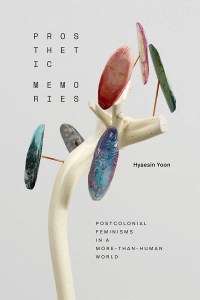
A review of Prosthetic Memories: Postcolonial Feminisms in a More-Than-Human World, Hyaesin Yoon, Duke University Press, 2025.
 The French poet Lautréamont, considered as a precursor by the surrealism movement, defined beauty as “the chance encounter between a sewing machine and an umbrella on an operating table.” Surgery here symbolizes the unexpected and the incongruous: for the surrealists, surgery is akin to collage or to the automatic writing of the “exquisite corpse.” It allows for the cutting, isolating and grafting of body parts to create hybrid and chimerical assemblages, far removed from any anatomical logic. Similarly, in Prosthetic Memories, Hyaesin Yoon develops the Korean narrative of tongue surgery for improving English pronunciation, considered as the “cyborgian assemblage of a tongue on the operating table.” Surrealism may be considered as one of the ancestors of postmodern scholarship. Lines of flight between the two intellectual traditions could be traced through assemblages, more-than-human combinations, postcolonial longings, diasporic identities, new materialisms, and the breakdown of a stable subject. Surrealism helped normalize several moves that later became central to postmodern and poststructural thinking: distrust of rational transparency, fascination with fragmentation and juxtaposition, and the idea that meaning emerges through unstable combinations rather than fixed essences. Its techniques of automatic writing, dream logic, montage, and uncanny object relations loosened the authority of linear narrative and coherent subjectivity. The paintings of Salvador Dali, or the poetry of André Breton and Philippe Soupault, displayed the hybrid bodies, animate objects, and crossings between the biological and the mechanical that later theorists could radicalize in a more explicitly political and technological register. That doesn’t mean surrealists were postmodern critics avant la lettre: it means that their work can be productively reinterpreted as a forerunner of modern currents in the humanities and the social sciences.
The tongue on the operating table
But the “tongue on the operating table” is not just a surrealist metaphor or a creative wordplay. As detailed in Hyaesin Yoon’s book, this assemblage of mouth and machinery describes the very real practice of South Korean children undergoing tongue surgery to improve their English pronunciation and thus become competitive subjects in the neoliberal economy. According to media reports, affluent South Korean parents, mostly mothers, have surgeons sever the ligament under their children’s tongues to help them master the [r] sound, which Koreans often collapse into an [l]. This news story reflects several tropes often mentioned in discussing contemporary Korean society: the English craze that permeated South Korea after the “IMF crisis” of 1998; the power of Korean mothers who often go out of their way to equip their children with the skills and traits deemed necessary to compete in the global economy; the prevalence of facial plastic surgery to mold subjects into attractive bodies; and strong social pressure to conform to perceived cultural norms and increasingly global standards. The “mother tongue” also has deep civilizational echoes in Korean culture. Korean subjects were deprived of their national language and even personal surnames during Japanese colonial rule, turning the defense of the Korean language into a matter of pride and sovereignty. According to traditional lore, the consonants in the hangul script were designed to visually represent the shape of one’s mouth, tongue, and throat when producing each sound. For instance, <ㄱ> accounts for the shape of the tongue in the articulation of [k] in the mouth. Korean characters are thus grafted onto the body, turning the individual self into a cyborg-like assemblage of biological organs, primitive information and communications technologies, and national policies of cultural uniformization.
The “cut from one’s mother tongue” creates a split subject, unmoored from its national origin and yet viscerally attached to the motherland. It is not a coincidence that the first news reports on tongue surgery appeared in the Los Angeles Times, the Californian metropolis being home to a large population of ethnic Koreans. The outmigration of Koreans from the Korean peninsula since the 19th century has resulted in a large diaspora that spans virtually all corners of the world. Even domestically, Koreanness is increasingly described in global terms. The cultural wave known as Hallyu – spanning K-pop, dramas, film, fashion and beauty – has become synonymous with Korea’s image abroad. Koreans increasingly identify with modernity and technological advancement, while many foreigners remain drawn to the country’s cultural heritage and historical depth. In the age of global flows and transborder scholarship, Korean studies are consonant with contemporary concerns in the humanities: diasporic identities, postcolonialism, science and technology studies, and non-Western feminisms. Hyaesin Yoon, who teaches gender studies at the Central European University in Vienna, speaks from a diasporic position that projects topics identified as Korean onto a transnational framework of intellectual scholarship. Her areas of interest include biopolitics, postcolonial critiques, posthumanisms, art performance and literary theories, and feminist studies of science, technology, and medicine. Her book is published by Duke University Press in a cutting-edge series that situates it within critical race studies, postcolonial studies, and feminist science studies, while also mobilizing insights from disability studies, trans and queer theories, and posthumanism. In her introduction, she makes references to Donna Haraway’s “Cyborg Manifesto” and to Judith Butler’s ethics of mourning to position her book at the intersection of these two branches of contemporary feminist thought. Her approach is resolutely transdisciplinary and is based on “a variety of practices, including close reading of literature, films, and newspapers; archival research; in-person and email interviews; and visits to a biotech research facility.”
Body-technology interfaces
The common thread in her case studies – tongue surgery, machine poetry, commercial pet cloning, and human stem cell research – is the idea that memory is not simply housed in human minds but is redistributed across bodies, machines, companion species, bodily cells, and transnational circuits of power. Or to borrow her words: “how we remember is embedded in our entanglements with human and nonhuman others in parasitic/nurturing, exploitive/creative, and unevenly interdependent webs spun beyond human consciousness and control.” She proposes the concept of “prosthetic memory” as an emergent mode of remembering in which memory extends beyond the human subject into technological and biological assemblages. That idea is more than a provocative metaphor: it becomes a way of rethinking embodiment, speech acts, species boundaries, and the politics of knowledge under neoliberal globalization. Prosthetic Memories is especially interested in how racialized, gendered, diasporic, queer, and otherwise marginalized subjects are entangled with those assemblages in ways that produce both trauma and transgression. Hyaesin Yoon is well aware of the ableist bias that the notion of prosthesis may entail: “the trope of prosthetics often assumes disability as a deficit that needs to be supplemented—corrected—by technology.” Her notion of prosthetic memory departs from the conventional conception of mechanical memory as an artificial supplement to human mnemonic power. It also questions the implicit gender roles that assign to women the work of remembering and caring for the community, as well as the transphobia prejudice that identifies mechanical intervention into the gendered body as a transgression of natural boundaries. Her programmatic approach of “rethinking postcolonial feminist mnemonics at the turn of the twenty-first century” across South Korea and the United States critically revisits the relationship between humans, non-human living beings, and biotechnologies. The various interfaces of body-technology she describes emphasize the inhuman otherness of lived memories, as when she considers “memories from the perspective of a cactus” in an art installation by Los Angeles-based artist Kang Seung Lee.
Each case study in Yoon’s Prosthetic Memories considers a specific body-technology interface, the power relations at play along the dimensions of sex/gender, race, and disability, and how the concept of prosthetic memory can contribute to the formation of alliances for marginalized subjects in a postcolonial framework. The “cut in the tongue” is gendered—Korean boys being taken to the clinic by their overbearing mothers—and reproduces lines of race and ethnicity while echoing memories from the colonial period and replacing them in a neoliberal context of unfettered globalization. The surrealist metaphor is richly evocative—one can also think of the Buñuel movie scene in which a razor blade slices through an eye—and is further developed in artworks curated by the author: a video installation (Mouth to Mouth, 1975) featuring a close-up of a mouth silently enunciating the eight Korean vowels, or a short film (Tongue-Tie, 2003) of a tongue surgery operation. Yoon reminds us that “the tongue is a crucial channel for technologies of power that produce and shape both colonial and anticolonial subjects”: language, both national and foreign, is itself intrinsically prosthetic. A detour through Black feminism allows her to “challenge the hegemonic sense of reality based on the unracialized relationship between body and language.” Tony Morrison’s 1993 Nobel lecture tells the story of language “as a bird in your hand,” emphasizing both its agency and its precarity. NourbeSe Philip, a Tobago-born poet, evokes a mother who “licks her newborn daughter clean,” crossing the boundary between human and animal. Language as a bodily practice allows the author to question “the posthumanist narrative of the turn from the linguistic to the material”: maternal corporeality is inscribed upon the body of the speaking subject, and the tongue, sliced by the scalpel or uncut, is the material embodiment of a language that bears the memories of a colonial past and a diasporic present. Mobilizing Black critique in an Asian or Asian-American context allows the author to undermine the implicit racial hierarchies that posit Black as inferior and white as superior, granting Asians the intermediary status of a model minority. While media reports often pit one community against the other, as during the LA riots of 1992, ethnic Koreans share with African Americans a diasporic identity, the memory of an oppressive past, and an acute sense of social justice.
Language as prosthesis
Language as mnemonic prosthesis is revisited through another classic example of neoliberal globalization: the outsourced US call centers in India, where operators are trained to erase their Indian accent in English in order to sound American. This example now seems dated as we have entered a world of artificial intelligence, speech recognition, voice synthesis, and AI-powered analytics. India’s IT giants have shifted from back-office outsourcing to tech automation and AI orchestration, making the issue of the “Neutral Accent” (to borrow from a book published by Duke University Press in 2015, which I reviewed here) an outmoded signpost on the way to global integration. Indeed, this evolution was foretold by American critic Susan Sontag who, in a 2002 lecture titled “The World as India,” envisaged a near future where computers would soon be able to perform most translating tasks, leaving the field of literature and poetry as the only domain of human translators’ intervention. The dialectics between the machine and the poem, translated or not, is thematized in the work of multimedia artist and poet Margaret Rhee, which plays with the queer and diasporic relationships among robot/machine, human, and poetry. Like AI-powered computers, Asian Americans are credited with superior productivity and rigor of execution, but are sometimes dismissed as lacking creativity and emotions. According to Margaret Rhee, robots are described as “immigrants of the future” and “second-class citizens,” which bears an “uncanny resemblance” to the “model minority stereotype” of Asian Americans. In her poetry collection Love, Robot (2017) and her multimedia installation Kimchi Poetry Machine (2014), Rhee discusses the ability for machines to experience love and write poetry, often used as a touchstone for testing the uniqueness of human emotional functions. The queer intimacy between a human and a robot has always been envisaged through the lenses of race (confer the many robots with Asian features in Hollywood movies) and traditional gender norms (the hero is male, the robot female). Through poetic language, Rhee’s robots provide an alternative to the conventional trope of Asian immigrants and machines as highly productive but devoid of interiority.
South Korea is often the origin of uncanny news in the science and technology sector. It frequently generates surreal or futuristic headlines, blending ultra-high-speed automation, eccentric robotic experiments, and deep-sea data center proposals to solve land shortages. The nation treats sci-fi concepts as urgent infrastructure policy rather than distant speculation. Hyaesin Yoon revisits two such stories that briefly impacted the news cycle: commercial pet cloning as a technological substitute for mourning a lost animal companion, and human stem cell research as a tool for regenerative medicine and anti-aging applications. She suggests an affinity between clones and female, queer, and colonial subjects because all four groups have historically been treated as copies, property, or outsiders rather than unique, autonomous individuals. Asian biotech scientists also operate with fewer restrictions to fast-track innovation than their Western counterparts, bypassing rigid ethical codes or early-stage drug approval processes. Animal rights advocates have long expressed deep ethical concerns regarding the commercial pet-cloning industry, including reports that dogs used as egg donors or surrogate mothers in countries like South Korea have sometimes been rented from or returned to meat farms where they face slaughter. Hyaesin Yoon is more concerned with the ethics of mourning and the theory of grievability that stem from these prosthetic memory dogs coming from the pet cloning industry. What turns a life worth grieving into a life worth cloning, and what kind of relationship is at stake when a singular attachment story is turned into a manufactured project? The distinction between animal biotechnology and human embryonic stem cell research is a fraught one, as illustrated by the story of Dr. Woo Suk Hwang who gained recognition for livestock cloning before being barred from Seoul National University for publishing fraudulent research on cloned human embryos.
Techno-Orientalism or the New Yellow Peril
There has been a change in Western perceptions of “the Orient”. Edward Said’s core thesis exposed in 1978 in Orientalism—that knowledge production is tied to power and used to “other” regions like the Middle East and Asia—require updating and decentering. The rise of powerful Asian and Middle Eastern economies and media hubs means the “West defines the East” dynamic is increasingly challenged by multipolar narratives. Techno-Orientalism updates traditional orientalism by replacing ancient, pre-modern stereotypes with futuristic aesthetics, robotics, and cyborgs, reflecting Western anxieties about Eastern economic and technological power. Dehumanization is still there: Asian bodies and cultures are often associated with machinery, or portrayed as hive-minded, emotionless, and robotic. Contemporary geopolitical anxiety around artificial intelligence frequently recycles 19th-century “Yellow Peril” rhetoric, merging historical anti-Asian racism with modern techno-Orientalism to frame Eastern technological advancement as an existential civilizational threat. Hyaesin Yoon shows that these modern narratives are still embedded in age-old circuits of disgust and shame, perceptions of social and cultural abjection. Especially when it comes to South Korea, complex domestic socio-economic issues such as dog meat consumption or facial surgery are often sensationalized abroad, reducing a high-tech society to a stereotype of hyper-anxiety or robotic work ethics. Internal Korean discourse is itself preoccupied with the binary of sŏnjin’guk (advanced nation) versus hujin’guk (underdeveloped nation), reflecting a historical sensitivity to Eurocentric global hierarchies. By adopting a postcolonial transspecies feminist approach, Prosthetic Memories reveals how intersecting structures of human nationalism, species hierarchy, and global capitalism shape bodies, marginalized groups, and non-human animals within rapid modernization.
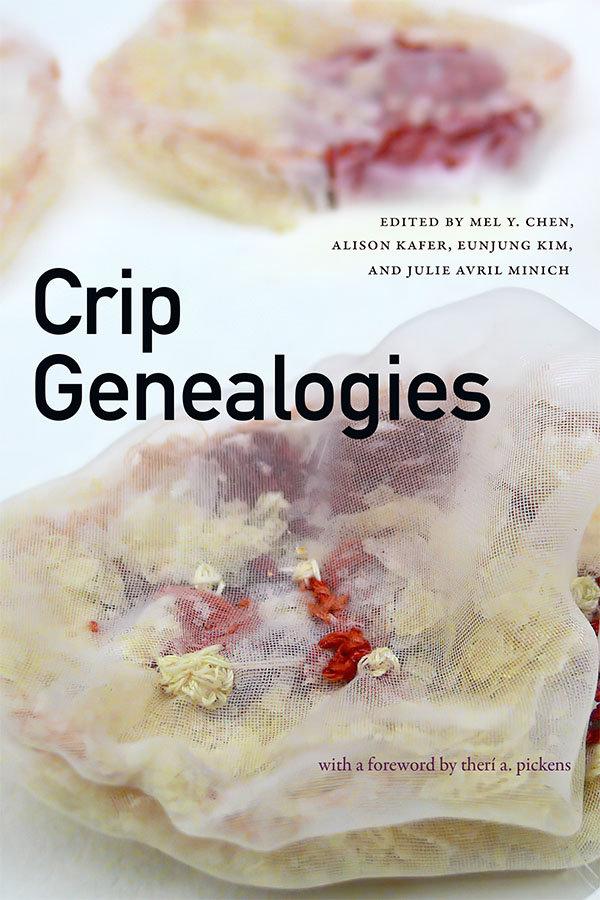 Crip Genealogies is an anthology of texts that claim the pejorative word crip as a moniker to distance themselves from earlier contributions in the field of disability studies. Crip is a diminutive for “cripple” and is used as a slur to designate people with visible forms of disabilities, mostly physical and mobility impairments. It is also a word associated with violence and ghetto culture, as the Crips are one of the largest and most violent associations of street gangs in Los Angeles. Reclaiming crip as a definition of self-identity is a way to return the stigma against the verbal offenders and to express pride in being a member of the disability community. In the academic world, it is also a way to carve a niche for critical disability studies and to express solidarity with non-normative forms of living that may also include queerness and ethnic pride. Symptomatic of this convergence between academic currents and social movements is the proliferation of acronyms to designate minoritarian identities that may be based on sexual orientation and gender identity (LGBTQ+), race and ethnicity (BIPOC, pronounced “bye-pock,” which stands for Black, Indigenous, and people of color), mental health and physical disability (MMINDS, an acronym which stands for Mad, “mentally ill,” neurodivergent, disabled, survivor), or an intersection thereof (SDQTBIPOC, which stands for sick and disabled, queer and trans non-white persons). Most contributors to Crip Genealogies are part of this extensive community and define themselves as queer persons of color, diversely abled, and straddling the line between scholarship and activism. The publication is meant to provide foundational basis for crip theory as a discipline opposed to the apolitical and normative aspects of disability studies and that is “disrupting the established histories and imagined futures of the field.”
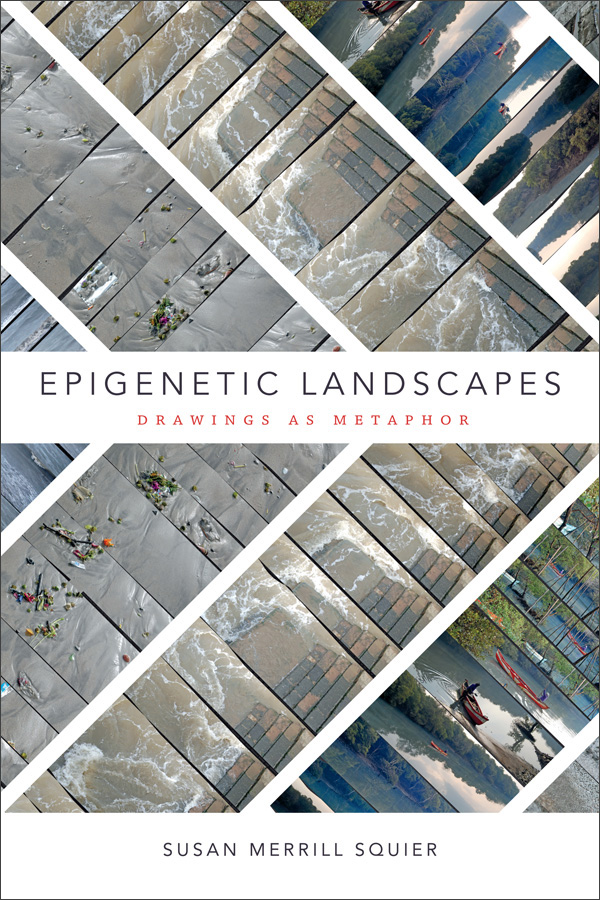 Susan M. Squier believes drawings, cartoons, and comic strips should play a role in science and in medicine. Not only in the waiting room of the medical doctor or during the pauses scientists take from work, but straight into the curriculum of science students and in the prescriptions given to ailing patients. She even has a word for it: graphic medicine, or the application of the cartoonist’s art to problems of health and disease. Her point is not only that laughing or smiling while reading a comic book may have beneficial effects on the patient’s morale and health. Works of graphic medicine can enable greater understanding of medical procedures, and can even generate new research questions and clinical approaches. Cartoons can help treat cancer; they might even contribute to cancer research. Pretending otherwise is to adhere to a reductionist view of science that excludes some people, especially women and the artistically inclined, from the laboratory. In order to make science more inclusive, scientists should espouse “explanatory pluralism” and remain open to nonverbal forms of communication, including drawings and pictures. Comics and cartoons are a legitimate source of knowledge production and information sharing, allowing for an embodied and personal experience to be made social. They are providing new ways to look at things, enabling new modes of intervention, and putting research content in visual form. In comics, body posture and gesture occupy a position of primacy over text, and graphic medicine therefore facilitates an encounter with the whole patient instead of focusing on abstract parameters such as illness or diagnosis. Studies are already suggesting that medical students taught to make their own comics become more empathetic caregivers as doctors. Health-care workers, patients, family members, and caregivers should be encouraged to create their own comics and to circulate them as a form of people-centered mode of knowledge creation.
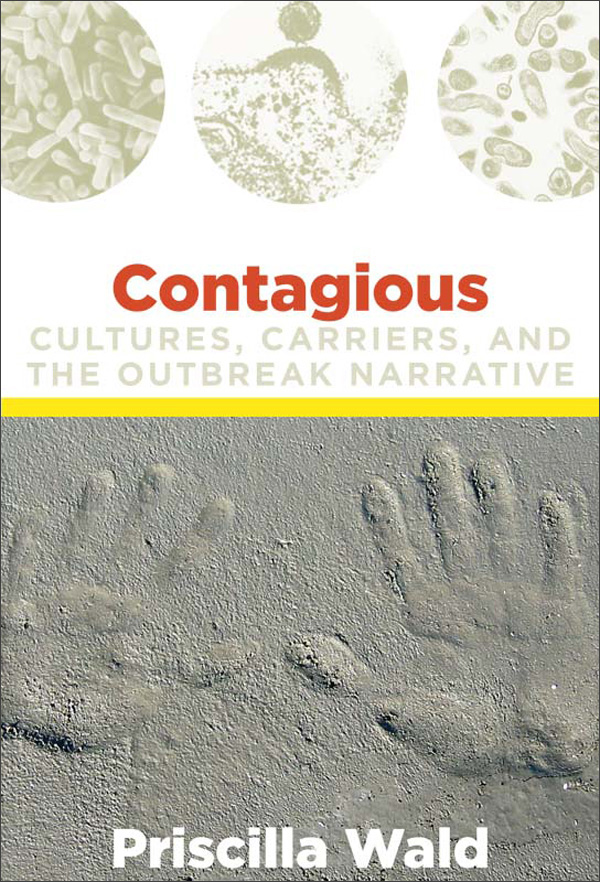 We think containing the spread of infectious diseases is all about science. In fact, more than we care to admit, our perception of disease contagion is shaped by fictions: blockbuster movies, popular novels, newspaper headlines, and magazine articles. These fictions frame our understanding of emerging viruses and the response we give to global health crises. Call it the outbreak narrative. It follows a formulaic plot that goes through roughly the same steps of emergence in nature or in labs, human infection, transnational contagion, widespread prevalence, medical identification of the virus, epidemiological containment, and final eradication. It features familiar characters: the healthy human carrier, the superspreader, the virus detective, the microbe hunter. It summons mythological figures or supervillains from past history: the poisonous Typhoid Mary from the early twentieth century, the elusive Patient Zero from the HIV/AIDS crisis. Through these fictions, new terms and metaphors have entered our vocabulary: immunodeficiency, false negative, reproductive rate, incubation period, herd immunity, “flattening the curve.” We don’t know the science behind the concepts, but we easily get the picture. Outbreak narratives have consequences: they shape the reaction to the health crisis by leaders and the public, they affect survival rates and contagion routes, they promote or mitigate the stigmatizing of individuals and groups, and they change moral and political economies. It is therefore important to understand the appeal and persistence of the outbreak narrative in order to design more effective and humane responses to the global health crises that lie ahead of us.
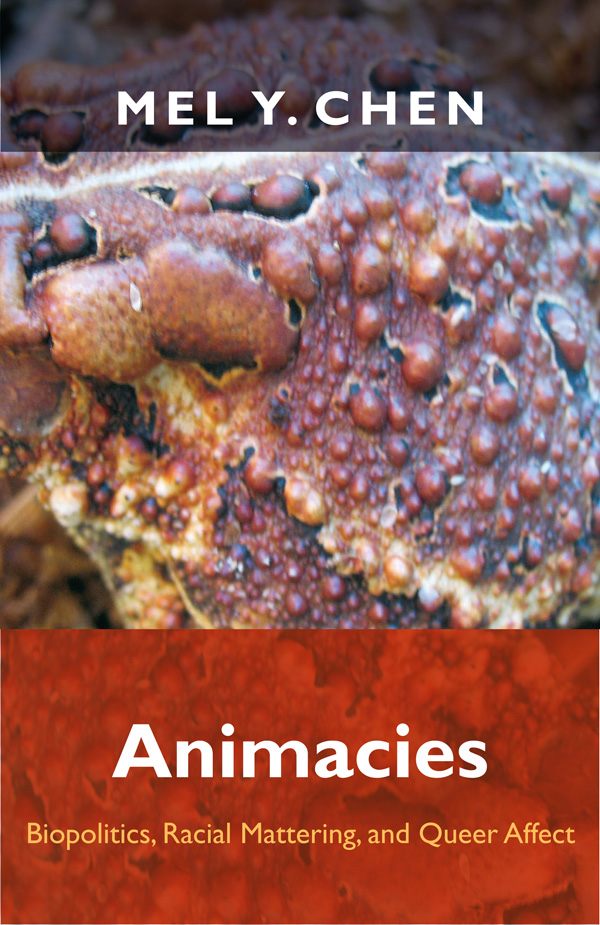 “Inanimate objects, have you then a soul / that clings to our soul and forces it to love?,” wondered Alphonse de Lamartine in his poem “Milly or the Homeland.” In Animacies, Mel Chen answers positively to the first part of this question, although the range of affects she considers is much broader than the lovely attachments that connected the French poet to his home village. As she sees it, “matter that is considered insensate, immobile, deathly, or otherwise ‘wrong’ animates cultural life in important ways.” Anima, the Latin word from which animacy derives, is defined as air, breath, life, mind, or soul. Inanimate objects are supposed to be devoid of such characteristics. In De Anima, Aristotle granted a soul to animals and to plants as well as to humans, but he denied that stones could have one. Modern thinkers have been more ready to take the plunge. As Chen notes, “Throughout the humanities and social sciences, scholars are working through posthumanist understandings of the significance of stuff, objects, commodities, and things.” Various concepts have been proposed to break the great divide between humans and nonhumans and between life and inanimate things, as the titles of recent essays indicate: “Vibrant Matter” (Jane Bennett), “Excitable Matter” (Natasha Myers), “Bodies That Matter” (Judith Butler), “The Social Life of Things” (Arjun Appadurai), “The Politics of Life Itself” (Nikolas Rose),“Parliament of Things” (Bruno Latour). Many argue that objects are imbued with agency, or at least an ability to evoke some sort of change or response in individual humans or in an entire society. However, each scholar also possesses an individual interpretation of the meaning of agency and the true capacity of material objects to have personalities of their own. In Animacies, Mel Chen makes her own contribution to this debate by pushing it in a radical way: writing from the perspective of queer studies, she argues that degrees of animacy, the agency of life and things, cannot be dissociated from the parameters of sexuality and race and is imbricated with health and disability issues as well as environmental and security concerns.
 It is said that Americans don’t have social security. Soldiers do. Earnings for active duty military service or active duty training have been covered under the Social Security Act since 1957. Veterans get social security benefits after they are discharged. Military service members who become disabled while on active duty can file for disability claims. The social security system also covers families and relatives of a deceased soldier. Active duty military members can retire after twenty years of active duty service. In exchange, they receive retirement pay for life. Veterans get free or low-cost medical care through VA hospitals and medical facilities. They have access to special education programs, housing and home loan guarantees, job training and skills upgrading, small business loans, and even burial and memorial benefits. Their situation contrasts with the thirty million Americans who do not have health insurance and who cannot afford medical costs, and with the many more who get only minimal retirement pension and healthcare. In sum, when you join the US Army, Uncle Sam gets your back covered.
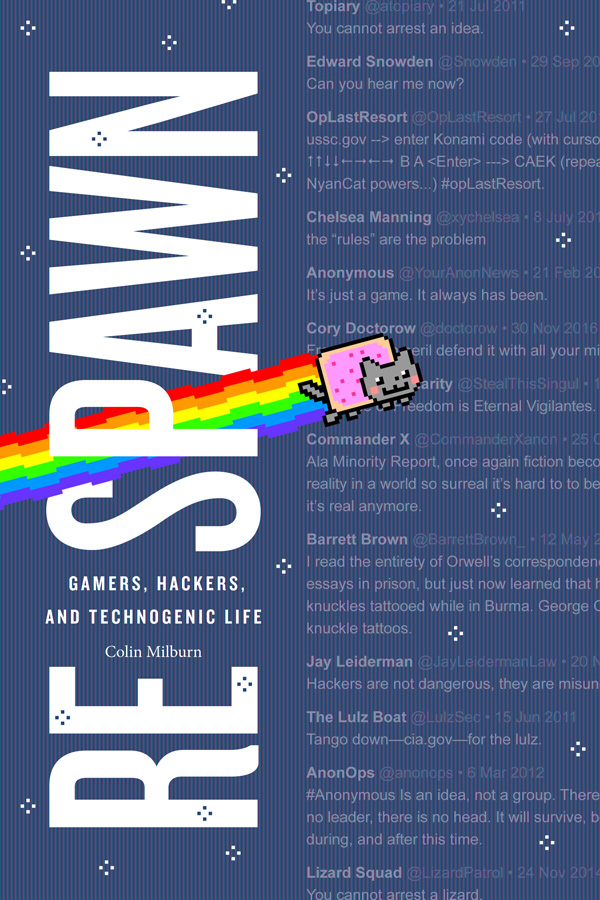 Video games are now part of popular culture. Like books or movies, they can be studied as cultural productions, and university departments offer courses that critically engage with them. Scholars who specialize in this field of study take various perspectives: they can chart the history of video game production and consumption ; they can focus on their design or their aesthetic value; or they can analyze their narrative content and story plot. There is no limit to how video games can be engaged: some thinkers even take them as fertile ground for philosophy and theory building. Within the past few years, a handful of books have been published on video game theory. Colin Milburn’s Respawn can be added to that budding strand of literature. It is a work of applied theory: the author doesn’t engage with longstanding philosophical problems or abstract reasoning, but draws from the examples of a wide range of games, from Portal and Final Fantasy VII to Super Mario Sunshine and Shadow of the Colossus, to illustrate how they impact the lives of gamers and non-gamers alike. In particular, he considers the value of video games for shaping protest and political action. Video games, with the devotion that serious gamers bring to the task, introduce the possibility of living otherwise, of hacking the system, of gaming the game. Gamers and hackers develop alternative forms of participatory culture along with new tactics of critique and intervention. Hacktivist groups such as Anonymous use video game language and aesthetics to disrupt the operations of the security state and launch attacks on the neoliberal order. Pirate parties have won seats in European legislatures and advocate a brand of techno-progressivism, digital liberties, and participatory democracy largely inspired by video games. Exploring the culture of video games can therefore offer a glimpse into the functioning of our modern democracies in a computerized world.
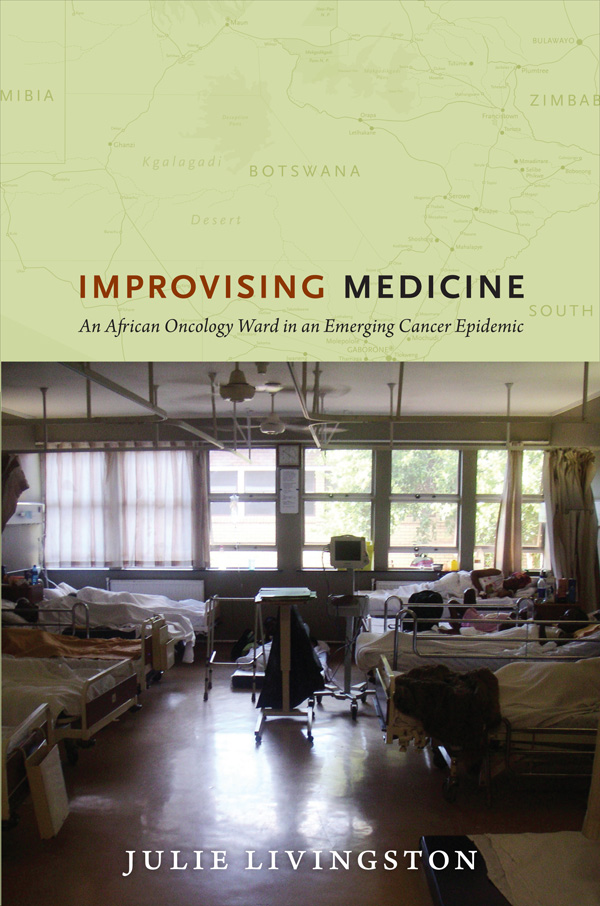 Improvising Medicine describes everyday life in a small oncology ward in Botswana, a Southern African country that has been decimated by HIV/AIDS and that now faces a rising cancer epidemic. AIDS, disease, heat, stench, misery, overcrowding, scarcity, death: the picture seems familiar, even cliché. But Julie Livingston warns (or reassures) her reader at the outset: this is not the book on Africa one has learned to expect (or to dread). As she notes, “the problems of pain, death, illness, disfigurement, and care that lie at the heart of this book are basic human ones.” This is, in essence, a book about human nature in the face of insufferable circumstances. It is told in the way anthropologists tell a story: with a concern for the local, the mundane, the quotidian. Improvising Medicine is based on an extended period of participant observation and hundreds of pages of research notes jotted down after long hours of assisting care workers in their daily chores. The particularities of ethnographic observation are reflected in the excerpts of the research diary that are inserted in the book, with the names and proclivities of each patient and coworker who, in the end, become familiar figures to the reader as they were for the fieldworker. And yet, between the localized setting and the universalist message, there are some conditions and lessons that pertain to Africa as a whole. The cancer ward in Princess Marina Hospital in Gaborone, Botswana’s capital, is referred to as an African oncology ward in an African hospital. The author routinely writes about an African ethic of care, about the defining features of biomedicine in Africa, or about the articulation between African practice and global health.
 This book can be read as an anti-American tract, or an anti-vaccine manifesto, or as a justification of anti-speciesism, or as an attack on liberal ideas of democracy, equality, and scientific progress. Of course, this is not the intention of the author. Neel Ahuja didn’t write a tract or a manifesto, but an elaborate social science book with deep theoretical repercussions. He is more descriptive than prescriptive, and his political message is not spelled out in detail. He situates himself in a progressive movement that is unconditionally anti-racist, feminist, and anti-war. But he doesn’t take position on vaccines, on animal rights, or on speciesism. His goal is not to provide simple answers, but to complicate things and deepen our vision of mankind and its living environment as some truths long held to be self-evident are losing political traction. However, liberal arguments can be used for very illiberal ends. As I read it, Bioinsecurities gives credence to very nasty arguments which, taken to their extreme, articulate a very anti-liberal and regressive agenda. Of course, some readers, and the author with them, may argue that it is perfectly fine to be anti-American, anti-vaccine, or to stand for a radical vision of animal rights, especially considering the background of brutal imperialism, public health manipulations, and disregard for non-human animals that have marked our common history and still inform our present. We should work against the public amnesia and state-endorsed manipulation of truth that prevent the public to exercise democratic oversight and make informed decisions on matters of life and death that affect us most. But an author also has to give consideration to how a book might be read or perceived. For me, Bioinsecurities dangerously straddles the line between liberalism and illiberalism, humanism and anti-humanism, and progressivism and regression.
