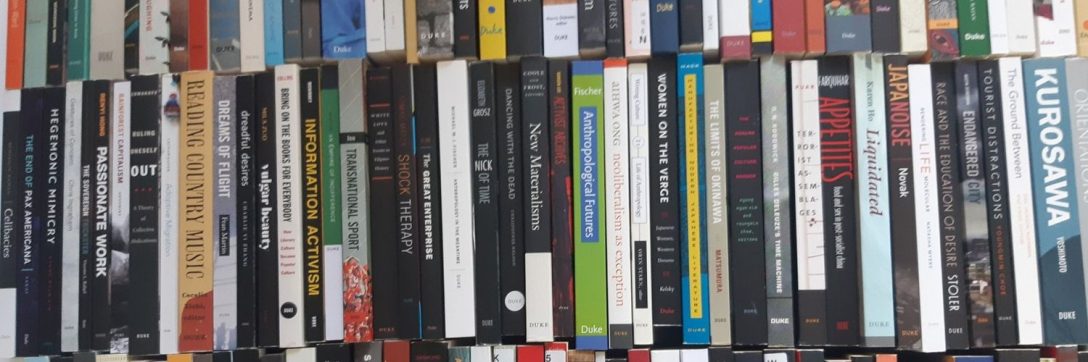

A review of Prosthetic Memories: Postcolonial Feminisms in a More-Than-Human World, Hyaesin Yoon, Duke University Press, 2025.
 The French poet Lautréamont, considered as a precursor by the surrealism movement, defined beauty as “the chance encounter between a sewing machine and an umbrella on an operating table.” Surgery here symbolizes the unexpected and the incongruous: for the surrealists, surgery is akin to collage or to the automatic writing of the “exquisite corpse.” It allows for the cutting, isolating and grafting of body parts to create hybrid and chimerical assemblages, far removed from any anatomical logic. Similarly, in Prosthetic Memories, Hyaesin Yoon develops the Korean narrative of tongue surgery for improving English pronunciation, considered as the “cyborgian assemblage of a tongue on the operating table.” Surrealism may be considered as one of the ancestors of postmodern scholarship. Lines of flight between the two intellectual traditions could be traced through assemblages, more-than-human combinations, postcolonial longings, diasporic identities, new materialisms, and the breakdown of a stable subject. Surrealism helped normalize several moves that later became central to postmodern and poststructural thinking: distrust of rational transparency, fascination with fragmentation and juxtaposition, and the idea that meaning emerges through unstable combinations rather than fixed essences. Its techniques of automatic writing, dream logic, montage, and uncanny object relations loosened the authority of linear narrative and coherent subjectivity. The paintings of Salvador Dali, or the poetry of André Breton and Philippe Soupault, displayed the hybrid bodies, animate objects, and crossings between the biological and the mechanical that later theorists could radicalize in a more explicitly political and technological register. That doesn’t mean surrealists were postmodern critics avant la lettre: it means that their work can be productively reinterpreted as a forerunner of modern currents in the humanities and the social sciences.
The tongue on the operating table
But the “tongue on the operating table” is not just a surrealist metaphor or a creative wordplay. As detailed in Hyaesin Yoon’s book, this assemblage of mouth and machinery describes the very real practice of South Korean children undergoing tongue surgery to improve their English pronunciation and thus become competitive subjects in the neoliberal economy. According to media reports, affluent South Korean parents, mostly mothers, have surgeons sever the ligament under their children’s tongues to help them master the [r] sound, which Koreans often collapse into an [l]. This news story reflects several tropes often mentioned in discussing contemporary Korean society: the English craze that permeated South Korea after the “IMF crisis” of 1998; the power of Korean mothers who often go out of their way to equip their children with the skills and traits deemed necessary to compete in the global economy; the prevalence of facial plastic surgery to mold subjects into attractive bodies; and strong social pressure to conform to perceived cultural norms and increasingly global standards. The “mother tongue” also has deep civilizational echoes in Korean culture. Korean subjects were deprived of their national language and even personal surnames during Japanese colonial rule, turning the defense of the Korean language into a matter of pride and sovereignty. According to traditional lore, the consonants in the hangul script were designed to visually represent the shape of one’s mouth, tongue, and throat when producing each sound. For instance, <ㄱ> accounts for the shape of the tongue in the articulation of [k] in the mouth. Korean characters are thus grafted onto the body, turning the individual self into a cyborg-like assemblage of biological organs, primitive information and communications technologies, and national policies of cultural uniformization.
The “cut from one’s mother tongue” creates a split subject, unmoored from its national origin and yet viscerally attached to the motherland. It is not a coincidence that the first news reports on tongue surgery appeared in the Los Angeles Times, the Californian metropolis being home to a large population of ethnic Koreans. The outmigration of Koreans from the Korean peninsula since the 19th century has resulted in a large diaspora that spans virtually all corners of the world. Even domestically, Koreanness is increasingly described in global terms. The cultural wave known as Hallyu – spanning K-pop, dramas, film, fashion and beauty – has become synonymous with Korea’s image abroad. Koreans increasingly identify with modernity and technological advancement, while many foreigners remain drawn to the country’s cultural heritage and historical depth. In the age of global flows and transborder scholarship, Korean studies are consonant with contemporary concerns in the humanities: diasporic identities, postcolonialism, science and technology studies, and non-Western feminisms. Hyaesin Yoon, who teaches gender studies at the Central European University in Vienna, speaks from a diasporic position that projects topics identified as Korean onto a transnational framework of intellectual scholarship. Her areas of interest include biopolitics, postcolonial critiques, posthumanisms, art performance and literary theories, and feminist studies of science, technology, and medicine. Her book is published by Duke University Press in a cutting-edge series that situates it within critical race studies, postcolonial studies, and feminist science studies, while also mobilizing insights from disability studies, trans and queer theories, and posthumanism. In her introduction, she makes references to Donna Haraway’s “Cyborg Manifesto” and to Judith Butler’s ethics of mourning to position her book at the intersection of these two branches of contemporary feminist thought. Her approach is resolutely transdisciplinary and is based on “a variety of practices, including close reading of literature, films, and newspapers; archival research; in-person and email interviews; and visits to a biotech research facility.”
Body-technology interfaces
The common thread in her case studies – tongue surgery, machine poetry, commercial pet cloning, and human stem cell research – is the idea that memory is not simply housed in human minds but is redistributed across bodies, machines, companion species, bodily cells, and transnational circuits of power. Or to borrow her words: “how we remember is embedded in our entanglements with human and nonhuman others in parasitic/nurturing, exploitive/creative, and unevenly interdependent webs spun beyond human consciousness and control.” She proposes the concept of “prosthetic memory” as an emergent mode of remembering in which memory extends beyond the human subject into technological and biological assemblages. That idea is more than a provocative metaphor: it becomes a way of rethinking embodiment, speech acts, species boundaries, and the politics of knowledge under neoliberal globalization. Prosthetic Memories is especially interested in how racialized, gendered, diasporic, queer, and otherwise marginalized subjects are entangled with those assemblages in ways that produce both trauma and transgression. Hyaesin Yoon is well aware of the ableist bias that the notion of prosthesis may entail: “the trope of prosthetics often assumes disability as a deficit that needs to be supplemented—corrected—by technology.” Her notion of prosthetic memory departs from the conventional conception of mechanical memory as an artificial supplement to human mnemonic power. It also questions the implicit gender roles that assign to women the work of remembering and caring for the community, as well as the transphobia prejudice that identifies mechanical intervention into the gendered body as a transgression of natural boundaries. Her programmatic approach of “rethinking postcolonial feminist mnemonics at the turn of the twenty-first century” across South Korea and the United States critically revisits the relationship between humans, non-human living beings, and biotechnologies. The various interfaces of body-technology she describes emphasize the inhuman otherness of lived memories, as when she considers “memories from the perspective of a cactus” in an art installation by Los Angeles-based artist Kang Seung Lee.
Each case study in Yoon’s Prosthetic Memories considers a specific body-technology interface, the power relations at play along the dimensions of sex/gender, race, and disability, and how the concept of prosthetic memory can contribute to the formation of alliances for marginalized subjects in a postcolonial framework. The “cut in the tongue” is gendered—Korean boys being taken to the clinic by their overbearing mothers—and reproduces lines of race and ethnicity while echoing memories from the colonial period and replacing them in a neoliberal context of unfettered globalization. The surrealist metaphor is richly evocative—one can also think of the Buñuel movie scene in which a razor blade slices through an eye—and is further developed in artworks curated by the author: a video installation (Mouth to Mouth, 1975) featuring a close-up of a mouth silently enunciating the eight Korean vowels, or a short film (Tongue-Tie, 2003) of a tongue surgery operation. Yoon reminds us that “the tongue is a crucial channel for technologies of power that produce and shape both colonial and anticolonial subjects”: language, both national and foreign, is itself intrinsically prosthetic. A detour through Black feminism allows her to “challenge the hegemonic sense of reality based on the unracialized relationship between body and language.” Tony Morrison’s 1993 Nobel lecture tells the story of language “as a bird in your hand,” emphasizing both its agency and its precarity. NourbeSe Philip, a Tobago-born poet, evokes a mother who “licks her newborn daughter clean,” crossing the boundary between human and animal. Language as a bodily practice allows the author to question “the posthumanist narrative of the turn from the linguistic to the material”: maternal corporeality is inscribed upon the body of the speaking subject, and the tongue, sliced by the scalpel or uncut, is the material embodiment of a language that bears the memories of a colonial past and a diasporic present. Mobilizing Black critique in an Asian or Asian-American context allows the author to undermine the implicit racial hierarchies that posit Black as inferior and white as superior, granting Asians the intermediary status of a model minority. While media reports often pit one community against the other, as during the LA riots of 1992, ethnic Koreans share with African Americans a diasporic identity, the memory of an oppressive past, and an acute sense of social justice.
Language as prosthesis
Language as mnemonic prosthesis is revisited through another classic example of neoliberal globalization: the outsourced US call centers in India, where operators are trained to erase their Indian accent in English in order to sound American. This example now seems dated as we have entered a world of artificial intelligence, speech recognition, voice synthesis, and AI-powered analytics. India’s IT giants have shifted from back-office outsourcing to tech automation and AI orchestration, making the issue of the “Neutral Accent” (to borrow from a book published by Duke University Press in 2015, which I reviewed here) an outmoded signpost on the way to global integration. Indeed, this evolution was foretold by American critic Susan Sontag who, in a 2002 lecture titled “The World as India,” envisaged a near future where computers would soon be able to perform most translating tasks, leaving the field of literature and poetry as the only domain of human translators’ intervention. The dialectics between the machine and the poem, translated or not, is thematized in the work of multimedia artist and poet Margaret Rhee, which plays with the queer and diasporic relationships among robot/machine, human, and poetry. Like AI-powered computers, Asian Americans are credited with superior productivity and rigor of execution, but are sometimes dismissed as lacking creativity and emotions. According to Margaret Rhee, robots are described as “immigrants of the future” and “second-class citizens,” which bears an “uncanny resemblance” to the “model minority stereotype” of Asian Americans. In her poetry collection Love, Robot (2017) and her multimedia installation Kimchi Poetry Machine (2014), Rhee discusses the ability for machines to experience love and write poetry, often used as a touchstone for testing the uniqueness of human emotional functions. The queer intimacy between a human and a robot has always been envisaged through the lenses of race (confer the many robots with Asian features in Hollywood movies) and traditional gender norms (the hero is male, the robot female). Through poetic language, Rhee’s robots provide an alternative to the conventional trope of Asian immigrants and machines as highly productive but devoid of interiority.
South Korea is often the origin of uncanny news in the science and technology sector. It frequently generates surreal or futuristic headlines, blending ultra-high-speed automation, eccentric robotic experiments, and deep-sea data center proposals to solve land shortages. The nation treats sci-fi concepts as urgent infrastructure policy rather than distant speculation. Hyaesin Yoon revisits two such stories that briefly impacted the news cycle: commercial pet cloning as a technological substitute for mourning a lost animal companion, and human stem cell research as a tool for regenerative medicine and anti-aging applications. She suggests an affinity between clones and female, queer, and colonial subjects because all four groups have historically been treated as copies, property, or outsiders rather than unique, autonomous individuals. Asian biotech scientists also operate with fewer restrictions to fast-track innovation than their Western counterparts, bypassing rigid ethical codes or early-stage drug approval processes. Animal rights advocates have long expressed deep ethical concerns regarding the commercial pet-cloning industry, including reports that dogs used as egg donors or surrogate mothers in countries like South Korea have sometimes been rented from or returned to meat farms where they face slaughter. Hyaesin Yoon is more concerned with the ethics of mourning and the theory of grievability that stem from these prosthetic memory dogs coming from the pet cloning industry. What turns a life worth grieving into a life worth cloning, and what kind of relationship is at stake when a singular attachment story is turned into a manufactured project? The distinction between animal biotechnology and human embryonic stem cell research is a fraught one, as illustrated by the story of Dr. Woo Suk Hwang who gained recognition for livestock cloning before being barred from Seoul National University for publishing fraudulent research on cloned human embryos.
Techno-Orientalism or the New Yellow Peril
There has been a change in Western perceptions of “the Orient”. Edward Said’s core thesis exposed in 1978 in Orientalism—that knowledge production is tied to power and used to “other” regions like the Middle East and Asia—require updating and decentering. The rise of powerful Asian and Middle Eastern economies and media hubs means the “West defines the East” dynamic is increasingly challenged by multipolar narratives. Techno-Orientalism updates traditional orientalism by replacing ancient, pre-modern stereotypes with futuristic aesthetics, robotics, and cyborgs, reflecting Western anxieties about Eastern economic and technological power. Dehumanization is still there: Asian bodies and cultures are often associated with machinery, or portrayed as hive-minded, emotionless, and robotic. Contemporary geopolitical anxiety around artificial intelligence frequently recycles 19th-century “Yellow Peril” rhetoric, merging historical anti-Asian racism with modern techno-Orientalism to frame Eastern technological advancement as an existential civilizational threat. Hyaesin Yoon shows that these modern narratives are still embedded in age-old circuits of disgust and shame, perceptions of social and cultural abjection. Especially when it comes to South Korea, complex domestic socio-economic issues such as dog meat consumption or facial surgery are often sensationalized abroad, reducing a high-tech society to a stereotype of hyper-anxiety or robotic work ethics. Internal Korean discourse is itself preoccupied with the binary of sŏnjin’guk (advanced nation) versus hujin’guk (underdeveloped nation), reflecting a historical sensitivity to Eurocentric global hierarchies. By adopting a postcolonial transspecies feminist approach, Prosthetic Memories reveals how intersecting structures of human nationalism, species hierarchy, and global capitalism shape bodies, marginalized groups, and non-human animals within rapid modernization.
 Mel Y. Chen’s Intoxicated: Race, Disability, and Chemical Intimacy across Empire is a critical exploration of how race, disability, and sexuality intertwine through the lens of toxicity and intoxication. As a scholar whose work spans queer theory, critical race studies, disability studies, and more, Chen crafts a text that is both intellectually rigorous and deliberately disorienting, challenging readers to rethink conventional frameworks of knowledge production. This “strange book,” as Chen describes it, is not meant to offer neat conclusions but aims to unsettle, agitate, and invite readers into an “intoxicated method” of unlearning and reimagining. It is based on autobiography and personal experience rather than the constraining textures of academic disciplines. In their first book, Animacies: Biopolitics, Racial Mattering, and Queer Affect, which I reviewed
 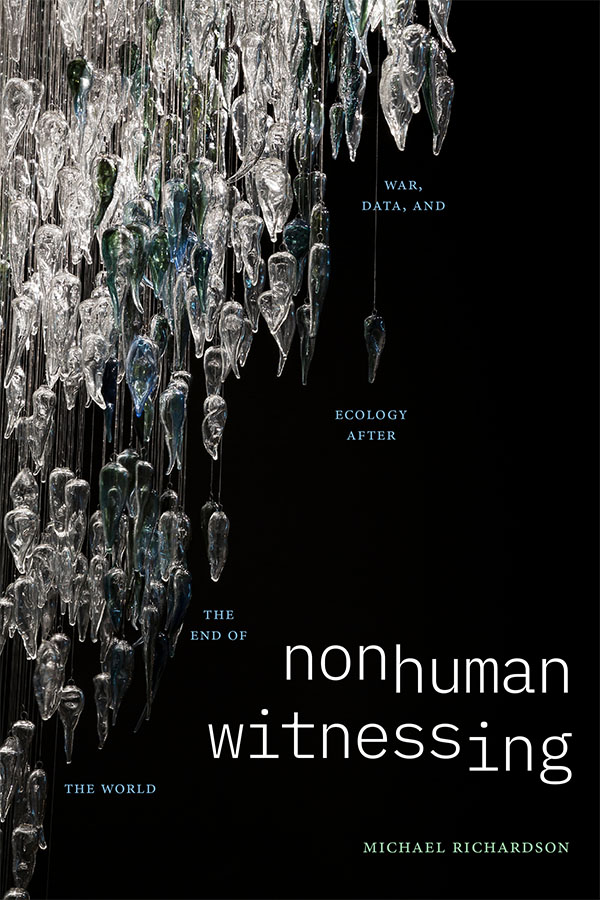 How to witness a drone strike? Who—or what—bears witness in the operations of targeted killings where the success of a mission appears as a few pixels on a screen? Can there be justice if there is no witness? How can we bring the other-than-human to testify as a subject granted with agency and knowledge? What happens to human responsibility when machines have taken control? Can nonhuman witnessing register forms of violence that are otherwise rendered invisible, such as algorithmic enclosure or anthropogenic climate change? These questions lead Michael Richardson to emphasize the role of the nonhuman in witnessing, and to highlight the relevance of this expanded conception of witnessing in the struggle for more just worlds. The “end of the world” he refers to in the book’s title has several meanings. The catastrophic crises in which we find ourselves—remote wars, technological hubris, and environmental devastation—are of a world-ending importance. Human witnessing is no longer up to the task for making sense, assigning responsibility, and seeking justice in the face of such challenges. As Richardson claims, “only through an embrace of nonhuman witnessing can we humans, if indeed we are still or ever were humans, reckon with the world-destroying crises of war, data, and ecology that now envelop us.” The end of the world is also a location: Michael Richardson writes from a perch at UNSW Sydney, where he co-directs the Media Futures Hub and Autonomous Media Lab. He opens his book by paying tribute to “the unceded sovereignty of the Bidjigal and Gadigal people of the Eora Nation” over the land that is now Sydney, and he draws inspiration from First Nations cosmogonies that grant rights and agency to nonhuman actors such as animals, plants, rocks, and rivers. “World-ending crises are all too familiar to First Nation people” who also teach us that humans and nonhumans can inhabit many different worlds and ecologies. The world that is ending before our eyes is a world where Man, as opposed to nonhumans, was “the unexamined subject of witnessing.” In its demise, we see the emergence of “a world of many worlds” composed of humans, nonhumans, and assemblages thereof.
 In April 2015, the Institut Français in Hanoi held a photography exhibition, Reporters de Guerre (War Reporters), marking the fortieth anniversary of the end of the Vietnam War. Curated by Patrick Chauvel, an award-winning photographer who had covered the war for France, the exhibition showcased the work of four North Vietnamese photographers (Đoàn Công Tính, Chu Chi Thành, Tràn Mai Nam, and Hùa Kiêm) whose documenting of the Vietnam War was often overshadowed by photographers from the Western press working from the South. The poster for the cultural event at L’Espace used an iconic image: a black-and-white picture of North Vietnamese soldiers climbing a rope against the spectacular backdrop of a waterfall, taken in 1970 along the Ho Chi Minh trail. Đoàn Công Tính, the photographer, had caught a moment of timeless beauty and strength, an image of mankind overcoming physical hindrances and material obstacles in the pursuit of a higher goal. However, a scandal erupted when Danish photographer Jørn Stjerneklar pointed out on his blog that this iconic image was doctored. He compared two versions, the recent print that appeared in the exhibition and the “original,” which was published in Tính’s 2001 book Khoảnh Khắc (Moments). Tính apologized profusely for “mistakenly” sending the photoshopped image, claiming that the original negative had been damaged and that he accidentally included a copy of the image with a photoshopped background in a CD to the exhibition’s organisers. But in a follow-up article on his blog, Stjerneklar pointed out that even the “original” had been retouched, as evidenced by the repeating pattern of the waterfall, and was likely a montage of another photograph which is displayed at the War Remnants Museum in Ho Chi Minh City. Stjerneklar’s story was picked up worldwide and ignited a lively debate around the presumed objectivity of photojournalism and the role of photography in propaganda.
 Brian Massumi owes his career to his ability to translate obscure texts into plain English, and to his penchant for doing the reverse. His first notoriety came from bringing Deleuze and Guattari’s A Thousand Plateaus to an English-speaking audience. Without him, what became an essential text for feminists, literary theorists, social scientists, philosophers, and avant-garde artists may have remained a local event, known only to the francosphere. His meticulous translation from French into English proved that translating untranslatable language constitutes a challenge, not an impossibility. He may have understood Deleuze and Guattari’s work better than they understood it themselves: going through the detour of a foreign language allowed the text to shed some of its obscurities, and to take on new ones as the translator engaged in his own rap and wordplays. Meaning always exceeds linguistic conventions contained in national boundaries and syntaxic rules. In this case, the obscure clarity of A Thousand Plateaus inspired many creators beyond the field of continental philosophy. References to Deleuze and Guattari’s work can be found in literary artworks, blockbuster movies, electronic music, and even in financial theory and military thinking. Massumi was both a translator and an interpreter of Deleuzian philosophy: his User’s Guide to Capitalism and Schizophrenia remains the most accessible and playful introduction to one of the major intellectual achievements of the late twentieth century. If, as Michel Foucault prophesied, the twenty-first century will be Deleuzian, it will be in no small part thanks to Brian Massumi and to his role as a translator and a go-between.
 “We hold these truths to be self-evident, that all men are created equal, that they are endowed by their Creator with certain unalienable Rights, that among these are Life, Liberty and the pursuit of Happiness.” These truths are no longer self-evident: few people now believe in a Creator ; the inclusion of women in the generic term “all men” has to be specified ; and rights in their modern acceptation are not endowed or bestowed, but conquered and defended. What about Life, Liberty and the pursuit of Happiness? Are they not the expression of an American ideology that is shared by few people, even in the United States? Life itself has become a contested issue, as it hinges on when life starts and ends and some people are claiming a right to death in order to exit life with dignity. The pursuit of happiness was a central theme in Hollywood comedies of the 1930s and 1940s—a time of great unhappiness—, but we now look at these black-and-white motion pictures with nostalgia and irony, while Hollywood has moved to other descriptions of people’s aspirations and beliefs. Most significantly, freedom now has a hollow ring. The “Liberty Bell” march or the “Battle Cry of Freedom” were calls to rally round the flag and show patriotism, but these battle songs were used to legitimate wars of aggression and imperialism that made freedom a mockery of justice and equality. Domestically, the “land of the free” has the highest rate of incarceration in the world. We now speak with less assurance than our forefathers about the rights and values enshrined in declarations of independence or bills of rights. What if they were wrong in proclaiming life, liberty and happiness as our guiding principles? What if the reverse was true? What if freedom was not universally desirable, but “ugly” and repulsive? This is the argument that Elisabeth Anker makes in her book Ugly Freedoms, as she invites us to challenge self-evident truths and commonly believed assumptions.
 In Dreadful Desires, Charlie Yi Zhang advocates “a new approach” and “a different perspective” on love and neoliberalism in contemporary China. As he describes it, “My study integrates the discursive with the ethnographic and combines grave scrutiny of political economies and empirical data with upbeat examinations of popular cultures.” His grave and upbeat essay documents how a neoliberal market logic permeates expressions of love and aspirations for a good life, and how a fiercely competitive conjugal market, polarized gender relationships, and residency-differenciated precarities in turn produce willful subjects who are ready to sacrifice their well-being to maximize the interests of the state and capital. Its content and writing style also reflect his personal background and professional training. Having left China in his late twenties to pursue an academic career in the US, Zhang returned to his homeland for a few months of fieldwork in 2012 in order to complete his PhD in gender studies at Arizona State University. He was subsequently hired by the University of South Dakota to teach global studies to undergraduate students for two years, then landed a job as Associate Professor in Gender and Women’s Studies at Kentucky University, where he completed his book manuscript. During his graduate studies, his sociology professor taught him “how to combine different methodologies into [his] unique voice.” He claims to have developed “a novel theoretical and methodological approach” that builds an “epistemic ground for fundamental change.” His ambition is no less than “to lay the foundation for better futures” and “to develop a different understanding of global neoliberalism and to transform the current system.” His book is published in the Thought in the Act series edited by Erin Manning and Brian Massumi, two Canadian theoreticians working at the intersection of philosophy and art critique.
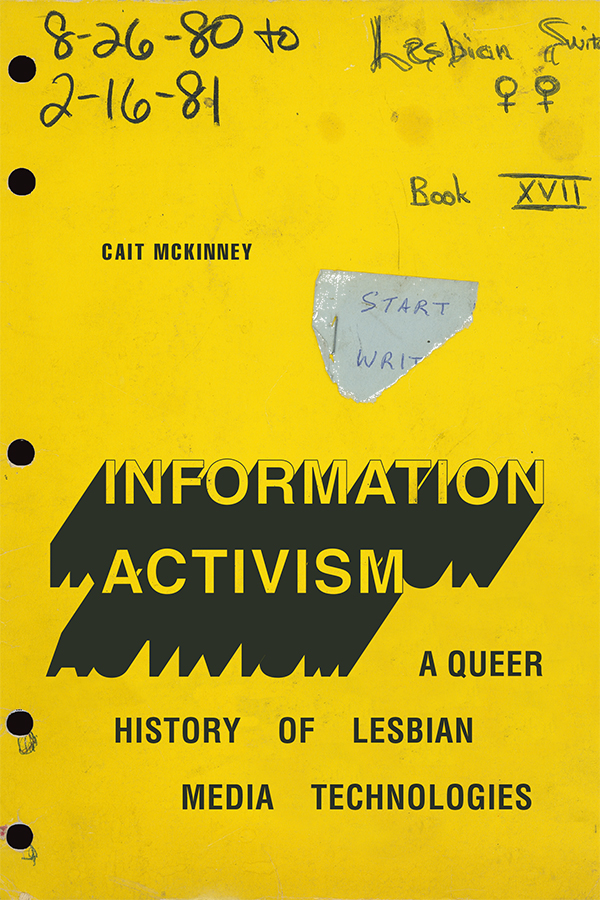 Lesbian feminists invented the Internet, and they did it without the help of a computer. This is the surprising finding that comes out of the book Information Activism: A Queer History of Lesbian Media Technologies, published by Duke University Press in 2020. As the author Cait McKinney immediately makes it clear, the Internet that lesbians built was not composed of URL, HTML, and IP servers: it was an assemblage of print newsletters, paper index cards, telephone hotlines, paper-based community archives, and early digital technologies such as electronic mailing lists and computer databases. What made these early media technologies “lesbian” is that they formed the information infrastructure of a social movement that Cait McKinney describes as “information activism” and that was oriented toward the needs and aspirations of lesbian women in North America during the 1980s and 1990s. And what makes Cait McKinney’s book a “queer history” is that she brings feminism and queer studies to bear on a media history of US lesbian-feminist information activism based on archival research, oral interviews, and participant observation through volunteering in the Lesbian Herstory Archives in New York. Information activism took many forms: sorting index cards, putting mailing labels on newsletters, answering the telephone every time it rings, converting old archives into digital format… All these activities may not sound glamorous, but they were part of the everyday politics of “being lesbian” and “doing feminism.”
 “Inanimate objects, have you then a soul / that clings to our soul and forces it to love?,” wondered Alphonse de Lamartine in his poem “Milly or the Homeland.” In Animacies, Mel Chen answers positively to the first part of this question, although the range of affects she considers is much broader than the lovely attachments that connected the French poet to his home village. As she sees it, “matter that is considered insensate, immobile, deathly, or otherwise ‘wrong’ animates cultural life in important ways.” Anima, the Latin word from which animacy derives, is defined as air, breath, life, mind, or soul. Inanimate objects are supposed to be devoid of such characteristics. In De Anima, Aristotle granted a soul to animals and to plants as well as to humans, but he denied that stones could have one. Modern thinkers have been more ready to take the plunge. As Chen notes, “Throughout the humanities and social sciences, scholars are working through posthumanist understandings of the significance of stuff, objects, commodities, and things.” Various concepts have been proposed to break the great divide between humans and nonhumans and between life and inanimate things, as the titles of recent essays indicate: “Vibrant Matter” (Jane Bennett), “Excitable Matter” (Natasha Myers), “Bodies That Matter” (Judith Butler), “The Social Life of Things” (Arjun Appadurai), “The Politics of Life Itself” (Nikolas Rose),“Parliament of Things” (Bruno Latour). Many argue that objects are imbued with agency, or at least an ability to evoke some sort of change or response in individual humans or in an entire society. However, each scholar also possesses an individual interpretation of the meaning of agency and the true capacity of material objects to have personalities of their own. In Animacies, Mel Chen makes her own contribution to this debate by pushing it in a radical way: writing from the perspective of queer studies, she argues that degrees of animacy, the agency of life and things, cannot be dissociated from the parameters of sexuality and race and is imbricated with health and disability issues as well as environmental and security concerns.
 The Duke Reader