
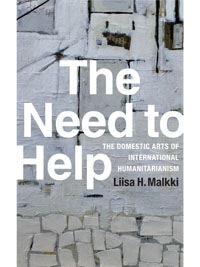
A review of The Need to Help: The Domestic Arts of International Humanitarianism, Liisa H. Malkki, Duke University Press, 2015.
 Liisa Malkki wrote her PhD and gained tenure at Stanford’s anthropology department based on her fieldwork among refugees from Burundi. She worked in a refugee camp in Tanzania in the mid-eighties, and presented the narratives she collected from Hutus fleeing political violence in a book, Purity and Exile. This book gained some public attention when it was criticized by Peter Gourevitch who argued, in the New York Review of Books, that her “mytho-history” was more myth than history, and later on when some of its testimonies of genocidal violence were echoed by the reports and stories coming out from the Rwandan genocide (this time with Hutus as perpetrators and Tutsis as victims). But Liisa Malkki didn’t want to be categorized into a box, much less be identified as a “refugee” scholar or a “genocide studies” specialist. This is why she turned to a terrain closer to her place of origin and less fraught with political disputes: Finnish Red Cross aid workers sent abroad on emergency relief missions, as well as other persons gravitating around the Red Cross movement in Finland. Although she spent her childhood in East Africa, and most of her professional career in the United States, she apparently remained close to her home country of Finland. This is where she conducted the fieldwork for this book, putting into use her intimacy with the people and their language as well as her knowledge of the domestic scene.
Act like a Finn
Who are the Finns? How can one hail from Finland? This is a question to which Finnish aid workers, and Finnish nationals in general, are often confronted. They have developed a response in action: to be a Finn is to act like a Finn, and to embody the virtues and proclivities that they associate with their homeland. Finns often speak of “having to prove themselves” on the international scene. For them, and therefore for their foreign interlocutors, Finnishness (suomalaisuus) involves calmness, discretion, honesty, social reserve (häveliäsyys), and hard work. Some people feel at ease with these national characteristics, and work hard to prove they deserve their reputation of hard workers. Other experience it as a constraint to their lives and try to escape from it—by going out to the “world out there” (olla maailmalla), or by developing other sensibilities not associated with the national character. In particular, in a society that prides itself on self-reliance, grit (sisa), and a fierce love of privacy and individualism, solitude and the repression of public emotions can be felt as a heavy burden. Finnishness is also sometimes associated with small-mindedness, provincialism, conventionality, and the rejection of foreigners. Hailing from a small and isolated country, Finns want to connect to the outside world, and be part of something “larger than themselves”. The ICRC provides them the opportunity to do just that.
If Liisa Malkki reports such traits, it is not to engage in an outmoded sociology of the national character, but to describe how Finnishness is perceived both as a resource and as a constraint by the people she interviewed. Talk of what Finnishness means, and self-stereotyping, are extremely common among Finns. Little is known from their country abroad, especially in the countries where Finnish aid workers are dispatched. Finland is a country remote from the Global South, by its latitude and its climate as well as by its national history. It never engaged in colonial expansion, and itself experienced imperial rule for most of its history, as a province of Sweden and then of Russia before gaining its independence in 1917. Just as the Finns want to appear as thrifty and hard-working, the Finnish state is characterized by its generous aid policy toward Third World nations but also, at the same time, by its stern condemnation of the profligacy of Greece and other southern members of the European Union. Finland wants to appear generous to strangers and willing to share its riches with those who really deserve it, yet according to media reports it treats foreign immigrants from developing nations as social outcasts, and admits very few refugees. It is in many ways a closed society. As the author argues, “refugees, immigrants and minorities from around the world (and especially their children) might be ‘Finns’ both culturally and in terms of citizenship—but they are still often the object of xenophobic slurs and attacks.”
Peace, neutrality, and humanitarianism
The fact that Finland is a small internationalist state committed to world peace and United Nations principles is also an important factor for the ICRC, an organization that has elevated the notion of neutrality, along with impartiality and humanity, to the status of a founding principle. Neutrality has long been a key part of Finland’s foreign policy and international image, and this helps to explain the heavy representation of Finns on ICRC missions in politically difficult conflicts elsewhere around the world, especially in Africa and the Middle East. Of course, as Liisa Malkki reminds us, neutrality (neutraalius) is a kind of politics, both for Finland and for humanitarian aid. For most of its modern history, Finland’s neutrality has been a strategic defense issue of great significance, although some people now see it as a relic of the Cold War that should be jettisoned. Similarly, neutrality is a policy tool that allows the ICRC to “talk to anyone” in an armed conflict or during a humanitarian crisis. Neutrality and the attempt to steer clear of politics has often been reproached to the Red Cross (was it right to stay “neutral” during the rise of Nazism in Hitler’s Germany?), and it can also lead to ethical dilemma and impossible situations. The author shows that neutrality is not only a code of conduct, but also a state of mind for aid workers who need to preserve “affective neutrality” in the face of human suffering. Like a surgeon in the middle of an operation, the aid worker (who often operates in the medical field) needs to concentrate on her work and shun out emotions, at least temporarily. Again, this attitude conforms to the Finnish national character of emotional restraint and hard work.
Like neutrality, humanity is part of the Red Cross ethos—it is a core value that Red Cross workers are supposed to serve. Humanity is here conceived in terms of “basic human needs” and of abstract “human rights” that have to be supplied and guaranteed by the “international community.” In the worst case, such views can lead the “needy African” to be imagined as a sort of specimen of “basic humanity” more biological than political—“bare life,” as Agamben and others have argued, more zoë than bios. Engagements with humanity understood in such generic terms can turn into political disempowerment. Paradoxically, it also can lead to dehumanization, as when the public’s compassion focuses on children and on animals, which is a way to deny human subjects their agency. Images of children in need are everywhere in humanitarian appeals to generosity in print and digital media. No wonder that this kind of sentimental humanitarianism has been the target of attacks by social critics, from Friedrich Nietzsche and Karl Marx to Hannah Arendt and Roland Barthes. Even politicians have joined in their critiques: Jean Kirkpatrick, a former US ambassador to the United Nations, once dismissed the category of “economic, social and cultural rights” enshrined in the Universal Declaration of Human Rights as “a letter to Santa Claus.” To the lofty scene of humanitarian ideals, they oppose the hard reality of conflicting interests, geopolitics, and war.
A letter to Santa Claus
As she confesses, Liisa Malkki started her research ready to see a dangerous kind of antipolitics in invocations of an unsituated “humanity” such as those found in the guiding principles of the ICRC. But the competing view, the misogynistic denunciation of the human herd by Nietzsche or the cynical realpolitik of politicians, does not get her favor either. She notes with some regret that the appeals to world peace, disarmament, and global social justice, which were once the preserve of powerful spirits such as Albert Einstein or Eleanor Roosevelt, have been trivialized and infantilized to the point of losing all political potency. Her chapter on Children, Humanity, and the Infantilization of Peace demonstrate how children have been invested with various ideals within a “transnational ritual sphere” that constitutes the figure of the child as the bearer of humanity. Again, it is easy to deride the lachrymose exploitation of children’s image by humanitarian marketing campaigns and peace education programs. But humanitarian appeal is not just the negation of politics: it is also, in itself, a form of politics. Liisa Malkki shows how an unblinking, absolute commitment to humanity (as to neutrality) involves its own kind of zealotry. Zealous humanism, she suggests, is no less extreme than religious fundamentalism. It is indeed rooted in religious values and Christian doctrines, although most of the Finns she interviewed denied any form of religious affiliation and were wholly secular.
There is a commonplace popular view that the humanitarian worker is moved by powerful ideals and feelings of compassion. But the people sent on humanitarian mission by the Red Cross refuted this image. For them, the “Mother Theresa-type” of people bent on self-sacrifice were clearly not wanted: they could put a mission at risk, and were at best a disturbance from a more efficient work ethos. The persons interviewed by Liisa Malkki took issue with their definition as humanitarian actors. They preferred to design themselves as “aid workers”, or to emphasize their professional affiliation—as doctors, nurses or engineers. Professional solidarity with their fellow team members and with their national counterparts in the field took precedence over abstract humanitarianism. They acknowledged several reasons for going on mission abroad, some mundane—to escape from the cold of Finland’s long winter and to find “warmer” places, meteorologicallly and socially—, others more practical—as a way of personal and professional development, to acquire new skills and exercise them in more demanding conditions. Going overseas made it possible for them to be part of something other and bigger than themselves. To be “out in the world” (olla maailmalla) was a powerful object of imagination for them. Many talked in terms of an international obligation and a “need to help” (tarve auttaa). But they were professionals before they were humanitarians.
Humanitarian aid always begins at home
Importantly, for Malkki, acknowledging the needs of aid workers does not diminish them or the work that they do. Nowhere does she suggest that they serve their own needs at the expense of the needs of others. On the contrary, recognizing needs on both sides of the aid relationship calls for a more reciprocal view of North-South relations. It complicates the dichotomy between the aid giver—perceived as generous, selfless, compassionate—, and the aid recipient who is identified solely by her needs. Malkki provides a case study of a kind of help for which there is no real recipient: the Finnish Red Cross Aid Bunny campaign, that had old ladies hand-knit toy-like figures that are then supposedly sent to children in need as part of emergency relief missions. The Aid Bunnies and their siblings—the Trauma Teddies, the Mother Theresa blankets, and so on—are easy to dismiss as silly sentimentalism and useless gift-giving: even Red Cross employees feel embarrassed by the accumulation of cardboards full of animal toys that they are mandated to send to the field. But again, Liisa Malkki eschews from taking an easy target at these forms of wasteful generosity. Instead, she concentrates on the social activities and inner lives of the Finnish ladies who contribute to these campaigns, showing again a powerful need to donate their time and attention to causes that pull them upward.
One shouldn’t beware of Finns bearing gifts. Their intentions are sincere, their feelings are true, and their hard work speaks louder than their words. The conduct of Red Cross aid workers may appear as self-serving and parochial, the sentimentalism of old ladies knitting teddy bears for imaginary victims may generate scorn and indifference. But consider the alternative. Cynicism and hard-nosed interest breed conflict and isolation. Without proper stimulus, the faculty to empathize with one’s fellow human wanes and dwindles. Imagining children in need and longing to help them may be considered as a calisthenics for the enhancement of empathy. Compassion needs training. Viewed from this perspective, the cultivation of humanitarian sentiments, encouraged by the state and various social institutions, is closely linked to the generous aid policies of Nordic countries. Manufacturing consent to ODA policies involves not only rational arguments about aid effectiveness and geopolitical payoffs, but also a sentimental education of the imagination, a cultivation of the “need to help.” This is especially true in a country like Finland, where smallness and isolation breed a desire to be connected to something other and greater than oneself. There is something in the home society of Finland that creates a specific “need to help.” Humanitarian aid always begins at home.
 The Duke Reader