
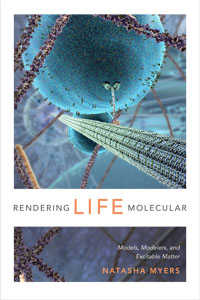
A review of Rendering Life Molecular: Models, Modelers, and Excitable Matter, Natasha Myers, Duke University Press, 2015.
 There is an annual competition that allows PhD students to dance their research. The contestants, individually or in groups, present their research results in a choreography that gets evaluated by a jury. The first “Dance Your PhD Contest,” held in 2008, attracted significant interest from the media and on Youtube, and the number of applicants has been increasing ever since. Other Youtube videos extend a second lease of life to students’ dancing performances and staged choreographies inspired by scientific discoveries. In 1971, a football field at Stanford University became the scene of a large-scale “molecular happening,” in which more than one hundred performers staged the intricate molecular interactions involved in protein synthesis.
These performances, of course, do not count as research, and they will not feature in a scientist’s resumé. But anthropologist Natasha Myers takes them very seriously. In Rendering Life Molecular, she wants to expand what counts as science and science-making to include what she refers to as “body-work” or, in more technical terms, “kinesthetic animations”, “haptic vision”, “molecular calisthenics”, “mimetic modeling”, and other body experiments. She does so by paying attention to what otherwise may go unnoticed in scientific work: gestures and mimics, emotions and affects, metaphors and values, and other forms of life in the laboratory that are muted in other accounts of science-in-the-making.
Body work doesn’t count as research
Bodies, play, and emotions have no proper place in a scientific lab. And yet, as one of Natasha Myers’ informants remarks, “you can’t learn something if you don’t get your body involved.” Touching, sensing, feeling, and knowing are entangled in laboratory research. Life science research is a full-bodied practice. The researchers’ moving bodies and their moving stories are integral to scientific enquiry. Lecturers encourage students in molecular biology to learn the fold of their molecule by heart, to trace the direction of each component by hand, and to be able to render it with their entire body. Researchers’ bodies become effective proxies for their molecules. Indeed, a cartoon reproduced by the author in her book opening features a male scientist twisting his body into the shape of a double helix, while his colleague sitting at his bench chides him: “Very good, Michaels—you’re a DNA molecule. Now, get back to work.”
The most obvious sense that connects us to reality is seeing. And yet, “seeing” a molecule is not at all obvious. Protein molecules are so tiny that long waves of visible light pass right by them without registering their presence. The only way researchers can get a glimpse of their molecule is by transforming it into a crystal, collecting data on the position of each atom through a process known as X-ray diffraction, and working on the data to generate a model of the atomic configuration of the protein. Every step in this process is fraught with difficulties. Crystallographic techniques are far from foolproof, and almost every project is plagued by setbacks, failures, and detours. Not any crystal will do: viable protein crystals must be well-ordered to diffract X-rays. Protein crystals are not only hard to grow; they are also quite unstable and can disintegrate easily. Once crystallized, a molecule has to stand still through a kind of freeze-frame technique so the data can be collected.
A happy and well-folded molecule
Once collected, the data has to fit into the model, which again involves many tweaking and adjusting. Molecule models are three-dimensional structures made up of thousands of atoms, and their configuration has to conform to the modeler’s intuition. Some models simply don’t look right: they seem distorted, misfolded, and “in pain”; others look “happy,” “relaxed,” and well-folded. It takes a long time to develop the skill set required to “feel the pain” of a misshapen protein model. Tacit knowledge can only be acquired and communicated “from body to body.” Modelers have to exercise their synesthetic reason in an open-ended, improvisational, and intuitive mode. This process cannot be automated: it demands “hands-on” practice. This is why the laboratory retains the structure of the master-disciple relationship, with senior researchers cast in the role of the charismatic magician and PhD students playing the sorcerer-apprentice.
Making crystallographic data visible in the form of electron density maps and molecular models allows the researcher to play with the data with the help of animated software. Three-dimensional models are essential visualization tools for teaching, learning, and research. But computers will never replace the “feel” for the molecule that patient work in the lab cultivates. While today almost all crystal structures are built on-screen, physical models like the ones used in high school chemistry do retain their pedagogical value. Researchers can easily get “lost in the map” and forget the assumptions on which computer software are built. Leaders in the field are prompt to qualify the limits of the data—these are just models, and modelers must keep their interpretations open. Students are taught to distrust computer algorithms and to exercise expert judgment at every step of the model-building process.
Playing techno music to a crystal
Protein crystallography is therefore more craft than science. The indirect nature of diffractive optics makes it necessary for modelers to get fully entangled with their instruments and materials as they rend imperceptible substances into visible and palpable forms. It is possible that a crystallographer will never find the perfect condition for a protein to crystallize; he or she may spend years in her PhD trying to set the conditions right. In one case, reported in a scientific paper, the researchers had to add one percent pickle juice “from the Sweetand Snappy Vlassic brand” to the crystallization mix. Experienced crystallographers regularly joke that protein crystallization requires “voodoo magic.” Some insist on playing techno music while they mix their biochemical media. Others have found that proteins will crystallize only if they are wearing their “special sweater.” Some even talk and sing to their crystal. As Natasha Myers remarks, ”it seems in these contexts that magic, ritual, and superstition are not a ‘threat’ to science; rather, they are integral to its practice.”
Laboratories are not just factories for the production of scientific facts; they are living spaces where practitioners engage the whole range of their human affects and senses. Myers focuses on one dimension of laboratory labor that is so often overlooked in accounts of the political economy of science. This is an attention to the affective labor involved in scientific research and training; a form of labor that is crucial to the work of producing and circulating valuable scientific facts. Affective labor is a concept developed by feminist scholars and political theorists to analyze forms of labor, such as nurture and care, which have historically been undervalued or otherwise made invisible. The laboratory researchers studied by Myers do not only take care of themselves and of others: they also cultivate a kind of “care of the molecule”. They go to extraordinary lengths to “keep their molecules happy” and to nurture the perfect conditions for their protein to crystallize. A crystallographic model is not just “matter of fact”; it is also a “matter of care.”
Affective labor
This image of the laboratory as a nurturing and caring environment stands in stark contrast with the dominant view that emphasizes disembodied reasoning, competitive spirit, and economic rationality. Natasha Myers gives the example of the documentary Naturally Obsessed that documents how graduate students cultivate the ethos and habits they need to succeed in science. The story focuses on only one class of affects: competition, and an exclusive focus on result delivery. Winning the game in this rendering requires graduate students to solve the structure of a prized protein molecule before others beat them to it. In this context, remarks one student, “one of the best thing that you can do as a scientist is suffer from obsessive-compulsive disorder. So that you become obsessed with a problem and can’t stop working on it until you get to your answer.” Indeed, as Myers notes, the figure of the obsessive-compulsive scientist is one whose ethos and habitus are perfectly tuned in to a neoliberal economy. As a recruitment tool for high school students, this documentary is itself a pedagogical device that can shape what its viewers come to think a life in science should be like.
Natasha Myers wants to give a different image of science. Her book stems from a strong belief that “there are other analytic frames and other ways of telling stories about the life sciences and lives in science.” To use a cliché, her depiction of science is more “feminine,” more attuned to sensations and affects, than the heroic masculine renderings of science-in-the-making. Her depiction of dancing molecules and epistemic choreographies is not fortuitous: she confesses that “as a life-long dancer, my attentions were especially attuned to the relationship between movement and forms of knowing in science.” She develops a new vocabulary to describe the role of the body in scientific work, turning tacit knowledge into explicit discourse. Rendering Life Molecular is also an epistemologically rich book, engaging in meaningful discussions with prominent authors in the field of science studies, such as Donna Haraway, Emily Martin, Lorraine Daston, and many others. Natasha Myers opens new venues for research: this is a book I will return to for close reading of chapters and added insights on what renders life molecular.
 The Duke Reader