

A review of The Impotence Epidemic: Men’s Medicine and Sexual Desire in Contemporary China, Everett Yuehong Zhang, Duke University Press, 2015.
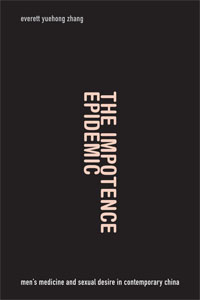 Everett Zhang was conducting fieldwork in two Chinese hospitals, documenting the reasons why men sought medical help for sexual impotence, when Viagra was first introduced into China’s market in 2000. He therefore had a unique perspective on what the media often referred to as the “impotence epidemic”, designating both the increased social visibility of male sexual dysfunction and the growing number of patients seeking treatment in nanke (men’s medicine) or urological hospital departments. At the time of Viagra’s release, Pfizer, its manufacturer, envisaged a market of more than 100 million men as potential users of “Weige” (伟哥, Great Brother) and hoped to turn China into its first consumer market in the world. Its sales projections were based on reasonable assumptions. The number of patients complaining from some degree of sexual impotence was clearly on the rise, reflecting demographic trends but also changing attitudes and values. There was a new openness in addressing sexual issues and a willingness by both men and women to experience sexually fulfilling lives, putting higher expectations on men’s potency. Renewed attention to men’s health issues since the 1980s had led to the creation of specialized units in both biomedical hospitals and TCM (traditional Chinese medicine) clinics. There was no real competitor to Pfizer’s Viagra, as traditional herbal medicine or folk recipes clearly had less immediate effects in enabling sexual intercourse.
Taking Viagra along with herbal medicine
And yet Viagra sold much less than expected. In hospitals and health clinics, Chinese patients were reluctant to accept a full prescription. Instead, they requested one or two single pills, as if to avoid dependence. The drug was expensively priced, and customers were unwilling to sacrifice other expenses to make room in their budget. In addition, Viagra did not substitute for traditional remedies, but rather developed in tandem with them as people switched between Viagra and herbal medicine, taking both for seemingly compelling reasons. Viagra addressed the issue of erectile dysfunction, and its bodily effects were clearly experienced by Chinese men who reacted to it in much the same way as male subjects elsewhere. But it did not bring an end to the “impotence epidemic”, which continued to be framed as more than a health issue by the Chinese media. Viagra did not “cure” impotence or restored men’s potency because it was unable to do so. Pfizer’s projected sales figures had been based on false assumptions, and the Chinese market proved more resistant than initially envisaged.
Zhang proposes a compelling theory of why it was so, thereby demonstrating the value of a fieldwork-based anthropological study as distinct from other types of scholarly explanations. In contrast to the dominant biomedical paradigm, he rejects the notion that male potency can be reduced to the simple ability to achieve an erection. Impotence is much more than a bodily dysfunction or a “neuromuscular event”: witness, as Zhang did, the despair of men who complain of having lost their “reason to live”, or the frustration of women who accuse their companion of having become “less than a man”. But impotence is not only a metaphor, as some cultural critics would have it. Impotence is often presented as the symbol of a masculinity in crisis or as a sign of the “end of men” and the rise of women in postsocialist China. But these generalizations do not reflect the practical experiences of impotent men, nor do they explain why the demand for more and better sex resulted in anxiety for some men, leading to impotence. “In fact, notes the author, none of the discussions surrounding Chinese masculine crises was either soundly conceptualized or empirically supported.”
Male potency cannot be reduced to the ability to achieve an erection
Zhang’s fieldwork confirmed the rise of women’s desire or increased people’s longing to enjoy sex throughout their adult life, but did not go as far as to validate the claim of an “impotence epidemic” or to testify to a “new type of impotence”. During the Maoist period, people were discouraged from seeing doctors about impotence, as sexuality was repressed and the desire for individual sexual pleasure was regarded as antithetical to the collective ethos of revolution. If anything, patients came to consultations to complain about nocturnal emissions (yijing), a complaint that more or less disappeared in the post-Maoist era. When men’s health clinics or nanke departments emerged in the new era, they medicalized impotence and established it as a legitimate “disease” warranting medical attention. Private selves emerged when the overall ethos of sacrifice and asceticism gave way to the exaltation of romantic love and then to the justification of sexual desire and pleasure. But structural impediments to sexual desire did not disappear overnight, such as the physical separation of married couples and other constraints on intimacy induced by the danwei (work unit) and hukou (household registration) systems. Other biopolitical interventions created gaps between the revolutionary class and the outcast relatives of counter-revolutionaries, between the urban and the rural or, more recently, between the rich and the poor.
The main value of the book lies in its rich collection of life stories and individual cases of men and women confronted with impotence. The amount of suffering accumulated under Maoist socialism is staggering. People interviewed in the course of this research retained collective memory of starvation during the Great Leap Famine, and feeling hungry was a common experience well into the sixties. Maoist China was a man-eat-man’s world, where middle-aged men would snatch food from school children or steal from food stalls to assuage their hunger. It was also a time when children would denounce their parents for counterrevolutionary behavior, or would call their mother by their given name in a show of disrespect in order to draw a clear line between themselves and bad parents. Sexual misery and backwardness also provided a common background. Some of Zhang’s interlocutors never touched a woman’s hand until they were thirty years old; others confessed that the first time they saw a naked female body was when they saw a Western oil painting of a female body, or when they glimpsed scenes of a classical ballet in a movie. A nineteen years-old girl didn’t understand the question when the doctor asked if she had begun lijia (menstruation) and thought lijia was a foreign word. Many persons consulting for impotence confess that they never had sexual intercourse or had tried to have sex once of twice but failed. Their conviction that they were impotent was based on very limited physical contact with women or was merely a product of their imagination.
Bedroom stories
As Zhang argues convincingly, it takes two to tango; or in words borrowed from phenomenology, “in the final analysis, curing impotence means building intercorporeal intimacy.” In paragraphs that could have been borrowed from Masters and Johnson, Zhang describes the various components of sexual intercorporeality: bodies need to be in contact, as in “touching, kissing, licking, rubbing, and so on”; but they also need to be in sync, geared toward one another in a process of “bodying forth”; and other sensory inputs (such as “seeing, touching, and smelling the naked female body, tasting the tongue of the female, or hearing her scream”) may provide additional stimulus. Male impotence very often originates in the failure of one of these intercorporeal dimensions: lack of touching, as when the husband lies side by side to his wife, waiting to achieve an erection; ignorance of the most basic facts of life, due to the lack of sex education; and withdrawal from the sensory world that is symptomatic of a more serious loss of “potency” in life. As the author notes, with a good deal of common sense, “women’s involvement in managing impotence is not any less important than men’s, and, in fact, at times may be more important. Impotence, after all, is not only a neurovascular event affecting the individual male body. It is also a social, familial event and an intercorporeal, gendered event.”
The Impotence Epidemic is not only ethnographically rich, it is also theoretically elaborate. Zhang received his PhD in anthropology from the University of California at Berkeley, in a department known for its emphasis on social and cultural theory. One of his teachers, Paul Rabinow, initiated generations of English-speaking students to the thought of French philosopher Michel Foucault. His thesis advisor, Arthur Kleinman, who teaches medical anthropology at Harvard, recently edited a book (reviewed here) about how anthropologists engage philosophy. Zhang confesses he took classes in philosophy, including one with John Searle, who involuntarily provided him with a way to think about erection (“Now I want to raise my right arm. Look, my right arm is up.”) Throughout the book, he makes frequent references to Gilles Deleuze, Michel Foucault, Merleau-Ponty, and Heidegger, as well as to Freud and Lacan.
Confronting theory with fieldwork observations
Engaging the thought of these canonical authors can sometimes feel as intimidating as having sex for the first time. Zhang shows it doesn’t have to be so. What is important is to build a rapport. Zhang graduated from his theory-heavy curriculum with a pragmatic mindset and a heavy dose of common sense. He uses what he can get from the theoretical toolbox, without forcing his erudition onto the reader. He is able to summarize complex reasoning in a few sentences, and to turn difficult words into useful tools. Sometimes only the title of a book or one single expression coined by one distinguished thinker can open up an evocative space and act as useful heuristic. Zhang refers to Deleuze and Gattari’s A Thousand Plateaux to label his collection of life stories and medical cases as “one thousand bodies of impotence.” Impotence is itself a kind of plateau, defined by Gregory Bateson as a force of continuous intensity without any orientation toward a culminating point or an external end. Throughout his book, Zhang provides succinct and transparent definitions of key concepts–Deleuze’s assemblages, Bourdieu’s habitus, Foucault’s biopower, Merleau-Ponty’s intercorporeality, Heidegger’s being-in-the-world, etc. He then tests their validity by confronting them to his fieldwork observations, sometimes giving them a twist or new polish to make them fit with his ethnographic material. In many cases, theory is found lacking, and needs to be completed with the lessons learned from participatory observation.
Zhang’s two main sources of philosophical inspiration are Deleuze and Foucault. The first allows him to think about the impotence epidemic as a positive development that signals the rise of desire; the second provides him with a method for investigating the cultivation of self in post-Maoist China. Criticizing Lacan’s notion of desire as lack, Deleuze and Guattari introduce useful concepts to think about the production of desire or, as they say, “desiring production”, which includes “the desire to desire”. They describe the force of capitalism in terms of generating flows of production and desire, which are coded (restricted) and decoded (loosened) in a moral economy of desire. Their analysis focuses on the decoding phase that is the hallmark of capitalism, lessening restrictions on desire to create deterritorialized flows. Zhang prefers to focus on the “recoding” of flows of desire or “reterritorialization” as exemplified in the cultivation of life through an ethic of “yangsheng” which advocates preserving seminal essence. Sexual cultivation in contemporary China, like the “care of the self” in ancient Greece as studied by Foucault, is an ethical approach to coping with desire. Yangsheng involves everything from sleep to dietary regimens, bathing, one’s temperament in response to changes in climate, qigong, walking, and the bedchamber arts. It is a way to regain potency over one’s life. Foucault, in order to account for unreason and madness, chose to produce a history of reason in Western civilization. Similarly, studying impotence leads Zhang to delineate life’s potency, a notion that goes well beyond the ability to achieve an erection.
 The Duke Reader