
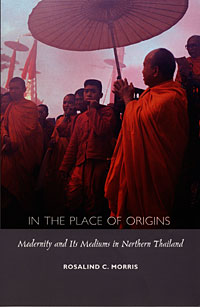
A review of In the Place of Origins: Modernity and Its Mediums in Northern Thailand, Rosalind C Morris, Duke University Press, 2000.
 “Dazzling” is a word that seems to come to mind when describing this book. It is used in a laudatory manner by the two academic luminaries who provided blurbs on the back cover. Rey Chow praises In the Place of Origins as “a dazzling accomplishment”. For Gayatri Spivak , “this is a text of dazzling instructive simplicity.” Well, I was more frazzled than dazzled by Rosalind Morris’s book. And I failed to perceive its “instructive simplicity”. To me, this was only a compendium of bewildering jargon, rambling descriptions, sloppy reasoning, and bad editing. It was ethnographically and theoretically uncouth. In fact, I couldn’t make any sense out of it. I had to get back at my reading several times to complete the book, and I did it only for the purpose of writing a review on this website. In short, my advise to the potential reader is: spare yourself that trouble. Don’t take pains to read it, for this was indeed a painful experience.
Thai people turn to mediums and spirits
Granted, the topic is interesting. Chiang Mai and northern Thailand are fascinating places, with a distinctive culture that mixes tradition with modernity. Mediums are part of the local landscape and, far from receding from the scene, they have benefited from a veritable explosion of magical practices. People turn to mediums and spirits for personal or professional purposes: for love and marriage, power and money, health and luck. Stereotypically, those seeking advice about love and beauty are young women, those wanting luck and physical prowess, young men. Business advice is as often the concern of middle-aged women as of men, but healing is a universal need. In the homes of mediums, one is apt to encounter bankers and real estate entrepreneurs, local politicians and mafia thugs, all coming for consultation and advice. Buddhist monks, who are considered capable of achieving magical powers through the study of texts and meditation practice, often deride mediums as charlatans. But clients tend to believe them because they have faith in the transformative powers of their predictions.
The episodes of spirit possession are a frightening scene, replete with growls, convulsions, spasms, vomiting, spitting, and speaking in unfamiliar voices. The first experience of possession comes without warning, and is often likened to a kind of violation, a dispossession of self-knowledge and of memory. It often takes years for mediums to come to terms with their new identity, to domesticate the spirit that periodically takes hold of their mind and body, and to channel the seizures towards professional ends. After each possession, the medium must be told what has happened, and he or she often asks what the spirit has said. Spirits are historical or legendary figures, and they transform the medium into the receptacle of their wisdom. Thus, when an illiterate woman is possessed by a Buddhist saint and enabled to write, entranced, in an old script, or when an uneducated medium is able to recite with perfection the verses of a Pali sutra that she cannot read, a miraculous aura surrounds her.
Rites of possession
Mediums acquire spirits over time, eventually being possessed by several discrete characters, most of whom are associated with a distinct epoch and a particular site of origin. The spirits who finally compose the miniature pantheon of one medium are all integrated with each other in an overarching hierarchy and with the spirits of other mediums in relation to whom they are also relatively positioned. Praise ceremonies assign each medium a definite place in the ritual hierarchy, with the hosts listed in the invitations in order of seniority. The performances of mediums are characterized by a profound concern with decorum, including period costumes signifying generic pastness and a proliferation of signifiers of invented tradition. Medias and the technologies of mass reproduction go hand in hand with the occult practices of mediumship, and many photographs or videos of medium performances circulate among the public. Rosalind Morris elaborates on the parallel between the medium and the media, between mediumship and the technologies of mass reproduction. “Ultimately, it is this knowing capacity to look like an image, to be legible as a copy, that constitutes the radical newness of mediumship in the age of mechanical reproduction.”
The argument—and the title—of the book are built on a simple tension between the past and the present, the origins and the locale. Spirit possession in northern Thailand or elsewhere has often been treated as a mode of “presencing the past”. Spirits are historical figures summoned to weigh on the concerns of the present. In the context of this ethnography, northern Thailand has emerged as a sign of pastness in the national imaginary. “Chiang Mai has become a fetish of the picturesque,” writes the author, and Northerners have come “to inhabit the delirium of the nation and to take on the function of signifying pastness.” The ancient kingdom of Lanna in particular has come to signify an anterior history that is both pre-Thai and proto-Thai. It was once a vassal state of Burma, and has been treated by the Siamese as a dependent locality subject to “internal colonialism”. The tourism industry has also incited local affiliation and a production of local culture. Chiang Mai is “a city in which the signs of antiquity are constantly being produced anew.” Pastness, and specifically northern pastness, has become an object of desire. Hence the proliferation of imitation antiques, period costumes, and ethno-tourism among hill tribe peoples in the surrounding mountainous areas. Even the local language or dialect has experienced a kind of revival.
Northern Thailand is the nation’s constitutive outside
Rosalind Morris keeps coming back to the idea of origins, although she doesn’t specify what she really means by that. Northern Thailand is seen as the nation’s constitutive outside, a place of origins where the foundations of Thailand originated. Chiang Mai is located “at the center of the periphery”, sitting at the margin of the nation-state and providing it with a token authenticity. Mediums claim a special connexion to original figures, heroes and deities who are part of the national narrative. Rites of possession hint at the origin of language, as they “constantly reenacts the drama of language’s origination.” Yet “for every tale of origin, there is an encounter with the absence of origins.” Alterity lurks in the place of origins. Myths of origins often have heroes and founders of dynasties coming from outside and conquering the land. Foreign gods such as Shiva enter into the national pantheon. Many mediums are themselves of non-Thai, especially Chinese ethnicity. They use artifacts and magic formulas borrowed from tribes peoples and other minorities. Origins “is experienced as a site of loss”, a place that is always already absent.
The book is ostensibly based on field research in northern Thailand, although the context and duration of fieldwork is not specified. The author claims of having spoken to “monks, mediums, flower vendors, teachers, students, maid, and taxi drivers”. But she says very little about the context of these conversations, how they were structured, and how she fit in the picture as a participant observer. She assumes heroic knowledge on the part of the ethnographer: commenting at length on a nineteenth-century love poem, she notes that reading this text properly requires skills in “Pali, Sanskrit, Khmer, Mon, Burmese and Thai”, as well as extensive knowledge of the Buddhist literature. It also requires a good knowledge of Derrida and of deconstruction as it is practiced in comparative literature departments in the US. Elsewhere in the book, she peppers her observations with snippets from Freud, Heidegger, Benjamin, Adorno, Foucault, Baudrillard and Bourdieu. As she states in the first chapter, “this book is informed by a belief that a post-structuralist valorization of difference and indeterminacy, as being at once the limit and the enabling condition of translation, is supported and even demanded by the reading of modern northern Thai texts.” In other terms, you won’t be able to read her book if you haven’t been through Post-Structuralist Theory 101. But even if you did, skip it.
 The Duke Reader