

A review of Adopted Territory: Transnational Korean Adoptees and the Politics of Belonging, Elena J. Kim, Duke University Press, 2010.
 A while ago Fleur Pellerin, then a junior Cabinet member of the French government led by president François Hollande, made her first visit to Korea. To the French, she was known as an elite public servant-turned-politician and put in charge of the digital economy and entrepreneurship portfolio, and also as the only minister with an Asian face. In Korea she became known as “one of us” or a “blood relative”, and during her business trip to Seoul she was welcomed as if she was the homecoming queen. She had a chat with then president Park Geun-hye, and featured in many television shows and media articles. Her first name, Fleur (“flower”), led to a crazed “Fleur-mania”, and her Korean name, Kim Jong-suk, was also made public.
Korea’s largest export
Like about 12 000 French citizen and 160 000 persons worldwide, Fleur Pellerin is a Korean adoptee. She left Korea when she was six months old, never met her biological parents again, and knows next to nothing about her birth country. For Koreans, she is the poor immigrant who made it abroad, and on top of that in a country known for its high culture and glamour – the conclusion of Korean TV dramas usually has the heartbroken heroin go to France to “refashion herself”. But she also reminds Koreans of darker times, and of a phenomenon of transnational adoption that many feel awkward about. Not so long ago, the nation’s pride in hosting the 1988 Summer Olympics was bruised by reports in the American press asserting that children constituted Korea’s “largest export”. Reaching out to adopted Koreans abroad, incorporating them in the community of overseas Koreans, and heralding their success was therefore a way for the Korean public to turn a sore spot into a matter of pride and celebration.
As Elena Kim reminds her readers in her ethnography of adopted Korean communities, Korean adoptees came to the West in distinct waves. First came the war orphans and mixed-blood children of US soldiers and Korean women. Then, in the 1960s and 1970s, American and West European families adopted the offsprings of single mothers or poor households who were convinced to relinquish their newborn baby in exchange of a hefty sum. Today, nearly all the children adopted overseas are infants born to unwed mothers in their late teens and early twenties. Meanwhile, the Koreans adopted in the past decades have become adults in their country of adoption, and today form a global community composed of subsets of regional and online groups with distinct histories and concerns. Internet and globalization have brought them together, and many are claiming voice and agency as a particular public with shared experience and common bonds.
The problem of adoption
The propinquity of money and children in transnational adoption and the attendant suspicion of human trafficking have made Korea’s overseas adoption program a target of criticism throughout its history. It has been argued that orphanages (which were largely funded by Western relief organizations), and, later, state-subsidized adoption agencies, functioned as a surrogate welfare system and a conduit for foreign exchange. It has been further advanced that Korea’s international adoption system not only retarded the development of domestic adoption and child welfare policies, but also provided a quick-fix solution that has been complicit in the social disenfranchisement of Korean women. Today South Korea has the lowest birth rate in the world, with fast increasing numbers of abortion and divorce. The “problem” of adoption (ibyang munje) has become a matter of public debate in which adult Korean adoptees and Korean birth mothers of an earlier period increasingly have a say.
What is unique about Korea’s adoption program? First, conventional wisdom in South Korea and in the Western countries to which adoptees are sent blames the persistence of Confucian family values and preoccupations with patrilineal bloodlines for the reluctance among Koreans to adopt “their children”. This is changing fast, with placement agencies now under the obligation to encourage domestic adoption first and famous media figures making a public gesture of adopting their own children. Second, the Korean state has so far failed to promote extended models of family arrangements, provide adequate financial support for single mothers, or tackle the problem of inadequate sex education. Adult adoptees such as Fleur Pellerin and lesser-known figures could help challenge dominant representations and policy outcomes, especially when they come from Europe, where the social security system is well developed and recomposed families are almost becoming the norm. Third, the long shadow of stigma associated with unwed motherhood in Korea is slowly eroding as Korean society enters a phase of globalized modernity.
A social experiment
But the most distinctive feature of Korea’s adoption program is that it came first, and therefore became the template for subsequent programs. Korean adoptees represented a “social experiment”, the outcomes of which were subject to intense scrutiny and debate since the practice began in the mid-1950s. Korean adoptions, determined to be largely successful by social workers and academic experts, expanded dramatically in the 1970s and paved the way for subsequent waves of adoptions of children from the developing world into white Western homes. By the 1970s, largely due to the success of the Korean model, transnational adoption became an institutionalized social welfare practice into many nations and a naturalized “choice” for individuals in the United States or in Europe. As Elena Kim notes, the adoption model is built upon the archetypal figure of the orphan who is construed as the ultimate figure of global humanitarianism, permitting Americans in particular to “save” children who are themselves often victims of American foreign policy decisions.
Not all adoptees were raised in wealthy, happy families with caring surrogate parents. Some experienced hardships and rejection by siblings and relatives; a significant number faced racism and bigotry at school or in their community; and most of them had to cope with the awkward feeling of being “yellow outside, white inside”. Adoption is based on separation, and the traumatic scene of abandonment sometimes lingers. According to adoption specialists, loss and grief are inescapable aspects of the adoption experience for all members involved in an adoption. Adoptees and their relatives construct “what if” scenarios and “phantom lives” of what they would have become if they had stayed in Korea. Some adopted Koreans dream of a more authentic self in their birth country, while foster parents or agency workers sometimes construct cautionary tales about girls being forced into prostitution or reduced to a dehumanized treatment. For the most politically oriented adoptees, crafting a germane public discourse for discussing the politics of adoption is a difficult process. Typically, the adoptee can only feel gratitude and indebtedness for having been given “life” and “opportunity” through inclusion in the bourgeois nuclear family, and more complex feelings of ambivalence, mourning, or resentment are suppressed, condemned as ungrateful, or pathologized.
The quest for roots
Faced with the taboos and emotionally charged issues that adoption raises, some adoptees simply choose to ignore their roots and go on with their lives. Others, increasingly, go on a quest for origins to discover the country of their birth and, for some of them, to try to meet with their biological parents. Since 2012, adopted Koreans can choose for double citizenship, or they can apply for a visa that allows them to live and work in Korea. But language and, sometimes, prejudices, remain a problem and put a barrier between them and the rest of the population. A social event known as The Gathering allows them to get together and share experience. Meeting other adoptees can feel like rediscovering one’s lost tribe: “None of us had real peer groups growing up,” notes one adoptee. “When we found each other, it was an electric thing.” Self-exploration through shared storytelling is central to adoptee social practices and can be seen as a performative negotiation of self and world. The misadjustment or lack of fit with dominant national, ethnic, and cultural models forms the basis for creating a space where, as more than one adoptee has stated, “there’s less explaining to do”.
Adopted Territories is a work of cultural anthropology that comes loaded with theoretical concepts and abstract discussions. For Elena Kim, drawing on social theorists such as Judith Butler and Aihwa Ong, adoption blurs and unsettles the categories of race, nation, and family. Not unlike the forms of gay and lesbian kinship identified by queer theory, adoptees’ experiences with nonnormative family forms lay the ground for alternative forms of personhood and kinship, contributing to the production of a shared global imaginary that has taken on transnational dimensions. “Adoptee kinship” is defined as “a form of solidarity based upon radical contingency rather than biologically rooted certitudes”. From this perspective, kinship is not a preexisting truth that is discovered or found, but rather a set of relationships actively created out of social practice and cultural representation. It is a model of kinship that is not exclusive but additive, transnational, and expansive. “Public intimacy”, another oxymoron, designates the potential sites of identification and association that extend beyond the biological family, thereby producing new kinds of identities and intimate relations.
Social theory
The notion of “counterpublic”, a term coined by Nancy Fraser in her critique of Habermas’ model of the public sphere, “highlights the fact that the adoptee social imaginary exists in diacritical relation to dominant publics – whether in the United States, Europe, South Korea, or an increasingly transnational public sphere.” The adoptee counterpublic is organized around a discursive process of identity construction in which adoptees endeavor to define themselves as a group that is distinct from others yet exists in relation to the wider public. By coining the notion of “contingent essentialism”, the author points to the fact that “adoptee identity is at once essentialized as something natural and also construed as something cultural and socially constructed.” Contingent essentialism is distinct from the biologism or genetic essentialism that characterizes much of the public discourse about adoptees and their “real” origins, identities, or families. Elena Kim defines “adopted territories” as “networks of adoptees and their activities, situated in a range of virtual and actual locations, that comprise the transnational Korean adoptee counterpublic.”
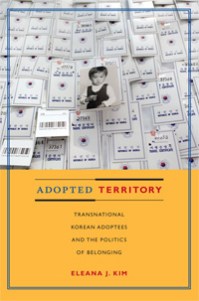
Borrowed from Judith Butler, the notion of “constitutive outside” points to the legal fiction of the orphan that leaves behind an excess of relationship, which “enchains” the child givers and recipients and “haunts” adoptee subjectivities. “Adoption not only makes children into orphans, but, over time, also produces missing persons,” writes Elena Kim, who illustrates her writing with artworks from internationally adopted artists. The book cover, a community artwork conceived by artist and activist Leanne Leith, features numbered tags bearing travel certificates delivered by the Republic of Korea, each tag representing one South Korean gone missing through international adoption. Much as the abstract conceptualizations, the live testimonies of adoptees and art pictures displayed in the book illustrate the potent message of longing and belonging that addresses a constitutive dimension of our shared humanity. Korean adoptees or not, “we all negotiate contingencies of personhood out of insufficient and mutable categories of the biological and the social.”
 The Duke Reader