
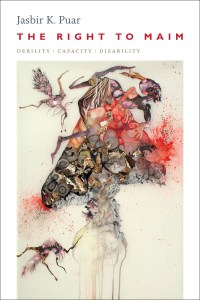
A review of The Right to Maim: Debility, Capacity, Disability, Jasbir K. Puar, Duke University Press, 2017.
 Take the following affirmations. The main cause of disabilities worldwide is American imperialism. Israel wants to turn Palestinians into a population of cripples. Disability in Western societies is a reflection of white privilege. The production of disability is a policy objective. Debilitation—making people disabled—is a profitable venture. Disability is a privileged category that bestows rights and preferential treatment on its beneficiaries. Discourses of disability empowerment, pride, visibility and inclusion create disenfranchisement, precarity, invisibility, and exclusion as their constitutive other. Disability rights leads to the debilitation of a large number of individuals. Gay marriage is a reaffirmation of white privilege that was lost by being gay. Neoliberalism sentences whole populations to a condemnation of slow death. Who would subscribe to such absurd statements? Yet this is more or less what Jasbir Puar wants us to believe. She does so with great rhetorical skills and communicative persuasion. The bigger the fabrication, the better it works. Her strategy to convince the reader of these provocative affirmations can be broken down into three consecutive steps borrowed from the vocabulary of military operations: shock and awe, dazzle and confuse, swarm and saturate.
Shock and Awe, Dazzle and Confuse, Swarm and Saturate
Jasbir Puar first relies on the impact factor of a series of outrageous statements unleashed upon the reader in close succession. The goal at this stage is not to convince or to seduce, but to shock and to leave in awe. Examples of such statements abound: they are introduced right from the first pages of the book, as if to prepare the ground for the upcoming battle. Israeli Defense Forces have a logic of “creating injury and maintaining Palestinian populations as perpetually debilitated, and yet alive, in order to control them.” “What counts as a disability is already overdetermined by ‘white fragility’ on the one side and the racialization of bodies that are expected to endure pain, suffering, and injury on the other.” “The category of disability is instrumentalized by state discourses of inclusion not only to obscure forms of debility but also to actually produce debility and sustain its proliferation.” “Debilitation is caused by global injustice and the war machines of colonialism, occupation, and US imperialism.” “Debilitation is not a by-product of the operation of biopolitics but an intended result.” “I am arguing that debilitation and the production of disability are in fact biopolitical ends unto themselves.” “Disability rights solutions, while absolutely crucial to aiding some individuals, unfortunately lead to further perpetuation of debilitation.” “Part of how white centrality is maintained is through the policing of disability itself.” “The production of most of the world’s disability happens through colonial violence, developmentalism, war, occupation, and the disparity of resources—indeed through US settler colonial and imperial occupations, as a sign of the global reach of empire.”
All the above quotes come from the sixteen pages-long preface, which lays the ground for the shock and awe operation. They are presented in a categorical and assertive tone that brooks no discussion. The goal is to cause maximum confusion and disorientation in a minimum span of time. Critical faculties and plain common sense are numbed and silenced by the accumulation of reality-distorting statements. The use of overwhelming argumentative power and the display of rhetorical force will destroy the reader’s will to argue or find nuance. Military vocabulary tells it well: shock and awe is what the opening chapter purports to deliver. It is likely that the reader, having come to this book through reputation or advice, shares some of the proclivities and commitments of the author. But this heavy barrage of fire maximizes the initial distance with the author: Jasbir Puar’s writing style and political stance are upping the ante for most progressive and mainstream readers, making it clear that The Right to Maim is no ordinary pursuit. Reading this book will confront them with controversial ideas and radical viewpoints, so one better has to brace oneself, buckle up, and prepare for a tough ride. And indeed, the opening sentence of The Right to Maim’s preface interpellates the reader by shouting the injunction: “Hands up, don’t shoot!” This was, of course, the rallying cry of the Black Lives Matter campaign, along with the slogan “I can’t breathe!” taken after the last words of Eric Garner who was put in chokehold by a NYPD officer. These are in fact “disability justice rally cries,” argues the author who sees a convergence of struggles and intersectional politics along the need to resist the sovereign right to maim.
Withholding death while denying life
The next step in the battle plan conducted by the book is a charm offensive that will leave the reader dazzled and confused. The seduction of The Right to Maim operates at many levels. The first rule of the book’s attraction is the allure of style. Jasbir Puar writes in a clear and exacting fashion that demands a high degree of attention from the reader but that is in the end very rewarding. She situates disabilities in a semantic field that also includes debility, capacity, and their associated processes of disablement, debilitation and incapacitation. This conceptual triangle complicates the ability/disability binary: “while some bodies may not be recognized as or identify as disabled, they may well be debilitated, in part by being foreclosed access to legibility and resources as disabled.” Debility allows the text to “illuminate the possibilities and limits of disability imaginaries and economies.” It also allows the author to contribute to political theory by complementing the approach of biopolitics first proposed by Michel Foucault and epitomized in the maxim “to make live and to let die.” The necropolitics of Achille Mbembe rephrases this expression by adding the decision “to kill or to let live”, thus giving rise to four coordinates: making live, making die, letting live, letting die. For Jasbir Puar, the “license to kill” that the sovereign state grants itself is complemented by the “license to disable” or the sovereign right to maim. To the politics of life and death, she adds the politics of keeping barely alive, of making available for injury, of withholding death while denying life. This politics of “will not let die” is best identified with the role of the Israeli state vis-à-vis Palestinians in the occupied territories, but it also characterizes US imperialism as well as, in its most general expression, neoliberal capitalism. By taking the high ground of theory, and adding a new development to the thought of none other than Michel Foucault, Jasbir Puar is able to rally the academic crowd and the intellectually-minded reader to her own radical agenda.
In addition to contributing to high theory, Jasbir Puar purports to explore the intersections and overlaps between various subdisciplines: disability studies, critical race studies, transgender and queer studies, postcolonial studies, to which she also adds affect theory, ecologies of sensations, “the fields of posthumanism, object-oriented ontology, and new materialisms.” These are all well-identified niches in the academic market: by touching upon them, and discussing the relevant authors and their most recent works, Puar makes sure her contribution will also be catalogued into each of these subfields, thereby gaining visibility and exposure. The result is often a tightrope exercise, as when she puts disability studies into dialogue with transgender studies—transsexualism was until recently catalogued as a “gender identity disorder,” while transsexuals often claim the health benefits associated with disability in order to support their bodily transformation. She quotes individuals with highly complex identities, such as a disability justice activist who identifies herself as a “queer, physically disabled Korean woman transracial and transnational adoptee,” not to mention the “trans women of color” who seems to be the main political subjects worthy of engagement. Puar engages critically with the notion of intersectionality, defined in the context of the convergence of struggles between feminist, LGBT, and ethnic minority movements. For her, “the invocation of intersectional movements should not leave us intact with ally models but rather create new assemblages of accountability, conspiratorial lines of flight, and seams of affinity.” Intersectionality often relies on an imaginary of social exclusion whereby the disabled person or the queer are supposed to be white and the racialized other is straight. For Jasbir Puar, one should clearly identify the ally and the enemy: she multiplies attacks against American imperialism, neoliberalism, and sionism, and underscores that her agenda is “unequivocally antiwar, pro-labor, antiracist, prison abolitionist, and anti-imperialist.” She concludes her book by stating that “the ultimate purpose of this analysis is to labor in the service of a Free Palestine.” Disability justice or LGBT rights must be embedded in this political agenda and contribute to its advancement: otherwise, they are a masquerade and serve only to whitewash (or “pinkwash”) the oppressive politics of the neocolonial state.
What happens after human rights have been bestowed
Part of the confusion caused upon the reader comes from the fact that Jasbir Puar directs some of her harshest criticisms against the basic tenets of progressive liberalism. She notes that her book “is largely about what happens after certain liberal rights are bestowed, certain thresholds or parameters of success are claimed to have been reached.” What is left of policies of human rights when rights have been granted and are universally recognized? First, discourses on rights create what is known in development circles as the last mile problem: there are always rights-bearers and potential beneficiaries that are harder to reach and to include into policies of empowerment and capacitation. For instance, people with mental and cognitive disabilities, or people stuck in a vegetative state, are often not considered in disability justice campaigns and continue to be the most marginalized of people with disabilities. Or the right to protest—a right that is held very dear by Jasbir Puar—supposes that street demonstrations and protest meetings be made barrier-free and accessible for people with disabilities. Policies of human rights not only fail to include some individuals as they create privileges for others: they deliberately generate exclusion and rightlessness as their constitutive other. For Puar, debilitation is not a by-product of the operation of biopolitics but an intended result, a supplement that often reinforces and overlaps with disability. Rights discourse produces human beings in order to give them rights; but by doing so they discriminate which bodies are vested with futurity and which aren’t. The paradigmatic example for Jasbir Puar is the LGBT rights movement, which produces “the sexual other as white and the racial other as straight.” As she argues by surveying the legal debate on transgender identity in the context of the 1990 Americans with Disabilities Act, hailing some disabilities as a matter of pride and recognition further marginalizes other disabilities. And even trans or disabled identities can lead the way to forms of normative nationalism—what the author, having coined the word “homonationalism” ten years before in her first book, proposes as the new concepts of “trans(homo)nationalism” and “crip nationalism”.
Another tactics is to supplement the blitzkrieg of her opening statements with a succession of skirmishes that makes her conquer ground over sceptic readers. She uses common sense and established facts to give some grounding to her radical affirmations. Nobody can deny that racism, colonialism, economic exploitation, and environmental pollution have debilitating effects on a vast number of people. Debilitation is indeed an effect of Israeli policies that restrict mobility and impose checkpoints that impair the circulation of able-bodied and disabled Palestinians alike. Reconstruction is big business in the West Bank and Gaza for donor agencies and NGOs that are kept in lucrative operations by the need to regularly rebuild what the Israeli army repeatedly destroys. Police officers throughout the world use nonlethal weapons such as plastic bullets and gas grenades that may cause injuries to the individuals they target, and some police forces, mostly in illiberal regimes, do use firepower against unarmed insurgents and shoot to cripple and to maim. There is a “white bias” in disability studies in the sense that most contributors to the field are indeed white. US wars leave in their trails injured soldiers and civilians who may thus be disabled for life. In Western societies, rights are granted to disabled persons that are denied to other populations, including their caretakers, who often come from disenfranchised populations and may not have access to healthcare themselves (see the French movie The Intouchables.) Disability becomes a rights-creating category by virtue of state recognition, while persons in various states of debilitation but who are not granted disabled status do not benefit from these privileges. Personal debt incurred through medical expenses is known as the number one reason for filing for bankruptcy in the United States. Israel makes efforts to market itself as a gay-friendly destination, thereby leaving itself open to accusations of pinkwashing.
A grand finale
These swarming arguments and saturation of the rhetorical space have one objective: to create “facts on the ground” through a reality-distorting field that annihilates the mental resistance of the reader. By acknowledging some facts and statements, the reader is led to subscribe to the radical propositions that form the armature of the demonstration. Much like the book opened with a barrage of fire, it ends with a grand finale, a climatic articulation of debilitation as a biopolitical end point unto itself. The explanations for the book’s title and some of the provocative affirmations stated in the preface are only given in the last chapter, where the right to maim is identified with Israel’s policy in the occupied territories. As a substitute to the word “genocide”, Jasbir Puar uses the concept of “spacio-cide” in the context of describing Gaza, one of the most densely populated place on earth, and also a region with the highest rate of people with disabilities. She identifies checkpoints as “chokepoints”: “because of this asphyxiatory control, Israel can create a crisis at will, having already set in place the bare minimum requisite for life that can be withheld at any moment.” Plastic bullets are the weapon of choice with the intended effect of hurting and injuring people, while the constraints on circulation create an entire population with mobility disabilities. But Jasbir Puar’s indictment of the politics of debilitation doesn’t stop at Israel’s (contested) borders. In her interpretation, Gaza becomes the standard by which all situations of political conflict should be evaluated. The sovereign right to maim is also applied by the United States in its handling of its racial situation and, one could add, the way the French government dealt with the yellow jackets demonstrations. Even the hidden structure of subjectivity is marked by the triangle of debility, capacity, and disability. Gaza is everywhere.
During the heydays of Marxism, French philosophers used to say that “philosophy is, in the last instance, class struggle in the field of theory.” Jasbir Puar might correct that theory is, nowadays, intersectional struggle in the field of political analysis. Theory is, for her, the continuation of political warfare by other means. This weaponization of social science serves practical goals: The Right to Maim is a political intervention in the context of campus politics where various groups call for the boycott of Israel, and Jasbir Puar fully aligns herself with this Boycott, Divestment, and Sanctions (BDS) campaign. But she doesn’t stop there: she brings warfare and military tactics to theory itself, and presents her arguments in the way military leaders execute a battle plan. Her three-pronged strategy—shock and awe, dazzle and confuse, swarm and saturate—will leave the reader in a state of shock and confusion, forced to take a stand between passive adhesion or outward rejection. Commenting on her political agenda is beyond the scope of this review. But I don’t subscribe to this agonistic interpretation of scholarship. Social science, and the humanities in general, has at its core mission the identification of the commonalities of humankind. It is only on this common ground that differences can flourish. Beyond the emphasis on difference and conflict, social science should strive to find a higher order of unity and reconciliation. This dialectics is completely absent from the scope of The Right to Maim.
 The Duke Reader
[…] made against Israel’s gay-friendly policy by Jasbir Puar in The Right to Maim (which I reviewed here). Sebastiano d’Ayala Valva’s documentary Les travestis pleurent aussi, located in the Clichy […]
LikeLike