
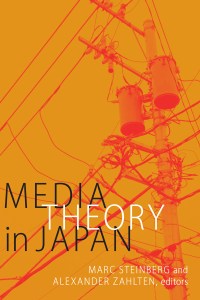
A review of Media Theory in Japan, edited by Marc Steinberg and Alexander Zahlten, Duke University Press, 2017.
 “Can you name five media theorists from Japan?” is the question that opens the book’s introduction by the two editors, Marc Steinberg and Alexander Zahlten. Taking up the challenge proposed by the two authors, I wrote my own entry in the book’s margins, with the intention of coming back to this list later once I would complete my reading. The handout to the assignment read as follows: Maruyama Masao, Ohmae Ken’ichi, Murai Jun, Azuma Hiroki, Sasaki Akira. The list will sound obscure to most non-specialists of Japan—and I must confess I include myself in this category. I just happen to have spent a couple of years in Japan in my formative years, and over the following two decades I have accumulated a small portable library of Japanese books and journals, mostly in the social sciences and in philosophy, although my resolution to read them has been forever deferred. Among these books, then, and to come back to my list, stands Maruyama Masao as a postwar critic or hihyōka who turned his liberal gaze on the then-dominant media, the press; Ohmae Ken’ichi as a management guru who heralded the advent of the information society in the 1980s; Murai Jun as the father of the Japanese internet; Azuma Hiroki as the theoretician of the otaku generation; and Sasaki Akira as an astute critic of Japanese theory (Nippon no shisō) and contemporary soundscapes. Having completed the reading of Media Theory in Japan, I am returning to my initial list of authors to put these names in context, add a few more, and write down a few notes on my newly-acquired knowledge.
“There is media theory in Japan”
First, a few definitions are in order. Media theory is more affiliated to the field known as theory—a low-brow version of speculative philosophy—than to the discipline of media studies, although the latter can make use of the first. The editors wryly remark that “the default setting for media theory is America; for a philosophy of media, France; and for media philosophy, Germany.” They hasten to remark that “there is media theory in Japan”; it just hasn’t made a global imprint the way that French philosophy of the 1970s made its mark on critical studies worldwide, or that Japanese management concepts influenced the curriculum of business schools at the end of the twentieth century. Theory is translated in Japanese as riron or shisō. It is closely related to the terms of tetsugaku (philosophy), hihyō (critique), and giron (debate). Compared to abstract philosophy, theory most often take the form of essay articles (ronbun) in monthly magazines or roundtable discussions (zadankai, taidan) whose proceeds are edited and published in books or monthly reviews. Critics (hihyōka) and thinkers (shisōka) are looked down by academics (gakusha) and researchers (kenkyūka) who specialize in one discipline and approach it with rigor and a sense of proper hierarchy; but the musings and cogitations of public intellectuals find many venues in Japanese society and are part of the intellectual landscape. Media theory, apart from being formalized as an academic discipline with strong American influences, remains therefore more open to free thinkers and dilettantes.
A second remark is that there has been several theory booms in Japan, which remains a theory-friendly society. The suffix –ron is affixed to many notions, including Japaneseness (nihonjinron) and media-ron. There is a history to be written that would address theory and its publics in Japan, from the Marx-boys of the 1960s to the shinjinrui (new breed of humans) of the 1970s, the Deleuzian schizo-kids of the 1980s, the otaku of the 1990s and the zeronendai Millennials. As much as media theory in Japan is, to a large extent, a theory of fandom, there are theory fans and theory addicts. Some thinkers develop a cult followership; other self-identify as fans of theoretical practice themselves and import into critical thinking the mindset and paraphernalia of fandom. There are, or there was at some point, theory camps, theory competitions, theory prizes, and, of course, theory manga and amateur movies. Theory in Japan blurs the distinctions between knowledge production, knowledge consumption, and knowledge circulation. It is a domain perpetually in flux, a moving target or a fluid that penetrates the interstices of society. Much like the fansub online communities who provide crowdsourcing subtitles of popular series on the Internet, media theory is a kind of theorization from below, by fans and media addicts. Through modern history, theory in Japan has been closely related to the dominant forms of subcultures, from ero-guro (erotic-grotesque, a Japanese literary and artistic movement of the 1920s and 1930s) to puro-gure (progressive rock). Theory corresponds to an age or a phase in life that often fades away with time: one usually grows out of one’s theory addiction.
Public intellectuals and media figures
It is altogether fitting that my first name on the list, Maruyama Masao, was known as a critic and a public intellectual more than as an academic. The study of media in Japan always had a precarious place in academia. Scholars trained in Germany introduced shimbungaku (“newspaper studies”) before the war, while cultural critics reflected upon the introduction of the cinema and, later on, of television. Media theory is usually developed to make sense of the dominant media of the day. It is always the science of “new media,” and the advent of yet another new generation of media profoundly transforms media theory along the way. The meaning of “new” itself is often predicated upon repetition. As Aaron Gerow shows in his entry “from film to television”, there are massive parallels between mid-century debates on the Age of Television and earlier theorizations on the introduction of the motion pictures, which themselves echoed turn-of-the-century debates on the onslaught of western modernity. “In Japan in particular, theories of film and television were deeply imbricated with historically specific but long-standing conflicts over problems of class, mass society, the everyday (nichijō), and the place of the intellectual.” The resistance of many intellectuals to cinema and then to television was deeply rooted. For Shimizu Ikutarō, a socialist, “television cannot permit the conditions that foster the roots of revolution.” For Katō Hidetoshi, a liberal intellectual influenced by American social critique, television’s “ability to penetrate everyday existence provides with considerable power, and could lead to the establishment of fascism in a time of peace.” Kobayashi Hideo, the pivotal Japanese critic of his time, also had ambivalent feelings regarding the advent of mass media in society.
My second entry, Ohmae Ken’ichi, a prolific writer and successful consultant at McKinsey, points toward a second figure that is familiar beyond the realm of media study: the foreign management guru and his close kin, the Japanese sidekick who introduces the first to Japanese audiences. The authors of Media Theory in Japan chose to concentrate on another character: Marshall McLuhan, the Canadian theorist of media who remains famous for a few aphorisms that sum up his approach (“the medium is the message,” “the global village”). The way McLuhan was introduced and popularized in Japan at the end of the 1960s differs from his reception in other countries. As Marc Steinberg notes, “McLuhan’s reception in Japan was colored by the fact that he was introduced by figures closely associated with television broadcasters and ad agencies, and thus he was read as a management guru by white collar ‘salary men’, media workers, and business moguls alike.” McLuhan became big in Japan because his theory was presented as actionable, like a kind of ‘prescription drug’ with the potential to provide concrete results to its users. The McLuhan boom, which was short-lived, coincided with the popularization of the term media-ron or media theory, an indeed with the use of the word ‘media’ as a stand-alone concept. McLuhan’s World, written by the media figure Takemura Ken’ichi, became even more popular than McLuhan’s book itself. This was “the first of a series of best sellers that walked the fine line between futurology (miraigaku), management theory, and media studies.” Other, more recent intellectual fads in Japan include the reception of Peter Drucker, Eduardo de Bono, Thomas Piketty, and the popularization of the concept of ‘platform,’ based on a theory of markets first coined by Nobel Prize-winner Jean Tirole and analyzed by Marc Steinberg in a more recent volume, The Platform Economy.
Nyū Aka and Dōbutsuka suru posuto modan
McLuhan’s success as a marketing guru makes visible the central role played by advertisement agencies, most notably by Dentsu, and the management consulting industry in general, in the introduction and filtering of media theory in Japan. Later on, the corporate world would also be instrumental in the reception of French theory, from Baudrillard to Derrida to Deleuze and Guattari, and in the popularization of the Japanese movement known as New Academy (Nyū Aka in short.) The central figure here is Asada Akira, which could have featured in my list and who is referred to in several chapters of the book. It is he, along with media critic Ōtsuka Eiji, who began to write complex analyses of the intersection of fandom and the popular media culture around manga and anime, often as an indicator of broader sociopolitical developments. According to Alexander Zahlten, Nyū Aka never formulated a theory of media. But the group changed the mode of theorizing itself: “Nyū Aka performed a media theory rather than formulating one.” A number of buzzwords inspired by Guattari and Deleuze—the paranoiacs and the schizo-kids, shirake (to be left cold) and nori (to get on board), asobi (play) and ironie—entered into popular parlance, and discussing the new philosophy was perceived as a fashion statement. After the movement petered out in the early 1990s, Asada Akira, who was also coeditor with Karatani Kōjin of the journal Hihyō Kūkan (Critical space), was tasked by the national telecom company NTT to curate a journal, InterCommunication, which explored the interfaces of theory, technology, and digital arts during Japan’s lost decades. For Marilyn Ivy, InterCommunication was still too heavily dependent of the telephonic paradigm and the “capitalism of the voice” to provide a real breakthrough in media theory; but it acted as a bridge between intellectuals and communities of practice in Japan and abroad at a critical juncture in the history of media theory.
It is with my entry of Azuma Hiroki as a postmodern media theorist that I hit the mark of the book’s main focus. Considered as the prince of the otaku culture, the author of Dōbutsuka suru posuto modan (translated as Otaku: Japan’s Database Animals) has brought the pop-massification of theory initiated by Nyū Aka to the next level. In this book, published in 2001 in a popular paperback series, Azuma focuses on anime, manga, and video games; he theorizes the database as a principal construct for the interpretation of post-Internet culture; and he examines new media artifacts such as fan-produced video games to produce an analysis of new media through the prism of the otaku. Borrowing concepts loosely inspired by French philosophy (Kojève’s animal, Lyotard’s postmodern, Derrida’ postcard), and adding his own brand of theoretical constructs (the database, the kyara or anime character, moe or virtual love for a fictional character), he became a standard-bearer of the zeronendai (2000s) generation before turning to political considerations after the Fukushima nuclear disaster. The two chapters centered on Azuma’s work, by Takeshi Kadobayashi and by Tom Looser, show there was a before and an after Japan’s Database Animals. Azuma launched his career as a philosopher in 1993 with a highly abstract terminology influenced by leading Japanese critics Karatani Kōjin and Asada Akira. He made a dramatic shift in his writing style with the publication of Japan’s Database Animals, which corresponded to a new media strategy addressed to a new readership; and he returned to a more philosophical orientation with his book General Will 2.0: Rousseau, Freud, Google, having failed to develop a media theory that his earlier works anticipated. This may explain, in passing, Azuma’s failed reception in France, where he was perceived as a low-brow analyst of geek culture, while his training and earlier contributions to high theory could have given him the potential to become a new Slavoj Žižek.
Making a dent in the universe
Media Theory in Japan describes a rich intellectual landscape and makes it accessible to the general public not versed in the Japanese language. There is indeed media theory in Japan, and my initial list of authors wasn’t completely off the mark. One question remains: why didn’t Japan’s media theories make a dent in the universe in the way that French Theory achieved or, in another realm, like the influence of Japanese management concepts over global practices? The editors don’t overstate their case when they remark that “Japan, with one of the largest and most complex media industries on the planet and a rich and sophisticated history of theorization of modern media, is nearly a complete blank spot on the Euro-American media-theoretical map.” One can first point to the lack of available translations: English is the lingua franca of media theory, and works by Japanese authors are rarely made available in English. Media theorists mostly talk among themselves, and Japanese thinkers are rarely part of this conversation. One could incriminate the dearth of proper translators and sites of mediation: the journal InterCommunication, which provided translations of Euro-American authors and put them in dialogue with Japanese intellectuals, was in the end a failure. One could also point towards the more general tendency to locate the West “as the site of Theory, and the Rest as the site of history or raw materials (‘texts’).” In this respect, this book provides a welcome gesture towards ‘Provincializing Europe’, and ‘Dis-orienting the Orient.’
But the blame cannot be put solely on the West. The authors point out that Japanese attempts to articulate a homegrown media theory generally ended in impasse and incompletion. Postwar critics of television were too imbued of their bourgeois superiority and dependent on American social critique to realize that when television was still a luxury in Japan, it was often viewed outside the home by anonymous crowds or neighbor communities—in train stations, cafés, shop windows, or at the place of neighbors opening directly onto the street (as we are reminded by the 2005 movie Always: Sunset on Third Street.) Nyū Aka’s discourse amounted to a form of knowledge curation more than a genuine articulation of media theory; and Azuma was compelled to abandon his plans to publish a comprehensive theory of media. The authors even detect a hysterical streak in the Japanese subject that leads to resistance to mediation and a tendency to resort to performance and acting-out as opposed to conceptualization and working-through: “Nyū Aka performed a media theory rather than formulating one,” and so did Azuma Hiroki or the earlier critics of the television age. As the chapter on McLuhan illustrates, Japanese reception deforms European and North American media theories, and acts as a black hole absorbing energy as opposed to a mirror reflecting light. The practice of hihyō is also to blame: “taking place mostly in magazines and journals and situated somewhere between criticism and academic theory, hihyō was tailored to the needs and speeds of a massively productive print culture” that remains insular by definition.
Media theory and management practice
It is here that the globalization of Japanese pop culture—video games, anime, manga, cosplay, fansubbing, instant video messaging as on Nico Nico Douga—offers the potential to change the picture. As has often been pointed out, these subcultures usually operate in an isolated environment (straddling the borders of Japan) and they are often subject to the Galapagos syndrome: they undergo evolutionary changes independently from the rest of the world, and they are sensitive to global exposure. But some variants can also withhold competition and thrive in an open environment. As the case of new media illustrates, distinct cultural-media configurations in turn give rise to distinct forms of mediation, and distinct kinds of media theorizations. The anime industry, analyzed in The Soul of Anime: Collaborative Creativity and Japan’s Media Success Story (reviewed here), provides alternative models of value creation that may be more attuned to our post-capitalist future: value is not synonymous with profits, and the relation between producers and consumers cannot be reduced to monetary transactions and economic self-interest. Similarly, management concepts born out of Japanese practice may find applications in media theory: the notion of platform, largely conflated with the strategies of the GAFA in the American context, took up a different meaning in Japan, due to its early introduction and mediation by Japanese management strategists. The same could be said of the concepts of learning-by-doing, of tacit and explicit knowledge, of modularity, and of co-evolution and symbiosis. Management scholars can learn a lot by reading books of philosophy and critical theory; likewise, media theory in Japan could be enriched by its dialogue with other fields of practical knowledge.
 The Duke Reader