
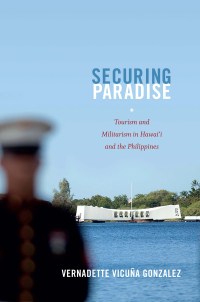
A review of Securing Paradise: Tourism and Militarism in Hawai’i and the Philippines, Vernadette Vicuña Gonzalez, Duke University Press, 2013.
 When she was a little girl growing up in the Philippines, Vernadette Vicuña Gonzalez considered American tourists and soldiers that she encountered or heard about as a benevolent presence. They were there to protect the land and to share their riches with a people in need of security and prosperity. This positive image was reinforced by the missionary schools founded by Americans, the remittances sent from abroad by relatives, the proceeds from commerce and military bases, and the endless stream of American movies and serials flowing from television. Later on, when her family emigrated to the United States, she would accompany her father to the Douglas MacArthur Memorial in Norfolk, Virginia, and share the gratitude held by many Filipinos for the general who liberated their country from Japanese occupation. For her, America was still the land of the free, a beacon of hope and opportunity for those seeking a better life beyond their own shores. But then she went to study at UC Berkeley and her worldview changed. She learned about the history of American imperialism, the gruesome stories of the Philippines-American war, the propaganda machine of Cold War politics, the complicity with authoritarian regimes, the destruction of the planet by the forces of neoliberalism, and the cynicism of exploitative raw power. Her homeland, the Philippines, became associated with the image of a puppet regime led by a dictator clinging to power with the backing of the US military. She applied the same critical lenses to the state of Hawaii and its populations after the was nominated as Associate Professor of American Studies at the University of Hawaii at Mānoa. For her, the Hawaiian archipelago was forced into the American fold at the end of the nineteenth century by a coalition of military imperialists, colonial planters, and migrant laborers who relegated the natives to subordinary status and even to cultural extinction. Being herself a nonnative in an adopted homeland, Vernadette Gonzalez purports to speak on behalf of the Native Hawaiians who should, however implausible it may sound, reclaim their sovereignty.
In the introduction, the author asks: “What alchemy transforms the terror of imperial violence and American postwar occupation to deeply felt understandings of American rescue, liberation, and benevolence?” One could raise the opposite question: how did a young girl raised in the spirit of America’s gentle embrace turn against a familiar presence and came to see it as a force of evil? How to explain this complete reversal, and what turned her from a believer of American kind-heartedness into a staunch critic of US malignity? Was it her studies in social sciences at UC Berkeley? And why did she choose to study at this university in the first place? Although she doesn’t give any biographical clues, I see three general reasons for this conversion: history, ideology, affect. These factors work both ways: the same historical, ideological and affective formations that explain Filipinos’ conversion to a myth of American compassionate guardianship also explain the anger, resentment, and challenge to the United States’ past and present imperial role. In a reversion of values, the soldier and the tourist can be seen alternatively as the Good American or the Ugly Yankee. Like a Janus-faced figure, the two characters are one and the same. He can be invited by his hosts to come home as a guest or, in the same movement, told to go home and depart. Thinking about tourism and militarism in Hawaii and the Philippines allows Vernadette Gonzalez to vent her anger against US imperialism past and present, and also to disavow the young girl who held hands with her father in American Pacific War memorials. In Securing Paradise, she applies critical lenses to analyze the history, ideology and affects sustaining the “military-tourism security complex” in the Philippines and in Hawaii.
Tourists and soldiers
In a way, the tourism industry is the opposite of militarization. Tourism is a peaceful activity, and tourists don’t go to war zones or to places exposed to the risk of insecurity. Unlike the soldier, the tourist doesn’t engage in violent or threatening behavior. He brings with him a camera, not a gun, and leaves behind dollars and trinkets, not bullets and explosives. The tourist is more often a ‘she’ than a ‘he’: a softer, warmer version of America’s presence in the tropics that stands in stark contrast to the masculine figure of oppression and threat. For Vernadette Gonzalez, the desires and economies of modern tourism are central to American military dominance in Asia and the Pacific. Tourism and militarism are mutually constitutive: both are part of am American project of domination and imperial outreach, and Hawaii and the Philippines form the first line of this concentric projection of power and sentiments. The roots and routes of the US military in these sites are foundational to tourist itineraries and imaginations. Tourism normalizes the presence of the military, prioritizes its needs, and disseminates a racialized and gendered idea of security. Both militarism and tourism rely on sedimented notions of colonized land and people (especially women) as waiting idly for their arrival, passively there for the taking. In many places, tourism has its roots in the militarized “rest and recreation” industry that thrived in the periphery of war theaters. The security that military bases provide is a fiction that starkly contrasts the reality of sexual exploitation and social insecurity that develops in the vicinity of army camps. The male tourist and the soldier both harbor voyeuristic and violent fantasies and usually turn their gaze against the bodies of women. For the author, many modern tourist sites are tainted by the illicit sexual economies and violence produced in rest and recreation sites of military occupation.
“Militourism” is designed as the activity fusing the two activities of militarism and tourism: making historic battlefields fit for tourism, creating memorials and museums to commemorate past military engagements, displaying military presence as a guarantee of security for foreign holidaymakers, or attracting active military personnel and retired soldiers to beach resorts and scenic sites. It also involves transforming former military bases into vacation sites and other sources of economic revenue, or building dual-use facilities and infrastructures such as scenic highways or helicopter landing platforms. In Asia and the Pacific, these “militourisms” take place on terrains that have long felt the impact of being objects of imperial desire. The first touristic explorations and adventures in the Pacific also doubled as military reconnaissance and imperial prospection. The image of the tropics as paradise was instrumental in justifying a policy of land grabbing and imperial expansion; it also served to lure young soldiers enrolling in overseas tours of duty. The world of the soldier and that of the tourist are often one and the same. The business of tourism benefits from the high drama of war: places like Pearl Harbor remain popular because war is at the core of America’s past and present identity. Likewise, the US military benefits from the glorification of American cultures of war that occurs in sites memorializing past military engagements. Gonzalez describes the activities of “remembering Pearl Harbor” at the USS Arizona Memorial or “playing soldier” on former US training grounds in Subic Bay as emotional labor: the labor that it takes to shape a national myth that is instrumental to Hawaiian dispossession and to the Philippines’s subordination.
History, ideology, affect
History is at the heart of people’s ambivalent attitudes towards the United States. The history of Hawaii and of the Philippines can be told in two very different ways: one eliciting sympathy and hope, the other criticism and grief. One reason for the adherence to the myth of American benevolence in the Pacific is that its believers are served with a rosy picture of history. And one reason for their conversion to the message of “Yankee Go Home” is that they come into contact with a very different story. It is this black book of misery and sorrow that Gonzalez presents to her readers. As she notes, Hawaii before the annexation by the United States was a sovereign kingdom that was undergoing struggles for internal unification and also fighting off external attempts on its autonomy. Massive population decline following the arrival of European explorers and sailors had produced conditions for exploitation, dispossession, and cultural ethnocide. A coalition formed by white plantation owners, missionary elites, and the US Navy collaborated to roll back native sovereignty with the Bayonet Constitution of 1887, the overthrow of the monarchy in 1893, and the annexation of the islands in 1898, creating America’s first foothold in the Pacific. This history is paralleled by America’s expansion westwards and its collusion with the Spanish empire in the Philippines. The Spanish-American War of 1898 was soon followed by the Philippine-American War, a nasty and brutish conflict in which torture was used against the native insurgents. This brought the Philippines into the American fold, and allowed the US Navy to strengthen its presence in the Pacific. Indeed, Hawaii and the Philippines would share linked fates as part of the American chain of garrison islands.
American tourists and soldiers are served a version of history that stands in stark contrast with the unofficial narrative told in Securing Paradise. They visit landmark sites and museums that present a sanitized version of the United States’ imperial expansion in the Pacific. America’s presence in the Philippines is retold as a story of rescue, liberation, and sharing of riches. The US administration of the Philippines, from 1898 to 1946, and the period following the annexation when Hawaii became a US Territory, from 1989 to 1959, are characterized as a progressive era during which the United States implemented a benign and modern form of stewardship. The authorities undertook a slate of reforms, hygiene, education, and economic projects that uplifted the population and created sympathy even among former insurgents. For example, in the Philippines, the military took on projects such as road building and land clearing to rehabilitate its public relations, substituting promises of constructive colonialism and economic development to its recent history of brutality and oppression. But it is the Pacific War that sealed the fate of these two territories and anchored them in the grand narrative of the United States’ national history. For the American public, Hawaii and the Philippines remain forever associated with Pearl Harbor, Corregidor, and the Bataan Death March. The enduring narratives of masculine sacrifice and heroism in World War II constitute the framing through which the two archipelagos are imagined and understood. This history is made visible and concrete through memorial sites and scenic circuits that have become a magnet for tourists. In these sites, visitors pay their respects to the dead, take part in rituals of remembering, and celebrate a bond of brotherhood with American soldiers, sealed with blood and anchored in Cold War rhetoric. Pilgrimage to historical military sites is not the preserve of American tourists or local visitors: even Japanese tourists are invited to “Remember Pearl Harbor” or to discover Corregidor as the “Island of Valor, Peace, and International Understanding.” For the author, the fetishization of December 7 overwrites January 17, 1893—the day the Kingdom of Hawaii was overthrown and its native population dispossessed.
Neoliberalism and neoliberation
The second factor that has the strength to induce positive or negative attitudes towards the United States is ideology. For Gonzalez, militarism and tourism in Asia-Pacific embody the ideologies of neoliberalism and what she calls neoliberation. Since the departure of the US military from the Philippines, Subic Bay and Clark Base have been transformed into special economic zones under public-private partnerships and now operate as commercial and tourist hubs integrated into global circuits of capital, labor, and commerce. The “post-base” era has not put an end to military cooperation between the US and the Philippines: on the contrary, US forces benefit from an advantageous Visiting Forces Agreement, they participate in joint training operation with their Filipino counterparts, and they are at the vanguard of the fight against Muslim extremist groups the southern region of Mindanao. The US Army left the Philippines through the door and came back through the window of opportunity provided by the fight against terror. Just as the war theaters of the Pacific War were transformed into symbols of liberation from Japanese occupation and fraternal collaboration between Filipino and American soldiers, the discourse of neoliberation transforms the exploitative economies of predatory capital and imperial outreach into narratives of security and shared prosperity. American military occupation and economic hegemony are cast in the same heroic light that fuses the twin ideologies of neoliberalism and neoliberation. The “return” of the base properties to the Philippines are presented as evidence of American generosity; meanwhile, the American military continues to occupy and tour the Philippines, and foreign capital, bolstered by the structural adjustment policies dictated by the Bretton Woods institutions, benefit from zero taxation and rampant violation of basic labor rights in the Special Economic Zones.
Or at least this is how Vernadette Gonzalez presents it, based on her own biased ideology and slanted perspective in which the United States is cast as the villain and its policies as conspirational schemes to maintain neocolonial influence over its dominion. This is, in a way, a missed opportunity: because beyond the Pavlovian denunciation of neoliberalism as evil, Securing Paradise raises many important economic issues. There is indeed an economic case to be made about the links between militarism and tourism. Both activities stem from certain comparative advantages and resource endowments, like having a long and accessible coastal line to build bases and resorts. Both generate rents and drive domestic prices up, giving rise to a particular version of the Dutch disease. Both military bases and tourism resorts may be the only viable economic sectors in territories that are otherwise too far away from centers of capitalistic concentration. There are complementarities between the two activities, as when the soldier goes on vacation as a tourist or when tourism is made safe by the presence of soldiers. But there are also contradictions, especially when the local population becomes more educated and more prosperous than the soldiers posted in their midst. Beyond a certain threshold, tourism development holds more promises than military build-up. When they are consulted about their own destiny, local populations will aspire to transform their territories into islands of peace, as opposed to hosting bases of discontent. But these issues of territorial specialization and economic reasoning are not raised in this book. Instead, the author adheres to a primitive notion of economics-as-witchcraft, with neoliberalism as dark magic and the Bretton Woods institutions as wicked witches. I don’t know where Vernadette Gonzalez got her economics, but it’s certainly not from UC Berkeley’s economic faculty. Even the variant known as international political economy, taught in political science departments and exerting some influence on literary scholars, has more consideration for basic facts and logical explanations than her casual treatment of economic factors.
Combat boots clamping and digital cameras clicking in Asia-Pacific
A conversion is always an affective turn: from love and attachment to abhorrence and alienation, from warm feelings of joy and happiness to dark motives of grievance and hate. Sometimes this reversal of sentiments can be triggered by a traumatic experience or a dreadful event: as when a story of rape and sexual aggression by soldiers or tourists turn the local population against any foreign presence. For Vernadette Gonzalez, the defining moment may have been provided by the image of President Ferdinand Marcos and his wife Imelda leaving the Malacañan Palace and fleeing the country in US army aircrafts after having been ousted by the people. She also describes a traumatic scene that happened to her shortly after September 11, when she was faced with the barrel of a gun for having committed a small breach of security protocol in a tourist resort. For her, tourism and violence are intimately intertwined. In the eyes of local authorities and American strategists, tourists’ safety and comfort take precedence over the needs and aspirations of the local population. The US military wants to make the world safe for tourism. It prioritizes certain forms of mobility and border-crossing at the detriment of others. As a result it makes the world more insecure, not less, and exposes local populations to new risks and insecurities. Although Vernadette Gonzalez doesn’t explicitly formulate policy recommendations, the solutions that can be inferred from the author’s presentation should be resolutely de-colonial: let the US forces go home for good this time, severe the ties of dependance and domination that bind local populations and indigenous peoples in exploitative conditions, reclaim the sovereignty of native right-holders and democratic representatives, protect the environment from the encroachment of army bases and tourist resorts, and bring an end to the tourism industry’s deleterious influence on the social fabric of host nations.
One may or may not agree with these solutions; but they appear to me as severely out of sync with the present geopolitical situation in Asia-Pacific. As the author herself acknowledges, the region is increasingly becoming more insecure; and the blame cannot be put solely on the presence of US forces, less even so on the continuous flow of American tourists. Any person who has travelled in the region can attest that the majority of tourists are no longer Americans or Europeans. These new tourists, who may be followed by soldiers as in the previous historical sequences described for Hawaii and for the Philippines, bring with them different dreams and aspirations, and interact with local populations and the environment in different forms and modalities. They too are looking for a paradise to cherish and to hold, but their version of heaven is based on different cultural and political assumptions. (For a local version of the mix between militarism, exoticism and affect, I recommend the 2016 Korean drama series Descendants of the Sun and its local adaptations by Vietnamese and by Chinese television.) One should lend an ear to the growing sounds of army boots and tourist crowds in Asia and the Pacific: are they harbingers of a new era when the digital camera will prevail over the machine gun, or will they repeat past experiences on a larger and more devastating scale? This is why I find books such as Securing Paradise useful: they allow readers who come to them with an unjaundiced eye to enter the fabrique of sentiments, and they enable us to envision a future that may not be determined solely by militarized tourism and the touring of armies on and off duty.
 The Duke Reader