
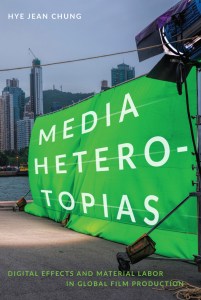
A review of Media Heterotopias: Digital Effects and Material Labor in Global Film Production, Hye Jean Chung, Duke University Press, 2018.
 It takes a lot of people to make a movie. It also takes a diversity of production sites, technologies, and product or service providers. The list of names, locations, companies, and generic technologies that were instrumental in making a movie are listed in the closing credits. A full set of credits can include the cast and crew, but also contractors, production sponsors, distribution companies, works of music licensed or written for the movie, various legal disclaimers, such as copyrights and more. Nobody really pays attention to this part, except for the theme song playing at full blast and the occasional traits of humor interrupting the credits scroll. These closing credits allow the spectator to make the transition between the world of fiction and the real world, and to put an end to the suspension of disbelief that made him or her adhere to the on-screen story. For Hye Jean Chung, who teaches cinema studies in the School of Global Communication at Kyung Hee University in South Korea, the spectator’s disregard for credit attributions is part of an operation of denial and erasure: denial of the work that went into making a movie, and erasure of the production sites and collaborative networks that increasingly place film production into an international division of labor. The ancillary bodies and sites of labor are erased from the film’s content and only appear in the end credits; but they somehow creep back onto the screen during the movie as well, producing what she calls “spectral effects” or traces that are rendered invisible and disembodied but that still haunt the movie like a ghostly presence. Taking on from Michel Foucault’s concept of heterotopia, she defines “heterotopic perception” as a mode of criticism that is sensitive to these spectral effects, and “media heterotopias” as a digitally enhanced audiovisual realm of representation that superimposes different layers of realities, spatialities, and temporalities.
Assembling a collection of movies from the Asia-Pacific region
These spectral effects and media heterotopias are particularly, though not exclusively, perceptible and legible in movies that use computer graphics, special effects, and digital technologies. Of the nine films that the author comments upon, six (Avatar, Oblivion, Interstellar, The Host, Godzilla, Big Hero 6) make heavy use of CGI and digital effects, while others use digital reediting (Wong Kar-wai’s Ashes of Time Redux) or animated sequences (Jia Zhangke’s The World). Only Tarsem Singh’s The Fall ostensibly insists on on-location filming (in more than 20 countries) and lack of special effects in its spectacular visuals. The conceptual framework proposed by Media Heterotopias is therefore amenable to many different kinds of movies, from Hollywood blockbusters to art-house films, from adventure fantasies to science-fiction flicks. A common thread running through this selection is the focus on Asia, as many of these films were shot or produced in Asia-Pacific; but the author insists that this book is not an area studies project, and she resolutely places her analysis in a transnational or global perspective. The focus of Asia-Pacific is thereby a reflection of the on-going trend that affects movie production and consumption as well as many other industries: the shift to a new center of gravity that includes East Asia and the western shores of the Americas, and that transforms the historical Eurocentric or Atlantic domination into a thing of the past.
Although Hye Jean Chung doesn’t identify herself as a Marxist scholar, her work is very much preoccupied with issues of capital accumulation, surplus value extraction, and commodity fetishism. Against a tendency to treat films as texts and material conditions as irrelevant, she reminds us that movies are made by real people engaged in a division of labor in which value created by some is appropriated by others. Theoretically, she situates her film studies in the legacy of Michel Foucault by picking up his concept of heterotopia. According to Foucault, the cinema itself (as a building) is an heterotopia in its ability of allowing several overlapping spaces to exist. A cinema theater is a room with a two-dimensions screen where a three-dimensions world is able to exist. Heteropias in cinema (films) are therefore increasing the amount of overlapping worlds and thus question the status of reality of any of those worlds. Another important if yet more implicit reference of the book is Jacques Derrida’s Specters of Marx, where the heritage of Marxism is reclaimed by a new materialism acknowledging the haunting presence of ghosts and spirits. By being attentive to spectral effects and ghostly presences, Media Heterotopias offers a kind of spectral critique or hauntology that places human labor and production processes squarely at the center of media theory.
The effacement of labor and the ideology of seamlessness
As many critics have pointed out, the world has been fundamentally altered by digital technologies. Our perception of reality itself is changing at a fast pace. Time is no longer a moving arrow flowing from past to present and toward the future: temporal linearity is now supplanted by intensive time, for which the only meaningful distinction is that of real time and delayed time. Digital technologies also transform our conception of space: they abolish the distinction between real space and virtual space, merging the two into a new augmented reality where digital signaling is ubiquitous. These new spatio-temporal formations have a strong impact on production and labor, and movie production is no exception. Nonlinear digital workflows are replacing linear production processes with a simultaneous collaborative workspace. Digital platforms such as video conferencing, instant messaging, and online file sharing allow massively parallel processes of collaboration to take place. To expedite and streamline the work process, the creative labor of digital film production is dispersed across geographically diverse companies in global production pipelines. Formerly disparate stages of preproduction, production, and postproduction are increasingly becoming fused with one another in a collaborative space.
Globalization has developed an ideology of seamlessness: borders are no longer a barrier to the free flow of goods, capital, and images; and production processes are integrated into global value chains operating just-in-time and without friction. For Hye Jean Chung, this fetishizing of a seamless integration conceals the actual living bodies and physical sites of labor that provide the material conditions of transnational activities. These bodies and locations are often firmly anchored to their national territories and regional infrastructures, with the cultural and geopolitical characteristics that are attached to them. The world isn’t flat, but a lot of work, including ideological work, goes into the task of making it appear as flat and frictionless. Similarly, both digital aesthetics and digital production processes partake in an ideology of seamlessness. Digital cinema produces a seamless effect when computer generated figures and sceneries are smoothly integrated with real actors, actual landscapes, and practical sets. By erasing material traces, visible joins and seams from the various stages of digital processing, the final product is made to look flawless and natural, even though digital images are composed of multiple layers of heterogeneous time and space. The photorealistic aspect of CGI makes it easy to suspend disbelief and create a pure spectacle of illusory seduction. This propensity toward the illusion of seamlessness has always been part of cinema’s attraction; but digital technology allows to make all traces of labor-intensive production invisible and well-hidden. Only remnants remain, coming back in the movie screen to haunt it as a spectral presence.
Self-referentiality and structural homologies
In some cases, the ideology of seamlessness provides the material for the film story. This is particularly the case in science fiction movies, even when they are critical of capitalistic processes or technological developments. James Cameron’s Avatar offers a simplistic denunciation of technology-driven imperialism and an apology of a holistic, nature-centered, culturalistic worldview. But the heavy dependence on CGI and digital effects as well as the film’s reliance on global production and distribution networks contradict the explicit message of the movie. Who should we trust, the Na’vi and their natural utopia untainted by human technology, or the visual effects that replicate the mixing of human and alien DNA performed by Pandora’s greedy aggressors? Avatar treats body as media; migrating to a different body is reflexive of the digital filmmaking process itself. Another structural homology between movie content and filmmaking process is the act or cultural or geographical appropriation. Film commentators noted that each article of Na’vi clothing and jewelry was handmade and woven by a team of New Zealand costume designers. They underscored that the “alien” culture of Pandora was actually based on the indigenous Polynesian cultures of the Pacific Islands: for instance, the Na’vi gesture of touching foreheads is directly borrowed from the Māori’s traditional greeting, the hongi. Such acts of cultural appropriation go unnoticed or are even praised to illustrate the film’s cultural deftness. But it is doubtful whether Māori communities or other South Pacific Islanders received any benefits from these borrowings. Geographical borrowings, such as location shootings in fragile ecosystems or in scenic landscapes, are even more pernicious: they leave in their trail a legacy of environmental devastation, and often open the way for mass tourism and commercial exploitation of nature, as in the Pandora tours and Avatar-themed Na’vi wedding packages that are offered in the sites where some of the movie scenes were shot.
Another form of geographical exploitation consists of making a landscape alien, as in the science fiction movies Oblivion and Interstellar that were shot using real locations in Iceland. In these films, Iceland functions as an in-camera special effect by providing the image of a primitive or post-apocalyptic landscape that is then mixed with computer-generated imagery. Again, it is doubtful whether Icelanders received any benefit from the inclusion of their country’s natural assets as raw material in global value chains. As Hye Jean Chung notes, “certain sites of production develop as centers or nodes of production pipelines, whereas others are relegated to satellite sites of production or peripheral industries that provide human labor and natural resources to this centralized core that upholds and reinforces Hollywood’s hegemony.” Films like The Host or Godzilla however show that hegemony can be de-centered and that nations are in competition over the definition of a global imaginary. The composite body of The Host’s monster crosses genres and territories: although firmly anchored in the cultural specificity of Korean cinema, it cannot be interpreted “neither as a transplant of Hollywood’s conventions into a Korean background nor as a transfusion of Korean culture into Hollywood’s standards.” The monster, envisaged by director Bong Joon-ho as an imagined vision of “Korean-ness,” is in reality produced by a mix of Korean and non-Korean labor and technologies; and the film is itself a blend of heterotopic genres, from science fiction and monster movies to action films, family drama, political satire, and comedy. The 2014 Hollywood’s version of Godzilla, too, mixes imaginaries and straddles boundaries across the Pacific Ocean. Created by merging cross-border bodies and assets in both narrative and production spaces, it mobilizes a postwar Japanese myth born out of the atomic bomb and projects it on a global scale. The monster functions as a floating signifier, whose hybridity enables multiple national identities and transnational imaginaries to coexist. But the Hollywood’s production didn’t kill the indigenous gojira franchise: in Japan, the US-made monster was criticized as “out of shape” and as having a neck “like an American football’s athlete’s,” while the story lacked the denunciation of atomic warfare and the social critique that the Japanese versions developed.
Heterotopia is not only what movies make of it: it is inscribed in sites and territories, in imaginaries and aspirations. Theme parks like the World Park in Beijing and the Window of the World Shenzhen feature scaled-down replicas from various parts of the world; they offer the opportunity to travel abroad while staying at home. For the local migrants who work in these parks however, like the characters of Jia Zanke’s movie The World, the cosmopolitan lifestyle they showcase remains an simulacrum. Jia’s film deconstructs the transnational fantasy embedded in the World Park by revealing the various forms of uninspiring work that is necessary in producing and maintaining the illusion of cosmopolitanism. The characters’ lives are mediated by technology. They constantly send text messages on their cell phones and watch at digital video screens. Their dreams and fantasies, figured by animated sequences that punctuate the film, are made of simulated artifacts and reconstructions, as fake and artificial as the world they inhabit or the characters they are asked to impersonate. Big Hero 6 features another form of heterotopia in the hyperrealist scenes and cityscapes of “San Fransokyo”, a fictional metropolis that integrates the cultural iconography of Tokyo into the urban geography of San Francisco. This form of techno-Orientalism, reminiscent of the futuristic city displayed in Ridley Scott’s Blade Runner, is indexed on a cultural reality: the role Asian migrants have played in shaping San Francisco, a city that is now heralded as the capital metropolis of the Asia-Pacific century. In Big Hero 6, which was produced as a Disney franchise, East meets West in a virtual space rendered seamless by transpacific collaborations in the field of computer graphics and creative urban design.
From post-Marxist analysis to new materialism
What does heterotopic analysis bring to the field of cinema studies? First, it brings together two strands of film critique that are often developed separately: content and context, internal versus external critique, semantic interpretation or industry analysis, the viewer’s perspective or the point of view of the producers. As Hye Jean Chung convincingly demonstrates, the border between the two realms is porous: the ideology of seamlessness erases all traces of human labor and technical work from within the movie, but reality creeps back into the film’s narrative, making the seams apparent and the labor traceable. Many movies, especially but not exclusively in science fiction, are self-reflexive about the filmmaking process and the technological tools used in film production. Analyzing the film’s content also offers a perspective on how it was conceived and developed. Second, Media Heterotopias offers a post-Marxist analysis of the global division of labor in cultural and creative industries. The author often refers to the long work hours, tight schedules, night shifts, physical migration, or sedentary confinement along complex networks of transnational collaboration. Value accumulates at the most capitalistic points of the value chain, while other parts of the production pipeline are submitted to ruthless labor exploitation or imperialistic appropriation of cultural and natural assets. As a third point, I see this book as a contribution to the literature on new materialism. The materiality of geographical location, physical labor, and industrial practices is put alongside processes of dematerialization and digitalization, giving rise to a new kind of mediated materiality. The layered nature of digital imagery makes it an assemblage of heterogeneous time-spaces, a composite of physical and virtual elements that give rise to spectral effects and phantomatic presence. Reality is what comes back to haunt us when the real has been dissolved into digital fictions.
 The Duke Reader