
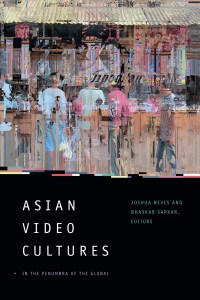
A review of Asian Video Cultures: In the Penumbra of the Global, edited by Joshua Neves and Bhaskar Sarkar, Duke University Press, 2017.
Reflecting on the uploaded content usually found on YouTube, legal scholar and political activist Lawrence Lessig made the following comment: “The vast majority of remix, like the vast majority of home movies, of consumer photographs, or singing in the shower, or blogs, is just crap. Most of these products are silly or derivative, a waste of even the creator’s time, let alone the consumer’s.” This is a book about crap. But it isn’t a crap book: as Charles Baudelaire and Walter Benjamin have taught us, there is meaning and enjoyment to be found in the transient, the fleeting, the contingent. It is by acknowledging these mundane aspects of everyday life that we can paint a true picture of modernity. Modernity as experienced by Baudelaire or Benjamin was Parisian, pedestrian, and picturesque. Our modernity falls under the sign of the global; and it is now in Asia, not on the streets of Paris, that new forms of contemporaneity are being experienced. Videos posted on YouTube and its regional equivalents—China’s Youku, Japan’s Niko Niko Dōga—as well as images circulating on low-tech video supports such as Video CDs and microSD cards are not only the crap of lived experience and a waste of consumer’s time. They are invested with imaginaries, intimacies, and identities that summon other ways of being in the world. As such, they provide weak signals, background noise, and narrow bandwidth communication to the careful observer attuned to Asia’s many presents and futures. But attending to these realities cannot be done merely from a computer screen. The various contributions in Asian Video Cultures emphasize ethnography as a crucial methodological tool for achieving better comprehension of video cultures at all levels of analysis and advocates anthropological case studies and cross-cultural analysis as foundational to a much-needed critical global media perspective.
Asian modernities
The “Asia” the editors have in mind is different from the landmass imagined by politicians, corporate executives, and ideologues. It is not defined by geography: art videos assembled by a gay Singaporean artist in Germany are as much part of Asia as the Bollywood movies that circulate in northern Nigeria. The book includes fieldworks studies taking place in Palestine and Lebanon, while other Asian geographies, such as Central Asia or Iran, are conspicuously absent. Articles about India dominate the count, and introduce us to fine-grained descriptions of localist movements such as the consumption of music videos by rigorist Meo villagers in the state of Haryana or the accession of Telangana to statehood through a politics of YouTube remixes and online comments. Some countries known for their digital modernity, such as Japan and Korea, only appear tangentially, while we are reminded that Indonesia has (or had) the second-highest number of Facebook users in the world. Just as the nation-state was molded by the printing press and the emergence of national literatures, imagined communities in Asia are currently being formed through the circulation of images and affects on online platforms and offline hardware devices. The YouTube video or its social media equivalent is at once intimate and political. It shapes an imaginary and carries values of immediacy, propinquity, self-expression, and affective engagement. Internet videos herald “the age of the amateur” which blurs the divisions between producer and consumer, media and content, uploading and downloading. They proliferate “in the penumbra of the global”, in the twilight hours between dusk and dawn when all cats are grey and dogs and wolves are confused.
The new media formations that the book chapters describe are often relegated at the margin of scholarly attention, statist projects, and corporate strategies. A common trope among intellectuals is to disparage media practices across the region as the emanation of a culture of copy, duplication and counterfeit, devoid of any intellectual creativity and adversarial to legitimate market value. According to this common view, the West is the originator of value and content, and the East free-rides on this authentic culture of innovation by offering knockoffs and low-cost imitations. The tolerance that Asian states grant to these intellectual property infringements is the sign of a retrograde political culture that is, in the end, adversarial to economic development. Another stereotype, which partly contradicts this first trope, is to view the state in Asia as authoritarian and manipulative. In his critique of Stalin’s Russia, Karl Wittfogel saw the authoritarian nature of communism as an extension of the need of totalitarian rule to control water that had shaped civilizations in most of Asia. This “oriental despotism” now takes the form of media censorship, Internet control, and political repression in densely populated cities and states that cannot tolerate political dissent. For the editors, these views, which still inform much of what passes as area studies in Euro-American university departments, are inspired by Cold War geopolitics and market neoliberalism: their objective is to make Asia fit for capitalism and democracy. They prevent us to register the profound social changes that are taking place at the level of the infra-political: most media practices described in this volume operate below the radar of the state and the market. They also make connections beyond and outside the borders of the state, giving way to transnational currents that are as constitutive to globalization as the movement of goods, services, and capital.
Bringing media to the village
Beyond the triumphant view of emerging Asia as a continent of skyscrapers and digital connectivity, one should not forget that Asia is also composed of slums, shantytowns, and remote villages. The economies of survival that sustain these margins also shape the technologies, idioms, and practices that characterize Asian video cultures. In “Video documentary and rural public China,” Jenny Chio describes how video is integrated into contemporary rural and ethnic minority livelihoods in China’s southwestern provinces. She shows that one can be modern and rural and ethnic at the same time. Video recordings of local festivals and folk performances of ethnic Miao communities find their ways to the smartphone screens and computer monitors of migrant workers and farming households living in factory towns or staying in isolated villages. They exist alongside, but not necessarily in conflict with, mainstream national media. The videographers who produce these videos are self-taught or, in some instances, beneficiaries of video-production training workshops run by local NGOs. They bring “media to the village,” but also participate in a rural public culture that allows for different forms of media representation and public participation. Slums and villages shouldn’t be identified as the “local” in opposition to the global. In another chapter on “Sensory politics in Northern Nigeria,” Conerly Casey takes the case of Muslim secondary-school girls who develop signs of spirit possession that include “dancing like they do in Indian masala films.” Qur’anic scholars who adhere to a strict interpretation of the Sunna immediately forbade Bollywood movies, while the local video movie industry produced song-and-dance copies of Bollywood productions and young adults circulated a PalmPilot version of the Kamasutra known as the Palmasutra. Stories of spirit possession, forbidden images, and sexual fantasies also played out in national politics when Nigeria’s strongman, General Sani Abaca, dropped dead after a late-night visit with two “Indian prostitutes”. The transnational circulation of images and content affect people at the level of the sensory, the intimate, the emotional, but also the religious and the political.
Another bias in media studies is to focus on large cinema screens and TVs or computer monitors, and to leave aside smaller screen displays and low-tech hardware supports. Products like VCDs, digital audio tapes, MiniDiscs, and SD cards were widely adopted in the region and successfully competed with DVDs and web uploads until smartphones became ubiquitous in the 2010s. The ethnographies collected in Asian Video Cultures attest that the preferred mode of diffusion is often off-line and through movable hardware devices that are passed on through informal networks of distribution and exchange. As Chia-chi Wu shows in her study of trans-Chinese screen practices, Asia is the continent of small-screen realities. In Chinese-language communities in the recent past, a growing lexicon of the “mini”, the “small” and the “micro” has developed in multifarious forms with radically different political and cultural meanings. “Wēi”, meaning “micro” in Mandarin, has been used in ubiquitous names like Wēibó (China’s version of Twitter), Wēixìn (WeChat in Chinese), and wēi xiǎo shuō (micro-fictions or SNS novels) or wēi diàn yǐng (micro-cinema or “micro film”). Other neologisms centering on the concept of small are also popular, such as xiǎo què xìng (small pleasures), wēi zhěng xíng (micro-plastic surgery) or wēi lǚ xíng (micro-travel). Asian minimalism, a film orientation associated with directors You Hsiao-hsien and Jia Zhang-ke, has given rise to the rejuvenation of short-film culture on a regional scale, as evident now in the flourishing of film festivals devoted exclusively to short films or micro-movies. Wēi diàn yǐng has almost completely replaced the Mandarin term for movie shorts, duǎn piàn, which now sounds old-fashioned if not obsolete. As Chinese consumers are enjoined to embrace “wēi” or “micro”, technologies that exploit the small, the mundane, the daily pleasures, and the quotidian begin to shape a specifically Asian or Chinese modernity. All these little things resonate with subtle, multilayered meanings about the production of a self-managing, complacent, and self-comforting subject that is compatible with market neoliberalism and state authoritarianism: of course, making “big” acts of disobedience is not tolerable or even imaginable in China.
Platform and content
Two terms dominate the formulation of corporate strategies and government policies in the digital sector throughout Asia: “platform” and “content”. The shared goal is to create home-grown platforms that would compete with the dominant players, such as Google, Facebook, Amazon or Apple, and to generate content targeted at global audiences. But video cultures show us that platforms can be improvised, such as in the exchange of microSD cards among traders and consumers, and that content is often user-generated with a very local audience in mind. Niko Niko Dōga, abbreviated Nico-dō, is a Japanese video-sharing service owned by Kadokawa Corporation as part of a media mix strategy that fuses platform and content. The media mix originally refers to the practice of turning books or manga into moving images or products and vice versa. It ties video together with print, games, plastic figures, comics, and novels in a tightly knit ecosystem. Unlike other video sharing site, comments generated by users on Niko Niko Dōga are overlaid directly onto the video, synced to specific playback times. This feature allows comments to respond directly to events occurring in the video, in sync with the viewer—creating a sense of a shared watching experience. Nico-dō delivers not only videos but also manga, novels, and magazines, via the same interface as its videos, and conjunction with its unique comments function.In Japan, the emphasis on platforms was a rather late addition in corporate strategic discourse. Previous priorities in the 1990s focused on contents and intellectual property, as policy makers entertained the hope that Japanese cultural goods would make up for the decline of Japanese industrial power. But once it was adopted in the 2000s, platforms became ubiquitous. Former telecom services such as NTT DoCoMo’s i-mode were reconceptualized as platforms, and business seminars with MIT professors were organized on the logic of multi-sided markets—as platforms are modeled among economists. The enthusiasm for platform reflected the craze about media theory that had developed among Japanese executives at the time of Marshall McLuhan’s book Understanding Media in the 1960s. Indeed, as Marc Steinberg notes in his contribution, “what we used to call media we now call platforms.”
There is a dark side of Asian video cultures that the authors of this volume do not really explore, and to which they refer only tangentially. In Asia as elsewhere, the Internet is a breeding ground for conspiracy theories, right-wing ideologies, racist provocations, and nationalist mobilizations that abuse free speech and undermine democracy. Evidence points to an Asian genealogy of some of these extremist forums. Japan’s infamous 2Channel (2ch.net), known as nichan, served as the model for the English-language 4chan, on which the hacker collective Anonymous and the far-right conspiracy movement QAnon first developed. First launched in 1999 as a bulletin-board where full anonymity was guaranteed, 2chan became known as a hub for the Net-Right or netto uyoku that bears some responsibility for the rightward swing of Japanese politics in the past two decades. Likewise, nationalism and anti-foreigner sentiment in China would never have developed to the extend it now has without the availability of Internet forums and text messaging services that allowed disgruntled youths to vent the anger they couldn’t direct at the authoritarian regime. The dark side of the net is also reflected in the proliferation of pornographic pictures and sex videos that affects individuals and communities in Asia as in other continents. Without going so far as saying that “mobile phones are responsible for rapes,” as the Karnakata legislature did to ban smartphones in schools and colleges across the state, the proliferation of smutty videos and pictures on modern social networks has certainly taken a toll on populations and especially on the most vulnerable: women, the young, those least able to navigate discriminately the new currents of online streams. With great freedom comes great responsibility.
The new Internet archive
The authors of Asian Video Cultures prefer to insist on the positive, creative and empowering aspects of new media. They offer vignettes of individual emancipation, community involvement, emergent solidarities, and artistic production that all point toward the same direction. Patricia Zimmermann describes a new-media portal in Indonesia that has been described as the “YouTube for Southeast Asia activists”. It focuses not on the national but on micro-territories and micro-practices such as the production of short documentaries for social media that address issues of environmental degradation, social mobilization, and migrant rights, thereby circumventing the mainstream media’s stranglehold on information. Tzu-hui Celina Hung documents how immigrant brides in multicultural Taiwan are able to better negotiate the terms of incorporation into their new household by exchanging information and sharing their stories on social networks. Rahul Mukerjee and Abhigyan Singh explain how young men from the Meo ethnic group in rural Mewat in northwestern India are able to escape the strictures of their rigorist community by appropriating the symbols of individual emancipation, the motorbike and the mobile phone. Feng-Mei Heberer analyzes the art videos of Singaporean artist Ming Wang who performs drag cross-dressing by impersonating the role of female protagonists in German classical movies, thereby giving a face to under-represented ethnic and sexual minorities in Germany. S.V. Srinivas studies the mobilization that led to the formation of Telangana State within India through online activities such as uploading videos and posting comments in the local language on YouTube. Like literacy in 19th century Europe, the diffusion of video cultures in contemporary Asia is conducive to the formation of new subjects and collectives. Unlike literacy, however, it largely escapes the sphere of the state and is not framed by national policies. Video documentaries and short movies are produced outside of the state media system and circulate beyond the realm of the market. Another key difference is that we are able to document 19th century history through the print archive formed by the collection of books, newspapers, pamphlets, and printed material kept in libraries and archival depots. How will future historians and researchers document our video cultures, and how will they deal with the crap that is uploaded daily on YouTube?
 The Duke Reader