
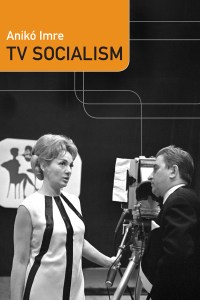
A review of TV Socialism, Anikó Imre, Duke University Press, 2016.
 In her 1978 hit song “TV-Glotzer,” Nina Hagen sings from the perspective of an East German unable to leave her country, who escapes by watching West German television. She switches channels from East to West and stares at the tube where “everything is so colorful.” As she puts it, TV is her drug while literature makes her puke and she keeps eating chocolate that makes her fatter and fatter. The song was written when Nina Hagen was still living in East Berlin but made a hit in Western Europe, where “white punks on dope” could identify with the lyrics and share the spirit of “no future” rebellion. Anikó Imre’s TV Socialism gives a different perspective on television in socialist Europe. For her, television isn’t a drug but a matter of scholarly enquiry, and her book is a dense academic text that comes fully equipped with historical references, textual analysis, and footnotes. The book is a seminal contribution to the field of “socialist television studies” and challenges many ideas by which we assess Eastern Europe’s socialist past. But first, what does she mean by TV socialism? What links TV to socialism, and what makes socialist TV different from the television programs that were produced at the same time in Western Europe, in the United States, or in the developing world? How did television in Hungary, Poland, Czechoslovakia or the GDR shape the imaginaries of viewers, and what remains from this socialization through small-screen images in a post-socialist world? Or to repeat Anikó Imre’s introduction title, “Why do we need to talk about socialism and TV?”
TV as a propaganda tool
According to conventional opinion, TV in socialist Europe was a propaganda tool. Its goal was to educate and enlighten all social classes, giving access to culture and information while also providing a light form of entertainment for the masses. Educational TV had to demonstrate social commitment to the cause of the State and the Party, show solidarity with the Soviet Union, acknowledge the superiority of European high culture, and contribute to the building of socialism. Teaching viewers how to be good socialist citizens was a central mission of national broadcasters. Lenin famously called on good socialists “to study, to study, and again to study,” and television was one of the mass media that could bring the study guide to the living room. Of course, socialist workers were not to be treated as students, for they embodied the knowledge and values that the sphere of culture only reflected. TV programs had to be relevant to the workers and understandable to them. TV was meant to be watched collectively in offices, factory clubs, and cultural centers. Instead of depicting life as it was, reality-based programs shifted the emphasis to teaching citizens how to behave in an ideal socialist society. But this consciousness-raising documentary realism was always articulated with the privates pleasures of television’s emotional realism. The doctrine of socialist realism also acknowledged the role of emotional expression to promote Soviet ideals. The same Lenin distinguished between propaganda, a way to convince through rational argumentation, and agitation, which mobilized emotion and affect. Like the theater according to Bertold Brecht, television was a tool of agit-prop and, as such, could lead to the creation of new forms of cultural expression, distinct from the dull productions of bourgeois culture.
This description above summarizes the standard view of socialist television, as held by critics and sycophants alike and as it was sometimes expressed by the rulers of socialist republics. But Anikó Imre shows that it was a far cry from reality. Really-existing socialist TV was not so much different from television as it existed at the time in Western Europe, and indeed there were many linkages and influences that crossed the iron curtain. To dismiss (or to hail) socialist TV as mere propaganda widely misses the mark. In her introduction, Anikó Imre articulates three surprising facts that help readers see TV and socialism from a different angle. The first surprise is that television in Eastern Europe was much more exciting and entertaining than its status as propaganda tool would make us believe. Authorities had to reckon with television’s power as a mass medium, and mostly left professionals in charge of its development. TV managers used this autonomy to operate under the radar screen of censorship, to play catch-up with Western broadcasting programs, and to formulate a light critique of the regime through irony and self-derision. The second surprise is that TV broadcasters cared about their audience, their viewer ratings and their domestic market share. They were commercially oriented, and operated in a competitive field where they had to fight for available human brain time. A large part of their revenue came from advertising. As a result, they provided the public with what people most enjoyed: quiz shows, pop music, comedy, and drama serials. It is these forms of popular entertainment, and not the live broadcast of classical music concerts or didactic science programs, that came to define what socialist TV was all about. As a third surprise, Anikó Imre shows that socialist TV was not bounded by state borders and national identities. It was transnational even before the word was invented, with border-crossing signals and program exchanges that allow the author to provide an integrated picture of Eastern European TV as opposed to a juxtaposition of country studies.
National leaders are watching TV
The way national leaders engaged with TV had a heavy influence on program content. János Kádár never watched TV as his taste drew him to high culture and concert halls. Leonid Brezhnev had his appointed head of Soviet television design programs especially for him and his wife, while his children and other relatives had the house equipped with another TV set and a Japanese VCR to watch shows and movies from the West. In the 1970s, Nicolae Ceaușescu opened his country screens to US series and German quiz shows in order to demonstrate his independence from the Soviet Union and to gain favor with the West, then in the 1980s he turned increasingly dictatorial and reduced television broadcasting to a few hours a week with programs lauding his every words and actions. Josip Broz Tito encouraged TV channels to draw on advertising income and even had a Slovenian station broadcast commercials in Italian to audiences across the border to get additional revenue. Erich Honecker redirected the course of East German TV when he famously diagnosed “a certain boredom” around television and urged its managers to create “good entertainment” at the Eighth Party Congress in 1971. What all these leaders had in common is that they tried to mold the new medium to their own purposes, but failed to dictate their taste and preferences to the public. Television’s lower cultural status allowed it to escape the strictures of official culture and to develop free forms of popular entertainment. Socialist TV shared with Western European broadcasters the same commitment to realism and the ethos of public service. Tight state control and censorship also characterized periods of Western European TV programming. De Gaulle famously gave orders and directives to TV channel managers that he himself appointed, and it was rumored that news anchors on French TV had an earplug that linked them directly to the ministry of information. As for the feeling of boredom that Erich Honecker perceived in the East German public, French téléspectateurs could feel it as well: “La France s’ennuie,” titled Le Monde in a famous editorial on the cusp of the May 1968 movement.
It may come as a surprise to a generation raised on Japanese anime and American TV series that TV programs from the East once had a not-so-insignificant market share in Western European markets. This was especially the case for children’s television. Growing up in the 1970s in the United Kingdom or in France meant watching a lot of imported East European children’s programmes. There was the Singing Ringing Tree with scary dwarves hailing from East German studio DEFA, Taupek the Mole which came from Czechoslovakia and used giggles or non-verbal exclamations instead of words to communicate, and something quite bizarre called Ludwig which was an animated series about a machine that played Beethoven to his animal chums. Some animation feature films were drawn from Continental Europe’s tales and legends, like The Snow Queen produced at the Soyuzmultfilm studio in Moscow or The Pied Piper by Czech studio Kratky Film; other animations developed Slavic themes like Gallant Robber Rumsaïs or Tchessilco the Magician, which were broadcast in France by ORTF. Not only did people in the Soviet satellites love their children too: they watched along with them what was recognized at the time as the best TV animation in the world. These animated pictures’ influence over Western animation, and over Western audiences, cannot be overstated. Anikó Imre doesn’t cover children TV in her book, but its development is quite similar to the other genres she reviews. The socialist reality-based, educational TV programs she describes were a kind of prehistory to the much more excoriated and inflamed reality-TV shows that took European channels by storm in the 1990s. Aside from proper language and decency, a lot was lost in the move from socialist realism to reality TV.
Did women have better sex under socialism?
Women are said to have had it better under socialism: better labor market participation, better jobs, better maternity leave and child care, and even better sex. Whether this is true remains controversial. Anikó Imre paints a mixed picture of women’s reflection in the mirror of socialist TV. On the one hand, television addressed many topics conventionally considered as women’s issues: child rearing and education, cooking and housekeeping, romance and family issues, and even birth control and sex life. But on the other hand, the default national viewer addressed by socialist television was most often the white, male, abled and working heterosexual citizen. Women as a homogenized social group were identified with special needs and tasks such as reproduction, family care, and emotional labor, and with inferior skills for political participation and mastering of technology. The blond female host was often associated with the pretty face and decorative position of the program announcer, while men anchors were clearly in control. This gendered hierarchy was also reflected in the two-tier production structure: television remained a male-dominated industry, and women typically worked below the line as technicians, make-up teams, or secretaries. The occasional powerful woman in television often did everything to efface herself and masquerade as one of the boys. Over the years, socialist television turned more feminine, if one identifies feminity with melodrama and consumerism. The thaw period beginning in the late 1960s brought political and economic changes that required socialist parties to readjust their gender policies. Women were presented as key agents of the “socialist lifestyle” and featured prominently in the genre that Anikó Imre labels the “late socialism soap opera.” Unlike historical dramas from the previous period, which removed the narrative into the past and revolved around heroic male figures, these domestic serials took place in the present and evolved around key female characters who acted as problem solvers and natural caretakers. This idealist image of the socialist woman who is independent, desirable and capable, is reflected the stunning photo portraits of Júlia Kudlik and Irena Dziedzic, with their fashionable hairstyle and modish dress, eliciting from the reader the male gaze that the author’s feminist agenda precludes.
Anikó Imre’s description of socialist TV defies Cold War stereotypes of a gray, repressive, joyless and isolated Eastern Europe. Men and women beyond the Iron Curtain knew how to have fun: only they did it differently, infused with the traditions of Mitteleuropa and the contradictions raised by socialism. The ruling communist parties and the strictures of state socialism couldn’t be criticized upfront. But citizens could vote with their eyeballs by switching channels, turning to programs broadcasted from neighboring countries, or turning off TV altogether. The more elitist, austere, realistic, and educational television attempted to be, the more it was mocked and abandoned by viewers, who wanted fiction, humor, and entertainment. The public could also distance itself from really existing socialism through mockery and satire. The systemic deficiencies of socialism were treated with light humor: living conditions in housing blocks, queuing for acquiring consumer products, facing the maze of bureaucracy, and other absurdities of the era were addressed in a light and relaxing manner. Reality shows at once celebrated and poked gentle fun at socialist institutions and rituals. Some 1980s serials took subversion to surprising levels: as the author notes, humor “thrives on oppression and censorship, rather than being silenced by it.” Rather than a government-controlled soapbox that repelled humor, much of socialist TV programming was actually perceived by audiences as comic because socialism itself was absurdly comical. Television was an theater of the absurd: the distance between the utopian horizon of socialism and the existing conditions of life was too great to swallow without a heavy dose of humor. The comic absurdity of late socialism could also draw from older traditions of cabaret, farce and carnivalesque entertainment that echoed the “agit-hall” operetta from Weimar Germany or the monologues, dance numbers and songs from Viennese Kabarett. This tradition of political satire survived and in some contexts flourished in the late shows and New Year extravaganzas offered to TV viewers. Here again, as for reality TV, the author sees in this wave of derision a harbinger if not a direct influencer of the politically-charged entertainment programs that were later developed in Western Europe and the Unites States, from the Guignols de l’Info to The Daily Show.
The afterlife of TV Socialism
What remains of socialist TV in today’s Europe united by political integration and market consumerism? TV Socialism addresses the afterlife of socialist TV in three different guises: as postsocialist TV programming, as an archive steeped in nostalgia, and as an academic discipline. First, socialist TV continues to have an active social life in the countries that have made the transition from state socialism to market capitalism. There is much more continuity between late socialism and postsocialism than the narratives centered on Cold War and transition to market would make us believe. Many idiosyncratic genres, distribution patterns, and reception practices have perpetuated into the present day. Some shows and serials have continued into postsocialism; other contemporary programs have deliberately attempted to reproduce the mood and values of late socialist TV, giving it a nationalist twist; and there has also been some reruns of older TV shows, with specialized channels catering to a nostalgic public. New circulating formats, from DVD to on-demand catalogues and YouTube uploads, have brought a new lease of life to vintage programs that have acquired a cult-like status. Anikó Imre adopts a critical perspective on postsocialist nostalgia, known in Germany as Ostalgie, claiming that it is a naive and postimperial gaze on a mythified past. But her own attitude shows that there is pleasure and knowledge to be gained from delving into TV archives, and that the repertoire of antiquated shows and series should not be left to oblivion. Taking socialist TV seriously grants access to an image of life under socialism that stands in stark contrast to the clichés of Cold War stereotypes. Rather than scarcity, homogeneity, and brainwashing, TV Socialism conveys a mixture of familiarity and strangeness, which helps to defamiliarize some of the basic assumptions about Eastern Europe and socialism. As Anikó Imre notes, television has long been relegated to the status of a minor and inferior object for scholarly studies, both in the Slavic and Eastern European Studies departments of American universities and in the cultural studies programs that have burgeoned in Europe. By moving it centerstage, she deconstructs the opposition between high and low culture as well as the Cold War division between East and West and between socialism and postsocialism.
 The Duke Reader