

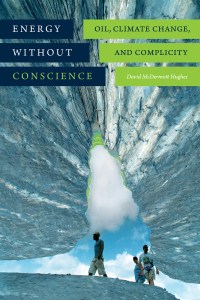
A review of Energy without Conscience. Oil, Climate Change, and Complicity, David McDermott Hughes, Duke University Press, 2017.
 As a small state composed of two islands off the coast of Venezuela, Trinidad and Tobago is heavily exposed to the risk of climate change. It is vulnerable to the rise in sea levels, increased flooding, extreme weather events, hillside erosion and the loss of coastal habitats, all of which are manifestations of the continued progression of climate change. Rising sea levels and temperatures will also impact its economy, vegetation and fauna, health, and living conditions, to the point of making current livelihoods wiped out. But there is another side to the story of climate change in this small island state. Trinidad and Tobago ranks fourth globally in per capita emissions of carbon dioxide. Each of the 1.2 million inhabitants of the two islands emitted, on average, 31.3 tons of CO2 in 2017, six times the world average. Unbeknownst to the public, who tends to associate this island paradise with beach resorts, rum-based concoctions, and calypso music, Trinidad and Tobago is an oil state, a hydrocarbon economy. In the early 1990s, its hydrocarbon sector moved from an oil-dominant to a mostly natural gas-based sector, and from land-based sites to offshore production. It is now the largest oil and natural gas producer in the Caribbean, the world’s sixth-largest LNG exporter, and the largest LNG exporter to the United States, accounting for nearly 71% of US LNG imports in 2014. If we include the carbon emissions of the oil, gas, and petrol products it sells overseas, Trinidad’s carbon footprint is disproportionately large. When it comes to climate change, Trinidad and Tobago is all at once victim and perpetrator, innocent and guilty, passive object and active subject. How do its inhabitants and its political leaders react to this situation?
Victim and accomplice
The answer is, in short, denial. To the dismal of David M. Hughes, who spent a year around 2010 conducting interviews with petroleum geologists, oil and gas executives, and environmentalists, the majority of his informants simply didn’t seem to care about carbon emissions and their impact on climate. When they did care, as in the wake of hurricanes, droughts and fires that affected the country at that time, it was to posit the island state as a victim of climate change, claiming compensation and redress from richer countries. Victimhood constitutes a “slot” in the sense that anthropologists give to the term when they refer to the “savage slot” or the “tribal slot.” To quote from Hughes, “the victim slot artificially clarifies an inherently murky moral situation. It whitewashes – as innocent – societies, firms and industrial sectors otherwise clearly complicit with carbon emissions and climate change.” History predisposed Trinidadians to that role: as victims of colonialism, of the slave trade, and of the plantation economy, Trinidad’s inhabitants naturally associate themselves with other island populations that have been victimized by the history of imperialism and the modern contempt for small states. Diplomats used this chord to initiate an alliance of like-minded states in climate negotiations, eventually giving birth to the concept of SIDS or Small Island Developing States. The irony is that Trinidad and Tobago is neither a “developing state”—according to the World Bank, it falls into the “high income” category—nor an innocent victim of climate change when it comes to per capita emissions.
Another strategy of denial is to act in bad faith, to take the term popularized by Jean-Paul Sartre. By silence and omission, Trinidad diplomats and policy leaders were able to pair with the vulnerable victims of climate change. When they took the floor in international fora, it was to claim moral superiority and victim status. “We are the conscience of the world when it comes to climate issues,” declared the environment minister on behalf of small island states. Prime Minister Patrick Manning obfuscated critiques when confronted with the high figures of per capita emissions. “The atmosphere does not respond to per capita emissions,” he repeated whenever relevant. “It only responds to absolute emissions.” In absolute terms, “we emit very little,” officials claimed, quoting the figure of 0.1 percent of global carbon emissions per year. They invoked the principle of historical responsibility to shift the blame away from developing nations: rich countries are mostly to blame for past emissions, and they should pay for their accumulated contributions to global warming. Historical responsibility, like per capita emissions, are a bone of contention in climate change negotiations. They raise legitimate questions, but they also conceal as much as they illuminate. According to Hughes, the category of victimhood redeems its sufferers in an almost Christian fashion: “It allows good people to do bad things in the biosphere.” For him, it is more relevant to consider the category of “high emitting individuals” who are present in all countries and who, taken together, number about one billion people and are responsible for the bulk of carbon emissions.
Taking sides
In conducting his research in Trinidad, David M. Hughes was in a peculiar position. Anthropologists are often supposed to take sides: for the tribe they observe against the dominant society that encroaches on their livelihoods, for the colonized against the colonizers, for the local resistance against the global empire. They want to protect the livelihoods of the natives against the onslaught of cultural modernity and social change. Hughes takes the reverse position: for him, the oil and gas industry should go extinct. Exploiting hydrocarbons is both immoral and irresponsible. The core business of any oil company damages the whole world. Oil firms should be consigned to an ash heap, worthy of condescension and worse. When burned in large volumes, hydrocarbons wreak havoc and endanger the planet. In a petrostate, the objectives of sustainability and resilience are turned on their head: the status quo is not an available option. To mitigate climate change, Trinidad and all the petrostates will need to replace the paradigm of hydrocarbons with sustainable forms of energy and economic activity. The idea of peak oil and the depletion of oil reserves makes this energy transition necessary, but we should not simply wait for oil and gas to run out before taking action on the climate. Proven reserves greatly exceed what the atmosphere can safely absorb before 2050. The role of ethnography should be, in this case, to study the enemy and document how they think, act, and feel in order to combat them. Hughes divides the Trinidad population into three groups: the engineers and executives who directly depend on the oil and gas industry; the middle- and upper-class urbanites who depend on the oil infrastructure without giving it a thought; and the poorer part of the population, including the inhabitants of Tobago, who have a minimal footprint in terms of energy consumption and carbon dioxide emission.
And so Hughes became an activist or engaged ethnographer. His political agenda was to challenge people’s complicity with climate change and to raise public concerns about carbon emissions and fossil fuel. He used his contacts in the oil and gas industry to corner people into conversations they did not wish to hold, exposing their omissions and contradictions. Along with other environmental activists, he participated in a round of public consultations on the country’s first policy regarding climate change. He raised the issue of per capita emissions repeatedly and suggested that the policy document include targets for cutting them. He suggested Trinidad identify less with Tuvalu or the Maldives and more with Bahrain, Qatar, and Saudi Arabia. To become a carbon-neutral destination, Trinidad would have to radically change its business model, exiting from the oil and gas industry and developing renewable energies such as solar and wind power. But the energy transition was seen more as a threat than as an opportunity by Trinidad’s industrialists who saw the substitution of oil and gas with wind and solar energy as a form of “aboveground risk” on a par with sabotage or nationalization. The anthropologist-turned-activist did find some environmentally-minded people and joined their fight against a proposed aluminum smelter that would have constituted a threat to the environment and human health. The activists defeated the smelter itself, but they acquiesced to the adjoining power plant, the complex’s only emitter of carbon dioxide. Even the most free-thinking Trinis failed to criticize the principle of burning oil and gas itself.
Oil culture
Trinidad’s society is suffused with oil, and yet hydrocarbons are relatively absent from art and culture. Around 1850, Michel-Jean Cazabon, the first great Trinidadian painter and internationally known artist, made sketches of Pitch Lake with heavy asphalt bubbling on the surface. Trinidad is also the place where the world’s first continually productive oil well was drilled in 1866. In both world wars, Trinidad’s oil propelled British and Allied forces. After independence in 1962, the country developed its gas sector, becoming a major exporter of downstream products such as methanol and plastics. Belying the resource curse that has plagued other countries, oil has given Trinidad and Tobago economic stability and political sovereignty. The island’s two Nobel laureates, V.S. Naipaul and Derek Walcott, do not address the oil industry in their writings—there is a dearth of petro-novels or oil fictions globally—but their characterization of Trinidad as a small and forlorn country did play a role in the cultivation of victimhood that characterizes modern attitudes to climate change. No official in Port of Spain is accepting partial responsibility for climate change. Provocatively, Hughes posits that Trinidad could assume its part of greatness and leadership if it acknowledged its status as one of the world’s largest per capita emitter of greenhouse gases. But he knows this is not going to happen. The country, like the rest of the planet, is stuck with oil and doesn’t want to claim responsibility for the wrongs it produces. The victim paradigm reigns supreme: environmental change is presented as something we all suffer passively, rather than actively influence.
Things weren’t meant to be that way. There were times when energy pricked the conscience of individuals. Hughes describes the successive energy transitions that characterized Trinidad’s history, highlighting the moral choices and the roads not taken. In the 1740s, the Jesuit Joseph Gumilla proposed developing a tropical colony built on abundant sunlight and fertile soil. Josef Chacon, the last governor for Spain before the English took power in 1797, encouraged settlers from neighboring French Caribbean islands, to come and grow sugar cane. Calculating the inputs necessary for agricultural productivity, he factored in slave labor and plantation managers but entirely omitted sunlight or other forms of energy. Plantation slaves were the first fuel, the first transatlantic flow of energy, whose exploitation meant the obliteration of conscience. In the early 1860s, Conrad Stollmeyer, a German immigrant, also proposed an utopian colony, a “paradise without labor” where humans were replaced by machines to be powered by sun, wind, and other tropical forces. But his utopian dreams soon faded and instead the German engineer developed a technology to transform heavy asphalt into kerosene, finding a new way to fuel the economy in addition to somatic power and natural energy. As this short history shows, people have already suggested the abandonment of former sources of energy and the adoption of new ones. What if Trinidad had developed into a natural colony based on abundant sunlight and water, or if mechanized agriculture had substituted to indentured labor and the need to bring in slaves? There were solutions that predated the problems, and we could return to them if only as a form of counterfactual speculation.
Energy without conscience
The title of Hughes’ book echoes Rabelais’ famous quotation: “science without conscience is but ruination of the soul.” According to environment science, energy without conscience leads to the ruin of the planet. But what could energy with conscience be? Hughes suggests that we should apply to energy consumption the same moral lenses that we once applied to slave labor: “oil might become the new slavery.” Burning oil constitutes a form of environmental injustice and human structural violence. It is not fair to say that we are all complicit in this endeavor: some people consume energy less than others, and the blame should be accrued first to persons and corporations responsible for the largest emissions. But energy with conscience should not be just about putting blame and calling for climate justice. If climate change is to become a moral issue, it has to be framed into imaginaries and narratives as powerful as the ones that maintain the status quo. In his conclusion, Hughes notes that slavery gave a bad name to physical labor or somatic power: “it may be particularly difficult in Trinidad, the United States, and other postemancipation societies to propose muscle as a performer of work.” In public consultations, his proposal to establish bicycle lanes in Port of Spain was met with skepticism. And yet it is a mixture of brains and brawn, of ideas and effort, that may take the islands of this world out of their complicity with oil and climate change.
 The Duke Reader