
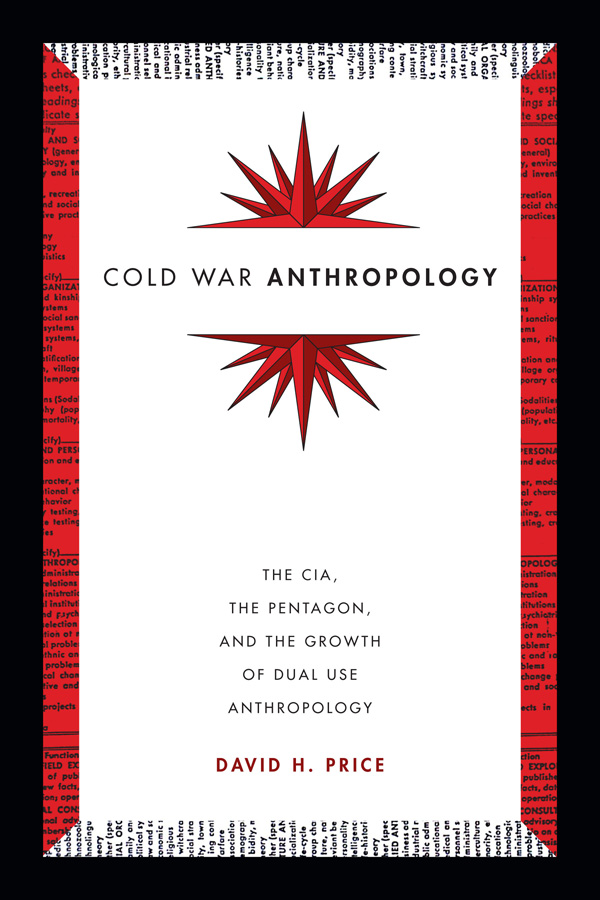
A review of Cold War Anthropology: The CIA, the Pentagon, and the Growth of Dual Use Anthropology, David H. Price, Duke University Press, 2016.
 Agency is a key concept in anthropology and the social sciences, meaning the capacity of a person or a group to act on its own behalf. The agency that David Price has in mind in this book has a completely different meaning. It designates the Central Intelligence Agency, and it reveals the links during the Cold War between the anthropologist profession and the national intelligence and defense apparatus of the United States. Cold War Anthropology makes use of the concept of dual use: “dual use science” refers to the military applications of basic science research, while “dual use technologies” are normally used for civilian purposes but may help build weapons and military systems. Similarly, anthropology is a civilian pursuit that purports to increase our knowledge of foreign cultures and societies, but it can be used for defense and security purposes: Know thy enemy has been a basic recommendation since mankind engaged in warfare and diplomacy. Intelligence, the gathering of information on foreign powers, makes use of various academic disciplines; it is only natural that anthropology, which developed alongside colonialism and followed the ebbs and flows of imperial powers, also lent itself to militarist uses. And nowhere was the demand for such knowledge higher than in the United States during the Cold War, which saw the dominant world power engage in the gathering and analysis of information in all corners of the world.
The Agency’s agency
Dual use anthropology was an offspring of World War II. During the war, cultural anthropologists worked as spies, educators, cultural liaison officers, language and culture instructors, and strategic analysts. In a previous book, Anthropological Intelligence, David Price documented American anthropologists’ contribution to the conduct of the war and the consequences their collaboration in war projects had over the course of the discipline. Cold War Anthropology picks up the ball where the previous book left off. Former members of OSS service who returned to university positions after the war kept their connections with the intelligence apparatus and helped the CIA and other agencies recruit new hires and gather information. By the mid-1970s, it was estimated that as many as five thousand academics were cooperating with the CIA on at least a part-time basis. But anthropologists taking part in the counterinsurgency operations of the Cold War didn’t have the excuse of protecting freedom and democracy at home and abroad. Cold War insurgencies were America’s dirty wars and anthropologists, like the quiet American in Graham Greene’s novel, became complicit in illegal activities ranging from kidnapping, murder, covert arm dealing, and coup d’état to the widespread infiltration of domestic academic institutions. Most of them were “reluctant imperialists” who believed they engaged in apolitical or politically neutral work, while some, including Clyde Kluckhohn and Clifford Geertz, developed “dual personalities” that allowed them to work on projects with direct or indirect connections to the CIA or the Pentagon while omitting such links from the narratives of their research.
David Price draws a typology of the relationships between anthropologists and the intelligence apparatus as a two-by-two matrix: relations could be witting-direct, witting-indirect, unwitting-direct, and unwitting-indirect. The first case represents the anthropologist-as-spy or as operative working for the US government. In a few instances, cultural anthropologists and archaeologists used fieldwork as a cover for espionage. Through access to declassified archives, the author was able to document a few cases of undercover agents who used their participation in research missions in Afghanistan, in Iran or in other hot spots to gather intelligence, provide support for special operations, and recruit informants. Not all anthropologists worked undercover, however. During the period, advertisements for military, intelligence, or State Department positions routinely appeared in the News Bulletin of the AAA, the discipline association’s newsletter. Some anthropologists moved between the government and the academy: Edward T. Hall, the founder of cross-cultural studies, taught cultural sensitivity training courses at the State Department’s Foreign Service Institute, while John Embree, the author of the first monograph on a Japanese village, became the first cultural relations adviser at the US Embassy in Bangkok in 1947 (they both objected to the use of academic research by the CIA.) Other anthropologists held CIA desks or maintained close contacts with the agency for recruitment, contract work, and data gathering. More generally, many anthropologists accepted as a matter of routine to debrief at Langley or within the precinct of the US Embassy when returning from fieldwork in sensitive areas.
Witting-indirect or unwitting-direct collaborations
The second model of anthropology-intelligence collaboration, implemented in full knowledge of it but in an indirect manner, refers to the way research was funded in the Cold War era. Rockefeller, Carnegie, Ford, and other private foundations shaped the funding of anthropological research during the Cold War. These wealthy private institutions were often directed by elite men rotating in and out of federal agencies with national security interests. They channeled the funds and designed research projects in ways that coalesced with CIA’s needs and foreign policy imperatives. This increasing availability of foundation funding was welcomed by anthropologists, who seldom considered what obligations might accompany such gifts or how the gifts might shape avenues of inquiry or analysis. Anthropologists working on research projects funded by private foundations deliberately or sometimes half-wittingly ignored the political contexts in which the projects were embedded. Clifford Geertz, who participated in the Modjokuto Project in Indonesia, turned a blind eye to the political forces that framed his first fieldwork opportunity. In later analyses, the development of area studies in American and Western Europe universities was connected to the Cold War agendas of the CIA, the FBI, and other intelligence and military agencies. Critics alleged that participating in such programs was tantamount to serving as an agent of the state. While cases of collaboration between academia and the intelligence apparatus must be assessed carefully, it is true that some research questions were prioritized and other were neglected, while geographic priorities aligned with geopolitical interests.
The third form of linkage between academic research and foreign policy-making occurred unbeknownst to the anthropologists but with direct interventions from intelligence agencies. In addition to reputable private foundations, the CIA used “paper foundations” or “pass-through” conduits to channel funds toward research without leaving footprints. The recipient individual or academic institution that received CIA funding from either a front or a conduit was generally not aware of the origin of the research grant. The funding of particular projects shaped disciplinary research agendas. The CIA also used fronts to secretly finance the publication of books and articles propagating its views, or supported journals that took a critical stance on communism and left-wing politics, such as Jiyū in Japan, Encounters in Great Britain, or Preuves in France. Some of the books were donated by US Embassies abroad or, in some cases, sold through local retailers. When these CIA-funded foundations were exposed by investigative journalists in the late 1960s, the reaction was surprisingly moot. Art Buchwald jokingly remarked the reason why the National Student Association received a CIA grant was because the organization was confused with the NSA. The Asia Foundation acknowledged CIA funding while claiming that this didn’t in any way affect the content of its policies and programs. With much soul-searching and political bickering, the American Anthropological Association adopted a code of ethics stating that “constraint, deception, and secrecy have no place in science.” Radical young scholars dubbed it too little too late, and formed a new caucus named Anthropologists for Radical Political Action, or ARPA, to push for further reforms.
Dual use anthropology
The fourth cell in the quadrant refers to unwitting and indirect forms of collaboration between anthropologists and spy agencies. The CIA’s method of harnessing the field research of others was not always manipulative. Ethnographic knowledge was in high demand by military and intelligence agencies during the Cold War, and many operatives learned their cues by perusing through the works of anthropologists. Participant observation’s approach to cultural understanding gave anthropologists the sort of cultural knowledge that made the discipline attractive to government officials willing to probe the hearts and minds of those living in lands of geopolitical interest. Anthropological field research sometimes facilitated intelligence operations by nonanthropologists through knowledge of the human terrain, understanding of social dynamics, and manipulation of power struggles. In other cases, it was used in human resource training programs to prepare for a foreign posting or develop culturally sensitive lenses of analysis. While much of the research funded in the postwar 1940s and throughout the 1950s aligned well with the needs and ideologies of the American Cold War state, in the 1960s and 1970s radical voices used these same funds to generate their own critiques. But postmodern anthropology was less relevant for practical concerns and fell out of favor with literate diplomats, military officers, and spies. Militarized uses of anthropology continued through other channels, such as the rise of private consultancies or the deployment of social scientists in combat teams.
According to David Price, the deleterious effects of dual-use anthropology were manyfold. False accusations of spying could put the fieldwork anthropologist in danger, expose his or her informants to various threats, and lead to expulsion or denial of access to the field. It was common for American anthropologists during the Cold War to be falsely suspected of spying. As mentioned, it was also routine for anthropologists returning from fieldwork to receive requests for debriefing in US Embassies or back home. Through witting or unwitting collaboration, direct or indirect solicitations, and dual-use research, the CIA’s ethical misconduct hinged on lying to the scholars about the origin of the grant money they received, the end use of their research results, and the choice of research priorities. Particularly in the context of the Vietnam war, anthropological research sustained counterinsurgency operations, the mobilization of highland tribes in armed conflicts, population regroupment in strategic hamlets and, arguably, the design of interrogation methods. David Price documents several cases of military applications of ethnographic research in South-East Asia, as well as the strong reaction of the profession to ban any form of collaboration with the military-intelligence apparatus. But he believes that many of the fundamental issues raised during this period remains unresolved. On the contrary, the conjugation of limited employment possibilities, growing student loan debt, and campus austerity programs are opening new inroads for the extension of military and intelligence forays in anthropological circles.
No Such Agency
Cold War Anthropology claims to break new ground in exposing the links between the anthropology profession and the national security apparatus. Although the author had to rely on the Freedom of Information Act to obtain declassified documentation, he doesn’t reveal state secrets or expose skeletons in the profession’s closet: for the most part, these links were hidden in plain sight. The collaboration between anthropologists and the intelligence service was an open secret. It is not obvious that the gains obtained by the intelligence community were worth compromising the integrity of scholars: the information that the CIA obtained from the AAA or the Asia Foundation, such as the detailed roster of American anthropologists or the names of Asian area specialists, would today be gathered in a few seconds through an Internet search. Similarly, the patient gathering of photographs indexed and catalogued to yield intelligence information would pale in comparison with modern satellite imagery or the harvesting of social media content. David Price’s aversion toward the CIA and the FBI also extends to the military and to the diplomatic service: he includes the State Department and USAID in the circle of Cold War institutions, and doesn’t clearly discriminate between covert operations and legitimate governmental activities. Similarly, he conflates anthropology and archeology, and bundles all fieldwork-based social sciences in one fell swoop. Meanwhile, the NSA gets no mention at all, except when it gets confused with the National Student Association—confirming the legend that the NSA was so secret its acronym stood for “No Such Agency.”
 The Duke Reader