
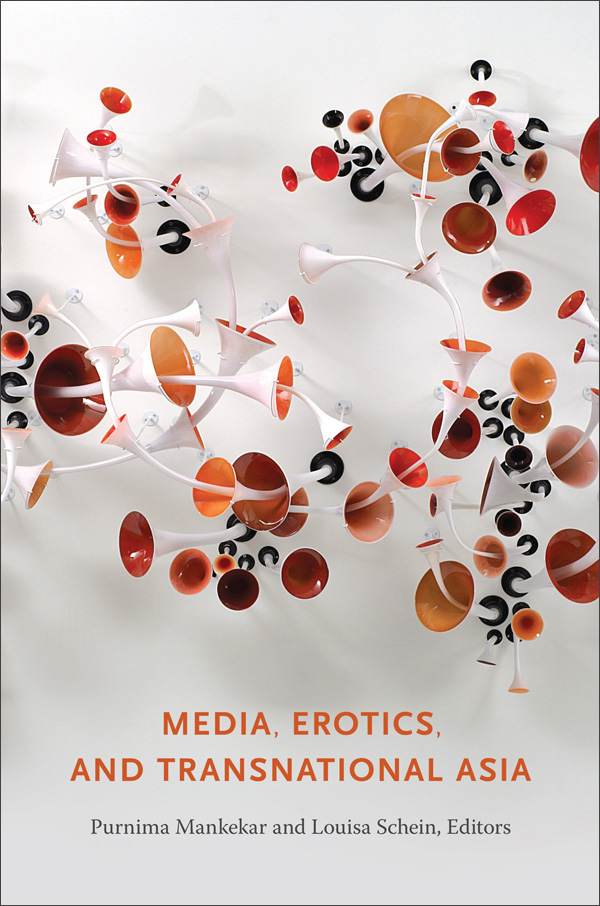
A review of Media, Erotics, and Transnational Asia, edited by Purnima Mankekar and Louisa Schein, Duke University Press, 2013.
 This is not a book about Asian sex videos. Indeed, reading Media, Erotics, and Transnational Asia should lead the reader to question why the category “Asian sex video” exists in the first place, why Asian bodies are disproportionately represented in Internet porn, and how we should react to such unregulated flow of images. In fact, none of the entries in this book deals with explicitly erotic content or with pornography, and the only chapter that concerns the Internet as a medium, a study of online discussions about correspondence marriage between the US and the Philippines, insists on rejecting facile analogies with the sex trade or with mail-to-order catalogues. For scholars and for feminists—and most authors in this volume are women—, the erotic has to be distinguished from the sexual. And writing about eroticism should in no way lead to stoke the base instincts of the reader. The erotic extends beyond sex acts or desires for sex acts to become “enmeshed in, for instance, yearnings for upward mobility, longings for ‘the homeland,’ formulations of nationhood and citizenship, and ruptures of ethnic and racial identity.” Desires for sexual encounters intertwine with those for commodities and lifestyles. Such a paneroticism may break gender, class, ethnicity, or age boundaries. Synonymous with desire, it may be at odd with an Orientalist vision of Asia as feminized and the West as setting the standard for homo- and heteronormativity. For instance, “what constitutes ‘lesbian’ desire may look both and function differently than it does within Euro-American social and historical formations, and draw from alternative modes of masculinity and feminity.”
Editing a volume for Duke University Press
The book is an edited volume composed of ten chapters and a dense introduction in which the two editors explain what they mean by “media,” “erotics,” “transnational,” and “Asia.” It is difficult to strike the right balance in the introductory chapter of a collection of scholarly essays written by different authors. One the one hand, the editors want to add value to the book chapters by giving coherence and theoretical depth to the assembled pieces. On the other hand, they need to reflect the diversity of the contributions and leave open their conceptual relevance for theory-building. The introduction is often the book’s signature, its most ambitious part and the text for which it will be remembered. The risk is to promise more than the book chapters can deliver by engaging in intellectual virtuosity, or to remain at the plane of immanence and offer a paraphrase of the book’s content. Mankekar and Schein lean on the theoretical side. Their introduction is thick, sometimes obscure, and heavily referenced. Their ambition is to “construct a transnational analytics” to account for the mediation of erotics in Asia and beyond. They position the book for a broad audience spanning several subdisciplines—Asian studies, media studies, gender studies, and sexuality studies, as well as anthropology and critical theory. And yet they address scholars, and it is as scholarship that they want their contribution to be noticed and remembered. My reading as a non-scholar may therefore miss the mark or misinterpret the intent of the authors. But this is a risk I am willing to take.
One way of studying erotics through transnational media in Asia is to read texts, watch pictures or videos, listen to recordings or radio shows, and then to write about their form and content using the tools and methods of literary criticism and media analysis. This is not how the authors in this volume proceed. For them, desire and erotics can only be revealed through participation in mediated worlds, in a combination of textual analysis and ethnographic research. Erotics is what people make of it: a medium or a text can only be deemed erotic if the viewers invest it with fantasies and emotional longings. Eroticism is in the eye of the beholder: we should “suspend any bounded or determinate option of what comprises erotic texts.” The preferred method of studying erotics is through ethnography and participant observation, or face-to-face interviewing. But the ethnographer cannot only approach his or her informants and say: “Let’s talk about sex.” As Purnima Mankekar notes: “I deemed it neither ethical nor culturally appropriate to interrogate my lower-middle-class and working-class informants about their attitudes toward sex or, worse, their sexual practices.” She doesn’t explain why she considered sex talk inappropriate or unethical, but her reticence probably has something to do with academic norms of proper behavior as much as with cultural sensitivities in a lower-middle-class Indian context. In any case, some of the contributors to this volume do talk to informants about media and sex, as in Friedman’s analysis of the film Twin Bracelets and its reception among interpretive communities in the United States, Taiwan, and China, or in Manalasan’s discussion of the reception of the movie Miguel/Michelle among queer Filipino audiences in Manila and in New York. In other situations, the ethnographer had to listen to her informants’ “silences, hesitations, and discursive detours” and “go beyond the verbal, the discursive, and the visible.”
Getting a book published
When writing a text and seeking publication, the scholar has to choose between three options: the self-standing book or monograph, the journal article, or the chapter in an edited volume. Getting a book published by an university press is the most difficult option: academic publishing houses are fortresses guarded by stern gatekeepers, and getting access involves a long process of book project’s proposal, manuscript editing, and peer review. The publication of a first book, commonly one that is drawn from a dissertation, is a critical event in the career of a scholar, and the book will usually remain the author’s signature to the wider academic community for the rest of his life. Publishing a journal article is more standard: for a scholar, a good publication record is a sine qua non, and life on the academic front is ruled by the discipline of publish or perish. Getting published depends on the prestige and disciplinary slot of the academic journal and necessitates a capacity to adjust to scholarly criteria of presentation without necessarily requiring literary talent. The book chapter is the most flexible contribution: contributing authors are usually invited by the editors to write a chapter for the book, based on presentations they made at conferences or in a rewriting of previously published research material. The editors will be reviewing and accepting the chapters and also be suggesting the authors if any revisions are needed. Though they are supported by their publishers, editors remain of sole responsibility when it comes to the content integrity of their book. Again, the importance of writing an excellent introductory chapter cannot be overstated. The introduction should serve as a “lure” that attracts the reader, allows the reader to comprehend the book’s intent, and encourages the reader to continue reading. In terms of bookshelf longevity, the full-fledged book comes first, then the edited volume and, last, the scholarly article.
Most contributors to Media, Erotics, and Transnational Asia have published a book, sometimes two or even three, with Duke University Press. Having read and reviewed some of these books on this blog, I will draw a comparison between the full-length books they have published and the chapters in this volume. My favorite author in the sample is Everett Yuehong Zhang, author of The Impotence Epidemic, a study of changing attitudes about sexuality in an increasingly globalized China. The chapter he offers here could have been included in his previous book and centers on the host and participants of a radio talk show addressing sexuality from a clinical perspective. It is only loosely connected to the twin themes of media and erotics that define the edited volume: radio broadcasting is not the medium we first think about when studying transnational media, and there is nothing erotic in talking about premature ejaculation, masturbation, or erectile failure with a medical doctor—even though desires to be normal, to enjoy a fulfilling sexual life, and to have fun talking about personal matters after decades of Maoist silence are also addressed. Dr. Ma, the talk show host, treats both male and female sexual issues and is very open about discussing sexual desire and pleasure in public. His co-host, Ms. Sun, recalls how uncomfortable she was at first using the technical term for masturbation, shouyin, with two characters meaning “hand lust,” and how talking about masturbation became easier in the 1990s with the adoption of a new word, ziwei, meaning “self-consolation.” This change of words signals a transition from the desire to be moral to the desire to be normal, and from a moral economy of seminal essence and revolutionary ardor to the realm of medical normality and individual gratification.
From the book to the article
Whispering Tonight, the call-in radio show and its case study by Everett Zhang, is a microcosm of all the issues raised by The Impotence Epidemic. One the one hand, it contextualizes sexuality within the social changes brought by recent economic reform and through the production of various desires in post-Maoist China. It relocates the body from the periphery where it was confined under Maoism toward the center of public attention, private concerns, and emotional investments. It provides a thick description of call-in patients’ complaints and doctor’s comments, based on extensive fieldwork and ethnographic documentation. On the other hand, and perhaps more explicitly than in the book, this volume’s chapter is a piece of applied theory. It draws on a rich array of concepts borrowed from French theory, and especially Deleuze and Guattari’s conceptualization of flows and affects. Deleuzian notions are sometimes hard to grasp and may provide more obscurity than light, but Zhang uses them in a simple and straightforward way, giving added depth and relevance to his text. The second piece of medical anthropology in this volume, a chapter by Judith Farquhar on “Self-Health Information in Beijing in the 1990s,” also echoes a book by the same author (Appetites: Food and Sex in Post-Socialist China), but is written in a more personal and reflexive way. Farquhar starts by describing her encounter with two men poring over an illustrated sexual disease textbook in a bookstore, and wonders what meaning this experience had for them—seeking sexual satisfaction or documenting a medical condition—and for the anthropologist, who didn’t dare interrupt and ask. She then examines a number of methodological problems that plague efforts to understand the popular and the everyday in any scholarly project. Self-health manuals, pop psychology books, and other mass-consumption publications can be used as an archive of everyday living in post-socialist China, but do not reveal how this information is read and assimilated by readers.
In addition to the introduction, Purnima Mankekar provided a chapter in this volume that is based on the research she presented in her two books published by Duke University Press, Screening Culture, Viewing Politics and Unsettling India. I usually prefer to read full-length books in anthropology than journal articles or edited volumes. My feeling is that the author needs space in order to set the scene, present the characters, and flesh out his or her argument, and that a single book chapter or article usually falls short on these three counts. But Mankekar’s chapter in this book, “Dangerous Desires,” nicely complements the two books she wrote based on the same ethnographic material: the reception of TV programs, and in particular state-sponsored television serials, viewed by upwardly-mobile, yet lower-to-middle class urban women in New Delhi. Her objective in this chapter is to examine the place of erotics in the reconfiguration of gender, family, class, caste, and nation, through the eroticization of commodity desire in TV commercials and the proliferation of sexual content in programs broadcast by transnational satellite networks. As noted above, she couldn’t just go out and ask her informants to have a “sex talk” on what they were viewing; she had to learn to watch alongside them and over their shoulders, interpreting bodily cues and discursive detours that saturated their conversations. For instance, many women she spoke with expressed their erotic longing via their yearning for certain commodities. On other occasions, her informants expressed their attitudes, feelings, and, very occasionally, their experiences of sex and erotics while discussing television programs. Desire for commodities and sexual longings were very often perceived as threats to proper gender behavior, to social status, and to the Indian nation as a whole. But Doordarshan state-run television no longer has a monopoly of public broadcasting, and the proliferation of satellite channels is having an impact on perceptions and values.
Telling better stories
Anne Allison, who provides the last chapter in this volume, teaches cultural anthropology at Duke University and has published several books on Japan. She wrote the book Nightwork on hostess clubs and Japanese corporate culture after having worked at a hostess club in Tokyo, and she has also researched erotic comic books and mother-son incest stories. The novel she reviews in her essay, Memoirs of a Geisha, doesn’t belong to the erotica literature: it is a fictional memoir of a Japanese geisha, penned by an American man and made into a movie by Steven Spielberg with Chinese actress Zhang Ziyi. Others would call it a story of cultural appropriation or a bad case of Orientalism; but Allison chose to focus on the reaction of (mostly female) American readers who, in the interviews she had with them and in the comments they wrote on Amazon, felt titillated by the fiction and enthralled by its exoticism. She reads erotic desire through the lens of the allure of fantasies generated by being transported to another place and time. In this case, desire is thoroughly political, but it doesn’t involve the masculine fantasies of empire and domination that Edward Said saw as the hallmark of Orientalist thinking. Exotica functions as erotica in the blurring of historical fiction and personal memoir, the minute description of sexual rituals such as the mizuage (by which a young geisha sells her virginity), and the allure of soft kimono fabric and intricate tea ceremony. “When readers described their experience of Memoirs to me,” writes Allison, “it was often in language befitting a love affair. They would smile and get excited, talk quickly and move their bodies. Passion, bordering on arousal, was palpable.” This, concludes Allison, raises a challenge for the anthropologist: “How to tell better stories that are imaginative and compelling, without falling into the trap of exoticizing or essentializing?”
 The Duke Reader