
A review of Animacies: Biopolitics, Racial Mattering, and Queer Affect, Mel Y. Chen, Duke University Press, 2012.
 “Inanimate objects, have you then a soul / that clings to our soul and forces it to love?,” wondered Alphonse de Lamartine in his poem “Milly or the Homeland.” In Animacies, Mel Chen answers positively to the first part of this question, although the range of affects she considers is much broader than the lovely attachments that connected the French poet to his home village. As she sees it, “matter that is considered insensate, immobile, deathly, or otherwise ‘wrong’ animates cultural life in important ways.” Anima, the Latin word from which animacy derives, is defined as air, breath, life, mind, or soul. Inanimate objects are supposed to be devoid of such characteristics. In De Anima, Aristotle granted a soul to animals and to plants as well as to humans, but he denied that stones could have one. Modern thinkers have been more ready to take the plunge. As Chen notes, “Throughout the humanities and social sciences, scholars are working through posthumanist understandings of the significance of stuff, objects, commodities, and things.” Various concepts have been proposed to break the great divide between humans and nonhumans and between life and inanimate things, as the titles of recent essays indicate: “Vibrant Matter” (Jane Bennett), “Excitable Matter” (Natasha Myers), “Bodies That Matter” (Judith Butler), “The Social Life of Things” (Arjun Appadurai), “The Politics of Life Itself” (Nikolas Rose),“Parliament of Things” (Bruno Latour). Many argue that objects are imbued with agency, or at least an ability to evoke some sort of change or response in individual humans or in an entire society. However, each scholar also possesses an individual interpretation of the meaning of agency and the true capacity of material objects to have personalities of their own. In Animacies, Mel Chen makes her own contribution to this debate by pushing it in a radical way: writing from the perspective of queer studies, she argues that degrees of animacy, the agency of life and things, cannot be dissociated from the parameters of sexuality and race and is imbricated with health and disability issues as well as environmental and security concerns.
Intersectionality
Recent scholarship has seen a proliferation of dedicated cultural studies bearing the name of their subfield as an identity banner in a rainbow coalition: feminist studies, queer studies, Asian American studies, critical race studies, disability studies, animal studies… In a bold gesture of transdisciplinarity, Mel Chen’s Animacies contributes to all of them. The author doesn’t limit herself to one section of the identity spectrum: in her writing, intersectionality cuts across lines of species, race, ability, sexuality, and ethnicity. It even includes in its reach inanimate matter such as pieces of furniture (a couch plays a key part in the narrative) and toxic chemicals such as mercury and lead. And as each field yields its own conceptualization, Mel Chen draws her inspiration from what she refers to as “queer theory,” “crip theory,” “new materialisms,” “affect theory,” and “cognitive linguistics.” What makes the author confident enough to contribute to such a broad array of fields, methods, and objects? The reason has to do with the way identity politics is played in American universities. To claim legitimacy in a field of cultural studies, a scholar has to demonstrate a special connexion with the domain under consideration. As an Asian American for instance, Mel Chen cannot claim expertise in African American studies; but she can work intersectionally by building on her identity as a “queer woman of color” to enter into a productive dialogue with African American feminists. The same goes with other identity categories: persons with disabilities have a personal connexion to abled and disabled embodiment, while non-disabled persons can only reflect self-consciously about their ableism. Even pet lovers, as we will see, have to develop a special relationship with their furry friends in order to contribute to (critical) animal studies.
Using this yardstick, Mel Chen qualifies by all counts to her transdisciplinary endeavor. She identifies herself as Asian American, queer, and suffering from a debilitating illness. She gives many autobiographical details to buttress her credentials. She mentions that her parents were immigrants from China who couldn’t speak proper English and used singular and plural or gendered pronominal forms indifferently. She grew up in a white-dominated town in the Midwest and was used to hearing racist slurs, such as people yelling “SARS!” at her—this was before a US president publicly stigmatized the “Chinese virus.” She shows that prejudice against the Chinese has a long history in the United States. The book includes racist illustrations dating from the nineteenth century featuring Chinese immigrants with a hair “tail” and animal traits that make them look like rodents. Chen analyzes the racial fears of lead poisoning in the “Chinese lead toy scare” of 2007 when millions of Chinese exported toys made by Mattel were recalled due to overdoses of lead paint. She exhumes from the documentary and film archives the figure of Fu Manchu, a turn-of-the-century personification of the Yellow Peril, and proposes her own slant on this character that is said to provide “the bread and butter of Asian American studies.” Mel Chen’s self-reported identity as queer is also documented. She mentions her “Asian off-gendered form” when describing herself, and frequently refers to her own queerness. In an autobiographical vignette, she designates her partner as a “she” and puts the pronoun “her” in quotes when she refers to her girlfriend (Chen’s own bio on her academic webpage refers to her as “they”). Her scholarship builds on the classics of queer studies such as Judith Butler and Eve Kosofsky Sedgwick, and she feels especially close to “queer women of color” theorizing. She exposes to her readers some unconventional gender and sexuality performances, such as the category of “stone butch” designating a lesbian who displays traditional masculinity traits and does not allow herself to be touched by her partner during lovemaking (to draw a comparison, Chen adds that many men, homo or heterosexual, do not like to be penetrated.)
Feeling Toxic
But it is on her medical condition that Mel Chen provides the most details. Moving to the “risky terrain of the autobiographical,” she mentions that she was diagnosed as suffering from “multiple chemical sensitivity” and “heavy metal poisoning.” This condition causes her to alternate between bouts of morbid depression and moments of “incredible wakefulness.” She makes a moving description of walking in the street without her filter mask and being in high alert for toxins and chemicals coming her way: navigating the city without her chemical respirator exposes her to multiple dangers, as each passerby with a whiff of cologne or traces of a chemical sunscreen may precipitate a strong allergic reaction. In such condition, which affects her physically and mentally, she prefers to stay at home and lie on her couch without seeing anybody. But Mel Chen doesn’t dwell on her personal condition in order to pose as a victim or to elicit compassion from her readers. Firstly, she feels privileged to occupy an academic position as gender and women studies professor at UC Berkeley: “I, too, write from the seat and time of empire,” she confesses, and this position of self-assumed privilege may explain why she doesn’t feel empowered enough to contribute to postcolonial studies or to decolonial scholarship. More importantly, she considers her disability as an opportunity, not a calamity. Of course, the fact that she cannot sustain many everyday toxins limits her life choices and capabilities. But toxicity opens up a new world of possibilities, a new orientation to people, to objects and to mental states. As we are invited to consider, “queer theories are especially rich for thinking about the affects of toxicity.”
This is where the love affair with her sofa comes in. When she retreats from the toxicity of the outside world, she cuddles in the arms of her couch and cannot be disturbed from her prostration. “The couch and I are interabsorbent, interporous, and not only because the couch is made of mammalian skin.” They switch sides, as object becomes animate and subject becomes inanimate. This is not only fetishism: a heightened sense of perception of human/object relations allows her to develop a “queer phenomenology” out of her mercurial experience. New modes of relationality affirm the agency of the matter that we live among and break it down to the level of the molecular. Mel Chen criticizes the way Deleuze and Guattari use the word “molecularity” in a purely abstract manner, considering “verbal particles” as well as subjectivities in their description of the molar and the molecular. By contrast, she takes the notion of the molecular at face value, describing the very concrete effects toxic molecules have on people and their being in the world. These effects are mediated by race, class, age, ability, and gender. In her description of the Chinese lead toy panic of 2007, she argues that the lead painted onto children’s toys imported to the United States was racialized as Chinese, whereas its potential victims were depicted as largely white. She reminds us that exposure to environmental lead affects primarily black and impoverished children as well as native Indian communities, with debilitating effects over the wellbeing and psychosocial development of children. Also ignored are the toxic conditions of labor and manufacture in Chinese factories operating mainly for Western consumers. The queer part of her narrative comes with her description of white middle-class parents panicking at the sight of their child licking their train toy Thomas the Tank Engine. In American parents’ view, Thomas is a symbol of masculinity, and straight children shouldn’t take pleasure in putting this manly emblem into their mouth. But as Chen asks: “What precisely is wrong with the boy licking the train?”
Queer Licking
In addition to her self-description as Asian, queer, and disabled, Mel Chen also claims the authority of the scholar, and it is on the academic front, not at the testimonial or autobiographical level, that she wants her Animacies to be registered. Trained as “a queer feminist linguist with a heightened sensitivity to the political and disciplinary mobility of terms,” she borrows her flagship concept from linguistics. Linguists define animacy as “the quality of liveness, sentience, or humanness of a noun or noun phrase that has grammatical, often syntactic, consequences.” Animacy describes a hierarchical ordering of types of entities that positions able-bodied humans at the top and that runs from human to animal, to vegetable, and to inanimate object such as stones. Animacy operates in a continuum, and degrees of animacies are linked to existing registers of species, race, sex, ability, and sexuality. Humans can be animalized, as in racist slurs but also during lovemaking. “Vegetable” can describe the state of a terminally-ill person. As for stones, we already encountered the stone butch. Conversely, animals can be humanized, and even natural phenomena such as hurricanes can be gendered and personified (as with Katrina.) Language acts may contain and order many kinds of matter, including lifeless matter and abject objects. Dehumanization and objectification involve the removal of qualities considered as human and are linked to regimes of biopower or to necropolitics by which the sovereign decides who may live and who must die.
This makes the concept of animacy, and Mel Chen’s analysis of it, highly political. Linguistics is often disconnected from politics: Noam Chomsky, the most prominent linguist of the twentieth century, also took very vocal positions on war and American imperialism, but he kept his political agenda separate from his contribution to the discipline. In How to Do Things with Words, J. L. Austin demonstrates that speech acts can have very real and political effects, and in Language and Symbolic Power, Pierre Bourdieu takes language to be not merely a method of communication, but also a mechanism of power. Mel Chen takes this politicization to its radical extreme. She criticizes queer liberalism and its homonormative tendencies to turn queer subjects into good citizens, good consumers, good soldiers, and good married couples. Recalling the history and uses of the word queer, which began as an insult and was turned into a banner and an academic discipline, she notes that some queers of color reject the term as an identity and substitute their own terminology, as the African American quare. She also questions the politics by which animals are excluded from cognition and emotion, arguing that many nonhuman animals can also think and feel. Positioning her animacy theory at the intersection of queer of color scholarship, critical animal studies, and disability theory, she argues that categories of sexuality and animality are not colorblind and that degrees of animacy also have to do with sexual orientation and disability. She brings the endurance of her readers to its break point by invoking subjects such as bestiality and highly unconventional sexual practices. Her examples are mostly borrowed from historical and social developments in the United States, with some references to the People’s Republic of China. She exploits a highly diverse archive that includes contemporary art, popular visual culture, and TV trivia.
Critical Pet Studies
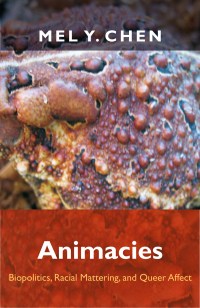
According to “Critical Pet Theory” (there appears to be such a thing), scholars have to demonstrate a special bond with their pet in order to contribute to the field of animal studies. Talking in abstract of a cat or a dog won’t do: it has to be this particular dog of a particular breed (Donna Harraway’s Australian shepherd ‘Cayenne’), or this small female cat that Jacques Derrida describes in The Animal That Therefore I Am. Talking, as Deleuze and Guattari did, of the notion of “becoming-animal” with “actual unconcern for actual animals” (as Chen reproaches them in a footnote) is clearly a breach in pet studies’ normative ethics. Even Derrida failed a simple obligation of companion species scholarship when he failed to become curious about what his cat might actually be doing, feeling, or thinking during that morning when he emerged unclothed from the bathroom, feeling somehow disturbed by the cat’s gaze. Mel Chen’s choice of companion species is in line with her self-cultivated queerness: she begins the acknowledgments section “with heartfelt thanks to the toads,” as well as “to the many humans and domesticated animals populating the words in this book.” The close-up picture of a toad on the book cover is not easily recognizable, as its bubonic glands, swollen excrescences, and slimy texture seem to belong both to the animal kingdom and to the realm of inert matter. Animacy, of course, summons the animal. But Mel Chen is not interested in contributing to pet studies: she advocates the study of wild and unruly beasts or, as she writes, a “feral” approach to disciplinarity and scholarship. “Thinking ferally” involves poaching among disciplines, raiding archives, rejecting disciplinary homes, and playing with repugnance and aversion in order to disturb and to unsettle. Yes, the toad, this “nightingale of the mud” as the French poet would have said, is an adequate representation of this book’s project.
 The Duke Reader