
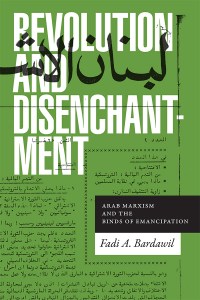
A review of Revolution and Disenchantment: Arab Marxism and the Binds of Emancipation, Fadi A. Bardawil, Duke University Press, 2020.
 Ten years have passed since the wave of protests that swept across North Africa and the Middle East. Time has not been kind to the hopes, dreams, and aspirations for change that were invested in these Arab uprisings. A whole generation is now looking back at its youthful idealism with nostalgia, disillusion, and bitterness. Revolutionary hope is always followed by political disenchantment: this has been the case for all revolutions that succeeded and for all attempts that failed. Fadi Bardawil even sees here the expression of a more general law: “For as long as I can remember, I have witnessed intellectuals and critical theorists slide from critique to loss and melancholia after having witnessed a political defeat or experienced a regression in the state of affairs of the world.” These cycles of hope and disillusion are particularly acute in the Arab world, where each decade seems to bring its own political sequence of rising tide and lowering ebb. Revolution and Disenchantment tells the story of a fringe political movement, Socialist Lebanon (1964-70), through the figures of three Marxist intellectuals who went through a cycle of revolutionary fervor, disenchantment, despair, and adjustment. Waddah Charara (1942–), Fawwaz Traboulsi (1941–), and Ahmad Beydoun (1942–) are completely unknown for most publics outside Lebanon, and their reputation in their country may not even have crossed the limits of narrow intellectual circles. They have now retired from an academic career in the humanities and social sciences, and few people remember their youthful engagement at the vanguard of the revolutionary Left. But their political itinerary has a lot to tell about the role of intellectuals, the relationship between theory and practice, and the waves of enthusiasm and disillusion that turn emancipatory enterprises into disenchanted projects.
The ebbs and flows of revolution
Fadi Bardawil proposes to his readers a tidal model of intellectual history. There were four consecutive tides that affected the lives of the three intellectuals under consideration—as well as, less directly, his own: Arab nationalism, Leftist politics, the Palestinian question, and political Islam. Each tide followed its ebb and flow of enthusiasm and disenchantment, leaving behind empty shells and debris that have drifted onshore for the scholar to pick. The generation to which the three intellectuals belong was formed during the high tides of anticolonial Pan-Arabism, founded the New Left, and adhered to the Palestinian revolution before ending up as detached, disenchanted critics of sectarian violence and communal divisions. Collectively, they point to a different chronology and geography of the reception of revolutionary ideas in the Middle East. The conventional periodization and list of landmark events identified by historians do not fully apply: for instance, the June 1967 Arab-Israeli War is often overemphasized as a turning point, while the collapse of the union between Egypt and Syria in September 1961 is now largely forgotten. But the Palestinian question predates 1967, while the 1961 breakdown of Arab unity ushered in the first immanent critique of the regimes in power. Similarly, the traditional East/West and North/South binaries cannot account for the complexities and internal divisions of Middle East societies. Beirut was closer to Paris and to French intellectual life than to other regional metropoles, including Cairo where the Nasser regime silenced all oppositional voices. The site of the “main contradiction” was not always the West, as Marxist scholars assumed; very often the contradictions were integral to the fabric of Arab societies.
Like the rest of the Arab world, the Lebanon in which the three intellectuals grew up was tuned to the speeches of Gamal Abdel Nasser broadcast by Radio Cairo and by demonstrations of support to the Algerian national liberation struggle. Palestinian refugees who had fled Israel in the aftermath of 1948 were a familiar presence in Lebanon, and the Arab Catastrophe or Nakba—as the Palestinian exodus was designated—loomed large in the Arab nationalist agenda. As one of the interviewees recalls, “the ‘Arab Cause’ was more dominant in our lives than Lebanese concerns.” Lebanese intellectuals from Sunni, Shi’i and Druze backgrounds were attracted to Nasserist nationalism and Ba’thist ideology and politics, while a majority of the Christian population supported the pro-Western politics of President Camille Chamoun (1952—58). Chamoun’s decision not to severe diplomatic ties with France and Great Britain after the Suez crisis in 1956 resulted in a political crisis that drew heavier American involvement in the form of economic assistance and military presence. The summer of 1958 was an important milestone in the development of the generation that was now in high school: sectarian tensions and the political deadlock led to a short civil war in Beirut, while inter-Arab relations and Cold War politics provoked a shift in alliances. The union between Egypt and Syria came to an end in 1961, and authoritarian regimes settled under the guise of socialist and Ba’thist ideologies in Syria and Iraq. The tidal wave of Pan-Arabism and its promise of a united popular sovereignty on Arab lands after defeating colonialism was now at its low point. The budding young intellectuals became disillusioned with Arab nationalism and turned to Marxism to fuel their quest for social change and emancipation.
Translating Marx into Arabic
The intellectual generation that founded Socialist Lebanon in 1964, with Waddah Charara, Fawwaz Traboulsi, and Ahmad Beydoun at the forefront, was also the product of an education system. Lebanon was created as an independent country in 1943 under a pact of double negation: neither integration into Syria (the Muslims’ Pan-Arabic demand) nor French protection (the Christians’ demand). Ties were not severed with France, however, as the Maronite elite used predominantly French and sent its children to French schools and universities, while international education was also buttressed by the presence of English language schools and the American University of Beirut. Charara was a southern Lebanon Shi’a who went to a francophone Beirut school and left for undergraduate studies in Lyon, completed later by a doctorate in Paris. Traboulsi was the son of a Greek Catholic Christian from the Bekka Valley who attended a Quaker-founded boarding school near Mount Lebanon and studied in Manchester as well as the American University of Beirut. Ahmad Beydoun went to a Lebanese school that pitted pro-Phalangist Maronites and pro-Ba’th nationalists against each other. Learning French and English in addition to their native Arabic, and studying abroad, opened new intellectual venues for these promising students. As Bardawil notes, “Foreign languages is a crucial matter that provides insight into the readings, influences, and literary sensibilities and imaginaries out of which an intellectual’s habitus is fashioned.”
The habitus of the generation that came of age at the turn of the 1960s was decidedly radical. Socialist Lebanon, the New Left movement that they founded in 1964, was in its beginnings more a study circle than a political party. The readings of these young intellectuals were extensive and not circumscribed by disciplinary boundaries: Marxist theory, French philosophy, psychology, sociology, art critique, economics… They published a bulletin that was printed underground using Roneo machines and distributed clandestinely. In order to avoid being taken for wacky intellectuals, they rarely made quotes from the French intellectuals they were imbibing (Althusser, Foucault, Lacan, Castoriadis, Lefebvre…), and mostly referred to the cannon of the revolutionary tradition: Marx, Engels, Trotsky, Lenin, but also some Cuban references and, in the end, Mao. Through their translations and commentary, they also gave agency to other voices from the South: Fanon, Ben Barka, Giap, Cabral, Che Guevara, Eldrige Cleaver, Malcolm X and others. Books published by Editions Maspero in Paris, as well as articles from Le Monde Diplomatique, Les Temps Modernes, and the New Left Review, were pivotal in the readings discussed in Beirut at that time. So were the pamphlets of Leftist opponents of the Nasser regime in Egypt such as Anouar Abdel Malak, Mahmoud Hussein, and Hassan Riad (the pseudonym of Samir Amin): “What couldn’t be published in Cairo in Arabic was published in France and translated back into Arabic in Beirut with the hope that it would circulate in the Arab world.”
Left-wing groupuscules
In addition to reading, discussing, writing, and translating, the young revolutionaries engaged in clandestine political activities. Unlike their gauchistes equivalents in France, Germany or Italy, they ran the risk of arbitrary arrest, detainment, and execution: hence their practice of secrecy, with underground political cells and anonymity publishing. Their critiques targeted the Ba’th and Arab nationalist ideologies, the authoritarian regimes in power in the region, the national bourgeoisie, and last but not least the pro-Soviet communist parties. The Lebanese Communist Party was the target of their most ferocious attacks, but intra-leftist skirmishes also targeted other groupuscules. The Arab-Israeli war in June 1967, often considered as a watershed for the region and for the world, brought to the fore the Palestinian question. Bardawil argues that the date of 1967, referred to in Arabic as an-Naksah or “the setback”, was more a turning point for the intellectual diaspora than for local actors. Indeed, Edward Said recalls in his autobiography the shock and wake-up call that the defeat of the Arab armies caused in his personal identity: “I was no longer the same person after 1967,” he wrote. The 1967 setback was also used by nationalist military regimes to legitimize their own repressive politics in the name of anti-imperialism and the fight for the liberation of Palestine. But as we saw, the nationalist tide had already ebbed in 1961, and Socialist Lebanon had developed a radical critique of the gap separating the regimes’ progressive professions of faith and their authoritarian rule.
The Palestinian resistance post-1967 became a local player in Lebanese politics, putting on the table again the question of Lebanon’s national identity. It generated its own cycle of hope and disenchantment for the Left. For the cohort of intellectuals forming Socialist Lebanon, it was a time of fuite en avant. The group became increasingly cultist and sectarian, and turned to Maoism to articulate its militant fervor and revolutionary praxis. In 1970, Socialist Lebanon fused with the much larger Organization of Lebanese Socialists, establishing a united organization that became known as the Marxist-Leninist Organization of Communist Action in Lebanon (OCAL). In true gauchiste fashion, OCAL would be plagued by splits and expulsions from the beginning. Note however that the call for action directe and a “people’s war” that Charara articulated in his Blue Pamphlet did not turn into political assassinations and terrorism. The reason was that Lebanese society was already plagued by violence: violent strikes and demonstrations were repressed in blood; armed Palestinian resistance gained force until Israel invaded in 1978 and pushed PLO and leftist militants away from the borders; and terrorist actions were indeed taken up by Palestinian groupuscules such as the PFLP-EO that committed the Lod Airport massacre in May 1972, with the participation of three members of the Japanese Red Army. The low ebb of the Palestinian tide came with the defeat of the Palestinian revolution in Lebanon in 1982. By then, Lebanon had already plunged into a sequence of civil wars (1975—1990) splitting the country along sectarian lines; the Iranian revolution (1979) had ushered a new cycle of militant fervor centered on political Islam; and the Lebanese intellectuals had retired from political militancy to join secure positions in academia.
From Nakba to Naksa and to Nahda
This summary of the historical plot line of Revolution and Disenchantment doesn’t do justice to the theoretical depth and breadth of the book. Trained as an anthropologist and as a historian, Fadi Bardawil attempts to do “fieldwork in theory” as a method to locate “not only how theory helps us understand the world but also what kind of work it does in it: how it seduces intellectuals, contributes to the cultivation of their ethos and sensibilities, and authorizes political practices for militants.” He treats the written and oral archives of the Lebanese New Left as a material to ponder the possibility of a global emancipatory politics of the present that would not be predicated on the assumption that theory always comes from the West to be applied in empirical terrains in the South. He takes issue with the current focus on Islamist ideologues such as Sayyid Qutb and Ali Shariati that are used by Western scholars for “thinking past terror,” while the indigenous tradition of Marxism and left-wing thinking is deemed too compromised with the West to offer an immanent critique of Arab politics. As Bardawil notes, quite a few of the 1960s leftists rediscovered the heritage of the earlier generation of Nahda (Renaissance) liberal thinkers such as Taha Husayn (1889–1973) and ‘Ali ‘Abd-al-Raziq (1886–1966) or, like the aging and sobered Charara, turned to Ibn Khaldun (1332–1406) to understand the logics of communal violence that had engulfed Lebanon. Revolution and Disenchantment also reflects the coming-of-age story of the author who started his research project in the US in the wake of the September 11 attacks, still marked by the Left-wing melancholia of his school years in Lebanon, then matured into a more balanced approach that took its cues from the mass mobilizations known collectively as the Arab Spring.
Postscript: I read a book review of Revolution and Disenchantment written by a PhD student specializing in Middle East studies who regretted the fact that readership of this book will most likely be limited to a fringe audience of area specialists. If only this book could become a core text for an introduction to intellectual history or for a class on world Marxism!, she bemoaned. My answer to that is, you never know. Manuscripts have a strange and unpredictable afterlife once they get published, and neither the author nor the publisher can tell in advance which readership they will eventually reach. Remember the circuits of the French editions of revolutionary classics published by Editions Maspero in a historical conjuncture when theory itself was being generated not from Europe but from the Third World. Add to that the fact that Revolution and Disenchantment is available free of charge for downloads on the website of Duke University Press (with a trove of other scholarly books), and you may have in your hands the potential of an unlikely success. Besides, the political effects of a text, and the difference that it makes, cannot be measured by the number of clicks and readers but depend on the questions asked by the reading publics and the stakes animating their practical engagements. You never know in advance which texts will be included in future political archives and curricula, or who will read what and for what purposes. Reading today about the Lebanese New Left in Hanoi is not more uncanny than translating Mao and Giap into Arabic in Beirut during the sixties. New forms of critique and their transnational travels may produce unexpected political effects that go beyond the closed lecture circuit of jet-lagged academics. This is one reason why the Arab Springs were followed with passion in China, leading the Communist authorities to delete all references to the events on Chinese social media. Ten years after, a new cycle of democratic hope and enlightenment may begin.
 The Duke Reader