
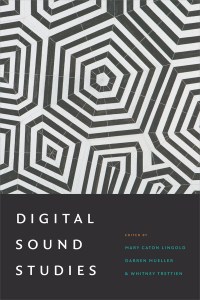
A review of Digital Sound Studies, edited by Mary Caton Lingold, Darren Mueller, and Whitney Trettien, Duke University Press, 2018.
 Nowadays young PhDs majoring in the social sciences and the humanities often list an interest in sound studies when they enter the academic job market. Likewise, digital humanities is a booming field encompassing a wide range of theories and disciplines bound together by an interest in digital tools and technologies. There is a premium in listing these categories as fields of interest in one’s CV, even though the young scholar’s specialization may lie in more traditional disciplines such as English literature, modern history, or American studies. This is what economists call job market signaling: by associating themselves with “hot” topics, potential new hires make themselves in hot demand and differentiate their profile from more standard competitors. And yet, digital humanities and sonic materials have so far had a limited impact on social science scholarship. The humanities remain text-centric and bound by technologies inherited from the printing press and the paper format. The reproduction of sound is ubiquitous, and digital technologies are everywhere but in the content of academic journals and university syllabuses. Student evaluation is still mostly based on silent modes of learning such as final essays, midterm exams, and reading responses. Sonic modes of participation such as asking questions, providing oral feedback, and exchanging ideas with peers during class discussions are weighted with a limited coefficient compared to other evaluation metrics based on the written text.
A new age of digital acoustics
In a way, digital humanities and sound studies are a story of literary scholars catching up with the times. What isn’t digital these days? We live our lives immersed in digital environments and aided by digital devices that transform the way we work, relax, and communicate. The sounds of nature and of city life have given way to artificial soundscapes shaped by recorded music and transmitted signals. We live in an age where a new orality sustained by distant communication, radio, television, and other electronic devices has partially substituted to the written word and the visual cue. Almost all college students now have an audio and video device in their pocket—the challenge is rather to make them silence their smartphone and concentrate on the aural and visual environment of the classroom as opposed to their earbuds and small screens. It has become standard to include video and audio files in powerpoint presentations and to use multimedia material inside humanities work across all fields. As the editors of Digital Sound Studies note, “It has never been easier to build and access sonic archives or incorporate sound into scholarship.” Social scientists and humanities scholars who have grown up alongside digital technologies and audio equipment are comfortable using them in their research and in their teaching. So why not make digital sound itself the object of enquiry?
Despite its societal impact and economic value, technology is not the primary engine of change in the academy. The real game changer is money. Monetary incentives, reinforced by institutional recognition, are what makes the academic world go round. The editors of this volume are very open about it: “One of the reason that digital humanities has burgeoned is that there’s money behind it.” Take the case of Joanna Swafford, from Tufts University. As a PhD student specializing in Victorian poetry, she would have faced a dull doctoral environment and a bleak employment future. Instead, gaining some programming and web development skills, she designed Songs of the Victorians, an archive of Victorian song settings of contemporaneous poems. She went on to create Augmented Notes, a software tool that allows users to integrate an audio file with a score image and a text commentary so that everyone, regardless of musical literacy, can follow along the audio song, the score, and the written text. She was supported in her endeavor by multiple scholarships, research grants, fellowship programs, and skill upgrading sessions in the digital humanities. Her case is not isolated: enterprising scholars in humanities departments everywhere are riding the digital wave to get equipments and research fundings that their more classically inclined colleagues can only dream of. And they are adding sound and music to the mix in order to create a multi-sensory and multimodal experience.
Low cost, high rewards
There are huge incentives to get into digital humanities. By contrast, barriers to entry into the field of digital humanities are very low. The great bulk of research that is being produced can be characterized as low tech, even though there is a premium in making elaborate project designs and using advanced technology methods. Most multimedia tools are already on the shelves, sometimes accessible free of charge as open software and web-based solutions. The curated sound studies blog Sounding Out! is a prime example of a low-tech enterprise: the hosts just use the WordPress platform, SoundCloud, and YouTube, and put all their energy in giving editorial advice and feedback to contributing authors. New academic journals and publishing platforms such as Scalar have created venues for born-digital work that encourage exploration and experimentation while building on established traditions of academic writing and argumentation. New text mining techniques using machine learning and AI allow to search, analyze, and visualize large bodies of audiovisual material. But tagging and indexing audio files to train the machine-learning algorithm is a low-tech, labor-intensive process that requires only limited equipment. Providing uniformity across the sound samples raises the issue of language-based classification systems and individual perception. What sounds “loud” or “inaudible” depends on the person and on the context. More generally, people working on sound are always confronting the issue of writing about sound in text. There is a very limited vocabulary of representing sound, and this vocabulary is usually not included in school curriculum. Categories borrowed from prosody and rhetorics—timbre, accent, tone, stress, pitch frequency, duration, and intensity—are finding new uses in technologies exploring speech patterns and sound archives in order to “search sound with sound.”
There is also a premium for political correctness. Digital sound studies in a North American context intersect with issues of race, gender, sexual orientation, disability, and postcoloniality. The editors point out that generations of black cultural critics and authors have drawn deeply from music and sound in their writings. Black studies has also had to confront sonically encoded racist stereotypes, such as those made popular through blackface minstrelsy and the use of “negro dialect” in early radio and television. In his contribution, Richard Rath tries to render in sonic form a text describing the music and dance of enslaved Africans on a Jamaican plantation in 1688. He tinkers with various musical instruments and electronic tools to exercise what he calls the “historical imagination,” but is reluctant to take on the voice of enslaved Africans himself or to make “a singalong with audiences of mostly white folks,” as such performance would smack of cultural appropriation—he has less qualms about having the classroom clap in three and four beat patterns to illustrate polyrhythm. Similarly, African-American writer and Harlem Renaissance figure Zora Neale Hurston is mentioned in several chapters and gets much credit for performing and recording the Deep South songs that white male scholars Franz Boas and Alan Lomax made her collect—the fact that she exposed the sexual promiscuity of some of her childhood neighbors in the ethnography of her hometown in Florida is not mentioned, but remains controversial to this day.
Raiders of the lost sound
Some academic disciplines are more attuned to digital sounds than others. In the 1960s and 1970s ethnomusicologists often included LPs with their monographs so readers could hear the music the book described. Anthropology and folklore scholars also used recording equipment to document oral traditions and sonic environments. These fields have evolved as technology moved from analog to digital, and they have acquired a new sensitivity to power imbalances and cultural hegemony: it is no longer white men recording native sounds for their own uses. Sonic archives and recordings are repatriated to their communities of origin, sometimes using portable devices like USB sticks and minidiscs in places with low internet connectivity. Literary studies have also experienced a sonic turn. In particular, the intersection of music and poetry is a booming area of research. The English Broadside Ballad Archive at the University of California, Santa Barbara, is bringing musical settings to the fore by digitizing almost eight thousand ballads from England, and it includes facsimiles, transcriptions, and when available, audio recordings of the ballads. In the Songs of the Victorians project mentioned above, Joanna Swafford was able to show that women musicians used songs performed in the parlor as part of a courtship ritual that unsettled the gendered status quo. Poetry is also a place where, in the space of one generation, scholars have rediscovered the importance of voicing and listening. Literature needs not be a silent experience: some words cry out to be articulated, whispered, or shouted.
Historians are also designing their acousmetologies, exploring the world through sound and recreating historical soundscapes that are true to the past “wie es eigentlich gewesen.” As Geoffroy-Schwinden argues, digital explorations of sonic history must do more than simply attempt to recreate the sound and fury of the past; these projects must also historicize sound and contextualize the listening experience, as similar sounds were not perceived in the same way then and now. Musicians attempting to execute historically informed performances must not stop at the use of period instruments and past performance techniques: they must also recreate the ancient concert hall soundscape with its low-voice conversations, loud cheers, sneezing and coughing that modern concert goers try to silence as much as they can. Immersive environments can go beyond the sonic experience and include the visual, the haptic, the olfactive, the tactile, and the visceral. Listening is a multisensory experience: incorporating sound into digital environments must also attend to the ways in which users physically interact with and are affected by sound at the level of the senses. In many experiments such as the reconstruction of historical soundscapes (Emily Thompson,s “The Roaring Twenties,” Mylène Pardoen’s “Projet Bretez”) or the incorporation of multi-vocal narratives in social science projects (Erik Loyer’s “Public Secrets”), the frontier between art and science blurs and the public is invited to take part in a performance of “artistic research.” This, according to the editors, illustrates the “turn toward practice” and away from high theory that characterizes recent academic orientations, of which digital humanities is a part.
Talking shop
By combining two hot topics, digital humanities and sound studies, this book provides a blueprint for making sound central to research, teaching, and publishing practices. And yet, despite its profession of inclusiveness and accessibility, this seems to me a book targeted to a very small segment of the academic world, as potential readers will mostly be people already engaged in teaching and research activities they describe as digital sound studies. Instead of addressing digital natives and sound aficionados at large, they engage in a conversation that concerns mostly themselves. The concluding chapter, which takes the form of a discussion between Jonathan Sterne and the three editors, illustrates this inward-looking and parochial nature of the whole endeavor. The discussants concentrate on practical issues that appear mundane to outsiders but in which they invest considerable energy: how to get tenure, what counts as scholarly work as opposed to teaching duties or to community projects, how to get published into the “best” journals, which fields are hot and which aren’t, what will be the next epistemological turn or the new paradigm that will redefine scholarly practices, etc. Free labor is an issue for them: like everybody else, they do many things for fun, like blogging or building stuff, but unlike other professions they would like to see these activities recognized as part of their academic contribution. Scholars can be openly frank and direct when they speak among themselves. They use simple words and colloquialisms, as opposed to the heavily barbed jargon of academic publications. But they also expose their petty interests and narrow corporatism when they are allowed to talk shop in public. Digital Sound Studies taught me more about the functioning of academia in a segment of disciplinary studies than about sound studies and digital humanities as such.
 The Duke Reader