
A review of Edges of Exposure. Toxicology and the Problem of Capacity in Postcolonial Senegal, Noémi Tousignant, Duke University Press, 2018.
 Capacity building is the holy grail of development cooperation. It refers to the process by which individuals and organizations as well as nations obtain, improve, and retain the skills, knowledge, tools, equipment, and other resources needed to achieve development. Like a scaffolding, official development assistance is only a temporary fixture; it pursues the goal of making itself irrelevant. The partner country, it insists, needs to be placed in the driver’s seat and implement its domestically-designed policies on its own terms. Once capacity is built and the development infrastructure is in place, technical assistance is no longer needed. National programs, funded by fiscal resources and private capital, can pursue the task of development and pick up from where foreign experts and ODA projects left off. And yet, in most cases, building capacity proves elusive. The landscape of development cooperation is filled with failed projects, broken-down equipment, useless consultant reports, and empty promises. Developing countries are playing catch-up with an ever receding target. As local experts master skills and technologies are transferred, new technologies emerge and disrupt existing practices. Creative destruction wreaks havoc fixed capacity and accumulated capital. Development can even be destructive and nefarious. The ground on which the book opens, the commune of Ngagne Diaw near Senegal’s capital city Dakar, is made toxic by the poisonous effluents of used lead-acid car batteries that inhabitants process to recycle heavy metals and scrape a living. Other locations in rural areas are contaminated with stockpiles of pesticides that have leaked into soil and water ecosystems.
Playing catch-up with a moving target
Edges of Exposure is based on an eight-month period of intensive fieldwork that Noémi Tousignant spent by establishing residence in the toxicology department of Université Cheikh Anta Diop in Dakar, in an ecotoxicological project center, and in the newly-established Centre Anti-Poison, Senegal’s national poison control center. The choice to study the history of toxicology in Senegal through the accumulation of capacity in these three institutions was justified by the opportunity they offered to the social scientist: toxicity, that invisible scourge that surfaced in the disease outbreaks of “toxic hotspots” such as Ngagne Diaw, was made visible and exposed as an issue of national concern by the scientists and equipments that tried to measure it and control its spread. Layers of equipments that have accumulated in these two locations appear as “leftovers of unpredictable transfers of analytical capacity originating in the Global North.” Writing about history, but using the tools of anthropology and ethnographic fieldwork, the author combines the twin methods of archeology and genealogy. The first is about examining the material and discursive traces left by the past in order to understand “the meaning this past acquires from and gives to the present.” The second is an investigation into those elements we tend to feel are without history because they cannot be ordered into a narrative of progress and accomplishment, such as toxicity and technical capacity.
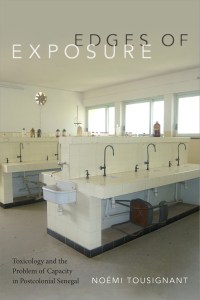
Noémi Tousignant begins with a material history of the buildings, equipments, and archives left onsite by the successive waves of capacity building campaigns. The book cover picturing the analytical chemistry laboratory sets the stage for the ongoing narrative, with its rows of unused teaching benches, chipped tiles, rusty gas taps, and handwritten signs instructing not to use the water spigots. The various measurement equipments, sample freezers, and portable testing kits are mostly in disrepair or unused, and local staff describe them as “antiques,” “remnants,” or leftovers of a “wreckage.” They provide evidence of a “process of ruination” by which capacity was acquired, maintained, and lost or destroyed. The buildings of Cheikh Anta Diop university—named after the scholar who first claimed the African origins of Egyptian civilization—speak of a time of high hopes and ambitions. The various departments, “toxicology,” “pharmacology,” “organic chemistry,” are arranged in neat fashion, and each unit envisions an optimistic future of scientific advancement, public health provision, and economic development. The toxicology lab is supposed to perform a broad range of functions, from medico-legal expertise to the testing of food quality and suspicious substances and to the monitoring of indicators of exposure and contamination. But in the lab, technicians complained that “nothing worked” and that outside requests for sample testing had to be turned down. Research projects and advanced degrees could only be completed overseas. Capacity was only there as infrastructure and equipment sedimented over time and now largely deactivated.
Sediments of cooperation
Based on her observations and interviews, Noémi Tousignant reconstructs three ages of capacity building in Senegalese toxicology, from the golden era of “la coopération” to the financially constrained period of “structural adjustment” and to a time of bricolage and muddling through. The Faculty of Pharmacy was created as part of the post-independence extension of pharmacy education from a technical degree to the full state qualification, on par with a French degree. For several decades after the independence, the French government provided technical assistants, equipment, budget, and supplies with the commitment to maintain “equivalent quality” with French higher education. The motivation was only partly altruistic and also self-serving: the university was put under French leadership, with key posts occupied by French coopérants, and throughout the 1960s about a third of its students were French nationals. It allowed children of the many French expats in Senegal to begin their degree in Dakar and easily transfer to French universities, and also provided technical assistants with career opportunities that could be later translated into good positions in the metropole. France was clearly in the driver’s seat, and Senegalese scientists and technicians were invited to join the bandwagon. But the belief in equivalent expertise and convergent development embodied in la coopération also bore the promise of a national and sovereign future for Senegal and opened the possibility of African membership in a universal modernity of technical norms and expertise. Coopérants’ teaching and research activities were temporary by definition: they were meant to produce the experts and cadres that would replace them.
The genealogy of the toxicology discipline itself delineates three periods within French coopération: from post-colonial science to modern state-building and to Africanization. The first French professor to occupy the chair of pharmaceutical chemistry and toxicology in Dakar described in his speeches and writings “a luxuriant Africa in which poison abounds and poisoning rites are highly varied.” His interest for traditional poisons and pharmacopeia was not only motivated by the lure of exoticism: “tropical toxicology” could analyze African plant-based poisons to solve crimes, maintain public order, and identify potentially lucrative substances. In none of his articles published between 1959 and 1963 did the French director mention the toxicologist’s role in preventing toxic exposure or mitigating its effects on a population level. His successors at the university maintained French control but reoriented training and research to fulfill national construction needs. They acquired equipment and developed methods to measure traces of lead and mercury in Senegalese fish, blood, water, and hair, while arguing that toxicology was needed in Senegal to accompany intensified production in fishing and agriculture. But they did not emphasize the environmental or public health significance of these tests, and their research did not contribute to the strengthening of regulation at the national and regional level. Africanization, which was touted as an long-term objective since the time of the independence, was only achieved with the abrupt departure of the last French director in 1983 and its replacement with Senegalese researchers who had obtained their doctoral degree in France. But it coincided with the adoption of structural adjustment programs and their translation into budget cuts, state sector downsizing, and shifting priorities toward the private sector.
After la coopération
Ties with France were not severed: a few technical assistants remained, equipment was provided on an ad hoc basis, and Senegalese faculty still relied on their access to better-equipped French labs during their doctoral research or for short-term “study visits.” But the activation of these links came to rely more on the continuation of friendly relations and favors than on state-supported programs and entitlements. French universities donated second-hand equipment and welcomed young African scientists to fill needed positions in their research teams. They made the occasional favor of testing samples that could no longer be analyzed with the broken-down equipment in Dakar. The toxicology department at Cheikh Anta Diop University could not keep up with advances in science and technology, with the emergence of automated analytical systems and genetic toxicology that made cutting-edge research more expensive and thus less accessible to modestly funded public institutions. Some modern machines were provided by international aid agencies as part of transnational projects to monitor the concentration of heavy metals, pesticides, and aflatoxins—accumulated often as the result of previous ill-advised development projects such as the large-scale spraying of pesticides in the Sahel to combat locust and grasshopper invasions. But, as Tousignant notes, such scientific instruments “are particularly prone to disrepair, needing constant calibration, adjustments, and often a steady supply of consumables.” The “project machines” provided the capacity to test for the presence of some of the toxins in food and the environment, but they did not translate into regulatory measures and soon broke down because of lack of maintenance.
The result of this “wreckage” is a landscape filled with antique machinery, broken dreams, and “nostalgia for the futures” that the infrastructures and equipment promised. Abandoned by the state, some research scientists and technicians left for the private sector and now operate from consultancy bureaus, local NGOs, and private labs with good foreign connections. Others continue to uphold the ideal of science as a public service and try to attract contract work or are occasionally enlisted in transnational collaborative projects. Students and researchers initiate low-cost, civic-minded “research that can solve problems,” collecting samples of fresh products, powdered milk, edible oils, and generic drugs to test for their quality and composition. Meanwhile, the government of Senegal has ratified a series of international conventions bearing the names of European metropoles—Basel, Rotterdam, Stockholm—addressing global chemical pollution and regulating the trade of hazardous wastes and pesticides. Western NGOs such as Pure Earth are mapping “toxic hotspots” such as Ngagne Diaw and are contracting with the Dakar toxicology lab to provide portable testing kits and measure lead concentration levels in soil and blood. Entreprising state pharmacologists and medical doctors have invested an unused wing of Hôpital Fan on the university campus to create a national poison control center, complete with a logo and an organizational chart but devoid of any equipment. Its main activity is a helpline to respond to people bitten by poisonous snakes.
Testing for testing’s sake
Toxicology monitoring now seems to be submitted to the imperatives of global health and environmental science. Western donors and private project contractors are interested in the development of an African toxicological science only insofar as it can provide the data point, heatmaps, and early warning systems for global monitoring. The protection and healing of populations should be the ultimate goal, and yet the absence of a regulatory framework, let alone a functional enforcement capacity, guarantees that people living in toxic environments will be left on their own. In such conditions, what’s the point of monitoring for monitoring’s sake? “Ultimately, the struggle for toxicological capacity seems largely futile, unable to generate protective knowledge other than fragments, hopes, and fictions.” But, as Noémi Tousignant argues, these are “useful fictions.” First, the maintenance of minimal monitoring capacity, and the presence of dedicated experts, can ensure that egregious cases of “toxic colonialism” such as the illegal dumping of hazardous waste, will not go undetected and unanswered. Against the temptation to consider the lives of the poor as expendable, and to treat Africa as waste, toxicologists can act as a sentinel and render visible some of the harm that populations and ecosystems have to endure. Second, like the layers of abandoned equipment that documents the futures that could have been, toxicologists highlight the missed opportunity of protection. “They affirm, even if only indirectly, the possibility of—and the legitimacy of claims to—a protective biopolitics of poison in Africa.”
 The Duke Reader