
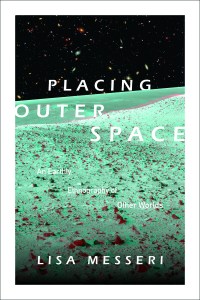
A review of Placing Outer Space: An Earthly Ethnography of Other Worlds, Lisa Messeri, Duke University Press, 2016.
 When I heard Lisa Messeri had written an ethnography about space research, my first reaction was: what’s an anthropologist like her doing in a place like this? How can one study outer space with the tools and methods of social science? What is the distinct contribution of the anthropologist in a field dominated by rocket scientists and big bang theoreticians? What can the cosmos teach us about ourselves that is not grounded in hard science and space observatory data? To be sure, there is no anthropos to study in outer space, and other worlds are beyond the grasp of the ethnographer. The sociology of other planets remains a big question mark. So far, you cannot make participatory observation in space stations or conduct fieldwork on Mars. We may hire anthropologists, linguists, semioticians, and indeed all the help we can get when we encounter extraterrestrial civilizations and extraplanetary forms of life; but so far these close encounters of the third type remain the stuff of science-fiction novels and blockbuster movies. But on second thought, an anthropologist in outer space is not completely out of place. Anthropologists have always accompanied explorers and discoverers to the frontiers of human knowledge. They helped us understand alien cultures and foreign civilizations to make them less distant, and drew lessons from their immersion into other worlds for our own society. Anthropologists make the strange and the alien look familiar, and the “view from afar” that they advocate also makes our own planet look alien and unfamiliar. They also help us make sense of science’s results and methods, and have been a trusted if somewhat critical companion of scientific research and laboratory life. Science and technology studies (STS in the jargon) have taught us that natural scientists—contrary to a common prejudice—are never simply depicting or describing reality out there “just as it is”: their research is always characterized by a specific style and colored by the “scientific imagination.”
Bringing space down to Earth
An “anthropology off the Earth” therefore seems like the obvious next step for the discipline when humanity has entered the space age. And indeed, outer space is no longer the exclusive domain of what is usually designated as “hard” science. Today supposedly “messier” or “softer” sciences play an increasing role, exerting significant influence on how the extraterrestrial is portrayed and understood. A growing number of researchers in the social sciences and the humanities have begun to focus on the wider universe and how it is apprehended by modern cosmology. Call it the “four S”: social studies of space science. What unites these efforts is that the many surprises you may encounter “out there” also tell us something about ourselves, here on this planet. Space science gives us access to something that surpasses humanity and yet simultaneously contains it. Astronomy doesn’t stand apart from more earthly pursuits. The quest for an Earth-like planet not only promises a better understanding of places elsewhere in our galaxy but also provides a mirror for examining terrestrial relations from a different perspective. Anthropology can contribute to bringing space science down to Earth by its firm grounding in participant observation, its twin process of familiarization and alienation, and its attention to dimensions that are not spontaneously considered by space scientists: inequalities of gender, class, and ethnicity; legacies of colonial and imperial approaches; and terrestrial understandings of nation and nationalism. In a time of post-colonialism, gender equality, and trans-border flows, we must resist the language of “colonization,” “manned” missions, and “frontiers.”
I first used Placing Outer Space as a primer in space and planetary science. Before completing her PhD in MIT’s program in History, Anthropology, and Science, Technology and Society, Lisa Messeri took a Bachelor’s degree in aerospace engineering, and is deeply familiar with the environment in which she immersed herself for her fieldwork. Focusing on planetary scientists as the main target of her ethnographic study, she describes the practices and techniques that allow them to transform planets from abstract objects into places full of meanings and considered from the point of view of potential habitability. Her knowledge of planetary science vastly exceeds the few nuggets I retained from junior high school and teenage readings. I was reminded that there used to be water on Mars, and that the Moon and the Earth were once one and the same. I knew about gravitational pull and orbiting ellipses that make planets dance around the Sun in a well-designed choreography. I had to update some basic facts such as the list of planets in the solar system: apparently, Pluto is no longer a planet (says who?, asks Messeri in a 2010 article.) I had vaguely heard of the existence of planets outside the solar system, but I was surprised to learn that the first detection of an extrasolar planet orbiting a Sun-like star only happened in 1995. Before that, exoplanets were a conjecture deduced from statistical reasoning: considering the almost infinite number of stars in the universe, it is only logical that some may have planets orbiting them. By the same token, scientist also deduce the existence of Earth-like planets, and conjecture that a fraction of these planets can also support life. Some physicists speculate on the number of inhabited planets in the universe, and make a probabilistic argument about the existence of extraterrestrial civilizations that may be able to communicate with us (this is called the Drake equation and was first proposed in 1961.)
Finding exoplanets
These dreams and speculations, what Messeri calls the “planetary imagination,” have always animated space research. What is new with modern planetary science is that now these theoretical musings can be backed by hard numbers and observations. Scientist have embarked on a quest to find Earth-like worlds and environments that may be conducive to life on other planets. This is an almost impossible task: Lisa Messeri compares it to spotting a firefly with a searchlight when you are in the East Coast and the searchlight is in California. And yet, since the detection of the first exoplanet in 1995, more than a thousand exoplanets have been confirmed at the time of Messeri’s writing. A more recent estimate indicates that more than 4,000 exoplanets have been discovered and are considered “confirmed.” However, there are thousands of other “candidate” exoplanet detections that require further observations in order to say for sure whether or not the exoplanet is real. Messeri explains us how this detection and confirmation process works. Telescopes collect starlight and measure how the flux or energy output of a star changes over time. Applying several filters, and separating signal from noise, astronomers are able to detect a U-shaped dip in the light curve: this is the signature of an exoplanet, the sign that a planet has passed in front of a star and has blocked a minuscule fraction of the star’s light. Further tinkering with the data allows the researcher to estimate the distance of the planet from the star and its approximate mass and density. These measures will tell you whether this planet is “habitable,” whether it is made from solid rock and able to sustain water. Based on spectrum data, you can even speculate about the existence of an atmosphere and its temperature. But for the moment, finding and describing an exoplanet is as much a work of science as an art of persuasion: you have to convince colleagues that the squiggle in the data that you detect is indeed the signature of a celestial body. Young scientists-in-training have to learn how to see a stream of data as a planet, as a world. It is the ability to conjure worlds that reinforces the community of exoplanet astronomers. Their faith unites them in the pursuit of the holy grail: the discovery of a planet just like our own orbiting a star like the Sun.
Because of rapid advances in detection and computing technologies, almost all data are digital in observational astronomy nowadays. As a result, its practitioners have become more akin to number crunchers than skywatchers. As Messeri notes, “inspiration might strike while gazing up at the night sky, but the real work happens in front of a computer, and discourse is dominated by methods of data processing and analysis.” In daily conversations, the feeling of excitement comes not from speculating about habitable planets but from marveling over how “clean” the dataset looks. Exoplanet astronomy increasingly relies on space-based telescopes that beam large streams of big data back to Earth. But despite this transition to a remote model of observation, researchers still find it useful to travel regularly to observatories built on mountaintops in exotic locations. Messeri accompanies an exoplanet researcher and her PhD student to the Cerro-Tolol Inter-American Observatory (CTIO) in central Chile. Habiting a mountain observatory, even on a temporary basis, is justified on several grounds. It anchors astronomers into the history of their discipline, as old observatories in lower altitudes are often turned into space museums. It is a rite of passage into the profession for aspiring researchers, and generates social interactions and face-to-face collaboration between members of the same epistemic community. It allows astronomers to tinker with the equipment and to interact with technicians. And as Messeri notes, “being at the observatory affords one of the few chances to remember and reconnect with the awesomeness of a dark sky.” Going to faraway places on top of mountains reminds astronomers that the ultimate goal of their quest is to inhabit another world. It is also, in a way, a voyage of conquest and annexation. In conversation with Peter Redfield’s Space in the Tropics, an ethnography on the French space program in French Guiana, the author explores how observatories are “situated in a landscape with multiple histories and ties to the local, even if there are actions (intentional or not) that seek to exclude the local.”
Earth-centrism and post-colonialism
Other aspects links exoplanetary science to a post-colonial enterprise. Finding an exoplanet is by definition an Earth-centered enterprise: an habitable planet is defined as a planet that offers an acceptable environment for human beings. The “habitable zone” circling a certain category of star is defined as a region in which a planet would receive neither too little nor too much heat, and where liquid water and an oxygen atmosphere could be sustained. Due to Earth-centrism and other speciesism bias, we cannot conceive of a place conducive to life that would be devoid of these elements. The vision of Mars as a terrain for exploration and discovery also remains clouded by an Earth-centric bias. In two chapters, Messeri describes how Mars scientists transform the Earth into a Martian kind of place by simulating habitat into extreme desert environments, and how they help to bring Mars down to Earth by mapping its rugged terrain with the help of satellites images and the pictures taken by the Rover missions. By stating that “humanity’s new frontier can only be on Mars,” the Mars Society, which funds the Mars Desert Research Station in the Utah desert, is reinvigorating the rhetoric of exploration, the frontier, and colonization that reminds us of “how the West was won” and populations subjected to the logic of empires. In an age in which a proliferation of new space ventures look set to explore and exploit outer space in the interests of those who are capable of sponsoring such efforts, Messeri warns us about “the inherent hierarchies and exclusions that come with place-making practices.” But she also notes that space exploration, including commercial space flight and space tourism, is in a large part “orthogonal to profit,” and underscores that “the aim of this book is not to unpack the white, American, imperial subtext of invocations of exploration.” Taking the discourse of planetary scientist at face value, she prefers to insist on the moral element that comes with the perception of our place in the cosmos.
As noted earlier, anthropology, with its habit of making the unfamiliar familiar and of looking at our earthly condition from afar, is a welcome companion to space science and the quest for habitable planets. By positioning the Earth as one planet among many on which humans might be capable of living, social studies of outer space can help us to make sense of what it means to be on Earth. The planetary imagination is sustained by the effort to envisage what it is to be like in other worlds. The Mars mission in the Utah desert prepares astronauts to the condition humans could face in a Martian colony. Earth is being transformed into a laboratory of sorts, where scientists experiment with life on other planets. In the process, astronomy is becoming a fieldwork-based science, not unlike anthropology itself. Fieldwork is grounded in a notion that “being there” is a valuable and telling experience, and scientists trained in geology can pierce up a narrative about Mars based on the shapes of dried-up rivers, the tumbling of craters, and the presence of rock concretions. The 3D-mapping of Mars shows the Red Planet on a human scale and allows the user to “see like a rover” by navigating the landscape in an immersive experience similar to the one offered by Google Maps. These open-source maps and user-friendly interfaces assume and thus disseminate an inherent worthwhileness in studying other planets, and act as a recruiting and advocacy tool for NASA. Turning Mars into a place on Earth, and preparing to make an earthly place out of Mars, also helps us to understand our own planet in unfamiliar terms. Earth is literally made alien when seen from outer space, as in the famous Blue Marble image made from the Voyager-1 spacecraft that ushered a new ecological consciousness about the finite resources of our planet. As Messeri notes, “the most prominent legacies of the space age are not prolonged human presence in space and exploration of nearby planets but a new way to observe and study our own planet.” Similarly, the quest for an Earth-like planet is not driven by the hubris to conquer other worlds, but by the belief that humans will finally feel less cosmically alone.
Place-making and being out of place
Lisa Messeri’s distinct contribution in Placing Outer Space lies in her analysis of the role of place in planetary science and astronomy. Drawing from insights ranging from critical geography’s conceptualization of space as a social, historical, and political phenomenon, to Heidegger’s Heimatlosigkeit, she finds that place-making is central to the work of outer space scientists who transform infinite space into a definite place to be. As she argues, place “is not just a passive canvas on which action occurs but an active way of knowing worlds. Even when place is not self-evident, as perhaps with invisible exoplanets, it is nonetheless invoked and created in order to generate scientific knowledge.” Place transforms the geographically alien into the familiar, and helps us to imagine other planets as habitable worlds. Place is more than a given category; it is a way of knowing and of making sense. It involves the four processes of narrating, mapping, visualizing, and inhabiting that are used by scientists to imagine themselves in other worlds. The author sees an irony in the tension between the urge to see planets as places and the increasing sense of placelessness that we experience on Earth. Astronauts and space scientists increasingly spend time away from office or from home, turning a seat and a laptop in a conference venue or in an observatory into a working environment. The need to inhabit a physical space is declining just as the desire to detect a habitable planet is on the rise. With remote access to the Internet and data stocked in clouds, our mode of being seems increasingly disconnected from place. And yet, place is where we long to be, the destination that invites us to make ourselves at home, on Earth as it is in heaven.
 The Duke Reader