
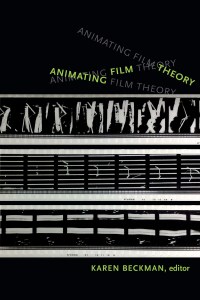
A review of Animating Film Theory, edited by Karen Beckman, Duke University Press, 2014.
 I must confess I am averse to film theory. The little I have read in this field confirms me in my opinion: film theory is empirically useless, epistemologically weak, and aesthetically unappealing. Nothing of substance has been written about the topic since Plato’s Cave, the allegory that has people watch shadows projected on the wall from objects passing in front of a fire behind them and give names to these shadows. The books and articles that are collated to form the discipline’s canon are a mixed bag of philosophical references, journalistic musings, and academic jabber. In my opinion, Deleuze’s two-volume work on film, The Movement-Image and The Time-Image, are among his weakest books. They do not amount to a philosophy of cinema, or a theory of film: at best, they are reflections on time and space that take cinema as a pretext and Bergson as an interlocutor. In textbooks and introductory chapters, film theory is a collage of quotations by cultural critics, mostly from the early twentieth century, who have commented on the birth of cinema in the context of mass culture and reproduction technologies. Remarks written in passing by Walter Benjamin or Theodor Adorno are elevated to the rank of high theory and revered as sacred scriptures by a discipline desperately in need of founding fathers. The French contributors to the Cahiers du Cinéma dabbled in film critique as a hobby and did not think of themselves as serious thinkers: they were puzzled to see cinema studies emerge as an academic discipline, and they certainly would have disapproved the emergence of a canon of officially approved texts that includes their own. When film theory tries to build a firmer intellectual grounding, it mobilizes thinkers who have written outside the purview of cinema studies and have never commented on films: Saussure, Lévi-Strauss, Derrida, Lacan, or Baudrillard. Gilles Deleuze for the French domain and Stanley Cavell in America stand as the two exceptions: they have devoted whole books to cinema as part of a program of applied philosophy. My preference goes to Cavell over Deleuze.
Animated films and live-action movies
My biases against film theory were compounded by this volume on animation film theory. If a theory of films rests on shaky ground, what about a theory that takes animated movies as its object and proposes to build an autonomous discourse on this subset of film media? A discipline is not defined by its empirical topic, but by its methods and the way it builds a scientific object as a matter of scholarly investigation. The existence of animated movies and frame-by-frame films—which predate the birth of cinema—is in itself no justification to devote an academic discipline to their study and to engage them theoretically. I do not mean to say that animation movies should be forever marginalized and ignored by cinema specialists and cultural critics. They can provide food for thought for many disciplines and, in some instances, are valuable sources of theoretical engagement. But a discourse on animation does not a theory make. Building an animation theory has more to do with intellectual posturing and academic differentiation than with scientific rigor and sound scholarship. A caricature of the attitude that I have in mind is provided by Alan Cholodenko’s contribution to this volume. An American-Australian scholar who retired in 2001 from the University of Sidney, Cholodenko describes himself as the godfather of animation theory: “theorizing of and through animation has been my project for the last twenty-three years.” His claim of having come first to lay the “first principles” of the discipline doubles the proposition that “historically as well as theoretically, film is the ‘stepchild’ of animation, not the other way around.” Drawing inspiration from the work of Jacques Derrida and Jean Baudrillard, and postulating animation as the mother of all disciplines, his contribution to this volume amounts to little more than self-promotion and personal aggrandizement.
What came first, film or animation? And who can claim the privilege of having “invented” animation cinema, in theory and in practice? A central tenet of the fledgling discipline is that animation represents the past and the future of all cinema. Lev Manovich, an author of books on digital culture and new media, made that claim in 2001: “Born from animation, cinema pushed animation to its periphery, only in the end to become one particular case of animation.” The division of cinema into live action and animation has been recently blurred by the digital turn: through CGI and pixel-by-pixel editing, live-action movies are merging with animation in a way that makes them undistinguishable. The cartoonization of live-action movies is propelled by special effects and computer graphics that makes whatever the mind can conceive achievable on screen. Some actors, Jim Carrey for instance (but the same could have been said of Charlie Chaplin or Buster Keaton), have built a whole career acting like cartoon characters. Contributors to Animating Film Theory show that the dividing line between film and animation has never been clear-cut. Photographs and moving pictures have always been mixed with drawings and text editing, such as in Dziga Vertov’s Kino-Pravda (Film Truth) experimental newsreel series in 1922-25, or in cartoons in which drawings “come to life” or live scenes are inserted in graphic sketches, a common practice since the silent movies era down to Robert Zemeckis’ Who Framed Roger Rabbit (1988). The incorporation of animated beings into real-world settings is only one example of the blurring of distinctions between animation and film. Whole movies, like Disney’s 2019 version of The Lion King, are photorealistic renderings of live action scenes in which each detail of character and scenery is animated step-by-step by computer graphics (the sole non-animated shot in the entire film is the sunrise in the opening scene.)
The French did it first
The history of animation intersects with movie history but they do not necessarily move at the same pace. The Lost World (1925) was the first feature-length film made in the United States, possibly the world, to feature model animation as the primary special effect, or stop motion animation in general. The Enchanted Drawing is a 1900 silent film best known for containing the first animated sequences recorded on standard picture film, which has led its director J. Stuart Blackton to be considered the father of American animation. As for the first animated cartoon, it is attributed (by the French) to Emile Cohl, who produced the short movie Fantasmagorie in 1908. Others point to the French inventor Charles-Emile Reynaud and his 1877 patent of the praxinoscope, an animation projection device that predated the invention of the cinématographe by Louis Lumière in 1895. Other optical toys from the nineteenth century or earlier go by the names of zoetrope, thaumatrope, phenakistoscope, and camera obscura. Likewise, animation film theory has many fathers and the competing quest for precursors, pioneers, and key figures oppose various nations, periods, and individuals. One (French) contributor to this volume casts a Frenchman named André Martin as “the inventor of animation cinema” and 1953 as the date when his invention was recorded. Another (Japan specialist) author exhibits another figure, Imamura Taihei, as the first critic to devote a whole book on animation, A Theory of Cartoon Film, first published in 1941. It turns out André Martin used the expression “cinéma d’animation” in the body of a Cahier du Cinéma article about the Cannes festival, thereby donning prestige and dignity to a genre situated at the intersection between “le septième art” (French jargon for movies) and “le neuvième art” (graphic novels and comic strips). As for Imamura Taihei, he confirms the fact that Japan stands as a key site for animation and for theory. His genealogy of cartoons and comic strips goes back to the twelfth century’s emaki picture scrolls, and also includes acting techniques found in the Nō theater and folding screen paintings from the Edo period.
To build a theory of animation, Karen Beckman, the editor of this volume, has mined systematically the writings of film theory specialists to search for references to animation. As she states in the opening chapter, “animation’s persistent yet elusive presence within film theory’s key writings make it both easy to overlook and essential to engage.” These key writings include texts by Norman McLaren, Peter Kubelka, Vachel Lindsay, Jean Epstein, Béla Balázs, Germaine Dulac, Miriam Hansen, and André Bazin, none of which I was familiar with. Throughout the book, the rare mentions of cartoons and animation movies in the writings of cultural critics and philosophers are treated as precious discoveries. Theorists of film and mass culture such as Sergei Eisenstein, Walter Benjamin, and Theodor Adorno repeatedly turned to Disney cartoons and Looney Tunes characters in articulating their reflections on aesthetics and politics. Eisenstein devised a category of “plasmaticness” that he evoked in order to stress the originary shape-shifting potential of the animated movie, the way an object or image can potentially adopt any form. For Benjamin, “Mickey Mouse proves that a creature can still survive even when it has thrown off all resemblance to a human being. He disrupts the entire hierarchy of creatures that is supposed to culminate in mankind.” Adorno and Horkheimer found nothing funny about cartoons and argued that Donald Duck actively participated in the violent oppression of the proletariat by the forces of capitalism. Writing later in the century, Stanley Cavell mulled over the “abrogation of gravity” in cartoons where Sylvester the Cat or Wil E. Coyote run over the edge of a cliff and continue their course in midair. This allows the author of the last chapter in the volume to enunciate the “first theorem of cartoon physics”: “Any body suspended in space will remain in space until made aware of its situation” (the second theorem states that “Any body passing through solid matter (usually at high velocity) will leave a perforation conforming to its perimeter”.)
Cartoon physics
Animation theory is not necessarily tied to film theory: indeed, many contributions to this volume do not start from the pantheon of film theory authors or the key concepts of the discipline. Animation can be engaged with and theorized from other perspectives: as a strand of critical thought that focuses on subaltern cultures, as in Japan, or within an epistemology of scientific objectivity and experimental representation, or from the point of view of graphic art history and media art. Several chapters focus on the link between scientific visualization practices and the history of animation. The scientific experiment plays a central role in the history of cinematography. Animation itself rests on a scientific fact: by presenting a sequence of still images in quick enough succession, the viewer interprets them as a continuous moving image. This persistence of retinal perception was exploited by the early devices of animation that used a series of drawn images portrayed in stages in motion to create a moving picture. One contributor even sees the origins of 3D animation in a 1860 invention by French entrepreneur François Willème. A glass dome, housing a perimeter ring of twenty-four cameras directed inward at a central subject, allowed camera shutters to open simultaneously to produce a “photosculpture” that was not unlike the bullet-time sequence in the film The Matrix. The experiment of film allows the viewer to experience the world in a novel way: animation, like the scientific experiment itself, becomes the way to think at the limit of understanding in an attempt to get past that limit. Scientific uses of animation include medical anatomy and health education, dimensional modeling in biology or in physics, mathematical abstraction, and all kinds of pedagogical materials. Animated images do not only illustrate: they are instrumental in the process of discovery. Climate science would be less potent without the time-lapse images of shrinking glaciers and melting polar ice caps.
Japan is in a league of its own when it comes to animation theory. As mentioned, a book on the theory of anime, Manga eiga-ron, was written as early as 1941, with subsequent editions in 1965 and in 2005. In Japanese, eiga-ron has a different meaning from “film theory”, and a different history as well. Contributions to Animating Film Theory show how animation needs to be thought in relation to media beyond film to account for the singular place of animated images in Japan. One author explores how experimental Japanese Xerox artists in the 1960s operated a crossover between animation and graphic design that sheds light on the specific context within which the issue of technological reproduction and duplication was discussed. The first translation in Japanese of Walter Benjamin’s essay “The work of art in the age of mechanical reproduction” was published and discussed in Graphication, Fuji Xerox’s corporate PR magazine that presented itself as a cutting-edge publication venue for graphic art and media criticism. More generally, the great divide between commercial and academic publications that marks the intellectual landscape in America does not exist in Japan, where the bulk of critical theories are translated, published and disseminated through non-academic journals as well as mass-market books and “mooks” (a magazine in book format.) Two of Japan’s main animation critics and public intellectuals, Otsuka Eiji and Azuma Hiroki, have organized part of their critical work outside the circuit of academia and write for a broad public readership consisting of hardcore fans of media subcultures. They invite a re-reading of the question of realism in animation: beyond photographic realism and a drawing style inherited from manga comics, anime films hint toward a new style of transmedia realism without any real-world referent. The vibrant worlds of Japanese anime, manga, and video games form the basis of an alternative sphere of expression that popular Japanese critics theorize from outside the realm of film studies.
Whither animation theory?
For Gilles Deleuze, the primary operation of philosophy is problematization, the cultivation of problems such that philosophy can then go about the task of fabricating concepts. What is the problem of animation that it requires a theory? What are the key concepts that may allow animation theory to make sense and generate meaning? Film studies, in their classical form, evolved from questions of ontology, to questions of reception, to questions of context. What is film and its relationship with reality? How does film have an effect on its viewers? What is the social and political context in which film is made and received? Starting from a different set of questions, animation theory must take its own course and develop its own methodological tools. Animating Film Theory only points toward that goal, and merely sketches out the challenges that theory-makers and philosophers of the moving image might have to grapple with. The first question, already pointed out by Sergei Eisenstein and Jean Epstein, has to do with the quality of “animism” that turns people into objects and objects into animate creatures: what makes a world animated and imbued with a life of its own? A second set of questions could coalesce around the issue of self-reflexivity: animation movies are aware of themselves as works of imaginary creation, and the hand of the drawer is never far from the drawn picture. What separates us from the world of fiction, and how can we inhabit it by breaking the fourth wall that separates screen characters from the audience? The third indication we might learn from animated movies is not to take life too seriously: as the last chapter on “cartoon physics” indicates, we will always enjoy a good Tom-and-Jerry cartoon and the hilarity that courses ending in midair and cat-shaped holes might provoke.
 The Duke Reader