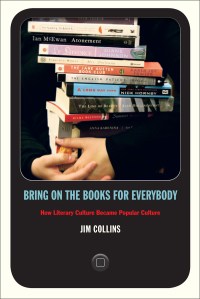
A review of Bring on the Books for Everybody: How Literary Culture Became Popular Culture, Jim Collins, Duke University Press, 2010.
 I do not want to brag, but I am in a league of my own when it comes to reading habits. I am not a professional reader, teacher, academic, or publisher, and yet I achieved to read 365 books in 2020—the year of the great lockdown. What started out as a silly gambit on January 1st—my “one-book-a-day” challenge—turned out to be a transformative experience. If “frequent readers” are said to read twelve to forty-five books a year, and “avid readers” read fifty or more books a year, I propose to create the category of “voracious reader” for those who read more than a hundred books per year, and “gargantuan reader” for those who pass the two hundred mark. And yes, like frequent flyers accumulating miles on air travels, we should get bonuses and free books from online bookstores. To be fair, the type of books you put on the count matters. My daughter just read fifty volumes of Detective Conan during a full weekend of binge manga reading. I do not read comic books, and I have a certain aversion for novels and literature. My preference goes to nonfiction, and more specifically to academic books like the ones published by Duke University Press. They take more time to read and assimilate—this is why I did not write 365 book reviews in the year 2020. Reviewing a book requires time and effort: I am not a native English speaker, and I have long lost the habit of writing term papers and class assignments. But writing reviews, and posting them on the internet, makes me feel I am part of a community—a learned society of sorts, or a book club with a membership limited to one.
One-book-a-day challenge
Bring on the Books for Everybody (BoBE for short) focuses on books different from the ones I am usually reading: it deals with literary culture, and takes most of its examples from novels and literary fictions. Its central argument—that ordinary readers and media personalities have seized the means of literary taste production from the hands of the high priests of academia and literary criticism who once maintained the gold standard of literary currency—contradicts my personal infatuation with high theory and arcane academic books. I must confess I prefer to read comments on literature and literary analysis than literature per se. And yet BoBE’s message resonates with the reading practices I have developed. It argues that popular literary culture is now ubiquitous: it is to be found in Barnes & Noble superstores, Amazon reviews, blockbuster adaptations, and television book clubs, as much as in the hallowed grounds of public libraries and academic office shelves. Similarly, theory is not a category limited to academic scholars and is now making a dent in real life, nurturing new forms of activism and self-realization. Reading literature or nonfiction does not compete with other activities such as surfing the web, watching movies on Netflix, or posting messages on social networks: it feeds itself from such activities in a mutually reinforcing manner. Reading is not a solitary act but a social endeavor, enmeshed in webs of communication and commerce that are interpersonal, transnational, and technological. Reading theory or literature is a self-cultivation project that sometimes borders on self-help therapy. Books are a lucrative market and reading practices are shaped by market forces and economic factors.
New reading practices are challenging existing notions of literary authority. Asked which personality reads the most books in a year, the average American may come up with the name of Warren Buffet, Bill Gates, Mark Zuckerberg, or Elon Musk. The academic scholar surrounded by his bookshelves and piling volumes on his desk has been replaced by the capitalist investor, the billionaire philanthropist, the founder of a corporate empire, or the serial entrepreneur. According to Wikipedia, Warren Buffett became America’s most successful investor because he used his voracious reading habit to learn everything there was to know about every industry. Microsoft founder Bill Gates posts his reading list of the past year along with his annual letter to investors. In 2015, Facebook CEO Mark Zuckerberg vowed to read one book every other week “with an emphasis on learning about different cultures, beliefs, histories and technologies.” Young Elon Musk is said to have read for 10 hours each day before growing up to become Tesla CEO. These new reading heroes stand in stark contrast with the college dork, the science nerd, the bookworm, the librarian rat, the armchair theorist, who used to be identified as the most voracious readers. The message they convey is less on which books you should read, but that you should read a lot, and that book reading is somehow connected to economic success and a well-balanced lifestyle. Such individuals seem spectacular to us, almost superhuman. And yet, the apparent enigma in their ability to read a lot amid a very busy schedule spurs the curiosity in us about them even more. We want to know the secret behind their power.
Readers with charisma
Capitalist entrepreneurs and media celebrities have now become the taste arbiters of literary culture. They are challenging existing notions of literary authority and cultural legitimacy. As Jim Collins notes, documenting the rise of a new type of master curators such as Oprah Winfrey or Nancy Pearl, “By the late nineties, literary taste brokers outside the academy could present themselves as superior to an academy that could now simply be ignored.” Academics have painted themselves into a corner of irrelevance and ridicule by sticking to an outmoded model of exclusivity and distinction. The idea that genuine cultivation and proper taste could be secured only through proper instruction and acquired only within the academy didn’t resist the democratization of book guides, reader forums, and amateur circles. Readers were empowered to talk about literary books and form reading communities that didn’t feel intimidated by the traditional discourses of literary appreciation. The discrediting of the academy and the empowering of amateur readers have led to new forms of conversation about books. A new set of players, locations, rituals, and use values for reading literary fiction has emerged on the margins of literary culture. Within this radically secularized conversation, the new cast of curators and readers talk about books in ways that are meaningful to amateur readers, and they have the media technologies at their disposal to make their conversations into robust forms of popular entertainment.
Another central thesis of BoBE is that the literary experience has now become part of our visual culture. Books are a component of a media mix that includes a variety of texts and images: commentary, interviews, cover art, book club flyers, and cinematic adaptations, along with their spin-off products. “What used to be an exclusively print-based activity has become an increasingly image-based activity in which literary reading has been transformed into a variety of possible literary experiences.” Literary value is an important component of the success of high-concept adaptation movies and literary-inspired films: as Miramax producer Harvey Weinstein put it, “our special effects are words.” Within this predominantly visual culture, reading the book has become only one of a host of interlocking literary experiences. New reading practices are changing the public’s expectation concerning just what a literary experience should look like. It now usually comes with a Latte and a proper mise-en-scène. Reading is intertwined with tastes in music, clothing, and entertainment that come as a package: the choice of books, like the choice of wine, interior design, cosmetics, fashion accessories, and cooking utensils, attests to a set of shared values and rituals. A new kind of novels offers an exercise in self-cultivation, affirming the superiority of the reader’s taste culture and self-consciously reinventing the novel of manners for contemporary audiences. Even Jane Austen or Henry James can be read as self-help manuals for busy millennials: contemporary readers still use them as primers about the world, as introductory courses in graceful living.
From literature to theory
My reading practices are different from the ones surveyed in BoBE. I don’t take my cues on what to read from TV celebrities or corporate CEOs. Although I concentrate on scholarly books, I don’t follow an academic syllabus or a prescribed reading list. I don’t have a political agenda to document and sustain. I don’t need a caste of high priests to tell me what to read and how to read it. I make mine Martin Luther’s formula to trust only the scriptures, Sola Scriptura. My choice of books is serendipitous and owes much to the availability of second-hand books on internet platforms or discount bookstores. In concentrating on books published by Duke University Press and other academic publishers, I try to challenge not only the boundaries between the disciplines but, more importantly, the boundary between the academy and the world outside. I try to make academic books relevant for daily life and casual conversations. My reading of academic books is definitely non-academic. I do not skim volumes or skip chapters; I tend to read from the first to the last page. I don’t take notes, but I underscore important sentences or paragraphs with a pen and a ruler. It helps me process mentally the content of the book and to increase my retention rate. This way I can peruse the underscored parts in a second reading and get the gist of the book in a summary. Inscribing my mark on the pages of a book also makes it clear who is the boss. Some books are meant to be read as a struggle, and you definitively want to be on top. I feel perfectly comfortable taking on books that are supposed to be fully accessible only to professional readers. If I don’t understand the book’s content, I blame the author, not me.
New technologies have an influence on the way I read. I started to write book reviews on Amazon, developing on a writing habit I had picked up as a student. BoBE mentions the history of Amazon’s curatorial activities: reviews, articles, and interviews that were originally drafted by an editorial team have been progressively replaced by customer-generated content and algorithms linking customers sharing similar tastes (“Customers who bought this book also bought…”). The book also refers to new technologies of taste acquisition that empower amateur readers to assume the role of curators of their own archives. The website Goodreads (owned by Amazon) allows to track one’s readings, to set book lists and reading challenges for the upcoming year, and to arrange one’s library as an extension of one’s self. The solitary act of reading a book has been transformed by the advent of reader comments, star ratings, and customer evaluations. According to Jim Collins, “The desire to make those evaluations public demonstrates that the need to display one’s personal taste in terms of the books one chooses to read forms an essential part of the pleasures of reading.” People will greatly enjoy reading a whole lot more if they start telling people about what they have read. The author, who used to be a distant figure one approached reverently, now maintains a familiar presence on social networks. Nothing gives me more joy than getting positive feedback from an author on a book review I have advertised on Twitter.
The Duke Reader
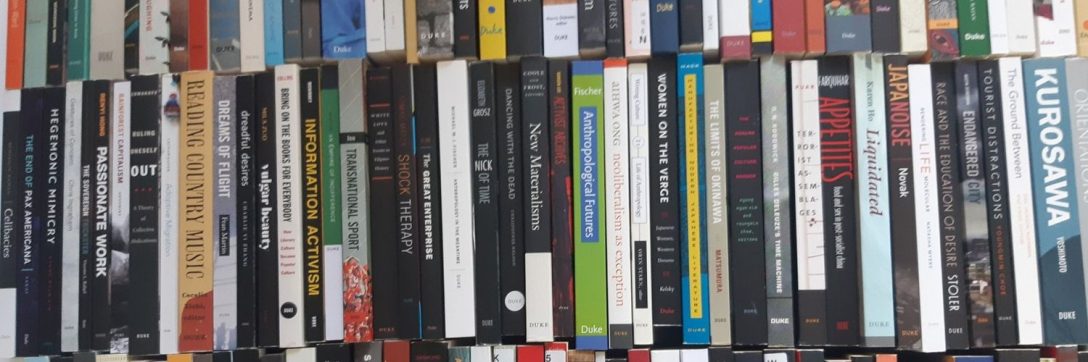
So why Duke University Press? This relatively obscure publishing house has recently attracted a fair share of media attention: its editor, Ken Wissoker, as well as two of its star authors, Lauren Berlant and Donna Haraway, have been chronicled in The New Yorker. As the author of the first portrait notes, “Duke has become known as a press that blends scholarly rigor with conceptual risk-taking, where high and low art boldly intermingle on principle.” The history of Duke University Press is, partly, the history of cultural studies in the United States. It is not attached to one discipline: as an example, it is difficult to categorize BoBE between literary criticism, film studies, and the sociology of reception. Duke publishes a steady stream of volumes anchored in the social science disciplines: sociology, anthropology, history, and literary criticism. It is also open to the new disciplines that have flourished in the margins of academia: media studies, sound studies, gender studies, queer theory, critical race studies, disability studies. It is not the preserve of tenured professors and established authors: its catalogue is open to junior faculty, adjuncts, and members of the intellectual proletariat. Part of the story of how Black Lives Matter and the #MeToo movement came to the academy goes through Duke Press. It is one of the few academic presses with crossover appeal: because its editorial line is so cutting-edge, it can make interventions in contemporary debates beyond the purview of American academy. Through The Duke Reader, I am happy to associate myself with its development.
 The Duke Reader