
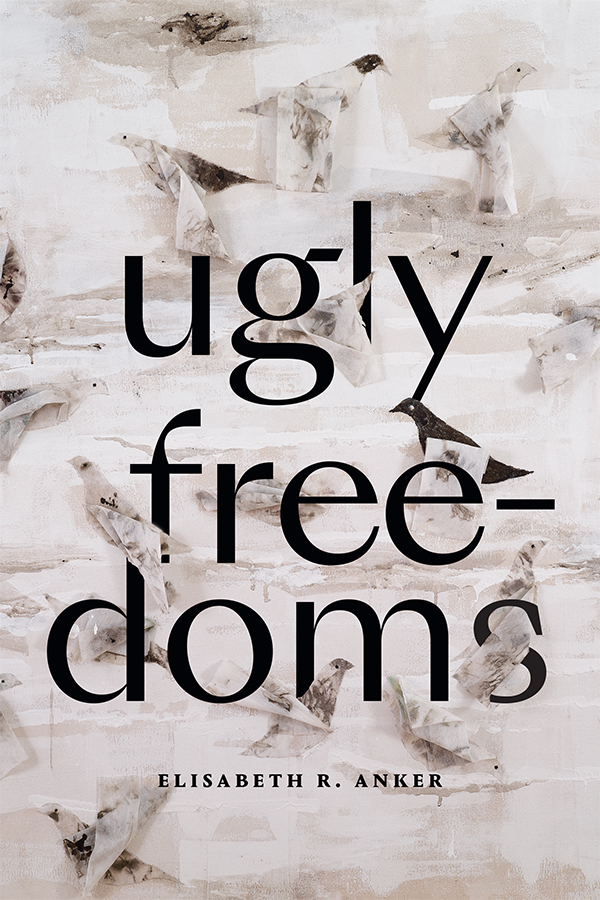
A review of Ugly Freedoms, Elisabeth R. Anker, Duke University Press, 2022.
 “We hold these truths to be self-evident, that all men are created equal, that they are endowed by their Creator with certain unalienable Rights, that among these are Life, Liberty and the pursuit of Happiness.” These truths are no longer self-evident: few people now believe in a Creator ; the inclusion of women in the generic term “all men” has to be specified ; and rights in their modern acceptation are not endowed or bestowed, but conquered and defended. What about Life, Liberty and the pursuit of Happiness? Are they not the expression of an American ideology that is shared by few people, even in the United States? Life itself has become a contested issue, as it hinges on when life starts and ends and some people are claiming a right to death in order to exit life with dignity. The pursuit of happiness was a central theme in Hollywood comedies of the 1930s and 1940s—a time of great unhappiness—, but we now look at these black-and-white motion pictures with nostalgia and irony, while Hollywood has moved to other descriptions of people’s aspirations and beliefs. Most significantly, freedom now has a hollow ring. The “Liberty Bell” march or the “Battle Cry of Freedom” were calls to rally round the flag and show patriotism, but these battle songs were used to legitimate wars of aggression and imperialism that made freedom a mockery of justice and equality. Domestically, the “land of the free” has the highest rate of incarceration in the world. We now speak with less assurance than our forefathers about the rights and values enshrined in declarations of independence or bills of rights. What if they were wrong in proclaiming life, liberty and happiness as our guiding principles? What if the reverse was true? What if freedom was not universally desirable, but “ugly” and repulsive? This is the argument that Elisabeth Anker makes in her book Ugly Freedoms, as she invites us to challenge self-evident truths and commonly believed assumptions.
Actually existing freedoms
Her point of departure is to consider “really existing freedoms,” not ideals or abstractions put forth in declarations of independence, philosophical treatises, and patriotic songs. And reality is where freedom often turns ugly. Anker’s argument is not to say that freedom leads to its own excesses and that it should be limited and regulated, or that autocratic regimes are better than unbridled democracies. She doesn’t claim that one person’s freedom ends where another’s begins, as in the popular saying that “the right to extend your hand stops where my nose begins.” She even contests John Stuart Mill’s do-no-harm rule as a limitation of freedom: under this criterium, most of our valued principles, including freedom from tyranny and national sovereignty, would be only empty promises. She is not interested in classical distinctions between “freedom to” and “freedom from,” what Isaiah Berlin distinguishes as positive and negative freedoms, or in Benjamin Constant’s “Liberty of Ancients Compared with that of Moderns.” She discards both liberal political theory and Marxist or postcolonial critiques of freedom. For Marx, exploitative forms of freedom such as freedom to sell one’s labor on a free market are “a mere semblance, and a deceptive semblance.” Under this vision, freedom is an excuse or a veil that capitalists and profit-makers use to hide and legitimize subjugation and exploitation: the ideology of freedom diverts workers from fighting for the overhaul of the capitalist order. For Frantz Fanon, colonial ideology has colonized what freedom is and who can practice it. Reclaiming freedom is a violent act: as Jean-Paul Sartre wrote in his preface to Fanon’s Wretched of the Earth, “killing a European is killing two birds with one stone, eliminating in one go oppressor and oppressed: leaving one man dead and the other man free.” But these masculinist visions of liberty still posit an untainted, heroic version of freedom and liberation that we should all strive for.
The ugly freedoms catalogued in this book do not serve these grand narratives. Freedom, for peoples liberated by US military interventions, often means being subjected to torture, indiscriminate killings, and lifelong incapacitation. Death is what liberty often tastes like for the liberated subject. On the other end of the war spectrum, freedom for Americans at home means suburban boredom, overweight-induced health risks, and unsustainable consumption. Torture, dispossession, and racial domination are not an excess or a deviation from principled ideals; they are a regular practice of American freedom. The history of freedom in the United States is tied to centuries of brutality, genocide, rape, environmental destruction, and racial hierarchy. It is too reassuring to claim that rights violations are a temporary blip in the long journey toward freedom and emancipation, or that truth will eventually prevail over the hypocrisy of those who use a distorted view of freedom to legitimate their predatory practices. American freedom entails the right to exploit and the power to subjugate. It continues to this day in ongoing settler practices of land appropriation, racial violence, and cultural erasure. US visions of freedom also contribute to mass carbon emissions, deforestation, pollution, and loss of biodiversity. Slave ownership was not different in nature from the exploitation of natural resources: in both cases, private individuals have final authority to use and dispose of their property as they see fit. Such freedom stands in stark contrast from indigenous peoples’ relations to land, living creatures, and fellow humans included in nonhierarchical webs of reciprocity and stewardship. For Michel Foucault, the history of reason included unreason as its constitutive other. Similarly, Elisabeth Anker shows that discourses of freedom and emancipation are built upon the very same philosophy and practices that wiped away indigenous cultures and justified the enslavement of racial others.
The Black Book of Freedom in America
Anker’s black book of freedom in America begins with the settler colony of Barbados, where sugar plantations offer a material archive of freedom’s violent practices. The Barbados sugar plantation owner is a key figure in the history of slavery and freedom. Cultivating sugar, as opposed to other crops, required the mobilization of money, indentured workforce or slave labor, land reclaimed from the wild, and other natural resources. It was also a lucrative business: indeed, it was the first crop to render colonization profitable, and Barbados was the first English colony to successfully cultivate and market sugar. As they became richer, Barbadian sugar plantation masters demanded more self-rule against the colonial metropole, prioritized rational choice and self-interest in juridical relations, and developed an ethos of entrepreneurship and profit-making. Meanwhile, their development was backed by unacknowledged indigenous dispossession, the wholesale destruction of ecosystems for short-term profit, and the inscription of racial hierarchies into the first English-language slave code in the world. Any free white person could discipline and punish any Black slave from a perceived infringement of the code. New practices generated on Barbados influenced political theories of individual freedom, especially in John Locke’s contribution to the Fundamental Constitutions of Carolina, which was created to bring Barbadian practices to North America. Locke’s doctrine that property rights stem from improvement of land through enclosure and industry gave legal credence to the appropriation of native lands and the violation of treaties concluded with Native American nations; and his defense of New World colonization is also a defense of “every free man to have absolute dominion and power over his negro slaves.” The Barbadian sugar master is therefore a key figure of modern freedom; and the plantation slave, its constitutive other, is a core constituent in the elaboration of political theories of individual freedom. The history of sugar doesn’t stop here: Anker reminds us that the pursuit of sugar profit contributed to US imperialist wars in Cuba, Puerto Rico, Hawai’i, and the Philippines, all of which were occupied in part to grow sugarcane. Sugar, “freedom’s digestible form,” also finds its way in contemporary artworks such as Kara Walker’s Marvelous Sugar Baby (2014), a gigantic sculpture of a nude Black woman in a sphinx position temporarily installed in an abandoned sugar factory in New York City.
Slavery, as a legal construct, was interpreted by its promoters not as the opposite of liberty but as a practice of freedom. It provided the ruling class the privilege of ownership, prosperity, and leisure, including the leisure to write treatises on liberty. Radical discourses of emancipation are themselves built upon the very same modern philosophies and practices that enslaved the racial others and justified their enslavement. Unfreedom remains after and even through emancipation. This is the disturbing lesson of Manderlay, a 2005 movie by Danish director Lars von Trier in which a Black community chooses to remain enslaved on the Manderlay plantation seventy years after emancipation. Manderlay deconstructs “the mythic march of freedom” that places Black unfreedom in the past, claims uninterrupted progress to the present, and considers white emancipators as the main protagonists. In fact, de jure emancipation neither offers freedom nor ends slavery. It casts freedom as a gift from a magnanimous nation to a grateful Black population, who first requires disciplinary guidance to become responsibly free. It sheds light on another set of “ugly freedoms”, acts of rebellion or defiance that would otherwise seem to reflect defeat and despair but that, in the movie under consideration, ultimately bring an end to the slavery plantation. The Manderlay residents have rejected the compulsion to desire the freedom they have been gifted and are seeking instead to define and enact a conception of freedom on their own terms. These deviant practices of freedom are ugly and compromised: they include theft, gambling, rape, property destruction, and the maintenance of slavery on the plantation where willing subjects self-organize their daily lives. Black freedom is typically cast as both illegible and a threat to the social order. But it also challenges the very presuppositions of white supremacy by establishing a political community that is not grounded in private possession, patriarchal mastery, and racial hierarchy. The freedom of Manderlay’s Black residents is not predicated on their virtuous suffering, on their likability, or on their resistance, as if they would have to be morally pure to deserve to be free.
Tainted freedoms
We now live in a neoliberal economic system in which trade and financial flows, not people, must be set free. Many critics have described the rise of economic and social insecurity, the erosion of public spaces, the financiarization of transactions, and the encroachment of economic logic to previously nonmarketized activities that characterize the advent of neoliberalism. In order to thwart neoliberalism, Elisabeth Anker exposes the ugly freedoms that it represents, from the freedom to own guns to the freedom to evict nonpaying tenants, but also the tainted freedoms found in discarded and devalued spaces that can challenge the neoliberal order. She turns to a television drama set in Baltimore, The Wire (2002-2008) that describes the effects of raw, unencumbered capitalism on local governance and law enforcement. Part of the power of neoliberal capitalism is its insistence that there is no viable alternative to the American clientelist way of organizing politics and economics. But a series like The Wire shows that neoliberalism’s triumph has never been complete: its progression is obstructed and undermined by everyday acts of resistance and forces of bureaucratic inertia. Failed circuits, ineffective norms, outmoded technologies, and agency rivalry do not articulate an alternative to the current system or propose a vision for how the world could be organized otherwise, but neither do they lead to the conclusion of withdrawal, capitulation, and defeat. As Anker notes, commenting on Lauren Berlant’s cruel optimism, lack of guiding vision do not equate to hopelessness. Characters in The Wire have renounced the unattainable fantasy of the good life and know that clinging to that ideal will only bring them pain. For many, only the drug trade can offer economic support and a semblance of order; but even in the drug business, money and profit-making are not the primary factors for motivating individual action. The Wire’s depiction of Baltimore city life illustrates how neoliberal governance strategies can be weaker than otherwise presumed.
The last chapter of Ugly Freedoms examines freedom as climate destruction, or “Guts, Dust, and Toxins in an Era of Consumptive Sovereignty.” It draws from the work of Donna Haraway, Anna Tsing, Mel Chen, and other proponents of “queer inhumanisms” which focus on attachments with objects and creatures consigned to the nonhuman, the inanimate, the mineral, or the molecular. It also draws from visions of the individual as primarily an assemblage of microbes, toxins, companion species, and social interactions constituted in webs of dependence. At the planetary level, ugly freedoms are propelled by the forces of neoliberal capitalism, human exceptionalism, settler colonialism, and resource extraction, which all contribute to environmental damage and establish a regime of consumptive sovereignty. Its vision to liberate individuals by installing them as masters over things they consume puts the world they live in on a path to self-destruction: “consumptive sovereignty inexorably leads to the wasting away of much life, to incinerated landscapes, extinct species, desiccated habitats, toxic dust storm, climate refugees, and increasingly precarious populations.” But Anker also expands the commons, agents, and collectives that can be considered as political subjects of freedom. A new vision of freedom is to be “found in the dank registers of human guts, in the dirty register of household dust and shed skin, and in the geochemical registers of preplanetary gases and synthetic toxins, sites rarely explored for their political visions let alone for nurturing the hallowed practice of freedom.”
The Ugly American
Ugly Freedoms comes at a time when American liberal democracy is in tatters. Free speech has turned into ugly speech, moneyed interests dominate the legislative process, and the pledge to honor the flag of the United States of America, and the government for which it stands, has been debased by angry crowds of looters and rioters assaulting the Capitol. America is no longer a shining city upon a hill whose beacon light guides freedom-loving people everywhere. It now appears as it has always been: a settler state built on the genocidal erasure of its native population and the exploitation of Black slave labor, whose abusive practices of racial division and imperial dominance continue to this day. Americans conquered their independence over the British King to make sure they couldn’t be bossed around by a distant monarch; yet their freedom meant they could be as conspicuously greedy and wasteful as the most corrupt king or queen. It is when they want to do good and project their values overseas that Americans, like in the Marlon Brando movie, are at their ugliest. To paraphrase Graham Green in The Quiet American, I never knew a people who had better motives for all the trouble they caused. Exporting freedom has become a piece of a hegemonic ideological infrastructure, and efforts to impose democracy by force have turned into a nightmarish caricature. To be sure, no nation can claim for itself the saintliness of the promised land, and no iteration of freedom is wholly pure, righteous, or free from ambivalence. But it is time to take America down from the moral high ground that it claims for itself, and to subject its imperium to the law of nations, or indeed to the fate of any object exposed to the gravitational pull: what has been elevated must come down.
 The Duke Reader