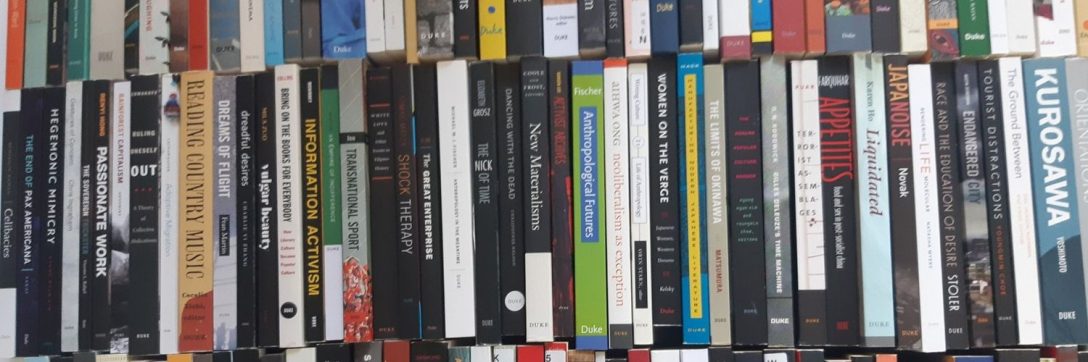

A review of The Power at the End of the Economy, Brian Massumi, Duke University Press, 2014.
 Brian Massumi owes his career to his ability to translate obscure texts into plain English, and to his penchant for doing the reverse. His first notoriety came from bringing Deleuze and Guattari’s A Thousand Plateaus to an English-speaking audience. Without him, what became an essential text for feminists, literary theorists, social scientists, philosophers, and avant-garde artists may have remained a local event, known only to the francosphere. His meticulous translation from French into English proved that translating untranslatable language constitutes a challenge, not an impossibility. He may have understood Deleuze and Guattari’s work better than they understood it themselves: going through the detour of a foreign language allowed the text to shed some of its obscurities, and to take on new ones as the translator engaged in his own rap and wordplays. Meaning always exceeds linguistic conventions contained in national boundaries and syntaxic rules. In this case, the obscure clarity of A Thousand Plateaus inspired many creators beyond the field of continental philosophy. References to Deleuze and Guattari’s work can be found in literary artworks, blockbuster movies, electronic music, and even in financial theory and military thinking. Massumi was both a translator and an interpreter of Deleuzian philosophy: his User’s Guide to Capitalism and Schizophrenia remains the most accessible and playful introduction to one of the major intellectual achievements of the late twentieth century. If, as Michel Foucault prophesied, the twenty-first century will be Deleuzian, it will be in no small part thanks to Brian Massumi and to his role as a translator and a go-between.
The Deleuzian Century
But the most important lies elsewhere. Brian Massumi was not only the faithful translator of a thought originating from France and the commentator who explained its meaning to a general audience. He is also an author in his own right, and now can claim the paternity of an œuvre. He was the first thinker to write French theory in English. And if it wasn’t confusing enough, he did it from a perch at McGill University in Montréal, in the French-speaking province of an English-speaking country. Like Jean-Jacques Rousseau, who first earned his living from copying musical scores, Massumi was first a copyist or a scribe, then an interpreter of others’ compositions, and then a composer of his own symphonies and sonatas. From his work as a passeur, a boatman taking cultural productions from one river bank to the next, he drew the resources to become a navigator in the rough waters of postmodern philosophy. Like Charon, the ferryman of the Ancient Greek underworld, he has to be paid with the silver coins put over the eyes of dead philosophers. In this case, Deleuze and Guattari provided him with the viaticum that allowed him to launch his ship into stormy seas. In a way, his work predates artificial intelligence: it is the text that an AI software system would have produced after having been fed with the complete works of Gilles Deleuze and other luminaries of postmodern thinking. One can also say that Massumi did to Deleuze what Deleuze claimed to have done to Spinoza and to Bergson: taking an author from behind and giving him a child that would be his own offspring, yet monstrous. Massumi invites us to see the history of philosophy as a sort of buggery or (it comes to the same thing) immaculate conception.
Brian Massumi makes many references to Lewis Carroll’s Alice’s Adventures in Wonderland and its sequel Through the Looking-Glass. Like Alice, the author identifies a rabbit hole as a point of entry to the Market in Wonderland. This entry point is called affect, and following the white rabbit of economic interest through it leads to a world where the rules keep changing, nothing is what it seems, and some people appear (like the Queen of Hearts) to be able to believe six impossible things before breakfast. When Alice was invited for tea, she naturally assumed that she would sit in one chair and enjoy her tea in the pleasant company of a collection of strange but interesting characters. Little did she know what would follow. At the Mad Hatter’s tea party, the time was always six o’clock and though Alice moved from chair to chair as she, the Mad Hatter and the March Hare moved places around the table, Alice never actually got any tea to eat or drink. Likewise, we assume we are invited to discuss economics and its limits whereas in fact we are summoned to a trial where language is put to the test and things are not what they seem. “Must a name mean something?” Alice asks Humpty Dumpty, only to get this answer: “When I use a word… it means just what I choose it to mean – neither more nor less.” Similarly, Massumi’s book, like Deleuze and Guattari’s, can mean many things to different persons. It is a remix of concepts imported from French theory, abstract notions and models used in scientific disciplines such as economics or physics, and the author’s own idiosyncrasies, such as the literary reference to Alice in Wonderland. The language used by Massumi can be highly metaphorical: “We are all paying guests at the Tea Party of choice, spreading our favorite jam on our very own slice of the bread of life, served on the silver platter of efficiency by the invisible hand.”
The Market in Wonderland
The Power at the End of the Economy is the power of economics at its frontiers, where economists dispense with the hypothesis of rational choice and efficient markets and experiment with alternative ideas. The idea that economics only deals with rational agents maximizing expected utility no longer characterizes economic science in its most recent developments. New fields of research, from neuroeconomics to behavioral economics and theoretical finance, are modeling how economic choices are made without relying on flawed assumptions and erroneous hypotheses. Bounded rationality implicates the idea that humans take shortcuts that may lead to suboptimal decision-making, and that emotions, habits, biases, heuristics, and environmental factors also contribute to individual and societal preferences. Massumi’s book starts where the explaining power of economics ends and has to give way to alternative explanations starting from very different premises. We find affects, hence power, at the end of the economy. Specifically, emotions and affects bind subjects together into collectivities, taking on a life of their own through circulation and exchange. We do not live in a world peopled by economic actors, producers and consumers, buying and selling at an equilibrium price on well-designed markets. We live in an economy of affects, and we must learn to detach these affects from the level of the individual. Affects operate at the infra-individual level, through and beyond the human actor: the pertinent scale of analysis is at the level of the body, the organ, or the body without organs. Affects are relational entities: they are generated by relationships between people, things, and their environment. They are trans-individual: they form packets and bundles of tendencies that are routed and rerouted through feedback loops and short circuits, bypassing the conscience of the self-contained individual.
Unlike many critics, Massumi has understood that modern economics no longer posits a rational actor as the foundation of the discipline. In neuroeconomics, behavioral economics, or certain parts of empirical finance, decisions are influenced by psychological, cognitive, emotional, cultural and social factors and may differ from those implied by classical economic theory. Economics may also dispense with the individual as the unit of analysis: not necessarily by taking collective units and aggregates, like in macroeconomics, but by focusing on factors at the infra-individual level: brain waves and neurotransmitters affecting the chemistry of the brain; rumors and pieces of information circulating in financial networks; discrete preferences and inclinations that may coexist in one same individual. Modern economics tends to consider goods as a set of functions: for example, replacing demand for cars with demand for mobility. Similarly, the individual in Massumi’s post-economics world is a bundle or an assemblage of tendencies and affects, wave packets and oscillatory processes. Nothing guarantees that these circuits and resonances will converge to an equilibrium or that they will conform to economic orthodoxy. We have moved beyond the mirror and through the looking-glass into a world of power and intensity. The telos or purpose of an economic system may not necessarily be described in terms of interest, utility, wealth, or happiness; it can also be characterized by intensities and forces, potencies and tendencies. For power is what lies at the end of the economy. Remember the dialogue between Alice and Dumpty Dumpty: “The question is,’ said Alice, “whether you can make words mean so many different things.” “The question is,” said Humpty Dumpty, “which is to be master — that’s all.”
Mastering economics
Apart from economics, Brian Massumi takes his inspiration from other disciplines. I was surprised by the extent of his readings, which appear in the end notes and bibliographical references. He refers to a long list of popular management books to illustrate the notions of decison-without-deliberation and deliberation-without-attention: in the 1990s, managers were supposed to follow their intuition and “gut feelings” or practice Zen meditation in order to thrive on chaos and manage complexity. And indeed, experimental psychology has shown that intuitive reasoning leads to better choices than rational calculus or profit maximization. Giving too many reasons and considerations leads to bad decisions, whereas simple rules and heuristics generate the right course of action. The study of non-conscious decisions has become a thriving field, illustrated by concepts such as choice blindness, irrational exuberance, and strategic ignorance. In conditions of radical uncertainty, rational choice and intuition converge in a zone of indistinction where one approach can collapse into its opposite like in a Möbius strip. Footnotes include a reference to Elie Ayache’s book, The Blank Swan: The End of Probability, which applies ideas from modern philosophy and theoretical physics to the predictability of extreme events in a chaotic system. The same set of ideas were applied by Massumi in his subsequent book, Ontopower: War, Powers, and the State of Perception, which tackles the issue of preemption in international relations and modern warfare. Together with this volume, these two books form an ontology of the present, shedding light on the ways we formulate political agency as well as validate ethical and political decisions.
By unpacking the notion of affect, Brian Massumi proposes to bring an end to the linguistic turn—the idea that everything is composed of texts, discourse, written signs, signifiers and signified, layers upon layers of interpretations and rewritings. Intervening where interpretation and hermeneutics ran master, he attempts to replace deconstruction with schizoanalysis, and Derrida by his rival Deleuze. Rather than discrete language structures, he emphasizes the continuous flow of vital processes; rather than social construction and differed meanings, the immediate nature of perception and affects; emergence and immanence rather than transcendence and metaphysics; ontogenesis in place of ontology; variations in intensity rather than differences of degree; virtuality and potential rather than probability and risk. The key word in this Copernican revolution is affect. Massumi pioneered the affective turn by acknowledging the intertwining of the material, the social, and the cultural as well as their interrelational articulations. As Massumi puts it, affect is neither about the cognitive realm nor about the discursive domain, but rather is in excess of a conscious state of perception and of bodily responses. Affects refer to pre-individual bodily forces, linked to autonomic responses, which augment or diminish a body’s capacity to act or engage with others. By linking affect to intensity or force, Massumi also sees affect as “body movement looked at from the point of view of its potential – its capacity to come to be, or better, to come to do.” This notion of affect gives rise to an alternative conceptualisation of agency. Affective agency is about relations of affective circulation between material elements and the intensive affect that a particular body is capable of at various degrees of potentiality. In other words, the subject emerges as a collection of circuits immanent to both bodily matter and to all matter more generally.
Built-in obscurity
What characterizes Massumi’s texts is their hermeticity and indecipherability. He laces his writings with obscurity just like manufacturers use built-in obsolescence in their products to sell more at faster rates. His thinking is only valid as to the extent that it goes beyond his own presuppositions and readers’ expectations. He doesn’t know at the start of a paragraph when it will end and where it will lead to. Like a crazy dancer, he is always ready to move one step beyond and be surprised by his own moves. Like the cartoon character, he is constantly running over a cliff and walking into midair until he gets caught by the gravitational pull. He knows that some of the sentences he is writing cannot possibly make sense, and that others, when translated into plain language, are trivial and commonsensical. But he doesn’t care: what matters is the flow, the rhythm, the scansion. What pleases him most is when he is able to write down things he didn’t think he could think. This is the definition of enjoyment according to Lacan: the jouissance of the thing as impossible, the excess or surplus of exultation which has no use value and which persists for the mere sake of pleasuring the self. Reading The Power at the End of the Economy made me remember a scene in the movie Lost in Translation, when the director of a TV commercial is talking to the actor Bill Murray and giving him detailed instructions in Japanese, only to be summed up by the English two words: “more intensity!” by the incompetent interpreter. Many pages and long sentences by Brian Massumi could be summed up as such: “more intensity!”
 The Duke Reader