
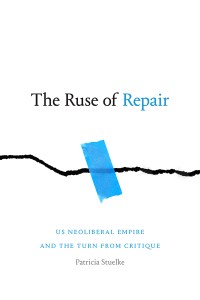
A review of The Ruse of Repair: US Neoliberal Empire and the Turn from Critique, Patricia Stuelke, Duke University Press, 2021.
 In 1956, Nathalie Sarraute published The Age of Suspicion, a series of essays about the modern novel starting from the following observation: “A suspicion hangs over the characters of the novel. The reader and the author have come to feel a mutual mistrust.” This book heralded the Nouveau roman and the turn toward critique: all components of a novel, from character to plot and to author, were subjected to radical deconstruction and became marked by indeterminacy, ambiguity, and equivocation. In the politically charged atmosphere of the 1960s and 1970s, literary critique became paranoid. The protagonists of postmodernist fiction often suffered from what Tony Tanner calls in City of Words (1971) a “dread that someone else is patterning your life, that there are all sorts of invisible plots afoot to rob you of your autonomy of thought and action, that conditioning is ubiquitous.” Uncovering the violence of the US empire and the racist ideology of the settler state became the order of the day. Revolution was in the air: there was a direct connection between criticism and protest, and between protest and radical change. Then suddenly, criticism became passé and suspicious modes of reading were themselves the object of suspicion. Psychology was back in favor, novels were again supposed to have a plot with a beginning and an end, and the focus of attention turned to the intimate, private matters, affects, and the body. Racial and imperialist violence no longer needed exposure: what was required was remediation and repair of the damaged self. Interpretive practices and political claims that leftist criticism had dismissed as “merely aesthetic” or “merely reformist” were drawn back to the center of the agenda.
Paranoid reading and reparative reading
In The Ruse of Repair, Patricia Stuelke offers a history and a critique of this reparative turn. Turning away from literary criticism and toward cultural history, she situates the rise of repair as a “structure of feeling” in literary, scholarly, and solidarity movements in the 1980s, a period marked by the ascendancy of US neoliberal empire. Specifically, the five chapters each address episodes in which reparative visions of solidarity and belonging displaced revolutionary political projects and contributed to the broader sweep of neoliberal reforms: sex-radical feminism with regard to the Iranian revolution and the so-called sex wars; black-diasporic solidarity with the Caribbean prior to the US military invasion of Grenada in 1983; the Central America solidarity movement protesting Reagan’s covert wars in Nicaragua, Guatemala, and El Salvador; creative writing programs in American universities and their contribution to the emergence of a veteran literature reflecting the trauma of the Vietnam War; and the popular music playlist weaponized by US soldiers during their invasion of Panama in 1989. Stuelke sees the origins of the reparative turn in Melanie Klein’s theories on human development and defense mechanisms, who can be read as a disavowal of “responsibility in a history of colonial war and violence that preserves and extends life to some while simultaneously withholding it from others.” Klein’s theorization of the reparative was shaped first in the debates over whether Germany should have to pay reparations after its World War I defeat, and then whether Germans should bear the guilt for war crimes and genocide in World War II. Another important milestone is Eve Kosofsky Sedgwick’s opposition between “paranoid reading” and “reparative reading,” in which the feminist scholar argued that the time of the “hermeneutics of suspicion” was over and one should return the reparative techniques that Klein had advocated. Sedgwick advanced that paranoid critique was irrelevant in an era when the lies and acts of violence of the repressive state were hidden in plain sight for anyone to see, and that one should instead concern oneself with how people find comfort, nourishment, and personal fulfilment amid precariousness and despair. The 1980s, in particular, was a decade that anticipated the ascent of reparative thinking. For Stuelke, “the turn to repair is entangled with the very history and practices of neoliberal empire and the settler colonial carceral state.” The ruse of repair, like Hegel’s ruse of reason, means that the analytical tools, patterns of interpretation, and structures of feeling that arose in the critical years of anti-imperialist militancy and radical feminism were instrumental in the ascent and triumph of neoliberalism and racial capitalism.
“Freedom to Want,” as the first chapter is titled, sets the stage by examining the logics of queer feminist anti-imperialist critique through the sex-radical solidarity politics of lesbian feminists who expressed support for progressive causes in the US and abroad, and through the institutionalization of sex-radical feminism and queer studies in the US academy. Stuelke’s archive of texts is composed of a 1986 essay by Joan Nestle, the co-founder of the Lesbian Herstory Archives ; Going to Iran (1982), Kate Millett’s memoir of traveling to witness the Iranian Revolution in 1979 ; the collective anthologies Powers of Desire (1983) and Pleasure and Danger (1984) published in the wake of the Barnard Conference on Sexuality in 1982 ; and the feminist sex wars that ensued. Joan Nestle took activism in the wake of the civil rights movement as a form of embodiment, a liberation of the lesbian self: “my body made my history… my breasts and hips shout their own slogans.” Kate Millet crafted the testimony of her trip to Iran as a reparative fantasy of revolution intermingled with the story of her reconciliation with her aunt. For the author, “Millett’s account of her relationship to the Iranian Revolution is exemplary of how feminist and queer sex-radical movement activists were revising their radical politics as neoliberalism solidified and, more insidiously, how neoliberal visions of privacy influenced the scope of their solidarity imaginaries.” The liberation of desire was elevated as the goal of solidarity politics: US imperialism was analyzed as a violent practice of sexual repression, while the turn to repair marked the passage from negative and paranoid freedom (“freedom from”) to positive and reparative freedom (“freedom to”). Sexual freedom was envisaged as “the test of how women are surviving,” and national self-determination was conflated with individual sexual expression and the neoliberal privatization of the self. Gender studies inherited this “progress narrative” of a history that celebrates women’s agency, pleasure, and difference, reifying sexual desire as natural and eclipsing the historical and material conditions of its production. The imaginaries of sex-radical feminists, and of the antipornography feminists who opposed them at the Barnard Conference, were laced with imperialist fantasies and settler colonial visions. Meanwhile, the sex wars was a white-on-white conversation, and black feminists, or queer feminists of color, were elided from the scene. Key expressions in this chapter include “racial capitalism,” “settler colonialism,” “the repressive hypothesis,” “body’s politics”, “affective infrastructures,” “valorization of privacy,” “reparative fantasies,” “homonormative politics,” and “feminism’s complicity with neoliberalism.”
The reinvention of Zora Neale Hurston
The second chapter of The Ruse of Repair, “Debt Work,” takes the reader on a journey to the Caribbean in the footsteps of three African American writers who have earned their place in the pantheon of black feminism: Harlem Renaissance figure Zora Neale Hurston, whose novel Their Eyes Were Watching God (1937) was rediscovered by recent literary criticism and became an all-star classic; and Audre Lorde and Paule Marshall, two radical feminist scholars and poets born to Caribbean immigrants who wrote memoirs rooted in Caribbean islands and diasporic identities (Zami (1983), Praisesong for the Widow (1983), Triangular Road (2009)). Patricia Stuelke sees a reparative imaginary at work in the writings of black feminist scholars about the Caribbean: the emphasis on motherhood, matrilineal family, diasporic solidarity, sexual romance, queer intimacy, and communal care were part of an effort to market the Caribbean to US tourists, and particularly to black single women from the middle class, in the early 1980s. They were heir to a long history of romanticization of the Caribbean that imagined the region as the site of matriarchal past and diasporic celebration of the present. They underscored the pivotal importance of black women as transmitters and preservers of culture, identity, and heritage. Stuelke questions the politics of these authors’ canonization as well as the reinvention or revival of Zora Neale Hurston, who wrote her classic novel during a stay in Haiti. She sees a confluence between a US black diasporic reparative imaginary of the Caribbean and America’s expansion of liberal empire. Of course, US black feminism was not the sole agent of the United States’ neoliberal recolonization of the Caribbean: the fabrication and manipulation of debt, structural adjustment programs, and the military invasion of Grenada on October 25, 1983 (“Apocalypso Now”), were pivotal in bringing Caribbean states in line with neoliberal imperatives. But imagining the Caribbean as a timeless paradise for US black women had the effect of effacing the tumultuous present marked by revolution in Grenada and contestation elsewhere. The chapter proposes key expressions and concepts to analyze these dilemma: “a black feminist reparative imaginary,” “poetics of black queer maternity,” “failed affinity with the Caribbean,” “imperial romance,” “settler modernity,” “queered diasporic belonging,” and “the unpaid debts of antiblackness.”
In the third chapter, “Solidarity as Settler Absolution,” Stuelke examines the trajectory from militancy to domesticity that led several human rights activists to turn from the denunciation of “Reagan’s dirty wars” in Central America to concerns closer to home and to the self. Her archive includes several narratives and documentary photographs produced as part of the so-called Central America solidarity movement: Joan Didion’s El Salvador (1986), Rebecca Gordon’s Letters from Nicaragua (1986), Barbara Kingsolver’s The Bean Trees (1988), Demetria Martinez’s Mother Tongue (1994), and the book and exhibition El Salvador: Thirty Photographers (1983) curated by Harry Mattison, Susan Meiselas and Fae Rubenstein. During this period, North American activists mobilized thousands to agitate in the streets and on campuses against Reagan’s foreign policy in Central America. They staged protests, carried out acts of civil disobedience, and organized photography exhibitions, theater performances, and documentary films projections documenting human rights violations and counterinsurgency war crimes. Many traveled to Nicaragua, El Salvador, and Guatemala to witness the violence of US-orchestrated military operations and bring their testimonies back home. Yet a close reading of these texts shows the prevalence of reparative approaches inspired by desires to find relief, absolution, and personal accomplishment in mediated gestures of solidarity. Many Central American guerrilla fighters and displaced refugees also deliberately played on the feelings of guilt and contrition of First World audiences to gain support. Displays of “good ethnicity” and “innocent suffering” by indigenous populations were particularly appreciated. But in narratives of Central American solidarity, the indigenous refugee character who helps the heroin find purpose and dedication ultimately disappears from the scene at the time the main character finds her “true self.” Stuelke finds in these fiction and nonfiction stories traces of “imperial romance,” “racialization of intimacy,” “white supremacist nostalgia,” “sentimental reparativity,” “staging of forgiveness,” and “settler absolution.”
The literary afterlife of military interventions
The fourth chapter, “Veteran Diversity, Veteran Asynchrony,” focuses on the centrality of the Vietnam War in US literary program fiction in the 1980s by examining various texts chronicling the popularity of creative writing programs among US war veterans, and by analyzing a sample of writings illustrative of the genre (Lorrie Moore’s Anagram (1986), Maxine Kingston’s China Men (1980), Robert Olen Butler’s On Distant Ground (1994), and two short stories by Tobias Wolff.) As the author notes, “the experience of the Vietnam War was imagined unequivocally as the stuff of ‘literary value,’ authorizing veterans not only to write, but also to teach creative writing.” This urge to convert war experience into literary capital was not new: Master of Fine Arts (MFA) programs teaching creative writing developed in relation to war, welcoming many veterans from World War II or the Korean War, and promoting a style of writing heavily influenced by war reporters such as Ernest Hemingway or John Hersey. By the 1970s and 1980s, this style became known as literary minimalism or “dirty realism” and popularized a distanciated vision of contemporary life. MFA programs discouraged antiwar fiction or critique inspired by radical politics. They also eschewed genre fiction or popular novels appealing to the taste of the general public. The emphasis had to be on silent suffering, lingering trauma, and repressed emotions. For a whole generation, “becoming a writer meant learning how to represent the seemingly unrepresentable trauma of the Vietnam War.” The Vietnam veteran functioned as a figure of wounded masculinity and emotional maladjustment that severed anti-imperialist analysis of US violence in Vietnam: the remedy for their moral pain and the nation’s ills would be found not in the elimination of US imperialism, but rather through the recognition of veterans’ plight by their fellow citizens. The university played an important role in the shift from anti-imperialist critique to the neoliberal politics of recognition, and creative writing programs were a key site in which new visions of repair and restoration were first articulated. Here again, displays of “settler common sense,” “conquest’s absolution or repair,” “institutional polishing,” “compensatory attachments,” “controlled pathos,” “white male victimhood,” “depoliticized acts of recognition,” and “empire resurgence” are in order.
The fifth and last chapter, “Invasion Love Plots and Antiblack Acoustics,” chronicles the US invasion of Panama in 1989 by focusing on a particular episode: the sonic assault of Panama’s president Manuel Noriega through US troop’s blasting of rock music featuring love-gone-wrong songs. It first sets the stage by reviewing the film Dollar Mambo (1993) that follows a set of character around December 20, 1989, the day the US army invaded Panama and thousands of innocent people were killed. The film has very few dialogue and relies on sound, instrumental music, and dance to convey dramatic tension and riveting climax. The author then examines the soldier-curators’ selection of “musical messages” sent through loudspeakers surrounding the papal diplomatic compound where Panama’s president had taken refuge. Here, Patricia Stuelke’s archive is composed of the list of songs that the US troops requested on Southern Command Network (SCN) radio for this musical assault that was supposed to drive Noriega out of the compound due to his hatred of rock’n’roll—and also to prevent reporters from eavesdropping on US negotiations with the Papal Nuncio. A reading of the playlist confirm that US troops were trying to send a message to the failed dictator who had once been America’s stooge. Love-gone-wrong pop songs and heartbreak country ballads were particularly numerous: through these lyrics, America was trying to convey to its former partner the message that it “Feels a Whole Lot Better (When You’re Gone)” and that “The Hardest Part Of Breaking Up (Is Getting Back Your Stuff)”. Soldiers also chose some songs with explicit anti-imperialist messages that were repurposed to herald a new age of free trade and democracy in the Western Hemisphere. By contrast, local musical genres inspired by Latin and African-American music, such as Jamaican reggae, dancehall music, and reguetón were conspicuously absent, and other popular American genres such as hip-hop and R&B were underrepresented. The infrequency of black music on the playlist is even more striking given the disproportionate representation of black soldiers in the military since the 1970s. For the author, “the sounds and popular music of the US invasion of Panama provided not just a soundtrack, but a genre of explanation for US empire’s drive to fortify the neoliberal economic order in the Caribbean.” Keywords in this chapter include “poptimism,” “musical resistance,” “sonic warfare,” “weaponization of sound,” “post-breakup makeover,” “repair of a damaged US white masculinity,” and “antiblack acoustics.”
Literary criticism and cultural history
Patricia Stuelke’s critique of the turn away from criticism and toward repair is itself hyper-critical: in the debate between paranoid reading and reparative reading, she clearly verges on the paranoid, and considers reparation as complicit with the fantasy that amends can make the violence of the past disappear. She suspects dark motives in the best of intentions of popular authors who supported radical movements and anti-imperialist critique in the liberal 1970s, only to become more preoccupied with repairing the self in the counter-revolutionary 1980s. There is a streak of paranoia running in her denunciation of reparative approaches as complicit with neoliberal racial capitalism’s spread in the 1980s. Evoking paranoia nowadays reminds readers of conspiracy theories, which tend to be more common on the far right of the political spectrum. The Ruse of Repair may thus be appealing to readers of opposite persuasions: conservatives will find solace in the fact that even the sacred cows of radical feminism and anti-imperialism are severely bruised by her critical impulse, while progressives will be encouraged in their drive to pursue the work of deconstruction to its ultimate consequences. There is indeed a potentially right-wing element in the rejection of repair as a valid approach to social problems: if the world is beyond repair and people cannot make use of affectionate care, then why bother in the first place, and why not acquiesce to the manipulative power of the repressive state? The paranoid compulsion is also a turn away from “The Pleasure of the Text” (Roland Barthes, 1973) and a rejection of literature as such. Nathalie Sarraute, Tony Tanner, and Eve Kosowsky Sedgwick took literature seriously: for them, literary works could enlighten the past and show the way to the future. By contrast, there are very few literary fictions or poems in the sample of documents that the author examines, and her analysis eschews any aesthetic appreciation of their literary value or any analysis of the basis of literary expression. She treats her texts as symptoms illustrative of broader trends in American society, displaying intentions and thoughts that reflect her own reading more than the avowed goals and beliefs of the original authors. Postcolonial critique and queer theory find their origins in literary criticism, and yet they tend to reject literature as a valid site of inquiry and scholarship. They write their books and journal articles “In Hatred of the Novel” (Marthe Robert, 1982) or dismiss literature altogether as irrelevant and ideologically compromised. The field of American Studies in which this book is catalogued is the expression of this conflation between literary criticism, historiography, and critical theory. In the turn (or return) to hyper-criticism, literature is sorely missed.
 The Duke Reader