

A review of Black Disability Politics, Sami Schalk, Duke University Press, 2022.
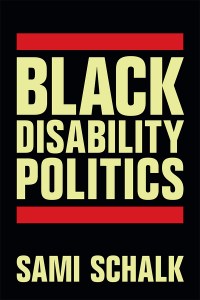
“This is a book written for Black people, especially Black disabled people.” Faced with this strong message in the introduction, the reader cannot help but ask questions. Who wrote this book, and for what purposes? Who shall read it, and to what ends? The author’s answer to the first question is straightforward: Sami Schalk identifies herself as “a fat Black queer disabled woman,” or “a Black person who seeks to avenge the suffering of my ancestors and to earn the respect of future generations.” Her goal is to understand how Black people have addressed disability as a political concern, and to develop Black disability politics as a tool and as a weapon in the fight for recognition and justice. She turns to history “because it benefits us as Black people to know and learn from what our ancestors did, to understand and honor them, and to continue their legacy of finding liberation.” Regarding the second question, the answer is even more blunt: Black readers are welcome. This book was written for them, especially for Black disabled people. As for non-Black persons, they are asked not to intrude into the conversation, for this book is not for or about them. The author makes an exception for “disabled people of color, disabled queer people, and disabled queer people of color”: even if they are not Black, the combination of traits that marginalizes them at multiple levels gives them a seat in the conversation about disability justice and collective liberation. But beware: white disabled persons should not confiscate the conversation, for their advocacy of disability rights has often led to the exclusion of people of color, queer people, or otherwise marginalized persons. Especially if you are white, living with disability does not give you the privilege to speak on behalf of other disabled persons.
A conversation about disability and Blackness
Black Disability Politics starts from the premise that “disability, as an identity, an experience, and a political category, has been conceptualized and approached differently by Black activists and intellectuals than by white activists and intellectuals.” There is something in Black disability that makes it different from disability without qualifier. Black disability has to be understood within the context of white supremacy. Even in the legal and medical sense, Black disabled persons are not equivalent to white disabled ones. Disabilities more common in rich white families are more likely to receive legal and medical recognition, while the types of disability more common in poor and racialized communities may not fit into legal and medical definitions of disability. In addition, “we cannot understand Black disability politics without engaging histories of anti-Black violence, scientific and medical racism, health disparities, health activism and environmental racism.” This makes the fight against ableism align with denunciations of racism, sexism, homophobia, classism, and fatfobia. The author points out “the whiteness and racism of the disability rights movement and disability studies as a field,” which often excludes or alienates Black disabled people. She defines the key principles around which Black disability politics is built: it has to be “intersectional but race centered” (race trumps other factors as it combines with them); not necessarily based on disability identity (unlike the white-dominated disability rights movement); contextualized and historicized (the book presents itself as a first step into that direction); centered on those most impacted by discrimination and injustice (i.e. multiply marginalized disabled people); holistic (the author believes in the “bodymind” literature); and action oriented (“I do not believe in knowledge for the sake of knowledge”). The reason Black disability politics, or the combination of critical race studies and disability studies, didn’t appear sooner as a discipline and as a social movement is because the few voices that have connected disability justice and Black liberation have been consistently ignored, overlooked, or other wise silenced by a white-dominated disability rights’ paradigm.
The book explores how Black people have engaged with disability as a social and political concern through delving into the history of two institutions: the Black Panther Party, or BPP, and the National Black Women’s Health Project, of NBWHP. To many, the Black Panther Party conjures up a hypermasculine image of Black men in leather coats and berets carrying shotguns. Yet for the bulk of its existence, and especially after 1972, the BPP had a majority of women in its membership, and many women featured prominently in its leadership. The BPP had a stated policy of gender equality from its outset, in stark contrast with many leftist groups at the time. While the role of women in the BPP and the Black struggle more broadly has been highlighted by recent scholarship, the same isn’t true of people with disabilities. The same prejudice that identifies Black Panthers with hyper macho men applies to its alleged ableism and neglect of disability rights. Surely a group that advocated armed self-defense and class struggle couldn’t open its ranks broadly to persons impaired in their ability to fight and to parade. Sami Schalk wants to correct this misperception and testify that disabled persons, and disability justice, indeed had a place in the concerns of the Black Panther movement. Exhibit #1 in this rehabilitation trial is a cover story of the weekly newspaper of the BPP dated May 7, 1977, and titled “HANDICAPPED WIN DEMANDS – END H.E.W. OCCUPATION.” The story that unfolds tells the involvement of the BPP in the “504 seat-in,” a nationwide protest in which people with disabilities and their supporters occupied federal buildings in order to push the issuance of long-delayed regulations regarding Section 504 of the Rehabilitation Act of 1973. Based in Oakland, California, the BPP apparently provided support to the San Francisco seat-in in the form of free meals for the 150 people involved and, as the magazine title testifies, a press release. In addition, two BPP members, one of them in a wheelchair, participated in the occupation of the Department of Health, Education and Welfare (HEW) in San Francisco and appeared on the article’s photo illustration.
Exhibits and posters
Exhibit #2 advanced by Sami Schalk to support the Panthers’ Black disability politics is the Panther-supported Oakland Community School’s stated policy of openness and inclusion “regardless of ability, ethnicity, or geographic location” (although the author couldn’t find any evidence that children with disabilities actually attended the school.) Another argument in the defense of the long-neglected disability politics of the Black Panther Party is the fight against the “medical and psychiatric industrial complexes” that made psychiatric abuse in mental and carceral institutions a pressing racial concern. Here again, exhibit #3 is composed of “numerous” press articles (thirteen in total) from the Black Panther weekly magazine that raised issues like forced pharmaceutical treatment, unpaid labor inside mental institutions, physical abuse in nursing homes, and involuntary commitment to state institutions. Another set of newspaper clips (exhibit #4) documents the use of psychiatric drugs in prisons as a means of control, while exhibit #5 consists of denunciations of the return of psychosurgery as a way to mitigate aggression and violence. A trial-within-the-trial, presented as a “praxis interlude,” takes issue with the ableist language and tropes used in some of the Black Panther magazine articles, such as the word vegetable to describe the potential result of psychosurgery and forced pharmaceutical treatment, or the presentation of disability and chronic illness as tragedies in need of prevention and eradication. Here the Black Panther activists are found guilty (“vegetable is used in a clearly ableist way”), but with extenuating circumstances (the term has to be placed “in its historical, medical, and linguistic context”) and they are released on parole provided they will use more proper language (alternative rhetoric and anti-ableist approaches are given.)
The author then turns to the National Black Women’s Health Project, a Black feminist health activist organization started in the early 1980s. Here, the tone is not judicial but celebratory: unlike the mock trial destined to rehabilitate the Black Panther Party’s disability politics from ignorance and neglect, the two chapters devoted to the NBWHP is an exhibition of Black women’s “empowerment through wellness.” Poster #1 in this celebratory exhibition analyzes Black feminist health activism as another prime example of Black disability politics, assessing how disability was explicitly and implicitly included within this collective’s holistic approach to health and wellness. Here the author is faced with a conundrum: she could find very few references to disability (and to the word “feminism”) in publications and internal documents of the NBWHP. But she sees this relative absence as a confirmation that Black disability politics is “intersectional but race centered, not based in disability identity.” Race and gender trump (dis)ability in the affirmation of a collective identity. The NBWHP insisted on the political nature of health and took a holistic approach that included disability in its definition of health and well-being. The self-help groups it organized were neither based in disability identity nor segregated by disability or health status (although they were segregated by race and gender: only Black women could attend.) Its publications addressed a wide variety of health and wellness problems, refusing to stigmatize or shame Black women for their health and promoting wellness for all (in a country where the majority of people don’t have social security.) It insisted on the emotional aspects of wellness and disease, and acknowledged the role of spirituality, faith, and religion in the lives of Black women (Amen to that!). For Sami Schalk, “the NBWHP was not a disability rights organization but a health organization that frequently acted in solidarity with disabled people in much of its work and included disabled people in leadership positions” (like many other health NGOs.)
HIV/AIDS is a disability
Poster #2 gets a little bit more specific on how the NBWHP provided support for people living with disability and chronic disease. The author performs a close analysis of the organization’s work on HIV/AIDS as a disability condition. The organization contributed to awareness and prevention through educational publications and campaigns taking into acount “the reality of Black women’s sexual lives.” It also provided material and emotional support for Black women living with HIV/AIDS (in the form of magazine articles and focus group discussions.) Here Sami Schalk is faced with a similar dilemma as in Poster #1: the programs focused on HIV/AIDS make no mention of disability at all. She nonetheless considers them a valid example of Black disability politics, and for three reasons. A chronic disease like HIV/AIDS is a disability condition, and is recognized as such under the American Disability Act (ADA). Even if a person doesn’t self-identify as disabled, she may be objectively included in the category. The distance or denial taken by some Black communities toward disability (the “Black disability consciousness gap”) can be explained by structural racism and the history of systemic oppression on the part of whites. Even so, the NBWHP is not without blame for keeping silent on HIV/AIDS as a disability issue and for failing to inform AIDS patients that they were eligible for support under the ADA. Again, in this mini-trial, NBWHP is deemed to have benefited from extenuating circumstances (there are “important historical and cultural reasons for that avoidance”) and is left with a prescription to encourage people to openly identify as disabled (even if they don’t have “a piece of paper to prove that”). To show that the lessons of the past are directly connected to the work of the present, Sami Schalk concludes Black Disability Politics by summarizing her interviews with eleven Black disabled activists and cultural workers whom she made provide feedback on the last chapter of her book (they were paid for their time), and four examples of contemporary instantiations of Black disability politics (a website, a book, another website, and another book.)
I feel uncomfortable in commenting this book. As a non-Black, non-disabled, non-academic, non-American, non-native speaker, I have the feeling I am intruding in a place where I don’t belong, and taking part in a conversation without a full understanding of its terms and stakes. And yet, Black Disability Politics is not a community blog or a restricted-access newsletter. It is published in an academic publishing house with an international distribution, its author presents herself as a scholar, and she wants a wide readership as she offers free access to the book through her webpage. I am therefore authorized to offer my five-cents comments for all it’s worth: if someone or something is intruding, it is this book that is trespassing into my favorite academic press series, not me. My first remark is that each time Sami Schalk uses the word Black (and she uses that word a lot), she should specify: Black American. Or maybe African American, or any other term that emphasizes geographical context. The USA is a country where, at any point in time, more than two million people find themselves behind bars; where most people don’t have social insurance; where life expectancy for men is inferior to Iran’s; and where there are more homicides in a day than in Japan during a whole year. African Americans are disproportionately represented in these categories (incarcerated, non-insured, premature deaths, authors or victims of violent crimes.) This situation should inspire shame and a modicum of modesty to all Americans, regardless of race or political persuasion. Viewed from outside, the United States increasingly appears as a country you don’t want to deal with, and definitely not as a country that should give lessons to the rest of the world. Unfortunately, what happens in the US doesn’t stay in the US. The United States influences conversations globally, especially academic conversations or discussions that find their origins on American campuses. What goes around comes around: China’s propaganda apparatus has seemingly become an active supporter of the global Black Lives Matter (BLM) movement – mostly in the form of lambasting the US government and system. In France, conservative forces dismiss any discussion on racial justice or equal opportunity by invoking “wokeness” and the excesses of political correctness observed in the US. As much as Sami Schalk wants to restrict participation in the conversation she is establishing with Black activists and scholars in the United States, I don’t want Black Disability Politics to be part of the conversation about race, disability, and politics in France.
Activism as a vocation
My second remark is that Sami Schalk should take sides more clearly: does she write as a scholar or as an activist? Does she take science or politics as a vocation? The material she presents (what I called exhibits and posters) may be fit for a trial or an exhibition, but cannot pass any academic test in the social sciences. The author recognizes it herself: “Black disability politics refuses to be disciplined,” and breaks away “from the typical disciplinary academic monograph mode.” Mining the past and the present to find heroic ancestors and comrades-in-arms does not a history book make: legacy is not history, and the intention to “exalt,” “honor,” or “avenge” past figures is usually a bad start for writing history books. I personally think African Americans deserve a genuine historical narrative of their relationship with disability, not an hagiography that takes no account of the rules of the discipline. The role of the historian should not be to “draw lessons from the past” but study it as it was. He or she should refrain from two major sins: presentism, or the introduction of present-day ideas and perspectives into depictions or interpretations of the past; and taking the role of the judge, for history is not a courthouse or a trial. She should try to exploit a vast array of sources, including oral testimonies, community documents, and national archives, but she should also apply critical lenses to appreciate the veracity of the sources and not take testimonies at face value. When doing survey research, the important thing is not to obtain a waiver from an institutional review board, but to apply the tools and methods of the social sciences regarding sample selection, baseline or control group, questionnaire design, and textual analysis of responses. If the scholar wants to take the position of the political militant or the social activist (and she is perfectly free to do so), she should specify in each of her interventions in which capacity she is speaking. Readers may find such literature inspiring or uplifting, or they may prefer to turn to other narratives as a source of inspiration. Personally, I still find relief in the statements of Martin Luther King and in his “dream that my four little children will one day live in a nation where they will not be judged by the color of their skin but by the content of their character.”
 The Duke Reader