
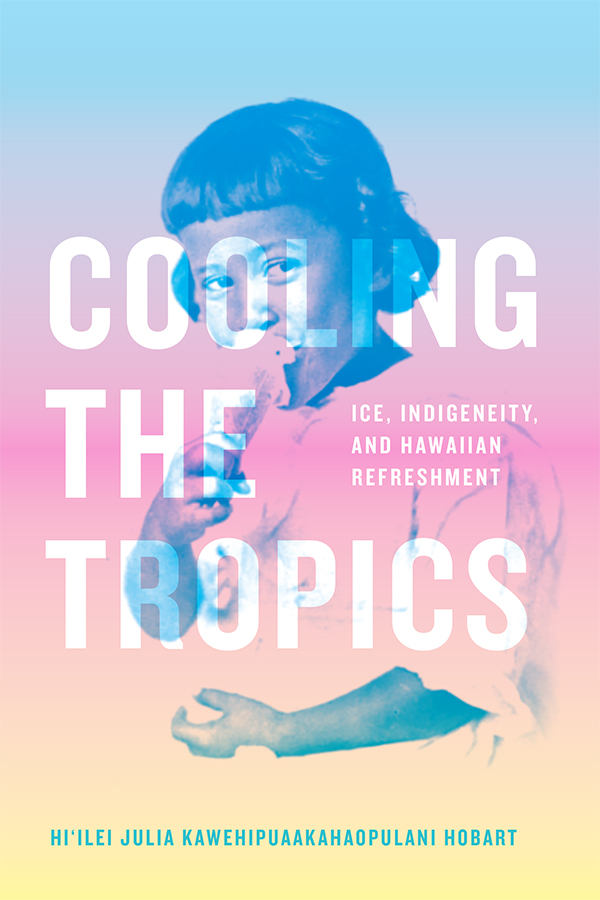
A review of Cooling the Tropics: Ice, Indigeneity, and Hawaiian Refreshment, Hi′ilei Julia Kawehipuaakahaopulani Hobart, Duke University Press, 2022.
 Many public events in the United States and in Canada begin by paying respects to the traditional custodians of the land, acknowledging that the gathering takes place on their traditional territory, and noting that they called the land home before the arrival of settlers and in many cases still do call it home. Cooling the Tropics does not open with such a Land Acknowledgement, but Hi′ilei Julia Kawehipuaakahaopulani Hobart (thereafter: Hi′ilei Hobart) claims Hawai’i as her piko (umbilicus) and pays tribute to the kūpuna (noble elders) and the lāhui (lay people) who “defended the sovereignty of [her] homeland with tender and fierce love.” She describes her identity as “anchored in a childhood in Hawai’i, with a Kānaka Maoli mother who epitomized Hawaiian grace and a second-generation Irish father who expressed his devotion to her by researching and writing our family histories.” She expresses her support for decolonial struggles and Indigenous rights, and participated in protests claiming territorial sovereignty for Hawai’i’s Native population. How can one decolonize Hawai’i? How can Hawaiian sovereignty discourse articulate a claim to land restitution and self-determination that is not a return to a mythic past? What about racial mixing, once regarded with anxiety and now touted as a symbol of Hawai’i’s success as a multicultural US state? What happens to settler colonialism and white privilege when the local economy and the political arena are dominated by populations originating from East Asia and persons of mixed descent? Is economic self-reliance a feasible option considering the imbrication of Hawai’i’s economy into the US mainland’s market? Can the rights of the Indigenous population be better defended in a sovereign Hawai’i? What is the meaning of supporting decolonial futures that include “deoccupation, demilitarization, and the dismantling of the settler state”? Can decolonization be achieved by nonviolent means, or do sovereignty’s activists have to resort to rebellion and armed struggle? What would be the future of a decolonized Hawai’i in a region fraught with military tensions and geopolitical rivalries? What can a decolonial perspective bring to the analysis of Hawai’i’s colonial past and possible futures? And why is academic research on Hawai’i’s history and society so often aligned with the decolonization agenda, to the point that decolonial approaches are almost synonymous with Hawaiian studies in the United States? More to the point: how can a PhD student majoring in food studies and chronicling the introduction of ice water, ice-making machines, ice cream, and shave ice in Hawai’i address issues of settler colonialism, Indigenous dispossession, Native rights to self-determination, and decolonial futures?
Decolonize Hawai’i
Unbeknownst to most Americans, and to all non-US citizen but a few exceptions, there is a thriving independence movement taking place in the Hawaiian Islands today. It was borne out of an unlawful US-backed overthrow of the Hawaiian Kingdom in 1893, it survived Hawai’i’s accession to statehood in 1959, and it is currently in opposition to the territorial encroachment by military infrastructure and other state interests over confiscated land and sacred sites. The Hawaiian soveignty movement doesn’t advocate a return to a mythic past. Simply put, Native communities demand respect for their traditional cultures, consideration for their role as stewards of the land, and empowerment to take part in all decisions that affect them. Since 2014, local activists have opposed the construction of the Thirty Meter Telescope (TMT), a scientific endeavor with governmental support from Canada, France, Japan, China, and India. Slated to become the most powerful telescope on the planet, the stadium-sized facility threatens to desecrate one of the most sacred sites for Kānaka Maoli. Construction was temporarily halted due to a blockade of the roadway leading to the site, and further protests as well as legal battles prevented construction of the telescope to resume. Hi′ilei Hobart took part in the protests, helping to keep the basecamp of picketers provisioned with food and beverages. Participating in local struggles fed into her dissertation in more than one way. Firstly, it underscored the obvious: ice and snow are native to Hawai’i; they are not an imported commodity brought by Anglo-American settlers along with “civilization”. Those who tell the story of how ice first came to Hawai’i get it wrong: ice and snow have been there since time immemorial. During winter, snow frequently falls on the ice-capped summits of the island chain’s tallest mountains. But even confronted with this evidence, popular discourse continues to construe ice and snow as alien to Hawai’i, and to frame Maunakea―the site of the TMT―as a terra nullius unoccupied by the Native population and thus open for grabs and available for construction in the name of science and progress. Discursive logics have combined to produce Maunakea as “not-for-Hawaiians” (Kānaka Maoli were supposed to steer away from altitude, and the first individuals on record to climb the mountaintops were Westerners), as “not-Hawai’i” (outsiders picture Hawai’i as a tropical paradise of lush valleys and beaches), and as “not-Earth” (NASA used the desolate volcanic site for outerspace simulations of spacewalks on Mars and the moon). Cumulative efforts to frame Maunakea as empty and alien have resulted in disregard for Natives’ rights and belief systems.
The second lesson Hi′ilei Hobart could draw from her roadblock picketing is a better sense of the local cosmogonies that tie humans with nature and the elements in Hawai’i. For Kanaka Maoli, Maunakea’s snow, mist, and rain are not just atmospheric phenomena: they signal the lingering presence of gods (akua) and ancestors’ spirits who have been occupying the place even in the absence of humans. Local tales or mo’olelo kept by way of oral transmission carry foundation myths of the islands and mountains and attest to Maunakea’s central role in Indigenous place and thought, while animating the elements and other life forces with their own spirit and consciousness. Likewise, for the anthropologist, commodities are animated with a life of their own. According to Marx, a wooden table “does not only stands with its feet on the ground, but, in relation to all other commodities, it stands on its head, and evolves out of its wooden brain grotesque ideas, far more wonderful than if it were to begin dancing of its own free will.” Ice and refreshments in the tropics are imbued with values, desires, longings, and social hierarchies. They have a history that intersects with the history of settler colonialism, racial capitalism, and the militaro-touristic complex in Hawai’i. Discourses about ice encapsulate ideas about race, modernity, gender, and the affective sensorium. They help rationalize Indigenous dispossession and contribute to the legitimization of imperialism. As historian Eric Jennings has demonstrated, the concepts of freshness and refreshment marked colonial relationships in the tropics. The hill stations and colonial spas built by the French and the British in their colonial outposts were predicated on the idea that fragile European bodies could not endure tropical heat and had to periodically regain some of their vigor in high-altitude places where conditions of life in the homeland were reproduced. The same logic explains how ice and frozen refreshments were progressively naturalized in Hawai’i’s foodscape. First to penetrate the Hawaiian market in the nineteenth century, ice cubes were associated with masculinity, alcohol consumption, saloon culture, plantation ownership, and white privilege. By contrast, the more feminine ice water came to be seen as a means to achieve temperance, mitigating the warm climate, and cooling after effort. Ice cream was a symbol of whiteness, sugary sweetness, purity, leasure, and innocent childhood; for young women, who could frequent the ice cream parlor without being chaperoned, the fast-melting delicacy was also synonymous with freedom and romantic encounters. Born on the plantations, shave ice is associated with brown labor, rural life, Asian migrants, mom-and-pop stores, and nostalgia for simpler times.
Infrastructures of the cold
As a third lesson of the author’s fieldwork as an activist came the realization that American society depends on thermal infrastructures, from the cold chain to keep perishable foodstuff to air conditioning and big houses protected from outside temperature. Freezers and refrigerators are essential to modern survival. These infrastructures have become so embedded in everyday life that they fade into the background, and their very invisibility guarantees that structures of dispossession and extraction go unnoticed. This is what the author labels “thermal colonialism”, defined as the modes by which temperature was managed and organized to favor settlers’ interests and reproduce racial hierarchies. Americans have become quite literally “conditioned” to experience coolness or frozen taste in hot weather, to the point that they consider the “right to chill” as constitutionally guaranteed. But desire for freshness and refreshment has a history: it is not biologically determined. We realize the importance of infrastructures of the cold when they fail us: the fragility of the cold chain in Hawai’i reveals itself after a hurricane, when lines of supply are disrupted, or each time the islands brace for an emergency. When things fall apart, networks of care and resilience take precedence over market relations and commercial interests. This is what Hi′ilei Hobart realized in the encampment at Mount Maunakea as she filled coolers with ice and drained their brown water to keep foodstuff fresh and edible. Managing community food resource pooling made her aware of food insecurity and thermal dependence in a state that heavily relies on imported goods and processed food. As her food studies turned to food work, she realized that “all that is frozen melts into water” (to paraphase Marx’s famous quote) and wondered whether Hawai’i had a future beyond the ice age: “what place does refrigeration have within Indigenous futures that move beyond settler capitalism, when coldness has played such an intimate role in these systems of oppression?” Draining water from coolers also drew her attention to melt as a condition of our current times marked by climate change and the images of fast-disappearing glaciers. She also discovered the materiality of freshness and frozenness, which pointed to a different kind of political economy as the one she had envisaged as a graduate student: an economy that is not based on commodity fetishism and labor exploitation, but on user value and short “farm-to-fork” circuits of exchange. Commodity trade, Marx argues, historically begins at the boundaries of separate economic communities based otherwise on a non-commercial form of production. As Marx explains, the commodity remains simple as long as it is tied to its use-value: “A commodity appears, at first sight, a very trivial thing, and easily understood. Its analysis shows that it is, in reality, a very queer thing, abounding in metaphysical subtleties and theological niceties.”
Hi′ilei Hobart’s history of how artificial ice came to Hawai’i is heavily dependent on her sources. Scarce at the beginning, with a few advertisements and newspaper clippings (including publications in the local language, ‘ōlelo Hawai’i), they include a wider array of testimonies, photographs, business records, cookbooks, consumer goods, and personal memories as we move closer to the present. She first chronicles the great American ice trade, in which big blocks of ice harvested from lakes in the Northeast or in Alaska circulated the globe from 1840 to 1870, the year the first ice-making machines were introduced. The ice that went to the tropics was a luxury product, used in cocktails, to chill wines, and for service at fine hotels where American planters, Western missionaries, European tourists, and Hawaiian elites mingled. The ice importing business never really took off in Hawai’i: even though entrepreneurs petitioned the local rulers for monopoly rights and invested in storage facilities, the venture remained unprofitable and was interrupted in 1860 after two decades of sporadic shipments. King Kamehameha III had mixed feelings about alcoholic beverages and iced punches: ruling over a “semi-European” polity that was modernizing fast, he also leaned to the robust temperance movement championed by Western missionaries and patronage ladies. He eventually died in 1854 after drinking from a poisoned punch-bowl of iced champagne. Under the reign of the last Hawaiian monarch, King Kalākaua, Honolulu was a fast-growing city with all the trappings of a Western metropole. ‘Iolani Palace, the royal residence, had electricity, indoor plumbing, and telephones even before Buckingham Palace or the White House. Among these technologies, ice machines and ice factories came into operation in the 1870s, transforming a once-foreign commodity into a local product.
Entering the Ice Age
Hawai’i entered the ice age at about the same period as the United States: when home refrigeration, cold chains for perishable goods, ice cream parlors, and soda fountains connected Honolulu’s domestic life to global standards of modernity. But unlike in the mainland, the use of freezing technologies were subject to colonialist frames of interpretation and local resistance. Settler reports of Kānaka aversion to ice stood as indictment of their slow pace to civility. Native people’s first contact with ice cream, taken as extremely hot instead of freezing cold, was derided as a sign of inferior civilizational status. Hawaiian-language newspapers, however, refuted implications that Kānaka Maoli were confused about or afraid of ice, and advertised the lavish cosmopolitan banquets including icy desserts served at the ‘Iolani Palace. But haole (foreigners), ali’i (elite Hawaiians), and maka’āinana (local commoners) reacted differently to frozen tastes, reflecting hierarchies of class, gender, and racialized proximity to whiteness. The racist and classist distinctions manifested themselves after US annexation during the pure food battles of the 1910s. The newly appointed food commissioner decided to apply US legislation strictly to ban poi, a local dish alternatively described as a truly delicious paste with yeasty flavor or “a native concoction that tastes like billboard paste,” and to increase the butterfat content of ice cream to mainland levels, contradicting local tastes and recipes developed by Japanese and Chinese ice cream vendors.
Shave ice and its “rainbow” of flavors is now offered as a metaphor for the “rainbow state” and its multiethnic, postracial population. As a symbol of Hawai’is racial landscape, the rainbow offers an important vehicle for the affective, and often tense, sentiments of identity and belonging. How did a food practice brought by Japanese migrants come to epitomize a US state, and how did a sugar plantation economy built along racial lines produce a racially harmonious society in the only US state with a nonwhite majority population? Shave ice offers an alternative narrative to forms of refreshment oriented toward white leasure, like the ice creams or tiki cocktails fetishized by the touristic gaze. Historians trace the origin of shave ice to Japanese agricultural workers and plantation store owners who brought the food tradition of kakigōri from Japan. Born in rural spaces where non-Hawaiians put down deep community roots, shave ice offers an alternative story about race and refreshment, one that is not tethered to whiteness and the leisure class. Asian immigrant populations in Hawai’i, once systematically marginalized, have become a “model majority” characterized by upward class mobility and adherence to nationalist values. They dominate the local economy, to the point scholars have forged the category “Asian settler colonialism” to describe the ascendancy of working-class communities of color. Hawai’i is now considered as a laboratory for multiethnic harmony as well as a harbinger of what the whole United States could become: a postracial nation, turning its back on its history of Native Indian extermination and Black enslavement. These fictions mask ongoing structural racism against Native Hawaiians and other ethnic minorities (Samoans, Filipino-Americans…) The shave ice success story glosses over such divisions and obscures Kānaka Maoli claims for Indigenous sovereignty. For present-day Hawaiians, it also brings back shared memories of childhood and nostalgia for “simpler times” characterized by community resilience, rural life, and low economic wealth. Again, this nationalist narrative envisioning an ahistorical and uncomplicated past erases a history of racial discrimination and labor exploitation, and produces “Hawaiians” as an always already multiethnic category that excludes indigeneity or Kānaka Maoli claims to place.
Hawaiian futures
I don’t see much potential in an independent, sovereign, or post-statehood Hawai’i that would grant Indigenous people rights of self-determination and privileges of territorial ownership. There are other ways to tackle the deep structural inequalities and discrimination that affect the Native population. As the French have experienced in French Polynesia, recognizing Indigenous rights is not synonymous with granting full independence or a right to secession. Politics of atonement and official apologies may be aligned with the Anglo-saxon protestant mindset, but they have their limits: short of reparations and restitution, they leave intact the structures of power that have led to Native dispossession and do not advance the living conditions of Indigenous populations. Economic needs must also be addressed, and the responsibility of all leaders, oriented toward independence or otherwise, is to chart a course that guarantees economic growth and sustainable development. I see tourism as a chance for Hawai’i, and militarization as a necessity borne out of historical and geopolitical concerns. Americans will always remember Pearl Harbor. Hawai’i is America’s first line of defense and its most strategic outpost in the Pacific. The security of the continent hinges on the continued presence of military forces which, along with tourism, form the twin pillars of the economy. Envisaging a decolonial future for Hawai’i seems to me more dystopian than real. And yet, with all these caveats in mind, I still find potential for decolonial approaches in modern scholarship about Hawai’i or other territories in the Pacific. Other Pacific islands have acceeded to independence and have demonstrated the viability, resilience, and vitality of Indigenous sovereign states. In the case of Hawai’i, but also the other US territories in the Pacific (Northern Mariana Islands, Guam, and American Samoa), solutions might exist toward or beyond US statehood without resorting to full independence. Besides, scholarship and politics are distinct endeavors. The challenge that decolonial studies must address is the decolonization of the mind. I see must potential in a decolonial perspective to the history of Hawai’i and other once occupied nations, and I learned much from reading Cooling the Tropics as much as I enjoyed reviewing it. One can quote Marx without being a Marxist; one can use decolonial scholarship without believing in a decolonial future for Hawai’i.
 The Duke Reader