
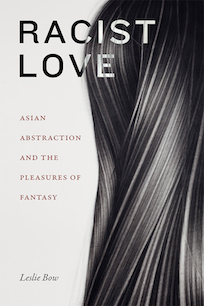
A review of Racist Love: Asian Abstraction and the Pleasures of Fantasy, Leslie Bow, Duke University Press, 2022.
 Racist Love starts from the position that love can be racist. This is an idea that many people may find difficult to admit. Of course, most people will acknowledge that racism can be at work in the sexual fantasies of old white men attracted to young Asian women. In the same vein, the way Asian American communities are praised as a “model minority” can also be called racist. But can the sincere love of a white person to his or her Asian partner be called racist? What about the unconditional love of a mother to her child in the case of interracial adoption? And even if racist love exists, is the fact that some white people, male or female, prefer Asian sexual partners different from the attraction other people feel for blondes or redheads? Where do you draw the line between a preference for physical attributes in a partner and racism? If transracial love is systematically tainted by racism, what about the love or attraction one may feel towards people of one’s own ethnic group? Can people of color be suspected of racist inclinations because they are attracted to persons outside their ethnic group, or is racist love the preserve of white people? How to deal with the case of non-Asian persons (say, Gwen Stefani) who are so attracted by everything Asian that they themselves identify as Asian? There are no easy answers to these questions and, especially in the French context, it is hard to engage a conversation on these issues. Speaking of racism usually elicits the topical response “I am not a racist!”, while using the expression “structural racism” tends to deprive people of their agency. Racism, like religious beliefs or political affiliations, are topics that are best kept out of conversations at the dinner table.
Asian fetishism
The value of Leslie Bow’s book is is not to raise the issue of racist love in the abstract, but through the exploration of cultural artifacts, children’s books, collectibles, and artworks. These material objects act as substitutes for Asian people, displaying some of the traits Americans associate with Asian cultures. These ethnic signs can take the form of artifacts (fans, chopsticks, rice bowls, dress style, and textile patterns) or body parts (slanted eyes and other facial features, black hair, petite silhouette) that are detachable from the whole body to convey attributes of gender, youth, and ethnicity. Together, they express a racial imaginary infused with desire, longing, and intimate connection. They show that “race can be a source of pleasure” and not just rejection or apprehension. Racism can be made cute and charming, as in the Hello Kitty series or the geisha car in Pixar’s animated movie Cars 2. These inanimate objects “spark joy”, to use the terms of Marie Kondo, the Japanese lifestyle guru. They also reinforce racial stereotyping as a process of abstraction in which a quality ascribed to one member of a group then applies to all. One such Asian stereotype is the notion of inscrutability: Hello Kitty’s lack of mouth and facial expression offers a blank slate for the feelings of the viewer. Another prejudice is the association of Asian women with submissiveness and passivity. This stereotype affects Asian American women in their career, causing many to plateau, but also in their affective life. Asian female bodies are fetishized, oversexualized, and objectified in the fantasies of white males. Asian women deal with a very specific type of racialized sexism that makes them especially vulnerable. For Leslie Bow, attraction is the very form of anti-Asian bias, and translates into a specific desiring structure characterized by equivocation. Racist love can easily turn into racist hate: they are the two sides of the same coin.
Portraying differences among peoples using animal surrogates has always been a standard approach in children’s literature. It has also always been controversial: from the “fairy tale wars” of the 1920s to the Great Society programs in the 1960s and to more recent initiatives to expunge public libraries from allegedly controversial or inappropriate material, adults have always invested children’s literature with a great deal of phantasies and anxieties. Once thought as a tool for celebrating human variation and diversity, the practice of enlisting animal as racial proxies for child audiences is now seen by some as fraught with stereotypes and latent racism. As a critic notes, “we expect a white child to find it easy to identify with an animal but not with a Black character. Is the child further removed from a person of another race than another species?” More specifically, why are Asian characters always depicted as panda bears, ninja turtles, or karate chicken? Can biodiversity act as a metaphor for racial diversity? Do narratives about overcoming species bias encourage ethnic tolerance among children? For Leslie Bow, children’s literature mostly reflects adult concerns. Taking D.W. Winnicott’s definition of the teddy bear as an exemplary transitional object for the child, she asks: “by the same token, how do picture books represent transitional phenomena for adults, a site where racial fears and desires also find expression if not also release?” Illustrated books depicting animal characters and how they can get along across species are “racial transitional objects” for adults. Much like stories can help the child work through unconscious pressures, race-as-species characters reveal unconscious adult pressures to promote both color blindness and diversity. Whereas young children may relate more to human characters than anthropomorphized animals, adults prefer to envision democratic inclusion without the messy divisiveness of American racial history.
Transracial adoption
Nowhere is this urge to reassure parents more apparent than in the vast literature that has developed over the past twenty years around transracial adoption. Leslie Bow lists dozens of illustrated books addressing the experience of transnational adoption as transpecies parenthood, from the Ugly Duckling story to mama polar bear and the grizzly cub. Such books aim to reassure the reader of the adoptee’s integration into a loving family despite biological differences. But according to many adult adoptees, such books do not mirror the experiences of transracial adoptees. They present transspecies adoption as the happy resolution of a mother-quest narrative, whereas the reality of intercountry adoption more often reflects a parental quest for a child. They assume a complex chain of inferential reasoning, from visual difference to species, from species to race, from race to different human features, and then require the child to discount the importance of these differences that may not have been perceived in the first place. Adoptive animal parents are very often single and female, leaving the adult companion largely absent. Books emphasize maternal love and caring as the solution to all personal or societal concerns regarding family resemblance or discrimination. They reinforce adoptive parents’ refusal to acknowledge racial difference and racial tensions within the family. The authors of these books are almost exclusively adoptive parents, although a young generation of adopted persons is starting to produce graphic novels reflecting their experience of intercountry adoption for adolescents and young adults. One such book reviewed by Leslie Bow was written by an American-Born Chinese who takes the character of the monkey-king in the classic novel Journey to the West to express his feeling of inadequacy and physical difference.
Moving from anthropomorphic characters to racist kitsch, Leslie Bow explores an archive of mundane household goods personifying East Asian iconography: Asianized chopstick holders and rice bowls, kitchen timers and coin banks, luxury handbags personifying “crazy rich Asians,” and a Mandarin citrus squeezer made by Italian designer Alessi. Given the legacy of white supremacy in the United States, these objects may well be seen as a form of hate speech. They parallel the infamous history of Black mammy cookie jars and Black lawn jockeys that now trade on eBay as collectibles, often bought by African Americans who “collect racism” as pedagogic tools to remind viewers of a repressed history that still produces deep affective responses. In the American context, stereotyping is now recognized as a microaggression that negatively affects the mental health and well-being of people of color. Hence the prohibition of the Indian American mascots of sports teams, ethnic Halloween costumes, brand commodities playing with racist clichés, and various instances of cultural appropriation. Household goods with Asian faces elicit different responses: they are both offensive and inoffensive, an ambivalence that the author experienced herself through her reaction to some items: “I thought it was adorable.” The racist love of cute things characterizes America’s reception of the Japanese aesthetic of kawaii or cute style. For Leslie Bow, cuteness is the aestheticization of powerlessness. The racial cute veils pleasure in domination; it allows for the enjoyment of unequal relations of power, and invokes asymmetries of power underlying racialization. Addressed to children and young women, the kawaii aesthetic marks an association with dependence and innocence. It conflates Orient and accessory, Asian as thing or commodity. It takes delight in the diminutive, the passive, the inscrutable. For the author, “the pleasure surrounding cute commodities, their enactment of complimentary racial stereotyping, masks a fetishistic anxiety surrounding East Asia writ large.”
Fetishistic anxiety
Fear and anxiety also characterize what the author defines as techno-Orientalism, the projection of an Asianized future fueled by perceptions of economic ascendency in Asia. She analyzes three examples of the embodiment of a posthumanist future centered on Asia: the field of social robotics dominated by Japanese companies and researchers; humanoid robots who disproportionately tend to be modeled as Asian and female; and fictions involving AI characters such as Alex Garland’s Ex Machina. According to Leslie Bow, “techno-Orientalism is tech feeling as anti-Asian bias.” It reproduces the fetishistic structure of feeling that she has identified as racist love: anxiety transformed into pleasure. Attitudes towards artificial intelligence and social robots are often depicted as different in East Asia, compared to western countries where growing dependency on automatons generates negative feelings. In particular, Japan has more robots than any other country with robots contributing to many areas of society, including manufacturing, healthcare, and entertainment. Humanoid robots commercialized by Japanese companies are built as companion machines that establish bonds of sympathy and trust with their owners. But superior research and manufacturing skills in East Asia do not explain why robotic technology is so often embodied as Asian and female. Asian female clones, robotic geishas, mecha women, and digital assistants are coming out of research labs and now populate the reception desks of department stores, the animated stands of gaming conventions, and the imaginaries of Hollywood movies. For Leslie Bow, these robotic dolls reproduce familiar tropes about Asian women: “innocent and passive yet willing to please; sexually desirable but curiously lacking sexual desire; marvelously enhanced yet emotionally fragile.” They reinforce the association between Asian women and modern slavery, sexual exploitation, and human trafficking. The attitude they encourage among their public is highly problematic: boys and adults are encouraged to touch the face, to poke the body, and to aggress verbally in order to elicit reaction. It is as if #MeToo and the obligation of consent never happened. “Our visions of the future are thus tethered to existing social categories and histories even at the moment we imagine transcending them.”
In her last chapter, Leslie Bow turns to contemporary visual art and media engaging fetishism. Asian fetishism is “the quintessential form of racist love”: race fetishism involves sexual objectification and the same processes of reduction and exaggeration bound to the stereotype. Asian women are reduced to hair, eyes, or skin; they are seen as a type in which one individual represents them all. For the author, “the Asian fetish represents a form of harm that reflects a presumably degrading fantasy of reduced personhood, an injurious affront to individuality.” Fetishism is pleasure that masks anxiety: this is the same structure of feeling that has been identified as racist love. Fetishism is not necessarily a bad thing: a case can be made for fetishism as a site of split identifications and queer desires. It can be turned into a productive site of artistic expression. Several such artworks are curated in the book: Laurie Simmons’s photographic series The Love Doll consisting of images of a life-size doll from Japan exposed in various locations and situations; Elisha Lim’s cake sculpture of high-heel boots; Hong Chun Zhang’s collective self-portrait Three Graces depicting Asian women as wholly hair; Japanese artist Mari Katayama creating self-portraits using her own disabled body as a living sculpture; and video artist Laurel Nakadate provocatively engaging lonely white men to convince them to be involved in her videos. In the same way she reacted to racist cute objects with a mix of attraction and repulsion (“I both hate it and love it”), Leslie Bow questions her fascination with fetishistic art, and her scholarly involvement in the field of Asian American studies more generally. Asian American as a category of political visibility is also a type, she remarks, and “my critical and pedagogical practice may inadvertently enforce taboos surrounding race.” What is the point of critique that offers us pleasurable images simultanenous with the message that it’s wrong to enjoy them? How to answer a student who, after a class discussion on race fetishism, requested: “Remind me again why that’s wrong?”
The Uncanny Valley
What’s wrong with racist love is that it can easily turn into racist hate. Hate and love are merely flip sides of the same coin of stereotyping. Roboticians talk about the “uncanny valley” phenomenon, the point at which our reaction to artificial human likeness veers from familiarity into repulsion. As the appearance of a robot is made more human, some observers’ emotional response to the robot becomes increasingly positive and empathetic, until it reaches a point beyond which the response quickly becomes strong revulsion. The tipping point on the continuum between racist love and racist hate is easily crossed. Witness the evolution of relations between the United States and Japan, or with China, over the course of the past century. America and Japan fought as bitter enemies during World War II; yet during the Cold War and beyond, Japan arguably became America’s closest and most reliable ally in the Asia-Pacific region. Sino-American relations show that the “responsible stakeholder” in the global economy can turn in less than a decade into a “strategic competitor” or an existential threat. Within the United States, the “model minority” will regularly transform into a target for envy and aggression. The slur can be indistinguishable from the compliment. This is why fetishistic love, racial scopophilia, and perverse spectatorship are suspect pleasures: they trigger profoundly ambivalent desires split between repulsion and attraction. Racist love is not located in vague and ineffable beliefs or in great conscious or unconscious prejudices—the sky of ideas—but it has a material, corporeal and organic reality. Throughout her book, Leslie Bow approaches it in the series of objects that surround people most closely: children’s picture books, home décor and kitchen tchotchkes, dolls and machines. She cannot hide her own attraction to this Asian paraphernalia; likewise, she suspects that her own investment in Asian American studies may itself be fetishistic. The structure of the fetish (“a story masquerading as an object”) is similar to the structure of feeling that characterizes racist love: anxiety transformed into pleasure, positive attraction as anti-Asian bias. It pursues a satisfaction that is impossible. As Leslie Bow reminds us, “desire is not democratic”: sexual attraction cannot be legislated in the same context as rights violations. Likewise, you cannot judge Hello Kitty figures and children’s books based solely on the criteria of adult critics and scholars: it would be missing the way they “spark joy” and elicit simple pleasures.
 The Duke Reader