

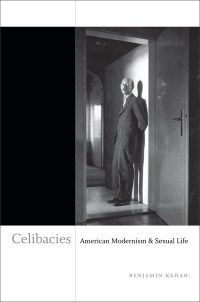
A review of Celibacies: American Modernism and Sexual Life, Benjamin Kahan, Duke University Press, 2013.
 Literary criticism has accustomed us to read sex between the lines of literary fiction. What Maisie Knew was what her parents were doing in the bedroom; The Turn of the Screw would have the heroin screwed if the door was unlocked; and Marcel Proust’s Lost Time was time not spent in the arms of his lover. According to this view, literature is when the author wants to suggest something about a person or thing, but then for whatever reason he or she may not wish to explicitly state what is on his or her mind, and so the author writes a novel, or poetry. Psychoanalysis has several words for this urge to dissimulate and beautify: sublimation, repression, transfer, displacement, defense mechanism, the conflict between the super-ego and the id. They all refer to the transformation of socially undesirable impulses into desirable and acceptable behaviors. But what if the opposite was true? What if no sex means no sex, and there is no dark secret to probe into? The French philosopher Michel Foucault hinted at this possibility in his History of Sexuality when he criticized the repressive hypothesis, the idea that western society suppressed sexuality from the 17th to the mid-20th century due to the rise of capitalism and bourgeois society. Foucault argued that discourse on sexuality in fact proliferated during this period during which experts began to examine sexuality in a scientific manner, cataloguing sexual perversions and emphasizing the binary between hetero- and homosexuality. By opposition, Roland Barthes, Foucault’s colleague at the Collège de France, proposed a concept to bypass the paradigm of sexuality and go beyond the binary construction of meaning: the Neutral. “I define the Neutral as that which outplays the paradigm, or rather I call Neutral everything that baffles paradigm,” he wrote. According to Barthes, the Neutral, or the grammatical Neuter (le neutre) operates a radical deconstruction of meaning and sexuality. It allows us to reexamine from a fresh perspective the question of le genre, understood in its dual sense of literary genre and of gender.
The repressive hypothesis
Biographies of Roland Barthes point out that he remained a bachelor all his life and shared an apartment with his mother, to whom he devoted a vibrant eulogy at the time of her death. Barthes was also a closet homosexual, never avowing in public his penchant for boys and his dependence on the gigolo trade. His works are almost silent on his sexuality. Barthes’s homosexuality concerned only a private part of his life; it was never made public, because it simply wasn’t. Homosexuality was never for Barthes anything other than a matter of sex, limited to the question of the choice of a sexual object. He wasn’t gay (a term that functions as a seal of identity), and would never have been part of the political movement for the recognition of homosexual rights. This indifference was not a repression: it was another way of expressing what being modern meant for him, even if Bathes’ modernity was closely related to a certain resistance to the modern world. In a society obsessed with the new and the rejection of conventional forms, it is attachment to the past that now constitutes a form of marginality or even clandestinity and, as such, a heroism of the ordinary. Being modern doesn’t just mean taking part in the intellectual or artistic spectacle of contemporary society. It also, and above all, means constructing meanings, words, ways of being, cultural and textual interventions that precede what a society makes available. To be modern is to make one’s desire come to language. In this sense, Benjamin Kahan’s Celibacies, a work of literary criticism and cultural history, articulates other ways of being modern. Focusing on a diverse group of authors, social activists, and artists, spanning from the suffragettes to Henry James, and from the Harlem Renaissance’s Father Divine to Andy Warhol, Kahan shows that the celibate condition, in the diverse forms that it took in the twentieth century, meant much more than sexual abstinence or a cover for homosexuality. To those who associate the notion of celibacy with sexual repression, submission to social norms, and political conservatism, he demonstrates that celibacies in the twentieth century were more often than not on the side of social reform, leftist politics, and artistic avant-garde.
Celibacies is placed under the sign of Eve Sedgwick’s Epistemology of the Closet, with a quote used as an epigraph that opens the book: “Many people have their richest mental/emotional involvement with sexual acts that they don’t do, or even don’t want to do.” Sedgwick deemed the hermeneutic practice of uncovering evidence of same-sex desire and its repression in literature, “paranoid reading.” To this trend, she opposed a reparative turn in literary studies: reparative reading seeks pleasure in the text and works to replenish the self. Sedgwick’s injunction to move from paranoid to reparative reading has been diversely followed. On the one hand, queer studies continue to read the absence of sex as itself a sign of homosexuality or of repressed desire, as an act of self-censorship and insincerity. The closeted subject has internalized social norms and keeps the true self hidden from outside views, sometimes hidden from the conscious self as well. By opposition, the queer subject brings desire to the fore, and challenges tendencies to oppose private eroticism and the systems of value that govern public interests. On the other hand, queer theory rejects normativities of all stripes, including homonormativity. It understands sex and gender as enacted and not fixed by natural determinism. Since the performance of gender is what makes gender exist, a performance of “no sex” creates a distinct gender identity: no means no, and abstinence from sex is not always the sign of repressed sexuality. It is possible to theorize gender and even sexuality without the interference of sex. But according to Kahan, celibacy is distinct from asexuality, understood as the lack of sexual attraction to others, or low or absent interest in or desire for sexual activity. Celibacy is a historical formation or a structure of attachment that can be understood as a sexuality in its own right. Its meaning has evolved in the nineteenth and twentieth centuries: it has be used as a synonym for unmarried, as a life stage preceding marriage, as a choice or a vow of sexual abstinence, as a political self-identification, as a resistance to compulsory sexuality, as a period in between sexual activity, or as a new form of gender identity organized in a distinct community culture. Celibacies used in the plural reflect these overlapping meanings and cast a light on literary productions illustrating the impact of modernism in America.
The educated spinster
Celibacy once was a recognized social identity defined by its opposite, heterosexual marriage. According to Simone de Beauvoir, “the celibate woman is to be explained and defined with reference to marriage, whether she is frustrated, rebellious, or even indifferent in regard to that institution.” Its determinants were political and economical rather than sexual or sentimental: celibacy was a necessary condition for middle- and upper-class white women to gain legal and financial independence. At the end of the nineteenth century, “marriage bars” required the dismissal of female employees upon their marriage or the prohibition of the employment of a married woman. Educated women who wanted to enter a career or a profession had to remain unmarried or to hide their marriage. They did so in large numbers: “Of women educated at Bryn Mawr between 1889 and 1908, for instance, fifty-three percent remained unwed.” For this reason, celibacy is at the very heart of the history of labor in America. It is also a key component of social mobilization and civic campaigns: in the United States, unmarried, educated women composed much of the rank and file of social movements campaigning for universal suffrage, temperance, and social purity. The centrality of celibacy for first-wave feminism cannot be emphasized enough. For the author, women’s “choice not to marry is indicative of a willingness to think outside existing social structures and thus it is associated with freedom of thought.” For their male contemporaries, it was also associated with ridicule. Women campaigning for female suffrage were belittled as “suffragettes”; and other expressions disparaged women who had chosen to stay single (“singletons,” “bachelorettes,” “old maids,” “spinsters.”) The male bachelor, by contrast, was seen as socially able to marry but having delayed marriage of his own volition; he could be characterized as “a good catch,” “a stag,” or “a jolly good fellow.”
Celibacy’s history is imbricated with the history of homosexuality. Discussing Henry James’ novel The Bostonians, Kahan investigates one of the most contested site of celibacy in the history of homosexuality: the Boston marriage. The term “Boston marriage” describes a long-term partnership between two women who live together and share their lives with one another. In James’s satirical novel, the romance between the heroin Verena Tarrant and Olive Chancellor, a Boston feminist and social campaigner, is placed on equal footing with the romance between Verena and her other suitor, Basil Ransom. This love triangle is often read as a lesbian plot: Olivia’s decision to leave her parents’ house, move in with Verena and study in preparation for a career in the feminist movement is seen as the result of a love attraction. Benjamin Kahan proposes another interpretation based on the constitutive role of celibacy as a means for independence and self-determination. The Boston marriage, which does not grow out of “convenience or economy,” is associated with collaborative literary production. It reflects Henry James’ own condition as a lifelong bachelor and his conception of authorship as a vocation. The artist, like the bachelor, is fundamentally monadic and stands apart from social spheres of influence: “rather than seeing James’s celibacy as only an element of a homosexual identity, I understand it as a crucial component of his novelistic production.” In a separate chapter examining the work of Marianne Moore, a twentieth-century American poet, Kahan sees echoes of her lifelong celibacy in her poetics and conception of time. Moore’s “celibate poetics” involve a lack of development within the poem, a lack of climax, a backwardness that reverses the passage of time, as well as pleasure in difficulty, lack of explicitness, and a style at once shy and flamboyant. Moore’s remark that “the cure for loneliness is solitude” makes solitary existence a fully contented mode of sociability and a crucial part of her poetics.
Black celibacy and queer citizenship
In his effort to make celibacy be seen as progressive and pleasurable, Benjamin Kahan underscores that the celibate condition in the twentieth century was not restricted to middle-class white women. Black celibacy was advocated by a now forgotten figure of the Harlem Renaissance, Father Divine, “an intellectual and religious leader who believed he was God.” His cult, the Peace Mission Movement, organized his followers into interracial celibate living arrangements called kingdoms. These celibate communes were a direct response to economic conditions: rents in Harlem were prohibitively high, making necessary for families to share apartments or take in lodgers. Cooperative housing also echoed the calls from Claude McKay, a socialist and a poet, to seize the means of production and organize the black community on a self-sustaining basis. Lastly, black celibacy and chastity vows countered racist depictions of the black body as oversexualized and promiscuous. By making a celibate identity available to black subjects, Father Divine allowed black men and women to participate in the public sphere and created economic and spiritual opportunities for racial equality. Celibacy was also used as a strategy for queer subjects to circumvent the prohibition preventing homosexual immigrants from becoming American citizens. Before the passage of the McCarran-Walter Act in 1952, the queer citizen could, according to the letter of the law, belong to America so long as he remained celibate or was not “caught in an act of moral turpitude.” The British poet W. H. Auden became an American citizen in 1946 by practicing “cheating celibacy,” a position both inside and outside the rules that he thematized in his 1944 poetic essay The Sea and the Mirror: A Commentary on Shakespeare’s The Tempest”. This long poem is a series of dramatic monologues spoken by the characters in Shakespeare’s play in which Caliban renunciates his former self in favor of a queer form of belonging. But as Kahan notes, “black queer writers like Claude McKay, James Baldwin, and Langston Hughes had significantly less ability to move in and out of America’s borders than white authors like Auden.”
Kahan’s choice to associate Andy Warhol with celibacy is disconcerting. The pop artist was openly gay and had a reputation for promiscuity and swishiness. His art collective, the Factory, was populated by “drag queens, hustlers, speed freaks, fag hags, and others.” But “‘gayness’ is not a category that we can control in advance.” If Warhol’s declarations can be taken at face value, he claimed that he didn’t have any sex life: “Well, I never have sex” and “Yeah. I’m still a virgin,” he responded in an interview. Evidence also suggests that the Factory wasn’t the “Pussy Heaven” or “Queer Central” journalists once described: according to one witness, celibacy organized life at the Factory, and Warhol’s abstinence from sex shaped relations of power and subjection. As Kahan sees it, the tradition of celibate philosophers underwrites the Factory’s mode of government and theorizes a concept of group celibacy. Warhol’s marriage to his tape recorder exemplified his rejection of traditional marriage and emotional life: “I want to be a machine.” In the view of a contemporary, “everything is sexual to Andy without the sex act actually taking place.” His celibacy operates at a zero degree of desire. My Hustler, his 1965 movie with film director Paul Morrissey and actor Ed Hood, presents a twisted celibate plot characterized as much by sexlessness as by sex. Valerie Solanas tried to kill Andy Warhol in 1968 because she claimed “he had too much control of [her] life”. In the SCUM Manifesto she published before her attempted murder, the radical feminist urged women to “overthrow the government, eliminate the money system, institute complete automation and destroy the male sex.” Kahan places both Warhol and Solanas in a tradition of philosophical bachelorhood that precludes sex in favor of alternative modes of governance.
Celibate readings
In the conclusion of Celibacies, Benjamin Kahan argues that celibacy should not be abandoned to the American political right, with its apology of abstinence before marriage and traditional gender roles. Celibacy from the 1880s to the 1960s has been on the side of reform and modernism. Celibate women could access public space and the professions at a time social norms prevented educated married women from entering the workforce. In the 1930s, celibacy was a possible option availing economic advantages to African-Americans in Harlem or allowing queer foreigners to access U.S. citizenship. Celibacy could also be a philosophical choice or a condition for artistic production. Having a room of one’s own was easier when one didn’t have to share the apartment with another person or raise a family. Forms of celibacies have also been animated by “sexual currents, desires, identifications, and pleasures.” Celibacy’s imbrication with homosexuality is not just a modern invention: depictions of “Boston marriage” in the late nineteenth century had strong implications of lesbianism. But celibacy was not only a pre-homosexual discourse or the result of sexual repression: it was a form of sexuality in its own right, entailing a more radical withdrawal than is the case with the closet homosexual or the scholar practicing sexual abstinence. No sex means sex otherwise, or a different form of sexuality. Looking to literary works of fiction and poetry through the prism of celibacy leads to valuable insights: Kahan reads a “celibate plot” in Henry James’ The Bostonians or Andy Warhol’s My Hustler, and highlights a “celibate poetics” in the poems of Marianne Moore or W. H. Auden. This book is published in a series devoted to queer studies because, as the author argues, “celibate and queer readings overlap without being coextensive.” Much as queer theory has the effect of “undoing gender,” the primary purpose of the Neutral according to Roland Barthes is to undo the classifying function of language and thus to neutralize the signifier’s distinctive function. “L’écriture célibataire” is the form the Neutral took in American modernism.
 The Duke Reader