
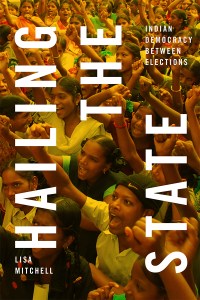
A review of Hailing the State: Indian Democracy between Elections, Lisa Mitchell, Duke University Press, 2023.
 We are tirelessly reminded that India is “the world’s largest democracy.” In times of general elections, like the one taking place from 19th of April to 1st of June 2024, approximately 970 million people out of a population of 1.4 billion people are called to the ballot box in several phases to elect 543 members of the Lok Sabha, the lower house of India’s bicameral parliament. The election garners a lot of international attention. For some, it is the promise that democracy can flourish regardless of economic status or levels of income per head: India has been one of the poorest country in the world for much of the twentieth century, and yet has never reneged on its democratic pledge since independence in 1947. For others, it is the proof that unity in diversity is possible, and that nations divided along ethnic, religious, or regional lines can manage their differences in a peaceful and inclusive way. Still for others, India is not immune to the populist currents menacing democracies in the twenty-first century. For some observers, like political scientist Christophe Jaffrelot, India’s elections this year stand out for their undemocratic nature, and democracy is under threat in Narendra Modi’s India. And yet India is a functional democracy where citizens participate in voting at far higher rates than in the United States or Europe. Lisa Mitchell’s book Hailing the State draws our attention to what happens to (as the book’s subtitle says) “Indian democracy between elections.” Except during general election campaigns, foreign media’s coverage of Indian domestic politics is limited in scope and mostly concentrates on the ruling party’s exercise of power in New Delhi. Whether this year’s elections are free and fair will be considered as a test for Indian democracy. But as human rights activist G. Haragopal (quoted by the author) reminds us, “democracy doesn’t just means elections. Elections are only one part of democracy.” Elected officials have to be held accountable for their campaign promises; they have to listen to the grievances of their constituencies and find solutions to their local problems; they have to represent them and echo their concerns. When they don’t, people speak out.
Repertoires of protest
They do so in distinctly Indian ways, using repertoires of protest that differ markedly from modes of action used in other democracies. During the Telangana movement to create a separate state distinct from Andhra Pradesh, people resorted to roadblocks on state and national highways, rail blockades, fasting vows or hunger strikes, mass outdoor public meetings, strikes or work stoppages, sit-ins, human chains, processions, and marches to the capital. Collective mobilizations acquired grand names such as Mahā Jana Garjana (lit., “great roar of the people”), Sakala Janula Samme (general strike; lit., “All People’s Strike”) or Dilli Chalo (“Let’s Go to Delhi”) movements, while more ordinary practices were designated as garjanas (mass meetings), dharnās (sit-ins), padayātras (foot pilgrimages), and rāstā (blockades) and rail roko actions. During the 2020–2021 Indian farmers’ protests against three farm bills that were passed by the Parliament of India in September 2020, Tamil Nadu farmers resorted to various techniques to gain political attention, including “shaving half their beards and hair, displaying skulls and femur bones purported to be from farmers who had committed suicide, eating rats and snakes, marching in the nude to the prime minister’s office, and vowing to drink their own urine and eat their own feces.” According to Lisa Mitchell, we should not see these practices as specific to southern Indian states or linked with low-status caste or religious-based identitarian politics. First, these registers of political participation are not marginal to Indian democracy: “the many collective assemblies that sought to hold elected officials accountable to their promises to create the new state of Telangana are just one set of examples of the many similar practices that animate India’s wider political terrain.” Second, these collective modes of assembly serve a political function: they are “widely seen in India as everyday communicative methods for gaining the attention of officials, making sure that election promises are implemented, and ensuring the equitable enforcement of existing laws and policies.” And third, these mass protests have a history that predates the institution of Indian democracy, finding their roots in colonial times and even in the precolonial efforts to gain audience with domestic rulers.
Lisa Mitchell defines “hailing the state” as “a wide range of practices that can be grouped together around their common aim to actively seek, maintain, or expand state recognition and establish or enhance channels of connection to facilitate ongoing access to authorities and elected officials.” The expression inverts or subverts the state tactic identified by French philosopher Louis Althusser as “hailing” or “interpellation” by which a state official—in the Althusserian vignette, a policeman—interpellates a citizen with a halting order (“Hey, you!”). For Michel Foucault, a disciplinary society is a society where one becomes a docile body due to the presence, or threat of, constant surveillance and discipline. In political analysis inspired by Marxism or Foucaldian studies, the capitalist state is always on the side of oppression or surveillance and subjects are drawn to passive submission or led to active resistance. According to anthropologist James Scott, “weapons of the weak” include everyday forms of resistance such as footdragging, dissimulation, false compliance, pilfering, feigned ignorance, slander, arson, sabotage, and so forth. But as Lisa Mitchell notes, many collective actions of protest are in fact efforts to seek recognition and inclusion by state authorities, not to subvert or to bypass them. In both the Telangana movement and the 2020-21 farmers’ protests, the demands made were not for the overthrow of the state, but rather for dialogue with representatives of the state, for inclusion within the processes that would determine state policies, and for the fulfillment of earlier political promises that had not yet been realized. Failure to achieve recognition forces petitioners to amplify their voices in order to be heard by public administrators, political leaders, and the general public: “when one’s interests are ready well represented and one can be certain that one’s voice will be heard, there is little need to mobilize collectively in the streets. However, when one’s voice and interests repeatedly fail to find recognition, an alternative is to make one’s articulations more difficult to ignore by joining together in collective communicative action.”
Turning up the volume
Hailing the State is organized around seven sets of collective mobilizations: (1) sit-ins (dharna) and hunger strikes (nirāhāra dīkṣa); (2) efforts to meet or gain audience (samāvēśaṁ) with someone in a position of authority; (3) mass open-air public meetings (garjana); (4) strikes (samme, bandh, hartāl); (5) alarm chain pulling in the Indian railways; (6) road and rail blockades (rāstā and rail roko agitation);and (7) rallies, processions, and pilgrimages to sites of power (yātra, padayātra), along with the mass ticketless travels that often enable these gatherings. These social movements are not the expression of preexisting cultural identities; on the contrary, as Mitchell shows, Telangana or Dalit identities are constructed out of collective action and are the result of efforts to amplify voices and have them recognized. Actors who seek recognition, connection with, or incorporation into structures of state power are drawn together by a common desire to gain visibility and inclusion. Rather than ascribing a different “culture” to subaltern counterpublics and explaining differences in political repertoires by differences in underlying ideologies, we should consider that the styles of public expression are produced through failure of recognition and unequal access to power. Distinctions in the level of responsiveness by authorities to various individuals and groups explain the civility and order, or violence and unruliness, by which collective claims are made. Subaltern actors are not more prone to violence and angry protest than elites; it is just that the later usually settle their problems with ruling powers behind closed doors and without having to raise their voice, whereas the former are forced to find ways to amplify their voices. Speaking softly or writing in moderate tones is a condition of privilege, based on the expectation that one’s voice will be heard and acknowledged. We should not dismiss the masses firsthand as unruly, angry and uncivil, without considering that for them the “conditions of listening” are often not in place. Likewise, we should not draw a sharp line between the practices of “civil society” and those of “political society,” or between public places open to collective political activity and other urban venues devoted to circulation or economic activity.
Many acts of civil disobedience or nonviolent protest in India are associated with Mahatma Gandhi and the legacy of his struggle for Indian independence. Yet a history of these practices shows that they have very ancient roots, and that they didn’t stop with independence. Fasting and threatening to commit suicide at the doorstep of a powerful person, or assembling in a designated place to gain audience and present petitions are repertoires of practice recorded in ancient Hindu scriptures and colonial archives. Local rulers were usually quite responsive in promising redress to such appeals, at which point the fasting brahmin or the gathering crowd would return home and resume daily activities. Similarly, as Mitchell notes, “work stoppages, mass migrations, and collective strikes to shut down commerce and transportation are evident in South Asian archival sources from at least the seventeenth century, perhaps even earlier, and were clearly used to make representations to state authorities at the highest level.” Later on, East India Company officials and then British colonial administrators were unable to comprehend the social context of petitioning and therefore invariably took any large demonstration to be an act of hostile rebellion. They referred to the collective actions as “combinations” or, less generously, as “insurgencies,” “mutinies,” insurrections,” “revolts,” or “rebellions,” even when their participants sought only to gain an audience with officials in circumstances in which earlier communicative efforts were ignored or refused. When collective actions did become violent, it was often in response to authorities firing on crowds to silence and disperse them. Leaders of the newly independent India in 1947 largely inherited both the ideological perspective on collective assembly and the legal and policing systems established by the British. But they were never entirely successful in eliminating the collective practices that offered time-tested models for effectively engaging and communicating with officials, authority figures, and others in positions of power.
Railways democracy
Public transportation networks play a central role in the organization of collective political actions. Streets, highways, intersections, railway stations, rail lines, and road junctions are sites where people gather, claims are made, and communication with the state is pursued. A history of Indian democracy would not be complete without mentioning the role railways traffic and infrastructure have played in creating a common polity. As soon as they were built, the railways became a key target of anticolonial protest. Practices such as alarm chain pulling, rail blockades known as roko, and ticketless travel to join political rallies were so common that they eventually came to be redefined by the government as political manifestations, and efforts to impose penalties on perpetrators were lifted. Disruption of rail traffic reached such heights and became such a regular challenge to authorities that the Indian Railways developed a policy of mitigation and adaptation, adding additional wagons to accommodate the large numbers of people traveling without tickets to mass meetings or authorizing the stoppage of a train for a brief moment in order to allow demonstrators to have their picture taken by the media before clearing the way. Political scientists have underscored the role of the printing press or the mass media in the emergence of a public arena and the rise of democratic governance. Similarly, railways in India have been an effective medium of political communication. Halting a train in one location enabled a message to be broadcast up and down the entire length of a railway line, forcing those from other regions to pay attention to the cause of a delay. Road blockages have become equally important ways to convey political messages. Genealogies of democracy in India should not only focus on deliberative processes and political representation, but should also include material infrastructures such as railways and roads. Democracy is something people do, and places of participation and inclusion are a fundamental part of what democracy means.
Hailing the State is based on archival evidence and ethnographic observation. The author has documented the social movement that led to the creation of a separate Telangana state, the result of sixty years of mobilization by Telangana residents for political recognition. This movement culminated on June 2, 2014 with the creation of India’s twenty-ninth state, which bifurcated the existing Indian state of Andhra Pradesh. Proponents of a separate Telangana state felt that plans and assurances from the state legislature and Lok Sabha had not been honored, and mobilized to hold government officials accountable to their promises. They cultivated a distinct cultural identity based partly on a variant of the Telugu language, and resented having their accent ignored or mocked by speakers coming from coastal Andhra. Lisa Mitchell also documents other social movements led by Dalit students, women, and peasants in India’s southern states. Her archival work led her to exploit the archives of Indian railways, documenting the debates around alarm chain pulling and roko rail blockades over the twentieth century. Her book is also theoretically ambitious. In her text and in her endnotes, she discusses the ideas of European philosophers like Althusser, Foucault, Balibar, Lefebvre, and Habermas, highlighting their insights and perceptiveness but also their biases and shortcomings. Mitchell invites us to “decenter England (and Europe more generally) as the ‘precocious’ and normative site for historical innovation in collective forms of contentious political action.” The way democracy works in India between elections holds lessons for the rest of the world. In particular, observers would have ben less puzzled by the various Occupy movements in Western metropoles (and the Yellow Vests protests in France) had they paid any attention to the Telangana movement or other forms of collective public performances in southern India.
The India Stack
Democracy these days is becoming more abstract and dematerialized: from online consultations to e-governance, people increasingly turn to the internet for information about their rights, delivery of social services, and feedback about public matters. Digital government is supposed to enhance governance for citizens in a convenient, effective, and transparent way, eliminating opportunities for corruption and embedding democratic processes in the information infrastructure. India is at the vanguard of this movement: with a vision to transform India into a digitally empowered society and knowledge economy, the government has digitized the delivery of vital services across various domains, ensuring transparency, inclusivity, and accessibility for all citizens. The “India Stack” includes Aadhaar, the world’s largest digital ID programme; the United Payments Interface (UPI), India’s homegrown real-time mobile payments system; and the Data Empowerment and Protection Architecture (DEPA), India’s version of the General Data Protection Regulation in the European Union. But e-government and personal identity numbers can also be used to limit political access to persons in position of power or to reduce opportunities for recognition and face-to-face communication. As Lisa Mitchell notes, the decision to launch a website for receiving online petitions and substitute it to direct access was met with great protest. The removal of Dharna Chowk, Hyderabad’s designated place for assembly and protest, to a site far away from the center of power was perceived as an authoritarian effort to silence dissent and limit political opposition. Foreign observers often deride the institution of granting audience, whereby citizens wait in line to meet a government official and petition for justice, relief, or favor, as the remains of a “feudal mindset” inherited from Mughal administrators and British officers. But Indian citizens are attached to their own ways of hailing the state, and such collective performances are neither antithetical nor incidental to the functioning of India’s democracy between elections.
 The Duke Reader