
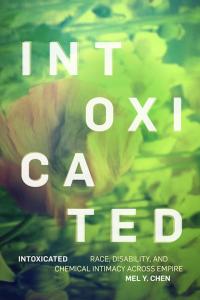
A review of Intoxicated: Race, Disability, and Chemical Intimacy across Empire, Mel Y. Chen, Duke University Press, 2023.
 Mel Y. Chen’s Intoxicated: Race, Disability, and Chemical Intimacy across Empire is a critical exploration of how race, disability, and sexuality intertwine through the lens of toxicity and intoxication. As a scholar whose work spans queer theory, critical race studies, disability studies, and more, Chen crafts a text that is both intellectually rigorous and deliberately disorienting, challenging readers to rethink conventional frameworks of knowledge production. This “strange book,” as Chen describes it, is not meant to offer neat conclusions but aims to unsettle, agitate, and invite readers into an “intoxicated method” of unlearning and reimagining. It is based on autobiography and personal experience rather than the constraining textures of academic disciplines. In their first book, Animacies: Biopolitics, Racial Mattering, and Queer Affect, which I reviewed here, Mel Y. Chen identified themselves as Asian American, queer, and suffering from a debilitating illness. They adopted the gender-neutral pronoun “they” or “them” to refer to oneself in the third person of the singular and gave some elements of their biography: growing up in a white-dominated town in the Midwest when they used to hear racist slurs thrown at them; being a first-generation student in a California college while their Chinese immigrant parents could barely master standard English; alluding to a female love partner while referring to their own queerness or kinkiness; mentioning various mental and physical impairments, among which multiple chemical sensitivity due to heavy metal poisoning.
A second book
Ten years later, and after having edited a primer on Crip Genealogies in the same academic publishing house (also reviewed here), Mel Chen is back in the game with a “second book” that bears the mark of the genre: less experimental and risk-taking, more assured in the legitimacy of its intellectual position, but also based on more limited archival research or fieldwork, also with a fair deal of repetition and cross-references. The autobiographical elements are still there: again, Mel Y. Chen defines themselves as neurodivergent (“even if I have an unstable relationship with the linguistic signification of this term”) and suffering from various ailments (“my asthma, my bleeding, my sickness”; “rolling migraines”). They survived a car accident in 1999 but “my knee and hip remain quirky.” They confess of being consecutively “slow” and “agitated,” alternating between bouts of “agitated reading, slow thinking, agitated writing, slow reading, agitated thinking, slow writing.” Perpetually experiencing a “brain fog,” Chen doesn’t often get stoned or high on drugs, but they confess they did on a particular occasion, which made them feel a lot better. It is not clear why Chen discloses all these autobiographical elements—“despite being a very private person,” they confess—, but the reason may have to do with campus politics as it is practiced in North American universities. There, academics state their positionality and indicate “from where they speak” in order to acknowledge how their personal identities, experiences, and social locations shape their research process and findings. Intoxicated is more concerned with “the politics of knowledge in the academy” than in autobiography per se. Mel Y. Chen positions themselves in the classroom or the lecture hall and tells of various interactions with the public. They describe talking back to contradictors on the use of non-binary pronouns (they/them/theirs) or confronting their feeling of compassion for people with disabilities, which Chen personally finds sickening.
Intoxicated is structured with an introduction, three chapters, and an “Afterwards,” each engaging with the concept of intoxication as a mode of understanding the entanglements of empire, race, and disability. Chen draws on nineteenth-century biopolitical archives from England and Australia, examining how colonial powers constructed racialized and disabled subjects through discourses of toxicity. Key examples include English scientist John Langdon Down’s characterization of intellectual disability (then termed “mongoloid idiocy”) as an “Asian interiority” and Queensland’s targeting of Aboriginal peoples under the guise of regulating black opium. These historical cases anchor Chen’s broader argument that intoxication—both literal and metaphorical—shapes marginalized subjects, often marked by “slowness” or agitation. The book’s chapters are not traditional case studies but rather “slantwise” explorations that weave together archival analysis, personal anecdotes, art, and contemporary political moments. Chapter 1, “Slow Constitution,” connects Down syndrome to colonial logics of development, revealing how racial and disability discourses converge. Chapter 2, “Agitation as a Chemical Way of Being,” explores opium’s role in imperial governance, while Chapter 3, “Unlearning: Intoxicated Method,” proposes intoxication as a reflexive, non-linear approach to knowledge. The “Afterwards” reflects on the ongoing reverberations of these entanglements, urging readers to embrace ambiguity over closure.
An intoxicated method
Chen’s greatest strength lies in their refusal to conform to traditional academic norms. The “intoxicated method” is a bold critique of linear, extractive scholarship, favoring instead a diffuse, atmospheric approach that mirrors the porous nature of toxicity itself. This method is particularly compelling in Chen’s analysis of historical archives, where the author illuminates how colonial administrations used intoxication to racialize and disable subjects. For instance, Chen’s discussion of Down’s racialized framing of intellectual disability is a revelatory critique of Western racial science in the 1870s, showing how disability was constructed as a “throwback” to a “primitive” Asian race. The reference to “Mongolism” or “Mongolian idiocy,” officially replaced by the medical category “Down syndrome” in 1972, is by no means a thing of the past: it still lingers in peoples’ minds, shaping attitudes and perceptions. It equates Asian features with disability, insulting both communities: Asians via racial caricature, and people with Down syndrome via dehumanizing pathologization. For Chen; this racist slur also has a personal feel: as an Asian American, “this was something I’d grown up with.” But perhaps more offensive that racial slurs and micro-aggressions was the feeling of compassion and empathy that they encountered at various stages of their research. Visiting the archives of British clinician John Langdon Down, best known for his description of the genetic condition that was later named after him, the author heard the librarian trying to exculpate the eminent physician for his use of the term “mongoloid”: “Of course, people didn’t know better at the time.” Similarly, during a seminar in South Africa, a white middle-aged woman came to the lecturer to argue that early concerns for disabled peoples were inspired by care and compassion, and that they should be redeemed as such. In these awkward situations, Chen is very attentive to eyes movements: people trying to evade the author’s gaze, or trying to lock vision with moisty and pleading eyes. For Chen, “some of these moments feel so queasy and out of time that they threaten being beyond inquiry, beyond mention.”
Mel Y. Chen is very sensitive to any reference to toxicity in the archives, especially when they relate to race and disability. As an abundant scholarship has established, indigenous peoples and racial minorities often face disproportionate exposure to toxic chemicals, a pattern known as environmental racism. Ethnic minorities in the US experience higher ambient air pollution, higher rates of toxic pollution from minerals (lead, mercury, cyanide) or from agribusiness pesticides, and have less access to affordable medical care. Other instances of intoxication in relation to race include the alcoholic proclivity among Native Americans or Pacific Islanders, or the infamous legacy of the opium trade in China. The overlap between race and debility has also been well documented and by no means limits itself to the case of the “mongoloid” designation. For Mel Y. Chen, the association of certain racial characteristics with cognitive deficiency continues insidiously in the United States and elsewhere: “Disability continues to lurk in the description of races and may lurk in the defining theme of race itself, race as a colonial trope of incapacity.” Less noticed is the role of toxicity in relation to debility and disablement. Chemicals like lead, mercury, benzene, pesticides, and solvents disrupt neurological, respiratory, and organ function, leading to lifelong impairments. Prenatal or early childhood exposure can contribute to developmental delays and mental retardation. Mel Y. Chen triangulates these three tropes of analysis into a race-disability-intoxication nexus. “Intoxication, they note, often lurk in scenes where race and disability come together” (one could add add sexuality, or queerness, to this conundrum). Chen puts great emphasis on the fact that nineteenth-century physician John Langdon Down used opium to sedate some of his disabled patients in his English clinic (although that must have been standard practice at the time). The opium trade, in its chemical, racial, and debilitating dimensions, is another instantiation of this triangle that stands at the core of Intoxicated.
The race-disability-intoxication triangle
The book’s interdisciplinary scope is another strong point. Chen seamlessly integrates critical ethnic studies, queer theory, and disability studies, while also engaging with art, pop culture (e.g., zombies as disabled figures), economics (“toxic assets” threatening financial health), and personal narratives. This expansive approach makes the book a rich text for scholars across fields, particularly those interested in how toxicity operates as a biocultural and political force. Critical race studies scholars will find in Intoxicated and its intersection of overlapping figures(Asian, disabled, intoxicated) a sharp contrast to the image of the Asian American as a model minority. The “model minority” figure, or myth, has been central to Asian American Studies as both a foundational critique and a persistent object of analysis. It shaped the discipline by prompting scholars to debunk stereotypes and reveal intra-group disparities. Associated to the model minority figure are the invisibility of Asian populations in the US context, their supposed discretion and effectiveness in the classroom or at the workplace, as well as the frailed masculinity of Asian men and the docile feminity of Asian women. The model minority model portrays Asian men as desexualized, emasculated, or effeminate; hardworking but passive, lacking leadership or physical prowess. Conversely, Asian women face hypersexualization as aggressive “Tiger Moms,” submissive Madam Butterfly, exotic Lotus Blossoms or seductive dragon ladies. The least one can say is that Mel Y. Chen doesn’t fit this model minority slot. To the docile and obedient figure of the Asian American student or scholar, they oppose “agitation as a chemical way of being.” The book crafts a different place for Asian Americans or for Asians, more rebellious and committed to the affirmation of each individual’s identity. More exposed to toxic attacks and poisonous libels, this non-normative identity is also paradoxically more resilient.
Chen’s affirmative stance on queer/crip forms of learning and unlearning is also noteworthy. Rather than framing intoxicated subjects as mere victims of pollution or failure, Chen celebrates their capacity for worldmaking under imperialism. This perspective is refreshing, offering a hopeful counterpoint to the often grim realities of colonial violence. Much like “queer” reclaims a slur for LGBTQ+ identities, people claim “crip” (a reclaimed slur for “cripple”) as a disability identity to express pride, reject ableism, and build community solidarity. Both draw from theory and are firmly rooted in academia: crip theory adapts queer methods to undo mainstream practices, revealing ableist exclusions. Professors routinely foster “agitation” through discussions that unsettle students’ assumptions—critiquing compulsory able-bodiedness or binary identities. Crip and queer pedagogies use fluidity and “crip time” to co-construct access, rejecting rigid norms of proper behavior. Chen welcomes, even encourages, agitation in the classroom. “When I begin classes or deliver talks, they note, I have developed the practice of opening them with an invitation to be otherwise.” Students are allowed “to rock, to twitch, to stand when others are not standing or to sit when others are standing.” Illegitimated expressions, such as wrong or slow cognition and agitated gesture, or incoherent behavior, usually end in the exclusion from places of higher learning. “Cognitive or intellectual disability—and its broad matrix of cognitive variation—is the near unthinkable for academia.” And yet some characterization of neuroatypicality seems standard for academics, whose work often gravitates towards solitary research, deep focus, and contestation of accepted theories. Differences should be celebrated, not frown upon, in an environment devoted to the production of new ideas and unconventional methods.
Here’s to the crazy ones
Despite its brilliance, Intoxicated is not without flaws. Its experimental style and compressed length (190 pages) can leave readers disoriented. Some readers may express frustration with the book’s “jumpy” pacing and lack of clarity around key concepts like “chemical intimacy.” While Chen’s intention is to resist “thorough aboutness,” this approach risks alienating readers who seek more concrete definitions or sustained analysis. For example, one may get the impression that the book’s most compelling moments—such as personal anecdotes or detailed historical discussions—are often too brief, overshadowed by dense theoretical detours. Additionally, the book’s ambitious scope can feel overwhelming. Chen’s attempt to cover vast temporal and thematic ground—spanning centuries, continents, and disciplines—sometimes sacrifices depth for breadth. Readers hoping for a focused exploration of environmental racism, for instance, may find the emphasis on intoxication diffuse. Intoxicated is best suited for graduate students, scholars, and readers comfortable with dense, theoretical texts and non-linear arguments. It is not an easy read, but its rewards lie in its ability to unsettle and inspire. For those studying race, disability, or empire, Chen’s work is a brilliant, if challenging, invitation to rethink how we engage with the toxic legacies of colonialism. I recommend approaching it with patience, ready to embrace its ambiguities as part of its intoxicated method.
 The Duke Reader