
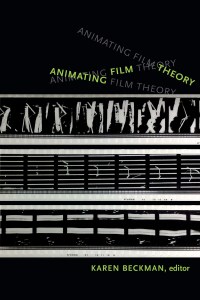
A review of Animating Film Theory, edited by Karen Beckman, Duke University Press, 2014.
 I must confess I am averse to film theory. The little I have read in this field confirms me in my opinion: film theory is empirically useless, epistemologically weak, and aesthetically unappealing. Nothing of substance has been written about the topic since Plato’s Cave, the allegory that has people watch shadows projected on the wall from objects passing in front of a fire behind them and give names to these shadows. The books and articles that are collated to form the discipline’s canon are a mixed bag of philosophical references, journalistic musings, and academic jabber. In my opinion, Deleuze’s two-volume work on film, The Movement-Image and The Time-Image, are among his weakest books. They do not amount to a philosophy of cinema, or a theory of film: at best, they are reflections on time and space that take cinema as a pretext and Bergson as an interlocutor. In textbooks and introductory chapters, film theory is a collage of quotations by cultural critics, mostly from the early twentieth century, who have commented on the birth of cinema in the context of mass culture and reproduction technologies. Remarks written in passing by Walter Benjamin or Theodor Adorno are elevated to the rank of high theory and revered as sacred scriptures by a discipline desperately in need of founding fathers. The French contributors to the Cahiers du Cinéma dabbled in film critique as a hobby and did not think of themselves as serious thinkers: they were puzzled to see cinema studies emerge as an academic discipline, and they certainly would have disapproved the emergence of a canon of officially approved texts that includes their own. When film theory tries to build a firmer intellectual grounding, it mobilizes thinkers who have written outside the purview of cinema studies and have never commented on films: Saussure, Lévi-Strauss, Derrida, Lacan, or Baudrillard. Gilles Deleuze for the French domain and Stanley Cavell in America stand as the two exceptions: they have devoted whole books to cinema as part of a program of applied philosophy. My preference goes to Cavell over Deleuze.
Animated films and live-action movies
My biases against film theory were compounded by this volume on animation film theory. If a theory of films rests on shaky ground, what about a theory that takes animated movies as its object and proposes to build an autonomous discourse on this subset of film media? A discipline is not defined by its empirical topic, but by its methods and the way it builds a scientific object as a matter of scholarly investigation. The existence of animated movies and frame-by-frame films—which predate the birth of cinema—is in itself no justification to devote an academic discipline to their study and to engage them theoretically. I do not mean to say that animation movies should be forever marginalized and ignored by cinema specialists and cultural critics. They can provide food for thought for many disciplines and, in some instances, are valuable sources of theoretical engagement. But a discourse on animation does not a theory make. Building an animation theory has more to do with intellectual posturing and academic differentiation than with scientific rigor and sound scholarship. A caricature of the attitude that I have in mind is provided by Alan Cholodenko’s contribution to this volume. An American-Australian scholar who retired in 2001 from the University of Sidney, Cholodenko describes himself as the godfather of animation theory: “theorizing of and through animation has been my project for the last twenty-three years.” His claim of having come first to lay the “first principles” of the discipline doubles the proposition that “historically as well as theoretically, film is the ‘stepchild’ of animation, not the other way around.” Drawing inspiration from the work of Jacques Derrida and Jean Baudrillard, and postulating animation as the mother of all disciplines, his contribution to this volume amounts to little more than self-promotion and personal aggrandizement.
What came first, film or animation? And who can claim the privilege of having “invented” animation cinema, in theory and in practice? A central tenet of the fledgling discipline is that animation represents the past and the future of all cinema. Lev Manovich, an author of books on digital culture and new media, made that claim in 2001: “Born from animation, cinema pushed animation to its periphery, only in the end to become one particular case of animation.” The division of cinema into live action and animation has been recently blurred by the digital turn: through CGI and pixel-by-pixel editing, live-action movies are merging with animation in a way that makes them undistinguishable. The cartoonization of live-action movies is propelled by special effects and computer graphics that makes whatever the mind can conceive achievable on screen. Some actors, Jim Carrey for instance (but the same could have been said of Charlie Chaplin or Buster Keaton), have built a whole career acting like cartoon characters. Contributors to Animating Film Theory show that the dividing line between film and animation has never been clear-cut. Photographs and moving pictures have always been mixed with drawings and text editing, such as in Dziga Vertov’s Kino-Pravda (Film Truth) experimental newsreel series in 1922-25, or in cartoons in which drawings “come to life” or live scenes are inserted in graphic sketches, a common practice since the silent movies era down to Robert Zemeckis’ Who Framed Roger Rabbit (1988). The incorporation of animated beings into real-world settings is only one example of the blurring of distinctions between animation and film. Whole movies, like Disney’s 2019 version of The Lion King, are photorealistic renderings of live action scenes in which each detail of character and scenery is animated step-by-step by computer graphics (the sole non-animated shot in the entire film is the sunrise in the opening scene.)
The French did it first
The history of animation intersects with movie history but they do not necessarily move at the same pace. The Lost World (1925) was the first feature-length film made in the United States, possibly the world, to feature model animation as the primary special effect, or stop motion animation in general. The Enchanted Drawing is a 1900 silent film best known for containing the first animated sequences recorded on standard picture film, which has led its director J. Stuart Blackton to be considered the father of American animation. As for the first animated cartoon, it is attributed (by the French) to Emile Cohl, who produced the short movie Fantasmagorie in 1908. Others point to the French inventor Charles-Emile Reynaud and his 1877 patent of the praxinoscope, an animation projection device that predated the invention of the cinématographe by Louis Lumière in 1895. Other optical toys from the nineteenth century or earlier go by the names of zoetrope, thaumatrope, phenakistoscope, and camera obscura. Likewise, animation film theory has many fathers and the competing quest for precursors, pioneers, and key figures oppose various nations, periods, and individuals. One (French) contributor to this volume casts a Frenchman named André Martin as “the inventor of animation cinema” and 1953 as the date when his invention was recorded. Another (Japan specialist) author exhibits another figure, Imamura Taihei, as the first critic to devote a whole book on animation, A Theory of Cartoon Film, first published in 1941. It turns out André Martin used the expression “cinéma d’animation” in the body of a Cahier du Cinéma article about the Cannes festival, thereby donning prestige and dignity to a genre situated at the intersection between “le septième art” (French jargon for movies) and “le neuvième art” (graphic novels and comic strips). As for Imamura Taihei, he confirms the fact that Japan stands as a key site for animation and for theory. His genealogy of cartoons and comic strips goes back to the twelfth century’s emaki picture scrolls, and also includes acting techniques found in the Nō theater and folding screen paintings from the Edo period.
To build a theory of animation, Karen Beckman, the editor of this volume, has mined systematically the writings of film theory specialists to search for references to animation. As she states in the opening chapter, “animation’s persistent yet elusive presence within film theory’s key writings make it both easy to overlook and essential to engage.” These key writings include texts by Norman McLaren, Peter Kubelka, Vachel Lindsay, Jean Epstein, Béla Balázs, Germaine Dulac, Miriam Hansen, and André Bazin, none of which I was familiar with. Throughout the book, the rare mentions of cartoons and animation movies in the writings of cultural critics and philosophers are treated as precious discoveries. Theorists of film and mass culture such as Sergei Eisenstein, Walter Benjamin, and Theodor Adorno repeatedly turned to Disney cartoons and Looney Tunes characters in articulating their reflections on aesthetics and politics. Eisenstein devised a category of “plasmaticness” that he evoked in order to stress the originary shape-shifting potential of the animated movie, the way an object or image can potentially adopt any form. For Benjamin, “Mickey Mouse proves that a creature can still survive even when it has thrown off all resemblance to a human being. He disrupts the entire hierarchy of creatures that is supposed to culminate in mankind.” Adorno and Horkheimer found nothing funny about cartoons and argued that Donald Duck actively participated in the violent oppression of the proletariat by the forces of capitalism. Writing later in the century, Stanley Cavell mulled over the “abrogation of gravity” in cartoons where Sylvester the Cat or Wil E. Coyote run over the edge of a cliff and continue their course in midair. This allows the author of the last chapter in the volume to enunciate the “first theorem of cartoon physics”: “Any body suspended in space will remain in space until made aware of its situation” (the second theorem states that “Any body passing through solid matter (usually at high velocity) will leave a perforation conforming to its perimeter”.)
Cartoon physics
Animation theory is not necessarily tied to film theory: indeed, many contributions to this volume do not start from the pantheon of film theory authors or the key concepts of the discipline. Animation can be engaged with and theorized from other perspectives: as a strand of critical thought that focuses on subaltern cultures, as in Japan, or within an epistemology of scientific objectivity and experimental representation, or from the point of view of graphic art history and media art. Several chapters focus on the link between scientific visualization practices and the history of animation. The scientific experiment plays a central role in the history of cinematography. Animation itself rests on a scientific fact: by presenting a sequence of still images in quick enough succession, the viewer interprets them as a continuous moving image. This persistence of retinal perception was exploited by the early devices of animation that used a series of drawn images portrayed in stages in motion to create a moving picture. One contributor even sees the origins of 3D animation in a 1860 invention by French entrepreneur François Willème. A glass dome, housing a perimeter ring of twenty-four cameras directed inward at a central subject, allowed camera shutters to open simultaneously to produce a “photosculpture” that was not unlike the bullet-time sequence in the film The Matrix. The experiment of film allows the viewer to experience the world in a novel way: animation, like the scientific experiment itself, becomes the way to think at the limit of understanding in an attempt to get past that limit. Scientific uses of animation include medical anatomy and health education, dimensional modeling in biology or in physics, mathematical abstraction, and all kinds of pedagogical materials. Animated images do not only illustrate: they are instrumental in the process of discovery. Climate science would be less potent without the time-lapse images of shrinking glaciers and melting polar ice caps.
Japan is in a league of its own when it comes to animation theory. As mentioned, a book on the theory of anime, Manga eiga-ron, was written as early as 1941, with subsequent editions in 1965 and in 2005. In Japanese, eiga-ron has a different meaning from “film theory”, and a different history as well. Contributions to Animating Film Theory show how animation needs to be thought in relation to media beyond film to account for the singular place of animated images in Japan. One author explores how experimental Japanese Xerox artists in the 1960s operated a crossover between animation and graphic design that sheds light on the specific context within which the issue of technological reproduction and duplication was discussed. The first translation in Japanese of Walter Benjamin’s essay “The work of art in the age of mechanical reproduction” was published and discussed in Graphication, Fuji Xerox’s corporate PR magazine that presented itself as a cutting-edge publication venue for graphic art and media criticism. More generally, the great divide between commercial and academic publications that marks the intellectual landscape in America does not exist in Japan, where the bulk of critical theories are translated, published and disseminated through non-academic journals as well as mass-market books and “mooks” (a magazine in book format.) Two of Japan’s main animation critics and public intellectuals, Otsuka Eiji and Azuma Hiroki, have organized part of their critical work outside the circuit of academia and write for a broad public readership consisting of hardcore fans of media subcultures. They invite a re-reading of the question of realism in animation: beyond photographic realism and a drawing style inherited from manga comics, anime films hint toward a new style of transmedia realism without any real-world referent. The vibrant worlds of Japanese anime, manga, and video games form the basis of an alternative sphere of expression that popular Japanese critics theorize from outside the realm of film studies.
Whither animation theory?
For Gilles Deleuze, the primary operation of philosophy is problematization, the cultivation of problems such that philosophy can then go about the task of fabricating concepts. What is the problem of animation that it requires a theory? What are the key concepts that may allow animation theory to make sense and generate meaning? Film studies, in their classical form, evolved from questions of ontology, to questions of reception, to questions of context. What is film and its relationship with reality? How does film have an effect on its viewers? What is the social and political context in which film is made and received? Starting from a different set of questions, animation theory must take its own course and develop its own methodological tools. Animating Film Theory only points toward that goal, and merely sketches out the challenges that theory-makers and philosophers of the moving image might have to grapple with. The first question, already pointed out by Sergei Eisenstein and Jean Epstein, has to do with the quality of “animism” that turns people into objects and objects into animate creatures: what makes a world animated and imbued with a life of its own? A second set of questions could coalesce around the issue of self-reflexivity: animation movies are aware of themselves as works of imaginary creation, and the hand of the drawer is never far from the drawn picture. What separates us from the world of fiction, and how can we inhabit it by breaking the fourth wall that separates screen characters from the audience? The third indication we might learn from animated movies is not to take life too seriously: as the last chapter on “cartoon physics” indicates, we will always enjoy a good Tom-and-Jerry cartoon and the hilarity that courses ending in midair and cat-shaped holes might provoke.
 In An Empire of Indifference, Randy Martin makes the argument that a financial logic of risk management underwrites US foreign policy and domestic governance. Securitization, derivatives, hedging, arbitrage, risk, multiplier effect, leverage: these keywords of finance can be applied to the field of war-making and empire-building. The war on terror has created an empire of indifference that distances itself from any particular situation, just like the high finance of Wall Street is unconcerned about the travails of the real economy in Main Street. Finance can help us understand how foreign policy decisions are made, military interventions are planned, and scarce resources are allocated for maximum leverage. As a diplomat trained in economics, I find this angle very stimulating. However, the author approaches it from the perspective of the cultural critic, not as an economist or a political scientist. His book is written on the spur of the moment and oscillates between a denunciation of the war on terror and a conventional analysis of mounting risks in the financial sector. His logic is sloppy at best and his references to finance and economics are unsystematic and clumsy. Even his Marxism is of the literary type: he treats Marx as a shibboleth and a source of metaphors, not as an analytical toolbox or a conceptual guide. In the following lines, I would like to reclaim the impetus of mixing economics, war studies, and finance. But first, let me try to summarize Randy Martin’s argument.
 Lesbian feminists invented the Internet, and they did it without the help of a computer. This is the surprising finding that comes out of the book Information Activism: A Queer History of Lesbian Media Technologies, published by Duke University Press in 2020. As the author Cait McKinney immediately makes it clear, the Internet that lesbians built was not composed of URL, HTML, and IP servers: it was an assemblage of print newsletters, paper index cards, telephone hotlines, paper-based community archives, and early digital technologies such as electronic mailing lists and computer databases. What made these early media technologies “lesbian” is that they formed the information infrastructure of a social movement that Cait McKinney describes as “information activism” and that was oriented toward the needs and aspirations of lesbian women in North America during the 1980s and 1990s. And what makes Cait McKinney’s book a “queer history” is that she brings feminism and queer studies to bear on a media history of US lesbian-feminist information activism based on archival research, oral interviews, and participant observation through volunteering in the Lesbian Herstory Archives in New York. Information activism took many forms: sorting index cards, putting mailing labels on newsletters, answering the telephone every time it rings, converting old archives into digital format… All these activities may not sound glamorous, but they were part of the everyday politics of “being lesbian” and “doing feminism.”
 At the turn of the twenty-first century, China became identified as the world’s factory and India as the world’s call center. Like China, India attracted the attention of journalists and pundits who heralded a new age of globalization and documented the rise of the world’s two emerging giants. Foremost among them, Thomas Friedman wrote several New York Times columns about call centers in Bangalore and devoted nearly half a book, The World is Flat, to reviewing personal conversations he had with Indian entrepreneurs working in the IT sector. He argued that outsourcing service jobs to Bangalore was, in the end, good for America—what goes around comes around in the form of American machine exports, service contracts, software licenses, and more US jobs. He further expanded his optimistic view to conjecture that two countries at both ends of a call center will never fight a war against each other. An intellectual tradition going back to Montesquieu posits that “sweet commerce” tends to civilize people, making them less likely to resort to violent or irrational behavior. According to this view, economic relations between states act as a powerful deterrent to military conflict. As during the Cold War, telecom lines can be used as a tool of conflict prevention: with the difference that the “hot line,” which used to connect the Kremlin to the White House, has been replaced by the “help line” which connects everyone in America to a call center in the developing world. The benefits of openness therefore extend to peace as well as prosperity. In a flat world, nations that open themselves up to the world prosper, while those that close their borders and turn inward fall behind.
  Susan M. Squier believes drawings, cartoons, and comic strips should play a role in science and in medicine. Not only in the waiting room of the medical doctor or during the pauses scientists take from work, but straight into the curriculum of science students and in the prescriptions given to ailing patients. She even has a word for it: graphic medicine, or the application of the cartoonist’s art to problems of health and disease. Her point is not only that laughing or smiling while reading a comic book may have beneficial effects on the patient’s morale and health. Works of graphic medicine can enable greater understanding of medical procedures, and can even generate new research questions and clinical approaches. Cartoons can help treat cancer; they might even contribute to cancer research. Pretending otherwise is to adhere to a reductionist view of science that excludes some people, especially women and the artistically inclined, from the laboratory. In order to make science more inclusive, scientists should espouse “explanatory pluralism” and remain open to nonverbal forms of communication, including drawings and pictures. Comics and cartoons are a legitimate source of knowledge production and information sharing, allowing for an embodied and personal experience to be made social. They are providing new ways to look at things, enabling new modes of intervention, and putting research content in visual form. In comics, body posture and gesture occupy a position of primacy over text, and graphic medicine therefore facilitates an encounter with the whole patient instead of focusing on abstract parameters such as illness or diagnosis. Studies are already suggesting that medical students taught to make their own comics become more empathetic caregivers as doctors. Health-care workers, patients, family members, and caregivers should be encouraged to create their own comics and to circulate them as a form of people-centered mode of knowledge creation.
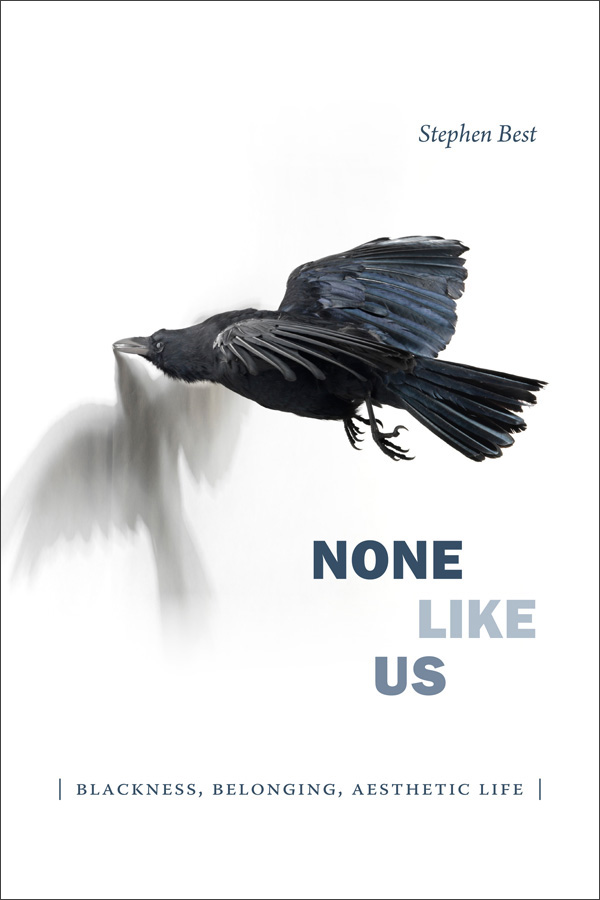 This essay stands at the intersection of black studies, queer theory, and literary criticism and art critique. Its title, None Like Us, is taken from a sentence in David Walker’s Appeal to the Coloured Citizens of the World, arguably the most radical of all anti-slavery documents written in the nineteenth century. The quotation, put on the book’s opening page, describes the wretched condition of coloured people in the United States as observed by the author. It ends with a prayer to God that “none like us ever may live again until time shall be no more.” Who is the “us” that the epigraph dooms to self-extinction and oblivion? Is there a collective subject when humans were treated as objects and disposed of as pieces of property? Can one write the history of people who did not exist, or whose existence is forever predicated on a negative relation to history? How does that “none like us” leave open the possibility for an “I,” the first singular person of the art critic, the historian, the queer subject? As Stephen Best writes, “None Like Us begins in the recognition that there is something impossible about blackness, that to be black is also to participate, of necessity, in a collective undoing.” Whatever blackness or black culture is, it cannot be indexed to a “we.” The condition of being black is rooted in a sense of unbelonging: “forms of negative sociability such as alienation, withdrawal, loneliness, broken intimacy, impossible connection, and failed affinity, situations of being unfit that it has been the great insight of queer theorists to recognize as a condition for living.”
 When I heard Lisa Messeri had written an ethnography about space research, my first reaction was: what’s an anthropologist like her doing in a place like this? How can one study outer space with the tools and methods of social science? What is the distinct contribution of the anthropologist in a field dominated by rocket scientists and big bang theoreticians? What can the cosmos teach us about ourselves that is not grounded in hard science and space observatory data? To be sure, there is no anthropos to study in outer space, and other worlds are beyond the grasp of the ethnographer. The sociology of other planets remains a big question mark. So far, you cannot make participatory observation in space stations or conduct fieldwork on Mars. We may hire anthropologists, linguists, semioticians, and indeed all the help we can get when we encounter extraterrestrial civilizations and extraplanetary forms of life; but so far these close encounters of the third type remain the stuff of science-fiction novels and blockbuster movies. But on second thought, an anthropologist in outer space is not completely out of place. Anthropologists have always accompanied explorers and discoverers to the frontiers of human knowledge. They helped us understand alien cultures and foreign civilizations to make them less distant, and drew lessons from their immersion into other worlds for our own society. Anthropologists make the strange and the alien look familiar, and the “view from afar” that they advocate also makes our own planet look alien and unfamiliar. They also help us make sense of science’s results and methods, and have been a trusted if somewhat critical companion of scientific research and laboratory life. Science and technology studies (STS in the jargon) have taught us that natural scientists—contrary to a common prejudice—are never simply depicting or describing reality out there “just as it is”: their research is always characterized by a specific style and colored by the “scientific imagination.”
 In 1990, Youssou N’Dour, Senegal’s most famous musician, released an album titled Set. The main song had the following line: Set, set oy. Ni set, set ci sa xel lo, ni set ci sa jëff oy… I had no idea what it meant, but in her book Garbage Citizenship, Rosalind Fredericks provides translation and context: Cleanliness, oh cleanliness. Be clean, pure in your spirit, clean in your acts… The injunction to be clean and to make clean (set setal in wolof), repeated in the song’s chorus, echoes the rallying cry of a grassroot movement in which young men and women set out to clean the city of Dakar from its accumulating garbage, substituting a failing urban waste infrastructure and denouncing the corruption of a polluted political sphere. Labelled as an exemplary case of participatory citizenship and youth mobilization, the movement was captured by political clientelism and made to serve the neoliberal objectives of labor force flexibility and public sector cutbacks. At the height of the movement in 1989, Dakar’s mayor made a shrewd political calculus to recruit youth activists into a citywide participatory trash-collection system. Their incorporation into the trash sector was facilitated by a discourse of responsibility through active participation in the cleanliness of the city. They became the backbone of the municipal waste management system and remain included in the sector’s labor force to this day. The history of the Set/Setal movement is only one of the case studies that Rosalind Fredericks develops in her book. The author finds the same activists who spontaneously took to the streets to clean up Dakar in 1988-89 having moved into low-pay positions as trash workers in a reorganized infrastructure that used derelict garbage trucks and often delayed payment of salaries. Together with their labor union leaders, they staged another kind of public protest in 2005-07: the garbage strike, supported by Dakar inhabitants who brought their household dumpings to the main arteries of the capital and piled them for all politicians to see. Other cases studied by the author include a NGO-led, community-based trash collection project in a peripheral neighborhood mobilizing voluntary women’s labor and horse-drawn carts, and the functioning of a trash workers’ union movement affirming the dignity of labor through discourses of Islamic piety.
 In Brazil, women claim the right to be beautiful. When nature and the passing of time don’t help, beauty can be achieved at the end of a scalpel. Plastic surgery or plástica is not only a status good or the preserve of socialites and celebrities: according to Ivo Pitanguy, the most famous Brazilian plastic surgeon and a celebrity himself, “The poor have the right to be beautiful too.” And they are banking on that right. Rio and São Paulo have some of the densest concentrations of plastic surgeons in the world, and financing plans have made plástica accessible to the lower middle class and even to favela residents. While in the United States, people may hide that they have had plastic surgery like it’s something shameful, in Brazil they flaunt it. The attitude is that having work done shows you care about yourself—it’s a status symbol as well as a statement of self-esteem. Cosmetic surgery’s popularity in Brazil raises a number of interesting questions. How did plastic surgery, a practice often associated with body hatred and alienation, take root in a country known for its glorious embrace of sensuality and pleasure? Is beauty a right which, like education or health care, should be realized with the help of public institutions and fiscal subsidies? Does beauty reinforce social hierarchies, or is attractiveness a “great equalizer” that neutralizes or attenuates the effects of class and gender? Does plástica operate on the body or on the mind, and is it a legitimate medical act or a frivolous and narcissistic pursuit? Does beauty work alienate women or is it a way to bring them into the public sphere?
 “Property is theft !” declared Pierre-Joseph Proudhon, denouncing the inanity of social institutions undergirding bourgeois society. He was criticized by Karl Marx, who judged the formula self-refuting, and by Marx Stirner, who wrote: “Is the concept ‘theft’ at all possible unless one allows validity to the concept ‘property’? How can one steal if property is not already extant?” Indigenous people face the same set of objections when they claim ownership of the land that has been stolen from them. Their traditional culture and enduring values often emphasize a special connection to land and place. They are the “children of the soil,” “sprung from the land itself” as the word “autochthonous” indicates in its Greek etymology. They can legitimately claim the right of first occupancy and document their collective memory of having been there first. The dispossession of their ancestral lands occurred under conditions that would today be judged unlawful or illegitimate, and that was condemned as such at the time it occurred. But on the other hand, the emphasis on possession and ownership contradicts the values of shared responsibility, stewardship, and common property that many Indigenous people, indeed many persons, associate with land and natural assets. How can one argue that the earth is not to be thought of as property at all, and that it has been stolen from its rightful owners? What does it mean, then, to be dispossessed of something that you never really “had” in the first place, and to reclaim something that was never really “yours” to begin with? Can we make the legitimate claims of Indigenous people compatible with political visions that do not advocate property and ownership at their point of departure?
