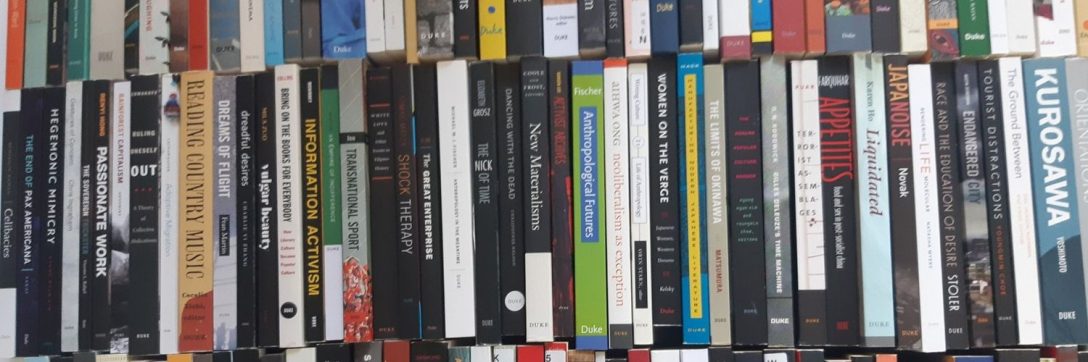

A review of The Structure of World History: From Modes of Production to Modes of Exchange, Kojin Karatani, Duke University Press, 2014.
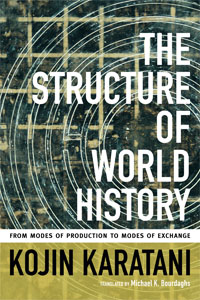 There is a tradition of contemporary Japanese philosophers drawing from anthropology (the names of Shinichi Nakazawa and Akira Asada come to mind). There is also a Japanese tradition of philosophical re-readings of Marx (with Kozo Uno or Makoto Itoh). I am interested in the first tradition. I regard the second as negligible. In The Structure of World History, Kojin Karatani combines the two approaches. He offers a broad synthesis on the origins of the state, the market, and the national community, based on the works of classical anthropologists. And he provides a close reading of Marx’s texts in order to construct his own philosophical system, encompassing the whole of human history. I found the first part based on anthropology most valuable. I only skipped through the second part. Below are a few reading notes and commentary intended to provided a cursory reading of Karatani’s book.
A Japanese rereading of Marx
Marx, like Comte and Hegel before him, saw the history of the human race as neatly divided into historical phases. He identified five such phases: the primitive horde, Asiatic despotism, the ancient classic state, Germanic feudalism, and the modern state under capitalism. The principle of that division was to be found in modes of production and the type of labor relations they generated. The stateless clan society was characterized by primitive communism: there was no private property, and goods were shared among all members of the clan. It was followed by the Asiatic mode of production in which the despotic king owned everything and his subjects nothing. Then came the Greek and Roman slavery system giving power to a minority of citizens, followed by the Germanic feudal system with its relations of allegiance and serfdom, and modern bourgeois capitalism characterized by the opposition between capital and labor. Thus Marx famously proclaimed that all history was the history of class struggle, and that it necessarily tended towards the advent of communism, in which class would disappear and the state would wither away.
Other authors, mainly inspired by Marx, offered their own classification of social formations. To the five modes of production identified by Marx, Samir Amin added two others: the trade-based social system seen in various Arab countries, and the social formation based on the “simple petty-commodity” mode of production seen in seventeenth-century Britain. Building his own theory of world systems, Immanuel Wallerstein described a succession from mini-systems that preceded the rise of the state, to world empires that were ruled by a single state, and then world-economies in which multiple states engaged in competition without being unified politically. The modern world system of global capitalism itself went through the successive stages of mercantilism, liberalism, and imperialism, each dominated by a single hegemonic power: first Holland, then Britain, and then the United States.
Stages of development
Yet other thinkers identified various stages of development by the dominant world commodity or technology: the wool industry in the stage of mercantilism, the textile industry in liberalism, heavy industries in imperialism, and durable consumer goods such as automobiles and electronics in the stage of capitalism. Our present times may witness the rise of a new stage in which information serves as the world commodity. Still for others, each historical phase is characterized by the dominant mode of energy supply: from biomass and wood to windmills and hydropower and then to coal and steam, then electricity and the oil engine, followed by gas turbines and nuclear power or renewable energies. These periodicizations are only variants of a dominant scheme that locates the crux of world history in the realm of production.
While offering his own teleology based on modes of exchange as opposed to modes of production, Karatani introduces variants and correctives in these classifications in order to paint a more complex picture of world history. For instance, he argues that societies existed in the form of nomadic bands before the rise of clan society, and that the real turning point came with the adoption of fixed settlements, with its accompanying institutions of property, religious rituals, and political coercion. Contrary to the standard view of the Neolithic revolution that associates sedentarization with agriculture, he argues that fixed settlements preceded the appearance of agriculture, and first took the form of fishing villages located at the mouth of rivers and trade routes. Stockpiling was first made possible through the technology for smoking fish, not piling grain or herding livestock. Nomadic tribes on one side, and clan societies on the other, engaged in different modes of exchange and redistribution: pooling of resources and “primitive communism” for the first, and the logic of the gift and the forms of trade described by classical anthropologists for the second. Along with Pierre Clastres and Marshall Sahlins, he agrees that primitive societies were “societies against the state”, and actively resisted the concentration of power through warfare and reciprocity of exchange.
The Asiatic mode of production revisited
Karatani also develops a more nuanced picture of the Asiatic state, considered by Hegel and Marx as well as by Karl Wittfogel as the symbol of despotism. Contrary to the vision of tyranny and oppression, he argues that the Asiatic social contract was based on a form of redistribution. People were not simply coerced: they voluntarily undertook to work for the sake of their king-priest, driven by religious beliefs and the offer for protection. State power is based on a specific mode of exchange, distinct from the first mode based on the reciprocity of the gift. Drawing resources from large-scale irrigation systems, the Asiatic state developed the first bureaucracies, created the first permanent standing armies, and organized long-distant trade with other communities. Through his bureaucrats, the despot was expected to rule, administer, show concern for, and take care of its subjects. It was not the Asiatic community that gave birth to the Asiatic despotic state; to the contrary, it was only after the establishment of a centralized state that a new community would emerge.
Karatani also offers a revision of our understanding of Greek and Roman antiquity. As he demonstrates, political theories and philosophy did not first emerge in the Greek polis, as is sometimes alleged. The formation of Asiatic states was associated with intense philosophical debates, as in the Warring States period in China which saw the emergence of the Hundred Schools of Thought. This is because the appearance of the state required a breaking with the traditions that had existed since clan society. Greece and Rome existed at the periphery of Asian empires and retained many aspects of clan societies. Rome in the end did become a vast empire, but that was due if anything to its adoption of the Asiatic imperial system, which survived the fall of Rome with the Byzantine dynasty and then the Islamic empires. For this reason, historians should regard the despotic state that emerged in Asia not simply as a primitive early stage, but rather as the entity that perfected the supranational state (or empire). Likewise, they should regard Athens and Rome not as the wellspring of Western civilization, but as incomplete social formations that developed at the submargins of Asian empires. Drawing from Karl Wittfogel, Karatani sees a subtle dialectics between civilizations-empires at the core, vassal states at the margins, independent polities at the submargin, and out-of-sphere communities that retained their nomadic lifestyle.
From modes of production to modes of exchange
Moving to his third mode of exchange, based on money and commodities, Karatani enters classic Marxian terrain, and offers vintage Marx analysis. That is where he kind of lost me, and my reading of this part is wholly incomplete. Drawing from the classic formulas M-C-M’ and M-M’, he argues that the world created by this third mode of exchange is fundamentally a world of credit and speculation, and that it still needs the backing of the first mode (based on reciprocity) and the second mode (drawing from the social contract offered by the state) in order to sustain itself. My attention also lapsed during his discussions on world money, world commodities, and world systems à la Wallerstein. It was only revived when he described the different schools of socialist thinking, seeing great commonality between Proudhon and Marx as well as with the Young Hegelians who first developed a theory of alienation of the individual through a critique of religion, state power, and capital.
Karatani then introduces his fourth mode of exchange, labelled mode D, which marks the attempt to restore the reciprocal community of mode A on top of the market economy of mode C, and without the state structure of mode B. Although this mode of exchange is an ideal form that never existed in actuality, it manifested itself in the form of universal religions and expressed the “return of the repressed” of the primitive community’s mode of reciprocal exchange in a higher dimension. His analysis sometimes borders on the bizarre, as when he warns of a looming ecological catastrophe and generalized warfare that may take humanity back to the stage of the nomadic tribe. His description of Kant as a closet socialist advocating the disappearance of the state and of capital also seems far-fetched. But it is his reading of Marx and Hegel through Kant that may provide the greatest food for thought to modern philosophers such as Slavoj Zizek, who quotes Karatani eloquently in his books. Based on solid anthropological data and a re-reading of Marx’s classic texts, Karatani’s work may generate a thousand theoretical explosions, placing the construction of world history systems back at the heart of the philosophical agenda.
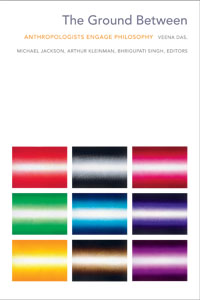 My strong belief is that this book will prove as important as the volume Writing Culture, published in 1986, which marked a turning point in the orientation of anthropological writing. This is not to say that anthropologists didn’t engage philosophy before Anthropologists Engage Philosophy, or that they will with renewed strength thereafter. Many classical anthropologists were trained as philosophers, especially in the French tradition where disciplinary borders are more porous. Pierre Bourdieu described his work in anthropology and sociology as “fieldwork in philosophy.” Nowadays “theory”, which samples a limited set of authors from contemporary philosophy, is part of the toolbox that every graduate student learns to master, and that they often repeat devotedly as a shibboleth that will grant them their PhD. What is striking in The Ground Between is the variety of authors that the contributors discuss, as well as the depth of their engagement, which goes beyond scholarly debates and is often set out in existential terms. For many anthropologists, philosophers are a life’s companion, helping them to navigate through the pitfalls of scholarship and the vicissitudes of life.
 Doreen Lee had all that was required to write a great history of Reformasi, the period of transition that led to the downfall of president Suharto and the establishment of democracy in Indonesia. Although she wasn’t there during the transition years of 1998-1999—she conducted her fieldwork between 2003 and 2005—, the Indonesia she observed was still resonating with the lively debates and political effervescence that arose out of the student movement and popular protests against the Suharto regime, also known as the New Order. She met with some of the key players of the democratic transition, and gained their trust as an outsider committed to the same progressive agenda. Having spent part of her childhood and teenage years in Jakarta, she was fluent in the local language, Bahasa Indonesia, and had the personal acumen to interpret words and deeds by putting them into their cultural context. She had access to a trove of previously unexploited documents—the activist archives mentioned in the title—, which consisted of leaflets, posters, pamphlets, poems, diaries, drawings, newspaper clippings, and numerous other fragments (“the trash of democracy”, as she calls it) that activists shared with her or that were deposited in the public libraries of Western universities. Using these fragments and testimonies would have allowed for a kind of micro-historical approach that is currently in fashion among historians. Alternatively, it could have been used to challenge conventional assumptions about the Reformasi by crossing sources, checking facts, debunking myths, and reassessing the role of students and activists in the popular movement that ushered a new era in Indonesia’s political history.
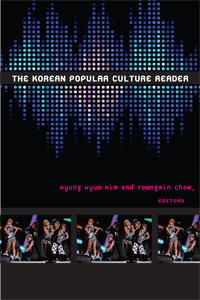 Why publish a reader on Korean popular culture? Because it sells. This is the startling confession the two editors of this volume, Kyung Hyun Kim and Youngmin Choe, make in their introduction. They are very open about it: their scholarly interest in Korea’s contemporary pop culture arose as a response to students’s interest in the field. It was a purely commercial, demand-driven affair. As they confess, “Korean studies had a difficult time selling its tradition and modern aesthetics in course syllabuses until hallyu (Korean Wave) came along.” Now students enrolling in cultural studies on American or European campuses want to share their passion for K-pop, Korean TV dramas, movies, manhwa comics, and other recent cultural sensations coming from Korea. Responding to high demand, graduate schools began churning out young PhD’s who specialized in such cultural productions. Course syllabuses were designed, classes were opened, workshops were convened, and in a short time the mass of accumulated knowledge was sufficient to allow the publication of a reader.
 The participant observer is the one who spoils the fun. He or she comes up with questions and doubts at the moment when the public wants answers and certitudes. Participating and observing are often two irreconcilable tasks. The observer introduces a distance when participants want to adhere to the show, and creates distinctions when the group wants to feel as one. Despite the pretense to the contrary, the researcher cannot fully belong, cannot fully take part into the action. Even when he or she choses to live among the natives, the anthropologist reminds people that he or she retains other obligations and belongings. The anthropologist dwells in the village but belongs to academia. The group can never claim him or her as one of them, because both know that he or she will have to leave one day and that his or her stay is temporary. Anthropologists are those who write things down at the end of the day: their commitment goes to scholarship, and they are dedicated to writing a book or a monograph about their experience in the field. They maintain critical distance and cultivate abstract reasoning, using categories that are in essence different from the ones that people use to frame their own experience.
 “Dazzling” is a word that seems to come to mind when describing this book. It is used in a laudatory manner by the two academic luminaries who provided blurbs on the back cover. Rey Chow praises In the Place of Origins as “a dazzling accomplishment”. For Gayatri Spivak , “this is a text of dazzling instructive simplicity.” Well, I was more frazzled than dazzled by Rosalind Morris’s book. And I failed to perceive its “instructive simplicity”. To me, this was only a compendium of bewildering jargon, rambling descriptions, sloppy reasoning, and bad editing. It was ethnographically and theoretically uncouth. In fact, I couldn’t make any sense out of it. I had to get back at my reading several times to complete the book, and I did it only for the purpose of writing a review on this website. In short, my advise to the potential reader is: spare yourself that trouble. Don’t take pains to read it, for this was indeed a painful experience.
 Korean cinema occupies a peculiar place in relation to hallyu. In a way, Korean movies were the harbingers of the Korean wave. They were the first Korean cultural productions to attract foreign recognition in international film festivals; they carved a global niche that was distinct from Hollywood movies or other Asian productions; and they emphasized distinctive aspects such as violence, romance, or geopolitical tensions. Cinema was the cultural medium through which Korea sought to establish itself as a new global standard. And yet K-movies are not considered part of hallyu the way K-drama, K-pop and even K-cuisine have now become. Only a handful of movies (Shiri, JSA, My Sassy Girl…) came to be seen as representative of the Korean wave, while other movies and moviemakers were perceived through the more traditional categories of film critique—national cinema, auteurship, movie genres, visual aesthetics, and narrative analysis. Korean cinema in many ways set the condition for hallyu’s expansion by inducing a shift in foreign perceptions of Korea. The country came to be seen as the producer of a different brand of modernity, distinct from Japan’s or China’s globalized cultures. Its movies were not only cheap imitation movies known collectively as Copywood; they were original productions in their own right. In addition, Korea’s movie industry demonstrated that critical and commercial success were not always incompatible: commercially successful movies could get critical acclaim, and art movies lauded by critics could also get a significant presence at the box office.
 Everett Zhang was conducting fieldwork in two Chinese hospitals, documenting the reasons why men sought medical help for sexual impotence, when Viagra was first introduced into China’s market in 2000. He therefore had a unique perspective on what the media often referred to as the “impotence epidemic”, designating both the increased social visibility of male sexual dysfunction and the growing number of patients seeking treatment in nanke (men’s medicine) or urological hospital departments. At the time of Viagra’s release, Pfizer, its manufacturer, envisaged a market of more than 100 million men as potential users of “Weige” (伟哥, Great Brother) and hoped to turn China into its first consumer market in the world. Its sales projections were based on reasonable assumptions. The number of patients complaining from some degree of sexual impotence was clearly on the rise, reflecting demographic trends but also changing attitudes and values. There was a new openness in addressing sexual issues and a willingness by both men and women to experience sexually fulfilling lives, putting higher expectations on men’s potency. Renewed attention to men’s health issues since the 1980s had led to the creation of specialized units in both biomedical hospitals and TCM (traditional Chinese medicine) clinics. There was no real competitor to Pfizer’s Viagra, as traditional herbal medicine or folk recipes clearly had less immediate effects in enabling sexual intercourse.
 It’s all in the title. UNSETTLING. INDIA. AFFECT. TEMPORALITY. TRANSNATIONALITY. The key concepts are all listed here, in a sequence that will be repeated over and over in the book, like a devotional mantra. It is, if you will, the anthropologist’s “Om mani padme hum”, the way she attains her own private nirvana. Purnima Mankekar’s objective, as she states repeatedly, is to examine “how India is constructed as well as unsettled as an archive of affect and temporality in contexts shaped by transnational public cultures and neoliberalism.” Each word in this mission statement opens a particular space for ordering the observations that she gathered in the course of her fieldwork in India and in California. Indeed, the chapters of the book hold together by a thread, and this common thread is provided by the words listed in the book’s title. So let me engage with them one by one, in no particular order of succession.
 The Duke Reader