
Drone Theory and Bearing Witness

A review of Nonhuman Witnessing: War, Data, and Ecology after the End of the World, Michael Richardson, Duke University Press, 2024.

Nonhuman witnessingHow to witness a drone strike? Who—or what—bears witness in the operations of targeted killings where the success of a mission appears as a few pixels on a screen? Can there be justice if there is no witness? How can we bring the other-than-human to testify as a subject granted with agency and knowledge? What happens to human responsibility when machines have taken control? Can nonhuman witnessing register forms of violence that are otherwise rendered invisible, such as algorithmic enclosure or anthropogenic climate change? These questions lead Michael Richardson to emphasize the role of the nonhuman in witnessing, and to highlight the relevance of this expanded conception of witnessing in the struggle for more just worlds. The “end of the world” he refers to in the book’s title has several meanings. The catastrophic crises in which we find ourselves—remote wars, technological hubris, and environmental devastation—are of a world-ending importance. Human witnessing is no longer up to the task for making sense, assigning responsibility, and seeking justice in the face of such challenges. As Richardson claims, “only through an embrace of nonhuman witnessing can we humans, if indeed we are still or ever were humans, reckon with the world-destroying crises of war, data, and ecology that now envelop us.” The end of the world is also a location: Michael Richardson writes from a perch at UNSW Sydney, where he co-directs the Media Futures Hub and Autonomous Media Lab. He opens his book by paying tribute to “the unceded sovereignty of the Bidjigal and Gadigal people of the Eora Nation” over the land that is now Sydney, and he draws inspiration from First Nations cosmogonies that grant rights and agency to nonhuman actors such as animals, plants, rocks, and rivers. “World-ending crises are all too familiar to First Nation people” who also teach us that humans and nonhumans can inhabit many different worlds and ecologies. The world that is ending before our eyes is a world where Man, as opposed to nonhumans, was “the unexamined subject of witnessing.” In its demise, we see the emergence of “a world of many worlds” composed of humans, nonhumans, and assemblages thereof.

From Drone Theory to Drone Art

Nonhuman Witnessing begins with a piece of drone theory. The proliferation of drones on the battlefield, and the ethical questions that they raise, has led to a cottage industry of “drone studies,” with conferences, seminars, workshops, and publications devoted to the field. Richardson adds his own contribution by asking how witnessing occurs within conditions of drone warfare and targeted strikes from above. Drones are witnessing machines, but also what must be witnessed: new methods and concepts have to be designed to make recognizable encounters with nonhuman systems of violence that resist the forms of knowing and speaking available to the eyewitness. To analyze the witnessing of violence, as well as the violence that can be done by nonhuman witnessing, Richardson turns to theory and then to the arts. Drawing from media studies literature, he complements the notion of media witnessing, or witnessing performed in, by, and through media, by his own concept of “violent mediation,” or violence enacted through the computational simulation of reality. He also borrows from Brian Massumi the notion of ontopower, the power to bring into being, and the operative mode of preemption that seeks to define and control threat at the point of its emergence. For Richardson, drone warfare is characterized by an acceleration of the removal of human agency from military decision-making. Violence is made ubiquitous; it can take place anywhere at any time. The volume of data produced by drone sensors far outstrips human capacities for visual or computational analysis. They are transformed into actionable data by on-board autonomous software systems that rely on edge computing and AI algorithms. In a logical progression, “automated data collection leads to automated data processing, which, in turn, leads to automated response”: an ultimate end of the militarization of violent mediation is thus the “elimination of the human within technological systems to anything other than the potential target for violence.” By opposition, art insists on what makes us human. The paintings, photographs, and other art forms presented by the author emphasize the awesome power of unmanned airplanes such as the Reaper, the destruction they cause on the ground, their impact on the daily lives of those who remain under their surveillance, and their incorporation into local iconographies such as traditional Afghan war rugs. Art makes sensible the “enduring, gradual, and uneven violence done to the fabric of life” by killing machines that escape traditional forms of human witnessing.

Despite the evocative power of the concepts and artworks presented in Nonhuman Witnessing’s pages, there is a disconnect between drone theory and drone reality. The use of drones by the U.S. for targeted killings is highly publicized, because it is the most controversial, but quantitatively it remains very minor in comparison to surveillance missions. The subject of drone theory is less the drone as such than it is the drone as an illustration of the violence waged by the United States in the Middle East following the war in Afghanistan and the occupation of Iraq. New versions of the theory still have to incorporate the use of drones by new actors and in other theaters of conflict: in the Syrian civil war since 2012, during the short war between Armenia and Azerbaijan in 2020, in the Houthi insurgency against the Yemeni military supported by Saudi Arabia, and, of course, since Ukraine’s aggression by Russia in February 2022 and in Israel’s offensive against Gaza following Hamas’ surprise attack on southern Israel on 7 October 2023. The logic of preemption that characterized the United States’ war on terrorism is less manifest in these evolving situations. So is the role of AI and embarked computer systems: drones increasingly appear as a low-tech, low-cost solution, a weapon of the poor and savvy against more formidable enemies. Drone warfare and lethal autonomous weapon systems raise some complex strategic, ethical and legal questions that have been examined by a number of authors. But they are far from the “killer robots” decried in the critical literature—or hyped as a selling point by arm producers and media commentators. Richardson’s arguments against signature strikes—i.e. strikes based on behavioral patterns rather than on identity (personality strikes)—are valid and have indeed led to a reduction in targeted killings ordered by the U.S. in Pakistan, Yemen, or Somalia. But civilian killings such as the one described in the opening of the book show not that the drone is an imprecise weapon, but that it has been used in an imprecise way, just as a needle can be used imprecisely. Drones, like other pieces of military technology, can serve as inspiration or subject-matter for artists and theoreticians. But as much as drone theory is based on biased empirical ground, drone art is not a recognizable category beyond the avant-garde genre of drone music, which bears no connection with military drones whatsoever.

The power of algorithms

Whereas the chapter on “witnessing violence” used outdated evidence and questionable theory, the second chapter, “witnessing algorithms,” addresses more recent concerns and state-of-the-art technologies: ChatGPT and other applications of machine learning, deepfakes, synthetic media, mass surveillance, and the racist or misogynist biases embedded in algorithmic systems. It is based on the same conceptual swing that understands witnessing algorithms as both algorithms that enable witnessing and algorithms as entities that must themselves be witnessed. Theoretically, it draws from Deleuze and Guattari’s conception of machines as assemblages of bodies, desires, and meanings operating a generalized machinic enslavement of man, and of affect theory as interpreted by Brian Massumi and his grammar of intensities, virtual power, and futurity. Based on these references, Richardson proposes his own notion of “machinic affect” understood as “the capacity to affect and be affected that occurs within, through, and in contact with nonhuman technics.” Machine learning and generative AI can lead to false witnessing and fabrication of evidence: hence the weird errors and aberrations, the glitches and hallucinations that appear in computer-generated images or texts. “Like codes and magic, algorithms conceal their own operations: they remain mysterious, including to their makers.” But instead of denouncing their lack of transparency and demanding to open the proverbial black box, Richardson starts from algorithmic opacity as a given and attends to the emerging power of algorithms to witness on their own terms. Doing so requires the bracketing of any ethical imperative to witnessing: witnessing is what algorithms do, regardless of their accuracy or falsity, their explainability or opaqueness. Facts do not precede testimony: registering an event and producing it take place on the same plane of immanence that makes no difference between the natural and the artificial. Examples mobilized by Richardson include the false testimony of deepfakes such as the porn video of Gal Gadot having sex with her stepbrother; the production of actionable forensic evidence through the automatic detection of teargas canister images by Forensic Architecture, a British NGO investigating human rights violations; the infamous Project Maven designed by the Department of Defense to process full-motion videos from drones and automatically detect potential targets; and computer art videos making visible the inner functioning of AI.

Richardson adds to the existing literature on AI by asking how algorithmic evidence can be brought into the frame of witnessing in ways that human witnessing cannot. But he only hints at a crucial fact: most machine learning applications touted as capable of autonomous reasoning and intelligent decision-making are in fact “Potemkin AI” or “non-intelligent artificial intelligence.” The innovation sector lives on hype, hyperbole, and promissory futures. Likewise, media reactions to new technologies always follow the same tropes, from the “disappearance of work” to the advent of “intelligent machines” or “killer robots.” But the reality is more sobering. Deepfakes produce images that are not different in nature from the CGI-generated movies that dominate the box office since at least two decades. Forensic Architecture, the human rights NGO surveyed in the book, makes slick graphic presentations used as exhibits in judicial trials or media reportages, but does not produce new evidence or independent testimony. State surveillance is a product of twentieth century totalitarianism, not the invention of modern data engineers. Algorithms are biased because we designed them this way. The magic we see in AI-powered services is a form of trickery: their operating mode remains hidden because service providers have an interest in keeping it so. As Richardson rightfully notes, “machine learning systems and the companies that promote them almost always seek to obscure both the ‘free labor’ of user interactions and the low-paid labor of digital pieceworkers on platforms such as Mechanical Turk.” As such as human work will not disappear with automation, it would be a mistake to believe that human witnessing will be substituted by nonhuman forms of bearing witness. There are many human witnesses involved in the production of nonhuman witnessing. Instead of anticipating the replacement of humans by other-than-human agents, we would do well to examine the concrete changes taking place in human witnessing. The debasement of all forms of public authority, the hijacking of political institutions by private interests, the commitment fatigue in the face of too many horrors and catastrophes seem to me at the root of the crisis in human witnessing, for which the nonhuman offers no solution.

Ecological catastrophe

Richardson then turns to Pacific islands and the Australian continent to investigate the role of nonhuman witnessing in times of ecological catastrophe caused by the fallout of nuclear explosions and anthropogenic climate change. These territories, and the people they harbor, can testify to the world-destroying potential of these two crises: “just as the Marshall Islands and other nations in the Pacific were crucial sites for nuclear testing throughout the Cold War, so too are they now the canaries in the mineshaft of climate change.” Witnessing is not reducible to language or to human perception: when they take a continent or a planet as the scale of observation, they deny the human a privileged status for establishing environmental change or atmospheric control. The subject of the Anthroposcene is not the anthropos or Man as traditionally conceived, but an assemblage of humans, technologies, chemical elements, and other terraforming forces. Witnessing ecologies imply that ecologies can be made to witness impending crises and that there is an ecology of witnessing in which every element mediates every other. Drawing from affect theory and trauma studies, Richardson proposes the notion of “ecological trauma” to suggest the idea that trauma escapes the confines of the human body: “it can be climatic, atmospheric, collective, and it can be transmitted between people and across generations.” Ecological catastrophe has already been experienced by First Nations who have seen their environment shattered by settler colonialism, of which the British nuclear testings that took place on the Montebello Islands and at Maralinga in South Australia are only a late instantiation. The entire ecology—people, water, vegetation, animals, dirt, geology—was directly exposed to radioactive contaminants during the blasts and fallout, and no real effort to mitigate the effect on Aboriginal inhabitants was attempted. Polluted soil and sand melted into glass are the media used by Australian artist Yhonnie Scarce, whose glassblowing structure adorns the cover of the book. Other aesthetic works also figure prominently in this chapter, from the aerial imaging through which the planet becomes media to poems by Indigenous writers bearing witness to the destruction of their lands. For Richardson, inspired by recent developments in media theory, “attending to the nonhuman witnessing of ecologies and ecological relations continually returns us to mediation at its most fundamental: the transfer and translation of energies from one medium to another.”

The idea that we should consider nonhumans as well as humans in our processes of witnessing and decision-making already has a significant history in the social sciences. It was first put forward by science and technology studies, or STS, and it is directly relevant for the examination of technological innovation or environmental degradation. Proposed by Bruno Latour, a French STS scholar, Actor-network theory, usually abbreviated as ANT, aims to describe any phenomena—such as climate change or large technological systems—in terms of the relationships between the human and nonhuman actors that are entangled in assemblages or networks of relationships. These networks have power dynamics leading to processes such as translation (the transport with deformation of an assemblage), symmetry (representing all agents from their own perspective) or, as proposed by Richardson, witnessing. It should not be confused with the idea that humans are incapable of witnessing events that are too large-scale or too complex to be grasped by the human mind. Indeed, history shows that local communities and scholars have long understood and monitored changes in the environment and their effect on human activities. In his late work, Latour also proposed the idea that since the environmental question was radically new, politics had to be completely reinvented. We should convene a “parliament of things” where both humans and nonhumans can be represented adequately and be brought to the stand to give testimony. Although Richardson scarcely refers to this literature—he is more interested in art critique than in science and technology studies—, he shares the view that nonhuman witnessing is politically transformative. His politics is anchored in the pluriverse (a world of many worlds), mindful of the myriad of relations between humans and nonhumans, inspired by the belief systems of First Nations, and predicated on the idea that “difference is not a problem to be solved but rather the ground for flourishing.” As he concludes, “there is no blueprint for such a politics, no white paper or policy guidance.” But it is already emergent at the level of speculative aesthetics and in the creative works that punctuate his book.

Thought in the Act

Nonhuman Witnessing is published in a series edited by Erin Manning and Brian Massumi at Duke University Press. Richardson shares with the editors the taste for mixing art with philosophy and for engaging in high theory and abstract concept-building based on concrete examples. He borrows several key notions from Massumi (intensities, futurity, virtuality, preemption), who himself poached many of his insights in Deleuze and Guattari’s philosophy. The new theories developed by these authors and others working in the same field go under the names of affect theory, radical empiricism, process philosophy, speculative pragmatism, ontological vitalism, and new materialism. Each chapter in the book follows an identical pattern. It introduces a new concept (“violent mediation,” “machinic affect,” “ecological trauma,” but also “radical absence” and “witnessing opacity”) that provides an angle to a series of phenomena. It develops a few cases or examples that mostly expose forms of violence that occur across a variety of scales and temporalities: military drones and remote wars (“killer robots”), algorithms (“weapons of math destruction”), and environmental devastation through nuclear testings and climate change (“the end of the world”). It covers both aspects of witnessing, as the originator of an act of testimony and as an object to be witnessed. And it uses artistic creations as illustrations of certain forms of witnessing that escape the standard model of bearing witness. The result makes a suggestive reading but sometimes lacks coherence and clarity. Richardson starts from an original idea (whether drones might become nonhuman witnesses) but stretches it a bit too far. For him, opacity is not a pitfall to be avoided but a quality to be cultivated. Rather than a contribution to theory, the book’s main impact might be on art critique. I truly admire the author’s ability to make art part of the discussion we have on humanity’s main challenges. I didn’t review the artworks curated by the author in detail, but their description makes the most lasting impression.
War Photos and Peace Signs from Vietnam

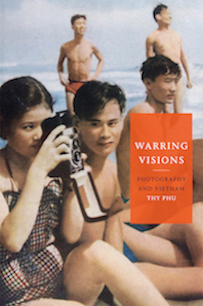
A review of Warring Visions: Photography and Vietnam, Thy Phu, Duke University Press, 2022.

Warring VisionsIn April 2015, the Institut Français in Hanoi held a photography exhibition, Reporters de Guerre (War Reporters), marking the fortieth anniversary of the end of the Vietnam War. Curated by Patrick Chauvel, an award-winning photographer who had covered the war for France, the exhibition showcased the work of four North Vietnamese photographers (Đoàn Công Tính, Chu Chi Thành, Tràn Mai Nam, and Hùa Kiêm) whose documenting of the Vietnam War was often overshadowed by photographers from the Western press working from the South. The poster for the cultural event at L’Espace used an iconic image: a black-and-white picture of North Vietnamese soldiers climbing a rope against the spectacular backdrop of a waterfall, taken in 1970 along the Ho Chi Minh trail. Đoàn Công Tính, the photographer, had caught a moment of timeless beauty and strength, an image of mankind overcoming physical hindrances and material obstacles in the pursuit of a higher goal. However, a scandal erupted when Danish photographer Jørn Stjerneklar pointed out on his blog that this iconic image was doctored. He compared two versions, the recent print that appeared in the exhibition and the “original,” which was published in Tính’s 2001 book Khoảnh Khắc (Moments). Tính apologized profusely for “mistakenly” sending the photoshopped image, claiming that the original negative had been damaged and that he accidentally included a copy of the image with a photoshopped background in a CD to the exhibition’s organisers. But in a follow-up article on his blog, Stjerneklar pointed out that even the “original” had been retouched, as evidenced by the repeating pattern of the waterfall, and was likely a montage of another photograph which is displayed at the War Remnants Museum in Ho Chi Minh City. Stjerneklar’s story was picked up worldwide and ignited a lively debate around the presumed objectivity of photojournalism and the role of photography in propaganda.
Photography and propaganda

That photography was, and still is, part of propaganda in Vietnam was never a secret. Along with my colleagues, I experienced it firsthand during my term as consular counsellor at the French Embassy in Vietnam. When the Institut Français organized photo exhibitions at its flagship cultural center L’Espace in Hanoi, every picture had to be vetted by controlling organs of the government. The answer often came at the last minute, and many photographs were rejected on the basis of obscure criteria. Still, young Vietnamese photographers were enthusiastic about events organized by the French culture center. With the help of French photographer Nicolas Cornet and other professionals, young photography apprentices honed their skills in creative workshops and attended seminars on portfolio building. Some talented photographers held their first solo exhibition at L’Espace before embarking on an international career. In April 2023 (after I had left Vietnam), the Institut Français in Hanoi and its director, Thierry Vergon, initiated the first International Photography Biennale in Hanoi, a major cultural event placed under the aegis of Hanoi’s People’s Committee in partnership with a network of Vietnamese and international partners. More than twenty exhibitions organized on several locations allowed the general public and professionals to discover the wealth of contemporary photography and the treasures of heritage photography in Vietnam. A series of outreach activities were scheduled throughout the Biennale, including workshops to connect stakeholders, roundtables and debates, training sessions, film screenings, and portfolio reviews. The initiative was used by Hanoi City, part of UNESCO’s Creative Cities Network, to bolster its image as a regional hub for culture and innovation. Still under the strictures of a socialist government, a new Vietnamese narrative on photography is slowly emerging. It is based on creativity, not control, and its aim is to put Vietnam’s capital on the map for cultural professionals and creative workers. Alternative visions of Vietnam are seeping through the web of censorship and are flourishing in the rare spaces of unrestricted freedom offered by social networks or independent cultural venues.

Thy Phu’s book Warring Visions shows that creativity was also present in the photographs taken during the Vietnam War (known in Vietnamese as the Resistance War against America.) Vietnamese photographers working for the Hanoi-based Vietnam News Agency (VNA) were no less talented than their Western counterparts operating from the South. War pictures published by the Western press (or by Japan’s) were as much involved in political propaganda as the “socialist ways of seeing Vietnam” that filled the pages of Vietnam Pictorial, an illustrated magazine run by the communist state. War was fought on the front of images, both in Vietnam and within America. Propaganda pictures were also waged by the South Vietnam government, with less international success. For Americans, the Vietnam War still haunts the national psyche with the ignominy of defeat. The war was a watershed in visual history, and the many pictures taken by Western reporters and photographers laid the foundation for battlefield reporting and contemporary photography studies. But as Thy Phu notes, “in addition to overlooking unspectacular forms of representation, the Western press, then as now, neglects Vietnamese perspectives, emphasizing instead the American experience of this war.” The role of Vietnamese photographers, including the many stringers and fixers working for full-time foreign correspondents, is systematically downplayed, although some of them took the most iconic photos that were to shape the imaginaries of the war (such as Napalm Girl, the picture of a naked girl running away from an aerial napalm attack.) But placing the spotlight on photographs taken by Vietnamese war photographers is only half of the story. According to Thy Phu, we need to enlarge the category of war photography, a genre that usually consists of images illustrating the immediacy of combat and the spectacle of violence, pain, and wounded bodies. Pictures depicting wedding ceremonies, family reunions, and quotidian rituals are also part of the Vietnamese experience during the war. Drawing from family photo books from the Vietnamese diaspora, discarded collections found in vintage stores in Ho Chi Minh City, or her own family records, Thy Phu reconstitutes a lost archive of what war in Vietnam might have been like for ordinary citizens.

Socialist ways of seeing Vietnam

The canon of war photography, as well as its most basic principles, were established during the Vietnam War. Pulitzer-winning images exposed the brutality and injustice of war, its toll on the body and on the mind of soldiers, its devastating consequences for civilians and their living environment. According to the profession, war images should by no means be staged or manipulated. They should expose reality as it is, captured on the spur of the moment by a neutral observer. It will come as no surprise to learn that North Vietnamese photographers obeyed to different rules and aesthetic principles. The images that were taken by these propaganda workers are full of positivism and youthful energy. Unlike the photos taken from the South showing the terrible effects of war, the images taken by photographers from the North show young soldiers smiling in front of the camera or caught in the middle of disciplined action, images of incredible romanticism in the middle of war. The goal was, of course, to highlight their heroism in order to stimulate other soldiers and citizens seeing the images. Ideology informed the subject matter of these photographs and guided practitioners into what to look at and how to represent it. Harsh material conditions also shaped the way photographs were taken and circulated. The photographers were foot soldiers in uniform who had been selected from among Hanoi’s university elite and given a crash course training in journalism and photo reporting before being sent to the frontline. Communist allies abroad provided cameras and lenses that were made in East Germany and the USSR. Equipment and film were in such short supply that they were not issued to individual photographers but were stored at the headquarters of organizations such as the Young Pioneers, the Army’s photographic department, and the VNA. In such conditions of scarcity, photographers were forced to shoot sparingly, to compose and stage their images prior to shooting, and to improvise solutions to compensate for the lack of equipment. In the absence of flash bulbs, the flare of rockets fired against a dark sky provided the light necessary for nighttime pictures. Piecing together several shots created an improvised panoramic view without need of a wide-angle lens. War photos were displayed in makeshift jungle exhibitions or village fairs, along with propaganda posters, to uplift the masses and disseminate a “socialist way of seeing” things. Photographs were also distributed to foreigners beyond the Communist bloc, especially to members of antiwar organizations, some of whom received copies of Vietnam Pictorial, an internationally circulated illustrated magazine.

Reviewing past issues of this magazine, three central subjects stand out: the heroic struggle of soldiers, the toil of factory workers and farmers, and the sacrifices of revolutionary Vietnamese women. Beautiful portraits of women harvesting lotus flowers, of young girls playing in poppy fields, or children riding on the back of water buffaloes also adorned the color covers of Vietnam Pictorial, with vibrant colors denoting artificially painted photographs and reminding readers of the bright socialist future for which war was fought. For Thy Phu, the revolutionary Vietnamese woman was more than just an image: it was a symbol, embodying contested visions of women’s role in anticolonial resistance and national reunification. The battle for this symbol was fought on two fronts. On the leadership side, the figure of Nguyễn Thị Bình, the Viet Cong’s chief negotiator at the Paris Peace Conference in 1973, opposed the fierceful Madame Nhu, the de facto First Lady of South Vietnam from 1955 to 1963. Both used feminity for political aims, wearing different styles of áo dài, Vietnam’s traditional dress, as a gendered display of nationalism. In contrast to Madame Bình’s demure attire which singled her out as the sole woman at the negotiating table, Madame Nhu favored a more risqué style of áo dài and did not hesitate to pose in masculinist postures, such as in the famous closeup picture where she is seen firing a .38 pistol. Both camps also sought to glorify women’s contribution to nationalist struggle by enrolling them in mass movements. In the South, Madame Nhu founded the Women’s Solidarity Movement of Vietnam (WSM) in order to give women military training and enroll them in paramilitary groups assisting the armed forces. Women in uniform included Hồ Thị Quế (the “Tiger Lady”), member of the Black Tigers Ranger Battalion, pictured in full battledress looking fiercely at the camera. In the North, young women were recruited en masse in the Youth Shock Brigades, also known as TNXP, and sent to the frontline in order to assist male soldiers or build the Ho Chi Minh trail. The image of “girls with guns” or “long-haired soldiers” stood in stark contrast with the more traditional pictures emphasizing motherhood and family that were used to appeal to the solidarity of women’s antiwar organizations in the United States. But pictures offer fertile ground for projection, misrecognition, and reinvention: the Vietnamese revolutionary woman was reclaimed as a radical chic symbol for American feminist struggles in which she had no part. The Vietnamese Communist Party won the day in the fight over images and symbols associated with womanhood. But as French historian François Guillemot reminds us, Vietnamese women, who represent half of society, suffered more than their half as a result of military conflict and civil war.

Lost archives

The Democratic Republic of Vietnam (DRV), now known as the Socialist Republic of Vietnam, ultimately claimed victory in the war of images and symbols. As a result, war images from the South were censored, erased, and eliminated from the record. They survive as embodied performances of reenactment and remembrance in the dispersed archives of the Vietnamese diaspora. To illustrate the war as seen from the perspective of South Vietnam, Thy Phu takes the example of Nguyễn Ngọc Hạnh who was one of the most respected Vietnamese photographers of his time. He served in the French Army until 1950, then transferred to the Armée Nationale Vietnamienne, which in 1956 became the Army of the Republic of Vietnam (ARVN). He attended the French Army photography school during the mid-1950s, was designated the official ARVN combat photographer in 1961, and ultimately attained the rank of Lieutenant Colonel. After the fall of Saigon in 1975, he was sent to a “re-education camp” with his fellow officers, but survived until he was released through the intervention of Amnesty International in 1983. He emigrated to the U.S. in 1989, where he passed away in 2017. Published in 1969 in collaboration with civilian photographer Nguyễn Mạnh Đan, his book Vietnam in Flames ranks in the top echelon of great Vietnam photobooks, right alongside Philip Jones Griffiths, David Douglas Duncan, and the best of the Japanese photographers. Hạnh made no secret that his photos were staged: he even explained in painstaking detail how he used drops of olive oil to place “tears” on one of his most notable photograph, Sorrow, the portrait of a lovely young woman weeping over the dog tags of her missing companion. As Thy Phu notes, manipulation has been a defining characteristic of war photography from the nineteenth century to the present. Indeed, some of the mots famous war photographs, such as Robert Capra’s The Falling Soldier, are said to be restaged or reenacted. Hạnh nevertheless insisted that his images are authentic documents that register the intensity of the emotions the war engendered. Photographs, like tears, are a social ritual. Whether they are authentic or inauthentic, induced or spontaneous, matters less than the fact that they are to be seen and recognized. As they circulate among the Vietnamese diaspora while they remain censored in Hanoi or Ho Chi Minh City, pictures from Vietnam in Flames contribute to a sense of community through collective suffering, sacrifice, and remembrance.

The two waves of Vietnamese refugees, those who fled in 1975 after the fall of Saigon and the “boat people” who left the country from the late 1970s into the early 1990s, left behind all their personal belongings, including family pictures and photo albums. Those who stayed behind pruned their photo collections of all images reminiscent of the old regime: men in ARVN uniform, pictures betraying friendly connections with Americans, or scenes denoting bourgeois proclivities such as foreign travels and private vacations. Remarkably, however, thousands of those photos have resurfaced in the marketplace in the form of orphan images and albums separated from their original owners and stories. These are images that have been “unhomed”: scattered, lost, or left behind. Together they provide a counter-narrative of the war, a testimony of Southern Vietnamese experiences that have been erased from the record and banished from official history. How to deal with those missing archives, lost memories, and orphaned pictures? What can be learned of family pictures in the absence of a story, when the memories that bring photographs to life are missing from official records and even personal collections? In Shakespeare’s Hamlet, only a scholar is capable of speaking with ghosts. Similarly, only artists can speak to the ghostly presence of these anonymous faces. Thy Phu, who herself assembled a community archive of family photographs and the stories about them, presents the artistic démarche of Dinh Q. Lê, a diaspora Vietnamese artist now based in Ho Chi Minh City and whose work was recognized by major exhibitions in Singapore, Tokyo, New York, and Paris. Since 1998, Lê has been working on a trilogy of installations that feature family photographs, objects that fascinate him because he lost all of his own photographs in the course of his family’s forced migration. Images are stitched together to form fragile-looking, rectangular installations like mosquito nets, or they are cut into enlarged strips that are weaved to form a new picture, superposing the initial faces on the strips and an emerging bigger picture. In his 2022 exhibition at the Quai Branly Museum, one of the weaved picture represented Madame Nhu waving a pistol, an image still taboo in Vietnam but that the artist was able to reinterpret through his own eyes. In another installation, onlookers from the Vietnamese diaspora were invited to pick up images covering the gallery floor and to consult an online database that draws on crowdsourcing to identify lost images of their own family, merging the acts of collecting, remembering, and archiving.

War photography in the age of generative AI

What does Thy Phu’s book tell us about photography censorship and creativity in contemporary Vietnam? How can we interpret war photography in the light of warring visions, ragged memories, and contested identities? The first lesson I learned from Warring Visions is that the distinction between propaganda pictures and war reporting is artificial: in the end, what matters is not political intent, but what we make of it. War pictures will always be used for political purposes. But those that remain in public memory transcend the immediacy of a cause and express universal values, sometimes at odds with the intention of their sponsors. The second lesson is that we need to expand our notion of war photography. Vernacular pictures representing quotidian rites of family life also tell stories about wartime conditions, and these stories must be collected and made known. As a third lesson, we should think hard about authenticity and manipulation of images in the age of generative AI and deep fakes. The indignation that followed Jørn Stjerneklar’s blog article exposing the manipulation of Đoàn Công Tính’s poster in 2015 was in a way misplaced: war pictures can be staged, reframed, doctored, reenacted, and, yes, photoshopped. As historians of war photography tell us, this has always been the case, and we should anticipate more of the same in our technologically savvy future. In my perception, Vietnamese nowadays have a more relaxed attitude to Photoshop than people in Europe or in North America. When I took ID pictures in Hanoi, the result came heavily retouched, with bright eyes and rosy cheeks. To tell the truth, I like the picture more than the original, and I still use it on my identity documents or CV profile. This tradition of retouching pictures goes back a long way, as evidenced by the family portraits and painted photographs from colonial Indochina. It is also linked to the highest levels of Vietnamese statesmanship: as is well known, prior to establishing the DRV in 1945, Hồ Chí Minh led a peripatetic life and worked a number of odd jobs. According to the records of the French police, around 1915-17 he worked as a photo retoucher in Paris by day and meeting leading Communist agitators by night. It is said that this humble experience with visual restoration led him to grasp photography’s political potential. It also taught him to be wary of photography’s role for state surveillance and identity control: only one portrait remains from this period, recognizable by the chipped upper part of his left ear that allowed the French police to check the identity of the Vietnamese revolutionary leader who changed his name and civil status several times over the course of his career.

The Reparative Turn

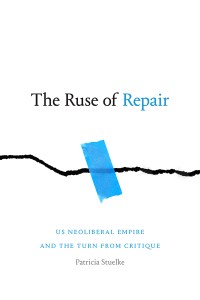
A review of The Ruse of Repair: US Neoliberal Empire and the Turn from Critique, Patricia Stuelke, Duke University Press, 2021. 

The Ruse of RepairIn 1956, Nathalie Sarraute published The Age of Suspicion, a series of essays about the modern novel starting from the following observation: “A suspicion hangs over the characters of the novel. The reader and the author have come to feel a mutual mistrust.” This book heralded the Nouveau roman and the turn toward critique: all components of a novel, from character to plot and to author, were subjected to radical deconstruction and became marked by indeterminacy, ambiguity, and equivocation. In the politically charged atmosphere of the 1960s and 1970s, literary critique became paranoid. The protagonists of postmodernist fiction often suffered from what Tony Tanner calls in City of Words (1971) a “dread that someone else is patterning your life, that there are all sorts of invisible plots afoot to rob you of your autonomy of thought and action, that conditioning is ubiquitous.” Uncovering the violence of the US empire and the racist ideology of the settler state became the order of the day. Revolution was in the air: there was a direct connection between criticism and protest, and between protest and radical change. Then suddenly, criticism became passé and suspicious modes of reading were themselves the object of suspicion. Psychology was back in favor, novels were again supposed to have a plot with a beginning and an end, and the focus of attention turned to the intimate, private matters, affects, and the body. Racial and imperialist violence no longer needed exposure: what was required was remediation and repair of the damaged self. Interpretive practices and political claims that leftist criticism had dismissed as “merely aesthetic” or “merely reformist” were drawn back to the center of the agenda. 

Paranoid reading and reparative reading 

In The Ruse of Repair, Patricia Stuelke offers a history and a critique of this reparative turn. Turning away from literary criticism and toward cultural history, she situates the rise of repair as a “structure of feeling” in literary, scholarly, and solidarity movements in the 1980s, a period marked by the ascendancy of US neoliberal empire. Specifically, the five chapters each address episodes in which reparative visions of solidarity and belonging displaced revolutionary political projects and contributed to the broader sweep of neoliberal reforms: sex-radical feminism with regard to the Iranian revolution and the so-called sex wars; black-diasporic solidarity with the Caribbean prior to the US military invasion of Grenada in 1983; the Central America solidarity movement protesting Reagan’s covert wars in Nicaragua, Guatemala, and El Salvador; creative writing programs in American universities and their contribution to the emergence of a veteran literature reflecting the trauma of the Vietnam War; and the popular music playlist weaponized by US soldiers during their invasion of Panama in 1989. Stuelke sees the origins of the reparative turn in Melanie Klein’s theories on human development and defense mechanisms, who can be read as a disavowal of “responsibility in a history of colonial war and violence that preserves and extends life to some while simultaneously withholding it from others.” Klein’s theorization of the reparative was shaped first in the debates over whether Germany should have to pay reparations after its World War I defeat, and then whether Germans should bear the guilt for war crimes and genocide in World War II. Another important milestone is Eve Kosofsky Sedgwick’s opposition between “paranoid reading” and “reparative reading,” in which the feminist scholar argued that the time of the “hermeneutics of suspicion” was over and one should return the reparative techniques that Klein had advocated. Sedgwick advanced that paranoid critique was irrelevant in an era when the lies and acts of violence of the repressive state were hidden in plain sight for anyone to see, and that one should instead concern oneself with how people find comfort, nourishment, and personal fulfilment amid precariousness and despair. The 1980s, in particular, was a decade that anticipated the ascent of reparative thinking. For Stuelke, “the turn to repair is entangled with the very history and practices of neoliberal empire and the settler colonial carceral state.” The ruse of repair, like Hegel’s ruse of reason, means that the analytical tools, patterns of interpretation, and structures of feeling that arose in the critical years of anti-imperialist militancy and radical feminism were instrumental in the ascent and triumph of neoliberalism and racial capitalism.

“Freedom to Want,” as the first chapter is titled, sets the stage by examining the logics of queer feminist anti-imperialist critique through the sex-radical solidarity politics of lesbian feminists who expressed support for progressive causes in the US and abroad, and through the institutionalization of sex-radical feminism and queer studies in the US academy. Stuelke’s archive of texts is composed of a 1986 essay by Joan Nestle, the co-founder of the Lesbian Herstory Archives ; Going to Iran (1982), Kate Millett’s memoir of traveling to witness the Iranian Revolution in 1979 ; the collective anthologies Powers of Desire (1983) and Pleasure and Danger (1984) published in the wake of the Barnard Conference on Sexuality in 1982 ; and the feminist sex wars that ensued. Joan Nestle took activism in the wake of the civil rights movement as a form of embodiment, a liberation of the lesbian self: “my body made my history… my breasts and hips shout their own slogans.” Kate Millet crafted the testimony of her trip to Iran as a reparative fantasy of revolution intermingled with the story of her reconciliation with her aunt. For the author, “Millett’s account of her relationship to the Iranian Revolution is exemplary of how feminist and queer sex-radical movement activists were revising their radical politics as neoliberalism solidified and, more insidiously, how neoliberal visions of privacy influenced the scope of their solidarity imaginaries.” The liberation of desire was elevated as the goal of solidarity politics: US imperialism was analyzed as a violent practice of sexual repression, while the turn to repair marked the passage from negative and paranoid freedom (“freedom from”) to positive and reparative freedom (“freedom to”). Sexual freedom was envisaged as “the test of how women are surviving,” and national self-determination was conflated with individual sexual expression and the neoliberal privatization of the self. Gender studies inherited this “progress narrative” of a history that celebrates women’s agency, pleasure, and difference, reifying sexual desire as natural and eclipsing the historical and material conditions of its production. The imaginaries of sex-radical feminists, and of the antipornography feminists who opposed them at the Barnard Conference, were laced with imperialist fantasies and settler colonial visions. Meanwhile, the sex wars was a white-on-white conversation, and black feminists, or queer feminists of color, were elided from the scene. Key expressions in this chapter include “racial capitalism,” “settler colonialism,” “the repressive hypothesis,” “body’s politics”, “affective infrastructures,” “valorization of privacy,” “reparative fantasies,” “homonormative politics,” and “feminism’s complicity with neoliberalism.”

The reinvention of Zora Neale Hurston

The second chapter of The Ruse of Repair, “Debt Work,” takes the reader on a journey to the Caribbean in the footsteps of three African American writers who have earned their place in the pantheon of black feminism: Harlem Renaissance figure Zora Neale Hurston, whose novel Their Eyes Were Watching God (1937) was rediscovered by recent literary criticism and became an all-star classic; and Audre Lorde and Paule Marshall, two radical feminist scholars and poets born to Caribbean immigrants who wrote memoirs rooted in Caribbean islands and diasporic identities (Zami (1983), Praisesong for the Widow (1983), Triangular Road (2009)). Patricia Stuelke sees a reparative imaginary at work in the writings of black feminist scholars about the Caribbean: the emphasis on motherhood, matrilineal family, diasporic solidarity, sexual romance, queer intimacy, and communal care were part of an effort to market the Caribbean to US tourists, and particularly to black single women from the middle class, in the early 1980s. They were heir to a long history of romanticization of the Caribbean that imagined the region as the site of matriarchal past and diasporic celebration of the present. They underscored the pivotal importance of black women as transmitters and preservers of culture, identity, and heritage. Stuelke questions the politics of these authors’ canonization as well as the reinvention or revival of Zora Neale Hurston, who wrote her classic novel during a stay in Haiti. She sees a confluence between a US black diasporic reparative imaginary of the Caribbean and America’s expansion of liberal empire. Of course, US black feminism was not the sole agent of the United States’ neoliberal recolonization of the Caribbean: the fabrication and manipulation of debt, structural adjustment programs, and the military invasion of Grenada on October 25, 1983 (“Apocalypso Now”), were pivotal in bringing Caribbean states in line with neoliberal imperatives. But imagining the Caribbean as a timeless paradise for US black women had the effect of effacing the tumultuous present marked by revolution in Grenada and contestation elsewhere. The chapter proposes key expressions and concepts to analyze these dilemma: “a black feminist reparative imaginary,” “poetics of black queer maternity,” “failed affinity with the Caribbean,” “imperial romance,” “settler modernity,” “queered diasporic belonging,” and “the unpaid debts of antiblackness.”

In the third chapter, “Solidarity as Settler Absolution,” Stuelke examines the trajectory from militancy to domesticity that led several human rights activists to turn from the denunciation of “Reagan’s dirty wars” in Central America to concerns closer to home and to the self. Her archive includes several narratives and documentary photographs produced as part of the so-called Central America solidarity movement: Joan Didion’s El Salvador (1986), Rebecca Gordon’s Letters from Nicaragua (1986), Barbara Kingsolver’s The Bean Trees (1988), Demetria Martinez’s Mother Tongue (1994), and the book and exhibition El Salvador: Thirty Photographers (1983) curated by Harry Mattison, Susan Meiselas and Fae Rubenstein. During this period, North American activists mobilized thousands to agitate in the streets and on campuses against Reagan’s foreign policy in Central America. They staged protests, carried out acts of civil disobedience, and organized photography exhibitions, theater performances, and documentary films projections documenting human rights violations and counterinsurgency war crimes. Many traveled to Nicaragua, El Salvador, and Guatemala to witness the violence of US-orchestrated military operations and bring their testimonies back home. Yet a close reading of these texts shows the prevalence of reparative approaches inspired by desires to find relief, absolution, and personal accomplishment in mediated gestures of solidarity. Many Central American guerrilla fighters and displaced refugees also deliberately played on the feelings of guilt and contrition of First World audiences to gain support. Displays of “good ethnicity” and “innocent suffering” by indigenous populations were particularly appreciated. But in narratives of Central American solidarity, the indigenous refugee character who helps the heroin find purpose and dedication ultimately disappears from the scene at the time the main character finds her “true self.” Stuelke finds in these fiction and nonfiction stories traces of “imperial romance,” “racialization of intimacy,” “white supremacist nostalgia,” “sentimental reparativity,” “staging of forgiveness,” and “settler absolution.”

The literary afterlife of military interventions

The fourth chapter, “Veteran Diversity, Veteran Asynchrony,” focuses on the centrality of the Vietnam War in US literary program fiction in the 1980s by examining various texts chronicling the popularity of creative writing programs among US war veterans, and by analyzing a sample of writings illustrative of the genre (Lorrie Moore’s Anagram (1986), Maxine Kingston’s China Men (1980), Robert Olen Butler’s On Distant Ground (1994), and two short stories by Tobias Wolff.) As the author notes, “the experience of the Vietnam War was imagined unequivocally as the stuff of ‘literary value,’ authorizing veterans not only to write, but also to teach creative writing.” This urge to convert war experience into literary capital was not new: Master of Fine Arts (MFA) programs teaching creative writing developed in relation to war, welcoming many veterans from World War II or the Korean War, and promoting a style of writing heavily influenced by war reporters such as Ernest Hemingway or John Hersey. By the 1970s and 1980s, this style became known as literary minimalism or “dirty realism” and popularized a distanciated vision of contemporary life. MFA programs discouraged antiwar fiction or critique inspired by radical politics. They also eschewed genre fiction or popular novels appealing to the taste of the general public. The emphasis had to be on silent suffering, lingering trauma, and repressed emotions. For a whole generation, “becoming a writer meant learning how to represent the seemingly unrepresentable trauma of the Vietnam War.” The Vietnam veteran functioned as a figure of wounded masculinity and emotional maladjustment that severed anti-imperialist analysis of US violence in Vietnam: the remedy for their moral pain and the nation’s ills would be found not in the elimination of US imperialism, but rather through the recognition of veterans’ plight by their fellow citizens. The university played an important role in the shift from anti-imperialist critique to the neoliberal politics of recognition, and creative writing programs were a key site in which new visions of repair and restoration were first articulated. Here again, displays of “settler common sense,” “conquest’s absolution or repair,” “institutional polishing,” “compensatory attachments,” “controlled pathos,” “white male victimhood,” “depoliticized acts of recognition,” and “empire resurgence” are in order.

The fifth and last chapter, “Invasion Love Plots and Antiblack Acoustics,” chronicles the US invasion of Panama in 1989 by focusing on a particular episode: the sonic assault of Panama’s president Manuel Noriega through US troop’s blasting of rock music featuring love-gone-wrong songs. It first sets the stage by reviewing the film Dollar Mambo (1993) that follows a set of character around December 20, 1989, the day the US army invaded Panama and thousands of innocent people were killed. The film has very few dialogue and relies on sound, instrumental music, and dance to convey dramatic tension and riveting climax. The author then examines the soldier-curators’ selection of “musical messages” sent through loudspeakers surrounding the papal diplomatic compound where Panama’s president had taken refuge. Here, Patricia Stuelke’s archive is composed of the list of songs that the US troops requested on Southern Command Network (SCN) radio for this musical assault that was supposed to drive Noriega out of the compound due to his hatred of rock’n’roll—and also to prevent reporters from eavesdropping on US negotiations with the Papal Nuncio. A reading of the playlist confirm that US troops were trying to send a message to the failed dictator who had once been America’s stooge. Love-gone-wrong pop songs and heartbreak country ballads were particularly numerous: through these lyrics, America was trying to convey to its former partner the message that it “Feels a Whole Lot Better (When You’re Gone)” and that “The Hardest Part Of Breaking Up (Is Getting Back Your Stuff)”. Soldiers also chose some songs with explicit anti-imperialist messages that were repurposed to herald a new age of free trade and democracy in the Western Hemisphere. By contrast, local musical genres inspired by Latin and African-American music, such as Jamaican reggae, dancehall music, and reguetón were conspicuously absent, and other popular American genres such as hip-hop and R&B were underrepresented. The infrequency of black music on the playlist is even more striking given the disproportionate representation of black soldiers in the military since the 1970s. For the author, “the sounds and popular music of the US invasion of Panama provided not just a soundtrack, but a genre of explanation for US empire’s drive to fortify the neoliberal economic order in the Caribbean.” Keywords in this chapter include “poptimism,” “musical resistance,” “sonic warfare,” “weaponization of sound,” “post-breakup makeover,” “repair of a damaged US white masculinity,” and “antiblack acoustics.” 

Literary criticism and cultural history

Patricia Stuelke’s critique of the turn away from criticism and toward repair is itself hyper-critical: in the debate between paranoid reading and reparative reading, she clearly verges on the paranoid, and considers reparation as complicit with the fantasy that amends can make the violence of the past disappear. She suspects dark motives in the best of intentions of popular authors who supported radical movements and anti-imperialist critique in the liberal 1970s, only to become more preoccupied with repairing the self in the counter-revolutionary 1980s. There is a streak of paranoia running in her denunciation of reparative approaches as complicit with neoliberal racial capitalism’s spread in the 1980s. Evoking paranoia nowadays reminds readers of conspiracy theories, which tend to be more common on the far right of the political spectrum. The Ruse of Repair may thus be appealing to readers of opposite persuasions: conservatives will find solace in the fact that even the sacred cows of radical feminism and anti-imperialism are severely bruised by her critical impulse, while progressives will be encouraged in their drive to pursue the work of deconstruction to its ultimate consequences. There is indeed a potentially right-wing element in the rejection of repair as a valid approach to social problems: if the world is beyond repair and people cannot make use of affectionate care, then why bother in the first place, and why not acquiesce to the manipulative power of the repressive state? The paranoid compulsion is also a turn away from “The Pleasure of the Text” (Roland Barthes, 1973) and a rejection of literature as such. Nathalie Sarraute, Tony Tanner, and Eve Kosowsky Sedgwick took literature seriously: for them, literary works could enlighten the past and show the way to the future. By contrast, there are very few literary fictions or poems in the sample of documents that the author examines, and her analysis eschews any aesthetic appreciation of their literary value or any analysis of the basis of literary expression. She treats her texts as symptoms illustrative of broader trends in American society, displaying intentions and thoughts that reflect her own reading more than the avowed goals and beliefs of the original authors. Postcolonial critique and queer theory find their origins in literary criticism, and yet they tend to reject literature as a valid site of inquiry and scholarship. They write their books and journal articles “In Hatred of the Novel” (Marthe Robert, 1982) or dismiss literature altogether as irrelevant and ideologically compromised. The field of American Studies in which this book is catalogued is the expression of this conflation between literary criticism, historiography, and critical theory. In the turn (or return) to hyper-criticism, literature is sorely missed.

Writing French Theory in English

A review of The Power at the End of the Economy, Brian Massumi, Duke University Press, 2014.

MassumiBrian Massumi owes his career to his ability to translate obscure texts into plain English, and to his penchant for doing the reverse. His first notoriety came from bringing Deleuze and Guattari’s A Thousand Plateaus to an English-speaking audience. Without him, what became an essential text for feminists, literary theorists, social scientists, philosophers, and avant-garde artists may have remained a local event, known only to the francosphere. His meticulous translation from French into English proved that translating untranslatable language constitutes a challenge, not an impossibility. He may have understood Deleuze and Guattari’s work better than they understood it themselves: going through the detour of a foreign language allowed the text to shed some of its obscurities, and to take on new ones as the translator engaged in his own rap and wordplays. Meaning always exceeds linguistic conventions contained in national boundaries and syntaxic rules. In this case, the obscure clarity of A Thousand Plateaus inspired many creators beyond the field of continental philosophy. References to Deleuze and Guattari’s work can be found in literary artworks, blockbuster movies, electronic music, and even in financial theory and military thinking. Massumi was both a translator and an interpreter of Deleuzian philosophy: his User’s Guide to Capitalism and Schizophrenia remains the most accessible and playful introduction to one of the major intellectual achievements of the late twentieth century. If, as Michel Foucault prophesied, the twenty-first century will be Deleuzian, it will be in no small part thanks to Brian Massumi and to his role as a translator and a go-between.
The Deleuzian Century

But the most important lies elsewhere. Brian Massumi was not only the faithful translator of a thought originating from France and the commentator who explained its meaning to a general audience. He is also an author in his own right, and now can claim the paternity of an œuvre. He was the first thinker to write French theory in English. And if it wasn’t confusing enough, he did it from a perch at McGill University in Montréal, in the French-speaking province of an English-speaking country. Like Jean-Jacques Rousseau, who first earned his living from copying musical scores, Massumi was first a copyist or a scribe, then an interpreter of others’ compositions, and then a composer of his own symphonies and sonatas. From his work as a passeur, a boatman taking cultural productions from one river bank to the next, he drew the resources to become a navigator in the rough waters of postmodern philosophy. Like Charon, the ferryman of the Ancient Greek underworld, he has to be paid with the silver coins put over the eyes of dead philosophers. In this case, Deleuze and Guattari provided him with the viaticum that allowed him to launch his ship into stormy seas. In a way, his work predates artificial intelligence: it is the text that an AI software system would have produced after having been fed with the complete works of Gilles Deleuze and other luminaries of postmodern thinking. One can also say that Massumi did to Deleuze what Deleuze claimed to have done to Spinoza and to Bergson: taking an author from behind and giving him a child that would be his own offspring, yet monstrous. Massumi invites us to see the history of philosophy as a sort of buggery or (it comes to the same thing) immaculate conception. 

Brian Massumi makes many references to Lewis Carroll’s Alice’s Adventures in Wonderland and its sequel Through the Looking-Glass. Like Alice, the author identifies a rabbit hole as a point of entry to the Market in Wonderland. This entry point is called affect, and following the white rabbit of economic interest through it leads to a world where the rules keep changing, nothing is what it seems, and some people appear (like the Queen of Hearts) to be able to believe six impossible things before breakfast. When Alice was invited for tea, she naturally assumed that she would sit in one chair and enjoy her tea in the pleasant company of a collection of strange but interesting characters. Little did she know what would follow. At the Mad Hatter’s tea party, the time was always six o’clock and though Alice moved from chair to chair as she, the Mad Hatter and the March Hare moved places around the table, Alice never actually got any tea to eat or drink. Likewise, we assume we are invited to discuss economics and its limits whereas in fact we are summoned to a trial where language is put to the test and things are not what they seem. “Must a name mean something?” Alice asks Humpty Dumpty, only to get this answer: “When I use a word… it means just what I choose it to mean – neither more nor less.” Similarly, Massumi’s book, like Deleuze and Guattari’s, can mean many things to different persons. It is a remix of concepts imported from French theory, abstract notions and models used in scientific disciplines such as economics or physics, and the author’s own idiosyncrasies, such as the literary reference to Alice in Wonderland. The language used by Massumi can be highly metaphorical: “We are all paying guests at the Tea Party of choice, spreading our favorite jam on our very own slice of the bread of life, served on the silver platter of efficiency by the invisible hand.”

The Market in Wonderland

The Power at the End of the Economy is the power of economics at its frontiers, where economists dispense with the hypothesis of rational choice and efficient markets and experiment with alternative ideas. The idea that economics only deals with rational agents maximizing expected utility no longer characterizes economic science in its most recent developments. New fields of research, from neuroeconomics to behavioral economics and theoretical finance, are modeling how economic choices are made without relying on flawed assumptions and erroneous hypotheses. Bounded rationality implicates the idea that humans take shortcuts that may lead to suboptimal decision-making, and that emotions, habits, biases, heuristics, and environmental factors also contribute to individual and societal preferences. Massumi’s book starts where the explaining power of economics ends and has to give way to alternative explanations starting from very different premises. We find affects, hence power, at the end of the economy. Specifically, emotions and affects bind subjects together into collectivities, taking on a life of their own through circulation and exchange. We do not live in a world peopled by economic actors, producers and consumers, buying and selling at an equilibrium price on well-designed markets. We live in an economy of affects, and we must learn to detach these affects from the level of the individual. Affects operate at the infra-individual level, through and beyond the human actor: the pertinent scale of analysis is at the level of the body, the organ, or the body without organs. Affects are relational entities: they are generated by relationships between people, things, and their environment. They are trans-individual: they form packets and bundles of tendencies that are routed and rerouted through feedback loops and short circuits, bypassing the conscience of the self-contained individual. 

Unlike many critics, Massumi has understood that modern economics no longer posits a rational actor as the foundation of the discipline. In neuroeconomics, behavioral economics, or certain parts of empirical finance, decisions are influenced by psychological, cognitive, emotional, cultural and social factors and may differ from those implied by classical economic theory. Economics may also dispense with the individual as the unit of analysis: not necessarily by taking collective units and aggregates, like in macroeconomics, but by focusing on factors at the infra-individual level: brain waves and neurotransmitters affecting the chemistry of the brain; rumors and pieces of information circulating in financial networks; discrete preferences and inclinations that may coexist in one same individual. Modern economics tends to consider goods as a set of functions: for example, replacing demand for cars with demand for mobility. Similarly, the individual in Massumi’s post-economics world is a bundle or an assemblage of tendencies and affects, wave packets and oscillatory processes. Nothing guarantees that these circuits and resonances will converge to an equilibrium or that they will conform to economic orthodoxy. We have moved beyond the mirror and through the looking-glass into a world of power and intensity. The telos or purpose of an economic system may not necessarily be described in terms of interest, utility, wealth, or happiness; it can also be characterized by intensities and forces, potencies and tendencies. For power is what lies at the end of the economy. Remember the dialogue between Alice and Dumpty Dumpty: “The question is,’ said Alice, “whether you can make words mean so many different things.” “The question is,” said Humpty Dumpty, “which is to be master — that’s all.”

Mastering economics

Apart from economics, Brian Massumi takes his inspiration from other disciplines. I was surprised by the extent of his readings, which appear in the end notes and bibliographical references. He refers to a long list of popular management books to illustrate the notions of decison-without-deliberation and deliberation-without-attention: in the 1990s, managers were supposed to follow their intuition and “gut feelings” or practice Zen meditation in order to thrive on chaos and manage complexity. And indeed, experimental psychology has shown that intuitive reasoning leads to better choices than rational calculus or profit maximization. Giving too many reasons and considerations leads to bad decisions, whereas simple rules and heuristics generate the right course of action. The study of non-conscious decisions has become a thriving field, illustrated by concepts such as choice blindness, irrational exuberance, and strategic ignorance. In conditions of radical uncertainty, rational choice and intuition converge in a zone of indistinction where one approach can collapse into its opposite like in a Möbius strip. Footnotes include a reference to Elie Ayache’s book, The Blank Swan: The End of Probability, which applies ideas from modern philosophy and theoretical physics to the predictability of extreme events in a chaotic system. The same set of ideas were applied by Massumi in his subsequent book, Ontopower: War, Powers, and the State of Perception, which tackles the issue of preemption in international relations and modern warfare. Together with this volume, these two books form an ontology of the present, shedding light on the ways we formulate political agency as well as validate ethical and political decisions.

By unpacking the notion of affect, Brian Massumi proposes to bring an end to the linguistic turn—the idea that everything is composed of texts, discourse, written signs, signifiers and signified, layers upon layers of interpretations and rewritings. Intervening where interpretation and hermeneutics ran master, he attempts to replace deconstruction with schizoanalysis, and Derrida by his rival Deleuze. Rather than discrete language structures, he emphasizes the continuous flow of vital processes; rather than social construction and differed meanings, the immediate nature of perception and affects; emergence and immanence rather than transcendence and metaphysics; ontogenesis in place of ontology; variations in intensity rather than differences of degree; virtuality and potential rather than probability and risk. The key word in this Copernican revolution is affect. Massumi pioneered the affective turn by acknowledging the intertwining of the material, the social, and the cultural as well as their interrelational articulations. As Massumi puts it, affect is neither about the cognitive realm nor about the discursive domain, but rather is in excess of a conscious state of perception and of bodily responses. Affects refer to pre-individual bodily forces, linked to autonomic responses, which augment or diminish a body’s capacity to act or engage with others. By linking affect to intensity or force, Massumi also sees affect as “body movement looked at from the point of view of its potential – its capacity to come to be, or better, to come to do.” This notion of affect gives rise to an alternative conceptualisation of agency. Affective agency is about relations of affective circulation between material elements and the intensive affect that a particular body is capable of at various degrees of potentiality. In other words, the subject emerges as a collection of circuits immanent to both bodily matter and to all matter more generally.

Built-in obscurity

What characterizes Massumi’s texts is their hermeticity and indecipherability. He laces his writings with obscurity just like manufacturers use built-in obsolescence in their products to sell more at faster rates. His thinking is only valid as to the extent that it goes beyond his own presuppositions and readers’ expectations. He doesn’t know at the start of a paragraph when it will end and where it will lead to. Like a crazy dancer, he is always ready to move one step beyond and be surprised by his own moves. Like the cartoon character, he is constantly running over a cliff and walking into midair until he gets caught by the gravitational pull. He knows that some of the sentences he is writing cannot possibly make sense, and that others, when translated into plain language, are trivial and commonsensical. But he doesn’t care: what matters is the flow, the rhythm, the scansion. What pleases him most is when he is able to write down things he didn’t think he could think. This is the definition of enjoyment according to Lacan: the jouissance of the thing as impossible, the excess or surplus of exultation which has no use value and which persists for the mere sake of pleasuring the self. Reading The Power at the End of the Economy made me remember a scene in the movie Lost in Translation, when the director of a TV commercial is talking to the actor Bill Murray and giving him detailed instructions in Japanese, only to be summed up by the English two words: “more intensity!” by the incompetent interpreter. Many pages and long sentences by Brian Massumi could be summed up as such: “more intensity!”

When Freedom Turns Ugly

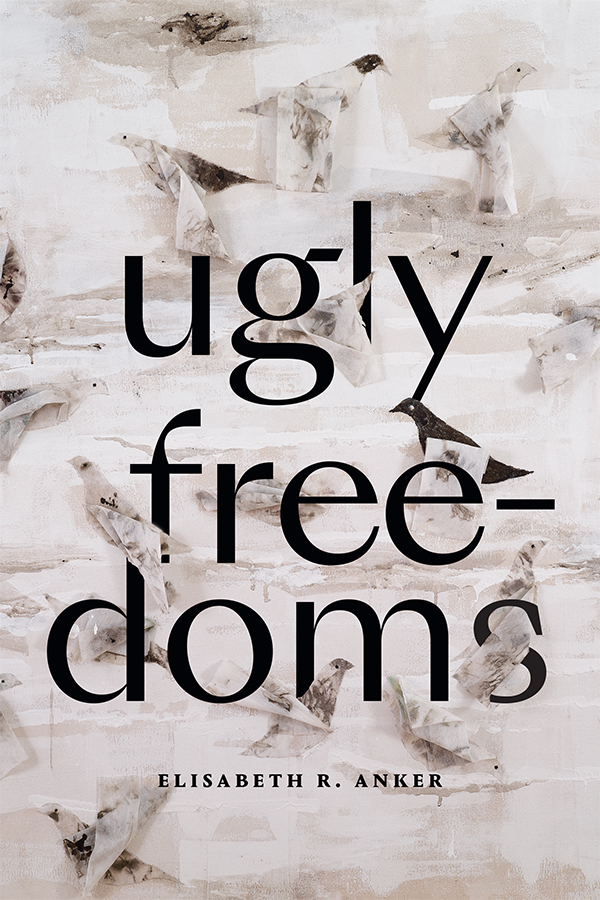
A review of Ugly Freedoms, Elisabeth R. Anker, Duke University Press, 2022.

Ugly Freedoms“We hold these truths to be self-evident, that all men are created equal, that they are endowed by their Creator with certain unalienable Rights, that among these are Life, Liberty and the pursuit of Happiness.” These truths are no longer self-evident: few people now believe in a Creator ; the inclusion of women in the generic term “all men” has to be specified ; and rights in their modern acceptation are not endowed or bestowed, but conquered and defended. What about Life, Liberty and the pursuit of Happiness? Are they not the expression of an American ideology that is shared by few people, even in the United States? Life itself has become a contested issue, as it hinges on when life starts and ends and some people are claiming a right to death in order to exit life with dignity. The pursuit of happiness was a central theme in Hollywood comedies of the 1930s and 1940s—a time of great unhappiness—, but we now look at these black-and-white motion pictures with nostalgia and irony, while Hollywood has moved to other descriptions of people’s aspirations and beliefs. Most significantly, freedom now has a hollow ring. The “Liberty Bell” march or the “Battle Cry of Freedom” were calls to rally round the flag and show patriotism, but these battle songs were used to legitimate wars of aggression and imperialism that made freedom a mockery of justice and equality. Domestically, the “land of the free” has the highest rate of incarceration in the world. We now speak with less assurance than our forefathers about the rights and values enshrined in declarations of independence or bills of rights. What if they were wrong in proclaiming life, liberty and happiness as our guiding principles? What if the reverse was true? What if freedom was not universally desirable, but “ugly” and repulsive? This is the argument that Elisabeth Anker makes in her book Ugly Freedoms, as she invites us to challenge self-evident truths and commonly believed assumptions.

Actually existing freedoms

Her point of departure is to consider “really existing freedoms,” not ideals or abstractions put forth in declarations of independence, philosophical treatises, and patriotic songs. And reality is where freedom often turns ugly. Anker’s argument is not to say that freedom leads to its own excesses and that it should be limited and regulated, or that autocratic regimes are better than unbridled democracies. She doesn’t claim that one person’s freedom ends where another’s begins, as in the popular saying that “the right to extend your hand stops where my nose begins.” She even contests John Stuart Mill’s do-no-harm rule as a limitation of freedom: under this criterium, most of our valued principles, including freedom from tyranny and national sovereignty, would be only empty promises. She is not interested in classical distinctions between “freedom to” and “freedom from,” what Isaiah Berlin distinguishes as positive and negative freedoms, or in Benjamin Constant’s “Liberty of Ancients Compared with that of Moderns.” She discards both liberal political theory and Marxist or postcolonial critiques of freedom. For Marx, exploitative forms of freedom such as freedom to sell one’s labor on a free market are “a mere semblance, and a deceptive semblance.” Under this vision, freedom is an excuse or a veil that capitalists and profit-makers use to hide and legitimize subjugation and exploitation: the ideology of freedom diverts workers from fighting for the overhaul of the capitalist order. For Frantz Fanon, colonial ideology has colonized what freedom is and who can practice it. Reclaiming freedom is a violent act: as Jean-Paul Sartre wrote in his preface to Fanon’s Wretched of the Earth, “killing a European is killing two birds with one stone, eliminating in one go oppressor and oppressed: leaving one man dead and the other man free.” But these masculinist visions of liberty still posit an untainted, heroic version of freedom and liberation that we should all strive for.

The ugly freedoms catalogued in this book do not serve these grand narratives. Freedom, for peoples liberated by US military interventions, often means being subjected to torture, indiscriminate killings, and lifelong incapacitation. Death is what liberty often tastes like for the liberated subject. On the other end of the war spectrum, freedom for Americans at home means suburban boredom, overweight-induced health risks, and unsustainable consumption. Torture, dispossession, and racial domination are not an excess or a deviation from principled ideals; they are a regular practice of American freedom. The history of freedom in the United States is tied to centuries of brutality, genocide, rape, environmental destruction, and racial hierarchy. It is too reassuring to claim that rights violations are a temporary blip in the long journey toward freedom and emancipation, or that truth will eventually prevail over the hypocrisy of those who use a distorted view of freedom to legitimate their predatory practices. American freedom entails the right to exploit and the power to subjugate. It continues to this day in ongoing settler practices of land appropriation, racial violence, and cultural erasure. US visions of freedom also contribute to mass carbon emissions, deforestation, pollution, and loss of biodiversity. Slave ownership was not different in nature from the exploitation of natural resources: in both cases, private individuals have final authority to use and dispose of their property as they see fit. Such freedom stands in stark contrast from indigenous peoples’ relations to land, living creatures, and fellow humans included in nonhierarchical webs of reciprocity and stewardship. For Michel Foucault, the history of reason included unreason as its constitutive other. Similarly, Elisabeth Anker shows that discourses of freedom and emancipation are built upon the very same philosophy and practices that wiped away indigenous cultures and justified the enslavement of racial others.

The Black Book of Freedom in America

Anker’s black book of freedom in America begins with the settler colony of Barbados, where sugar plantations offer a material archive of freedom’s violent practices. The Barbados sugar plantation owner is a key figure in the history of slavery and freedom. Cultivating sugar, as opposed to other crops, required the mobilization of money, indentured workforce or slave labor, land reclaimed from the wild, and other natural resources. It was also a lucrative business: indeed, it was the first crop to render colonization profitable, and Barbados was the first English colony to successfully cultivate and market sugar. As they became richer, Barbadian sugar plantation masters demanded more self-rule against the colonial metropole, prioritized rational choice and self-interest in juridical relations, and developed an ethos of entrepreneurship and profit-making. Meanwhile, their development was backed by unacknowledged indigenous dispossession, the wholesale destruction of ecosystems for short-term profit, and the inscription of racial hierarchies into the first English-language slave code in the world. Any free white person could discipline and punish any Black slave from a perceived infringement of the code. New practices generated on Barbados influenced political theories of individual freedom, especially in John Locke’s contribution to the Fundamental Constitutions of Carolina, which was created to bring Barbadian practices to North America. Locke’s doctrine that property rights stem from improvement of land through enclosure and industry gave legal credence to the appropriation of native lands and the violation of treaties concluded with Native American nations; and his defense of New World colonization is also a defense of “every free man to have absolute dominion and power over his negro slaves.” The Barbadian sugar master is therefore a key figure of modern freedom; and the plantation slave, its constitutive other, is a core constituent in the elaboration of political theories of individual freedom. The history of sugar doesn’t stop here: Anker reminds us that the pursuit of sugar profit contributed to US imperialist wars in Cuba, Puerto Rico, Hawai’i, and the Philippines, all of which were occupied in part to grow sugarcane. Sugar, “freedom’s digestible form,” also finds its way in contemporary artworks such as Kara Walker’s Marvelous Sugar Baby (2014), a gigantic sculpture of a nude Black woman in a sphinx position temporarily installed in an abandoned sugar factory in New York City.

Slavery, as a legal construct, was interpreted by its promoters not as the opposite of liberty but as a practice of freedom. It provided the ruling class the privilege of ownership, prosperity, and leisure, including the leisure to write treatises on liberty. Radical discourses of emancipation are themselves built upon the very same modern philosophies and practices that enslaved the racial others and justified their enslavement. Unfreedom remains after and even through emancipation. This is the disturbing lesson of Manderlay, a 2005 movie by Danish director Lars von Trier in which a Black community chooses to remain enslaved on the Manderlay plantation seventy years after emancipation. Manderlay deconstructs “the mythic march of freedom” that places Black unfreedom in the past, claims uninterrupted progress to the present, and considers white emancipators as the main protagonists. In fact, de jure emancipation neither offers freedom nor ends slavery. It casts freedom as a gift from a magnanimous nation to a grateful Black population, who first requires disciplinary guidance to become responsibly free. It sheds light on another set of “ugly freedoms”, acts of rebellion or defiance that would otherwise seem to reflect defeat and despair but that, in the movie under consideration, ultimately bring an end to the slavery plantation. The Manderlay residents have rejected the compulsion to desire the freedom they have been gifted and are seeking instead to define and enact a conception of freedom on their own terms. These deviant practices of freedom are ugly and compromised: they include theft, gambling, rape, property destruction, and the maintenance of slavery on the plantation where willing subjects self-organize their daily lives. Black freedom is typically cast as both illegible and a threat to the social order. But it also challenges the very presuppositions of white supremacy by establishing a political community that is not grounded in private possession, patriarchal mastery, and racial hierarchy. The freedom of Manderlay’s Black residents is not predicated on their virtuous suffering, on their likability, or on their resistance, as if they would have to be morally pure to deserve to be free. 

Tainted freedoms

We now live in a neoliberal economic system in which trade and financial flows, not people, must be set free. Many critics have described the rise of economic and social insecurity, the erosion of public spaces, the financiarization of transactions, and the encroachment of economic logic to previously nonmarketized activities that characterize the advent of neoliberalism. In order to thwart neoliberalism, Elisabeth Anker exposes the ugly freedoms that it represents, from the freedom to own guns to the freedom to evict nonpaying tenants, but also the tainted freedoms found in discarded and devalued spaces that can challenge the neoliberal order. She turns to a television drama set in Baltimore, The Wire (2002-2008) that describes the effects of raw, unencumbered capitalism on local governance and law enforcement. Part of the power of neoliberal capitalism is its insistence that there is no viable alternative to the American clientelist way of organizing politics and economics. But a series like The Wire shows that neoliberalism’s triumph has never been complete: its progression is obstructed and undermined by everyday acts of resistance and forces of bureaucratic inertia. Failed circuits, ineffective norms, outmoded technologies, and agency rivalry do not articulate an alternative to the current system or propose a vision for how the world could be organized otherwise, but neither do they lead to the conclusion of withdrawal, capitulation, and defeat. As Anker notes, commenting on Lauren Berlant’s cruel optimism, lack of guiding vision do not equate to hopelessness. Characters in The Wire have renounced the unattainable fantasy of the good life and know that clinging to that ideal will only bring them pain. For many, only the drug trade can offer economic support and a semblance of order; but even in the drug business, money and profit-making are not the primary factors for motivating individual action. The Wire’s depiction of Baltimore city life illustrates how neoliberal governance strategies can be weaker than otherwise presumed.

The last chapter of Ugly Freedoms examines freedom as climate destruction, or “Guts, Dust, and Toxins in an Era of Consumptive Sovereignty.” It draws from the work of Donna Haraway, Anna Tsing, Mel Chen, and other proponents of “queer inhumanisms” which focus on attachments with objects and creatures consigned to the nonhuman, the inanimate, the mineral, or the molecular. It also draws from visions of the individual as primarily an assemblage of microbes, toxins, companion species, and social interactions constituted in webs of dependence. At the planetary level, ugly freedoms are propelled by the forces of neoliberal capitalism, human exceptionalism, settler colonialism, and resource extraction, which all contribute to environmental damage and establish a regime of consumptive sovereignty. Its vision to liberate individuals by installing them as masters over things they consume puts the world they live in on a path to self-destruction: “consumptive sovereignty inexorably leads to the wasting away of much life, to incinerated landscapes, extinct species, desiccated habitats, toxic dust storm, climate refugees, and increasingly precarious populations.” But Anker also expands the commons, agents, and collectives that can be considered as political subjects of freedom. A new vision of freedom is to be “found in the dank registers of human guts, in the dirty register of household dust and shed skin, and in the geochemical registers of preplanetary gases and synthetic toxins, sites rarely explored for their political visions let alone for nurturing the hallowed practice of freedom.”

The Ugly American

Ugly Freedoms comes at a time when American liberal democracy is in tatters. Free speech has turned into ugly speech, moneyed interests dominate the legislative process, and the pledge to honor the flag of the United States of America, and the government for which it stands, has been debased by angry crowds of looters and rioters assaulting the Capitol. America is no longer a shining city upon a hill whose beacon light guides freedom-loving people everywhere. It now appears as it has always been: a settler state built on the genocidal erasure of its native population and the exploitation of Black slave labor, whose abusive practices of racial division and imperial dominance continue to this day. Americans conquered their independence over the British King to make sure they couldn’t be bossed around by a distant monarch; yet their freedom meant they could be as conspicuously greedy and wasteful as the most corrupt king or queen. It is when they want to do good and project their values overseas that Americans, like in the Marlon Brando movie, are at their ugliest. To paraphrase Graham Green in The Quiet American, I never knew a people who had better motives for all the trouble they caused. Exporting freedom has become a piece of a hegemonic ideological infrastructure, and efforts to impose democracy by force have turned into a nightmarish caricature. To be sure, no nation can claim for itself the saintliness of the promised land, and no iteration of freedom is wholly pure, righteous, or free from ambivalence. But it is time to take America down from the moral high ground that it claims for itself, and to subject its imperium to the law of nations, or indeed to the fate of any object exposed to the gravitational pull: what has been elevated must come down.

Love With Chinese Characteristics

A review of Dreadful Desires: The Uses of Love in Neoliberal China, Charlie Yi Zhang, Duke University Press, 2022.

Dreadful DesiresIn Dreadful Desires, Charlie Yi Zhang advocates “a new approach” and “a different perspective” on love and neoliberalism in contemporary China. As he describes it, “My study integrates the discursive with the ethnographic and combines grave scrutiny of political economies and empirical data with upbeat examinations of popular cultures.” His grave and upbeat essay documents how a neoliberal market logic permeates expressions of love and aspirations for a good life, and how a fiercely competitive conjugal market, polarized gender relationships, and residency-differenciated precarities in turn produce willful subjects who are ready to sacrifice their well-being to maximize the interests of the state and capital. Its content and writing style also reflect his personal background and professional training. Having left China in his late twenties to pursue an academic career in the US, Zhang returned to his homeland for a few months of fieldwork in 2012 in order to complete his PhD in gender studies at Arizona State University. He was subsequently hired by the University of South Dakota to teach global studies to undergraduate students for two years, then landed a job as Associate Professor in Gender and Women’s Studies at Kentucky University, where he completed his book manuscript. During his graduate studies, his sociology professor taught him “how to combine different methodologies into [his] unique voice.” He claims to have developed “a novel theoretical and methodological approach” that builds an “epistemic ground for fundamental change.” His ambition is no less than “to lay the foundation for better futures” and “to develop a different understanding of global neoliberalism and to transform the current system.” His book is published in the Thought in the Act series edited by Erin Manning and Brian Massumi, two Canadian theoreticians working at the intersection of philosophy and art critique.
Methodology and theory-building

Zhang’s methodology is far from unique in cultural studies and social science. He uses the standard anthropological method that relies upon informal conversations, focus group discussions, and direct observations collected in two Chinese cities, Hai’an and Wuxi, located in the Jiangsu province north of Shanghai. The first is a county-level city of one half-million inhabitants that encompasses rural areas and industrial zones on the south-western shores of the Yellow Sea; the second is a prefecture-level city of more than five million people in the southern delta of the Yangtze River with a rich history of silk weaving and artistic expression. During his four months of fieldwork, Zhang interviewed over a hundred rural migrants and local farmers or workers, men and women, asking questions about love, family life, and aspirations for the future. He “spent considerable time in the homes and dormitories of [his] informants” and at “various locations of production, such as construction sites, factories, small workshops, family mills, and farms.” He also participated in “nonproductive activities such as family dinners, birthday parties, weddings, festival celebrations, and mundane chores.” There are only two chapters, however, that are organized around his analysis of field data. The remaining three chapters, two of which were published in academic journals in earlier versions, offer a commentary on cultural productions and events, namely the sixtieth-anniversary ceremony of the regime’s founding in 1949, a popular TV reality show titled If You Are the One, and an analysis of middle-aged women’s passion for danmei fictions featuring same-sex relations between beautiful young men, based on a sample of sixteen fans. These chapters are written in the ethnographic tradition that combines factual description and abstract theorizing. Although he quotes data on China’s economic development and social transformation taken from the popular press and expert reports, Zhang does not use quantitative methods, structured questionnaires, or comparative case studies.

It is on the theoretical front that Zhang displays more originality and novelty. To quote from the introduction, he takes “a feminist intersectionnal approach to interrogate and untangle the mechanism that the Chinese state relies upon to define and redefine the affective parameters of desire and intimacy in binaristic terms of gender, class, sexuality, and ethno-race.” He also takes a “queer of color critique approach […] to foreground power relationships and engage the becoming aspects of the machinery to interrogate its speculative manipulation of affective ecologies.” He borrows from Judith Butler’s playbook the idea that “gender is intentional and performative” and that anatomical sex, gender identity, and embodied performance do not always align. He is attuned to the thinking of Sara Ahmed, Lauren Berlant, and Brian Massumi, who have developed new ways of articulating affective economies to neoliberalism. Ahmed allows him to present a “postorthodox Marxist perspective” in which affect is viewed as a different form of capital, which “does not reside positively in the sign or commodity, but is produced only as an effect of its circulation.” Berlant is another important source of inspiration: a dithyrambic endorsement on the book’s back cover advances that “Zhang offers to do for love in China what Lauren Berlant, in Cruel Optimism, does for hope.” As for Massumi, also associated with the affective turn in cultural studies, Zhang borrows his model of affective temporality that conflates an anticipatory present, a promisory future and a virtualized past. All three authors allow him to address “the theoretical lacunae that leaves affect, emotions, and feelings fatally underdiscussed in scholarly examinations of neoliberal subject and world making.”

The borderless Loveland and the difference-making machinery

Zhang’s distinctive contribution to social theory is to build a bridge between emotional affect and calculative reason, between love and neoliberalism. He brings affect theory to bear on political economy reasoning and geopolitical considerations. Specifically, love and aspirations for the good life are used strategically by the state to obtain acquiescence and participation in a polarized market economy. Class disparities and gender differences are exploited by the authoritarian state to recreate competition from within and to serve capital’s productive ends. Zhang also proposes a vast array of idiosyncratic concepts and neologisms to make sense of the entaglement between reason and affect in neoliberal China. He situates his ethnography in “the borderless Loveland,” an “affectsphere” or “fantasmatic lovescape” that shapes people’s love and caring capacities in order to harness China’s national interest with the transnational interests of capital. The Loveland is to be understood as a topological notion, not a geographical concept, as the author draws “a speculative topography of the everyday sensibilities.” The Loveland extends its reach beyond mainland China; it is alternatively presented as “borderless” or within boundaries that are “indeterminate” or “expansive.” Zhang’s creative use of topology extends to the concepts of biopolitics and biopower borrowed from Michel Foucault. The first, assimilated with calculative reason and state power, follows a top-down, vertical axis; while the second, located on the immanent plane of affects, circulates horizontally. Feminist scholarship complicates this two-dimensional diagram by introducing a “multilayered and multifaceted architecture” where domination and resistance are “multidirectional and multidimensionnal.” These overlapping layers consist of gender, class, ethno-race, and sexuality. The assemblage of these orthogonal coordinates and multiple dimensions give shape to what the author calls the “difference-making machinery,” a polarizing mechanism that pits disenfranchized groups against another to allow for their compound exploitation by the nation-state and multinational corporations. This neoliberal machinery “integrates the borderless Loveland into the regulatory biopolitical system to drive and sustain China’s marketization and reintegration into the global economy.”

Dreadful Desires documents two different moves: the colonization of love and sentiments by the market and the state, and the way “lovable and love-able” subjects in turn uphold the functioning of the market and the expansion of the state’s interests. The encroachment of a neoliberal logic upon the emotional lifeworld of Chinese citizens is illustrated by the TV date game show If You Are the One, a copycat of a British TV reality show with added Chinese characteristics. The crass materialism of female participants is illustrated by the attitude of one young woman who, asked by a male suitor if she would “like to go out for a ride on my bicycle”, bluntly answers: “I would rather be crying in a BMW car!” In the show as in real life, it is standard for a Chinese woman to evaluate a potential male partner’s worth and accomplishments by asking him questions about his educational background, job, salary, amount of savings in the bank, ownership of property and cars, and so on. Indeed, having an appartment, a luxury car, a hefty savings account and a high-paying job has replaced the “four big items” (si dajian) that prospective grooms were supposed to possess under Maoist China: a bicycle, a sewing machine, a wristwatch, and a radio. A new kind of masculinity has emerged, which valorizes entrepreneurship, business acumen, and material possessions. As for women, the requisites placed upon them are no less stringent. The “three good girl” (sanhao nüsheng), a honorary title for meritous students under Maoism, used to designate girls with good morality, good learning, and good health. Now women have to respond to superlative standards of attractiveness, including breast size and leg length; hold glamorous jobs in the service sector; and be ready to carry out expanded family duties to support their husband, in-laws, and future children. These impossible requiements are exerting a heavy toll on Chinese masculinities and feminities. The amount of cash and gifts exchanged in a wedding ceremony can result in lifelong debt for the average family. Migrant workers working on construction sites or women in textile factories stand ready to sacrifice their health and well-being in the hope of a better future, if not for them, then at least for their children. But the dream of a good life is forever deferred: “the harder they try, the more they are alienated from their homes.”

Xi Jinping’s love and peace ideology

The Chinese state is complicit in the exploitation of labor by capital and the reproduction of oppositional differences out of the intersection of class, gender, and sexuality. It fuels the construction boom that sacrifices migrant workers on the altar of economic development and excludes them from the cities they have helped build. It pits categories of labor and gender roles against each other, while repressing nonnormative forms of intimity in the name of “homepatriarchy”—a portmanteau word that combines heteronormativity, male privilege, state authoritarianism, and home ownership. For Zhang, internal migrations and the hukou system of residence registration play the role that racial segregation occupies in racially-divided America or in South Africa under apartheid. Hukou registration gives access to education, medical care, basic life insurance, and other social services. It considerably enhances the value of a prospective bride or groom on the marriage market; bachelors lacking the urban residence permit must work harder and save more to improve their marriageability, or find a bride from a poorer area of China or a less-developed country such as Vietnam. To be sure, the socialist state run by the Chinese Communist Party cannot condone class hierarchies and labor exploitation. New regulation on TV dating shows now mandates diversity of participants and equality of treatment—even though the guy with the biggest property portfolio still gets the girl. Drawing upon Marxist-Leninist ideology, the party-state extolls the eradication of class differences and the liberation of China from exploitation and oppression; but in the choreographied extravaganza of the sixtieth anniversary ceremony, gender difference reemerges in the celebration of the post-reform era as a way “to conceal the new class structure and class differentiation.” The figure of Xi Jinping, construed as a benevolent father and a good husband to the nation, reinforces the patriarchal nature of the regime. The party-state offers love and harmony as a solution to internal developments and external challenges; but in the eyes of the author, “China’s love-gilded cosmopolitan dream proves no less pernicious than the hate-filled paranoia stoked by incendiary nationalists” such as Donald Trump in the United States.

Is Charlie Yi Zhang a Marxist? He shows little interest for the historical Marx, noting only his endorsement of normative heterosexualiy as the foundation for human and societal development. He prefers to borrow from Petrus Liu a “queer Marxist approach” that rejects “inclusion as a mode of social redress.” He retains from Marxism and radical thought the role of crisis and contradictions in fostering political upheaval and social change. The “difference-making machinery” is ripe with contradictions and fault lines, the first being the “contradictory needs of freewheeling capital and the border-making nation-state.” Zhang uses the concept of apparatus that he borrows from Marxist thought; but whereas for Louis Althusser apparatuses were an emanation of the state and reflected its repressive or ideological functions, Zhang refers to “a fantasmatic apparatus of desire and intimacy” that draws people to “work hard, dream big, and die slowly.” Like Marx, Zhang also believes that the role of critical theory is not just to interpret the world, but to change it. His declared goal is “to find a place where the subalterns can survive and to help lay a foundation for long-run transformation.” Exposing the dissonance between promise and fulfillment in the “borderles Loveland” is bound to send shockwaves to the system, shattering the “life-sustaining fantasy” on which it is built. His economy of affects places contradiction and change solely on the side of the reproduction of capital, neglecting entirely the relations of production and the reproduction of labor that form the bedrock of Marx’s thought. Indeed, borrowing from Sara Ahmed’s “economic model of emotions” where capital and affect are the sole factors of production and reproduction, he completely ignores labor as the primary scene of class antagonism and alienation. The only form of labor that is acknowledged in this affect-dominated economy is emotional labor. Indeed, this neglect of “hard labor” that characterizes postmodern political economy reflects the disengagement of the younger generation of Chinese men and women, who shun factory or construction work in favor of lower-paid jobs in the service sector.

The cultural unconscious

To simplify Zhang’s thesis, love in China is shaped by the market, and the market in turn is moved by love, while the party-state sustains this dynamics by accentuating polarization in society. Charlie Yi Zhang is not the first one to raise the issue of love and sentiments in post-Mao China. Yan Yunxiang wrote a splendid ethnography on Private Life Under Socialism: Love, Intimacy, and Family Change in a Chinese Village, while Lisa Rofel used her extended fieldwork in a Chinese silk factory to write about Other Modernities: Gendered Yearnings in China after Socialism. These two ethnographies are based on solid empirical ground, cross-generational historical depth, and a broad-ranging critique of the meaning of modernity and social change during transition from socialism to the market. They have become classics in the anthropology literature, and allow us to understand the evolution of Chinese masculinities and feminities through experience-near concepts and thick descriptions. By comparison, Dreadful Desire is relying on more shallow observation and thinner engagement. The author attempts to compensate the limited time spent on the field with ambitious efforts at theorizing and conceptualizing, drawing from a broad range of authors and subdisciplines. But the experience-far concepts and philosophical metaphors like the “borderless Loveland” and the “difference-making mechanism” taught me more about the context of academic production on North American campuses than on the travails of migrant workers and urban citizens in Xi Jinping’s China. There is a cultural unconscious at work in the emphasis put on “the pursuit of happiness,” the possibility of a “new birth of freedom” that the author experiences while moving to the US, the protestant urge to publicly confess one’s personal background and life expectations, and the belief in the transition from a love-inpaired present to a “love-enabled future.” The proliferation of differences, gendered or otherwise, that the author attributes to a Chinese ideological state apparatus, better characterizes in my view the scissiparity reproduction of ever-increasing subfields of cultural studies and the multiplication of gendered, classed, sexualized, and ethno-racialized categories brought forth by identity politics on American campuses.

Gay Dykes on Acid-Free Paper

A review of Information Activism: A Queer History of Lesbian Media Technologies, Cait McKinney, Duke University Press, 2020.

Information ActivismLesbian feminists invented the Internet, and they did it without the help of a computer. This is the surprising finding that comes out of the book Information Activism: A Queer History of Lesbian Media Technologies, published by Duke University Press in 2020. As the author Cait McKinney immediately makes it clear, the Internet that lesbians built was not composed of URL, HTML, and IP servers: it was an assemblage of print newsletters, paper index cards, telephone hotlines, paper-based community archives, and early digital technologies such as electronic mailing lists and computer databases. What made these early media technologies “lesbian” is that they formed the information infrastructure of a social movement that Cait McKinney describes as “information activism” and that was oriented toward the needs and aspirations of lesbian women in North America during the 1980s and 1990s. And what makes Cait McKinney’s book a “queer history” is that she brings feminism and queer studies to bear on a media history of US lesbian-feminist information activism based on archival research, oral interviews, and participant observation through volunteering in the Lesbian Herstory Archives in New York. Information activism took many forms: sorting index cards, putting mailing labels on newsletters, answering the telephone every time it rings, converting old archives into digital format… All these activities may not sound glamorous, but they were part of the everyday politics of “being lesbian” and “doing feminism.”

The Internet that women built

Recently the role of women in the development of information technology and the Internet has attracted a great deal of attention. Thanks in part to the effort of popular author Walter Isaacson, the names of Ada Lovelace, Grace Hopper, Jean Jennings, and Jennifer Doudna have become more familiar to modern readers, and their enduring legacy may have contributed to attract more young women into computer science. Even so, computing remains a heavily male-dominated field, and the industry’s openness to “the crazy ones, the misfits, the rebels, the troublemakers, the round pegs in the square holes” (to quote from a famous Apple commercial) is mostly limited to the masculine part of mankind. It therefore bears reminding that the Internet revolution was brought forth by information activists of all stripes and colors, not just white cis males from California. The “misfits” lauded by Steve Jobs may also have included dykes, stone butches, high femmes, riot grrrls, and lavender women as well as trans and nonbinary subjects. Besides, as feminist critique has pointed out, the concept of the “Internet revolution” or the “information superhighway” are masculinist notions that need to be reexamined. There is a gender bias in popular accounts of technology development and innovation that tends to exclude the contribution of certain agents, especially queer subjects and women of color. Technologies are gendered, and they also exhibit heteronormative and white biases. To fix this problem, much more is needed than writing more inclusive histories of innovation and exposing occupational sexism in the technology industry.

The lesbian volunteers whose activities are chronicled in Information Activism did not really invent the Internet. They did something much more purposeful: they set out to create a world bearable and a life worth living for lesbian women in North America. They did this work within conditions of exclusion from access to reliable information about lesbian life and from the margins of social structures and even mainstream feminism. Confronted with discrimination, isolation, and invisibility, they decided to build an information infrastructure of their own, one connection at a time. Creating alternative communication channels responded to conditions in which many women lacked access to other lesbians and were desperate to find connection. Sometimes, the sole purpose of maintaining this information infrastructure was to show lesbian women that they were not alone. There was another person to talk to at the other end of the help line at the New York Lesbian Switchboard ; other researchers subscribing to the newsletter Matrices were doing stuff in a field marginalized within academic studies ; documents stored at the Lesbian Herstory Archives in New York City bore the testimony of queer lives whose memorialization was a source of inspiration for modern generations. In some cases, just knowing the information was “out there” was enough to go on living with a renewed purpose. In other instances, women engaged in long “rap sessions” discussing feminist politics over the phone, started collaborative research projects that led to the emergence of a full-fledge discipline of queer studies, or found companionship and accomplishment in their volunteering projects. Information makes promises and fulfills aspirations that are much greater than “finding things out.”

A Chatroom of One’s Own

Networks have been critical to the construction of feminist histories. Cait McKinney examines several cases of networked communication initiatives that predate the emergence of online media: the publication of the newsletter Matrices designed for sharing information and resources with anyone doing research related to lesbian feminism; the New York Lesbian Switchboard connecting callers to a source of information and advice; the Lesbian Herstory Archives’ collection of print documents and audio tapes; the patient collection of indexes and bibliographies that made lesbian feminist essays and periodicals searchable and actionable. The technologies used in these pre-digital enterprises now seem antique: typewriters, photocopiers, landline telephones, letter mail, stacks of papers, cardboards, index cards, and face-to-face interactions. But the results were far-reaching and futuristic. They laid the ground on which a lesbian-feminist movement could expand and self-organize. Information and communication networks allowed dispersed researchers to connect with each other, share information, and do lesbian research within unsupportive and sometimes openly hostile research environments. Women living in rural areas or isolated places were encouraged to become active nodes of the network by taking pictures, gathering newspaper clips, and audio-recording interviews to document events taking place in their geographic area. The Matrices newsletter facilitated historical research through the creation of a supportive information infrastructure ; it also allowed for the nationwide expansion of a social movement originally concentrated in New York; and it convinced dispersed readers that lesbian lives mattered and were worth documenting. Key initiatives grew out of the network, such as the volume Black Lesbians: An Annotated Bibliography compiled by JR Roberts to counter the invisibility of women of color in mainstream lesbian feminism. In the 1990s, many print newsletters lost relevance a web browsing developed and academic listservs became key networks for sharing information. Matrices stopped publishing in 1996, replaced ostensibly by commercial enterprises such as Google, Amazon, and digital publishing tools. But online communication does not present as much of a turning point as a continuation of networked modes of organization for feminist social movements.

Another example of continuity between analog and digital modes of communication is the lesbian telephone hotline staffed by volunteers in New York City that answered to every call with a listening ear and a range of helpful tips and advice. Like newsletters, telephone hotlines connected lesbians at a distance using information. For the historian, they are harder to document: volunteers were anonymous and cannot be traced back, and all that remains of the long nights spent answering the phone are the call logs recording every conversations with a few notes and doodles scribbled in the margin. The logs suggest that many callers expressed despair, loneliness, or confusion; but others called for help finding something fun to do that night, for precise information about support groups or community resources, or just to talk and “rap” about gender issues. Even before the appearance of mailing lists and online forums, the need to have a chatroom of one’s own was clearly felt and answered. McKinney also uses the log archives as entries to thinking about feminist research methods, multimedia practices, care provision, and affective labor involved in lesbian telephone hotlines. She reminds readers that feminist activism involved less acknowledged dynamics such as boredom, repetition, isolation, and burnout. What makes a telephone hotline “lesbian feminist” is the self-definition and principles under which the switchboard operated. Volunteers were recruited from within the lesbian community and bisexual women were tacitly kept out, while the policy toward trans women and gender nonconforming persons was left undefined, although their needs were also addressed on an ad hoc basis. These remarks remind us that terminology, such as the moniker “gay and lesbian” as opposed to the more contemporary “LGBTQI+”, are historical constructions that cast aside or rigidify some categories as much as they include or deconstruct others.

A feminist mode of network thinking

Network thinking has been a feature of feminist activism and knowledge production since before the consumer Internet. “Improving (lesbian) lives with information” could be the motto of a behemoth social media company catering to a niche market; it was always the principle under which lesbian activists operated. The feminist movement produced original ideas about communication, access to information, capacity building, and the power of alternative structures for organizing people and ideas. Lesbian feminists also offered pre-digital feminist critiques of networks as egalitarian ideals that can conceal functional hierarchies and threaten the privacy of participants. Computer networks were dreamt and imagined before they were invented and built. The librarians and volunteers who collected the Lesbian Periodicals Index  were imagining computer databases and electronic indexing while shuffling paper cards into shoeboxes ; the Lesbian Herstory Archives’ project leaders were figuring putting all their resources online before they had the equipment and manpower to convert documents into digital format. They were also early adopters of information technology, manifesting a can-do attitude and a hands-on sensibility familiar to feminist activism—and more generally to “women’s work.” McKinnon characterizes as “capable amateurism” a fearless approach to learning and implementing new media technologies; a gendered belief in the capacity of amateurs to work hard and acquire new skills; and a willingness to experiment, improvize, and figure things out on the fly. Lesbian feminism is also informed by values of non-hierarchy, direct participation by members, and an investment in decentralized processes.

Today these values are reflected in many internet communities. A good-enough approach (“rough consensus”), a culture of sharing (“copyleft”), and collectively organized work (“open source”) as well as political militancy (“Anonymous”) characterize segments of the computer industry as much as they are part of the lesbian-feminist heritage. One may even see in the Slow Web movement echoes of the politics of nonadoption and digital hesitancy that was developed by some activist groups surveyed by the author. Beyond lesbian history, these activists have much to teach all of us about why, when, and for whom information comes to matter. The lesbian feminist imagination allows us to envisage a world brought together by connection, care, and “sisterhood” that earlier feminist networks originally articulated and that worldwide Internet connectivity now makes potentially real. A lesbian-feminist approach also reminds us that networks make equalitarian promises that conceal the power structures, protocols, and control mechanisms they actually exert. Computer databases and search engines are not neutral; they determine what is thinkable and sayable through filtering access to information and indexing resources into categories and keywords. These are deeply political choices, and the way decision-making processes and governance bodies are structured matters a great deal. If we want to keep a free and open Internet and uphold the principle of net neutrality, perhaps we should learn from a history of information networks written through older forms of feminist print culture.

Lesbianism is so twentieth century

But does the lesbian past still talk to our queer age? As a self-described “masculine, nonbinary person,” Cait McKinney is ambivalent about the category of lesbianism. She originally assumed that “lesbian” as a specific term of self-identification was historically dated and situated in a period of late twentieth-century militancy, and she was surprised to learn that the term was still popular among a younger generation of queer-identified activists. Young volunteers at the Lesbian Herstory Archives articulate deep attachment to lesbian history and subcultures, and the snippets of information and pictures that the center posts on Instagram are instantly popular. Some business ventures exploit the revival in lesbian-feminist militancy heritage, selling T-shirts, collectable items, and other paraphernalia bearing slogans and pictures from the seventies and eighties. McKinney also thinks lesbianism, while providing a big tent for women with nonconforming gender identities, also had exclusionary effects as many lesbian-feminists were historically hostile to trans women and indifferent to women of color. As a matter of fact, lesbianism meant much more than women having sex with women. Likewise, the erotic exceeds what is commonly understood as sensuous, sexually appealing, and emotionally gratifying acts. Eroticism can be described as a communication practice, and information activism is definitely part of it. Reading archives against the grain (or along the archival grain, as Laura Stoller invites us to do) also refers to the grain of one’s skin, and the archival touch implies an embodied experience laden with sensory perceptions and affects. Libriarianship and archivism are professions that have been historically attractive to women, including persons attracted to same-sex relations, and they have often served as erotic projections of male—and sometimes female—desire. There is something queer about manipulating acid-free paper, and Information Activism consciously addresses how librarians and archivists cope with the affective and intimate impacts of accumulated print media.

Kiss the Frog

A review of Animacies: Biopolitics, Racial Mattering, and Queer Affect, Mel Y. Chen, Duke University Press, 2012.

Animacies“Inanimate objects, have you then a soul / that clings to our soul and forces it to love?,” wondered Alphonse de Lamartine in his poem “Milly or the Homeland.” In Animacies, Mel Chen answers positively to the first part of this question, although the range of affects she considers is much broader than the lovely attachments that connected the French poet to his home village. As she sees it, “matter that is considered insensate, immobile, deathly, or otherwise ‘wrong’ animates cultural life in important ways.” Anima, the Latin word from which animacy derives, is defined as air, breath, life, mind, or soul. Inanimate objects are supposed to be devoid of such characteristics. In De Anima, Aristotle granted a soul to animals and to plants as well as to humans, but he denied that stones could have one. Modern thinkers have been more ready to take the plunge. As Chen notes, “Throughout the humanities and social sciences, scholars are working through posthumanist understandings of the significance of stuff, objects, commodities, and things.” Various concepts have been proposed to break the great divide between humans and nonhumans and between life and inanimate things, as the titles of recent essays indicate: “Vibrant Matter” (Jane Bennett), “Excitable Matter” (Natasha Myers), “Bodies That Matter” (Judith Butler), “The Social Life of Things” (Arjun Appadurai), “The Politics of Life Itself” (Nikolas Rose),“Parliament of Things” (Bruno Latour). Many argue that objects are imbued with agency, or at least an ability to evoke some sort of change or response in individual humans or in an entire society. However, each scholar also possesses an individual interpretation of the meaning of agency and the true capacity of material objects to have personalities of their own. In Animacies, Mel Chen makes her own contribution to this debate by pushing it in a radical way: writing from the perspective of queer studies, she argues that degrees of animacy, the agency of life and things, cannot be dissociated from the parameters of sexuality and race and is imbricated with health and disability issues as well as environmental and security concerns.
Intersectionality

Recent scholarship has seen a proliferation of dedicated cultural studies bearing the name of their subfield as an identity banner in a rainbow coalition: feminist studies, queer studies, Asian American studies, critical race studies, disability studies, animal studies… In a bold gesture of transdisciplinarity, Mel Chen’s Animacies contributes to all of them. The author doesn’t limit herself to one section of the identity spectrum: in her writing, intersectionality cuts across lines of species, race, ability, sexuality, and ethnicity. It even includes in its reach inanimate matter such as pieces of furniture (a couch plays a key part in the narrative) and toxic chemicals such as mercury and lead. And as each field yields its own conceptualization, Mel Chen draws her inspiration from what she refers to as “queer theory,” “crip theory,” “new materialisms,” “affect theory,” and “cognitive linguistics.” What makes the author confident enough to contribute to such a broad array of fields, methods, and objects? The reason has to do with the way identity politics is played in American universities. To claim legitimacy in a field of cultural studies, a scholar has to demonstrate a special connexion with the domain under consideration. As an Asian American for instance, Mel Chen cannot claim expertise in African American studies; but she can work intersectionally by building on her identity as a “queer woman of color” to enter into a productive dialogue with African American feminists. The same goes with other identity categories: persons with disabilities have a personal connexion to abled and disabled embodiment, while non-disabled persons can only reflect self-consciously about their ableism. Even pet lovers, as we will see, have to develop a special relationship with their furry friends in order to contribute to (critical) animal studies.

Using this yardstick, Mel Chen qualifies by all counts to her transdisciplinary endeavor. She identifies herself as Asian American, queer, and suffering from a debilitating illness. She gives many autobiographical details to buttress her credentials. She mentions that her parents were immigrants from China who couldn’t speak proper English and used singular and plural or gendered pronominal forms indifferently. She grew up in a white-dominated town in the Midwest and was used to hearing racist slurs, such as people yelling “SARS!” at her—this was before a US president publicly stigmatized the “Chinese virus.” She shows that prejudice against the Chinese has a long history in the United States. The book includes racist illustrations dating from the nineteenth century featuring Chinese immigrants with a hair “tail” and animal traits that make them look like rodents. Chen analyzes the racial fears of lead poisoning in the “Chinese lead toy scare” of 2007 when millions of Chinese exported toys made by Mattel were recalled due to overdoses of lead paint. She exhumes from the documentary and film archives the figure of Fu Manchu, a turn-of-the-century personification of the Yellow Peril, and proposes her own slant on this character that is said to provide “the bread and butter of Asian American studies.” Mel Chen’s self-reported identity as queer is also documented.  She mentions her “Asian off-gendered form” when describing herself, and frequently refers to her own queerness. In an autobiographical vignette, she designates her partner as a “she” and puts the pronoun “her” in quotes when she refers to her girlfriend (Chen’s own bio on her academic webpage refers to her as “they”). Her scholarship builds on the classics of queer studies such as Judith Butler and Eve Kosofsky Sedgwick, and she feels especially close to “queer women of color” theorizing. She exposes to her readers some unconventional gender and sexuality performances, such as the category of “stone butch” designating a lesbian who displays traditional masculinity traits and does not allow herself to be touched by her partner during lovemaking (to draw a comparison, Chen adds that many men, homo or heterosexual, do not like to be penetrated.)

Feeling Toxic

But it is on her medical condition that Mel Chen provides the most details. Moving to the “risky terrain of the autobiographical,” she mentions that she was diagnosed as suffering from “multiple chemical sensitivity” and “heavy metal poisoning.” This condition causes her to alternate between bouts of morbid depression and moments of “incredible wakefulness.” She makes a moving description of walking in the street without her filter mask and being in high alert for toxins and chemicals coming her way: navigating the city without her chemical respirator exposes her to multiple dangers, as each passerby with a whiff of cologne or traces of a chemical sunscreen may precipitate a strong allergic reaction. In such condition, which affects her physically and mentally, she prefers to stay at home and lie on her couch without seeing anybody. But Mel Chen doesn’t dwell on her personal condition in order to pose as a victim or to elicit compassion from her readers. Firstly, she feels privileged to occupy an academic position as gender and women studies professor at UC Berkeley: “I, too, write from the seat and time of empire,” she confesses, and this position of self-assumed privilege may explain why she doesn’t feel empowered enough to contribute to postcolonial studies or to decolonial scholarship. More importantly, she considers her disability as an opportunity, not a calamity. Of course, the fact that she cannot sustain many everyday toxins limits her life choices and capabilities. But toxicity opens up a new world of possibilities, a new orientation to people, to objects and to mental states. As we are invited to consider, “queer theories are especially rich for thinking about the affects of toxicity.”

This is where the love affair with her sofa comes in. When she retreats from the toxicity of the outside world, she cuddles in the arms of her couch and cannot be disturbed from her prostration. “The couch and I are interabsorbent, interporous, and not only because the couch is made of mammalian skin.” They switch sides, as object becomes animate and subject becomes inanimate. This is not only fetishism: a heightened sense of perception of human/object relations allows her to develop a “queer phenomenology” out of her mercurial experience. New modes of relationality affirm the agency of the matter that we live among and break it down to the level of the molecular. Mel Chen criticizes the way Deleuze and Guattari use the word “molecularity” in a purely abstract manner, considering “verbal particles” as well as subjectivities in their description of the molar and the molecular. By contrast, she takes the notion of the molecular at face value, describing the very concrete effects toxic molecules have on people and their being in the world. These effects are mediated by race, class, age, ability, and gender. In her description of the Chinese lead toy panic of 2007, she argues that the lead painted onto children’s toys imported to the United States was racialized as Chinese, whereas its potential victims were depicted as largely white. She reminds us that exposure to environmental lead affects primarily black and impoverished children as well as native Indian communities, with debilitating effects over the wellbeing and psychosocial development of children. Also ignored are the toxic conditions of labor and manufacture in Chinese factories operating mainly for Western consumers. The queer part of her narrative comes with her description of white middle-class parents panicking at the sight of their child licking their train toy Thomas the Tank Engine. In American parents’ view, Thomas is a symbol of masculinity, and straight children shouldn’t take pleasure in putting this manly emblem into their mouth. But as Chen asks: “What precisely is wrong with the boy licking the train?”

Queer Licking

In addition to her self-description as Asian, queer, and disabled, Mel Chen also claims the authority of the scholar, and it is on the academic front, not at the testimonial or autobiographical level, that she wants her Animacies to be registered. Trained as “a queer feminist linguist with a heightened sensitivity to the political and disciplinary mobility of terms,” she borrows her flagship concept from linguistics. Linguists define animacy as “the quality of liveness, sentience, or humanness of a noun or noun phrase that has grammatical, often syntactic, consequences.” Animacy describes a hierarchical ordering of types of entities that positions able-bodied humans at the top and that runs from human to animal, to vegetable, and to inanimate object such as stones. Animacy operates in a continuum, and degrees of animacies are linked to existing registers of species, race, sex, ability, and sexuality. Humans can be animalized, as in racist slurs but also during lovemaking. “Vegetable” can describe the state of a terminally-ill person. As for stones, we already encountered the stone butch. Conversely, animals can be humanized, and even natural phenomena such as hurricanes can be gendered and personified (as with Katrina.) Language acts may contain and order many kinds of matter, including lifeless matter and abject objects. Dehumanization and objectification involve the removal of qualities considered as human and are linked to regimes of biopower or to necropolitics by which the sovereign decides who may live and who must die.

This makes the concept of animacy, and Mel Chen’s analysis of it, highly political. Linguistics is often disconnected from politics: Noam Chomsky, the most prominent linguist of the twentieth century, also took very vocal positions on war and American imperialism, but he kept his political agenda separate from his contribution to the discipline. In How to Do Things with Words, J. L. Austin demonstrates that speech acts can have very real and political effects, and in Language and Symbolic Power, Pierre Bourdieu takes language to be not merely a method of communication, but also a mechanism of power. Mel Chen takes this politicization to its radical extreme. She criticizes queer liberalism and its homonormative tendencies to turn queer subjects into good citizens, good consumers, good soldiers, and good married couples. Recalling the history and uses of the word queer, which began as an insult and was turned into a banner and an academic discipline, she notes that some queers of color reject the term as an identity and substitute their own terminology, as the African American quare. She also questions the politics by which animals are excluded from cognition and emotion, arguing that many nonhuman animals can also think and feel. Positioning her animacy theory at the intersection of queer of color scholarship, critical animal studies, and disability theory, she argues that categories of sexuality and animality are not colorblind and that degrees of animacy also have to do with sexual orientation and disability. She brings the endurance of her readers to its break point by invoking subjects such as bestiality and highly unconventional sexual practices. Her examples are mostly borrowed from historical and social developments in the United States, with some references to the People’s Republic of China. She exploits a highly diverse archive that includes contemporary art, popular visual culture, and TV trivia.

Critical Pet Studies

According to “Critical Pet Theory” (there appears to be such a thing), scholars have to demonstrate a special bond with their pet in order to contribute to the field of animal studies. Talking in abstract of a cat or a dog won’t do: it has to be this particular dog of a particular breed (Donna Harraway’s Australian shepherd ‘Cayenne’), or this small female cat that Jacques Derrida describes in The Animal That Therefore I Am. Talking, as Deleuze and Guattari did, of the notion of “becoming-animal” with “actual unconcern for actual animals” (as Chen reproaches them in a footnote) is clearly a breach in pet studies’ normative ethics. Even Derrida failed a simple obligation of companion species scholarship when he failed to become curious about what his cat might actually be doing, feeling, or thinking during that morning when he emerged unclothed from the bathroom, feeling somehow disturbed by the cat’s gaze. Mel Chen’s choice of companion species is in line with her self-cultivated queerness: she begins the acknowledgments section “with heartfelt thanks to the toads,” as well as “to the many humans and domesticated animals populating the words in this book.” The close-up picture of a toad on the book cover is not easily recognizable, as its bubonic glands, swollen excrescences, and slimy texture seem to belong both to the animal kingdom and to the realm of inert matter. Animacy, of course, summons the animal. But Mel Chen is not interested in contributing to pet studies: she advocates the study of wild and unruly beasts or, as she writes, a “feral” approach to disciplinarity and scholarship. “Thinking ferally” involves poaching among disciplines, raiding archives, rejecting disciplinary homes, and playing with repugnance and aversion in order to disturb and to unsettle. Yes, the toad, this “nightingale of the mud” as the French poet would have said, is an adequate representation of this book’s project.

Let’s Talk About Sex

A review of Media, Erotics, and Transnational Asia, edited by Purnima Mankekar and Louisa Schein, Duke University Press, 2013.

Transnational asiaThis is not a book about Asian sex videos. Indeed, reading Media, Erotics, and Transnational Asia should lead the reader to question why the category “Asian sex video” exists in the first place, why Asian bodies are disproportionately represented in Internet porn, and how we should react to such unregulated flow of images. In fact, none of the entries in this book deals with explicitly erotic content or with pornography, and the only chapter that concerns the Internet as a medium, a study of online discussions about correspondence marriage between the US and the Philippines, insists on rejecting facile analogies with the sex trade or with mail-to-order catalogues. For scholars and for feminists—and most authors in this volume are women—, the erotic has to be distinguished from the sexual. And writing about eroticism should in no way lead to stoke the base instincts of the reader. The erotic extends beyond sex acts or desires for sex acts to become “enmeshed in, for instance, yearnings for upward mobility, longings for ‘the homeland,’ formulations of nationhood and citizenship, and ruptures of ethnic and racial identity.” Desires for sexual encounters intertwine with those for commodities and lifestyles. Such a paneroticism may break gender, class, ethnicity, or age boundaries. Synonymous with desire, it may be at odd with an Orientalist vision of Asia as feminized and the West as setting the standard for homo- and heteronormativity. For instance, “what constitutes ‘lesbian’ desire may look both and function differently than it does within Euro-American social and historical formations, and draw from alternative modes of masculinity and feminity.”
Editing a volume for Duke University Press

The book is an edited volume composed of ten chapters and a dense introduction in which the two editors explain what they mean by “media,” “erotics,” “transnational,” and “Asia.” It is difficult to strike the right balance in the introductory chapter of a collection of scholarly essays written by different authors. One the one hand, the editors want to add value to the book chapters by giving coherence and theoretical depth to the assembled pieces. On the other hand, they need to reflect the diversity of the contributions and leave open their conceptual relevance for theory-building. The introduction is often the book’s signature, its most ambitious part and the text for which it will be remembered. The risk is to promise more than the book chapters can deliver by engaging in intellectual virtuosity, or to remain at the plane of immanence and offer a paraphrase of the book’s content. Mankekar and Schein lean on the theoretical side. Their introduction is thick, sometimes obscure, and heavily referenced. Their ambition is to “construct a transnational analytics” to account for the mediation of erotics in Asia and beyond. They position the book for a broad audience spanning several subdisciplines—Asian studies, media studies, gender studies, and sexuality studies, as well as anthropology and critical theory. And yet they address scholars, and it is as scholarship that they want their contribution to be noticed and remembered. My reading as a non-scholar may therefore miss the mark or misinterpret the intent of the authors. But this is a risk I am willing to take.

One way of studying erotics through transnational media in Asia is to read texts, watch pictures or videos, listen to recordings or radio shows, and then to write about their form and content using the tools and methods of literary criticism and media analysis. This is not how the authors in this volume proceed. For them, desire and erotics can only be revealed through participation in mediated worlds, in a combination of textual analysis and ethnographic research. Erotics is what people make of it: a medium or a text can only be deemed erotic if the viewers invest it with fantasies and emotional longings. Eroticism is in the eye of the beholder: we should “suspend any bounded or determinate option of what comprises erotic texts.” The preferred method of studying erotics is through ethnography and participant observation, or face-to-face interviewing. But the ethnographer cannot only approach his or her informants and say: “Let’s talk about sex.” As Purnima Mankekar notes: “I deemed it neither ethical nor culturally appropriate to interrogate my lower-middle-class and working-class informants about their attitudes toward sex or, worse, their sexual practices.” She doesn’t explain why she considered sex talk inappropriate or unethical, but her reticence probably has something to do with academic norms of proper behavior as much as with cultural sensitivities in a lower-middle-class Indian context. In any case, some of the contributors to this volume do talk to informants about media and sex, as in Friedman’s analysis of the film Twin Bracelets and its reception among interpretive communities in the United States, Taiwan, and China, or in Manalasan’s discussion of the reception of the movie Miguel/Michelle among queer Filipino audiences in Manila and in New York. In other situations, the ethnographer had to listen to her informants’ “silences, hesitations, and discursive detours” and “go beyond the verbal, the discursive, and the visible.”

Getting a book published

When writing a text and seeking publication, the scholar has to choose between three options: the self-standing book or monograph, the journal article, or the chapter in an edited volume. Getting a book published by an university press is the most difficult option: academic publishing houses are fortresses guarded by stern gatekeepers, and getting access involves a long process of book project’s proposal, manuscript editing, and peer review. The publication of a first book, commonly one that is drawn from a dissertation, is a critical event in the career of a scholar, and the book will usually remain the author’s signature to the wider academic community for the rest of his life. Publishing a journal article is more standard: for a scholar, a good publication record is a sine qua non, and life on the academic front is ruled by the discipline of publish or perish. Getting published depends on the prestige and disciplinary slot of the academic journal and necessitates a capacity to adjust to scholarly criteria of presentation without necessarily requiring literary talent. The book chapter is the most flexible contribution: contributing authors are usually invited by the editors to write a chapter for the book, based on presentations they made at conferences or in a rewriting of previously published research material. The editors will be reviewing and accepting the chapters and also be suggesting the authors if any revisions are needed. Though they are supported by their publishers, editors remain of sole responsibility when it comes to the content integrity of their book. Again, the importance of writing an excellent introductory chapter cannot be overstated. The introduction should serve as a “lure” that attracts the reader, allows the reader to comprehend the book’s intent, and encourages the reader to continue reading.  In terms of bookshelf longevity, the full-fledged book comes first, then the edited volume and, last, the scholarly article.

Most contributors to Media, Erotics, and Transnational Asia have published a book, sometimes two or even three, with Duke University Press. Having read and reviewed some of these books on this blog, I will draw a comparison between the full-length books they have published and the chapters in this volume. My favorite author in the sample is Everett Yuehong Zhang, author of The Impotence Epidemic, a study of changing attitudes about sexuality in an increasingly globalized China. The chapter he offers here could have been included in his previous book and centers on the host and participants of a radio talk show addressing sexuality from a clinical perspective. It is only loosely connected to the twin themes of media and erotics that define the edited volume: radio broadcasting is not the medium we first think about when studying transnational media, and there is nothing erotic in talking about premature ejaculation, masturbation, or erectile failure with a medical doctor—even though desires to be normal, to enjoy a fulfilling sexual life, and to have fun talking about personal matters after decades of Maoist silence are also addressed. Dr. Ma, the talk show host, treats both male and female sexual issues and is very open about discussing sexual desire and pleasure in public. His co-host, Ms. Sun, recalls how uncomfortable she was at first using the technical term for masturbation, shouyin, with two characters meaning “hand lust,” and how talking about masturbation became easier in the 1990s with the adoption of a new word, ziwei, meaning “self-consolation.” This change of words signals a transition from the desire to be moral to the desire to be normal, and from a moral economy of seminal essence and revolutionary ardor to the realm of medical normality and individual gratification.

From the book to the article

Whispering Tonight, the call-in radio show and its case study by Everett Zhang, is a microcosm of all the issues raised by The Impotence Epidemic. One the one hand, it contextualizes sexuality within the social changes brought by recent economic reform and through the production of various desires in post-Maoist China. It relocates the body from the periphery where it was confined under Maoism toward the center of public attention, private concerns, and emotional investments. It provides a thick description of call-in patients’ complaints and doctor’s comments, based on extensive fieldwork and ethnographic documentation. On the other hand, and perhaps more explicitly than in the book, this volume’s chapter is a piece of applied theory. It draws on a rich array of concepts borrowed from French theory, and especially Deleuze and Guattari’s conceptualization of flows and affects. Deleuzian notions are sometimes hard to grasp and may provide more obscurity than light, but Zhang uses them in a simple and straightforward way, giving added depth and relevance to his text. The second piece of medical anthropology in this volume, a chapter by Judith Farquhar on “Self-Health Information in Beijing in the 1990s,” also echoes a book by the same author (Appetites: Food and Sex in Post-Socialist China), but is written in a more personal and reflexive way. Farquhar starts by describing her encounter with two men poring over an illustrated sexual disease textbook in a bookstore, and wonders what meaning this experience had for them—seeking sexual satisfaction or documenting a medical condition—and for the anthropologist, who didn’t dare interrupt and ask. She then examines a number of methodological problems that plague efforts to understand the popular and the everyday in any scholarly project. Self-health manuals, pop psychology books, and other mass-consumption publications can be used as an archive of everyday living in post-socialist China, but do not reveal how this information is read and assimilated by readers.

In addition to the introduction, Purnima Mankekar provided a chapter in this volume that is based on the research she presented in her two books published by Duke University Press, Screening Culture, Viewing Politics and Unsettling India. I usually prefer to read full-length books in anthropology than journal articles or edited volumes. My feeling is that the author needs space in order to set the scene, present the characters, and flesh out his or her argument, and that a single book chapter or article usually falls short on these three counts. But Mankekar’s chapter in this book, “Dangerous Desires,” nicely complements the two books she wrote based on the same ethnographic material: the reception of TV programs, and in particular state-sponsored television serials, viewed by upwardly-mobile, yet lower-to-middle class urban women in New Delhi. Her objective in this chapter is to examine the place of erotics in the reconfiguration of gender, family, class, caste, and nation, through the eroticization of commodity desire in TV commercials and the proliferation of sexual content in programs broadcast by transnational satellite networks. As noted above, she couldn’t just go out and ask her informants to have a “sex talk” on what they were viewing; she had to learn to watch alongside them and over their shoulders, interpreting bodily cues and discursive detours that saturated their conversations. For instance, many women she spoke with expressed their erotic longing via their yearning for certain commodities. On other occasions, her informants expressed their attitudes, feelings, and, very occasionally, their experiences of sex and erotics while discussing television programs. Desire for commodities and sexual longings were very often perceived as threats to proper gender behavior, to social status, and to the Indian nation as a whole. But Doordarshan state-run television no longer has a monopoly of public broadcasting, and the proliferation of satellite channels is having an impact on perceptions and values.

Telling better stories

Anne Allison, who provides the last chapter in this volume, teaches cultural anthropology at Duke University and has published several books on Japan. She wrote the book Nightwork on hostess clubs and Japanese corporate culture after having worked at a hostess club in Tokyo, and she has also researched erotic comic books and mother-son incest stories. The novel she reviews in her essay, Memoirs of a Geisha, doesn’t belong to the erotica literature: it is a fictional memoir of a Japanese geisha, penned by an American man and made into a movie by Steven Spielberg with Chinese actress Zhang Ziyi. Others would call it a story of cultural appropriation or a bad case of Orientalism; but Allison chose to focus on the reaction of (mostly female) American readers who, in the interviews she had with them and in the comments they wrote on Amazon, felt titillated by the fiction and enthralled by its exoticism. She reads erotic desire through the lens of the allure of fantasies generated by being transported to another place and time. In this case, desire is thoroughly political, but it doesn’t involve the masculine fantasies of empire and domination that Edward Said saw as the hallmark of Orientalist thinking. Exotica functions as erotica in the blurring of historical fiction and personal memoir, the minute description of sexual rituals such as the mizuage (by which a young geisha sells her virginity), and the allure of soft kimono fabric and intricate tea ceremony. “When readers described their experience of Memoirs to me,” writes Allison, “it was often in language befitting a love affair. They would smile and get excited, talk quickly and move their bodies. Passion, bordering on arousal, was palpable.” This, concludes Allison, raises a challenge for the anthropologist: “How to tell better stories that are imaginative and compelling, without falling into the trap of exoticizing or essentializing?”

Shattered Bodies and Broken Minds

A review of After War: The Weight of Life at Walter Reed, Zoë H. Wool, Duke University Press, 2015.

After WarIt is said that Americans don’t have social security. Soldiers do. Earnings for active duty military service or active duty training have been covered under the Social Security Act since 1957. Veterans get social security benefits after they are discharged. Military service members who become disabled while on active duty can file for disability claims. The social security system also covers families and relatives of a deceased soldier. Active duty military members can retire after twenty years of active duty service. In exchange, they receive retirement pay for life. Veterans get free or low-cost medical care through VA hospitals and medical facilities. They have access to special education programs, housing and home loan guarantees, job training and skills upgrading, small business loans, and even burial and memorial benefits. Their situation contrasts with the thirty million Americans who do not have health insurance and who cannot afford medical costs, and with the many more who get only minimal retirement pension and healthcare. In sum, when you join the US Army, Uncle Sam gets your back covered.

Fieldwork and care work

But being a soldier in a warlike nation comes with a high risk. Wars waged abroad bring home their lot of shattered lives, broken bodies, and crippled minds. These are the lives and bodies that Zoë Wool encountered while doing fieldwork at Walter Reed Army Medical Center in Washington DC. Her book begins with a seven-pages lexicon of abbreviations and acronyms, from ACU (Army combat uniform) to VA (Department of Veterans Affairs). Any person who has approached a military administration will recognize the heavy use of jargon and code words that puts a distance between those in the know and the civilians outside. But the dehumanizing aspect of military language is soon countered by the vivid portraits from the gallery of characters that the reader encounters. Zoë Wool makes the book’s purpose and design clear in the introduction. Readers won’t find reams of statistics, or dates and facts arranged in a linear history, or the description of the running and functioning of an institution. Neither will they hear a vocal denunciation of the US military-healthcare complex. Although the author did some work with Iraq Veterans Against the War (IVAW) and attended congressional hearings related to the “war on terror,” her book centers on the lives of those with whom she spent time at Walter Reed.

Fieldwork, or spending time with people in order to answer research questions, is “the thing anthropologists do.” But the term “fieldwork” does not necessarily describe the kind of work researchers like Zoë Wool are engaged in. “Emotional work” or “caring” may be closer to what she actually did, although she wasn’t a caregiver or didn’t try to pass as such. But she cared about the people she encountered at Walter Reeds in a deep and emotional way. Whenever she could, she gave them a hand and helped them to do small things, she registered their ordinary thoughts, or lent an ear to their silence. Asked about the purpose of her research, she often said: “I just want to see what life is like here for you guys.” She wasn’t there to listen to their stories, for they had no stories to tell. Their broken bodies did the talking: missing limbs, infected bones, colostomy bags, catheters, intravenous lines, wheelchairs, and numbing medication. As for themselves, their experience and memory of the war theater was shattered and broken into pieces. Talk of war rarely took narrative form. Injured soldiers were often prompted to talk about their combat experience with visiting journalists and well-wishers, but the anthropologist didn’t add to their burden and ask them about this “asshole of a place” that was Iraq. They preferred to keep silent, and she respected that.

The most warlike people on earth

Life at Walter Reed follows very American norms. US soldiers and veterans swear only by nation, mother, and apple pie—or rather by country roads, girlfriend, and painkillers. A feeling of ordinariness permeates every situation in a place that nonetheless falls out of the ordinary. The fact that the patients are soldiers, and their injuries sustained during war, marks the situation in unique ways. Of course, Walter Reed has sheltered and treated other soldiers in previous engagements: Vietnam, Korea, World War II, and World War I. The United States is, after all, a bellicose nation, and Americans are the most war-prone people on earth if we judge by the twentieth century’s record. Heroism and patriotism have always been linked to the violence of war, and the image of the wounded soldier undergirds the national narrative of the United States. But this time was different. Injuries that were fatal in previous conflicts can now be healed or contained. A disproportionate number of soldiers were exposed to the blasting of IED or EFP (explosively formed projectiles) which have the purpose to maim and to cripple as much as to kill. These are the people that Zoë Wool encountered at Walter Reed. In addition to bodily injuries, they had to cope with PTSD, throbbing headaches, and the adverse effects of medication. Blown-up bodies can be stitched back; but broken minds can never be restored to normal.

The lives of injured soldiers at Walter Reed are characterized by an unstable oscillation between the extreme and the unremarkable, a balance the author calls “the extra/ordinary.” As she describes it, “Life was heavy and slow. Soldiers felt it in the excruciating sluggishness of each day. Hours died impossibly long deaths watching TV, playing video games, sleeping, smoking, nothing.” “Surprises were so expected you could almost see them coming.” Moments of intense boredom alternated with flashes of unbearable pain. People became fast friends without the preliminary step of getting acquainted, and they parted accordingly. While the atmosphere at the housing facility was made to recreate a “home away from home,” journalists and philanthropists popped in regularly, and people would get notes telling them Miss America will be making a visit. Publicity and patriotism saturated the place, with ubiquitous stars and stripes banners, yellow ribbons, and “support our troops” signs. Many patients hated going to special events for injured soldiers because doing so made them feel like a “charity case,” but they nonetheless accepted the invitation to be wined and dined by nation-loving benefactors.

Private donations and public support

Indeed, the mix of public support and private charity is what characterizes Walter Reed from the ground up. The housing facility in which Zoë Wool did her research, the Fisher House, is named after a married couple of benefactors who wanted to provide a living space for the spouses, parents and siblings of injured soldiers so as to recreate a form of family life. Each house functions as its own nonprofit organization and relies on the generosity of philanthropic organizations and individuals. Injured soldiers are never left alone: whether in the street or in their living room, grateful strangers come to see and meet and touch them in order to offer them thanks. The field of exchange in which soldiers are included is all at once moral, material, and affective. Claims about the sacrifice of injured soldiers are claims about the valuation of life and death in the context of America’s wars abroad. The deadly risk of soldiering is rendered sacred, and blood sacrifice is the measure the debt that society incurs. Soldiers do not always adhere to this moral economy: they do not see themselves as self-sacrificing heroes, and consider what they did on the war front as mere “work” or “a job”. Similarly, attending patriotic dinners, or accepting the grateful messages of strangers, is considered by them as part of their job.

The Fisher House at Walter Reed is also suffused with the ideology of the normative family. The institution was created to host the conjugal partners and close relatives of injured soldiers. It provides a space where couples can recreate a normal life before leaving to civilian residence. But normalcy can be elusive in the extra/ordinary context of Walter Reed. Soldiers typically married at a very young age shortly before getting enlisted, and never experienced married life as conventionally defined. Apart from their parents’ place, there was no place they could call home, a place where they used to reside and to which they could go back. Their injury and medical condition created new forms of dependency that raised specters of abandonment, isolation, and solitude. Families did not offer a refuge from the impermanence, instability, and boredom that characterized life at Walter Reed. They were torn by domestic violence, sexual frustration, or unwanted pregnancies. Soldiers held to intimate attachments like lifelines in a rough sea, while the material perks earned by their companion entered in the calculus of spouses who chose to love and to cherish for better and for worse. The pensioned veteran is the opposite of the single-mother “welfare queen”: social benefits and state support is what makes couples stay together.

The military-healthcare complex

Walter Reed General Hospital was built in 1908. It is the place American presidents visit to express the nation’s gratefulness to injured soldiers. It is also the place where Donald J. Trump got tested and treated for Covid-19. This mix of high politics and intimate care is what characterizes the military-healthcare complex. The expression “military-industrial complex” was coined by President Dwight D. Eisenhower to warn against the unholy alliance between the nation’s military and the defense industry that supplies it. Its medical equivalent raises another specter: that of a country in which a passage through the US Armed Forces is the only way to access decent living and healthcare for the disenfranchised classes. Military benefits are considered as the only legitimate form of social security. The welfare state is reduced to the warfare state. This dependency fuels an unending process of overseas wars and military entanglements. In her book, Zoë Wool doesn’t indulge in such social critique; but her deeply moving portrayal of shattered bodies and broken minds warns us of any temptation to consider homecoming soldiers solely as war heroes, victims of trauma, or bearers of patriotic pride.