
Let’s Talk About Sex

A review of Media, Erotics, and Transnational Asia, edited by Purnima Mankekar and Louisa Schein, Duke University Press, 2013.
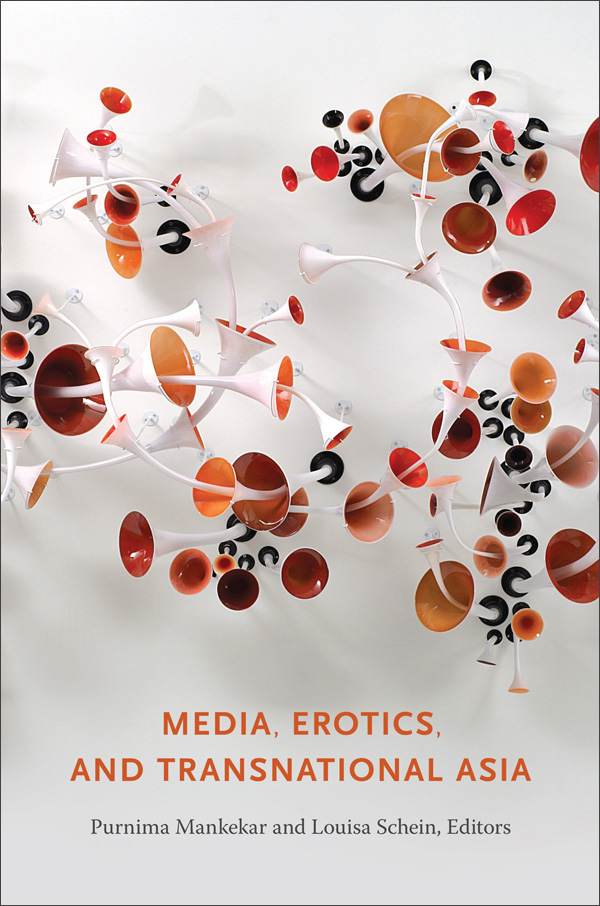
Transnational asiaThis is not a book about Asian sex videos. Indeed, reading Media, Erotics, and Transnational Asia should lead the reader to question why the category “Asian sex video” exists in the first place, why Asian bodies are disproportionately represented in Internet porn, and how we should react to such unregulated flow of images. In fact, none of the entries in this book deals with explicitly erotic content or with pornography, and the only chapter that concerns the Internet as a medium, a study of online discussions about correspondence marriage between the US and the Philippines, insists on rejecting facile analogies with the sex trade or with mail-to-order catalogues. For scholars and for feminists—and most authors in this volume are women—, the erotic has to be distinguished from the sexual. And writing about eroticism should in no way lead to stoke the base instincts of the reader. The erotic extends beyond sex acts or desires for sex acts to become “enmeshed in, for instance, yearnings for upward mobility, longings for ‘the homeland,’ formulations of nationhood and citizenship, and ruptures of ethnic and racial identity.” Desires for sexual encounters intertwine with those for commodities and lifestyles. Such a paneroticism may break gender, class, ethnicity, or age boundaries. Synonymous with desire, it may be at odd with an Orientalist vision of Asia as feminized and the West as setting the standard for homo- and heteronormativity. For instance, “what constitutes ‘lesbian’ desire may look both and function differently than it does within Euro-American social and historical formations, and draw from alternative modes of masculinity and feminity.”

Editing a volume for Duke University Press

The book is an edited volume composed of ten chapters and a dense introduction in which the two editors explain what they mean by “media,” “erotics,” “transnational,” and “Asia.” It is difficult to strike the right balance in the introductory chapter of a collection of scholarly essays written by different authors. One the one hand, the editors want to add value to the book chapters by giving coherence and theoretical depth to the assembled pieces. On the other hand, they need to reflect the diversity of the contributions and leave open their conceptual relevance for theory-building. The introduction is often the book’s signature, its most ambitious part and the text for which it will be remembered. The risk is to promise more than the book chapters can deliver by engaging in intellectual virtuosity, or to remain at the plane of immanence and offer a paraphrase of the book’s content. Mankekar and Schein lean on the theoretical side. Their introduction is thick, sometimes obscure, and heavily referenced. Their ambition is to “construct a transnational analytics” to account for the mediation of erotics in Asia and beyond. They position the book for a broad audience spanning several subdisciplines—Asian studies, media studies, gender studies, and sexuality studies, as well as anthropology and critical theory. And yet they address scholars, and it is as scholarship that they want their contribution to be noticed and remembered. My reading as a non-scholar may therefore miss the mark or misinterpret the intent of the authors. But this is a risk I am willing to take.

One way of studying erotics through transnational media in Asia is to read texts, watch pictures or videos, listen to recordings or radio shows, and then to write about their form and content using the tools and methods of literary criticism and media analysis. This is not how the authors in this volume proceed. For them, desire and erotics can only be revealed through participation in mediated worlds, in a combination of textual analysis and ethnographic research. Erotics is what people make of it: a medium or a text can only be deemed erotic if the viewers invest it with fantasies and emotional longings. Eroticism is in the eye of the beholder: we should “suspend any bounded or determinate option of what comprises erotic texts.” The preferred method of studying erotics is through ethnography and participant observation, or face-to-face interviewing. But the ethnographer cannot only approach his or her informants and say: “Let’s talk about sex.” As Purnima Mankekar notes: “I deemed it neither ethical nor culturally appropriate to interrogate my lower-middle-class and working-class informants about their attitudes toward sex or, worse, their sexual practices.” She doesn’t explain why she considered sex talk inappropriate or unethical, but her reticence probably has something to do with academic norms of proper behavior as much as with cultural sensitivities in a lower-middle-class Indian context. In any case, some of the contributors to this volume do talk to informants about media and sex, as in Friedman’s analysis of the film Twin Bracelets and its reception among interpretive communities in the United States, Taiwan, and China, or in Manalasan’s discussion of the reception of the movie Miguel/Michelle among queer Filipino audiences in Manila and in New York. In other situations, the ethnographer had to listen to her informants’ “silences, hesitations, and discursive detours” and “go beyond the verbal, the discursive, and the visible.”

Getting a book published

When writing a text and seeking publication, the scholar has to choose between three options: the self-standing book or monograph, the journal article, or the chapter in an edited volume. Getting a book published by an university press is the most difficult option: academic publishing houses are fortresses guarded by stern gatekeepers, and getting access involves a long process of book project’s proposal, manuscript editing, and peer review. The publication of a first book, commonly one that is drawn from a dissertation, is a critical event in the career of a scholar, and the book will usually remain the author’s signature to the wider academic community for the rest of his life. Publishing a journal article is more standard: for a scholar, a good publication record is a sine qua non, and life on the academic front is ruled by the discipline of publish or perish. Getting published depends on the prestige and disciplinary slot of the academic journal and necessitates a capacity to adjust to scholarly criteria of presentation without necessarily requiring literary talent. The book chapter is the most flexible contribution: contributing authors are usually invited by the editors to write a chapter for the book, based on presentations they made at conferences or in a rewriting of previously published research material. The editors will be reviewing and accepting the chapters and also be suggesting the authors if any revisions are needed. Though they are supported by their publishers, editors remain of sole responsibility when it comes to the content integrity of their book. Again, the importance of writing an excellent introductory chapter cannot be overstated. The introduction should serve as a “lure” that attracts the reader, allows the reader to comprehend the book’s intent, and encourages the reader to continue reading.  In terms of bookshelf longevity, the full-fledged book comes first, then the edited volume and, last, the scholarly article.

Most contributors to Media, Erotics, and Transnational Asia have published a book, sometimes two or even three, with Duke University Press. Having read and reviewed some of these books on this blog, I will draw a comparison between the full-length books they have published and the chapters in this volume. My favorite author in the sample is Everett Yuehong Zhang, author of The Impotence Epidemic, a study of changing attitudes about sexuality in an increasingly globalized China. The chapter he offers here could have been included in his previous book and centers on the host and participants of a radio talk show addressing sexuality from a clinical perspective. It is only loosely connected to the twin themes of media and erotics that define the edited volume: radio broadcasting is not the medium we first think about when studying transnational media, and there is nothing erotic in talking about premature ejaculation, masturbation, or erectile failure with a medical doctor—even though desires to be normal, to enjoy a fulfilling sexual life, and to have fun talking about personal matters after decades of Maoist silence are also addressed. Dr. Ma, the talk show host, treats both male and female sexual issues and is very open about discussing sexual desire and pleasure in public. His co-host, Ms. Sun, recalls how uncomfortable she was at first using the technical term for masturbation, shouyin, with two characters meaning “hand lust,” and how talking about masturbation became easier in the 1990s with the adoption of a new word, ziwei, meaning “self-consolation.” This change of words signals a transition from the desire to be moral to the desire to be normal, and from a moral economy of seminal essence and revolutionary ardor to the realm of medical normality and individual gratification.

From the book to the article

Whispering Tonight, the call-in radio show and its case study by Everett Zhang, is a microcosm of all the issues raised by The Impotence Epidemic. One the one hand, it contextualizes sexuality within the social changes brought by recent economic reform and through the production of various desires in post-Maoist China. It relocates the body from the periphery where it was confined under Maoism toward the center of public attention, private concerns, and emotional investments. It provides a thick description of call-in patients’ complaints and doctor’s comments, based on extensive fieldwork and ethnographic documentation. On the other hand, and perhaps more explicitly than in the book, this volume’s chapter is a piece of applied theory. It draws on a rich array of concepts borrowed from French theory, and especially Deleuze and Guattari’s conceptualization of flows and affects. Deleuzian notions are sometimes hard to grasp and may provide more obscurity than light, but Zhang uses them in a simple and straightforward way, giving added depth and relevance to his text. The second piece of medical anthropology in this volume, a chapter by Judith Farquhar on “Self-Health Information in Beijing in the 1990s,” also echoes a book by the same author (Appetites: Food and Sex in Post-Socialist China), but is written in a more personal and reflexive way. Farquhar starts by describing her encounter with two men poring over an illustrated sexual disease textbook in a bookstore, and wonders what meaning this experience had for them—seeking sexual satisfaction or documenting a medical condition—and for the anthropologist, who didn’t dare interrupt and ask. She then examines a number of methodological problems that plague efforts to understand the popular and the everyday in any scholarly project. Self-health manuals, pop psychology books, and other mass-consumption publications can be used as an archive of everyday living in post-socialist China, but do not reveal how this information is read and assimilated by readers.

In addition to the introduction, Purnima Mankekar provided a chapter in this volume that is based on the research she presented in her two books published by Duke University Press, Screening Culture, Viewing Politics and Unsettling India. I usually prefer to read full-length books in anthropology than journal articles or edited volumes. My feeling is that the author needs space in order to set the scene, present the characters, and flesh out his or her argument, and that a single book chapter or article usually falls short on these three counts. But Mankekar’s chapter in this book, “Dangerous Desires,” nicely complements the two books she wrote based on the same ethnographic material: the reception of TV programs, and in particular state-sponsored television serials, viewed by upwardly-mobile, yet lower-to-middle class urban women in New Delhi. Her objective in this chapter is to examine the place of erotics in the reconfiguration of gender, family, class, caste, and nation, through the eroticization of commodity desire in TV commercials and the proliferation of sexual content in programs broadcast by transnational satellite networks. As noted above, she couldn’t just go out and ask her informants to have a “sex talk” on what they were viewing; she had to learn to watch alongside them and over their shoulders, interpreting bodily cues and discursive detours that saturated their conversations. For instance, many women she spoke with expressed their erotic longing via their yearning for certain commodities. On other occasions, her informants expressed their attitudes, feelings, and, very occasionally, their experiences of sex and erotics while discussing television programs. Desire for commodities and sexual longings were very often perceived as threats to proper gender behavior, to social status, and to the Indian nation as a whole. But Doordarshan state-run television no longer has a monopoly of public broadcasting, and the proliferation of satellite channels is having an impact on perceptions and values.

Telling better stories

Anne Allison, who provides the last chapter in this volume, teaches cultural anthropology at Duke University and has published several books on Japan. She wrote the book Nightwork on hostess clubs and Japanese corporate culture after having worked at a hostess club in Tokyo, and she has also researched erotic comic books and mother-son incest stories. The novel she reviews in her essay, Memoirs of a Geisha, doesn’t belong to the erotica literature: it is a fictional memoir of a Japanese geisha, penned by an American man and made into a movie by Steven Spielberg with Chinese actress Zhang Ziyi. Others would call it a story of cultural appropriation or a bad case of Orientalism; but Allison chose to focus on the reaction of (mostly female) American readers who, in the interviews she had with them and in the comments they wrote on Amazon, felt titillated by the fiction and enthralled by its exoticism. She reads erotic desire through the lens of the allure of fantasies generated by being transported to another place and time. In this case, desire is thoroughly political, but it doesn’t involve the masculine fantasies of empire and domination that Edward Said saw as the hallmark of Orientalist thinking. Exotica functions as erotica in the blurring of historical fiction and personal memoir, the minute description of sexual rituals such as the mizuage (by which a young geisha sells her virginity), and the allure of soft kimono fabric and intricate tea ceremony. “When readers described their experience of Memoirs to me,” writes Allison, “it was often in language befitting a love affair. They would smile and get excited, talk quickly and move their bodies. Passion, bordering on arousal, was palpable.” This, concludes Allison, raises a challenge for the anthropologist: “How to tell better stories that are imaginative and compelling, without falling into the trap of exoticizing or essentializing?”
The Thin-Fat Indian

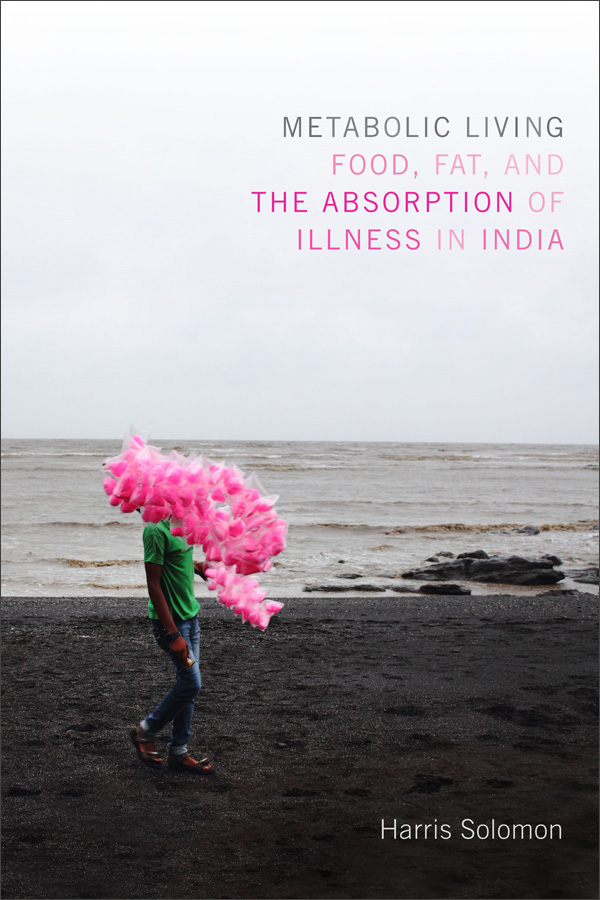
A review of Metabolic Living: Food, Fat, and the Absorption of Illness in India, Harris Solomon, Duke University Press, 2016. 

Metabloic LivingProselitizing vegetarians and people who advocate a healthier diet often point to the case of India as proof that millions of people, if not a whole nation, can live on a regimen without meat. Similarly, climate advocates calculate the carbon balance of raising cattle and conclude humanity will have to cut the beef from the menu list. As is well known, Hindu communities consider beef taboo, and several sects, like Vaisnavism or Jainism, follow a strict form of vegetarianism. Fasting is a practice common to Hindus and Muslims, and traditional Indian medicine or Ayurveda emphasizes the importance of a healthy and balanced diet. Despite continued history of malnutrition, Indian is often seen as synonymous with holistic health, slim bodies, and yoga exercise. According to common conceptions, India is predominantly a vegetarian nation and the traditional diet, based on legumes, beans, grains, fruits and vegetables can provide human bodies with ample amounts of fiber, fat, carbohydrates, proteins, vitamins and minerals. But is the Indian diet really that healthy as compared to the Western one? In fact, the image of the slim and fit Indian body is based on three myths. The biggest myth, of course, is that India is a largely vegetarian country. Actually, the majority of Indians consume some form of meat, mainly chicken and mutton, but also, in many cases, beef. Even Hindus, who make up 80 percent of the Indian population, are major meat-eaters, and beef is consumed by the lower castes or Dalits as well as by non-Hindus. The second myth is that there is such a thing as Indian cuisine, with identified recipes and specialties such as curry, naan, and chutney. In reality, India is a highly diverse society with food habits and cuisines changing every kilometer and within social groups. It makes no sense to speak of an Indian diet as a unified, constant, and bounded set of dishes and recipes. 

A land of obesity

The third myth is the one of the thin, fasting, and at times hungry Indian body. India, notorious for malnutrition, has now become a land of obesity. As Harris Solomon demonstrates in this book, Indians suffer from a bad case of metabolic living: a combination of diabetes, high blood pressure (hypertension), coronary disease, and overweight. In aggregate figures, India is the “global hub” of obesity and diabetes, with the highest number of diabetics globally and morbid obesity affecting 5 percent of the country’s population. These sources of morbidity are often linked to globalization, the diffusion of Western dietary habits, and urban lifestyles. Snack indulgence, lack of physical exercise, overconsumption, unbalanced diets, and the spread of fast food restaurants, are seen as explanatory factors. So is the local notion of tenshun, or stress at work and at home, which is seen as a symptom, cause, and effect of high blood pressure and diabetes. “Globesity” is supposed to accompany the expansion of the urban middle class and to flow from the West to the East. But despite common perceptions, obesity is not a disease of the rich or of the middle class while lower classes suffer from undernutrition and hunger. Metabolic illness affects rich and poor alike, while diabetes spreads across social groups and regions. According to Solomon, “the cultural figures of the middle-class housewife binging on barfi and the malnourished child must be understood in a reticular perspective.” His ethnographic  study provides such a perspective by focusing on three domains: everyday relations to food and health in a lower-middle-class neighborhood in Mumbai; observation of patient-doctor relations in two clinics specializing in metabolic disorders; and the commercialization of food by street vendors, food processing companies, and regulating agencies. 

In 2008, newspapers reported that millions of Indians suddenly became overweight. One article suggested that overnight, 70 million more people became “officially” obese. The reason for this sudden strike of obesity lies in a biomedical concept known as the body-mass-index, or BMI. BMI can be calculated simply by dividing a person’s weight in kilograms by their height in metres squared, or kg/m2. A BMI of 25.0 or more is overweight, while the healthy range is 18.5 to 24.9. But in 2008, the body mass index for Indians changed. The new threshold diagnosing overweight status was now set at a BMI of 23. What is overweight for Caucasians now became obese for Indians. In what was called the “thin-fat Indian” paradox, it was shown that thin bodies can be metabolically similar to fat bodies: thin in appearance but metabolically obese according to impaired insulin sensitivity and blood lipid concentration. As a result, Indians are developing metabolic diseases at a lower BMI than Caucasians. Also South Asians tend to accumulate abdominal fat, or “fat tummies,” and this leads to higher metabolic risk than otherwise. The origin of the thin-fat Indian paradox is sometimes linked to the “thrifty gene hypothesis”: a long history of malnutrition has caused people to accumulate fat during periods of food abundance in order to provide for periods of food shortage. It has also been shown that being born from a malnourished mother and suffering from hunger in early childhood strongly predicts metabolic disease in later life. As a result of this focus on body shape and mass index, to lose belly fat has become a national obsession. Scales proposing to measure passengers’ weight are ubiquitous in Mumbai’s local train stations, and for a one-rupee charge people can also obtain their BMI printed on a slip of paper.

Street food and processed food

But the lure of abundant and fatty food sometimes proves stronger than incentives to lose weight. In the community that Harris Solomon was researching, the temptation to indulge in excess eating had a particular name: vada pav, a deep-fried, battered potato ball sandwich sold on street stalls and catering to a clientele of children and adults gorging on snacks. Mumbai’s politicians extoll the vada pav as the city’s culinary treasure, providing jobs to street food vendors and contributing to a robust diet through vitamins and carbohydrates. The Shiv Sena, a regional political movement that promotes the rights of Hindu people born in the state of Maharashtra, has made the vada pav an integral part of its political platform, organizing street food festivals and proposing a standardized recipe bearing its name, the Shiv vada pav. Street carts are adorned with the logo of the party, a roaring tiger, and vendors are organized in clientele networks that control the streets. But the fact is that vada pav is high in calories, fat, and sugar and contributes to obesity. Not eating nutritious meals at the right time and eating unhealthy snacks between meals are recipes for poor health. Mumbai kids’ bad snack habits should be combatted through nutritional education in school and at home as well as public regulations. In the controversies over the vada pav, Solomon sees a mix of street politics and what he labels gastropolitics, where food is the medium, and sometimes the message, of conflict. Food is inextricably linked to politics, and cultural conflicts over foodstuff or culinary practices remind us that what we eat is constitutive of what we are.

Recently, vada pav street vendors have been facing a new form of competition: franchise restaurants modelled on McDonald’s or other fast food chains and offering a sanitized version of vada pav. In their motto, they promise to “give the street taste, without the danger.” In India, food safety is a real concern and the confidence of the public has been shaken by a series of cases of food poisoning or food adulteration. Milk has been found to be laced with soapy water, chalk, paint or talc to make it whiter; bananas and mangoes are treated with added chemicals to speed their ripeness; watermelons are injected with dirty sugar water to make them sweeter; and fraudsters add toilet tissue into the milk to thicken lassi drinks. By contrast, franchise outlets and food processing companies are advertising their products as safe and healthy. The added micronutrients or vitamins that brands advertise in their products are very attractive to working mothers who do not have time to make traditional snacks. Straddling the boundary between food and drugs, some even claim to address weight gain, cholesterol levels, and blood sugars. Critics argue that processed food is bad for the body and that food companies are fueling the obesity epidemic. To make products WTO-compliant, the law mandates that all food additives as well as nutrition information should be listed clearly on food packages. When the author interviewed executives of a snack company called Enjoy Foods, they expressed frustration at the labeling requirements mirroring those of the US Food and Drug Administration: “It’s so ridiculous. The US is full of obesity, but not here.” He also participated in a market research focus groups where housewives explained their frustration at being under constant scrutiny by their stepmother: “My dignity is at stake in my cooking. I can’t afford to make mistakes.”

Treating metabolic syndrome

From diets to homeopathy to Ayurvedic remedies, different methods have been proposed to alleviate metabolic disorder. Nutritional therapy usually comes first: patients are encouraged by their dietitian to recall everything they ate from morning to night, and to adopt a more balanced regimen. But in case diet and exercise prove ineffective, doctors may resort to a last-resort intervention: gastric bypass surgery, a surgical operation that changes the way the stomach and small intestine handle the food that goes through them. The procedure aims to make post surgical patients less hungry, to have more balanced digestive hormonal regulation, to experience normalized insulin responses, and to lose weight rapidly. The results are impressive: massive weight loss comes along with the alleviation of diabetes symptoms and reduced exposure to other metabolic risks. Advertised through before/after photos of obese patients turned slim, the operation also has its risks: complications and enduring effects exist, and the medicines the patient must take following the surgery are extensive. The main lesson of metabolic surgery is that losing weight does not necessarily depend on central control and forceful will: obesity is a disease that affects people regardless of their willpower or lifestyle choices. Paradoxically, by bypassing free will and self-discipline, surgery puts the individual back in control: to lose weight is to gain life, and people describe exceptional changes in their quality of life. The French philosopher Georges Canguilhem describes the transition from illness to health as “a shift in arrangements”: it may take the form of a different alignment between the gut and the brain, but it also involves a rearrangement of the relations between an individual body and its constitutive outside, from foods to physical stimuli and moral feelings.

Metabolic Living is published by Duke University Press in a series titled “Critical Global Health: Evidence, Efficacy, Ethnography.” Harris Solomon’s perspective is based not on biomedicine but on anthropology. Despite the rise of a field known as medical anthropology, the two disciplines differ in terms of research methodology, conceptual frameworks, and political implications. The anthropologist gathers empirical evidence through fieldwork and participant observation, not through questionnaires or field trials. The goal is to make a thick description of social patterns and to interpret cultures by proposing experience-near concepts, thereby providing an alternative framework to ever-more dominant quantitative-based approaches to global health science and policy. The anthropologist doesn’t build models or test hypotheses, but proposes a narrative that hinges on literary skills and personal experience. Metabolic Living exemplifies this approach. While it is in line with some concerns in global health, such as the shift from infectious to chronic diseases as the primary cause of morbidity, this ethnography brings the global to the local by describing medical conditions at the level of a given community. The Bandra coastal suburb in Mumbai, where the author settled for his fieldwork, is home to a Catholic community whose history goes back to the sixteenth century. His sites of observation includes households that the author visited with the help of a social worker; local churches and their attending priests; a public hospital and a private clinic; and more multisided spaces occupied by food companies, government regulators, and public health conferences. Participant observation as opposed to clinical observation also relies on chance encounters, happenstance, and serendipity. The concepts and guidelines that frame the analysis are designed along the way.

The metabolic city

In his introduction, Harris Solomon contends that “people are their metabolism, as opposed to having metabolisms.” To have metabolism is defined by a series of numbers and measurements: the body-mass-index, but also unhealthy levels of cholesterol, lipids, blood sugar, calories, etc. These numbers, in turn, determine the degree of exposure to life risks such as diabetes or cardiovascular disease. By contrast, the metabolic person, or living the metabolic life, can be understood in terms of porosity to the world and absorptive capacity. “How do we turn the environment into ourselves? What counts as food and when does it mean life? Who decides what enters the body, and what does it take to be fed by another?” are some of the research questions that motivate the author’s quest. Metabolic diseases are symptoms of porosity between bodies and elements such as food, fat, and pollutants. The permeability of organisms and their consequent capacity to change is what allows the author to make sense of metabolic living. The shifting boundaries of inside and outside, between the body and its environment, provide an alternative framework to the biomedical vision based on strict separations and thresholds. As Solomon claims, “A study of metabolic illness grounded in absorption, in contrast to one that assumes overconsumption as its starting point, can offer a thicker account of how people live through this phenomenon.” In the end, the notions of absorption and porosity extend from the organism and the body to the home and to the city as a whole. The challenges of the city are ever present and they permeate people’s lives in their most intimate, leaving them with no choice but to absorb their condition. A city that is too stressful and polluted for healthy life and where everyone is dieting to lose weight is a metabolic city. Unlike individuals, who can restore health and cure metabolism through exercise, dieting, or medical treatment, there is no prescription for this urban predicament.

The Undercover Anthropologist

A review of Cold War Anthropology: The CIA, the Pentagon, and the Growth of Dual Use Anthropology, David H. Price, Duke University Press, 2016.

Cold War AnthropologyAgency is a key concept in anthropology and the social sciences, meaning the capacity of a person or a group to act on its own behalf. The agency that David Price has in mind in this book has a completely different meaning. It designates the Central Intelligence Agency, and it reveals the links during the Cold War between the anthropologist profession and the national intelligence and defense apparatus of the United States. Cold War Anthropology makes use of the concept of dual use: “dual use science” refers to the military applications of basic science research, while “dual use technologies” are normally used for civilian purposes but may help build weapons and military systems. Similarly, anthropology is a civilian pursuit that purports to increase our knowledge of foreign cultures and societies, but it can be used for defense and security purposes: Know thy enemy has been a basic recommendation since mankind engaged in warfare and diplomacy. Intelligence, the gathering of information on foreign powers, makes use of various academic disciplines; it is only natural that anthropology, which developed alongside colonialism and followed the ebbs and flows of imperial powers, also lent itself to militarist uses. And nowhere was the demand for such knowledge higher than in the United States during the Cold War, which saw the dominant world power engage in the gathering and analysis of information in all corners of the world.

The Agency’s agency

Dual use anthropology was an offspring of World War II. During the war, cultural anthropologists worked as spies, educators, cultural liaison officers, language and culture instructors, and strategic analysts. In a previous book, Anthropological Intelligence, David Price documented American anthropologists’ contribution to the conduct of the war and the consequences their collaboration in war projects had over the course of the discipline. Cold War Anthropology picks up the ball where the previous book left off. Former members of OSS service who returned to university positions after the war kept their connections with the intelligence apparatus and helped the CIA and other agencies recruit new hires and gather information. By the mid-1970s, it was estimated that as many as five thousand academics were cooperating with the CIA on at least a part-time basis. But anthropologists taking part in the counterinsurgency operations of the Cold War didn’t have the excuse of protecting freedom and democracy at home and abroad. Cold War insurgencies were America’s dirty wars and anthropologists, like the quiet American in Graham Greene’s novel, became complicit in illegal activities ranging from kidnapping, murder, covert arm dealing, and coup d’état to the widespread infiltration of domestic academic institutions. Most of them were “reluctant imperialists” who believed they engaged in apolitical or politically neutral work, while some, including Clyde Kluckhohn and Clifford Geertz, developed “dual personalities” that allowed them to work on projects with direct or indirect connections to the CIA or the Pentagon while omitting such links from the narratives of their research.

David Price draws a typology of the relationships between anthropologists and the intelligence apparatus as a two-by-two matrix: relations could be witting-direct, witting-indirect, unwitting-direct, and unwitting-indirect. The first case represents the anthropologist-as-spy or as operative working for the US government. In a few instances, cultural anthropologists and archaeologists used fieldwork as a cover for espionage. Through access to declassified archives, the author was able to document a few cases of undercover agents who used their participation in research missions in Afghanistan, in Iran or in other hot spots to gather intelligence, provide support for special operations, and recruit informants. Not all anthropologists worked undercover, however. During the period, advertisements for military, intelligence, or State Department positions routinely appeared in the News Bulletin of the AAA, the discipline association’s newsletter. Some anthropologists moved between the government and the academy: Edward T. Hall, the founder of cross-cultural studies, taught cultural sensitivity training courses at the State Department’s Foreign Service Institute, while John Embree, the author of the first monograph on a Japanese village, became the first cultural relations adviser at the US Embassy in Bangkok in 1947 (they both objected to the use of academic research by the CIA.) Other anthropologists held CIA desks or maintained close contacts with the agency for recruitment, contract work, and data gathering. More generally, many anthropologists accepted as a matter of routine to debrief at Langley or within the precinct of the US Embassy when returning from fieldwork in sensitive areas.

Witting-indirect or unwitting-direct collaborations

The second model of anthropology-intelligence collaboration, implemented in full knowledge of it but in an indirect manner, refers to the way research was funded in the Cold War era. Rockefeller, Carnegie, Ford, and other private foundations shaped the funding of anthropological research during the Cold War. These wealthy private institutions were often directed by elite men rotating in and out of federal agencies with national security interests. They channeled the funds and designed research projects in ways that coalesced with CIA’s needs and foreign policy imperatives. This increasing availability of foundation funding was welcomed by anthropologists, who seldom considered what obligations might accompany such gifts or how the gifts might shape avenues of inquiry or analysis. Anthropologists working on research projects funded by private foundations deliberately or sometimes half-wittingly ignored the political contexts in which the projects were embedded. Clifford Geertz, who participated in the Modjokuto Project in Indonesia, turned a blind eye to the political forces that framed his first fieldwork opportunity. In later analyses, the development of area studies in American and Western Europe universities was connected to the Cold War agendas of the CIA, the FBI, and other intelligence and military agencies. Critics alleged that participating in such programs was tantamount to serving as an agent of the state. While cases of collaboration between academia and the intelligence apparatus must be assessed carefully, it is true that some research questions were prioritized and other were neglected, while geographic priorities aligned with geopolitical interests.

The third form of linkage between academic research and foreign policy-making occurred unbeknownst to the anthropologists but with direct interventions from intelligence agencies. In addition to reputable private foundations, the CIA used “paper foundations” or “pass-through” conduits to channel funds toward research without leaving footprints. The recipient individual or academic institution that received CIA funding from either a front or a conduit was generally not aware of the origin of the research grant. The funding of particular projects shaped disciplinary research agendas. The CIA also used fronts to secretly finance the publication of books and articles propagating its views, or supported journals that took a critical stance on communism and left-wing politics, such as Jiyū in Japan, Encounters in Great Britain, or Preuves in France. Some of the books were donated by US Embassies abroad or, in some cases, sold through local retailers. When these CIA-funded foundations were exposed by investigative journalists in the late 1960s, the reaction was surprisingly moot. Art Buchwald jokingly remarked the reason why the National Student Association received a CIA grant was because the organization was confused with the NSA. The Asia Foundation acknowledged CIA funding while claiming that this didn’t in any way affect the content of its policies and programs. With much soul-searching and political bickering, the American Anthropological Association adopted a code of ethics stating that “constraint, deception, and secrecy have no place in science.” Radical young scholars dubbed it too little too late, and formed a new caucus named Anthropologists for Radical Political Action, or ARPA, to push for further reforms.

Dual use anthropology

The fourth cell in the quadrant refers to unwitting and indirect forms of collaboration between anthropologists and spy agencies. The CIA’s method of harnessing the field research of others was not always manipulative. Ethnographic knowledge was in high demand by military and intelligence agencies during the Cold War, and many operatives learned their cues by perusing through the works of anthropologists. Participant observation’s approach to cultural understanding gave anthropologists the sort of cultural knowledge that made the discipline attractive to government officials willing to probe the hearts and minds of those living in lands of geopolitical interest. Anthropological field research sometimes facilitated intelligence operations by nonanthropologists through knowledge of the human terrain, understanding of social dynamics, and manipulation of power struggles. In other cases, it was used in human resource training programs to prepare for a foreign posting or develop culturally sensitive lenses of analysis. While much of the research funded in the postwar 1940s and throughout the 1950s aligned well with the needs and ideologies of the American Cold War state, in the 1960s and 1970s radical voices used these same funds to generate their own critiques. But postmodern anthropology was less relevant for practical concerns and fell out of favor with literate diplomats, military officers, and spies. Militarized uses of anthropology continued through other channels, such as the rise of private consultancies or the deployment of social scientists in combat teams.

According to David Price, the deleterious effects of dual-use anthropology were manyfold. False accusations of spying could put the fieldwork anthropologist in danger, expose his or her informants to various threats, and lead to expulsion or denial of access to the field. It was common for American anthropologists during the Cold War to be falsely suspected of spying. As mentioned, it was also routine for anthropologists returning from fieldwork to receive requests for debriefing in US Embassies or back home. Through witting or unwitting collaboration, direct or indirect solicitations, and dual-use research, the CIA’s ethical misconduct hinged on lying to the scholars about the origin of the grant money they received, the end use of their research results, and the choice of research priorities. Particularly in the context of the Vietnam war, anthropological research sustained counterinsurgency operations, the mobilization of highland tribes in armed conflicts, population regroupment in strategic hamlets and, arguably, the design of interrogation methods. David Price documents several cases of military applications of ethnographic research in South-East Asia, as well as the strong reaction of the profession to ban any form of collaboration with the military-intelligence apparatus. But he believes that many of the fundamental issues raised during this period remains unresolved. On the contrary, the conjugation of limited employment possibilities, growing student loan debt, and campus austerity programs are opening new inroads for the extension of military and intelligence forays in anthropological circles.

No Such Agency

Cold War Anthropology claims to break new ground in exposing the links between the anthropology profession and the national security apparatus. Although the author had to rely on the Freedom of Information Act to obtain declassified documentation, he doesn’t reveal state secrets or expose skeletons in the profession’s closet: for the most part, these links were hidden in plain sight. The collaboration between anthropologists and the intelligence service was an open secret. It is not obvious that the gains obtained by the intelligence community were worth compromising the integrity of scholars: the information that the CIA obtained from the AAA or the Asia Foundation, such as the detailed roster of American anthropologists or the names of Asian area specialists, would today be gathered in a few seconds through an Internet search. Similarly, the patient gathering of photographs indexed and catalogued to yield intelligence information would pale in comparison with modern satellite imagery or the harvesting of social media content. David Price’s aversion toward the CIA and the FBI also extends to the military and to the diplomatic service: he includes the State Department and USAID in the circle of Cold War institutions, and doesn’t clearly discriminate between covert operations and legitimate governmental activities. Similarly, he conflates anthropology and archeology, and bundles all fieldwork-based social sciences in one fell swoop. Meanwhile, the NSA gets no mention at all, except when it gets confused with the National Student Association—confirming the legend that the NSA was so secret its acronym stood for “No Such Agency.”

What Comes Next?

A review of After Ethnos, Tobias Rees, Duke University Press, 2018.

After EthnosWhat is anthropology? What should it be about, and how should it be pursued? These questions were raised with great intensity in the politically loaded context of the seventies. Radically different visions of anthropology were offered; people experimented with new forms of writing and storytelling; and the discipline was mandated to take a political stance in reaction to the issues of the day. As a result, anthropology was deeply transformed. The two canonical concepts that defined its academic status, culture and society, were discarded in favor of other constructs or organizing schemes—although modern ethnography is still referred to as cultural anthropology in the United States and as social anthropology in the United Kingdom. Fieldwork, the close and sustained observation of native customs and modes of thought by a participant observer, ceased to define the discipline. The methodology was adopted by other social sciences—or even by other occupations such as journalism, militantism, and even art—, while anthropologists experimented with multi-sited ethnographies or with research based on archival work. As Clifford Geertz and other anthropologists working in his wake made it clear, the collection of data by the ethnographer on the field is just the tip of the iceberg: it is based on years of reading other anthropologists’ work and attending academic lectures, and it is followed by the nitty-gritty work of reconstruction and composition that leads to the journal article or the scholarly volume. The anthropologist was recognized as a writer, as a maker of forms and a designer of concepts.
A designer of concepts

In his book, published in 2018, Tobias Rees takes these questions anew. After Ethnos grapples with the state of anthropology after the great surge of creativity and experimentation that followed the publication of the volume Writing Culture in 1986. It builds on an impressive bibliography of theoretical texts, as well as on countless seminar discussions, email exchanges, and tea corner conversations. It remains true to the creativity, artistic sensitivity, and  philosophically informed theorizing that redefined the discipline after the epistemological turn of the seventies and eighties. On the webpage of the Berggruen Institute in California, where he chairs the Transformations of the Human Program, Tobias Rees is presented as follows: “The focus of Rees’s work is on the philosophy, poetry, and politics of the contemporary. He is intrigued by situations that are not reducible to the already thought and known –– by events, small ones or large ones, that set the taken for granted in motion and thereby provoke unanticipated openings for which no one has words yet. In his writings, he seeks to capture something of the at times wild, at other times tender, almost fragile openness that rules as long as the new/different has not yet gained any stable contours. When it is (still) pure movement. His work on the brain, on microbes, snails and AI have increasingly given rise to two observations that have come to define his work. (1) A distinctive feature of the present is that the question concerning the human occurs less in the human than in the non-human sciences. Say, in microbiome research, in AI or in the study of climate change. (2) The tentative answers that are emerging from these non-human fields radically defy the understanding of the human as more than mere nature and as other than mere machines on which the human sciences were built.”

Tobias Rees claims that After Ethnos is a non programmatic book. And yet it reads like a manifesto of sorts, a rallying call aiming at offering a vision of what anthropology could look like after it has severed it ties to ethnos and, in a way, to anthropos. Many sentences indeed offer a programme or a platform for future anthropologists. New directions in contemporary research are assessed, lines of escape are drawn, and a new orientation for future research is proposed. The author doesn’t mean to condemn or be judgmental of certain forms of anthropology that remain tied to disciplinary traditions. But this is because traditional anthropology has disappeared from anthropology department in most American universities. As Rees soberly notes, “Classical modern ethnography has come to an end.” People who still focus on traditional societies now need an excuse for doing so. The burden of proof falls upon them to justify the choice of a research topic that was considered as mandatory by their predecessors. They insist on their distinctiveness from older forms of scholarship that were often tainted by racial prejudice and positions of power. Whereas it is still possible to situate oneself in the sociological tradition, paying tribute to the founding fathers and the great names of the discipline, the anthropological tradition is all but dead. It has been reduced to old books accumulating dust on libraries’ shelves, and that are turned open only to show how antiquated and prejudiced the founders of the discipline were.

The erasure of Man

For Tobias Rees, the conditions of possibility that have organized ethnography have become impossible to maintain. The abstract figure of “Man”, itself a recent invention, has been erased “like a face drawn in the sand at the edge of the sea” (to take Michel Foucault’s famous metaphor.) Likewise, the ethnos and its declinations—the ethnic group, the tribe, the singular people with its well-defined culture and mores, was understood as a social construct whose fiction was increasingly difficult to maintain. With these erasures, the great divides of modernity—man vs. nature, science vs. tradition, reason vs. emotion, human vs. animal, life vs. matter, etc.—have all been redrawn. Starting in the late 1980s or early 1990s a number of anthropologists began to enter—per fieldwork—domains that were formerly believed to be beyond the scope of anthropological expertise or interest, such as medicine, science and technology, media, the Internet, finance, and much more. The result was a flurry of innovative texts and monographs offering new departures for the discipline. Anthropologists took the perspective of the gingko tree or the matsutake mushroom that have been around from times immemorial to envisage the possibility of life without humans, to displace “Man” from the center and to make it little more than a late-coming and transient episode in the history of the earth. Others have described the world-making qualities of bacteria that effectively have produced and continue to produce our external and internal environment, from the steady production of oxygen in the atmosphere to their critical role in digestion and the immune system through the microbiome. The choice of topics for anthropologists seems limitless: there is now an anthropology of stones and rivers, of outer space and stellar systems, of the modern, the emergent, and the still-to-come…

As the author notes, it is not that the anthropologist after “the human” stopped caring about humans. On the contrary, a new sensitivity to emotions, attachments, suffering, and human care, came to inform many texts that were being produced. But classical categories like the social, the cultural, the historical, or the natural had to be discarded in order to give way to new formulations. New concepts were designed, borrowed in part from social theory or from philosophy: entanglements, assemblages, ensembles, apparatus, dispositifs, man/machine, multispecies, animacies They each point to the composite nature of the stuff that anthropologists study, which is a combination of humans and artefacts, of nonhuman species and animate bodies. As pointed out, anthropologists have gradually expanded their inquiries to the nonhuman natural world. The emergence of an anthropology not concerned with humans, or taking humans only as an observation point entangled in technological and interspecies relations, reconnects our societies with non-Western worldviews that have always integrated nonhumans into their cosmology. Besides, “Man”, as it was formerly conceived and now seems to have faded away, is not something to be mourned or regretted. What appears in retrospect is the disarming poverty of the figure of “the human” on which anthropologists have been relying for so long. Their traditional interest in kinship systems, gift exchanges, rites of passage, and mythic structures now seems to us only to have scratched the surface. By decoupling curiosity about “things human” from the cultural construct of “the human”, anthropologists open up new possibilities and understandings. As Tobias Rees notes, “the reason I don’t want to start with ‘the human’ is that I want to ground my research not in an answer—but in a question, in boundless questions.”

Fieldwork-based philosophy

Rethinking and redesigning the discipline from the perspective of the “after” gives birth to what the author calls a “philosophically inclined anthropology.” Philosophy and anthropology have always entertained awkward relations. Many scholars were drawn to anthropology and fieldwork as a way to escape the abstract strictures of philosophy. Philosophers, for their part, often consider anthropology as an applied science in a division of labor that leaves philosophy the key role of providing general themes and ideas. Moreover, anthropologists tend to rely on a small sample of philosophical works, authors, and concepts. The great bulk of philosophical enquiry falls outside the purview of the discipline. For Tobias Rees, “once anthropologists break with ethnos, anthropology has the potential to venture into the terrain it formerly left, unwittingly or not, to philosophy.” The discipline can become philosophical by practicing fieldwork-based philosophy, or empirically grounded ways of “thinking about thinking.” Although he makes only a passing reference to Henri Bergson, I see a strong similarity between the kind of thought he advocates and Bergson’s conceptualizing of time and movement. Like Bergson, Rees wants to cut loose “the new” from any linear comprehension of time. His key concepts—the actual, the after, the movement—are meant to capture “something that which escapes.” He would be on familiar ground with Bergsonian notions of “la durée”, “l’élan vital”, “l’intuition” or “l’évolution créatrice.” Bergson conceived of philosophy as movement in thought and, ultimately, as dance. Similarly, Tobias Rees draws a parallel between his “anthropology of the actual” and artistic practice—its poetic aim “is to render visible instances of the invisible.”

Anthropology also has to cultivate a certain disrespect for theory. In a way, theories always already know everything. By contrast, anthropologists characterize themselves by the capacity to be surprised. They are drawn to the field by the possibility that “elsewhere” could be “different”. For Tobias Rees, “fieldwork is a bit like the desire to find—or to be found by—that which makes a difference.” It is to immerse oneself into scenes of everyday life in order to let the chance events that make up the stuff of discovery give rise to new concepts and metaphors. Anthropologists don’t go to the field to validate theories they have conceived in their ivory tower; nor do they practice armchair theorizing by exploiting the data collected by others. They never deny the possibility that things could be otherwise than they appear at first glance; they take nothing for granted. This is especially true for the new kind of anthropology that Tobias Rees has in mind. Rather than difference in place, the fieldworker seeks displacement in time. She wants to capture “the openings, the bifurcations, the troubles, the jumping forth, the new causes.”  Fieldwork has not disappeared; on the contrary, anthropologists have transformed countless sites into fields that were once thought to be far beyond the scope of the discipline. Nonetheless, Tobias Rees leaves open the question whether anthropological research can be dissociated from fieldwork. “Is there any obvious reason, he asks, why fieldwork would be the only, the sole, the authoritative form of anthropological knowledge production?” He leaves the question open—but answers it implicitly by making no reference to empirically collected results in his book.

So what?

I leave this book with two questions. Is there a way to reconnect with the anthropological tradition? How to make anthropology relevant for our present time? Tobias Rees makes some references to the great founders of the discipline. He reminds us that Bronislaw Malinowski invented fieldwork only serendipitously and as a result of adverse circumstances. As a citizen of Habsburg Austria he was considered a political enemy of the British Empire when the First World War erupted. The only way to escape encampment was to leave Australia and to live on the Trobiand Islands, where his lack of financial means led him to plant his tent among the natives. Tobias Rees treats classical anthropology as archive, as a repository of texts that remains available for critique and contextualization. Can we do more, and consider accumulated knowledge as a building stone for cumulative science, or can we jettison the whole edifice without great loss? In fact, many basic tenets of the discipline, or truths that for a long time were held as self-evident, have been refuted and proven wrong by advances in the life sciences. Any discipline preoccupied with the human nowadays cannot do without the findings and insights provided by the cognitive neurosciences, evolutionary biology, gene mapping, primatology, or brain science. As Charles S. Pierce once put it, “any inquirer must be ready at all times to dump his whole cartload of beliefs the moment experience is set against them.” As for anthropology’s relevance for the present, the proof of the pudding, as they say, is in the eating.

Portrait of the Anthropologist a an Art Curator

A review of Anthropology in the Meantime: Experimental Ethnography, Theory, and Method for the Twenty-First Century, Michael M. J. Fischer, Duke University Press, 2018.

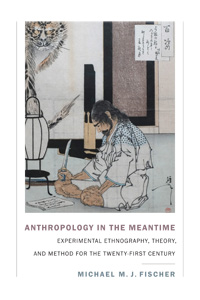
MeantimeAnthropology in the Meantime is a collection of essays by Michael Fischer that have been previously published in scholarly journals, edited volumes, or art catalogues. They have been substantially revised and rewritten for this edition in a book series, Experimental Futures, that the author curates at Duke University Press. Indeed, “curating” is the right word for describing Michael Fischer’s work: he fancies himself as an art specialist, using books as his personal gallery, and conceives of anthropology as akin to art critique or even as artistic performance, as evidenced by his circumlocutory writing style and his conception of fieldwork. In the art world, the title of “curator” identifies a person who selects and often interprets different works of art. In contemporary art, curators can make or break an artist’s career by their choice of works to display and of words to accompany them. In some cases, their celebrity can even eclipse that of the artists they work with. By donning the mantle of the art curator, the anthropologist attempts to weigh on what counts as (to quote the book’s subtitle) “ethnography, theory, and method for the twenty-first century.” Michael Fischer presents the work of his students and close associates, pays tribute to some of the big names in the discipline that he was privileged to work with, and recounts his own random walk through the past fifty years of anthropological research. Throughout this volume, he emphasizes the commonalities between anthropology and art. He claims in the introductory chapter that “ethnographers as literary forms are like novels, except they have to stick to reality”; “like anthropologists, artists have feet in several worlds” and the work of art “is often itself an ethnographic register of contemporary matters of concern.” Many readers will have first noticed Anthropology in the Meantime by its book cover, a striking Japanese woodblock print which represents a samurai about to commit seppuku. There is no connection between this artwork and the book content (nobody is going to commit suicide here, and references to Japan are sparse), except from the fact that this ukiyo-e comes from the personal collection of the author. Several other artistic belongings of the author are reproduced or referred to in the volume; and Michael Fischer claims that he chose the artwork cover of a recent bestseller in the same book series, Donna Haraway’s Staying with the Trouble, from a solo exhibition by Filipino artist Geraldine Javier, whose Chthulu-like creature was not inconsequential in the success of Haraway’s book.
Twice present at the creation

The curator or the art critic often claim for themselves a special relation with regard to art history. They were present at critical junctures, rubbed shoulders with time-defining artists before they became famous, and contributed to the build-up of their fame or the make-up of their value through critical interventions. They were the first to put names and labels on emerging trends and styles, thereby contributing to the creation of the various schools and artistic currents that are later remembered and celebrated in art history. Michael Fischer inserts in his chapters some biographical vignettes or snippets that attest his special position in anthropology’s recent history. He was twice present at the creation: he attended as an undergraduate the famous John Hopkins University’s conference in 1966 during which the word ‘poststructuralism’ was coined, and he was one of the contributing authors of the 1986 volume Writing Culture. This seminal book grew out of a week-long seminar at the School for American Research at Santa Fe, and in a fun piece Michael Fischer retranscripts the imaginary interventions of the book contributors, designated simply by their initials but early recognizable. But these were not the only times when Michael Fischer stood among giants and witnessed major turning points in the discipline. He wrote his PhD at the University of Chicago when Hannah Arendt and Clifford Geertz were on the faculty and Paul Rabinow was a fellow graduate student, and then moved to Harvard during the controversy over sociobiology and recombinant DNA. He was then recruited by George Marcus (the editor of Writing Culture) to join the Anthropology Department at Rice University, where he chaired the Rice Center for Cultural Study that became a hotbed for cross-disciplinary studies. An important turning point in his career, and for the discipline as a whole, coincided with his move to MIT, where he became Director of the Program in Science, Technology and Society. STS became the new frontier in anthropology and Michael Fischer was in the thick of it, teaching with Arthur Kleinman at the Harvard Medical School and becoming the coeditor of the book series Experimental Futures at Duke University Press. At the time this book was assembled, Michael Fischer was sharing his time between MIT and the National University of Singapore, where he was invited as Visiting Research Professor by some of his former students.

Like currency, the monetary value of art is based on convention: price is determined by an artist’s exhibition and sales record, importance and standing in art history, and ability to seize a certain Zeitgeist. Michael Fischer participates in the construction of disciplinary value in anthropology. He highlights the relevance of his book series by referring to previously published volumes and providing short summaries of their content. He advances the careers of his graduate students by emphasizing their contribution to anthropological knowledge. He caters to his own interest and reputation by detailing his own career path, which made him cross the way of, and rub shoulders with, giants in the field of academia. He uses the homage and the laudatory essay addressed to former colleagues and professors to praise and to aggrandize, but also to sideline and to bury, sometimes even to mock and to revile. He defines what’s hot and what’s not in modern anthropology, which happens to be the area in which he put his most recent investments. Constantly on the lookout for emerging trends and new currents, he uses the three C’s performed by art critics: commentary, criticism, critique. An artist’s inclusion in an important gallery and museum show can boost price and reputation: the same is true for edited volumes, which have a higher reputational impact than articles published in refereed journals (although the selection process is sometimes less rigorous and based on personal connections.) Michael Fischer is forever graced with the privilege of having written an essay for the 1986 book Writing Culture. He revels in that memory, bathes in the glow produced by this epoch-making volume, and keeps the fire alive by participating in anniversary essays and commemorations. He tries to recoup his erstwhile performance by proposing entries in edited volumes that hold the potential to redefine the parameters of the discipline:  such is, in my opinion, the book The Ground Between: Anthropologists Engage Philosophy, which was published in 2014 by the same Duke University Press and which I reviewed here. Needless to say, Michael Fischer’s contribution didn’t appear to me as the most memorable chapter in this volume.

Experimental ethnography

There were days when anthropologists were experimenting with various forms of writing and expressing while breaking scholarly traditions of orderly debates and publications. Fischer is proud to belong to that cohort of experimental authors who attempted to rewrite culture, and he himself experimented with various forms of writing tactics and media interventions. In a chapter titled “Experimental ethnography in ink, light, sound, and performance”, he lists the various attempts at creative ethnography-making that have characterized the recent decades, including filmmaking, photography, sound recording, fiction writing, theater and performance, and digital media. Research methods and what counts as fieldwork have also changed tremendously over the course of Fischer’s career. Today’s ethnographies are often multilocale and multiscale, moving from ground to theory and from micro to macro to address global processes of distributed value chains or flexible citizenship. They explore written archives and textual evidence, not just dialogic face-to-face contexts of human interaction. They also cater to nonhuman species and other nonhuman actors, living or artifacts, in a general theory that grants political agency and constitutive power to things. According to Fischer, the most exciting modern ethnographies address “the peopling of technologies”, the grounding of theory (“ground-truthing”) and the humanizing of science through digital humanities and science and technology studies. His career illustrates the shift in the focus of the discipline from a literary approach of cultural matters (“writing culture”) to a more recent involvement with scientific and technological assemblages. But he remained true to his former creed of avant-garde experimentalism: he sees himself and his cohort of graduate students as being at the cutting-edge of the discipline, and is forever willing to experiment and to innovate. He is also anxious not to miss the next new thing or not to mistake a passing fad or a false lead with an epistemological breakthrough. Remembering the seminal symposium at John Hopkins where Derrida, Barthes and Lacan had discussed structuralism, he casts Bruno Latour, Viveiro de Castro and Philippe Descola in the role of these old French luminaries and dedicates one chapter to “the so-called ontological turn”, which “became a hot topic at the American Anthropological Association meeting in 2013” (he concludes these discussions were just “fables and language games”).

After the turn of anthropology toward science and technology that he helped bring forward from his perch at MIT, Michael Fischer detects another shift, evidenced both in his career and in the broader discipline: the turn toward Asia. He notes that his own fieldwork and ethnographic work “has slowly shifted eastward from once upon a time in Jamaica to Iran, India, and now Southeast Asia.” He claims he was present at critical junctures in the history of these countries: he was doing fieldwork in Iran shortly before the Islamic revolution, and he was in India the year Indira Gandhi was assassinated and the Bhopal disaster took place. Unlike Clifford Geertz, who was accused of political blindness in the face of the 1965 massacres that tore Indonesia apart, Fischer claims he saw it coming, and that he was in a special position to interpret events as they unfolded. He underscores that “much of the future imaginary is located in Asia,” from current disasters such as avian influenza and other pandemics to intensifying threats of extreme climatic events and rising sea levels, not to mention industrial catastrophes such as Bhopal and Fukushima or geopolitical faultiness that are bringing the region to the brink of nuclear war. In the art world too, Asia is the place where things are happening. Art follows the money: there is an economic law enunciating that financial marketplaces, and these places only, can become global hubs for contemporary art. Fischer’s vocation as an art critic seems to have arisen from his contacts with Asian artists and performers. What began as a habit of illustrating powerpoint presentations with artworks (his contribution to a Clifford Geertz’s festschrift had illustrations “from cockfight to buzkashi”) evolved into a form of art criticism that he describes as “anthropological readings of novels, paintings, and films.” Fischer wrote a book on Iranian cinema at the time when a new generation of filmmakers (Abbas Kiarostami, Mohsen Makhmalbaf, Jafar Panahi…) started to emerge from that country, and he provided entries into exhibition catalogues of Asian artists during his residence in Singapore. He claims that literature, films, and arts can provide ethnographic registers: “My own sense is that there is more to be learned here about playing the scales of culture than from flat-footed talk of global assemblages, neoliberalisms, hybridities, and the like.”

Humanity’s futures

Beyond the name-dropping and memorabilia, art curators must also be able to read through the fog of information and images in order to form an appropriate picture of the times in which we are living. In order to define what is contemporary art and what isn’t, critics must first understand what “the contemporary” is. For Michael Fischer, writing around 2017, we live in a time warp akin to 1633, the year Galileo was condemned by the Roman Inquisition for affirming that the earth wasn’t at the center of the solar system, a theory first advanced by Copernicus. According to Freud, humanity’s narcissism received three blows in the course of modern history, associated with the names of Copernicus (the earth is not at the center of the universe), Darwin (man descents from the animal), and himself (the ego is not even master in his own house). We are witnessing the times in which the fourth blow is delivered, bearing the name of the Anthropocene: considering the rate of natural resources depletion and the alteration of earth system processes, we may not inhabit this planet for long. This realization may have triggered Fischer’s latest interest, at the crossroad between his previous involvements with science and technology studies and with literature criticism: reading Sci-Fi novels from Asian authors. As he notes, “science fiction stories from Asia merge in and out of our contemporary dreaming, nightmares, and experiential emotions, along with current industrial and nuclear age disasters and toxicities.” Asian sci-fi novels often stage an exit from humanity: when humans start to colonize space or learn to live underwater to escape a toxic earthly environment, they cease to be humans. Fischer sees that evolution underway: Singapore is testing and prototyping buildings from the seabed upward to expand its living spaces, while China is studying the genetic mutations that allow Tibetans to live at high altitudes, supposedly to prepare to a world with much higher sea levels in which lowlanders would migrate to the deserted highlands of Xinjiang and Tibet. Humanity would thus escape the problems of the Anthropocene by returning life to the oceans from which it came, or by colonizing the regions that were once deemed inhospitable to life. Meanwhile, the Pacific island nations where Bronislaw Malinowski, Margaret Mead, and other founders of anthropology first did their fieldwork would have long disappeared from the surface of the earth.

Fischer’s conception of anthropology is attuned to the future (remember the title of his book series, Experimental Futures), not to the past. Echoing Immanuel Kant, he defines the task of anthropology from a pragmatic point of view as: “Ask not what the human being or the world is but what we may expect of them—and of them in the plural.” Anthropology in the Meantime is the study of the emergent forms of life coming “out of the chrysalis of the twentieth century”: it is “the ethnography of how the pieces of the world interact, fit together or clash, generating complex unforeseen consequences, reinforcing cultural resonances, and causing social ruptures.” His interest in the arts also covers only the contemporary and the cutting edge, not the classical forms or the artworks bequeathed by history. But through the ethnographies of the world’s pieces, we fail to see the big picture, and our vision of the locale seems to disintegrate into the shattered surfaces of a kaleidoscope. Fischer claims to have done fieldwork in Asia over the last decade “from a perch in Singapore with forays elsewhere.” But the only empirical material he offers are accounts of his visits to art centers or “small ethnographic notes” taken from the classroom at Tembusu college (where Singapore students are “holding textbooks open with one hand, and with the other checking their teacher’s archived video lectures on their smartphones”). He only offers vignettes or personal anecdotes by way of firsthand observations. The rest is composed of lengthy discussions of other people’s ethnographies or references to his previous fieldworks in various terrains. He lists his own past publications as if they addressed empirical issues thoroughly and offered “concept-work” that allowed the “ground-truthing” of his current forays. But a quick look at some of his articles listed in the bibliography shows that the empirical content of his field-based ethnographies were always rather thin, and that the concepts he lists profusely at the beginning of each chapter or in the body of the text are never defined or clarified. While I first thought he made his career out of previously accumulated capital, making good use of previous fieldwork observations and theory building, I get the impression that his references are just that: self-references. His “zen exercises in theory making” might be evocative or even illuminating for some, but they didn’t led me to enlightenment. In this respect, reading Akashi Gidayu’s death poem on the book cover (“As I am about to enter the ranks of those who disobey/ ever more brightly shines/ the moon of the summer night”) was more fulfilling.

Wanted: proof-reader with a command of French and Japanese

As a last remark, I couldn’t get used to Michael Fischer’s writing style. He retained from his entry into the volume Writing Culture (“a trio of essays on ethnicity, torn religions, and science articulated through monologic, double-voiced, and triangulated autobiographic genre perspectives”) a peculiar and idiosyncratic rhetoric, with turgid and verbose expressions that require close attention but yield little intellectual payoff. He was right to note that Clifford Geertz, his former mentor at Chicago, was “one of the great stylists writing in anthropology, and [that he] achieved global recognition by way of it.” The same certainly cannot be said of Michael Fischer. He borrows from literary criticism the mania to split words with hyphens to point toward etymology and emphasize multiple meanings: ‘con-fusion’, ‘con-texts’. He also repeats the curious habit (or is it a typographical error?) of separating hyphenated expressions or compound words into two distinct words: ‘front line’, ‘key words’, ’policy making’, ‘science fiction’. I didn’t detect many typos or misspelled words in English due to the power of modern editing softwares; but spellcheckers do not detect errors in foreign languages, which are numerous in the two chapters that were specifically drafted for this volume. In the introductory chapter, Fischer states (and repeats twice, no doubt to emphasize his German language skills) that “nothing is worse than a period film about Vienna where the actors speak with Berlin or Hannover accents and idioms—hard to take it seriously.” But what is one to say about his repeated misspelling of French words or distorting of Japanese expressions—like his breaches of proper writing style, I tend to take it personally. In the prologue, l’homme total is feminized as l’homme totale, hara-kiri becomes hari-kari, and a parergon is misspelled as paregon. In the epilogue, which includes discussions on art and ethnographies originating from Japan, manga becomes magna, furusato is mistyped as furusatu, hikikomori are rendered as hikkihomori, and proper nouns like Ishiguro or Bakabon become Ishiguru and bakagon. These are errors that simple proof-reading would have detected; their presence in an ethnography or a scholarly book makes it hard to take it seriously.

Dancing with the Dead in Okinawa

A review of Dancing with the Dead: Memory, Performance, and Everyday Life in Postwar Okinawa, Christopher T. Nelson, Duke University Press, 2008.

Dancing With the deadOkinawa, a sub-tropical island 1,000 miles from Tokyo, was once an independent kingdom with its own language and customs. It was first invaded by Japan in the early 17th century, but was not fully absorbed into Japan until 1879. The Okinawans are said to be ethnically different from the Japanese, and have long been treated as second-class citizens. But Okinawans’ bitterest feelings go back to the Second World War, when the Japanese army, fighting in the name of the emperor, chose to make its last stand on Okinawa against the advancing allies. The battle for Okinawa lasted from March until August 1945, and cost the lives of more than 100,000 civilians and about the same number of combatants. Many of the civilians died in mass suicides forced on them by Japanese troops who were unwilling to allow the locals – whose loyalty was suspect anyway – to surrender to the invaders. Others died in the intense Allied shelling of the island, which came to be known as the ‘typhoon of steel’. The Japanese troops had dug deep bunkers and tunnels, and refused to surrender for weeks despite the overwhelming firepower of the US and British forces. In some cases, civilians who had retreated to caves stayed hidden until October 1945, not realizing that Japan had surrendered two months earlier. While American occupation of Japan ended in 1952, the United States administered Okinawa until 1972 and used their time as occupiers to build large military bases encroaching on privately held land. Still today, the United States military controls about 19% of the surface of Okinawa, making the 30,000 American servicemen a dominant feature in island life.

Coming to terms with past trauma

Christopher Nelson, an American anthropologist, treats Okinawa as a society affected with post-traumatic stress disorder. The trauma of the war still lingers: it surfaces in public conferences made by scholars-activists, in stand-alone shows performed by local artists, in student projects collecting oral histories from the elderly, or in the moves and rhythms of eisā, the traditional dance for the dead. Memories from the traumatic past are not just a bad episode that one could shrug away and then move on: for the author, “they are remembrances that are wrenching and traumatic, tearing the fabric of daily life, plunging those who experience them into despair and even madness.” Christopher Nelson uses the word “genocide” to qualify the battle of Okinawa, and treats the persons who have experienced the war as well as their descendants as “survivors.” Genocide, which the 1948 UN convention defines as “”acts committed with intent to destroy, in whole or in part, a national, ethnic, racial or religious group,” is an imprescriptible crime, for which there can be no forgiving and no forgetting. Memory in this case becomes an obligation as well as a compulsion: there is no way to escape the lingering pain or to heal the psychic wounds that individuals carry with them. Painful memories don’t stop with the Second World War and the American occupation: they are constantly reenacted in the dotted landscape of US military bases that have expropriated communities from their land, in the extreme noise pollution of military aircrafts flying low over densely populated areas, in the many traffic violations and acts of incivility committed by American soldiers and, in some instances, in the sex crimes and violence against women that remind local communities of their ancillary status.

According to psychologists, there are three ways to come to terms with a past trauma: acting-out, working-through, and letting-go. Acting-out is related to repetition, to the tendency to repeat something compulsively. People who undergo a trauma have a tendency to relive the past, to exist in the present as if they were still fully in the past, with no distance from it. The tendency to repeat traumatic scenes is a form of regression or transference that is somehow destructive and self-destructive. Yet, for people who have been severely traumatized, it may be impossible to fully transcend acting-out the past. Acting-out, on some level, may very well be necessary, even for secondary witnesses or for the descendants of past survivors. In the working-through process, the person tries to gain critical distance on a problem, to be able to distinguish between past, present and future. For the victim, this means his ability to say to himself, “Yes, that happened to me back then. It was distressing, overwhelming, perhaps I can’t entirely disengage myself from it, but I’m existing here and now, and this is different from back then.” Unless traumatic events are worked through, they can heighten insecurity not only in the immediate aftermath of violence but decades and even generations later.  Working-through involves a process of mourning, in which past atrocities are acknowledged, reflected on, and more fully understood in all their historically situated complexity. Letting-go is a process of separation and disentanglement from past trauma. The traumatic experience recedes into the past and fades from memory. Scores are settled, aggressors are ignored if not forgiven, and the exigencies of daily life take precedence over the work of mourning. The aggrieved party can still feel sadness or anger, but has regained full functioning and has reorganized life adjusting to the shock. We all must let go of the things of the past that hurts us if we want to move on with life. If we do not let go, we cannot only hurt ourselves, but also those around us that we care about.

Acting-out, working-through, and letting-go

The three processes of dealing with past trauma are all related to performance. Performance is an essentially contested concept that has been used in the humanities and social sciences to describe and analyze a wide variety of human activity. Here I take performance as both a description of the various cultural productions—storytelling, lecturing, singing, reading poetry, dancing—that Christopher Nelson witnessed and practiced during his fieldwork, and as the performative power of attitudes and conducts that can act upon reality and transform the way we envisage the past, the present and the future. As defined by Victor Turner, a pioneer in performance studies, “cultural performances are not simple reflectors or expressions of culture or even of changing culture but may themselves be active agents of change.” Seen in this perspective, acting-out is performance as repetition. The primal scene is repeated onto the stage of the unconscious, like the theatrical play-within-a-play that Hamlet presents to his murderous uncle. Past events intrude on the present existence, for example in flashbacks, or in nightmares, or in words that are compulsively repeated and that don’t seem to have their ordinary meaning. Working-through is performance as rehearsal. It is a conscious process that aims at achieving mastery over a sequence of moves and utterances, which can then be displayed and appreciated for their aesthetic or educational value. One needs method and discipline in working through past trauma, and the healing work is best done with the help of a specialist or stage director. Letting-go is performance as abandonment. It corresponds to the trance that people experience when dancing eisā, or to the concentration of the performer on stage. It is a half-conscious state in which the body takes precedence and leads the mind to a higher stage of awareness, sometimes close to rapture or ecstasy. Germans use the word ‘Gelassenheit’, translated as releasement, serenity, composure or detachment, to describe this letting-go of mind and body.

Christopher Nelson insists in taking part in performances as a way to get access to Okinawa culture and spirituality. His initial plan was to write an ethnography of land ownership, governance, and cultural transformation by consulting archives, interviewing landowners, and mapping the organization of military land use. But instead of a well-ordered terrain fit for the anthropological gaze, he found a place alive with demonstrations, meetings, and marches. The years from 1996 to 1998, when his fieldwork took place, were a turning point for Okinawa Prefecture. The country was still under the shock of the rape of an Okinawa schoolgirl by American servicemen and the public outrage at the lack of Japanese jurisdiction under the Status of Forces Agreement. In September 1996, Okinawans voted massively in favor of a reduction of US military bases on their islands, in a referendum aimed at pressuring Washington to pull out its troops. The strongly anti-base result, though widely expected, was a particularly important victory for Okinawa Governor Masahide Ota, a popular and outspoken opponent of the US troops. But in a spectacular reversal, Ota’s government capitulated to pressure from the central government and renewed the base leases that had come under expiration. Starting in February 1997, a series of public hearings allowed local communities and antiwar landowners to voice their anger, while representatives of the national government were forced to listen in humiliated silence and provided poor bureaucratic answers. Prime Minister Hashimoto visited the Prefecture capital in August 1997 and made a speech full of promises and ambiguities. Crown Prince Naruhito also visited and was greeted by an anonymous onlooker with a disrespectful “How’s your dad?” (twenty years before, when then Crown Prince Akihito visited the Himeyuri War Memorial at the Okinawa battlefield, an activist threw a firebomb at him). These episodes suggest that Okinawans’ renowned longevity is fueled not only by a diet rich in tofu and goya bitter melon, but also a healthy dose of civil disobedience.

Nuchi dū takara

Nuchi dū takara” (Life is a treasure) became the watchword of the anti base and antiwar movement in Okinawa. Legend has it that the words were uttered by Shō Tai, the last king of the Ryūkyū kingdom, upon being banished from the island after the Japanese annexation in 1879. The meaning of this phrase can be interpreted more aptly in the idea of life itself being precious, fleeting, and limited. Christopher Nelson sees this philosophy of life expressed in the bodily practices and everyday lifestyle of contemporary Okinawans. In fields and parking lots across central Okinawa, thousands of young Okinawa men and women practice eisā throughout the summer, preparing for three nights of dancing during Obon, the festival of the dead. They forego job opportunities, promotion to the mainland or reparatory sleep to become dancers and musicians. In the old Ryūkyū kingdom, only men of noble ancestry were allowed to participate in eisā and then only with the groups from their natal communities. Under Japanese militarism, Okinawan music and dance were suppressed, and young men and women had to gather in secret to celebrate moashibi parties. After the wreckage of the war, it took the energy and dedication of local artists such as Onaha Būten, Teruya Rinsuke and Kohama Shūhei to revive the old customs and adapt them to a new environment. They used tin cans, parachute cords and scraps of timber to make taiko drums and sanshin three-string instruments, and they toured internment camps and newly resettled neighborhoods to celebrate life and uplift spirits. Eisā was resuscitated as a community dance practiced by both men and women gathering in youth associations. Koza—Okinawa City—has emerged as the focal point of eisā performance, and the Sonda district, where the author practiced and performed for two consecutive summers, became the most famous of the groups within the city.

The description of the eisā dance festival, full with minute details and personal impressions, forms the last chapter of Dancing with the Dead. It is intended as a thick description in the sense that anthropologists give to the term: the cultural practice of eisā is situated in its social context and with the symbolic meaning that people attach to it. But the difference with Clifford Geert’s canonical description of the Balinese cockfight is that the anthropologist is himself a participant in the scene: he even takes center stage, providing a blow-by-blow account of his performance among the group of dancers in the streets of Sonda. The ‘I’ pronoun has become a standard feature in ethnographic writing, and the injunction to observe social practices is often coupled with the willingness to take part in the action. But here the participant-observer does more than participate and observe: he performs, in both meanings of taking part in a performance and in producing the reality that one is enunciating. What kind of traumatic event does the anthropologist need to act out, work through, and let go? Interestingly, Christopher Nelson records the primal scene of his encounter with Okinawa. Stationed as a military officer ten years before his reincarnation as an anthropologist, he goes out of a bar crowded with GIs and witnesses on the opposite sidewalk an old man in working clothes, looking at him. His inability at the time to “cross the street” and engage a conversation with the other is overcompensated by his urge to become the perfect participant-observer and mesh with the people during his fieldwork.

Okinawa studies in the United States

Christopher Nelson doesn’t situate his ethnography within a genealogy of American scholarly interest in Okinawa. Okinawa studies in the United States, like most area studies of the region, were inaugurated under military auspices. The demands of military intelligence during World War II and the immediate post-war period mobilized scientists and helped advance scientific knowledge of the Asia-Pacific region. Ruth Benedict’s The Chrysanthemum and the Sword, first published in 1946, had its pendant in the classic Okinawa: The History of an Island People by George H. Kerr, a former diplomat and US Navy officer. Kerr’s work later came to be regarded as a canonical anthropological study of Okinawa’s vanishing culture. It was translated into Japanese and paved the way for the establishment of post-World War II Okinawa studies. Presenting Okinawans as a distinct people, with its own culture and traditions, was a way to legitimize the United States’ continued occupation and trusteeship. The way Okinawans (or at least, a sample of individuals) are presented in Dancing with the Dead serves other goals, both individual and collective. On a personal basis, the narrative on memory and performance fulfills the requisites of a PhD dissertation after the initial research project focusing on land disputes has proved impractical. It also caters to the psychological need to take part, fit in, and blend with the locals that every foreign resident or visitor experiences abroad. Performing the dance of the dead is also a way to atone for past wrongdoings and mourn the innocent victims of hideous conflicts. But presenting Okinawans residents during the war as martyrs and their descendants as survivors from a genocide also produces an institutionalized language of forgiveness and reconciliation that does not necessarily fit with local realities and representations. Okinawans are not forever condemned to perform past traumas with their creative practices and acts of remembrance: they are also capable of letting go of the past and of inventing the new, the groundbreaking, and the still unknown.

The Government of Risk and the Politics of Security in Contemporary Cities

A review of Endangered City: The Politics of Security and Risk in Bogotá, Austin Zeiderman, Duke University Press, 2016.

Austin ZeidermanWhen Austin Zeiderman arrived in Bogotá in 2006 to conduct his fieldwork in anthropology, he didn’t know he was in for many surprises. The mismatch between the preconceived notions he had about Colombia’s capital and what he experienced on the ground couldn’t have been greater. People had warned him about the place: Bogotá was perceived as a city fraught with crime and corruption, where danger loomed at every corner. Not so long ago, Bogotá’s homicide rate was one of the highest in the world and assassinations, kidnappings, and bombings were almost routine. Histories of violence often produce enduring cultures of fear that are difficult to dispel: people develop strategies to avoid danger and cope with risk. For individuals as for collectives, the trauma of violence persists long after the traumatic event has faded into the past. People told the young anthropologist that he definitely shouldn’t venture in the slums that occupy the hillsides of Bogotá’s southern periphery. It is therefore with some apprehension that Austin Zeiderman joined la Caja, a municipal agency located in this danger zone, where he was to spend twenty months doing participatory observation. His first surprise was that danger and criminality were much talked about and feared, but he never experienced it firsthand: “not once during my time in these parts of Bogotá was I harassed, mugged, or assaulted.” Indeed, he felt almost more secure in the hillside barrios of Bogotá than in his native place of Philadelphia, where he had learnt to navigate the city with precaution so as to avoid potential threats. There had been a dramatic decline in violent crime in Bogotá, and the city was now safer than it had been for half a century. Instead of criminals, petty thieves, and corrupt officials, he met with law-abiding citizens, dedicated social workers, and peaceful communities.
Entering the danger zone

The second surprise was a conceptual one. Austin Zeiderman had retained from his graduate training in anthropology and urban ecology a heavy theoretical baggage and a commitment to apply critical thinking to his urban terrain. More specifically, his views were shaped by two strands of critical theory: urban political economy, heavily influenced by Marx and his twentieth-century epigones such as Henri Lefebvre and David Harvey, and the more recent approaches of neoliberal governmentality that build on the intuitions of the late Michel Foucault. For the first line of social critique, urban planning is a way to manage the contradictions of late capitalism. Displacement and expulsion of informal tenants are a case of “accumulation by dispossession,” a way by which the capitalist state exerts its monopoly of violence in order to “build the new urban world on the wreckage of the old.” The second paradigm associates “neoliberalism” with the deployment of market-based logics, the valorization of private enterprise, the reform of governmental institutions, the retrenchment of the public sector, and the formation of responsible, self-governing subjects. The author’s plan was therefore to investigate “neoliberal urbanism” at work, and to document the acts of resistance, adaptation, and self-making of the subaltern subjects who are hailed by the constitutive power of the neoliberal state. The fact that the World Bank, the arch-villain of antiglobalization protesters, had extended loans to the city of Bogotá to support the policy of relocation and urban renewal, only reinforced him in his critical orientation.

He was therefore surprised to discover that many individual households were happy to be relocated: indeed, some of them petitioned the municipality to be included in the relocation program. Eviction was not feared and resisted: it was seen as an opportunity to escape from risky environments and relocate to healthier, more secure suburbs. In fact, a hallmark of the resettlement program was its insistence that the decision to relocate was voluntary. Protecting the population from natural and human hazards was not a projection by the rich and the powerful to discipline the lives of the poor: it was based on the recognition of the sacred value of life, and corresponded to a major aspiration of the poorest, who were the first victims of insecurity and risk. The sprawling, self-built settlements of the urban periphery, commonly perceived as posing a threat to political stability and social order, turned out to have the greatest concentration of families living under threat. In other words, risky populations turned out to be the most exposed to risk. Another surprise was to to discover the political orientation of the social workers in charge of the eviction program. They were progressive individuals, who defined themselves half-jokingly as “half-communist” or “communist-and-a-half”, and who were deeply convinced of the positive effects that the relocation program would have on the lives of the poor. Rather than securing the city as a whole by evicting residents and demolishing buildings, their primary objective was to protect the lives of vulnerable populations living in the urban periphery. These social workers were in line with the political priorities of the municipality, which was run by left-of-center mayors who had attracted much appraisal for their reforms. Neoliberalism, it seems, could be used for progressive purposes.

The legacy of Antanas Mockus and Enrique Peñalosa

The young researcher was in a quandary. Should he extoll the virtues of the municipal government that had led over Bogotá’s urban renaissance, or even praise the leadership of the right-wing president Álvaro Uribe who launched successful campaigns against the FARC, Colombia’s main guerrilla movement? The success story of Bogotá had already been told: according to the international media and local pundits, it was the story of two charismatic mayors who, with unorthodox methods, in less than ten years turned one of the world’s most dangerous, violent, and corrupt capitals into a peaceful model city populated by caring citizens. In this book, Austin Zeiderman remains uncommitted towards the legacy of Antanas Mockus and Enrique Peñalosa, as well as their two left-leaning successors at Bogotá’s city hall. He notes that their choice of options remained limited and constrained by the national security landscape: any attempt at fundamentally challenging the status quo would have been countered by paramilitary forces known for persecuting activists or leaders with even vaguely radical agendas. His research site, an urban resettlement agency, was used by progressive mayors in order to distribute patronage and build a political constituency among the urban poor. As for Uribe’s two terms at the presidency, Austin Zeiderman notes that they were characterized by continued internal displacement, violence in rural regions, human rights violations, increased poverty and inequality, and collusion with drug traffickers. The author’s commitment to a progressive political agenda and to critical theory remained untainted: he was not ready for a conversion to neoliberalism. Besides, his academic focus was on social theory and anthropological fieldwork, not political science or media analysis.

This is when, combining these different thoughts and experiences, the young author had his epiphany: he would study “the government of risk and the politics of security in contemporary cities.” The topic was empirically relevant and theoretically adequate. The relocation program in which he worked was dedicated to protecting the lives of the poor and vulnerable populations from environmental hazards, such as floods, landslides, and earthquakes. Risk management had been accepted across the political spectrum as a legitimate way to govern the city and to allocate resources to people in need of support. “Life at risk” had become a category of entitlement through which the urban poor could claim assistance, protection, and care. By interviewing social workers and their benefactors, and by analyzing the techniques used to map risk and relocate people, he could make sense of these new forms of governmentality without falling into hagiography or empty critique. Theoretically, the concept of risk opened a rich space of associated notions and constructions that have been developed to characterize our modern condition. Of particular relevance to him was the notion of biopolitics developed by Michel Foucault and his epigones and defined as the way the state extends its power over bodies and populations by exerting its right to make live and to let die. Foucault’s schema also associates risk with the rise of the modern society by locating it at the center of the new art of government that emerges in the late eighteenth century. Austin Zeiderman proposes the concept of endangerment, and of the endangered city, to describe a world in which the unlimited improvement of urban life, even its sustained reproduction, are no longer taken for granted. The endangered city is not a city where life faces immediate danger: it is a place where citizens live under the shadow of insecurity and risk, even if these threats never actually materialize.

The agony of Omayra Sánchez

If there was a specific trauma that led government authorities and populations to turn their attention to the management of risk, it was to be found in the catastrophic events that took place in 1985. On November 13, a volcanic eruption set off massive mudslides and buried the town of Armero, killing over twenty-five thousand people. A young girl, Omayra Sánchez, became the symbol of this suffering for millions of TV viewers, as rescuers failed to free her from the mud and debris that had trapped her body. Just one week before, members of the M-19 guerrilla group had attacked the Palace of Justice in central Bogotá and had taken the judges and the public as hostages. The siege of the building by the army and the ensuing battle left more than one hundred people dead, including the Chief Justice and dozens of hostages. For the press, these two tragedies were “apocalypse foretold”: they could easily have been prevented, if only the state had lived up to its responsibility to protect the life of its citizens. Critics claimed that in both cases the government had advance warning of the impending tragedy and had failed to prevent known threat from materializing. As a consequence, governmental problems and their proposed solutions began to be increasingly understood within a security framework oriented toward the protection of life from a range of future threats. Prediction, prevention, and preparedness were the solution proposed, and the imperative to protect life by managing risks became the ultimate end of government. Of course, the power of the state to “make live and to let die” (to use Michel Foucault’s expression) is applied unevenly: in the Colombian context of 1985, “the figure of Omayra creates a boundary that differentiates those whose lives matter from those whose lives do not—the outlaws, insurgents, subversives, or terrorists who are dealt with as enemies of the state.” Austin Zeiderman also notes that the responsibility to protect lives imposed itself at the expense of other rationalities and state goals, such as development, democracy, and welfare.

Nothing characterizes more this shift in urban governmentality than the evolving missions of the Caja de la Vivienda Popular, the branch of Bogotá’s municipal government in which Austin Zeiderman did his fieldwork. The Caja was originally created in the 1940s to provide public housing for the poor and for public employees. Its role shifted from hygiene and poverty alleviation to slum eradication and urban renewal in the 1980s and then, starting 1996, to the resettlement of populations living in zones of high risk. Populations deemed vulnerable to environmental hazards, such as landslides and floods, were entitled to state subsidies and could benefit from a relocation program that allowed them to resettle in more secure environments. Rather than organizing housing policy in terms of social class, political citizenship, or economic necessity, vulnerability became the primary criterion that determined one’s eligibility to receive state benefits. In other words, “life at risk” came to displace “worker,” “citizen,” and “poor” as a new political category of political recognition and entitlement. The Colombian constitution’s article proclaiming the “right to life” (derecho a la vida) came to supersede the other article recognizing that all Colombians have the right to “decent housing” (derecho a una vivienda digna). Various disciplines, ranging from geology, hydrology and meteorology to sociology and new public management, were mobilized to establish risk maps and contingency plans delimitating zones of high risk (zonas de alto riesgo) whose inhabitants could claim eligibility to the relocation program. Similar approaches of urban mapping and risk calculation were applied to prevent violent crime and terrorism. In addition, sensibilización programs were conducted to educate the poor to behave in relation to future threats and to instill a collective ethos of risk management.

“Lagos is not catching up with us. Rather, we may be catching up with Lagos.”

In the last decade, Bogotá has become recognized internationally as a “model city” for its achievements in good urban governance across realms as diverse as education, security, transportation, civic order, and public space.  In the context of climate change and increased environmental hazards, disaster risk management has been especially singled out and given as an example for other cities to emulate. For Austin Zeiderman, the endangered city of Bogotá provides another kind of model: one that operates through rationalities of security and techniques of risk mitigation. As he notes, “whereas modernism heralded futures of progress, efficiency, and stability, there is a global trend toward envisioning urban futures as futures of potential crisis, catastrophe, and collapse.” Cities of the global South should no longer be expected to follow the development pathways of the “modern cities” of Europe and North America: indeed, cities from the North are now confronted with problems of insecurity, environmental threats, and terrorist violence that seem to come straight from the South. As one modern critic notes, “Lagos is not catching up with us. Rather, we may be catching up with Lagos.” This dystopian vision of the global urban future stimulates technologies of control and exclusion. A new urban security paradigm demands that all cities deploy protective and precautionary strategies against a range of threats in order to ensure their own reproduction. For Austin Zeiderman, models of urbanity that focus exclusively on risk and security draw resources away from concerns such as poverty, equality, education, housing, healthcare, or social justice. The politics of rights—rights to decent housing, rights to the city, human rights—becomes subordinated to a politics of life. Austin Zeiderman shows that this politics of life—in its devotion to the vulnerable, the dispossessed, and the victim—creates new forms of vulnerabilities, dispossession, and exclusion. By determining how certain forms of life are to survive, endure, or flourish, while others are abandoned, extinguished, or left to go extinct, biopolitics is inseparable from a politics of death, a thanatopolitics.

Writing Culture Redux

A review of Writing Culture and the Life of Anthropology, edited by Orin Starn, Duke University Press, 2015.

Writing Culture“Life” has emerged as a key concept in anthropology. It is the central notion that defines the discipline in our present day and age. So was “culture” in the eighties, when the volume Writing Culture was published. Many scholars and graduate students took to this book and projected unto it their hopes and frustrations with a discipline many considered as tainted by its colonial past and epistemological present. This was before the “culture wars” that cultural studies helped ignite, and after counter-culture had denounced America’s pretension to hegemony. Titling a book “Writing Culture and the Life of Anthropology,” almost thirty years after Writing Culture had practically declared anthropology dead, is to proclaim that there is life after death. Or maybe resurrection: in the course of three decades, anthropology has reinvented itself in order to make itself relevant for a world that has shattered its historical certitudes.

The resurrection of cultural anthropology

The return of the undead takes the form of a collection of essays, some reminiscent, others programmatic, others yet inward-looking and reflexive, written by some prominent figures in the discipline. Some of the contributors were “present at the creation”: the two editors of Writing Culture, James Clifford and George Marcus, as well as Michael Fisher, contribute essays to this volume. Others were involved as graduate students who had to take a stand about the book in class discussions or job market interviews—as the editor recalls, “you simply had to read—and have an opinion about—the book unless you wanted to appear pathetically behind the times.” Some of the people involved in the WC debate back then were feeling hysterical. By contrast, as James Clifford comments, we are now “feeling historical.” Writing Culture belongs to another era: “there is no entry for globalization in the book’s index. No Internet, no neoliberal, no postcolonial.” According to George Marcus, “Writing Culture was an ambitious and much needed critique of anthropology by means of literary therapy.” It was “perhaps the single most influential anthropology book in recent decades.” But the result of the “linguistic turn” was often “self-indulgent, jargon-strewn texts that only the initiated could understand.” For many commentators, Writing Culture led to a dead end.

So is anthropology dead? There is certainly an academic labor market crisis, coupled with a mutation in the publishing business. As noted in the introduction, “the dearth of stable tenure-track positions has created a whole large class of subemployed adjuncts who suffer through bad pay, the slights of second-class university citizenship, and a demoralizing uncertainty about their future prospects.” Anthropologists are in no less pressure to publish — and even in our age of on-line journals or internet archives, publishing a book still stands as a requisite for getting tenure. An ethnography’s typical print runs in a thousand copies—not much, for a discipline whose ambition is not only to study mankind, but also to change it. And yet “the number of anthropology majors, Ph.D. students, and faculty have not declined but have grown some over the past decade.” The American Anthropological Association today has thirty-eight subsections and more than eleven thousand members, and it sponsors twenty-two scholarly journals. AAA meetings are a moment of collective effervescence quite similar to the potlatch gatherings of North-West American Indians as described by classical anthropologists: “six thousand people united by a professional identity, but little else, come together for a frenzied few days of intense mutual activity.”

Anthropology is the best major for taking over the world

Indeed, a case could be made that anthropologists never had it so good. As a recent blog entry in “Living Anthropologically” has argued, anthropology may be the worst major for your career, but the best major for taking over the world. It is now well known that President Obama’s mother was a practicing anthropologist, and that she may have transmitted a certain worldview in her son’s upbringing, a worldview best summed up by Margaret Mead’s definition of the discipline: “the purpose of anthropology is to make the world safe for human differences.” This particular quote was used by president Obama when he greeted President Ashram Ghani of Afghanistan, a card-carrying PhD anthropologist. Before becoming president, Ashram Ghani had worked in the World Bank, an institution now run by an anthropologist, Jim Yong Kim. Jim Kim was among the first enrollees of Harvard’s experimental MD/PhD program in the social sciences, getting both an MD degree at Harvard Medical School and a PhD in the anthropology department. He then went on to create an NGO with another anthropologist, Paul Farmer, who has become a hero of sorts for his humanitarian work in Haiti. Before Piketty’s Capital became a bestseller worldwide, an anthropology book by David Graeber, Debt: The First 5000 Years, provided a manifesto for the Occupy Wall Street crowds. Other recent bestsellers include The World Until Yesterday by Jared Diamond, who was originally trained in physiology but who poaches the anthropology field relentlessly in his writings.

Anthropology, in short, is not an endangered genre. The essays collected in this volume all speak to the vitality of the discipline. Each will appeal to a different class of reader. As a self-taught amateur who reads anthropology as a way to get acquainted with mankind, I confess I remain impervious to some of the stylistic prowess displayed by some of the authors. The essay by Michael Taussig—I have yet to complete reading a book by him—seemed to me like a long rant inspired by the consumption of powdered coca leaves. It is bereft of all the traditional trappings of scholarship: there are no sections, no titles, no footnotes, and no bibliography. I couldn’t help notice that the word “F***” appears three times in the book, and that there are nineteen occurrences of the word “kinky” in one single article (“queer” gets several mentions as well, but one could argue it has become a scholarly notion.) Some entries are mere work in progress, like the ethnography of stone that hints at interesting developments in Chinese culture. Others present as heroic achievements what seems to me the standard use of widely available tools. Under the “digital pen” of some contributors, “concept work amid data or as data” means “taking field notes” or “writing a research diary.” A “draft” becomes a “prototype”, a website a “curated archive”, a blog or a twitter account a way by which “digital technology provides a means of continual reporting and engagement in relation to its granular, built publics along the way.”

A brave new disciplinary world

It is true that technology has changed the way anthropologists do business. Although fieldwork remains the hallmark of the profession, the “field” no longer seems far away at all in the age of Skype, Facebook, and the instant message. Ethnographers don’t limit themselves to distant terrains: it is “a brave new disciplinary world where just about anything anywhere has become fair ethnographic game.” Ethnographers no longer set tent in isolated communities: they follow the ebbs and flows of globalization, and engage multiple terrains and peoples to track life in an interconnected world. How, to take examples of recent monographs referred to in the introduction, “does one do the ethnography of Internet chat rooms, social media, or dot-come dating? As with fieldwork, the very word “ethnography” seems dated. Are there still ethnos to graph about?” After all, Orin Starr remarks, “the very idea of writing, at least anything more than a text or tweet, can seem old-fashioned now in the age of multimedia, streaming video and the avalanche of other digitized communication.” And yet, “as Jurassic a medium as print may be, the journal article and the book remain the gold standard for hiring and promotion.” The authors of Writing Culture were calling for new ways to experiment with forms and language. Now, as Orin Starn and Michael Fisher remark, they have to contend with the competition of nonfiction writers, novelists and moviemakers, who sometimes base their creation on extensive fieldwork but who succeed in establishing a better connexion with the public.

Could anthropology one day turn into a new religion? After all, there are prophets, priests and shamans in this book—each will be easily recognized. Writing Culture has acquired the status of a cult book or of sacred scriptures. Like the founders of any new creed, the promoters of “postmodernism” had to survive the routinization of charisma. There are chapels and churches, dogmas and rituals, anathema and exorcisms in the world of modern anthropology. What’s more, the people being studied are no longer passive: they “talk back” to the anthropologist, and may incorporate some of her findings into their belief systems.

Three stars from Duke University

Not all chapters of this book are equally memorable. My pick consists of three essays, which by themselves make this newly edited volume perhaps less epoch-making than the original Writing Culture, but nonetheless valuable. The first is the introduction by the editor, Orin Starn, who teaches at Duke University. It is a model of good humor and accessible prose, written in a light tone that nonetheless address deep questions. I like the part when he notes that “one is more likely to run into an anteater at a shopping mall than a Republican anthropologist,” or when he quotes Florida governor’s harsh words about anthropologists “as if we were just a grade above cockroaches or some other household pest.” As this introductory chapter is available on the publisher’s website, I encourage readers to peruse it.

The two other chapters that make this book worthwhile are the contributions by Charles Piot and Anne Allison, also from Duke. Plot revisits the analysis of African kinship systems, with a twist: in contemporary Togo, the US visa lottery system has led to the creation of a cottage industry in fake marriages and invented relatives, reenacting as it were the ancient traditions of situated kinship, bridewealth transactions, and “ghost marriage” with a deceased relative. Although Charles Piot certainly didn’t write it with this intention in mind, I recommend this chapter to consular officers in charge of visa procedures in West Africa and elsewhere: they will recognize some familiar figures, and may learn a few new tricks in the trade. As for Anne Allison, I have already reviewed her book on Precarious Japan, a deeply moving account of everyday life in the post-Fukushima era, which she here complements with ethnographic vignettes conveying messages of hope and resilience.

Anthropology from a Pragmatic Point of View

A review of Anthropological Futures, Michael M. J. Fischer, Duke University Press, 2009.

Michael FischerKant is seldom claimed as an ancestor by anthropologists. That he wrote an “Anthropology from a Pragmatic Point of View” is considered irrelevant for the history or epistemology of the discipline: the “study of man” that the philosopher from Königsberg had in mind was very different from the detailed ethnographic observations by the fieldworkers of the twentieth century. For modern scholars trained in the anthropology discipline, philosophy was considered a waste of time, mainly irrelevant and sometimes dangerous. Ethnography was about facts, not speculation.

Arguably, the main advances in the discipline are associated with anthropologists who were theoretically inclined, and philosophy formed the background of their intellectual constructions. But other philosophical references tended to outweigh Kant’s transcendental idealism. Hegel and Comte exerted a lasting influence on the social sciences, as well as Marx, Durkheim and Weber, whom sociology claims as founding fathers. More recently, anthropologists well versed in theory have turned to Heidegger as well as to French modern philosophers also popular in cultural studies departments: references to Foucault fill the pages of social science journals, and one also finds discussions on Derrida’s deconstructionism, Deleuze’s contribution to media studies, Levinas’ ethics of the Other, or Lacan’s brand of psychoanalysis. Most of the time, however, the philosophical underpinnings of ethnographic studies remain implicit, and social scientists who claim fieldwork as the foundational pillar of their discipline remain wary of theories that are not empirically grounded. Theoretical musings remain the preserve of elder scholars, who can claim the benefit of accumulated experience, have cultivated a taste for literary prowess, and are too old to go to the field anyway.

Claiming Kant as an ancestor of modern anthropology

The return to Kant proposed by Michael Fischer in Anthropological Futures is therefore intriguing. True, as he confesses, the author has always dabbled in philosophy. Along his training in anthropology, he kept philosophy as a minor in his curriculum, and he complemented his formal training with personal readings. His defining moment was when he attended a conference entitled The Structuralism Controversy held at John Hopkins University in 1966, with the cream of French theorists in attendance, from Lévi-Strauss to Derrida and Lacan: it was there that the word “poststructuralism” was apparently coined, and Fischer was, as he claims, present at the creation. Later at the University of Chicago, he was fortunate enough to attend lectures and seminars by Hannah Arendt, Paul Ricoeur, Mircea Eliade, and two former students of Ludwig Wittgenstein. But as his references show, he was always more inclined to pick ideas and metaphors from the latest postmodern critics and French luminaries than to meditate over the abstract metaphysics and stern moral imperatives of eighteenth century’s Immanuel Kant.

Returning to Kant is however justified on several grounds. First, as Fischer notes, particularly for French theory in the late twentieth century Kant remains an important intertext: for Bourdieu, Deleuze, Derrida, Foucault, Levinas, and others. Second, although it is not clearly stated, one gets the feeling that our world requires a moral compass and a pragmatic agenda that postmodern critics have been unable to provide. Rereading Kant, along with Hannah Arendt and other moralists, provide our contemporaries with such perspective. It is highly revealing that when Iranian intellectuals connected to Fischer and opposed to the clerical regime want to find references in modern philosophy, they turn to Hannah Arendt, Jürgen Habermas, Richard Rorty, and John Rawls, not Michel Foucault, Jacques Derrida and the like. The return to Kant is a return to the spirit of the Enlightenment. Countering interpretations by the Frankfurt School (who underscored the “dark side” of the Enlightenment) and by Lacan (who read Kant along with Sade), Fischer notes that “the Enlightenment was not so ethnocentric and parochial as some detractors suggest.”

In addition, one discovers in Kant an attention to detail, a recognition of the “plurality of the human condition” (to use Arendt’s words), and a focus on “the unsociable sociability of man” (Kant’s own expression) that prefigures modern anthropology. Kant apparently was an avid reader of travelers’ reports, explorers’ journals, and news from other countries. He considered his teaching of Anthropology as well as Geography as essential part in the upbringing of citizens of the world. While one should not expect from Kant’s writings anything approaching the thick description or comparative standards of modern ethnography, it nonetheless provides a logical prolegomenon to much of that project. As a last point, cosmopolitanism, conceived as not only knowing but participating in the world, again constitutes our political horizon. Despite its shortcomings, the European Union is the closest approximation to the federation of republics that Kant envisaged in his philosophical sketch for a perpetual peace.

Anthropology as a philosophical mode of enquiry

Fischer’s discussion on Kant is based on the premise that anthropology should return to fundamental moral and cultural issues and become what some precursors envisaged for it: a philosophical mode of enquiry, grounded in theory as well as observation, and bridging various disciplines into an integrated whole. Anthropology stands at the crossroad of the many academic disciplines that have developed over the years around literature departments and social science faculties. Indeed, just as Auguste Comte claimed sociology as the queen of all disciplines, Fischer envisages for anthropology a pivotal role, dethroning cultural studies in its ability to generate interdisciplinary work between the humanities and social sciences. In the end, such discipline should be capable of restoring the human being to a free condition. It should “not just ask what man is, but what one can expect of him.”

Fischer sees particular potential in his own branch of inquiry, the anthropology of science, whose ultimate objective is to reconnect the procedures of the natural sciences with the goals of the human sciences. In comparison with other social studies of science–the field seems to be replete with acronyms, from STS to SSK, SCOT and ANT–, anthropology can bring attention to other terrains beyond the traditional focus on Europe and America. This is what the author does, in short vignettes presenting research labs in emerging countries, with a focus that goes beyond the conventional claims of postcolonial studies or the center/periphery duality. As he notes in a short manifesto concluding a survey on the interface between nature and society, “An anthropology to come will need to be collaborative and intercultural, not only across traditional cultures, but across cultures of specialization, and it will need not only to incorporate the lively languages of the new technosciences, but also reread, decipher, and redeploy the palimpsests of traditional knowledges.”

Borrowing metaphors from the hard sciences

In his attempt to substitute anthropology to cultural studies at the pinnacle of the humanities, Fischer adopts many tics and proclivities of his colleagues in cultural studies departments. The book’s chapters are usually built around a basic notion (culture, science, nature, the body) that is “unpacked” into several loosely-connected dimensions, with various illustration from the arts and the social science literature. Bibliographical references are brought in more as a show of scholarship and for the halo of scientificity that they bring than for close readings or detailed criticism. Footnotes are prolific and develop a narrative of their own, sometimes orthogonal to the main body of the text. Like scholars in critical theory, Fischer likes to bring key words and metaphors from the hard sciences, often used out of context. Such categories include haplotype groups, experimental systems, recombinant science, graphemic spaces, object-oriented languages, emergent forms of life, and material-semiotic operators. Lastly, his writing lacks both the rigorous accuracy of science and the metaphorical literality of the humanities, leaving the reader with convoluted sentences that sometimes require second or third readings. These theoretical musings are far from the models of style and precision that authors such as Clifford Geertz have set forth for the discipline.