
A review of An Empire of Indifference: American War and the Financial Logic of Risk Management, Randy Martin, Duke University Press, 2007.
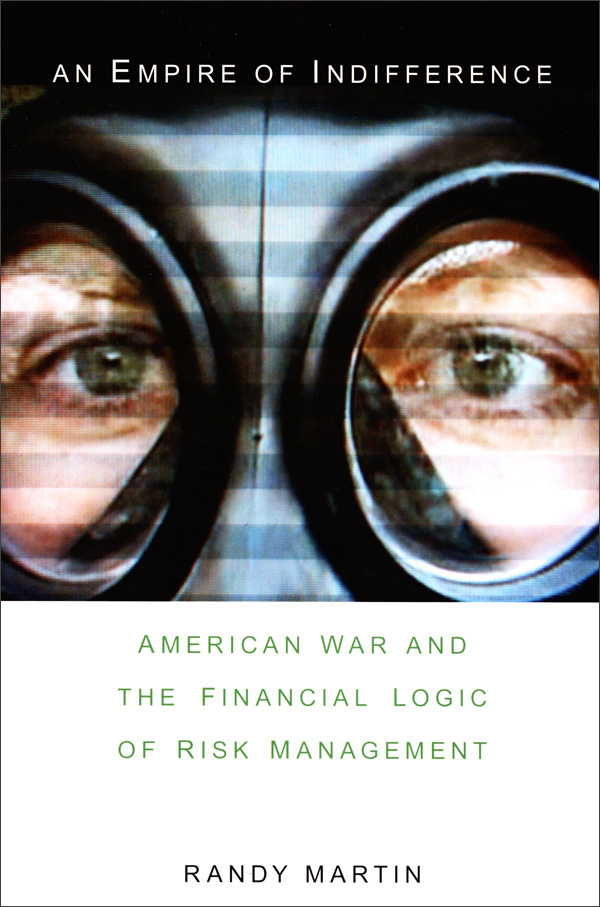 In An Empire of Indifference, Randy Martin makes the argument that a financial logic of risk management underwrites US foreign policy and domestic governance. Securitization, derivatives, hedging, arbitrage, risk, multiplier effect, leverage: these keywords of finance can be applied to the field of war-making and empire-building. The war on terror has created an empire of indifference that distances itself from any particular situation, just like the high finance of Wall Street is unconcerned about the travails of the real economy in Main Street. Finance can help us understand how foreign policy decisions are made, military interventions are planned, and scarce resources are allocated for maximum leverage. As a diplomat trained in economics, I find this angle very stimulating. However, the author approaches it from the perspective of the cultural critic, not as an economist or a political scientist. His book is written on the spur of the moment and oscillates between a denunciation of the war on terror and a conventional analysis of mounting risks in the financial sector. His logic is sloppy at best and his references to finance and economics are unsystematic and clumsy. Even his Marxism is of the literary type: he treats Marx as a shibboleth and a source of metaphors, not as an analytical toolbox or a conceptual guide. In the following lines, I would like to reclaim the impetus of mixing economics, war studies, and finance. But first, let me try to summarize Randy Martin’s argument.
Theories of imperialism
The link between the logic of capital and the expansion of Western power was first articulated in the theory of imperialism. For Marxists, imperialism is the highest stage of capitalism. Marx himself did not use the word “imperialism”, nor is there anything in his work that corresponds exactly to the concepts of imperialism advanced by later Marxist writers. He did, of course, have a theory of capitalism, and his work contains extensive, if rather scattered, coverage of the impact of capitalism on non-European societies. Unlike many of his successors, Marx saw the relative backwardness of the non-European world, and its subjection to European empires, as a transient stage in the formation of a capitalist world economy. The conceptualizing and theorizing of imperialism by Marxists has evolved over time in response to developments in the global capitalist economy and in international politics. For Rudolf Hilferding, finance capital is marked by the highest level of concentration of economic and political power. State power breeds international conflicts, while internal conflicts increase with the concentration of capital. Nikolai Bukharin transformed Hilferding’s analysis by setting it in the context of a world economy in which two tendencies were at work. The tendency to monopoly and the formation of groups of finance capital is one, and the other is an acceleration of the geographical spread of capitalism and its integration into a single world capitalist economy. Vladimir Illich Lenin also considered Hilferding’s thesis “a very valuable theoretical analysis” and complemented it with the view that rich capitalist nations were able to delay their final crisis by keeping the poorer nations underdeveloped and deep in debt, and dependent on them for manufactured goods, jobs, and financial resources. Rosa Luxemburg wrote the most comprehensive theory of imperialism, and her conclusion that the limits of the capitalist system drive it to imperialism and war led her to a lifetime of campaigning against militarism and colonialism.
Randy Martin only mentions these early contributions in passing. He devotes more time to contemporary critiques of imperialism articulated by Giovanni Arrighi, Michael Hardt and Antonio Negri, David Harvey, and others. Earlier Marxists saw the expansion of empires as the sign of capitalism’s imminent demise. By contrast, for their modern epigones, the empire is here to last. They analyze the constitution of global imperial formations as the extension of neoliberalism to all sectors of social life. Empire is the new logic and structure of rule that has emerged with the globalization of economic and financial exchanges. Although capital’s expansion inevitably involves proliferating economic and financial crises, these shocks to the system are not signs of imminent collapse but, instead, mechanisms of adaptation and adjustment. Under neoliberalism, war and empire-making are privatized and generate in response insurgencies and resistance of the multitudes from below. As Slavoz Zizek observed about the Iraq war, “there were too many reasons for the war”: the American decision to invade Iraq in March 2003 was overdetermined and justified by a long list of arguments, from bringing democracy to asserting hegemony and securing oil. President Eisenhower’s greatest fears about the expansion of the military-industrial complex have not only been realized, they have been surpassed due to the symbiotic relationship it has with the neoliberal agenda.
Asset-Backed Security
Works penned by critics of empire are usually reactive: they come after the facts and often react to geopolitical events such as the launch of a preemptive war by the US in response to the September 11 attacks, the occupation of Iraq and Afghanistan and the extension of counter-insurgency, or the vilification of presidential power brought forth by Donald Trump. Randy Martin’s book was published in 2007, shortly before the start of the subprime crisis that ushered a sharp decline in economic activity known as the Great Recession. He achieves a certain degree of prescience by pointing out the imbalances building in the subprime loan market and the excessive leverage of government-sponsored enterprises such as Fannie Mae and Freddie Mac. But his main contribution is to assess what the recent ascent of finance has meant for the conduct of military interventions and foreign policy. “Simply put, finance divides the world between those able to avail themselves of wealth opportunities through risk taking and those who are considered ‘at risk’.” Populations become the target of portfolio management at home and abroad. The logic of finance by which the United States manages its human assets and social liabilities now guides its foreign policy. The ability of an individual or a nation to sustain debt is portrayed as a sign of strength and rewarded with access to additional capital and good credit rating. Those citizens or countries deemed to being bad risks are cut short and left out to loan sharks and debt collectors.
Martin devoted one full book to The Financialization of Daily Life, analyzing the mechanisms by which finance permeates and orients the activities of markets and social life. An Empire of Indifference focuses on what finance does to foreign policy and war-making. War today takes on a financial logic in the way it is organized and prosecuted. America applies a utilitarian frame to war and peace, and seeks tradeoffs between security and risk. Security gives way to securitization, war-making follows the same rules as financial products such as options and derivatives, and Wall Street’s indifference to Main Street now extends to the empire’s carelessness about the lands and populations that become the target of foreign interventions. More specifically, the author sees a strong parallel between monetary policy and the Bush doctrine of preemptive strikes. Inflationary pressures have to be nipped in the bud before they affect the overall economy; likewise, enemies are to be defeated before they can make their antagonism manifest. By converting potential threats into actual conflicts, the war on terror transfers future uncertainty into present risk. Bridging the future into the present has been the guiding principle for monetary policy since the late 1970s. The same logic of rational expectations and backward induction now applies to military operations abroad and to homeland security: controlling risk necessitates constant interventions and is necessarily preemptive. For risks to be reliably calculable, the future must look like the present.
Security and securitization
Randy Martin sees other parallels between circuits of finance and the military. Both seek to leverage narrowly focused interventions and investments to more global effects. This is the logic of arbitrage, coupled with financial derivatives, that exploits small differences in market value and leverages it on a large scale. New battlefield tactics rely on concentrated, relatively small deployment of soldiers to achieve strategic results. Special Forces are meant to eliminate targets before a formal battle is joined; air strikes and armed drones use high-frequency information to maximize return. The intervention in Iraq was supposed to usher a new era of peace and democracy in the Middle East, solving the Palestinian question and giving lasting guarantees of security to Israel along the way. The outcome could have been predicted by pursuing the parallel with market forces and financial intermediation. The war on terror creates what it seeks to destroy; likewise, derivatives create the volatility they were meant to manage. Despite the rhetoric, preemptive wars and forward deployments do not necessarily attempt to deter enemy action, to ward off an undesirable future, but are as likely to prove provocative, to increase the likelihood of conflict, to precipitate that future. American imperium now oscillates between invasion and isolation and remains geared toward short-term gains and high risk, high rewards investments. In this new empire of indifference, people are left to manage the mess that the occupiers deposited before taking flight.
My main issue with Randy Martin’s Empire of Indifference is that the author is not an economist: he literally does not know what he is talking about. Finance is for him a play of words and a source of metaphors, not a rigorous method of allocating risk and maximizing return. Even his Marxism is literary and evocative as opposed to rational and analytical. The book is tied to a particular moment in recent history, associated with the doctrine of preemptive war and the marriage of convenience between neoliberalism and neoconservatism. Its chapters read more like newspaper columns or opinion essays meant to put the news in perspective and to influence public opinion toward desired goals. And yet, Martin’s proposition to look at imperial ambitions in the context of the powers of finance is highly relevant in our day and age. Since Keynes’ Economic Consequences of the Peace, economists have been brought to the negotiating table; it is now time to bring them to the war room as well. Finance is doubly performative: it impacts a nation’s ability to declare and sustain war, and it affects the way war is conducted. Financial markets are often seen as reacting to political events. They are the biggest consumers of country risk analysis and geopolitical futures, and they absorb information in real time. But finance also shapes our vision of possible futures and produces affects and expectations that impact the results of foreign engagements.
You may not be interested in war, but…
Maybe it is time for finance to become weaponized, and for corporate strategy and military tactics to cross-pollinate each other. The US military has a National Guard and Reserve component of more than 1.1 million members. I wonder how many of them work in the financial sector, or how many West Point graduates are employed by Wall Street firms. There has always been a revolving door between investment banking and the DoD. The generation that laid the ground of the post-WWII international order, known collectively as the Wise Men, all had military experience. Finance as an academic discipline grew out of war-financed research in decision science and optimization. Operation research and game theory were the brain children of the Cold War, and had military as well as economic applications. DARPA has pioneered the use of prediction markets and futures exchanges based on possible political developments in various countries and regions, including violent events such as assassinations or terror attacks. To paraphrase Leon Trotsky, economists and financial market operators may not be interested in war, but war is interested in them.
 On March 3, 2021, Byun Hui-su, South Korea’s first transgender soldier who was discharged from the military the year before for having gender reassignment surgery, was found dead in her home. Her apparent suicide drew media attention to transphobia and homophobia in the army and in South Korean society at large. According to Todd Henry, who edited the volume Queer Korea published by Duke University Press in 2020, “LGBTI South Koreans face innumerable obstacles in a society in which homophobia, transphobia, toxic masculinity, misogyny, and other marginalizing pressures cause an alarmingly high number of queers (and other alienated subjects) to commit suicide or inflict self-harm.” Recently people and organizations claiming LGBT identity and rights have gained increased visibility. The city of Seoul has had a Gay Pride parade since 2000, and in 2014 its mayor Park Won-soon suggested that South Korea become the first country to legalize gay marriage—but conservative politicians as well as some so-called progressives blocked the move, and the mayor committed suicide linked to a #metoo scandal in 2020. Short of same-sex unions, most laws and judicial decisions protecting LGBT rights are already on the books or in jurisprudence, and society has moved towards a more tolerant attitude regarding the issue. Nonetheless, gay and lesbian Koreans still face numerous difficulties at home and work, and many prefer not to reveal their sexual orientation to family, friends or co-workers. Opposition to LGBT rights comes mostly from Christian sectors of the country, especially Protestants, who regularly stage counter-protests to pride parades, carrying signs urging LGBT people to “repent from their sins.” In these conditions, some sexually non-normative subjects eschew visibility and remain closeted, or even give up sexuality and retreat from same-sex communities as a survival strategy.
 It is said that Americans don’t have social security. Soldiers do. Earnings for active duty military service or active duty training have been covered under the Social Security Act since 1957. Veterans get social security benefits after they are discharged. Military service members who become disabled while on active duty can file for disability claims. The social security system also covers families and relatives of a deceased soldier. Active duty military members can retire after twenty years of active duty service. In exchange, they receive retirement pay for life. Veterans get free or low-cost medical care through VA hospitals and medical facilities. They have access to special education programs, housing and home loan guarantees, job training and skills upgrading, small business loans, and even burial and memorial benefits. Their situation contrasts with the thirty million Americans who do not have health insurance and who cannot afford medical costs, and with the many more who get only minimal retirement pension and healthcare. In sum, when you join the US Army, Uncle Sam gets your back covered.
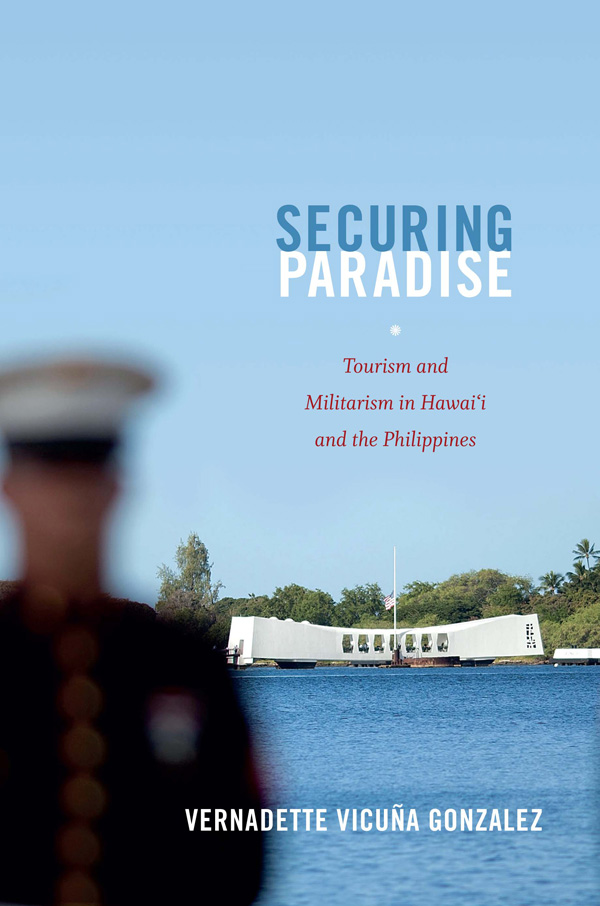 When she was a little girl growing up in the Philippines, Vernadette Vicuña Gonzalez considered American tourists and soldiers that she encountered or heard about as a benevolent presence. They were there to protect the land and to share their riches with a people in need of security and prosperity. This positive image was reinforced by the missionary schools founded by Americans, the remittances sent from abroad by relatives, the proceeds from commerce and military bases, and the endless stream of American movies and serials flowing from television. Later on, when her family emigrated to the United States, she would accompany her father to the Douglas MacArthur Memorial in Norfolk, Virginia, and share the gratitude held by many Filipinos for the general who liberated their country from Japanese occupation. For her, America was still the land of the free, a beacon of hope and opportunity for those seeking a better life beyond their own shores. But then she went to study at UC Berkeley and her worldview changed. She learned about the history of American imperialism, the gruesome stories of the Philippines-American war, the propaganda machine of Cold War politics, the complicity with authoritarian regimes, the destruction of the planet by the forces of neoliberalism, and the cynicism of exploitative raw power. Her homeland, the Philippines, became associated with the image of a puppet regime led by a dictator clinging to power with the backing of the US military. She applied the same critical lenses to the state of Hawaii and its populations after the was nominated as Associate Professor of American Studies at the University of Hawaii at Mānoa. For her, the Hawaiian archipelago was forced into the American fold at the end of the nineteenth century by a coalition of military imperialists, colonial planters, and migrant laborers who relegated the natives to subordinary status and even to cultural extinction. Being herself a nonnative in an adopted homeland, Vernadette Gonzalez purports to speak on behalf of the Native Hawaiians who should, however implausible it may sound, reclaim their sovereignty.
 The Duke Reader