
There Is No Us

A review of None Like Us: Blackness, Belonging, Aesthetic Life, Stephen Best, Duke University Press, 2018.

none-like-usThis essay stands at the intersection of black studies, queer theory, and literary criticism and art critique. Its title, None Like Us, is taken from a sentence in David Walker’s Appeal to the Coloured Citizens of the World, arguably the most radical of all anti-slavery documents written in the nineteenth century. The quotation, put on the book’s opening page, describes the wretched condition of coloured people in the United States as observed by the author. It ends with a prayer to God that “none like us ever may live again until time shall be no more.” Who is the “us” that the epigraph dooms to self-extinction and oblivion? Is there a collective subject when humans were treated as objects and disposed of as pieces of property? Can one write the history of people who did not exist, or whose existence is forever predicated on a negative relation to history? How does that “none like us” leave open the possibility for an “I,” the first singular person of the art critic, the historian, the queer subject? As Stephen Best writes, “None Like Us begins in the recognition that there is something impossible about blackness, that to be black is also to participate, of necessity, in a collective undoing.” Whatever blackness or black culture is, it cannot be indexed to a “we.” The condition of being black is rooted in a sense of unbelonging: “forms of negative sociability such as alienation, withdrawal, loneliness, broken intimacy, impossible connection, and failed affinity, situations of being unfit that it has been the great insight of queer theorists to recognize as a condition for living.”

A non-communitarian manifesto

None Like Us sometimes reads like a manifesto. The incipit: “a communitarian impulse runs deep within black studies,” sets the stage in almost Marxian fashion—one is reminded of the opening sentence of the Communist Manifesto. The specter of communism that is haunting Europe leaves way for the ghost of communitarianism that permeates African American scholarship. Also evocative of Marx and Lire Le Capital is the epistemological break that Stephen Best effectuates. He substitutes the “melancholic historicism” that characterizes black historiography with what he calls a “queer unhistoricism” that interrupts the connection between the past and the present. He breaks away from a century-long attempt to recover archival traces of black life under conditions of disavowal and silencing, to read the archive as a repository of lost traces and muted voices. Stephen Best also distances himself from all kinds of identity politics based on collective struggles and individual resistance. A politics of recognition cannot be predicated on a “we” that does not exist. Identities have to be radically deconstructed in order to assert freedom from constraining definitions of blackness and gender roles. A “gay black male” is an assemblage of three predicates, “gay,” black,” and “male,” that are equally problematic in assuming an essence that is only constituted through negation. As a non-communitarian manifesto, None Like Us is also an aesthetic treatise: the author engages in art critique and literary criticism, not to fly away from historical realities, but to induce us to “think like a work of art.”

A central tenet of African American studies rests on the thesis that black identity is uniquely grounded in plantation slavery and the Atlantic slave trade. The afterlife of slavery makes itself felt in the black political present and delineates a future in which reparation and redress are forever deferred. Recent historiography, to which Stephen Best contributed, has drawn our attention to the silenced voices that make themselves heard through the archive: the fugitive, the renegade, the maroon, the socially dead. Out of these enquiries emerged an obsession with “displacement, erasure, suppression, elision, overlooking, overwriting, omission, obscurantism, expunging, repudiation, exclusion, annihilation, and denial.” Like in Foucault’s essay “The Life of Infamous Men,” these figures emerge through the archive as “lowly lives reduced to ashes in the few sentences that struck them down” as if “they had appeared in language only on the condition of remaining absolutely unexpressed in it.” According to this melancholic view of history, “recovery from the slave past rests on a recovery of it.” To recover from past trauma, historians have to return to the scene of the crime, a crime imagined as the archive itself. Drawing from Freud’s definition of melancholia as an inarticulable loss that comes to inform the individual’s sense of his or her own subjectivity, Stephen Best writes: “Melancholy historicism provides for the view that history consists in the taking possession of such grievous experience and archival loss.”

The black radical tradition

Against this “traumatic model of black history” in which the present is merely the repetition of past humiliations, Stephen Best advocates a radical break with all attempts to recover a “we” out of the loss embodied in the archive. He borrows from what Cedric Robinson and others have called “the black radical tradition” in which violence is turned inward and rebellion leads to self-destruction. Examples mobilized by Robinson include the mass slaughter of cattle and destruction of crops ordered by the Xhosa prophetess Nongquawuse in 1856; the vanishing quilombo settlements of runaway slaves, mulattos, and outcasts on the Pernambuco coast of Brazil in the seventeenth century; and the 1915 uprising in Nyasaland (now Malawi) led by Baptist minister John Chilembwe who vowed to “strike a blow and die.” Exploring suicide and rumor in the eighteenth- and nineteenth-century archives of slavery, Stephen Best offers his own selection of vignettes and anecdotes. A “suicide bombing” occurred in 1659 when a besieged African chief blew up himself and his Dutch assailers by setting fire to a keg of powder. Archives of the Middle Passage tell tales of slaves hanging themselves, or starving themselves, or drowning themselves to end their living apocalypse, or holding their breath or swallowing their tongue in attempts at self-strangulation. People who consciously suppressed themselves in acts of self-immolation cannot be enrolled as subjects of history: theirs is “a history of people with whom we fail to identify, who appear stuck in the past beyond the reach of our historical categories.”

When it comes to black identity and the politics of race, the slave past was not always thought to explain the present. Stephen Best singles out the year 1988 and the publication of Toni Morrison’s Beloved as the moment when slavery emerged as the constituent object of African American studies. Beloved, which won the Pulitzer Prize that year, was not a unique occurrence: Alex Haley’s novel and TV series Roots had prepared the ground for a reappraisal of the slave past in popular culture, and in the late eighties and early nineties several history books anchored African American identity in “a continued proximity to the unspeakable terrors of the slave experience.” But the rise of Beloved moved the entire field of literary studies to a central place within African American studies, and this move redressed the “trade deficit” that cultural critics had accumulated with the discipline of history. Toni Morrison spoke of the slave past as a “carnage,” a “devastation” that will always be with us: “this is not a story to pass on.” But Toni Morrison’s more recent novel A Mercy (2008) opens the door for another appreciation of the slave past as it falls away and collapses into its own undoing. A Mercy is not an easy read: the chapters oscillate, confusingly at first, between a first-person narration and a third-person omniscience, reinventing the epistolary novel with dead letters whose failure to arrive comes from having never been sent. It is anchored in a world in which racial distinctions have not yet formed and much is up for grabs: the racial scripts and beliefs that are said today to make up slavery’s legacy have yet to settle into a lexicon. As the critic notes, “If Beloved incites melancholy, A Mercy incites mourning”: in Freud’s terms, melancholia is doomed to endless repetition, whereas mourning ends with a kind of forbearance.

Queer is the New Black

None Like Us is listed on the back cover as an intervention in “African American Studies” and “Queer Theory.” Stephen Best sees a high degree of complementarity between the two: “It startles how easily queerness percolates out of the condition of blackness.” Queer and slave historiography appear to be on the same page: the queer acknowledgement of non-relationality between the past and the present, what literary theorist Leo Bersani calls an “anti-communal mode of connectedness,” echoes the epistemological rupture that Best advocates. A queer orientation toward the past may preserve cultural critics from the melancholic turn that characterizes recent historiography. Black life and queer life are also intimately related through the experience of estrangement, alienation, and disaffiliation that Elizabeth Povinelli sees at the root of all progressive politics. None Like Us begins with a discussion of the different ways that both Best and James Baldwin found themselves, as young men, estranged from their fathers. Although their estrangement stems from opposite sources—Baldwin’s father’s disdain for his son, the pride of Best’s father at his son’s graduation ceremony—, there is a shared orientation toward a selfhood that occurs in disaffiliation rather than in solidarity. Part of this queerness comes from the experience of coming out of the closet as gay. As the author remembers from his tormented youth, “If I come out as gay, I will die in the eyes of my father, but I realize that a part of me is already gay and that he cannot not see that, too there must be a part of me that is already dead.” This skeleton in the closet precludes the possibility of a “we,” whether queer or black.

The chapter that opens the book’s part “On Thinking Like a Work of Art” begins with an address to the reader: “You” is the person who is put in front of the artwork and who experiences a kind of epiphany as one physical substance transmutes into another. In the Ghanaian artist El Anatsui’s richly woven tapestries, what initially presents itself as precious metal appears upon inspection to be throwaway-aluminum constructions of bottle caps and copper wire: “What was gold now reveals to be mere thrash.” In the layered paper canvases of the Los Angeles artist Mark Bradford, fragments of cardboard advertisements and printed materials are soaked into water and mixed with trash objects to generate relief within the surface itself: “What was originally ‘print’ finds itself transformed into ‘paint’.” Gwendolyn Brooks’s free-verse poems generate another kind of commentary that also mobilizes the tropes of conjuration, transmutation, and alchemy. Here the office of art is to afford a repetition of the artist’s gesture that “repairs inherently damaged or valueless experience.” And the curator, who mobilizes a rich array of sources and commentary listed in the endnotes, puts the “you” of the viewer in direct contact with the materiality of the artwork. Absent from the commentary are all the mediations that constitute art as an object of aesthetic value. Between the “I” of the critic and the “you” of the viewer, there is no “we” that would allow for the emergence of a community of value. When Foucault stated that “we have to create ourselves as a work of art,” or when Best proposes that “we must begin to think like artworks,” what they mean by “we” is mostly themselves.

Uncharted territory

Or so it seems to me. I could not relate to the book’s emphasis on art as embodied thinking or concepts brought into matter, and discussions on contemporary art brought me to uncharted territory. I had no prior knowledge of the visual artists that are commented in the book (I missed the El Anatsui’s retrospective at La Conciergerie in Paris as part of the Saison Africa2020), and I have not read a Toni Morrison novel since Tar Baby. Nor am I versed in recent historiography of the slave trade, and in the most recent discussions about black identity in the United States. I was more familiar with some of the literary criticism the author mobilizes, especially since literary criticism in the United States seems to be identified with France and French studies. Roland Barthes, Gérard Genette, Michel de Certeau, Michel Foucault, and Jacques Derrida—all listed in the index—are household names in academic circles on both sides of the Atlantic, and they point toward a common horizon that I was happy to share with the author. Also familiar was Stephen Best’s evocation of Walter Benjamin’s angel of history, that famous passage in which Benjamin gazes upon Paul Klee’s Angelus Novus and imagines that the Angel of History is looking toward the past and bears witness to history’s “piling wreckage upon wreckage.” This mix of familiar and unfamiliar shaped my reading of None Like Us, which I am happy to share with others.
Art-and-Technology Projects

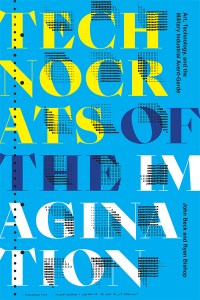
A review of Technocrats of the Imagination: Art, Technology, and the Military-Industrial Avant-Garde, John Beck and Ryan Bishop, Duke University Press, 2020.

Technocrats of the ImaginationThere is a renewed interest in the United States for art-and-technology projects. Tech firms have money to spend on the arts to buttress their image of cool modernity; universities want to break the barriers between science and the humanities; and artists are looking for material opportunities to explore new modes of working. Recent initiatives mixing art, science, and technology include  the Art+Technology Lab at LACMA (Los Angeles County Museum of Art), MIT’s Center for Art, Science, and Technology (CAST), and the E.A.T. Salon launched by Nokia Bell Labs. In their presentation documents, these institutions make reference to previous experiments in which artists worked with scientists and engineers in universities, private labs, and museums. LACMA’s A+T Lab is the heir to the Art&Technology Program (A&T) launched in 1967 by curator Maurice Tuchman with the involvement of the most famous artists of the period, such as Andy Warhol, Claes Oldenburg, Roy Lichtenstein, and Richard Serra. MIT was the host of the Center for Advanced Visual Studies (CAVS) founded in the same year by György Kepes, who had previously worked with László Moholy-Nagy at the New Bauhaus in Chicago. Bell Labs is where scientist Billy Klüver launched Experiments in Art and Technology (E.A.T.) with Robert Rauschenberg in late 1966. Technocrats of the Imagination tells the story of these early initiatives by replacing them in their intellectual and geopolitical context, exposing in particular the link with Cold War R&D and the rising influence of the military-industrial complex. The contradiction between an anti-establishment cultural milieu denouncing technocratic complicity with the Vietnam war and a corporate environment where these collusions were left unchallenged led these art-and-technology projects to their rapid demise. Modern initiatives operate in a different environment, but unquestioned assumptions may lead them to the same fate.
Creativity, collaboration, and experimentation

Why should artists collaborate with scientists and engineers? Then and now, the same arguments are put forward by a class of art curators, tech gurus, and project managers. The art world and the research lab are both characterized by a strategy of continuous innovation, collaborative experimentation, and disciplined creativity. They tend to abolish the boundaries between theory and practice, knowing and doing, individual inspiration and collective work. These tendencies were reinforced in the context of the 1950s and 1960s: in an age of big science and artistic avant-garde framed by integrative paradigms such as cybernetics and information theory, the artist and the engineer seemed to herald a new dawn of democratic organization and shared prosperity. The artist defined himself as a “factory manager” (Andy Warhol) and did not hesitate to don the white coat of the laboratory experimenter. The scientist was engaged in much more than the accumulation of scientific knowledge and science’s contribution was vital for the nation’s wealth and security. Both worked under the assumption that science could enlarge democracy and support the United States’ place in the world, and that American art should be considered on an equal footing with other professional fields of activity. But the shared virtues of creativity, collaboration, and experimentation covered profoundly different ideas of what those terms might mean and how they should be achieved. The conception of experimental collaboration in the arts was heir to a liberal tradition of educational reform emphasizing free expression and self-discovery. By contrast, innovation and experimentation as understood by institutions training and employing scientists followed a model of elite expertise and top-down management. They were also heavily compromised, as John Beck and Ryan Bishop emphasize, by their ties to the military-industrial complex.

Beck and Bishop place the genealogy of the three art-and-tech initiatives under the influence of two currents: John Dewey’s philosophy of democracy and education, and Bauhaus’ approach to artistic-industrial collaborations. The influence of John Dewey over the course of the twentieth century cannot be overemphasized. More than any other public intellectual, Dewey shaped and influenced debates on the relations between science, politics, and society in the United States. His principles of democratic education emphasizing holistic learning and the study of art were applied in Black Mountain College in North Carolina, a liberal arts education institution that left its imprint on a whole generation of future artists and creators (Robert Rauschenberg, Cy Twombly, John Cage, Merce Cunningham, Ray Johnson, Ruth Asawa, Robert Motherwell, Dorothea Rockburne, Susan Weil, Buckminster Fuller, Franz Kline, Aaron Siskind, Willem and Elaine de Kooning, etc.) The influence of Dewey’s pragmatism extended beyond the US, notably among German educational reformers, and his notion of “learning by doing” was picked up by the Bauhaus, a German art school operational from 1919 to 1933 that combined crafts and the fine arts. In return, Bauhaus furnished Black Mountain College with émigrés educators—Josef and Anni Albers, Xanti Schawinksy, Walter Gropius—and an utopian vision of a post-disciplinary, collectivist education that did not favor one medium or skill set over another. Bauhaus’ afterlife and legacy in the United States also manifests itself in the trajectories of Bauhaus veterans László Moholy-Nagy who created the short-lived Chicago School of Design in 1937, and György Kepes, who taught at MIT and ended up creating the Center for Advanced Visual Studies (CAVS) in 1967.

Bauhaus in America

It was Moholy-Nagy who originated the idea to stimulate interactions among artists, scientists, and technologists in order to spearhead creativity and innovation. His Hungarian compatriot and associate at the School of Design took the idea to the MIT, an institution whose motto mens et manus (“mind and hand”) echoed Dewey’s and Bauhaus’ devotion to “learning by doing” and “experience as experimentation.” MIT was a full research-based science university awash with money from government contracts and military R&D. Research teams working on ‘Big Science’ projects included not just scientists but engineers, administrators, and technicians collaborating together in a structured manner. Kepes’ tenure at MIT between 1946 and 1977 was characterized by a commitment to science and technology and a belief in the virtues of the unintended consequences of chance encounters leading to breakthrough innovations. His interdisciplinary teachings were structured around the principles of vision, visual technologies, and their social implications. Many disciplines were mobilized, including Gestalt psychology, systems theory, physiology, linguistics, architecture, art, design, music, and perception theory. Transdisciplinarity, holistic approaches, and the eclectic mix of science, technology, and artistic disciplines was in the air in the late sixties and influenced the counterculture as well as artistic creation. The same eclecticism presided over the creation of CAVS, a center dedicated to all aspects related to vision and visual technologies. Drawing in important artists and thinkers, including many Black Mountain alumni, CAVS laid the groundwork for subsequent MIT ventures such as the influential Media Lab, founded in 1985 by Nicholas Negroponte, and the Center for Art, Science, and Technology (CAST). It was in such environment that experimental filmmaker Stan Vanderbeek pondered the possibility of creating an “electronic paintbrush” to complement the electronic pen used in early man/machine interfaces.

The industrial corporation, the research university, and the private lab were the three nodes of the military-industrial complex. Hailed by Fortune magazine as “The World’s Greatest Industrial Laboratory,” the Bell Labs’ research center at Murray Hill in New Jersey was conceived along the lines of a miniature college or university. The laboratories themselves were physically flexible, with no fixed partitions and rooms so that they could be partitioned, assembled, and taken apart at short notice. Bell Laboratories cultivated creativity and innovation: researchers working at Bell Labs were credited with the development of the transistor, the laser, the photovoltaic cell, information theory, and the first computer programs to play electronic music. The proximity of New York City, which had become the capital of the art world, and the presence of an arts college at the neighboring Rutgers University, facilitated the rapprochement between the scientific avant-garde working at Murray Hill and the contemporary art world. Artists and musicians were offered organized tours of Bell Labs as a mean of opening dialogue and providing a sense of how technology could be harnessed for artistic creativity. Early realizations include Edgar Varèse’s Déserts (1950-54), an atonal piece that was described as “music in the time of the H-bomb”; Jean Tinguely’s Homage to New York (1960), a self-constructing and self-destructing sculpture mechanism that performed for 27 minutes during a public performance in the Sculpture Garden of the Museum of Modern Art in New York; and Robert Rauschenberg’s Oracle (1962-65), a five-part found-metal assemblage with five concealed radios and electronic components now displayed at the Pompidou Center in Paris. Also influential was the 9 Evenings: Theatre and Engineering, a series of performances that mixed avant-garde theatre, dance, music, and new technologies. In 1967, the engineer and project manager Billy Klüver set up the Experiments in Art and Technology (E.A.T.), a collaborative project matching avant-garde artists and Bell Lab researchers that attracted the application of more than 6000 artists, scientists and engineers. But the project soon foundered due to poor management and lack of funds.

From New York to Los Angeles and to the world

Place matters for artistic innovation, as it does for scientific discovery and technological breakthrough. During the twentieth century, the center of the advanced art world shifted from Paris to New York. Yet there was also a marked increase in the geographic origins of innovative artists. When he became the first curator of twentieth-century art at the Los Angeles County Museum of Art (LACMA), part of Maurice Tuchman’s mission was to put LA on the art map as “the center of a new civilization.” He did so by partnering with business organizations to sponsor an Art & Technology exhibition in 1971, with the participation of high-profile artists such as Roy Lichtenstein, Claes Oldenburg, Robert Rauschenberg, Richard Serra, and Andy Warhol. But at that time public opinion had already shifted away from the technocratic model of corporate liberalism, and the exhibition was a flop. Another Californian experiment sponsored by LACMA was the creation of artist-in-residence positions at RAND and the Hudson Institute, two think tanks working mostly for the government sector and tasked with: “thinking about the unthinkable.” But the New York-based sculptor John Chamberlain and the conceptual artist James Lee Byars had a difficult time adapting to their new environment. The first sent a memo to all RAND staff stating: “I’m searching for ANSWERS. Not questions! If you have any, will you please fill it below”: the incomprehension was total, and the memo fell flat. The second set up a “World Question Center” and invited the public to submit any kind of questions that would then be answered by a panel of intellectuals, artists, and scientists. But as the two authors of Technocrats of the Imagination comment: “If Byars could have included Stein, Einstein, and Wittgenstein in his teleconference, what might they have been permitted to say, given the serious limitations of the format? An expert is an expert is an expert.”

Twentieth century art was advanced by new institutions on the art scene: the Salons and group exhibitions of independent art collectives, the private art gallery, the art critique magazine, the contemporary art museum, and the international art biennale. World exhibitions also played a key role in the globalization of advanced art, and the American presence in these global events often displayed art-and-technology projects. Billy Klüver and the E.A.T. program at Bell Labs engineered the American pavilion for the Osaka World’s Fair, Expo ’70, in partnership with PepsiCo. The RAND Corporation was pivotal for displaying US advanced technology abroad in exhibitions of science, urbanism, postwar visions of the future, and consumer society. The Eames Office, a design studio based in Venice, California, was commissioned to contribute to the USIA-sponsored US pavilion at the 1959 Moscow World’s Fair and the Montreal Expo ’67, and designed the IBM pavilion at the 1964 New York World’s Fair. The aim of these exhibitions was geopolitical: they were to display America’s might at its most spectacular, and to offer a glimpse of the future in which technology played a key part. They were conceived as artist-led immersive environments in the tradition of the Gesamtkunstwerk or “total work of art” of the Bauhaus, and played a pioneering role in the development of multimedia installations and video art. Charles and Ray Eames were “cultural ambassadors” for the Cold War representation of the United States, and their design creations aligned with the political agenda the US government wished to communicate. The Eames Office made important cutting-edge documentaries such as Powers of Ten (1968), a short film dealing with the relative size of things in the universe and the effect of adding or subtracting one zero, or Think (1964), a multiscreen film in a large, egg-shaped structure called the Ovoid Theater that stood high above the canopy and central structure of the IBM pavilion at the New York World’s Fair.

Corporate neoliberalism

John Beck and Ryan Bishop focus their analysis on the ideological underpinnings and geopolitical ramifications of these art-and-technology projects. They argue that, contrary to their forward-looking ambitions and futuristic visions, MIT’s CAVS, Bell Lab’s E.A.T., and LACMA’s A&T’s program were behind their times. In the late 1960s, antiwar sentiment had hardened public opinion against corporations and technology more generally. The positions of the scientist and the engineer were compromised by their participation in the military-industrial complex:  “science and technology had come to be seen by many as sinister, nihilistic, and death-driven.” The idea that US corporations could plausibly collaborate with artists to create new worlds of social progress was now evidence of complicity and corruption—technology was the problem and not the solution. The political climate made it impossible to justify what was now summarily dismissed as “industry-sponsored art.” In this politically charged context, art and technology projects had very little to say about politics, American foreign policy, or the Cold War in general. Technocrats of the Imagination concludes with a comparison between these late-1960s projects and recent reenactments such as MIT’s CAST, LACMA’s A+T Lab, and Nokia’s E.A.T. Salon. Contrary to their predecessors, these new projects operate in a neoliberal environment driven by private corporations in which the sense of dedication to the public good that animated scientists and artists from the previous generation has all but disappeared. As the authors argue, the recent art-and-tech reboot “cannot be separated from or understood outside the deregulated labor market under neoliberalism that has demanded increased worker flexibility, adaptability, and entrepreneurialism.” The avant-garde artist’s new partner is not the white-coated scientist or the lab engineer, but the tech entrepreneur who claims the heritage of counterculture to advance techno-utopianism and radical individualism. Their claim of “hippie modernism” and their appropriation of the 1960s’ avant-garde is based on historical amnesia, against which this book provides a useful remedy.

The Stripe Guy and the Stick Man

A review of Disordering the Establishment: Participatory Art and Institutional Critique in France, 1958–1981, Lily Woodruff, Duke University Press, 2020.

Lily Woodruff

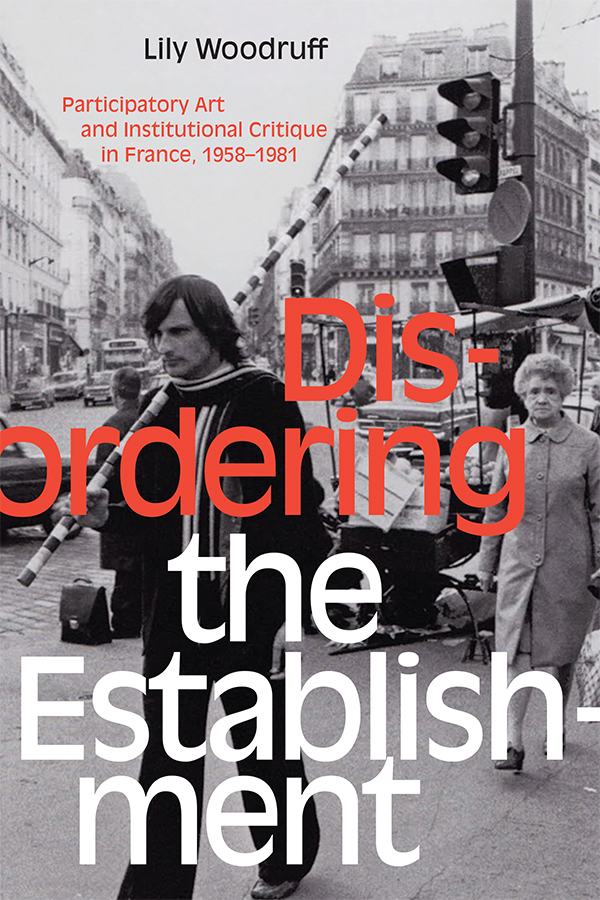
The book cover shows a man walking in the street carrying a multicolored wooden pole on his shoulder. The place is Paris, the man is an artist named André Cadere and the pole he carries, “a round bar of wood” as he calls it, is his signature artwork. How to look at a round bar of wood? is how an art critic called the catalogue of a Cadere exhibition. Perhaps we should look first as the surrounding scene: for as the French intellectual Guy Debord put it, “That which changes our way of seeing the street is more important than that which changes our way of seeing a work of art.” The location can easily be identified as Parisian; with its Hausmann buildings and streets paved with cobblestones, it represents an ordinary urban scene featuring a fruit stall with empty wooden crates, a man standing at a bus stop with his leather bag resting on his side, and an elderly passerby carrying her shopping basket, minding her business. The main character walks a slow pace, head slightly inclined, with long hair and an intense look. His bar of wood draws a diagonal that cuts across the picture, forming a triangle with the vertical street light pole. André Cadere was, by all accounts, an original. He regularly turned up uninvited at art-world parties, or left one of his signature batons leaning against a wall in exhibitions in which his work was not meant to be included. As well as bringing his batons into the art world, Cadere also presented them in public spaces, including restaurants and subways, announcing ‘exhibitions’ where he would appear between specific hours every day over a certain period of time, engaging passers-by with discussions about his baton and art. “Establishing Disorder” was the title of such a public talk where the artist discussed his work without exhibiting any, inviting his public to leave the room and return to their homes as a way to contest the art establishment.

Reengineering society

Disordering the Establishment, by Lily Woodruff, focuses on French artists or groups of artists in the period preceding and following the social upheaval of May 1968. She provides a total description of their artistic careers by putting their works into historical context and providing the critical apparatus built by art critics and influential thinkers to apprehend their contribution to French contemporary art and ideological debates. The 1950s and 1960s heralded the age of the technocrat: the new elite of administrators and technical experts who applied tools of social science to reengineer and modernize society. Their collective power was anonymous, science-based, and diffuse: they sought to exert authority through control of information flows, design of incentives, and manipulation of the environment more than by direct order and administrative fiat. One key word of the times was participation: for de Gaulle, workers’ participation in management aimed at substituting cooperation to antagonism and offered a way out of the class struggle that was plaguing French society. More generally, the public was invited to participate in the decisions that affected them, including aesthetic choices and cultural policies. The notion of feedback, taken from the study of cybernetic systems, was used to advocate a loop between the public, policy makers, and cultural producers in order to bring art closer to the popular audience and make it more relevant to its concerns. Technocratic idealism drove the projects of many artists, critics, architects, and urban planners. The creation of the grands ensembles or HLM (habitations à loyer modéré) in the suburbs was a grand scale experiment that attracted considerable attention at the time. Critics pointed out the dehumanizing aspects of modern habitats and the alienation brought about by a conservative social order. Others attempted not only to describe bourgeois society, but to change it through a new praxis emphasizing autonomy, creativity, and  political engagement.

The Groupe de Recherche d’Art Visuel (GRAV) was not a group of researchers, but a group of artists doing research. It was active in Paris from 1960 to 1968. Eleven artists signed the original manifesto, but only six of them formed the core of the group, among which François Morellet, Julio Le Parc, and Yvaral. Following the belief of Victor Vasarely (father of Yvaral) that the concept of the artist as a solitary genius was outdated, they cultivated anonymity and declared themselves to be “more a group of paintings than a group of painters.” In their “acte de fondation” manifesto, they spelled out nine stratagems that the group would use to unify their artistic activities and research discoveries so as to generate a constant movement of ideas and ensure that no one individual would claim authority on his own work or that of the group. Considering the objects that they produced not as finished artworks, but rather as research, they conceived of their creation process as a continual progression based on trial and error. The group guidelines closely resembled the technocratic language of the era. Using Op art and kinetic art as a medium, they defended abstraction against the prevailing popularity of figurative art among French left-wing artists and critics, and argued that abstract art was not opposed to the principles of dialectic materialism. Their plea for an abstract progressive art took inspiration from models of scientific research. They referred to “topology,” a branch of mathematics that served as a popular metaphor during the 1960s, and used Gestalt theory and cybernetics to create spaces of “visual therapy” in which viewers might discover more about their own process of reasoning than about the art itself. The cool, repetitive regularity emblematic of GRAV’s works embraced a rational geometric abstraction that stood in stark contrast to what the artists saw as the stagnating expressionisms and figurations of the French art scene. While the initial focus of the GRAV artists stemmed from experimenting with visual perception, the group’s works expanded to examine notions of spectator participation. In 1966, they brought their kinetic sculptures to the streets in a cargo van touring central Paris, distributing explanatory texts and questionnaires to the public. They installed walk-through labyrinths that they conceived of as social experiments, but that disgruntled critics compared to the devices one would expect to see at a Luna Park. They eschewed the art gallery circuit and imagined that ideally their art objects would be available for distribution at Monoprix discount stores. But the democratic ambition of their participatory displays was in tension with the rational and technocratic ethos of their approach. As the founder of the Situationist International Guy Debord put it, “What they call the avant-garde of absence is nothing more than the absence of an avant-garde.”

From enfant terrible to established artist

With the installation of his 260 truncated columns in the great courtyard of the Palais-Royal, Daniel Buren has become the symbol of the established artist. Commissioned by the Ministry of Culture, this work provoked an intense debate over the integration of contemporary art in historic buildings and about the imposition of aesthetic choices by an establishment of art administrators and policy-makers over a reluctant public. But in the 1960s and 1970s, Daniel Buren was the enfant terrible of contemporary art and the personification of anti-establishment. In 1969, he refused to have his work included in an exhibition of “Art in the street” because he did not want to be represented as one artist among others. He mocked the pretension of GRAV and kinetic artists to reach popular audiences in the cités HLM through imposed participation: “I am sure that it would be much more agreeable to be exploited.” Buren discovered the stripe motif that would become his signature while searching for inexpensive material on which to paint at the Marché Saint-Pierre in 1965. He was pursuing the “degree zero of painting,” an expression taken from Roland Barthes’ 1953 book Writing Degree Zero. In April 1968, Buren began pasting posters that he had commercially printed with his striped motif at various locations across Paris in what he called affichages sauvages, or wild posterings. The posters went up on palisades surrounding construction sites covered with advertisements, but also among other fly-posted tracts condemning the war in Vietnam and announcing meeting times for protests—Mai 1968 was to erupt the next month. Spurred by the student protests, he accompanied his works with a deluge of explanatory texts, written tracts, manifestos, and interviews in which he declared “the only thing that one maybe can do after having seen a canvas like one of ours is total revolution.” He saw French society as massively repressive and the contemporary art world as irretrievably compromised: he retrospectively described “a suffocating atmosphere, with the appearance of being tidy and policed, where avant-garde artists had an open table at prime minister Georges Pompidou’s place.” But his own work crucially depended on institutions for ideological support. While objecting to traditional ways of presenting art through the museum-gallery system, he cultivated his relations with galleries and biennales, creating pressing demand to show via the same system. As a sign that the times were changing, he began to produce decorative tape and wallpaper for private residences in the 1980s.

If Daniel Buren was the “stripe guy,” André Cadere is remembered as “the stick man,” the artist known for carrying a stick. He shared with the GRAV collective a taste for formalism and mathematics: his round bars of wood, of various size and length, were composed of colored segments repeating a combination sequence in which one deliberate error was inserted. He was less engaged than Buren in political talk; if anything, his status as a refugee exiled from his native Romania exposed him to the surveillance of the state police, and he has had enough of a taste of totalitarianism to appreciate democratic freedom as it was worth. The man with a stick was much less famous than the stripe-man, but he used his fellow artist’s fame to free-ride on his egoistic self-promotion. In 1973, he left a colored bar in an exhibition featuring Buren’s works and, when it was removed and hidden away in a closet, circulated an exhibition announcement instructing visitors to seek out the sequestered bar in the broom closet. Like Buren, Cadere produced a single type of iconic work based on a systematically repeated formula that negated the subjectivity of the artist and neutralized the significance of viewer interpretation. While Buren’s work from this period similarly played across the boundaries of institutional limitation, the highly visible and intentional attachment of the artwork to the body of the wandering artist was the feature by which Cadere argued his opposition to Buren. Whereas in situ works generally complemented the sites in which they were placed, Cadere’s juxtapositions based their critique on the cultural inappropriateness of the art object’s presence within and outside artistic contexts. Cadere’s guerrilla tactics was in line with his hobo lifestyle. He fashioned himself as a rogue art celebrity, building his identity on marginality and independence. Photographs (remember the book cover) represent him in various circumstances, with his trademark stick and intense look, but he was careful to distinguish between the artwork and its representation through documentary media. Cadere wanted his bars to be seen in their materiality, and insisted that his work was “exhibited where it is seen.” His round bars of wood are now displayed in museums and private collections, but they have lost their potential to disturb and to unsettle. 

Sociological Art

Though relatively unknown today, Sociological Art is thoroughly emblematic of the historical upheavals of the late 1960s and 1970s in France. The Sociological Art Collective was formed by Hervé Fischer, Fred Forest, and Jean-Paul Thénot in 1974 but each artist came to its positions independently by developing their own art projects. In 1971, Hervé Fischer invited other artists to send him their artworks which he tore up and disposed in garbage bags put on display in an art gallery. He also disposed of his own body by putting his head in a plastic bag or wrapping himself in vinyl sheets. For Fischer, tearing and throwing away was as much creative as it was destructive, and documenting this process of destruction was conceived as a work of art. Fred Forest, who worked as a telephone operator in the 1960s, organized his earlier works around the mediated participation of his audience. In Portraits de famille, he asked the residents of a suburban housing project to send family pictures at the dinner table, which he presented in a community exhibition. In Space-Media, he placed a blank rectangle in the newspaper Le Monde and inviting readers to fill it in with whatever they liked and mail it to him. Taking part in a popular television program, he made the screen grow black for a few seconds and invited spectators to fill that free space with the thoughts and comments that he then collected. On the occasion of the São Paulo biennale in October 1973, he organized a series of performances, including a procession through the city center with participants holding white placards: he was arrested by the junta police, who took it as a real protest. Jean-Paul Thénot distributed questionnaires with open or nonsensical questions that he analyzed with the statistical techniques used by opinion pollsters. Most of his polls reflected on the art world, as when he asked respondents to name the most representative French artist that would correspond to the mean average choice. Together, the three proponents of Sociological Art published manifestos, organized interdisciplinary performances, and conducted field experiments as in their large-scale artistic survey of the city of Perpignan. Rejecting aesthetic motivations, they argued that “sociological art has no style,” and they developed an ethics of nonintervention by providing raw data and community-based documents. 

I was completely unfamiliar with the episodes of contemporary art history that are described in this book. What I take from reading Disordering the Establishment is three things. First, Lily Woodruff succeeds in linking art to its historical context. Through her four case studies, she provides an alternative story of Les Trente Glorieuses, the three decades of robust economic growth, political dirigisme, and social upheavals that French citizens now remember with nostalgia and regret. Art is not estranged from its social and political environment: on the contrary, it reflects and contributes to the main debates of the day, projecting them on a different plane that makes the familiar look unfamiliar. By developing a critique of institutions, art brings disorder and dissonance into a well-ordered world. It reminds us that history always contains a part of randomness, of background noise and graphic disturbance that retrospective narratives tend to eliminate from the broad picture. When you switch the channel to this ambient noise, a different history appears, unfolding at street level and more attuned to the individual experience of passers-by. As a second contribution, the author brings contemporary art schools in close contact with intellectual history. I was in more familiar terms with the many intellectuals, social critics, and thinkers that Lily Woodruff quotes in abundance. The writings of Roland Barthes, Pierre Bourdieu, Guy Debord, Gilles Deleuze, Michel Foucault, Henri Lefebvre, Jean-François Lyotard, Edgar Morin, and others are very relevant for understanding artistic developments in France and putting them into their ideological context, not least because these thinkers were themselves close watchers of the art scene and commented upon contemporary artists in their work. Intellectual debates at the time were as much about aesthetics as they were political or philosophical. The anti-establishment mood was widely shared and gave way to various expressions: taken together, they form the most valuable inheritance that we received from this period. Artists and critics developed a form of specific courage: their attack on the establishment was not only intellectual posturing. They walked the talk and drew the consequences of their radical political stance in their specific field of activity, without fear of confrontation and marginality. That some of them rallied later on to existing institutions and centers of power only shows the precarious nature of the artistic field, where only institutions or the market can guarantee independence over the long term. As a third point, Disordering the Establishment seems to me a good model of how to write about art. Especially when it comes to contemporary creation, I am all in favor of pedagogy and even didacticism in the appreciation of the arts. I believe art and literature ought to convey information and instruction, along with pleasure and entertainment. Artworks cannot do this by themselves: they have to be accompanied by a critical apparatus or scholarly material that allows the public to shape its perception and understanding of art. In her masterful essay on participatory art and institutional critique in pre- and post-1968 France, Lily Woodruff  provided me with such a companion to an intelligent understanding of some recent artistic creations.

Timeless, Bottomless Bad Movies

A review of The End of Japanese Cinema: Industrial Genres, National Times, and Media Ecologies, Alexander Zahlten, Duke University Press, 2017.

The End of Japanese CinemaCinema is an industry. But very often aesthetics gets in the way of analyzing it as such. For cinema—or some portions of it—is also an art. Industry or art: these two approaches give rise to two distinct bodies of literature, one focusing on professions, publics, and profits, the other one on visual style, narrative content, and film textuality. There are movie industry specialists who may teach in professional schools or in economics and sociology departments, applying the standard tools of their discipline to one particular sector that represents up to one percent of the US economy. And there are cinema critics and film studies academics who develop concepts such as genre, auteur, style, form, periods, and apply them to a canon of authorized films conserved in national archives. Film studies may emphasize culture (cinema as representative of national culture), psychology (a movie reflects the inner psyche of its director), formalism (focusing on the formal or technical elements of a film), history (itself divided into the history of genres and national traditions), or theory (film theory as a branch of applied philosophy). What these approaches have in common is that they consider a movie as worthy of cultural commentary and critique. By contrast, an industry specialist is more interested in macro factors such as film production, distribution, and box office figures. He or she will focus on context more than content, on cost and revenues more than artistic quality. In the case of Japanese cinema, an art critic will focus on directors such as Kurosawa Akira or Ōshima Nagisa, specific genres such as jidaigeki (samurai movies) or kaijū eiga (monster movies), and techniques such as Ōzu Yasujiro’s signature tatami shots and multiple scene framings; while an industry specialist will study the studio system long dominated by Shōchiku, Tōhō, Tōei, Nikkatsu, and Daiei, the unionization of workers, or the distinct distribution channels for hōga (domestic movies) and yōga (foreign movies).
Pink Film, Kadokawa Film, and V-Cinema

In The End of Japanese Cinema, Alexander Zahlten combines the two approaches. He analyzes cinema as a cultural form and as a socio-economic activity with deep political ramifications. He proposes concepts that bridge the gap between the artistic and the industrial, the qualitative and the quantitative, the individual movie and the whole economic sector. It helps his case that the three categories he discusses—Pink Film or sexploitation films, Kadokawa Film produced by one single, multi-media entrepreneur, and V-Cinema made straight for the video market—are almost devoid of any artistic value. In fact, they are ignored in critical and academic discourse on films from Japan, and do not feature in Japanese movie histories. Like the infamous AV (adult videos), a large fraction of them may not even be included in film production statistics. But collectively they form an archive of close to 8000 movies: enough for the social scientist to build models, test inferences, and draw meaningful conclusions from such a large sample. They matter for a genuine history of cinema in Japan that is willing to go beyond the time-worn theories of auteurship, national character, and genre normativity. For all practical purposes, watching a movie in Japan meant, for a large fraction of the public and during a significant period of time, attending a film that belonged to one of these three categories. The reason academic work on films in Japan hardly discusses or even mentions these movies is because they cater to the base instincts of the public and are generally considered of bad taste and poor artistic value (some Pink films nonetheless made it to the Euro-American cinema festival circuit). If some of them achieved high scores at the box office or on video rental figures, it is because the public was lured by sexual attraction or by marketing ploys and media campaigns. This is particularly the case for Kadokawa films, which include a few blockbusters: but they were derided by the critics and the art movie profession, who declared that “Kadokawa films are not films” and, in the case of Kurosawa Akira at the 1980 Cannes film festival, refused to shake hands with the producer.

Sex sells, and it is no wonder that sexually themed films feature heavily in the sample studied by the author. In fact, it has been estimated that adult films represented up to 40 percent of the video rentals in the 1980s, and that close to 75 percent of films produced in Japan in 1982 positioned themselves in this market segment. Nudity and sex officially entered Japanese cinema with Kobayashi Satoru’s controversial and popular independent production Flesh Market (Nikutai no Ichiba, 1962), which is considered the first true pink film or pinku eiga. Pink films are not to be confused with Roman Porno films, a series of theatrical erotic movies produced by the movie studio Nikkatsu riding the wave that the first Pink movies had created. Nor are they similar to Adult Videos, pornographic films adapted to Japanese proclivities and visual censorship rules. Alexander Zahlten gives a strict definition of the Pink Film genre: a one-hour length format with regularly spaced erotic scenes (shot in color while the rest of the movie is often in black-and-white), a budget of around 3 million yens since the mid-1960s (decreasing in value over the years), an independent system of production, distribution, and exhibition (with specialized Pink Film theaters), extremely fast scripting and shooting schedules (tantamount to guerrilla warfare), and intensely misogynistic content. Pink movies carry explicit titles such as Meat Mattress (Niku futon), Naked Embrace (Hadaka de dakko) or Mature Woman in Heat Ball Licking (Jukujo hatsujō tamashaburi). But in fact, these films were much less explicit that their titles suggest. The same holds true for V-Cinema, which included sub-genres such as jokyōshi (female schoolteacher), danchi-dzuma (suburban wife), and chikan densha (train groper): the video cover sleeves were covered with titillating pictures that far exceeded the film’s actual explicitness. As for Kadokawa movies, they were geared for a mass audience and limited the stoking of the male public to the exhibition of underage starlets (the three Kadokawa girls, or Kadokawa san-nin musume). But they indulged in another kind of porn: the titillating of national feelings, with the screening of a national identity discourse that passed itself for cosmopolitanism and contemporaneity.

The politics of time and the aesthetics of confusion

Watching one of the first Kadokawa productions, Proof of the Man (Ningen no shōmei) made me feel particularly ill at ease. Besides the dismal performance of George Kennedy, a veteran of Japanese movies and one of the worst actors in the history of cinema, I couldn’t pinpoint the reason for my malaise, but it certainly had to do with the mixed-race character who provides the plot that the movie unfolds. The movie, and the TV drama that came after it, are suffused with deep-seated fears about miscegenation and inter-racial contact. We find the same ideologies of nationhood in the movies and dramas adapted from the novels of Yamazaki Toyoko. The question of the Other and the question of temporal hierarchy—with Japanese time being in front of its Asian neighbors yet still behind Euro-America—is a common theme of the three genres. As the author notes, “industrial genres performed complex negotiations concerning a position vis-à-vis dominant temporal discourses such as colonial time, sequential time, straight time, and homogenous time.” Pink Film rejected the possibility of a clear separation between past and present, showing how postwar Japan was haunted by remnants of its militaristic and colonial past. Kadokawa Film exchanged history itself for a perpetual present which brought confusion between the native self and the foreign Other, the victim and the victimizer, the movie plot and its reincarnation in other media supports. V-Cinema used video technology’s ability to manipulate time by starting, pausing, rewinding, stopping, and rewatching at the viewer’s convenience, thereby creating the temporality of the rewind and the fast-forward. Each industrial genre illustrates a politics of time. Each genre also generates an aesthetics of confusion: a mixing of identities, temporalities, geographies, and media. Pink Film insisted on the messy, confusing and contradictory experience of Japan two decades after the war. Kadokawa Film conflated genre and textuality with the trademark and business strategy of a corporation. V-Cinema was an untidy and disorganized collection of cheap flick pics, sleazy journalism, endless serials, how-to tapes, and soft porn videos. Not only the movies but also the viewers were confused: they deserted movie theaters and retreated to other pastimes (in 1984, motorboat racing boasted attendance figures twenty-five times the total audience of theatrical film.)

For traditional film critics, Japanese cinema offers a meta-narrative of Japaneseness: elements of culture are isolated and reflected in the form and content of a particular movie or in the history of a genre. For Alexander Zahlten, movies and genres in his sample are self-reflective. There is “a match between the textuality of the film and the textuality of the industry structure.” The aesthetics and business organization of the industrial genre is a reflection of the filmic codes and narrative patterns of the films that compose them. The story of an industrial genre is the story of a movie writ large. Textuality can be found at the level of the business structure, corporate strategy, labor relations, spatial organization, and lifecycle of industrial genres. Pink Film tells a story (largely fabricated) of antisystem resistance, oppositional realism, class politics, cultural avant-garde, and student warfare. These narrative elements are found in the films’ stories and style but also extend beyond it to encompass the identity politics of those involved in the production of Pink films, as well as their viewers and those who commented upon them. For Kadokawa Film, business practices were part of the product that was marketed to the public. The “media-mix strategy” that the company developed was a package of films, mass market paperbacks, magazine covers, and movie theme songs marketed by a single entrepreneur to the widest possible audience, with each product advertising the others. The larger-than-life personality of Kadokawa Haruki himself was part of the service package he proposed and was reflected in the movies in which he made guest appearances. He famously declared: “I like Japanese films, but I detest the Japanese film world.” His strategy was the opposite of business as usual: he broke cartels and pitted the majors each against the others, outsourced work, released Japanese films in theaters usually reserved for foreign movies, destroyed the block-booking system, deployed blitz media campaign to advertise the release of a new blockbuster, launched the careers of the first kawaii idols, and bypassed the critics to appeal directly to the audience. The story that V-Cinema narrates is one of postbubble angst and endless repetition.

Bridging the gap between art and industry

By narrating the story of industrial genres and reflecting upon the movies they encompass, Alexander Zahlten bridges the gap between art and industry, aesthetics and business. This theoretical gesture operates a transformation of what textuality itself entails. It is no longer attached to a story, a character, a subgenre, or a national space: in contents industries or platform business models, the media model is no longer based on a clear distinction between producer and consumer, with the media text delivering a message between them. The new media ecology emphasizes mobility and connectivity rather than a transmittable and consumable narrative. In today’s multimedia environment, the medium is the message: this is a truly McLuhanesque moment that is materialized in the growth of user-generated content and jishu (self-directed) productions, but that Zahlten also sees at work since the 1960s in the trajectories of the industrial genres. Kadokawa Haruki initiated the media-mix strategy by simultaneously releasing film, book, music theme, and media articles. His younger brother Tsuguhiko, who took over the company when Haruki was indicted with drug offense, introduced the platform business model that leverages user engagement and content creation. Moving away from novel adaptation, the company largely shifted to fictional characters from manga, anime, light novels, and games for the media mix, targeting a public of otaku millennials. The new media ecology in Japan marks the end of Japanese cinema: shinecon (cinema complexes) compete for viewers’ attention span, offering a free flow of subgenres, narratives, and characters without discernible borders, while the platform model shifts the emphasis from owning the commodity to owning the world in which the commodity exists and that generates commodifiable activity. The “contents business” has gripped the imagination of policymakers who see in Japan’s “Cool National Product” a vector of international influence and soft power. The story these new assemblages tell is still the story of Japan, but the visual plot is increasingly blurred by users’ online comments, viral internet memes, and gaming devices.

Are there general lessons that the economist or the business executive can draw from reading this book? The concepts that Alexander Zahlten proposes—the industrial genre, the politics of time and the aesthetics of confusion, the new media ecologies and the platform model—operate at both levels of industrial structure and textual content. Indeed, perhaps unwittingly, Zahlten borrows many concepts from industrial organization, the branch of economics that studies industrial sectors and firm strategies. Although he doesn’t always use these terms, he addresses issues of barriers to entry, sunk costs, market power, product differentiation, price discrimination, customer segmentation, niche markets, collusion and signaling. More specifically, his analysis can be linked to the organizational ecology approach associated with the names of Michael Hannan and John Freeman. There is the same focus on populations and cohorts as opposed to individual organizations and single movies or directors. The ecological approach insists on the environmental selection processes that affect organizations through a cycle of variation, selection, and retention. Similarly, Zahlten describes a wild creative exuberance and high profit margins at the beginning of an industrial genre’s life cycle, followed by a period of consolidation and attrition in which the genre ossifies and loses part of its innovative aspect. The history of industrial genres also illustrates the Galapagos syndrome that affects many Japanese productions: no movie in the sample succeeded in making a significant impact abroad. The media ecology is a closed system with no gateways or pass-through. There may however exist a subterranean influence exerted by Japanese industrial genres on the history of Korean cinema, as can be attested in the movies collected in the Korean Film Archive on Youtube. We find the same kinds of sexploitation movies, B-Films, and formulaic genres that were produced at a time when Japanese cultural exports to Korea were officially banned.

Spirited Away

Alexander Zahlten explains in the acknowledgments section that his book was long in the making. His PhD dissertation project spanned space and time between Germany, Japan, and the United States, and involved curating film programs for various institutions including the Athénée Français cultural center in Tokyo. While in Japan, he must have heard the sentence “you know Japanese cinema better than we do” many times. And indeed, his knowledge of the three industrial genres he covers in The End of Japanese Cinema makes him without peers. Only a film freak or a movie otaku may have accumulated more data and material on such a narrow topic. He complements his documentary work on film archives with interviews with directors and producers, analysis of trade journals and specialized publications, and readings of key texts in film theory and Japanese studies. He seems to know everything there is to know on Pink Film, Kadokawa Film, and V-Cinema. Like the young girl Chihiro in Miyazaki’s movie, he may have been “spirited away” by his topic: he spent an inordinate amount of time in a world of cheap movies and low-budget productions. For despite his timid denial, the movies covered in the book must have been a pain to watch. They are, to take the title of a Korean movie that is sometimes shown in indie-art theaters, “timeless, bottomless bad movies.” And yet, art can emerge from the rubble, and one can detect a certain beauty in the whole picture that each of these movies dots. Not only in the sense that art is in the eye of the beholder: the curator that guides the public through a selection of cultural productions is himself an artist, for he has the power to change our vision and to make us see things from a different angle. Who knows, next time I visit Japan, maybe I will pick one of these old movie tapes kept on the dusty shelves of sleazy video rental shops in the back alleys of train stations, between the pachinko parlor and the second-hand manga reseller.

Portrait of the Anthropologist a an Art Curator

A review of Anthropology in the Meantime: Experimental Ethnography, Theory, and Method for the Twenty-First Century, Michael M. J. Fischer, Duke University Press, 2018.

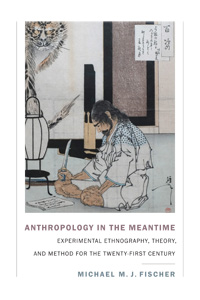
MeantimeAnthropology in the Meantime is a collection of essays by Michael Fischer that have been previously published in scholarly journals, edited volumes, or art catalogues. They have been substantially revised and rewritten for this edition in a book series, Experimental Futures, that the author curates at Duke University Press. Indeed, “curating” is the right word for describing Michael Fischer’s work: he fancies himself as an art specialist, using books as his personal gallery, and conceives of anthropology as akin to art critique or even as artistic performance, as evidenced by his circumlocutory writing style and his conception of fieldwork. In the art world, the title of “curator” identifies a person who selects and often interprets different works of art. In contemporary art, curators can make or break an artist’s career by their choice of works to display and of words to accompany them. In some cases, their celebrity can even eclipse that of the artists they work with. By donning the mantle of the art curator, the anthropologist attempts to weigh on what counts as (to quote the book’s subtitle) “ethnography, theory, and method for the twenty-first century.” Michael Fischer presents the work of his students and close associates, pays tribute to some of the big names in the discipline that he was privileged to work with, and recounts his own random walk through the past fifty years of anthropological research. Throughout this volume, he emphasizes the commonalities between anthropology and art. He claims in the introductory chapter that “ethnographers as literary forms are like novels, except they have to stick to reality”; “like anthropologists, artists have feet in several worlds” and the work of art “is often itself an ethnographic register of contemporary matters of concern.” Many readers will have first noticed Anthropology in the Meantime by its book cover, a striking Japanese woodblock print which represents a samurai about to commit seppuku. There is no connection between this artwork and the book content (nobody is going to commit suicide here, and references to Japan are sparse), except from the fact that this ukiyo-e comes from the personal collection of the author. Several other artistic belongings of the author are reproduced or referred to in the volume; and Michael Fischer claims that he chose the artwork cover of a recent bestseller in the same book series, Donna Haraway’s Staying with the Trouble, from a solo exhibition by Filipino artist Geraldine Javier, whose Chthulu-like creature was not inconsequential in the success of Haraway’s book.

Twice present at the creation

The curator or the art critic often claim for themselves a special relation with regard to art history. They were present at critical junctures, rubbed shoulders with time-defining artists before they became famous, and contributed to the build-up of their fame or the make-up of their value through critical interventions. They were the first to put names and labels on emerging trends and styles, thereby contributing to the creation of the various schools and artistic currents that are later remembered and celebrated in art history. Michael Fischer inserts in his chapters some biographical vignettes or snippets that attest his special position in anthropology’s recent history. He was twice present at the creation: he attended as an undergraduate the famous John Hopkins University’s conference in 1966 during which the word ‘poststructuralism’ was coined, and he was one of the contributing authors of the 1986 volume Writing Culture. This seminal book grew out of a week-long seminar at the School for American Research at Santa Fe, and in a fun piece Michael Fischer retranscripts the imaginary interventions of the book contributors, designated simply by their initials but early recognizable. But these were not the only times when Michael Fischer stood among giants and witnessed major turning points in the discipline. He wrote his PhD at the University of Chicago when Hannah Arendt and Clifford Geertz were on the faculty and Paul Rabinow was a fellow graduate student, and then moved to Harvard during the controversy over sociobiology and recombinant DNA. He was then recruited by George Marcus (the editor of Writing Culture) to join the Anthropology Department at Rice University, where he chaired the Rice Center for Cultural Study that became a hotbed for cross-disciplinary studies. An important turning point in his career, and for the discipline as a whole, coincided with his move to MIT, where he became Director of the Program in Science, Technology and Society. STS became the new frontier in anthropology and Michael Fischer was in the thick of it, teaching with Arthur Kleinman at the Harvard Medical School and becoming the coeditor of the book series Experimental Futures at Duke University Press. At the time this book was assembled, Michael Fischer was sharing his time between MIT and the National University of Singapore, where he was invited as Visiting Research Professor by some of his former students.

Like currency, the monetary value of art is based on convention: price is determined by an artist’s exhibition and sales record, importance and standing in art history, and ability to seize a certain Zeitgeist. Michael Fischer participates in the construction of disciplinary value in anthropology. He highlights the relevance of his book series by referring to previously published volumes and providing short summaries of their content. He advances the careers of his graduate students by emphasizing their contribution to anthropological knowledge. He caters to his own interest and reputation by detailing his own career path, which made him cross the way of, and rub shoulders with, giants in the field of academia. He uses the homage and the laudatory essay addressed to former colleagues and professors to praise and to aggrandize, but also to sideline and to bury, sometimes even to mock and to revile. He defines what’s hot and what’s not in modern anthropology, which happens to be the area in which he put his most recent investments. Constantly on the lookout for emerging trends and new currents, he uses the three C’s performed by art critics: commentary, criticism, critique. An artist’s inclusion in an important gallery and museum show can boost price and reputation: the same is true for edited volumes, which have a higher reputational impact than articles published in refereed journals (although the selection process is sometimes less rigorous and based on personal connections.) Michael Fischer is forever graced with the privilege of having written an essay for the 1986 book Writing Culture. He revels in that memory, bathes in the glow produced by this epoch-making volume, and keeps the fire alive by participating in anniversary essays and commemorations. He tries to recoup his erstwhile performance by proposing entries in edited volumes that hold the potential to redefine the parameters of the discipline:  such is, in my opinion, the book The Ground Between: Anthropologists Engage Philosophy, which was published in 2014 by the same Duke University Press and which I reviewed here. Needless to say, Michael Fischer’s contribution didn’t appear to me as the most memorable chapter in this volume.

Experimental ethnography

There were days when anthropologists were experimenting with various forms of writing and expressing while breaking scholarly traditions of orderly debates and publications. Fischer is proud to belong to that cohort of experimental authors who attempted to rewrite culture, and he himself experimented with various forms of writing tactics and media interventions. In a chapter titled “Experimental ethnography in ink, light, sound, and performance”, he lists the various attempts at creative ethnography-making that have characterized the recent decades, including filmmaking, photography, sound recording, fiction writing, theater and performance, and digital media. Research methods and what counts as fieldwork have also changed tremendously over the course of Fischer’s career. Today’s ethnographies are often multilocale and multiscale, moving from ground to theory and from micro to macro to address global processes of distributed value chains or flexible citizenship. They explore written archives and textual evidence, not just dialogic face-to-face contexts of human interaction. They also cater to nonhuman species and other nonhuman actors, living or artifacts, in a general theory that grants political agency and constitutive power to things. According to Fischer, the most exciting modern ethnographies address “the peopling of technologies”, the grounding of theory (“ground-truthing”) and the humanizing of science through digital humanities and science and technology studies. His career illustrates the shift in the focus of the discipline from a literary approach of cultural matters (“writing culture”) to a more recent involvement with scientific and technological assemblages. But he remained true to his former creed of avant-garde experimentalism: he sees himself and his cohort of graduate students as being at the cutting-edge of the discipline, and is forever willing to experiment and to innovate. He is also anxious not to miss the next new thing or not to mistake a passing fad or a false lead with an epistemological breakthrough. Remembering the seminal symposium at John Hopkins where Derrida, Barthes and Lacan had discussed structuralism, he casts Bruno Latour, Viveiro de Castro and Philippe Descola in the role of these old French luminaries and dedicates one chapter to “the so-called ontological turn”, which “became a hot topic at the American Anthropological Association meeting in 2013” (he concludes these discussions were just “fables and language games”).

After the turn of anthropology toward science and technology that he helped bring forward from his perch at MIT, Michael Fischer detects another shift, evidenced both in his career and in the broader discipline: the turn toward Asia. He notes that his own fieldwork and ethnographic work “has slowly shifted eastward from once upon a time in Jamaica to Iran, India, and now Southeast Asia.” He claims he was present at critical junctures in the history of these countries: he was doing fieldwork in Iran shortly before the Islamic revolution, and he was in India the year Indira Gandhi was assassinated and the Bhopal disaster took place. Unlike Clifford Geertz, who was accused of political blindness in the face of the 1965 massacres that tore Indonesia apart, Fischer claims he saw it coming, and that he was in a special position to interpret events as they unfolded. He underscores that “much of the future imaginary is located in Asia,” from current disasters such as avian influenza and other pandemics to intensifying threats of extreme climatic events and rising sea levels, not to mention industrial catastrophes such as Bhopal and Fukushima or geopolitical faultiness that are bringing the region to the brink of nuclear war. In the art world too, Asia is the place where things are happening. Art follows the money: there is an economic law enunciating that financial marketplaces, and these places only, can become global hubs for contemporary art. Fischer’s vocation as an art critic seems to have arisen from his contacts with Asian artists and performers. What began as a habit of illustrating powerpoint presentations with artworks (his contribution to a Clifford Geertz’s festschrift had illustrations “from cockfight to buzkashi”) evolved into a form of art criticism that he describes as “anthropological readings of novels, paintings, and films.” Fischer wrote a book on Iranian cinema at the time when a new generation of filmmakers (Abbas Kiarostami, Mohsen Makhmalbaf, Jafar Panahi…) started to emerge from that country, and he provided entries into exhibition catalogues of Asian artists during his residence in Singapore. He claims that literature, films, and arts can provide ethnographic registers: “My own sense is that there is more to be learned here about playing the scales of culture than from flat-footed talk of global assemblages, neoliberalisms, hybridities, and the like.”

Humanity’s futures

Beyond the name-dropping and memorabilia, art curators must also be able to read through the fog of information and images in order to form an appropriate picture of the times in which we are living. In order to define what is contemporary art and what isn’t, critics must first understand what “the contemporary” is. For Michael Fischer, writing around 2017, we live in a time warp akin to 1633, the year Galileo was condemned by the Roman Inquisition for affirming that the earth wasn’t at the center of the solar system, a theory first advanced by Copernicus. According to Freud, humanity’s narcissism received three blows in the course of modern history, associated with the names of Copernicus (the earth is not at the center of the universe), Darwin (man descents from the animal), and himself (the ego is not even master in his own house). We are witnessing the times in which the fourth blow is delivered, bearing the name of the Anthropocene: considering the rate of natural resources depletion and the alteration of earth system processes, we may not inhabit this planet for long. This realization may have triggered Fischer’s latest interest, at the crossroad between his previous involvements with science and technology studies and with literature criticism: reading Sci-Fi novels from Asian authors. As he notes, “science fiction stories from Asia merge in and out of our contemporary dreaming, nightmares, and experiential emotions, along with current industrial and nuclear age disasters and toxicities.” Asian sci-fi novels often stage an exit from humanity: when humans start to colonize space or learn to live underwater to escape a toxic earthly environment, they cease to be humans. Fischer sees that evolution underway: Singapore is testing and prototyping buildings from the seabed upward to expand its living spaces, while China is studying the genetic mutations that allow Tibetans to live at high altitudes, supposedly to prepare to a world with much higher sea levels in which lowlanders would migrate to the deserted highlands of Xinjiang and Tibet. Humanity would thus escape the problems of the Anthropocene by returning life to the oceans from which it came, or by colonizing the regions that were once deemed inhospitable to life. Meanwhile, the Pacific island nations where Bronislaw Malinowski, Margaret Mead, and other founders of anthropology first did their fieldwork would have long disappeared from the surface of the earth.

Fischer’s conception of anthropology is attuned to the future (remember the title of his book series, Experimental Futures), not to the past. Echoing Immanuel Kant, he defines the task of anthropology from a pragmatic point of view as: “Ask not what the human being or the world is but what we may expect of them—and of them in the plural.” Anthropology in the Meantime is the study of the emergent forms of life coming “out of the chrysalis of the twentieth century”: it is “the ethnography of how the pieces of the world interact, fit together or clash, generating complex unforeseen consequences, reinforcing cultural resonances, and causing social ruptures.” His interest in the arts also covers only the contemporary and the cutting edge, not the classical forms or the artworks bequeathed by history. But through the ethnographies of the world’s pieces, we fail to see the big picture, and our vision of the locale seems to disintegrate into the shattered surfaces of a kaleidoscope. Fischer claims to have done fieldwork in Asia over the last decade “from a perch in Singapore with forays elsewhere.” But the only empirical material he offers are accounts of his visits to art centers or “small ethnographic notes” taken from the classroom at Tembusu college (where Singapore students are “holding textbooks open with one hand, and with the other checking their teacher’s archived video lectures on their smartphones”). He only offers vignettes or personal anecdotes by way of firsthand observations. The rest is composed of lengthy discussions of other people’s ethnographies or references to his previous fieldworks in various terrains. He lists his own past publications as if they addressed empirical issues thoroughly and offered “concept-work” that allowed the “ground-truthing” of his current forays. But a quick look at some of his articles listed in the bibliography shows that the empirical content of his field-based ethnographies were always rather thin, and that the concepts he lists profusely at the beginning of each chapter or in the body of the text are never defined or clarified. While I first thought he made his career out of previously accumulated capital, making good use of previous fieldwork observations and theory building, I get the impression that his references are just that: self-references. His “zen exercises in theory making” might be evocative or even illuminating for some, but they didn’t led me to enlightenment. In this respect, reading Akashi Gidayu’s death poem on the book cover (“As I am about to enter the ranks of those who disobey/ ever more brightly shines/ the moon of the summer night”) was more fulfilling.

Wanted: proof-reader with a command of French and Japanese

As a last remark, I couldn’t get used to Michael Fischer’s writing style. He retained from his entry into the volume Writing Culture (“a trio of essays on ethnicity, torn religions, and science articulated through monologic, double-voiced, and triangulated autobiographic genre perspectives”) a peculiar and idiosyncratic rhetoric, with turgid and verbose expressions that require close attention but yield little intellectual payoff. He was right to note that Clifford Geertz, his former mentor at Chicago, was “one of the great stylists writing in anthropology, and [that he] achieved global recognition by way of it.” The same certainly cannot be said of Michael Fischer. He borrows from literary criticism the mania to split words with hyphens to point toward etymology and emphasize multiple meanings: ‘con-fusion’, ‘con-texts’. He also repeats the curious habit (or is it a typographical error?) of separating hyphenated expressions or compound words into two distinct words: ‘front line’, ‘key words’, ’policy making’, ‘science fiction’. I didn’t detect many typos or misspelled words in English due to the power of modern editing softwares; but spellcheckers do not detect errors in foreign languages, which are numerous in the two chapters that were specifically drafted for this volume. In the introductory chapter, Fischer states (and repeats twice, no doubt to emphasize his German language skills) that “nothing is worse than a period film about Vienna where the actors speak with Berlin or Hannover accents and idioms—hard to take it seriously.” But what is one to say about his repeated misspelling of French words or distorting of Japanese expressions—like his breaches of proper writing style, I tend to take it personally. In the prologue, l’homme total is feminized as l’homme totale, hara-kiri becomes hari-kari, and a parergon is misspelled as paregon. In the epilogue, which includes discussions on art and ethnographies originating from Japan, manga becomes magna, furusato is mistyped as furusatu, hikikomori are rendered as hikkihomori, and proper nouns like Ishiguro or Bakabon become Ishiguru and bakagon. These are errors that simple proof-reading would have detected; their presence in an ethnography or a scholarly book makes it hard to take it seriously.