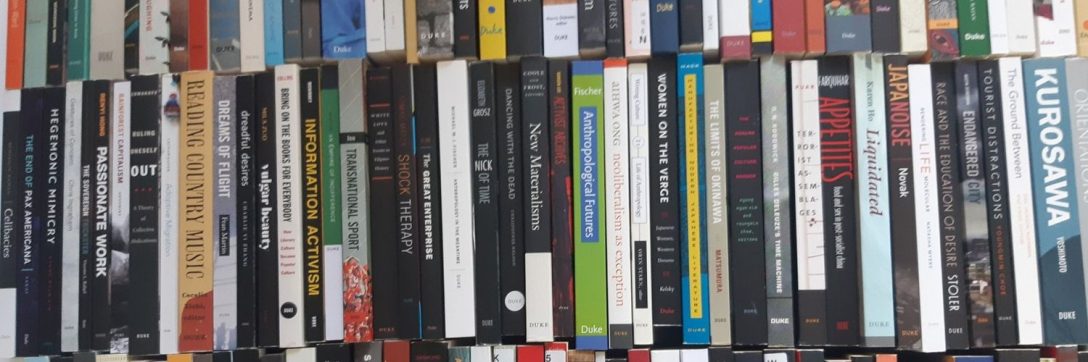

From Slumdog to Millionaire

A review of Producing Bollywood: Inside the Contemporary Hindi Film Industry, Tejaswini Ganti, Duke University Press, 2012.
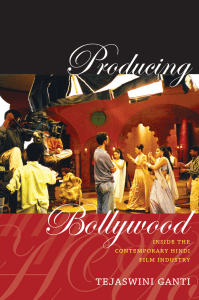
Imagine you are a foreign graduate student doing fieldwork in Hollywood and that you get to sit in a two-hour long interview with a major film star like Brad Pitt or Johnny Depp. This is precisely what happened to Tejaswini Ganti in the course of her graduate studies at the University of Pennsylvania when she was researching the local film industry in Mumbai, now better known as Bollywood. And it happened not only once: she sat in interviews with legendary actors such as Shah Rukh Khan, Aamir Khan, Shashi Kapoor, Sanjay Dutt, Amrish Puri, actress Ayesha Jhulka, as well as top producers and directors Aditya Chopra, Rakesh Roshan, and Subhash Ghai. What made this access possible? Why was a twenty-something PhD student in anthropology from New York able to meet some of the biggest celebrities in India? And what does it reveal about Bollywood? Obviously, this is not the kind of access a graduate student normally gets. Privileged access is usually granted to journalists, media critics, fellow producers, and other insiders. They observe the film industry for a reason: they are part of the larger media system, and they play a critical role in informing the public, evaluating new releases, building the legend of movie stars, and contributing to box-office success. As an anthropologist, Tejaswini Ganti’s approach to the Hindi film industry is different. As she states in her introduction, “my central focus is on the social world of Hindi filmmakers, their filmmaking practices, and their ideologies of production.” Her book explores “how filmmakers’ subjectivities, social relations, and world-views are constituted and mediated by their experiences of filmmaking.” As such, she produces little value for the marketization of Bollywood movies: her book may be read only by film students and fellow academics, and is not geared towards the general public. As befits a PhD dissertation, her prose is heavy with theoretical references. She draws on Pierre Bourdieu’s analysis of symbolic capital and his arguments about class, taste, and the practice of distinction. She uses Erving Goffman’s concept of face-work to describe the quest for respectability and avoidance of stigma in a social world associated with black money, shady operators, and tainted women. She steeps herself in industry statistics of production budgets, commercial outcomes, annual results, and box-office receipts, only to note that these figures are heavily biased and do not give an accurate picture of the movie industry in Mumbai.

Getting access

Part of Tejaswini Ganti’s success in getting access to the A-list of the Hindi film industry stems from her position of extraneity. As an “upper middle-class diasporic South Asian female academic from New York,” she didn’t benefit from “the privilege of white skin”—white European or American visitors could get access to the studios or film shoots in a way that no ethnic Indian outsider could—but she was obviously coming from outside and was not involved in power games or media strategies. For her initial contacts, she used the snowballing technique: personal friends in Philadelphia who had ties with the industry in Mumbai provided initial recommendations and helped her make her way through the personal networks and kinship relations that determine entry and access at every stage. Two different directors offered her the chance to join the team of directors assistants for two films, fulfilling the need for participant observation that remains a sine qua non in anthropology studies. People were genuinely puzzled by her academic interest in such a mundane topic (“You mean you can get a PhD in this in America?”) and eager to grant an interview to an outsider who had no stake in the game. Being a woman also helped: she “piqued curiosity and interest, often standing out as being one of the few—and sometimes only—women on a film act.” As she notes, she “did not seem to fit in any of the expected roles for women—actress, dancer, journalist, hair dresser, costume designer, or choreographer—visible at various production sites.” Contrary to common understanding about the gendered dimension of fieldwork, she actually had a harder time meeting women, specifically the actresses. She also experienced her share of sexual harassment, but as a young married woman with a strong will and a sharp wit she was able to handle unwelcome advances and derogatory remarks. Last but not least, dedicating an academic study to Bollywood provided a certain cachet and prestige to an industry that was desperately in need of social recognition. Actors and filmmakers strived not only for commercial success, but also for critical acclaim and cultural appraisal. A high-brow academic study by an American scholar gave respectability to the Hindi film industry “which for decades had been the object of much disparagement, derisive humor, and disdain.”

She also came at a critical juncture in the history of the Hindi film industry. She carried out her fieldwork for twelve months in 1996 and completed her dissertation in 2000, a period associated with the neoliberal turn in India’s political economy. She made shorter follow-up visits in 2005 and 2006, and her book was published by Duke University Press in 2012, at a time when neoliberalism was in full swing and the nationalist right was ascending. The Hindi film industry’s metamorphosis into Bollywood would not have been possible without the rise of neoliberal economic ideals in India. Along with the rest of the economy, the movie industry experienced a shift from public to private, from production to distribution, from domestic audiences to global markets, and from entertainment for the masses to gentrified leisure. The role of the state changed accordingly. At the time of independence, most leaders viewed the cinema as “low” and “vulgar” entertainment, popular with the uneducated “masses.” Gandhi declared many times that he had never seen a single film, comparing cinema with other “vices” such as satta (betting), gambling, and horseracing. Unlike Gandhi, Nehru was not averse to the cinema, but was critical of the kind of films being made at the time. He exhorted filmmakers to make “socially relevant” films to “uplift” the masses an to use cinema as a modernization tool in line with the developmentalist objectives of the state. He created a cultural bureaucracy to maximize the educational potential of movies, with institutions such as Doordarshan, the public service broadcaster, and the Films Division, the state-funded documentary film producer. Prohibitive policies such as censorship and taxation as well as bans on theater construction limited the development of commercial cinema, even though India soon became the most prolific film producing country in the world. How to explain the shift in attitudes toward mainstream cinema, from being a heavily criticized and maligned form of media to one which the state actually celebrated, touting as an example of India’s success in the international arena? There was, first, a rediscovery of cinema as national heritage, starting with the public celebrations of the cinema centenary in 1996. Cinema was also rehabilitated as an economic venture: large corporations such as the Birla Group, Tata Group, Sahara, Reliance, and others began to invest in the sector, displacing the shady operators that had associated Indian cinema with organized crime and money laundering. Multiplex construction replaced the old movie houses that had catered to the tastes and low budgets of the rural masses. Local authority started to offer tax breaks for films shot in their territory, while government agencies began to promote the export of Indian films to foreign markets. Formerly seen as a tool for social change, cinema was now envisaged as an engine of economic growth.

The gentrification of cinema

The result of this neoliberal turn was a gentrification of cinema. This transformation was reflected in the attitudes towards cinema, the ideology of industry players, the economic structure of the sector, and the content of movies themselves. One of the facts that surprised the author the she began her fieldwork in 1996 was the frequent criticism voiced by Hindi filmmakers concerning the industry’s work culture, production practices, and quality of filmmaking, as well as the disdain with which they viewed audiences. In discussions with filmmakers, the 1980s emerged as a particularly dreadful period of filmmaking, in contrast with both earlier and later periods of Hindi cinema. The arrival of VCR recorders and the advent of cable TV was hollowing out the market for theater moviegoing from both ends, resulting in a decline in cinematic quality. The upper classes completely skipped domestic cinema, the middle class increasingly turned to television and video recording, and working class audiences had access to video parlors where a simple hall with a television and a VCR replaced large-screen theaters. Filmmakers had no choice but to cater to the base instincts of the public, resulting in trashy movies with clichéd plots and dialogues, excessive violence, explicit sex, and vulgar choreography. The young ethnographer saw a marked evolution in her return visits to the field after 2000: while the Indian state recognized filmmaking as a legitimate cultural activity, filmmakers themselves began to feel pride in their work and became accepted into social and cultural elites. For Tejaswini Ganti, respectability and cultural legitimacy for commercial filmmaking only became possible when the developmentalist state was reconfigured into a neoliberal one, privileging doctrines of free markets, free trade, and consumerism. Urban middle classes were celebrated in state and media discourse as the main agents of social change as well as markers of modernity and development in India. A few blockbusters created a box-office bonanza and ushered in a new era for Bollywood movies. Released in 1995, Dilwale Dulhania Le Jayenge, better known by the initialism DDLJ, featured two young lovers (played by Shah Rukh Khan and Kajol) born and raised in Britain who elope in beautiful sceneries shot in Switzerland before facing the conflicting interests of their families in India. Love stories with extremely wealthy and often transnational characters began to replace former plots that often focused on class conflict, social injustice, and youthful rebellion. As the author notes, “through their valorization of patriarchy, the Hindu joint family, filial duty, feminine sexual modesty, and upper class privilege, the family films of the mid- to late 1990s were much more conservative than films from earlier eras; however, their visual, narrative, and performative style made them appear modern and ‘cool’.”

More than the content of films themselves, the material conditions of film-viewing and filmmaking were quoted as the main impetus for elite and middle-class audiences to return to cinema halls. The 1990s saw the advent of the era of the multiplex: with their smaller seating capacities, location in urban centers, and much higher ticket prices, multiplex theaters transformed the cinematic experience and allowed filmmakers to produce movies that would not have been commercially viable in the previous system. “What the multiplex has done today is release the producer from having to cater to the lowest common denominator,” says veteran actress Shabana Azmi. Indian middle-class norms of respectability and morality were embraced by the cinematic profession who sought to redeem its image formerly associated with organized crime, loose morals, and vulgar audiences. Girls from “good families” began to enter the industry as actresses, dancers, or assistants, their chastity protected by chaperones and new norms of decency on film sets: “while actresses frequently had to wear sexy, revealing clothing in certain sequences, once they were off camera their body language changed, going to great pains to cover themselves and create a zone of modesty and privacy in the very male and very public space of the set.” Male actors and directors also “performed respectability” and accomplished “face-work” by emphasizing their higher education credentials and middle-class lifestyle that cast them apart from “filmi” behavior—with the Indian English term filmi implying ostentation, flamboyance, crudeness, and amorality. Many individuals whose parents were filmmakers explained to the author that their parents had consciously kept them away from the film world. But many actors and directors were second-generation professionals who entered the industry through family connections and kinship networks. In Bollywood, cinema remains a family business, and while the Hindi film industry is very diverse in terms of linguistic, regional, religious, and caste origins of its members, the unifying characteristic of the contemporary industry is its quasi-dynastic structure. Getting a foothold into the profession requires connections, patience, and, at least in the stereotypical view associated with female actresses, a reliance on the “casting couch.”

An ethnography of Bollywood

This is why the kind of unmediated access, direct observation, and participatory experience that Tejaswini Ganti was able to accumulate makes Producing Bollywood a truly exceptional piece of scholarship. The author provides a “thick description” of an average day on an Hindi film set, rendering conversations, power relations, and social hierarchies. She emphasizes the prevalence of face-to-face relations, the significance of kinship as a source of talent, and the highly oral style of working. She depicts the presence of Hindi rituals, which have become incorporated into production routines, as well as the tremendous diversity—regional, linguistic, and religious—of members of the film industry. The movie industry is often analyzed through the lenses of Hollywood norms and practices: her ethnography of Bollywood aims at dislodging Hollywood from its default position by describing a different work culture based on improvisation, on-the-job training, and oral contracts. Films, deals, and commitments are made on the basis of face-to-face communication and discussion between key players, rather than via professional mediators or written materials. Actors, directors, writers, or musicians do not have any formal gatekeepers or agents as proxies for attaining work. If a producers wants a particular star for a film, he speaks directly with him. Heroines are usually chosen after the male star, director, and music director have been finalized for a film project, and are frequently regarded as interchangeable. Spending time on a Hindi film set, it is hard to miss the stark contrast between stars and everyone else around them, especially the way stars are accorded a great deal more basic comfort than the rest of the cast and crew. Chorus dancers and extras—referred to as “junior artists”—often do not have access to makeup rooms or even bathrooms. At any given point in time, only about five or six actors are deemed top stars by the industry, based on their box-office draw and performance. This makes the kind of access that the junior ethnographer enjoyed all the more exceptional.

Cinema is a risky business, and managing the uncertainty endemic to the filmmaking process is a key part of how the movie industry operates. Hindi filmmakers aim to reduce the risks and uncertainties involved with filmmaking in a variety of ways, from the most apparently superstitious practices—from conducting a ritual prayer to Ganesh, the elephant-headed Hindu god regarded as the remover of obstacles, to breaking a coconut to celebrate the first shoot of the day—to more perceptible forms of risk reduction, such as always working with the same team of people or remaking commercially successful films from the Tamil, Telugu, and Malayalam film industries. Although the driving force within the Mumbai industry is box-office success, it is a difficult goal, achieved by few and pursued by many. The reported probability of a Hindi film achieving success at the box-office ranges from 10 to 15 percent every year. The entry of the Indian corporate sector in the twenty-first century has infused the industry with much-needed capital and management skills. Many of the new companies have integrated production and distribution, which reduces uncertainties around the latter. Measures such as film insurance, coproductions, product placement, and marketing partnerships with high-profile consumer brands have also mitigated some of the financial uncertainties of filmmaking. The gentrification of cinema and the growth of multiplexes have helped to reduce the perception of uncertainty associated with filmmaking by reducing the reliance on mass audiences and single-screen cinemas. With their high ticket prices, social exclusivity, and material comforts, multiplexes have significantly transformed the economics of filmmaking. So has the growing importance of international audiences, with the South Asian diaspora providing one of the most profitable markets for Bollywood filmmakers. Diasporic audiences, especially in North America and the United Kingdom, are perceived as more predictable than domestic audiences. Not only has the multiplex and the gentrification of cinema created new modes of sociability and reordered public space, but it has also reshaped filmmakers’ audience imaginaries. Filmmakers still strive to produce the “universal hit,” a movie that can please “both aunties and servants,” but at the same time they complain that audiences are not “mature” enough to accept more risqué stories or artistically ambitious productions. This definition of the public as divided between “the masses and the classes” operates as a form of doxa—that which is completely naturalized and taken for granted—within the film industry.

The role of the state

The Hindi film industry offers a living proof example that competing against Hollywood’s dominance does not require huge barriers on imported films nor the provision of massive subsidies to domestic movies. In the movie industry as in other sectors, the role of the government is to set the broad economic environment promoting a sound and stable legal regime that is required by film companies. On this basis, film companies develop their business strategies, in particular they take the high risks inherent with this industry. A healthy domestic market requires that films from all origins compete on a level playing field to attract the largest number of domestic moviegoers. But very often the intervention of governments in the film industry goes beyond the provision of a level playing field. Public support such as subsidies, import restrictions, screen quotas, tax relief schemes, and specialized financial funds holds a preeminent place in the film policies of many countries. A generous film subsidy policy or certain import quotas can inflate the number of domestic films produced; but they rarely nurture a sustainable industry and often translate into a decline in film quality and viewers’ experience. In India, the government took the opposite direction to regulating the sector. Instead of subsidizing the industry, economic policies have treated cinema as a source of tax revenue rather than as an engine of growth. The main bulk of taxation is collected by individual state governments through the entertainment tax, which is a sales tax imposed on box-office receipts, ranging from 20 to 75 percent. India’s cinema industry has faced other regulatory hurdles, such as restrictions on screen construction that have hindered the expansion of cinemas, especially in smaller towns and cities. Even after being accorded official status as a private industry in 2001, moviemakers had tremendous difficulty in obtaining institutionalized funding, except for those already established companies that don’t need the capital and that can capitalize on lower bank interest rates compared to private financiers. The influx of capital from established financial institutions and business groups also brought in much needed management skills and planning capabilities. As a result, Bollywood has outperformed most of its competitors across a range of key dimensions (number of films produced, box office revenues, etc.) with much lower level of subsidies than the other countries and—above all from a cultural perspective—with an increase in quality and popular appeal of movies when compared to an earlier period or to foreign productions. Put that to the credit of neoliberalism.
A Flash in Japan

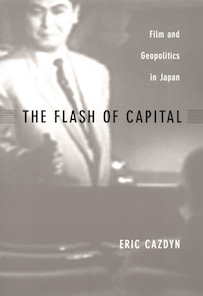
A review of The Flash of Capital: Film and Geopolitics in Japan, Eric Cazdyn, Duke University Press, 2002.

The Flash of CapitalThe “flash of capital” refers to the way the underlying structure of a national economy “flashes” or reverberates through the films it produces, and how cinema critique can highlight the relations between culture and capitalism, film aesthetics and geopolitics, movie commentary and political discourse, at particular moments of their transformation. A flash is not a reflection or an image, and Eric Cazdyn does not subscribe to the reflection theory of classical Marxism that sees cultural productions as a mirror image of the underlying economic infrastructure. Karl Marx posited that the superstructure, which includes the state apparatus, forms of social consciousness, and dominant ideologies, is determined “in the last instance” by the “base” or substructure, which relates to the mode of production that evolves from feudalism to capitalism and then to communism. Transformations of the mode of production lead to changes in the superstructure. Hungarian philosopher and literary critic György Lukács applied this framework to all kinds of cultural productions, claiming that a true work of art must reflect the underlying patterns of economic contradictions in the society. Rather than Marx’s and Lukács’ reflection theory, Cazdyn’s “flash theory” is inspired by post-marxist cultural theorists Walter Benjamin and Fredric Jameson, and by the work of Japan scholars Masao Miyoshi and Harry Harootunian (the two editors of the collection at Duke University Press in which the book was published). For Cazdyn, how we produce meaning and how we produce wealth are closely interrelated. Cultural productions such as films give access to the unconscious of a society: “What is unrepresentable in everyday discourse is flashed on the level of the aesthetic.” Films not only reflect and explain underlying contradictions but, more importantly, actively participate in the construction of economic and geopolitical transformations.
 Reflection theory and flash theory

 The Flash of Capital concentrates on those critical moments of Japanese modern history during which the forms of both cinematic and capitalist categories mutate. The author identifies three such mutations of Japanese modernity: (1) between being colonized and being a colonizer nation of the pre-World War II moment; between the individual and collective of the postwar moment; and between the national and the transnational of the contemporary situation. Colonialism, Cold War, globalization: these are the three moments that Cazdyn addresses through thematic discussions of cinematic visuality, of film historiography, of literary adaptations, of amateur acting, of pornography, and of aesthetic experiments. Rather than a linear history, he prefers to concentrate on key moments of transformation during which formal inventions on the level of the film aesthetic figure a way out of impossible situations before a grammar becomes available to make sense of them. By paying close attention to the details of cinematic texts, he reads the works of Japanese directors and film critics as so many symptoms of the most pressing social problems of the day. Cazdyn borrows from Fredric Jameson and other literary critics the technique of symptomatic reading, a mode of reading literary and cinematic works which focuses on the text’s underlying presuppositions. A symptomatic reading is concerned with understanding how a text comes to mean what it does as opposed to simply describing what it means or represents. In particular, it tries to determine what a particular text is unable to say or represses because of its ideological conviction, but that transpires at the formal level through flashes, allegories, and aesthetic choices. The films that Cazdyn passes under review occur at historical junctures in which the social and political events are difficult to articulate. There does not seem to be an effective language with which to express the transformations taking place at key moments of Japanese modernity. But, as Cazdyn notes, “some filmmakers take more risks than others. They risk speaking in a language for which there is no established grammar.”

 Japanese cinema has a peculiar affinity with the history of capitalist development. The movie industry is literally coeval with Japanese modernity: in the case of Japan, the history of film and the history of the modern nation share approximately the same span of time, both emerging in the 1890s. In addition, the one-hundred-year anniversary of film in Japan coincided with the fifty-year anniversary of the end of World War II. It comes as no surprise, therefore, that almost every history of Japanese film has used the history of the nation to chart its course. The three moments that The Flash of Capital choses to concentrate on are key turning points in Japanese modern history. They are also periods when Japanese cinema was particularly productive, with successive “Golden Ages” that have marked the history of Japanese cinema for a worldwide audience. The 1930s, the postwar period up to the late 1960s, and the 1990s were times fraught with contradictions. The antinomies and tensions between colonization and empire, between the individual and the collective, and between the national and the transnational made an imprint of the films produced during these periods, both at the level of content and in the formal dimension of aesthetic choices and scenic display. It is interesting to note that these moments have also produced canonic histories of Japanese cinema, both in print and through cinematic retrospectives. Cazdyn conducts a formal analysis of six histories of Japanese films, two of which are themselves films. The first historiographic works in the 1930s and early 1940s set the terms for a theory of cinema that was heavily influenced by Marxism and by nationalism; the 1950s saw the publication of Tanaka Jun’ichirō’s monumental encyclopedia of Japanese movies and Donald Richie and Joseph Anderson’s The Japanese Film; and the 1990s was marked by the one-hundred anniversary of Japanese cinema, with yet another four-volume encyclopedia and a film retrospective by Oshima Nagisa. Among scholars and students in the West, Richie and Anderson’s book has been a constant reference and has gone through a series of republications; it is, however, distinctly anticommunist and heavily marked by the Cold War context.

Colonialism, Cold War, globalization

 Cazdyn begins his discussion of the first period with an Urtext of Japan’s cinematography: the recording in 1899 of a scene from the kabuki drama Momojigari by the actor Ichikawa Danjūrō (the stage name of a lineage of actors that goes back to the seventeenth century down to the present). Attending a screening held at his private residence, Danjūrō was shocked by his own image staring back at him and made it clear that the film should never be screened during his lifetime. But he later agreed that a presentation of the movie reels at an event in Osaka he was unable to attend was more satisfactory than a performance by another kabuki troupe. This episode set the terms—repetition, reproductibility, ubiquity, copy rights, distribution networks, mass production—by which the movie industry later operated. By the 1930s, cinema had become well entrenched in Japan. The early figures of the onnagata (men playing women’s roles) and the benshi (commentator integrated into the story), taken from similar roles in the traditional performing arts (kabuki, noh, bunraku), had given way to the modern talkie movie, a star system based on female actors, and genres divided between jidai-geki (period dramas) and gendai-geki (modern dramas). Film adaptations (eiga-ka) of literary works of fiction (shōsetsu) served to gain legitimacy for cinema as an art form, circumvent censorship, consolidate a literary cannon, and affirm the superiority of the original through fidelity-based adaptations. The writer Tanizaki Jun’ichirō, who had offered his own theory of adaptation through his successive translations into modern Japanese of the Tale of Genji, criticized the filmization of his novel Shunkinshō by pointing out the erasing of multiple levels of narration and identity that was so central to his work. When Tanizaki’s novel is reduced to mere narrative content, “all that remains are the most reactionary and conservative elements.” For the author, Tanizaki’s aesthetic choices, and the films produced by the first generation of Japanese directors, were inextricably related to the most crucial issues facing the Japanese nation in the 1930s: the rise of militarism and the backsliding of democracy, the colonization of large swathes of Asia, the rejection of Western values in favor of Japanese mores. Remaining silent about these issues, like Tanizaki in his novels or Ozu Yasujirō in his early movies, are charges that can be held against the authors.

 The second Golden Age of Japanese cinema, and a high point of Japanese capitalist development, arose from the rubbles of World War II, found its most vivid expressions in the 1950s and early 1960s, and culminated in the avant-garde productions of the late 1960s and early 1970s. Out of this second period emerged not only a studio system modeled on Hollywood, but an impressive number of great auteurs that have become household names in the history of artistic cinema. Ozu’s challenging formal compositions, Kurosawa’s intricate plots, and Imamura’s nonlinear temporalities are immediately recognizable and have influenced generations of movie directors in the West and in Asia. The postwar period, which coincided with the Cold War, was marked by the subjectivity debate or shutaisei ronsō, which influenced popular ideas about nationalism and social change. For the postwar generation of left-leaning intellectuals, a sense of self—of one’s capacity and legitimacy to act as an individual and to intervene against the state and collective opinion—was crucial to keep the nation from ever being hijacked again by totalitarianism. But at the same time, the individual was summoned to put the interests of big corporations, administrative structures, and the Japanese nation as a whole before his or her own personal fulfillment, and to sacrifice the self in favor of economic development. In the context of the movie industry, the attempt to transcend the contradiction between the individual and the collective was resolved by positing a third term: the “genius” filmmaker who breaks out of the rigid structure and trumps the other two terms. The “great man theory” claims that an individual can rise up and produce greatness within—if not transcend—any structure. The same emphasis on the power of the filmmaker characterized film adaptations of literary works in the period. Encouraged by the Art Theater Guild, eiga-ka movies took liberties with the original text either by focusing on a particular section or adding content to the narrative. Shindō Kaneto’s 1973 adaptation of Kokoro, for example, deals only with the third letter of Sōseki’s famous shōsetsu, while in Ichikawa Kon’s Fires on the Plain the soldier-narrator of Ōoka Shōhei’s novel is shot and killed at the end instead of going to a mental hospital.

The withering away of the nation-state

 The era of globalization, the third period in Eric Cazdyn’s survey of movie history, marks a transformation in the operations of the nation-state and in the aesthetics of Japanese cinema. The problem of globalization is the problem of a globalized system in which nations are steadily losing their sovereignty but where state structures and ideological models cling to an outdated form of representation. The political-economic and the cultural-ideological dimensions do not move at the same speed: at the precise moment in which the decision-making power of the nation-state is declining, nationalist ideologies and identities are as strong as ever. Some authors combined a renewed emphasis on the nation with the full embrace of globalization. For Ōshima Nagisa, the enfant terrible of the Japanese New Wave, national cinema is dead, and Japan is being bypassed by the transnational forces of capital. In Merry Christmas, Mr. Lawrence (1983), he represents the Japanese from the viewpoint of the white prisoners of war. In L’Empire des sens (1976), the pornographic nature of the film does not lie in the content (although the actors Matsuda Eiko and Fuji Tatsuya are “really doing it”) but in the form of reception: the Japanese conversation about the film was almost entirely consumed by questions of censorship, while in France, where it was first released, the film was geared towards a general audience—and foreign visitors: Ōshima noted that one out of every four Japanese who traveled to France had seen the movie. For Cazdyn, a film that makes history is “a film that represents a transformation before it has happened, a film that finds a language for something before a language has been assigned, a film that flashes the totality of modern Japanese society in a way that is unavailable to other forms of discourse.” Rather than commenting on blockbuster movies and costly productions, he choses to read political allegories in experimental films such as Tsukamoto Tetsuya’s Tetsuo (1988) or the documentary films of Hara Kazuo such as Yukiyukite shingun (Naked Army, 1987). He even finds inspiration in adult videos, which he sees as a compromise between guerrilla-style documentaries on the left and reality TV on the right. He notes that approximately seventy-five percent of current adult-video films in Japan are documentary-style—that is, their narratives are not couched in fiction, but follow a male character walk the streets looking for sex and engaging women to that end. Similarly, in his documentaries, Hara Kazuo can often be heard asking questions and provoking situations. His films make change happen into the real.

Eric Cazdyn is well-versed in the history of Japanese Marxism and makes it a central tenet of his theorization of Japanese cinema. He refers to the pre-war Marxist debate between the Kōza-ha (the faction that remained loyal to the Japanese Communist Party and the Komintern) and Rōnō-ha (the faction that split from the JCP in 1927 and argued that a bourgeois revolution had been achieved with the Meiji Restoration). Another school of Marxism, the Uno-ha, was the school of the late Tokyo Imperial University economist Uno Kōzō, who was probably the single most influential postwar Japanese economist on the domestic academic scene. Uno drew a distinction between a pure theory of capitalism, a theory of its historical phases, and the study of concrete societies. He concentrated on the first, and dedicated himself to working through the most theoretical problems of Marx’s Capital, such as the labor theory of value, the money circuit represented by the M-C-M’ formula, commodity fetishism, and the recurrence of crises. Moving to the present, Cazdyn pays tribute to Karatani Kōjin, a contemporary philosopher and interpreter of Marx’s thought that has attracted a vast followership. Marxism has had a lasting influence on Japan’s intellectual landscape, and has impacted the work of many filmmakers in the course of the past century. Cazdyn recalls that many intellectuals joined film clubs in the late 1920s and early 1930s because they were some of the only places where members could read Marx’s Capital without falling prey to censorship and repression. But this utopian space was soon discovered, and by 1935 Marxist intellectuals were either behind bars, had retreated to their private space, or had embraced right-wing nationalism. Illustrative of this wave of political commitment is the Proletarian Filmmaker’s League or Prokino. Cold War histories of Japanese cinema have disparaged this left-wing organization by pointing out “the extremely low quality of its products.” Cazdyn rehabilitates the work of its main theorist, Iwasaki Akira, and of film documentarist Kamei Fumio, who treated montage as a “method of philosophical expression.”

New publics for old movies

What is the relevance of these references to Marxist theory and obscure works of documentary or fiction for contemporary students of Japanese cinema in North America and in Europe? Cazdyn highlights the changing demographics of the classes that enroll in his discipline: “Students were primarily attracted to the arts and Eastern religion in the 1960s and 1970s; in the 1980s, they were chasing the overvalued yen; and today, they are consumed by (and consumers of) Japanese popular culture—namely manga and anime.” He also notes that the study of national cinema as an organizing paradigm has lost much of its appeal. The academic focus is now on films that address issues of minorities in Japan—post-colonial narratives, feminist films, LGBT movies, social documentaries—or on transnational productions in which Japanese identity is diluted into a pan-Asian whole. But academics should not project their current global and professional insecurities onto the screen of cinema history. The demise of the nation-state, and the dilution of national cinema into the global, is not a foregone conclusion. Movies produced in Japan today do not seem to appear less Japanese than the ones made one or two generations ago. There is still a strong home bias in the preferences of viewers, who favor locally produced movies over foreign productions. Japanese films that are popular abroad do not necessarily make it big in Japan, and the art movie theaters or international festivals often include films that are completely unknown in their domestic market. The economic and geopolitical context matters for understanding a movie, but not in the sense that Cazdyn implies. The author’s knowledge of the real functioning of an economy is inversely proportional to his investment in Marxist theory. He confesses that his interest does not hinge “on the profits and losses incurred by the film industry in Japan.” But supply and demand, profits and losses, and production and distribution circuits matter for the evolution of cinema over the ages, and a theory that claims to conceptualize the link between films and their socio-economical context must grapple with economic realities, not just outmoded Marxist fictions.

Chinese Movie Stars Are Beautiful and Vulgar

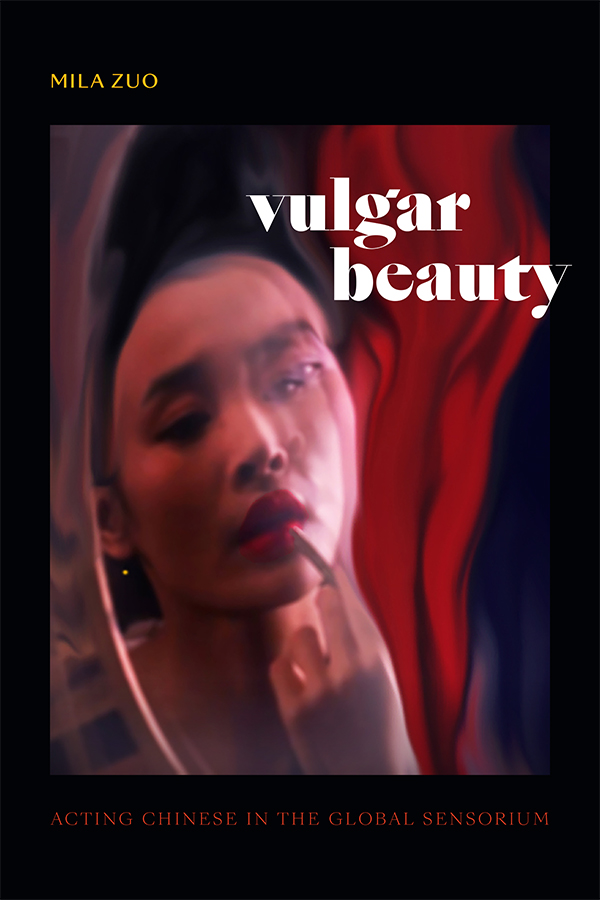
A review of Vulgar Beauty: Acting Chinese in the Global Sensorium, Mila Zuo, Duke University Press, 2022.

Vulgar BeautyEverything has been written about the “male gaze” and the fetishization of Asian bodies on cinema screens. As film studies and feminist scholarship make it clear, white male heterosexuals fantasize about oriental ladies and make the exotic rhyme with the erotic. But Mila Zuo is not interested in white male cinema viewers: her focus is on the close-up faces of Chinese movie stars on the screen, which she finds both beautiful and vulgar in a sense that she elaborates upon in her book Vulgar Beauty. As a film scholar with a knack for philosophy and critical studies, she builds film theory and cinema critique based on her own experience as an Asian American who grew up in the Midwest feeling the only Asian girl in town and who had to rely on movie screens to find kindred faces and spirits. As she recalls, “When on rare occasion I did see an Asian woman’s face on television, a blush of shame and fascination blanketed me.” True to her own experience, she begins each chapter with a short recollection of her personal encounter with Chinese movies or Asian movie stars. The films that she selects in Vulgar Beauty, and the film theory that she develops, are not about them (American white males): they are about us (Chinese-identifying female spectators and actresses) and even about me (as an individual with her own subjectivity and  life history). Her project is to “theorize vulgar Chinese feminity from the purview of a diasporic Chinese/Asian/American woman spectator.” She is “acting Chinese” in her effort to build film theory based on Chinese forms of knowledge and sense-making: the five medicinal flavors (bitter, salty, pungent, sweet, and sour); the practice of face reading or mian xiang; the role of blandness (dan) in the Chinese aesthetic tradition; the materialist cosmogony of traditional Chinese medicine; etc. Her conviction is that Chinese (or Asian American) film studies should not reproduce established patterns of normative knowledge production, but should be truly innovative and challenging even if it runs the risk of being vulgar.
From the male gaze to the female stare

In her endeavor, Mila Zuo does not start from zero. She enters a field rich in intellectual contributions, reflexive theorizing, and disciplinary specificities. The hallmark of Anglo-American cinema studies, and what sets it apart in a field previously dominated by European male theoretical thinkers, is its focus on identity politics and feminist critique. To the concept of the “male gaze,” first introduced by Laura Mulvey in 1975, Asian American feminist scholars have added a rich area of conceptual notions and propositions: the hyper-sexualization of petite Asian bodies; the inscrutability and artifice of the Asian face; the infantilization of actresses through notions of cuteness, perverse innocence, and capricious behavior; the masculinist ideology of Asian virtues such as submissiveness, modesty, and self-restraint; the idealization of filial piety and sentimental attachments. The corpus of theoretical references has been extended to include Lacanian psychoanalysis, Black feminism, and new materialism, all of which are discussed in Mila Zuo’s book. Efforts have been made to break off disciplinary barriers and academic compartmentalization: Vulgar Beauty does not limit itself to cinema from mainland China and includes discussions about blockbuster movies from Hollywood, art films from France, and non-movies such as Youtube videos of stand-up comedy actors. It remains within the paradigm of identity politics, with its emphasis on representing nation, ethnicity, gender, and sexuality. But in focusing on female beauty, it raises a question that earlier feminist scholars had deliberately side-stepped. Indeed, in her seminal essay on “Visual Pleasure and Narrative Cinema” that introduced the notion of the gaze, Laura Mulvey stated provocatively: “It is said that analyzing pleasure, or beauty, destroys it. That is the intention of this article.” Mila Zuo’s intention is not to destroy beauty, but to reveal it and to connect it to the basic sensations of taste, smell, and body touch.

In the decades since Mulvey’s essay was first published, film and cultural critics have been extending the implications of her work. The paradigm of the male gaze is subject to a law of diminishing returns and has now reached a dead end. Synonym with male voyeurism and domination, it equates lust with caution and defines beauty according to a narrow ideological agenda shaped by the drives of the actively-looking male heterosexual subject. On the other hand, Asian American scholarship is experiencing a renaissance of sorts, a new birth fueled by the insights of critical studies that focus on differences in class, ethnicity, sexual orientation, ableism, animacy, materiality, and affect. It is from these new strands of inquiry that Mila Zuo draws her theoretical apparatus. To the notion of the gaze, which presupposes a male heterosexual spectator, she substitutes the concept of staring, which leaves open the sexual identity and ethnicity of the viewer. “It would be more apt to say that stardom, an amplification of the actor as mythic and exceptional, engage the eye through an incitement to stare.” The gaze connotes mastery and possession on the side of the male viewer and a passive, submissive role, for the woman on the screen. The stare responds to an interpellation and is always in waiting of an impossible returning glance: “movie stars appear to invite staring.” In particular, Chinese stars hail Chinese-identifying spectators into feeling Chinese. Chineseness is used here as a notion that is supposed to be “performative, contingent, and nonessentializing.” As Rey Chow first proposed, Chineseness is about seeing and being seen: “the jouissance of this experience lies in the elusiveness of seeing the act of seeing oneself, as well as fantasizing about others seeing us seeing ourselves as a validating act.”

Adding spice to a bland recipe

Racial beauties can elicit such staring and generate a form of perverse enjoyment. Several chapters focus on movies where there is only one Asian character (as in Hannibal Rising, Irma Vep, Twin Peaks, and The Crow). Ethnicity so conceived borders on racial appropriation: as bell hooks observed, it adds “a spice, a seasoning that can liven up the dull dish that is mainstream white culture.” In Hannibal Rising, this spice has a bitter taste: Gong Li plays the role of a Japanese lady who trains the young Nazi-escaping Hannibal Lecter in the soft and hard arts of ikebana and swordsmanship. As one viewer commented, “Hannibal Rising puts the blame for a legendary serial killer where it belongs: with the Nazis. And the Communists. And the Japanese.” In Irma Vep and Twin Peaks, Maggie Cheung and Joan Chen add a salty and cool flavor to an otherwise predominantly white cast. Cheung, playing the role of an underworld criminal in a film-within-the-film, wears a tight latex costume modeled after Michelle Pfeiffer’s Catwoman outfit and finds it cool. “Like the latex encasing her body, Maggie’s racial body becomes a formal property through which the elasticity of French identity is tested.” Irma Vep became an “infatuation film” for the director Olivier Assayas and his lead actress, as the two fell in love on set and subsequently married. Twin Peaks was the first American TV show to cast an Asian actress with a leading role, as the pilot episode opens with a closeup on Joan Chen’s cold makeup face. But she disappears midway in season two as her soul (or at least her face) becomes trapped inside a desk drawer knob (or whatever). In The Crow, the atmosphere becomes pungent: actress Bai Ling, herself a hot mess and a regular on TV talk shows, embodies the limits of liberal openness and multiculturalism in a “fascistic-gothic” film that legitimizes spectacular forms of punishment against racial others.

Mila Zuo has assimilated the lessons of Asian American scholarship from the past two decades and applies it to cinema studies. She replaces Asian Americans, and in particular Chinese immigrants, in a long history of victimization and racial segregation. She mentions the Los Angeles Chinatown mob lynching of eighteen Chinese immigrants in 1871, the lethal gas execution of a Chinese convict by the state of Nevada in 1921, and the ethnic tensions between Asian and African American communities during the 1992 riots in South Central Los Angeles. She does not develop the trope of the model minority, but gives voice to Asian-American standup comedians who are able to transform racial alienation into sour jokes and laughter. Charlene Yi and Ali Wong are anything but expressions of the model minority myth. The first, whose offbeat improvisations appear on Youtube videos and who self-identifies as a nonbinary “they”, deconstructs the myth of romantic love in a road movie where they set out to interview random people about love. The second develops a form of bawdy humor and off-color cynicism, as when she comments on her abundant vaginal secretions at age eighteen: “Oh, my god, it was so juicy. You could just blow bubble wand with it, just… ‘I slime you, I slime you. Ghostbusters!’” The model minority Asian in America is supposed to be obedient, hardworking, and self-effacing. By contrast, these comedians elicit laughter by turning their social awkwardness into transgressions that evoke the flavorful aesthetic of sourness. Think of a baby eating a lemon for the first time: as Mila Zuo notes, “the sour is capricious and unexpected; it gets off rhythm, off clock.” Likewise, “racial sour” follows “another tempo, pace, and beat that is out of step and misaligned with dominant demands of time.”

Bitter and sweet

The first Chinese movies consumed by international audiences left a bitter taste to the spectators. In the post-Mao era, bitterness emerged as a structure of feeling, a way to reckon with a traumatic past by “recalling bitterness” during China’s feudal and communist periods and exalting nationalist resilience. Actress Gong Li emerged as the sensual embodiment of China’s bitter flavor, participating in the process of national wound healing while making the aesthetic of “eating bitterness” (chiku) suitable for worldwide consumption. Through a close reading of Red Sorghum, Mila Zuo shows how Gong became the suffering embodiment of China-as-woman, generating libidinal attraction and nationalist longings for reparative justice. As the Chinese saying goes, ”you can’t really know sweetness until you eat bitterness.” But the tastes dictated by Chinese authorities and the flavors favored by cosmopolitan audiences do not always align. The pungent atmosphere of Lust, Caution directed by Ang Lee and starring Tang Wei created a violent backlash among Chinese communities in China and abroad for its vivid sex scenes and moral ambiguity. Recent saccharine comedies like The Knot and If You Are the One imagine Taiwan’s reunification with the mainland through cross-strait romantic stories and are conceived as a channel for Chinese soft power propaganda. They cast Taiwan as “a female partner who, even if she hesitates, ultimately defers to a benevolent, masculine China.” But a close reading of how Taiwanese stars Vivian Hsu and Shu Qi are “acting Chinese” in these movies tells a different story. Hsu’s over-the-top performance in The Knot, where her display of excessive sweetness turns mushy and cheesy, betrays the desperation of soft power’s cloying and calculating tendencies. Noting the frequent use of fade-to-blacks and story cuts, Mila Zuo notes that “the film’s stammering fades gesture to its rheumatic problem—it has a joint issue, in both formal and politico-ideological terms.” As for Shu Qi’s performance in If You Are the One (a film that gave birth to a sequel and a TV show), it is characterized by the same excess of saccharine and glucose. Commenting on the heroine’s remark that “soft persimmons taste the best,” Mila Zuo notes that “persimmons, like kiwis, should be eaten when they are a little overripe, that is, when their flesh begins to soften and bloat.” Unbeknownst to the propaganda apparatus, the soft-sweetness of overripe fruits can act as an antidote of nationalist poison.

Mila Zuo’s book is structured around the five tastes of bitter, salty, pungent, sweet, and sour. These flavors or weidao are more than descriptions of culinary savor: they are aesthetic, sensorial, and affective categories that play a prominent role in traditional Chinese medicine and in Eastern epistemologies. They express a vision of the world that engages the whole cosmos: for example, “a bitter taste in the mouth denotes a disturbance of the element wood in the body, which is internally related to nerves and locomotion, and externally related to the season of spring, the direction of east, and the period of dawn.” Flavors not only make for a good dish but also an ordered cosmos: as Sun Tzu wrote, “Harmony is like soup. The salt flavoring is the other to the bitter, and the bitter is the other to the salt. With these two ‘others’ combining in due proportions and a new flavor emerging, this is what is expressed in ‘harmony.’” What flavors do to the body, how they are internally processed and digested by bodily organs and the fluids or scents they generate, is a reflection of the cosmic balance between the various elements. Material ingredients and spices also combine with affects: for example, salty coldness and sour anger are two ways to cope with aggression and xenophobia. Using epistemologies that are relevant to the formations of China, Mila Zuo brings a new perspective on cinema studies that otherwise rely on western theorizations and abstract categories. In particular, tasting and eating provide foundational understandings of beauty: a woman can be described as tender (nennü) or as ripe (shunü), and the weidao (sensory essence) of charm includes the scent of her skin, the softness of her body, and the sweetness of her smile as well as the bitterness of her tears and the saltiness of her perspiration.

Vulgar is not vulgar

I had trouble understanding what the author of Vulgar Beauty meant by “vulgar.” Applying it to Gong Li (an actress I tend to idolize and fetishize) seemed to me not only wrong, but also blasphemous. Even if I now get it, I am not sure I agree with the use of the term as characterized by Mila Zuo. As she explains, vulgar does not always imply vulgarity, just like sexy does not always relate to sex. “Vulgar senses” designate the bodily faculties of tasting, smelling and touching, in opposition to the more noble sensory abilities of seeing and hearing. It also refers to the “bad tastes” of the bitter, salty, pungent, and sour, as opposed to more pleasant savors of sweet and bland. Mila Zuo opposes “a paradigm of visuality and aurality, on which cinema is predicated, to an affective structure based on the lower sensorium”: one can taste and smell a movie as much as one can appreciate its visual scenes and sonic atmosphere. She also implies that her analysis is vulgar—not because she uses the word f*** several times, but due to her materialist orientation and use of “bad ideas” borrowed from Chinese cosmology. She deploys vulgarity as a critical methodology to reinscribe the Chinese body into the core of media studies. Her film commentary is sensitive to the material aspects of beauty—the “minor acts” of “eye tearing, skin perspiring, smiles cracking, fingers pointing, legs waddling.” Chinese actresses and Asian American comedians can be vulgar in a more common sense—lacking distinction and poise as defined in a white Anglo-Saxon context. The book opens with a scene starring Zhang Ziyi performing sajiao, or childish behavior directed toward a male partner, and there is certainly a lack of class and decorum in this display of self-infantilization. The same can be said of the book cover in which Joan Chen from Twin Peaks applies makeup facing a mirror in a scene that usually remains off stage. “Acting Chinese” means displacing the Western canon of beauty by including the lower senses and material elements that make vulgar beauty generative and beautiful.

Animation Studies and Cartoon Science 

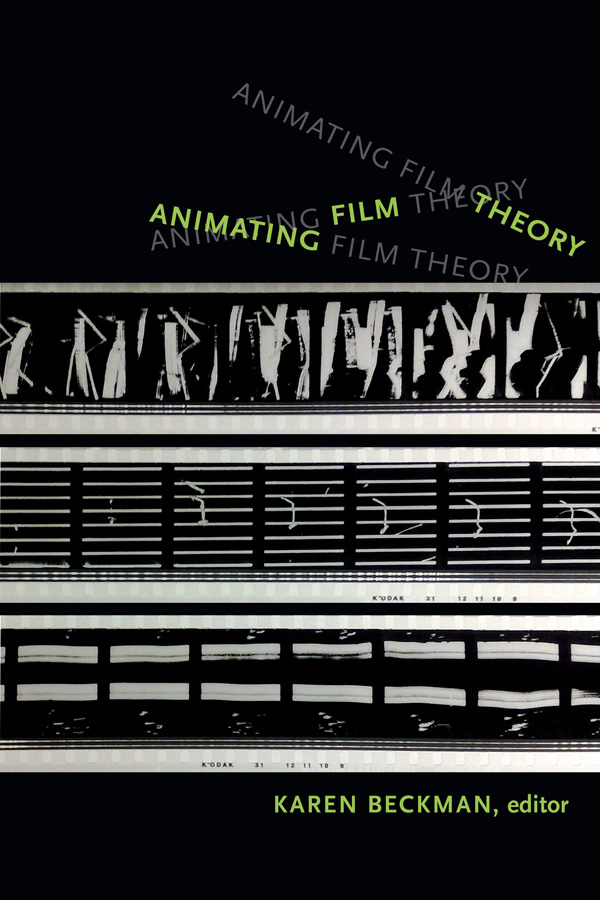
A review of Animating Film Theory, edited by Karen Beckman, Duke University Press, 2014.

Animating Film TheoryI must confess I am averse to film theory. The little I have read in this field confirms me in my opinion: film theory is empirically useless, epistemologically weak, and aesthetically unappealing. Nothing of substance has been written about the topic since Plato’s Cave, the allegory that has people watch shadows projected on the wall from objects passing in front of a fire behind them and give names to these shadows. The books and articles that are collated to form the discipline’s canon are a mixed bag of philosophical references, journalistic musings, and academic jabber. In my opinion, Deleuze’s two-volume work on film, The Movement-Image and The Time-Image, are among his weakest books. They do not amount to a philosophy of cinema, or a theory of film: at best, they are reflections on time and space that take cinema as a pretext and Bergson as an interlocutor. In textbooks and introductory chapters, film theory is a collage of quotations by cultural critics, mostly from the early twentieth century, who have commented on the birth of cinema in the context of mass culture and reproduction technologies. Remarks written in passing by Walter Benjamin or Theodor Adorno are elevated to the rank of high theory and revered as sacred scriptures by a discipline desperately in need of founding fathers. The French contributors to the Cahiers du Cinéma dabbled in film critique as a hobby and did not think of themselves as serious thinkers: they were puzzled to see cinema studies emerge as an academic discipline, and they certainly would have disapproved the emergence of a canon of officially approved texts that includes their own. When film theory tries to build a firmer intellectual grounding, it mobilizes thinkers who have written outside the purview of cinema studies and have never commented on films: Saussure, Lévi-Strauss, Derrida, Lacan, or Baudrillard. Gilles Deleuze for the French domain and Stanley Cavell in America stand as the two exceptions: they have devoted whole books to cinema as part of a program of applied philosophy. My preference goes to Cavell over Deleuze.

Animated films and live-action movies 

My biases against film theory were compounded by this volume on animation film theory. If a theory of films rests on shaky ground, what about a theory that takes animated movies as its object and proposes to build an autonomous discourse on this subset of film media? A discipline is not defined by its empirical topic, but by its methods and the way it builds a scientific object as a matter of scholarly investigation. The existence of animated movies and frame-by-frame films—which predate the birth of cinema—is in itself no justification to devote an academic discipline to their study and to engage them theoretically. I do not mean to say that animation movies should be forever marginalized and ignored by cinema specialists and cultural critics. They can provide food for thought for many disciplines and, in some instances, are valuable sources of theoretical engagement. But a discourse on animation does not a theory make. Building an animation theory has more to do with intellectual posturing and academic differentiation than with scientific rigor and sound scholarship. A caricature of the attitude that I have in mind is provided by Alan Cholodenko’s contribution to this volume. An American-Australian scholar who retired in 2001 from the University of Sidney, Cholodenko describes himself as the godfather of animation theory: “theorizing of and through animation has been my project for the last twenty-three years.” His claim of having come first to lay the “first principles” of the discipline doubles the proposition that “historically as well as theoretically, film is the ‘stepchild’ of animation, not the other way around.” Drawing inspiration from the work of Jacques Derrida and Jean Baudrillard, and postulating animation as the mother of all disciplines, his contribution to this volume amounts to little more than self-promotion and personal aggrandizement. 

What came first, film or animation? And who can claim the privilege of having “invented” animation cinema, in theory and in practice? A central tenet of the fledgling discipline is that animation represents the past and the future of all cinema. Lev Manovich, an author of books on digital culture and new media, made that claim in 2001: “Born from animation, cinema pushed animation to its periphery, only in the end to become one particular case of animation.” The division of cinema into live action and animation has been recently blurred by the digital turn: through CGI and pixel-by-pixel editing, live-action movies are merging with animation in a way that makes them undistinguishable. The cartoonization of live-action movies is propelled by special effects and computer graphics that makes whatever the mind can conceive achievable on screen. Some actors, Jim Carrey for instance (but the same could have been said of Charlie Chaplin or Buster Keaton), have built a whole career acting like cartoon characters. Contributors to Animating Film Theory show that the dividing line between film and animation has never been clear-cut. Photographs and moving pictures have always been mixed with drawings and text editing, such as in Dziga Vertov’s Kino-Pravda (Film Truth) experimental newsreel series in 1922-25, or in cartoons in which drawings “come to life” or live scenes are inserted in graphic sketches, a common practice since the silent movies era down to Robert Zemeckis’ Who Framed Roger Rabbit (1988). The incorporation of animated beings into real-world settings is only one example of the blurring of distinctions between animation and film. Whole movies, like Disney’s 2019 version of The Lion King, are photorealistic renderings of live action scenes in which each detail of character and scenery is animated step-by-step by computer graphics (the sole non-animated shot in the entire film is the sunrise in the opening scene.) 

The French did it first

The history of animation intersects with movie history but they do not necessarily move at the same pace. The Lost World (1925) was the first feature-length film made in the United States, possibly the world, to feature model animation as the primary special effect, or stop motion animation in general. The Enchanted Drawing is a 1900 silent film best known for containing the first animated sequences recorded on standard picture film, which has led its director J. Stuart Blackton to be considered the father of American animation. As for the first animated cartoon, it is attributed (by the French) to Emile Cohl, who produced the short movie Fantasmagorie in 1908. Others point to the French inventor Charles-Emile Reynaud and his 1877 patent of the praxinoscope, an animation projection device that predated the invention of the cinématographe by Louis Lumière in 1895. Other optical toys from the nineteenth century or earlier go by the names of zoetrope, thaumatrope, phenakistoscope, and camera obscura. Likewise, animation film theory has many fathers and the competing quest for precursors, pioneers, and key figures oppose various nations, periods, and individuals. One (French) contributor to this volume casts a Frenchman named André Martin as “the inventor of animation cinema” and 1953 as the date when his invention was recorded. Another (Japan specialist) author exhibits another figure, Imamura Taihei, as the first critic to devote a whole book on animation, A Theory of Cartoon Film, first published in 1941. It turns out André Martin used the expression “cinéma d’animation” in the body of a Cahier du Cinéma article about the Cannes festival, thereby donning prestige and dignity to a genre situated at the intersection between “le septième art” (French jargon for movies) and “le neuvième art” (graphic novels and comic strips). As for Imamura Taihei, he confirms the fact that Japan stands as a key site for animation and for theory. His genealogy of cartoons and comic strips goes back to the twelfth century’s emaki picture scrolls, and also includes acting techniques found in the Nō theater and folding screen paintings from the Edo period.

To build a theory of animation, Karen Beckman, the editor of this volume, has mined systematically the writings of film theory specialists to search for references to animation. As she states in the opening chapter, “animation’s persistent yet elusive presence within film theory’s key writings make it both easy to overlook and essential to engage.” These key writings include texts by Norman McLaren, Peter Kubelka, Vachel Lindsay, Jean Epstein, Béla Balázs, Germaine Dulac, Miriam Hansen, and André Bazin, none of which I was familiar with. Throughout the book, the rare mentions of cartoons and animation movies in the writings of cultural critics and philosophers are treated as precious discoveries. Theorists of film and mass culture such as Sergei Eisenstein, Walter Benjamin, and Theodor Adorno repeatedly turned to Disney cartoons and Looney Tunes characters in articulating their reflections on aesthetics and politics. Eisenstein devised a category of “plasmaticness” that he evoked in order to stress the originary shape-shifting potential of the animated movie, the way an object or image can potentially adopt any form. For Benjamin, “Mickey Mouse proves that a creature can still survive even when it has thrown off all resemblance to a human being. He disrupts the entire hierarchy of creatures that is supposed to culminate in mankind.” Adorno and Horkheimer found nothing funny about cartoons and argued that Donald Duck actively participated in the violent oppression of the proletariat by the forces of capitalism. Writing later in the century, Stanley Cavell mulled over the “abrogation of gravity” in cartoons where Sylvester the Cat or Wil E. Coyote run over the edge of a cliff and continue their course in midair. This allows the author of the last chapter in the volume to enunciate the “first theorem of cartoon physics”: “Any body suspended in space will remain in space until made aware of its situation” (the second theorem states that “Any body passing through solid matter (usually at high velocity) will leave a perforation conforming to its perimeter”.)

Cartoon physics

Animation theory is not necessarily tied to film theory: indeed, many contributions to this volume do not start from the pantheon of film theory authors or the key concepts of the discipline. Animation can be engaged with and theorized from other perspectives: as a strand of critical thought that focuses on subaltern cultures, as in Japan, or within an epistemology of scientific objectivity and experimental representation, or from the point of view of graphic art history and media art. Several chapters focus on the link between scientific visualization practices and the history of animation. The scientific experiment plays a central role in the history of cinematography. Animation itself rests on a scientific fact: by presenting a sequence of still images in quick enough succession, the viewer interprets them as a continuous moving image. This persistence of retinal perception was exploited by the early devices of animation that used a series of drawn images portrayed in stages in motion to create a moving picture. One contributor even sees the origins of 3D animation in a 1860 invention by French entrepreneur François Willème. A glass dome, housing a perimeter ring of twenty-four cameras directed inward at a central subject, allowed camera shutters to open simultaneously to produce a “photosculpture” that was not unlike the bullet-time sequence in the film The Matrix. The experiment of film allows the viewer to experience the world in a novel way: animation, like the scientific experiment itself, becomes the way to think at the limit of understanding in an attempt to get past that limit. Scientific uses of animation include medical anatomy and health education, dimensional modeling in biology or in physics, mathematical abstraction, and all kinds of pedagogical materials. Animated images do not only illustrate: they are instrumental in the process of discovery. Climate science would be less potent without the time-lapse images of shrinking glaciers and melting polar ice caps.

Japan is in a league of its own when it comes to animation theory. As mentioned, a book on the theory of anime, Manga eiga-ron, was written as early as 1941, with subsequent editions in 1965 and in 2005. In Japanese, eiga-ron has a different meaning from “film theory”, and a different history as well. Contributions to Animating Film Theory show how animation needs to be thought in relation to media beyond film to account for the singular place of animated images in Japan. One author explores how experimental Japanese Xerox artists in the 1960s operated a crossover between animation and graphic design that sheds light on the specific context within which the issue of technological reproduction and duplication was discussed. The first translation in Japanese of Walter Benjamin’s essay “The work of art in the age of mechanical reproduction” was published and discussed in Graphication, Fuji Xerox’s corporate PR magazine that presented itself as a cutting-edge publication venue for graphic art and media criticism. More generally, the great divide between commercial and academic publications that marks the intellectual landscape in America does not exist in Japan, where the bulk of critical theories are translated, published and disseminated through non-academic journals as well as mass-market books and “mooks” (a magazine in book format.) Two of Japan’s main animation critics and public intellectuals, Otsuka Eiji and Azuma Hiroki, have organized part of their critical work outside the circuit of academia and write for a broad public readership consisting of hardcore fans of media subcultures. They invite a re-reading of the question of realism in animation: beyond photographic realism and a drawing style inherited from manga comics, anime films hint toward a new style of transmedia realism without any real-world referent. The vibrant worlds of Japanese anime, manga, and video games form the basis of an alternative sphere of expression that popular Japanese critics theorize from outside the realm of film studies.

Whither animation theory?

For Gilles Deleuze, the primary operation of philosophy is problematization, the cultivation of problems such that philosophy can then go about the task of fabricating concepts. What is the problem of animation that it requires a theory? What are the key concepts that may allow animation theory to make sense and generate meaning? Film studies, in their classical form, evolved from questions of ontology, to questions of reception, to questions of context. What is film and its relationship with reality? How does film have an effect on its viewers? What is the social and political context in which film is made and received? Starting from a different set of questions, animation theory must take its own course and develop its own methodological tools. Animating Film Theory only points toward that goal, and merely sketches out the challenges that theory-makers and philosophers of the moving image might have to grapple with. The first question, already pointed out by Sergei Eisenstein and Jean Epstein, has to do with the quality of “animism” that turns people into objects and objects into animate creatures: what makes a world animated and imbued with a life of its own? A second set of questions could coalesce around the issue of self-reflexivity: animation movies are aware of themselves as works of imaginary creation, and the hand of the drawer is never far from the drawn picture. What separates us from the world of fiction, and how can we inhabit it by breaking the fourth wall that separates screen characters from the audience? The third indication we might learn from animated movies is not to take life too seriously: as the last chapter on “cartoon physics” indicates, we will always enjoy a good Tom-and-Jerry cartoon and the hilarity that courses ending in midair and cat-shaped holes might provoke.

Going to the Movies in Paris, Then and Now

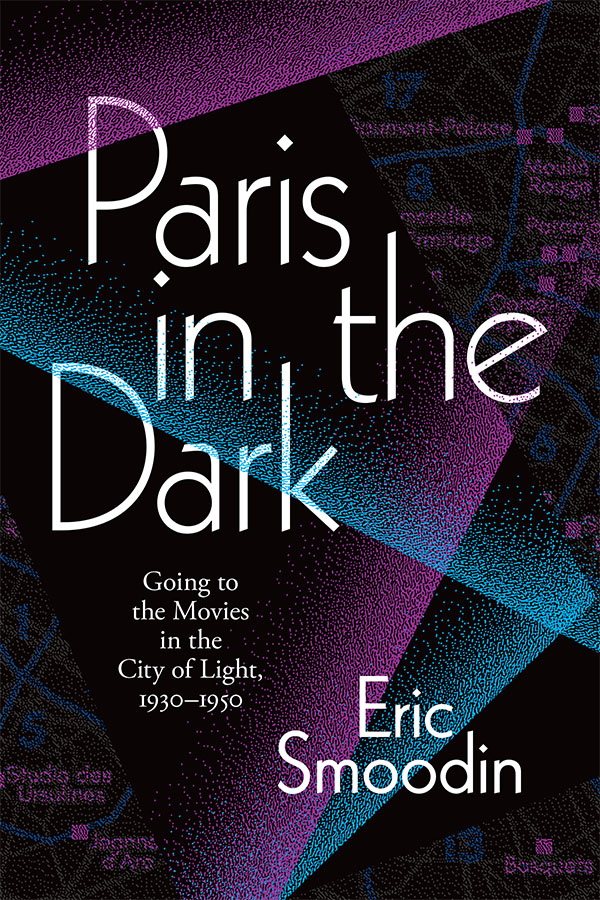
A review of Paris in the Dark. Going to the Movies in the City of Light, 1930–1950, Eric Smoodin, Duke University Press, 2020.

Paris in the DarkParis in the Dark made me remember going to the movies in Paris as a child and a teenager. Of course, I did not experience firsthand the period covered by the book, from the 1930s to around 1950. My formative years took place in the late 1970s and in the 1980s, and a lot of change took place between the period described in the book and the times I remember from my childhood. But Paris will always be Paris, and some aspects of the cinema culture that Eric Smoodin describes did sound familiar. The same time distance lies between 1980 and today and between 1980 and the 1930-1950 period, in the interval between the disappearance of silent movies and the beginning of color films. Maybe my childhood years were even closer from the era of black-and-white movies than they are from my present self. Time has been running faster lately: we now have the Internet and Netflix, while I am speaking of a period before DVDs and VHS. Time did not stand still between 1940 and 1980, but there was more continuity between these two dates for French moviegoers and cinema aficionados than between 1980 and now. Also I tend to look as past history from the same perspective that Eric Smoodin describes in his introduction and concluding chapter. He, too, spent time in Paris between 1980 and 1981, as a graduate student who went to the movies as often as he could. And he now looks at the 1930s and 1940s with eyeglasses colored by this youthful experience. We broadly belong to the same generation. And we both feel nostalgic for a time when “going to the movies” was something more than spending an evening out: it was a lived experience that shaped your identity and culture.
Movie magazines

The first thing Parisians and banlieusards did when they planned to go to the movies around 1980 was to buy Pariscope (or its competitor L’Officiel des Spectacles.) This moderately-priced magazine listed all the movies, spectacles, and entertainment events in Paris and its surrounding banlieue over the upcoming week. You could find the address and schedule of cinemas, theaters, concert halls, museums, with posters from the most recent movies and even ads for sex shops, swinger clubs, and Minitel rose online forums. Pariscope was created in 1965 and ceased publication in 2016. But Eric Smoodin could exploit a similar publication, Pour Vous, a popular film tabloid that was published between 1928 and 1940 and that contained complete listings of all the films playing in the city and in the suburbs. Using this archive as a source, he produces a map of the city’s twenty arrondissements with some of the major cinemas from the period 1930-1950, cinemas that were for most of them still in existence in 1980 but, with a few exception, have disappeared from present-day Paris. He makes the distinction between the cinémas des grands boulevards lining the Champs Elysées and other main avenues, the cinémas de quartier serving a more localized neighborhood, and the ciné-clubs that were mostly concentrated in the Quartier latin, the fifth and sixth arrondissement. Each category offered a different movie-going experience. Each also survived the passing of time and link the distant past to more recent childhood memories and to the present.

As a representative of the first category, take the Rex, situated on the boulevard de la Poissonnière, which was the largest cinema theatre in Europe at the time of its opening in 1932. The Rex was built by Jacques Haïk, a wealthy film impresario known for having introduced Charlie Chaplin to France. Haïk aimed to create the most beautiful movie theatre in Paris, where cinema-goers would have the illusion of watching a film in the open air, with the ceiling painted to represent a starry night sky. The French press noted the florid extravagance of this “cinéma atmosphérique,” with its “starred ceiling giving us the illusion of an oriental night.” During the Occupation, the Rex was requisitioned and became the Soldatenkino, reserved for German soldiers. In the 1950s, one of the first escalators in France was installed and inaugurated by Gary Cooper. For a child, going to such a theater was a magic experience. It sparked the imagination for a lifetime: I still remember the grand building, the queue to the ticket window, the tip to the ouvreuse or usherette, the ice-cream seller who also handled cigarettes and Kleenex, the commercials opened by the animated figure of Jean Mineur throwing his pickaxe to a target and hitting bull’s eye…

Grand cinemas, cinémas de quartier, and ciné-clubs

The Rex and other grand cinemas typically played new movies for only a week before they were fanned out to other cinemas in the neighborhood, where the most successful flicks could keep on screen for weeks on end. The cinéma de quartier is where most Parisians situate their early movie experience. This is where they remember going to the movies for the first time alone or with their friends as opposed to accompanied by their parents; where they exchanged their first kiss; where they laughed, cried, or screamed in reaction to the scenes of the screen. In France, a R-rated movie would be accessible to teenagers, and a “film interdit aux moins de 16 ans” would be rated X in the US. But there were always ways to fake your ID, negotiate your entry without paying with the ticket clerk, or using a backdoor and some lock-picking skills to free ride on a film show. The neighborhood cinema was a familiar presence that is still remembered fondly in adult life and that finds its ways into novels by Patrick Modiano or movies such as Cinema Paradiso. Its disappearance is always a local tragedy, and its replacement by multiple screen theaters wipes away an important part of the viewer’s experience. 

No other city in the world during the period covered by this book had so extensive a system of ciné-clubs as Paris. From early on, cinema was considered as part of culture, and was identified as “le septième art  by a French-Italian critic as early as 1923. But not all movies were art movies. And ciné-clubs or art-movie theaters had a connection with highbrow Parisian culture that the commercial cinema typically did not. Movies and documentaries could occasionally be projected in institutions other than cinemas: museums, concert halls, conference venues, public libraries, or amphitheaters. They were usually preceded by introductory remarks and followed by a “débat cinématographique” bringing in the film director, art critics, public lecturers, and the public. The frequently posh setting, the people who attended, and the discussions that took place made the ciné-club, far more than the ordinary cinema, a special location in the cultural geography of Paris. In the 1970s and 1980s, ciné-clubs were also present in suburban or provincial cities and towns, as well as in the form of a student-managed activity in lycées and universities. The screenings, which sometimes took the form of all-night movie marathons, could follow various patterns such as the director retrospective, the thematic series, the avant-garde aesthetic experience, and the sensational or censored film. This is where the cinematic auteurs from the Nouvelle Vague and the art critics from Les Cahiers du cinéma honed their skills and acquired their cinematic culture.

Version originale sous-titrée

American journalists quoted by Eric Smoodin reported that Parisians had a preference for French films, and tended to shun American films with French subtitles or sous-titres in favor of French-dubbed Hollywood movies. In fact, from a sample of 110 movies listed in Pour Vous in 1933, the author was able to identify 48 French films, 34 Hollywood movies, as well as a few movies from Great Britain, Germany, Italy, Spain, and Belgium. Assigning national origins to all movies from the period can be challenging, as there were quite a few binational coproductions as well as foreign films produced for the French market or multiple-language versions of the same movie. And many films were shown in their original language. The sous-titré movie held a privileged place in French cinema, especially among the cultured elite, even if they didn’t always understand the original English. In a city known for its international film culture, foreign movies have always shared the screen with domestic films. In the Paris of the 1980s, and especially in the art-movie theaters, you could see movies from a wide variety of international directors: Visconti, Pasolini, Fellini, Antonioni, Bergman, Eisenstein, Tarkovsky, Wajda,  Kieslowski, Ozu, Oshima, Kurosawa, Fassbinder, Wenders, Jarmusch, Lynch, Kubrick, etc., were household names for the true cinéphile.

Paris, and later Cannes (where the International Film Festival was first organized in 1939 and relaunched in 1946), could make or break the reputation of filmmakers and actors. Among the most compelling stars of the period were Maurice Chevalier and Marlene Dietrich, who rose to fame following the switch to sound technologies and eclipsed older stars from the silent era. Both actors were transnational celebrities. Chevalier started his career in the music hall in France but then moved to the United States to work with Paramount. Dietrich’s career was launched with her role in L’Ange bleu in 1930, and Parisian audiences could hear her singing the theme song in the original German (“Ich bin von Kopf bis Fuß auf Liebe eingestellt”). Much more than the silent film stars, whose nationality or regional origin could never be given away by their accents, both Dietrich and Chevalier were perceived as national subjects, as German in the first case and French in the second. Their stardom may have its roots in Hollywood, but could only attain its full development with  the success they attained with French audiences. It is only recently that French actors have started to feature in American movies without a heavy French accent—although Jean Dujardin, the lead character in the 2011 movie The Artist, articulates English in a distinctly French way.

For the historian, cinema in the 1930s was also a site of violence motivated by right-wing politics. The 1930 screening of L’Âge d’or, the surrealist movie by Luis Buñuel, was interrupted by the right-wing Ligue des Patriotes who threw ink at the cinema screen and assaulting viewers who opposed them. During the following months and years, there was a series of escalating incidents in Paris cinemas, with interruptions by the public leading to police intervention. Likewise, I remember showing support during my high-school years to the local ciné-club whose screenings of controversial movies such as Je vous salue Marie (1985) by Jean-Luc Godard or La dernière tentation du Christ (1988) by Martin Scorsese was opposed by demonstrations and booing from traditional Catholics. Choosing a particular movie or theater was also a way to manifest your political affiliation. During the 1930s, one ciné-club, Les Amis de Spartacus, was affiliated with the French Communist Party and typically showed films that had been banned in France, such as Sergei Eisenstein’s Le Cuirassé Potemkine (1925). Forty years laters, municipalities from the banlieue rouge headed by communist mayors would still screen movies from Eastern Europe and the Soviet Union that would not feature in commercial cinemas. But going to the movies also positioned you in the field of intellectual politics: being able to discuss cinema history and to comment on the latest film attraction was, and still is considered as a litmus test for the true Parisian intellectual. Eric Smoodin deserves the title in abstentia.

Post scriptum: Eric Smoodin, the author of Paris in the Dark, also writes a blog on WordPress, the Paris Cinema Project. It has more pictures and historical details than the book. Recommended reading.

Watching Crap Videos on YouTube

A review of Asian Video Cultures: In the Penumbra of the Global, edited by Joshua Neves and Bhaskar Sarkar, Duke University Press, 2017.

Asian Video Cultures

Reflecting on the uploaded content usually found on YouTube, legal scholar and political activist Lawrence Lessig made the following comment: “The vast majority of remix, like the vast majority of home movies, of consumer photographs, or singing in the shower, or blogs, is just crap. Most of these products are silly or derivative, a waste of even the creator’s time, let alone the consumer’s.” This is a book about crap. But it isn’t a crap book: as Charles Baudelaire and Walter Benjamin have taught us, there is meaning and enjoyment to be found in the transient, the fleeting, the contingent. It is by acknowledging these mundane aspects of everyday life that we can paint a true picture of modernity. Modernity as experienced by Baudelaire or Benjamin was Parisian, pedestrian, and picturesque. Our modernity falls under the sign of the global; and it is now in Asia, not on the streets of Paris, that new forms of contemporaneity are being experienced. Videos posted on YouTube and its regional equivalents—China’s Youku, Japan’s Niko Niko Dōga—as well as images circulating on low-tech video supports such as Video CDs and microSD cards are not only the crap of lived experience and a waste of consumer’s time. They are invested with imaginaries, intimacies, and identities that summon other ways of being in the world. As such, they provide weak signals, background noise, and narrow bandwidth communication to the careful observer attuned to Asia’s many presents and futures. But attending to these realities cannot be done merely from a computer screen. The various contributions in Asian Video Cultures emphasize ethnography as a crucial methodological tool for achieving better comprehension of video cultures at all levels of analysis and advocates anthropological case studies and cross-cultural analysis as foundational to a much-needed critical global media perspective.

Asian modernities

The “Asia” the editors have in mind is different from the landmass imagined by politicians, corporate executives, and ideologues. It is not defined by geography: art videos assembled by a gay Singaporean artist in Germany are as much part of Asia as the Bollywood movies that circulate in northern Nigeria. The book includes fieldworks studies taking place in Palestine and Lebanon, while other Asian geographies, such as Central Asia or Iran, are conspicuously absent. Articles about India dominate the count, and introduce us to fine-grained descriptions of localist movements such as the consumption of music videos by rigorist Meo villagers in the state of Haryana or the accession of Telangana to statehood through a politics of YouTube remixes and online comments. Some countries known for their digital modernity, such as Japan and Korea, only appear tangentially, while we are reminded that Indonesia has (or had) the second-highest number of Facebook users in the world. Just as the nation-state was molded by the printing press and the emergence of national literatures, imagined communities in Asia are currently being formed through the circulation of images and affects on online platforms and offline hardware devices. The YouTube video or its social media equivalent is at once intimate and political. It shapes an imaginary and carries values of immediacy, propinquity, self-expression, and affective engagement. Internet videos herald “the age of the amateur” which blurs the divisions between producer and consumer, media and content, uploading and downloading. They proliferate “in the penumbra of the global”, in the twilight hours between dusk and dawn when all cats are grey and dogs and wolves are confused.

The new media formations that the book chapters describe are often relegated at the margin of scholarly attention, statist projects, and corporate strategies. A common trope among intellectuals is to disparage media practices across the region as the emanation of a culture of copy, duplication and counterfeit, devoid of any intellectual creativity and adversarial to legitimate market value. According to this common view, the West is the originator of value and content, and the East free-rides on this authentic culture of innovation by offering knockoffs and low-cost imitations. The tolerance that Asian states grant to these intellectual property infringements is the sign of a retrograde political culture that is, in the end, adversarial to economic development. Another stereotype, which partly contradicts this first trope, is to view the state in Asia as authoritarian and manipulative. In his critique of Stalin’s Russia, Karl Wittfogel saw the authoritarian nature of communism as an extension of the need of totalitarian rule to control water that had shaped civilizations in most of Asia. This “oriental despotism” now takes the form of media censorship, Internet control, and political repression in densely populated cities and states that cannot tolerate political dissent. For the editors, these views, which still inform much of what passes as area studies in Euro-American university departments, are inspired by Cold War geopolitics and market neoliberalism: their objective is to make Asia fit for capitalism and democracy. They prevent us to register the profound social changes that are taking place at the level of the infra-political: most media practices described in this volume operate below the radar of the state and the market. They also make connections beyond and outside the borders of the state, giving way to transnational currents that are as constitutive to globalization as the movement of goods, services, and capital.

Bringing media to the village

Beyond the triumphant view of emerging Asia as a continent of skyscrapers and digital connectivity, one should not forget that Asia is also composed of slums, shantytowns, and remote villages. The economies of survival that sustain these margins also shape the technologies, idioms, and practices that characterize Asian video cultures. In “Video documentary and rural public China,” Jenny Chio describes how video is integrated into contemporary rural and ethnic minority livelihoods in China’s southwestern provinces. She shows that one can be modern and rural and ethnic at the same time. Video recordings of local festivals and folk performances of ethnic Miao communities find their ways to the smartphone screens and computer monitors of migrant workers and farming households living in factory towns or staying in isolated villages. They exist alongside, but not necessarily in conflict with, mainstream national media. The videographers who produce these videos are self-taught or, in some instances, beneficiaries of video-production training workshops run by local NGOs. They bring “media to the village,” but also participate in a rural public culture that allows for different forms of media representation and public participation. Slums and villages shouldn’t be identified as the “local” in opposition to the global. In another chapter on “Sensory politics in Northern Nigeria,” Conerly Casey takes the case of Muslim secondary-school girls who develop signs of spirit possession that include “dancing like they do in Indian masala films.” Qur’anic scholars who adhere to a strict interpretation of the Sunna immediately forbade Bollywood movies, while the local video movie industry produced song-and-dance copies of Bollywood productions and young adults circulated a PalmPilot version of the Kamasutra known as the Palmasutra. Stories of spirit possession, forbidden images, and sexual fantasies also played out in national politics when Nigeria’s strongman, General Sani Abaca, dropped dead after a late-night visit with two “Indian prostitutes”. The transnational circulation of images and content affect people at the level of the sensory, the intimate, the emotional, but also the religious and the political.

Another bias in media studies is to focus on large cinema screens and TVs or computer monitors, and to leave aside smaller screen displays and low-tech hardware supports. Products like VCDs, digital audio tapes, MiniDiscs, and SD cards were widely adopted in the region and successfully competed with DVDs and web uploads until smartphones became ubiquitous in the 2010s. The ethnographies collected in Asian Video Cultures attest that the preferred mode of diffusion is often off-line and through movable hardware devices that are passed on through informal networks of distribution and exchange. As Chia-chi Wu shows in her study of trans-Chinese screen practices, Asia is the continent of small-screen realities. In Chinese-language communities in the recent past, a growing lexicon of the “mini”, the “small” and the “micro” has developed in multifarious forms with radically different political and cultural meanings. “Wēi”, meaning “micro” in Mandarin, has been used in ubiquitous names like Wēibó (China’s version of Twitter), Wēixìn (WeChat in Chinese), and wēi xiǎo shuō (micro-fictions or SNS novels) or wēi diàn yǐng (micro-cinema or “micro film”). Other neologisms centering on the concept of small are also popular, such as xiǎo què xìng (small pleasures), wēi zhěng xíng (micro-plastic surgery) or wēi lǚ xíng (micro-travel). Asian minimalism, a film orientation associated with directors You Hsiao-hsien and Jia Zhang-ke, has given rise to the rejuvenation of short-film culture on a regional scale, as evident now in the flourishing of film festivals devoted exclusively to short films or micro-movies. Wēi diàn yǐng has almost completely replaced the Mandarin term for movie shorts, duǎn piàn, which now sounds old-fashioned if not obsolete. As Chinese consumers are enjoined to embrace “wēi” or “micro”, technologies that exploit the small, the mundane, the daily pleasures, and the quotidian begin to shape a specifically Asian or Chinese modernity. All these little things resonate with subtle, multilayered meanings about the production of a self-managing, complacent, and self-comforting subject that is compatible with market neoliberalism and state authoritarianism: of course, making “big” acts of disobedience is not tolerable or even imaginable in China.

Platform and content

Two terms dominate the formulation of corporate strategies and government policies in the digital sector throughout Asia: “platform” and “content”. The shared goal is to create home-grown platforms that would compete with the dominant players, such as Google, Facebook, Amazon or Apple, and to generate content targeted at global audiences. But video cultures show us that platforms can be improvised, such as in the exchange of microSD cards among traders and consumers, and that content is often user-generated with a very local audience in mind. Niko Niko Dōga, abbreviated Nico-dō, is a Japanese video-sharing service owned by Kadokawa Corporation as part of a media mix strategy that fuses platform and content. The media mix originally refers to the practice of turning books or manga into moving images or products and vice versa. It ties video together with print, games, plastic figures, comics, and novels in a tightly knit ecosystem. Unlike other video sharing site, comments generated by users on Niko Niko Dōga are overlaid directly onto the video, synced to specific playback times. This feature allows comments to respond directly to events occurring in the video, in sync with the viewer—creating a sense of a shared watching experience. Nico-dō delivers not only videos but also manga, novels, and magazines, via the same interface as its videos, and conjunction with its unique comments function.In Japan, the emphasis on platforms was a rather late addition in corporate strategic discourse. Previous priorities in the 1990s focused on contents and intellectual property, as policy makers entertained the hope that Japanese cultural goods would make up for the decline of Japanese industrial power. But once it was adopted in the 2000s, platforms became ubiquitous. Former telecom services such as NTT DoCoMo’s i-mode were reconceptualized as platforms, and business seminars with MIT professors were organized on the logic of multi-sided markets—as platforms are modeled among economists. The enthusiasm for platform reflected the craze about media theory that had developed among Japanese executives at the time of Marshall McLuhan’s book Understanding Media in the 1960s. Indeed, as Marc Steinberg notes in his contribution, “what we used to call media we now call platforms.”

There is a dark side of Asian video cultures that the authors of this volume do not really explore, and to which they refer only tangentially. In Asia as elsewhere, the Internet is a breeding ground for conspiracy theories, right-wing ideologies, racist provocations, and nationalist mobilizations that abuse free speech and undermine democracy. Evidence points to an Asian genealogy of some of these extremist forums. Japan’s infamous 2Channel (2ch.net), known as nichan, served as the model for the English-language 4chan, on which the hacker collective Anonymous and the far-right conspiracy movement QAnon first developed. First launched in 1999 as a bulletin-board where full anonymity was guaranteed, 2chan became known as a hub for the Net-Right or netto uyoku that bears some responsibility for the rightward swing of Japanese politics in the past two decades. Likewise, nationalism and anti-foreigner sentiment in China would never have developed to the extend it now has without the availability of Internet forums and text messaging services that allowed disgruntled youths to vent the anger they couldn’t direct at the authoritarian regime. The dark side of the net is also reflected in the proliferation of pornographic pictures and sex videos that affects individuals and communities in Asia as in other continents. Without going so far as saying that “mobile phones are responsible for rapes,” as the Karnakata legislature did to ban smartphones in schools and colleges across the state, the proliferation of smutty videos and pictures on modern social networks has certainly taken a toll on populations and especially on the most vulnerable: women, the young, those least able to navigate discriminately the new currents of online streams. With great freedom comes great responsibility.

The new Internet archive

The authors of Asian Video Cultures prefer to insist on the positive, creative and empowering aspects of new media. They offer vignettes of individual emancipation, community involvement, emergent solidarities, and artistic production that all point toward the same direction. Patricia Zimmermann describes a new-media portal in Indonesia that has been described as the “YouTube for Southeast Asia activists”. It focuses not on the national but on micro-territories and micro-practices such as the production of short documentaries for social media that address issues of environmental degradation, social mobilization, and migrant rights, thereby circumventing the mainstream media’s stranglehold on information. Tzu-hui Celina Hung documents how immigrant brides in multicultural Taiwan are able to better negotiate the terms of incorporation into their new household by exchanging information and sharing their stories on social networks. Rahul Mukerjee and Abhigyan Singh explain how young men from the Meo ethnic group in rural Mewat in northwestern India are able to escape the strictures of their rigorist community by appropriating the symbols of individual emancipation, the motorbike and the mobile phone. Feng-Mei Heberer analyzes the art videos of Singaporean artist Ming Wang who performs drag cross-dressing by impersonating the role of female protagonists in German classical movies, thereby giving a face to under-represented ethnic and sexual minorities in Germany. S.V. Srinivas studies the mobilization that led to the formation of Telangana State within India through online activities such as uploading videos and posting comments in the local language on YouTube. Like literacy in 19th century Europe, the diffusion of video cultures in contemporary Asia is conducive to the formation of new subjects and collectives. Unlike literacy, however, it largely escapes the sphere of the state and is not framed by national policies. Video documentaries and short movies are produced outside of the state media system and circulate beyond the realm of the market. Another key difference is that we are able to document 19th century history through the print archive formed by the collection of books, newspapers, pamphlets, and printed material kept in libraries and archival depots. How will future historians and researchers document our video cultures, and how will they deal with the crap that is uploaded daily on YouTube?

Global Production Networks and the Ideology of Seamlessness in Modern Filmmaking

A review of Media Heterotopias: Digital Effects and Material Labor in Global Film Production, Hye Jean Chung, Duke University Press, 2018.

Media HeterotopiasIt takes a lot of people to make a movie. It also takes a diversity of production sites, technologies, and product or service providers. The list of names, locations, companies, and generic technologies that were instrumental in making a movie are listed in the closing credits. A full set of credits can include the cast and crew, but also contractors, production sponsors, distribution companies, works of music licensed or written for the movie, various legal disclaimers, such as copyrights and more. Nobody really pays attention to this part, except for the theme song playing at full blast and the occasional traits of humor interrupting the credits scroll. These closing credits allow the spectator to make the transition between the world of fiction and the real world, and to put an end to the suspension of disbelief that made him or her adhere to the on-screen story. For Hye Jean Chung, who teaches cinema studies in the School of Global Communication at Kyung Hee University in South Korea, the spectator’s disregard for credit attributions is part of an operation of denial and erasure: denial of the work that went into making a movie, and erasure of the production sites and collaborative networks that increasingly place film production into an international division of labor. The ancillary bodies and sites of labor are erased from the film’s content and only appear in the end credits; but they somehow creep back onto the screen during the movie as well, producing what she calls “spectral effects” or traces that are rendered invisible and disembodied but that still haunt the movie like a ghostly presence. Taking on from Michel Foucault’s concept of heterotopia, she defines “heterotopic perception” as a mode of criticism that is sensitive to these spectral effects, and “media heterotopias” as a digitally enhanced audiovisual realm of representation that superimposes different layers of realities, spatialities, and temporalities.

Assembling a collection of movies from the Asia-Pacific region 

These spectral effects and media heterotopias are particularly, though not exclusively, perceptible and legible in movies that use computer graphics, special effects, and digital technologies. Of the nine films that the author comments upon, six (AvatarOblivionInterstellarThe HostGodzillaBig Hero 6) make heavy use of CGI and digital effects, while others use digital reediting (Wong Kar-wai’s Ashes of Time Redux) or animated sequences (Jia Zhangke’s The World). Only Tarsem Singh’s The Fall ostensibly insists on on-location filming (in more than 20 countries) and lack of special effects in its spectacular visuals. The conceptual framework proposed by Media Heterotopias is therefore amenable to many different kinds of movies, from Hollywood blockbusters to art-house films, from adventure fantasies to science-fiction flicks. A common thread running through this selection is the focus on Asia, as many of these films were shot or produced in Asia-Pacific; but the author insists that this book is not an area studies project, and she resolutely places her analysis in a transnational or global perspective. The focus of Asia-Pacific is thereby a reflection of the on-going trend that affects movie production and consumption as well as many other industries: the shift to a new center of gravity that includes East Asia and the western shores of the Americas, and that transforms the historical Eurocentric or Atlantic domination into a thing of the past.

Although Hye Jean Chung doesn’t identify herself as a Marxist scholar, her work is very much preoccupied with issues of capital accumulation, surplus value extraction, and commodity fetishism. Against a tendency to treat films as texts and material conditions as irrelevant, she reminds us that movies are made by real people engaged in a division of labor in which value created by some is appropriated by others. Theoretically, she situates her film studies in the legacy of Michel Foucault by picking up his concept of heterotopia. According to Foucault, the cinema itself (as a building) is an heterotopia in its ability of allowing several overlapping spaces to exist. A cinema theater is a room with a two-dimensions screen where a three-dimensions world is able to exist. Heteropias in cinema (films) are therefore increasing the amount of overlapping worlds and thus question the status of reality of any of those worlds. Another important if yet more implicit reference of the book is Jacques Derrida’s Specters of Marx, where the heritage of Marxism is reclaimed by a new materialism acknowledging the haunting presence of ghosts and spirits. By being attentive to spectral effects and ghostly presences, Media Heterotopias offers a kind of spectral critique or hauntology that places human labor and production processes squarely at the center of media theory. 

The effacement of labor and the ideology of seamlessness

As many critics have pointed out, the world has been fundamentally altered by digital technologies. Our perception of reality itself is changing at a fast pace. Time is no longer a moving arrow flowing from past to present and toward the future: temporal linearity is now supplanted by intensive time, for which the only meaningful distinction is that of real time and delayed time. Digital technologies also transform our conception of space: they abolish the distinction between real space and virtual space, merging the two into a new augmented reality where digital signaling is ubiquitous. These new spatio-temporal formations have a strong impact on production and labor, and movie production is no exception. Nonlinear digital workflows are replacing linear production processes with a simultaneous collaborative workspace. Digital platforms such as video conferencing, instant messaging, and online file sharing allow massively parallel processes of collaboration to take place. To expedite and streamline the work process, the creative labor of digital film production is dispersed across geographically diverse companies in global production pipelines. Formerly disparate stages of preproduction, production, and postproduction are increasingly becoming fused with one another in a collaborative space. 

Globalization has developed an ideology of seamlessness: borders are no longer a barrier to the free flow of goods, capital, and images; and production processes are integrated into global value chains operating just-in-time and without friction.  For Hye Jean Chung, this fetishizing of a seamless integration conceals the actual living bodies and physical sites of labor that provide the material conditions of transnational activities. These bodies and locations are often firmly anchored to their national territories and regional infrastructures, with the cultural and geopolitical characteristics that are attached to them. The world isn’t flat, but a lot of work, including ideological work, goes into the task of making it appear as flat and frictionless. Similarly, both digital aesthetics and digital production processes partake in an ideology of seamlessness. Digital cinema produces a seamless effect when computer generated figures and sceneries are smoothly integrated with real actors, actual landscapes, and practical sets. By erasing material traces, visible joins and seams from the various stages of digital processing, the final product is made to look flawless and natural, even though digital images are composed of multiple layers of heterogeneous time and space. The photorealistic aspect of CGI makes it easy to suspend disbelief and create a pure spectacle of illusory seduction. This propensity toward the illusion of seamlessness has always been part of cinema’s attraction; but digital technology allows to make all traces of labor-intensive production invisible and well-hidden. Only remnants remain, coming back in the movie screen to haunt it as a spectral presence.

Self-referentiality and structural homologies 

In some cases, the ideology of seamlessness provides the material for the film story. This is particularly the case in science fiction movies, even when they are critical of capitalistic processes or technological developments. James Cameron’s Avatar offers a simplistic denunciation of technology-driven imperialism and an apology of a holistic, nature-centered, culturalistic worldview. But the heavy dependence on CGI and digital effects as well as the film’s reliance on global production and distribution networks contradict the explicit message of the movie. Who should we trust, the Na’vi and their natural utopia untainted by human technology, or the visual effects that replicate the mixing of human and alien DNA performed by Pandora’s greedy aggressors? Avatar treats body as media; migrating to a different body is reflexive of the digital filmmaking process itself. Another structural homology between movie content and filmmaking process is the act or cultural or geographical appropriation. Film commentators noted that each article of Na’vi clothing and jewelry was handmade and woven by a team of New Zealand costume designers. They underscored that the “alien” culture of Pandora was actually based on the indigenous Polynesian cultures of the Pacific Islands: for instance, the Na’vi gesture of touching foreheads is directly borrowed from the Māori’s traditional greeting, the hongi. Such acts of cultural appropriation go unnoticed or are even praised to illustrate the film’s cultural deftness. But it is doubtful whether Māori communities or other South Pacific Islanders received any benefits from these borrowings. Geographical borrowings, such as location shootings in fragile ecosystems or in scenic landscapes, are even more pernicious: they leave in their trail a legacy of environmental devastation, and often open the way for mass tourism and commercial exploitation of nature, as in the Pandora tours and Avatar-themed Na’vi wedding packages that are offered in the sites where some of the movie scenes were shot.

Another form of geographical exploitation consists of making a landscape alien, as in the science fiction movies Oblivion and Interstellar that were shot using real locations in Iceland. In these films, Iceland functions as an in-camera special effect by providing the image of a primitive or post-apocalyptic landscape that is then mixed with computer-generated imagery. Again, it is doubtful whether Icelanders received any benefit from the inclusion of their country’s natural assets as raw material in global value chains. As Hye Jean Chung notes, “certain sites of production develop as centers or nodes of production pipelines, whereas others are relegated to satellite sites of production or peripheral industries that provide human labor and natural resources to this centralized core that upholds and reinforces Hollywood’s hegemony.” Films like The Host or Godzilla however show that hegemony can be de-centered and that nations are in competition over the definition of a global imaginary. The composite body of The Host’s monster crosses genres and territories: although firmly anchored in the cultural specificity of Korean cinema, it cannot be interpreted “neither as a transplant of Hollywood’s conventions into a Korean background nor as a transfusion of Korean culture into Hollywood’s standards.” The monster, envisaged by director Bong Joon-ho as an imagined vision of “Korean-ness,” is in reality produced by a mix of Korean and non-Korean labor and technologies; and the film is itself a blend of heterotopic genres, from science fiction and monster movies to action films, family drama, political satire, and comedy. The 2014 Hollywood’s version of Godzilla, too, mixes imaginaries and straddles boundaries across the Pacific Ocean. Created by merging cross-border bodies and assets in both narrative and production spaces, it mobilizes a postwar Japanese myth born out of the atomic bomb and projects it on a global scale. The monster functions as a floating signifier, whose hybridity enables multiple national identities and transnational imaginaries to coexist. But the Hollywood’s production didn’t kill the indigenous gojira franchise: in Japan, the US-made monster was criticized as “out of shape” and as having a neck “like an American football’s athlete’s,” while the story lacked the denunciation of atomic warfare and the social critique that the Japanese versions developed.

Heterotopia is not only what movies make of it: it is inscribed in sites and territories, in imaginaries and aspirations. Theme parks like the World Park in Beijing and the Window of the World Shenzhen feature scaled-down replicas from various parts of the world; they offer the opportunity to travel abroad while staying at home. For the local migrants who work in these parks however, like the characters of Jia Zanke’s movie The World, the cosmopolitan lifestyle they showcase remains an simulacrum. Jia’s film deconstructs the transnational fantasy embedded in the World Park by revealing the various forms of uninspiring work that is necessary in producing and maintaining the illusion of cosmopolitanism. The characters’ lives are mediated by technology. They constantly send text messages on their cell phones and watch at digital video screens. Their dreams and fantasies, figured by animated sequences that punctuate the film, are made of simulated artifacts and reconstructions, as fake and artificial as the world they inhabit or the characters they are asked to impersonate. Big Hero 6 features another form of heterotopia in the hyperrealist scenes and cityscapes of “San Fransokyo”, a fictional metropolis that integrates the cultural iconography of Tokyo into the urban geography of San Francisco. This form of techno-Orientalism, reminiscent of the futuristic city displayed in Ridley Scott’s Blade Runner, is indexed on a cultural reality: the role Asian migrants have played in shaping San Francisco, a city that is now heralded as the capital metropolis of the Asia-Pacific century. In Big Hero 6, which was produced as a Disney franchise, East meets West in a virtual space rendered seamless by transpacific collaborations in the field of computer graphics and creative urban design.

From post-Marxist analysis to new materialism

What does heterotopic analysis bring to the field of cinema studies? First, it brings together two strands of film critique that are often developed separately: content and context, internal versus external critique, semantic interpretation or industry analysis, the viewer’s perspective or the point of view of the producers. As Hye Jean Chung convincingly demonstrates, the border between the two realms is porous: the ideology of seamlessness erases all traces of human labor and technical work from within the movie, but reality creeps back into the film’s narrative, making the seams apparent and the labor traceable. Many movies, especially but not exclusively in science fiction, are self-reflexive about the filmmaking process and the technological tools used in film production. Analyzing the film’s content also offers a perspective on how it was conceived and developed. Second, Media Heterotopias offers a post-Marxist analysis of the global division of labor in cultural and creative industries. The author often refers to the long work hours, tight schedules, night shifts, physical migration, or sedentary confinement along complex networks of transnational collaboration. Value accumulates at the most capitalistic points of the value chain, while other parts of the production pipeline are submitted to ruthless labor exploitation or imperialistic appropriation of cultural and natural assets. As a third point, I see this book as a contribution to the literature on new materialism. The materiality of geographical location, physical labor, and industrial practices is put alongside processes of dematerialization and digitalization, giving rise to a new kind of mediated materiality. The layered nature of digital imagery makes it an assemblage of heterogeneous time-spaces, a composite of physical and virtual elements that give rise to spectral effects and phantomatic presence. Reality is what comes back to haunt us when the real has been dissolved into digital fictions.

Timeless, Bottomless Bad Movies

A review of The End of Japanese Cinema: Industrial Genres, National Times, and Media Ecologies, Alexander Zahlten, Duke University Press, 2017.

The End of Japanese CinemaCinema is an industry. But very often aesthetics gets in the way of analyzing it as such. For cinema—or some portions of it—is also an art. Industry or art: these two approaches give rise to two distinct bodies of literature, one focusing on professions, publics, and profits, the other one on visual style, narrative content, and film textuality. There are movie industry specialists who may teach in professional schools or in economics and sociology departments, applying the standard tools of their discipline to one particular sector that represents up to one percent of the US economy. And there are cinema critics and film studies academics who develop concepts such as genre, auteur, style, form, periods, and apply them to a canon of authorized films conserved in national archives. Film studies may emphasize culture (cinema as representative of national culture), psychology (a movie reflects the inner psyche of its director), formalism (focusing on the formal or technical elements of a film), history (itself divided into the history of genres and national traditions), or theory (film theory as a branch of applied philosophy). What these approaches have in common is that they consider a movie as worthy of cultural commentary and critique. By contrast, an industry specialist is more interested in macro factors such as film production, distribution, and box office figures. He or she will focus on context more than content, on cost and revenues more than artistic quality. In the case of Japanese cinema, an art critic will focus on directors such as Kurosawa Akira or Ōshima Nagisa, specific genres such as jidaigeki (samurai movies) or kaijū eiga (monster movies), and techniques such as Ōzu Yasujiro’s signature tatami shots and multiple scene framings; while an industry specialist will study the studio system long dominated by Shōchiku, Tōhō, Tōei, Nikkatsu, and Daiei, the unionization of workers, or the distinct distribution channels for hōga (domestic movies) and yōga (foreign movies).
Pink Film, Kadokawa Film, and V-Cinema

In The End of Japanese Cinema, Alexander Zahlten combines the two approaches. He analyzes cinema as a cultural form and as a socio-economic activity with deep political ramifications. He proposes concepts that bridge the gap between the artistic and the industrial, the qualitative and the quantitative, the individual movie and the whole economic sector. It helps his case that the three categories he discusses—Pink Film or sexploitation films, Kadokawa Film produced by one single, multi-media entrepreneur, and V-Cinema made straight for the video market—are almost devoid of any artistic value. In fact, they are ignored in critical and academic discourse on films from Japan, and do not feature in Japanese movie histories. Like the infamous AV (adult videos), a large fraction of them may not even be included in film production statistics. But collectively they form an archive of close to 8000 movies: enough for the social scientist to build models, test inferences, and draw meaningful conclusions from such a large sample. They matter for a genuine history of cinema in Japan that is willing to go beyond the time-worn theories of auteurship, national character, and genre normativity. For all practical purposes, watching a movie in Japan meant, for a large fraction of the public and during a significant period of time, attending a film that belonged to one of these three categories. The reason academic work on films in Japan hardly discusses or even mentions these movies is because they cater to the base instincts of the public and are generally considered of bad taste and poor artistic value (some Pink films nonetheless made it to the Euro-American cinema festival circuit). If some of them achieved high scores at the box office or on video rental figures, it is because the public was lured by sexual attraction or by marketing ploys and media campaigns. This is particularly the case for Kadokawa films, which include a few blockbusters: but they were derided by the critics and the art movie profession, who declared that “Kadokawa films are not films” and, in the case of Kurosawa Akira at the 1980 Cannes film festival, refused to shake hands with the producer.

Sex sells, and it is no wonder that sexually themed films feature heavily in the sample studied by the author. In fact, it has been estimated that adult films represented up to 40 percent of the video rentals in the 1980s, and that close to 75 percent of films produced in Japan in 1982 positioned themselves in this market segment. Nudity and sex officially entered Japanese cinema with Kobayashi Satoru’s controversial and popular independent production Flesh Market (Nikutai no Ichiba, 1962), which is considered the first true pink film or pinku eiga. Pink films are not to be confused with Roman Porno films, a series of theatrical erotic movies produced by the movie studio Nikkatsu riding the wave that the first Pink movies had created. Nor are they similar to Adult Videos, pornographic films adapted to Japanese proclivities and visual censorship rules. Alexander Zahlten gives a strict definition of the Pink Film genre: a one-hour length format with regularly spaced erotic scenes (shot in color while the rest of the movie is often in black-and-white), a budget of around 3 million yens since the mid-1960s (decreasing in value over the years), an independent system of production, distribution, and exhibition (with specialized Pink Film theaters), extremely fast scripting and shooting schedules (tantamount to guerrilla warfare), and intensely misogynistic content. Pink movies carry explicit titles such as Meat Mattress (Niku futon), Naked Embrace (Hadaka de dakko) or Mature Woman in Heat Ball Licking (Jukujo hatsujō tamashaburi). But in fact, these films were much less explicit that their titles suggest. The same holds true for V-Cinema, which included sub-genres such as jokyōshi (female schoolteacher), danchi-dzuma (suburban wife), and chikan densha (train groper): the video cover sleeves were covered with titillating pictures that far exceeded the film’s actual explicitness. As for Kadokawa movies, they were geared for a mass audience and limited the stoking of the male public to the exhibition of underage starlets (the three Kadokawa girls, or Kadokawa san-nin musume). But they indulged in another kind of porn: the titillating of national feelings, with the screening of a national identity discourse that passed itself for cosmopolitanism and contemporaneity.

The politics of time and the aesthetics of confusion

Watching one of the first Kadokawa productions, Proof of the Man (Ningen no shōmei) made me feel particularly ill at ease. Besides the dismal performance of George Kennedy, a veteran of Japanese movies and one of the worst actors in the history of cinema, I couldn’t pinpoint the reason for my malaise, but it certainly had to do with the mixed-race character who provides the plot that the movie unfolds. The movie, and the TV drama that came after it, are suffused with deep-seated fears about miscegenation and inter-racial contact. We find the same ideologies of nationhood in the movies and dramas adapted from the novels of Yamazaki Toyoko. The question of the Other and the question of temporal hierarchy—with Japanese time being in front of its Asian neighbors yet still behind Euro-America—is a common theme of the three genres. As the author notes, “industrial genres performed complex negotiations concerning a position vis-à-vis dominant temporal discourses such as colonial time, sequential time, straight time, and homogenous time.” Pink Film rejected the possibility of a clear separation between past and present, showing how postwar Japan was haunted by remnants of its militaristic and colonial past. Kadokawa Film exchanged history itself for a perpetual present which brought confusion between the native self and the foreign Other, the victim and the victimizer, the movie plot and its reincarnation in other media supports. V-Cinema used video technology’s ability to manipulate time by starting, pausing, rewinding, stopping, and rewatching at the viewer’s convenience, thereby creating the temporality of the rewind and the fast-forward. Each industrial genre illustrates a politics of time. Each genre also generates an aesthetics of confusion: a mixing of identities, temporalities, geographies, and media. Pink Film insisted on the messy, confusing and contradictory experience of Japan two decades after the war. Kadokawa Film conflated genre and textuality with the trademark and business strategy of a corporation. V-Cinema was an untidy and disorganized collection of cheap flick pics, sleazy journalism, endless serials, how-to tapes, and soft porn videos. Not only the movies but also the viewers were confused: they deserted movie theaters and retreated to other pastimes (in 1984, motorboat racing boasted attendance figures twenty-five times the total audience of theatrical film.)

For traditional film critics, Japanese cinema offers a meta-narrative of Japaneseness: elements of culture are isolated and reflected in the form and content of a particular movie or in the history of a genre. For Alexander Zahlten, movies and genres in his sample are self-reflective. There is “a match between the textuality of the film and the textuality of the industry structure.” The aesthetics and business organization of the industrial genre is a reflection of the filmic codes and narrative patterns of the films that compose them. The story of an industrial genre is the story of a movie writ large. Textuality can be found at the level of the business structure, corporate strategy, labor relations, spatial organization, and lifecycle of industrial genres. Pink Film tells a story (largely fabricated) of antisystem resistance, oppositional realism, class politics, cultural avant-garde, and student warfare. These narrative elements are found in the films’ stories and style but also extend beyond it to encompass the identity politics of those involved in the production of Pink films, as well as their viewers and those who commented upon them. For Kadokawa Film, business practices were part of the product that was marketed to the public. The “media-mix strategy” that the company developed was a package of films, mass market paperbacks, magazine covers, and movie theme songs marketed by a single entrepreneur to the widest possible audience, with each product advertising the others. The larger-than-life personality of Kadokawa Haruki himself was part of the service package he proposed and was reflected in the movies in which he made guest appearances. He famously declared: “I like Japanese films, but I detest the Japanese film world.” His strategy was the opposite of business as usual: he broke cartels and pitted the majors each against the others, outsourced work, released Japanese films in theaters usually reserved for foreign movies, destroyed the block-booking system, deployed blitz media campaign to advertise the release of a new blockbuster, launched the careers of the first kawaii idols, and bypassed the critics to appeal directly to the audience. The story that V-Cinema narrates is one of postbubble angst and endless repetition.

Bridging the gap between art and industry

By narrating the story of industrial genres and reflecting upon the movies they encompass, Alexander Zahlten bridges the gap between art and industry, aesthetics and business. This theoretical gesture operates a transformation of what textuality itself entails. It is no longer attached to a story, a character, a subgenre, or a national space: in contents industries or platform business models, the media model is no longer based on a clear distinction between producer and consumer, with the media text delivering a message between them. The new media ecology emphasizes mobility and connectivity rather than a transmittable and consumable narrative. In today’s multimedia environment, the medium is the message: this is a truly McLuhanesque moment that is materialized in the growth of user-generated content and jishu (self-directed) productions, but that Zahlten also sees at work since the 1960s in the trajectories of the industrial genres. Kadokawa Haruki initiated the media-mix strategy by simultaneously releasing film, book, music theme, and media articles. His younger brother Tsuguhiko, who took over the company when Haruki was indicted with drug offense, introduced the platform business model that leverages user engagement and content creation. Moving away from novel adaptation, the company largely shifted to fictional characters from manga, anime, light novels, and games for the media mix, targeting a public of otaku millennials. The new media ecology in Japan marks the end of Japanese cinema: shinecon (cinema complexes) compete for viewers’ attention span, offering a free flow of subgenres, narratives, and characters without discernible borders, while the platform model shifts the emphasis from owning the commodity to owning the world in which the commodity exists and that generates commodifiable activity. The “contents business” has gripped the imagination of policymakers who see in Japan’s “Cool National Product” a vector of international influence and soft power. The story these new assemblages tell is still the story of Japan, but the visual plot is increasingly blurred by users’ online comments, viral internet memes, and gaming devices.

Are there general lessons that the economist or the business executive can draw from reading this book? The concepts that Alexander Zahlten proposes—the industrial genre, the politics of time and the aesthetics of confusion, the new media ecologies and the platform model—operate at both levels of industrial structure and textual content. Indeed, perhaps unwittingly, Zahlten borrows many concepts from industrial organization, the branch of economics that studies industrial sectors and firm strategies. Although he doesn’t always use these terms, he addresses issues of barriers to entry, sunk costs, market power, product differentiation, price discrimination, customer segmentation, niche markets, collusion and signaling. More specifically, his analysis can be linked to the organizational ecology approach associated with the names of Michael Hannan and John Freeman. There is the same focus on populations and cohorts as opposed to individual organizations and single movies or directors. The ecological approach insists on the environmental selection processes that affect organizations through a cycle of variation, selection, and retention. Similarly, Zahlten describes a wild creative exuberance and high profit margins at the beginning of an industrial genre’s life cycle, followed by a period of consolidation and attrition in which the genre ossifies and loses part of its innovative aspect. The history of industrial genres also illustrates the Galapagos syndrome that affects many Japanese productions: no movie in the sample succeeded in making a significant impact abroad. The media ecology is a closed system with no gateways or pass-through. There may however exist a subterranean influence exerted by Japanese industrial genres on the history of Korean cinema, as can be attested in the movies collected in the Korean Film Archive on Youtube. We find the same kinds of sexploitation movies, B-Films, and formulaic genres that were produced at a time when Japanese cultural exports to Korea were officially banned.

Spirited Away

Alexander Zahlten explains in the acknowledgments section that his book was long in the making. His PhD dissertation project spanned space and time between Germany, Japan, and the United States, and involved curating film programs for various institutions including the Athénée Français cultural center in Tokyo. While in Japan, he must have heard the sentence “you know Japanese cinema better than we do” many times. And indeed, his knowledge of the three industrial genres he covers in The End of Japanese Cinema makes him without peers. Only a film freak or a movie otaku may have accumulated more data and material on such a narrow topic. He complements his documentary work on film archives with interviews with directors and producers, analysis of trade journals and specialized publications, and readings of key texts in film theory and Japanese studies. He seems to know everything there is to know on Pink Film, Kadokawa Film, and V-Cinema. Like the young girl Chihiro in Miyazaki’s movie, he may have been “spirited away” by his topic: he spent an inordinate amount of time in a world of cheap movies and low-budget productions. For despite his timid denial, the movies covered in the book must have been a pain to watch. They are, to take the title of a Korean movie that is sometimes shown in indie-art theaters, “timeless, bottomless bad movies.” And yet, art can emerge from the rubble, and one can detect a certain beauty in the whole picture that each of these movies dots. Not only in the sense that art is in the eye of the beholder: the curator that guides the public through a selection of cultural productions is himself an artist, for he has the power to change our vision and to make us see things from a different angle. Who knows, next time I visit Japan, maybe I will pick one of these old movie tapes kept on the dusty shelves of sleazy video rental shops in the back alleys of train stations, between the pachinko parlor and the second-hand manga reseller.

From Marx Boys to Schizo Kids to Otaku cultures

A review of Media Theory in Japan, edited by Marc Steinberg and Alexander Zahlten, Duke University Press, 2017.

Media Theory“Can you name five media theorists from Japan?” is the question that opens the book’s introduction by the two editors, Marc Steinberg and Alexander Zahlten. Taking up the challenge proposed by the two authors, I wrote my own entry in the book’s margins, with the intention of coming back to this list later once I would complete my reading. The handout to the assignment read as follows: Maruyama Masao, Ohmae Ken’ichi, Murai Jun, Azuma Hiroki, Sasaki Akira. The list will sound obscure to most non-specialists of Japan—and I must confess I include myself in this category. I just happen to have spent a couple of years in Japan in my formative years, and over the following two decades I have accumulated a small portable library of Japanese books and journals, mostly in the social sciences and in philosophy, although my resolution to read them has been forever deferred. Among these books, then, and to come back to my list, stands Maruyama Masao as a postwar critic or hihyōka who turned his liberal gaze on the then-dominant media, the press; Ohmae Ken’ichi as a management guru who heralded the advent of the information society in the 1980s; Murai Jun as the father of the Japanese internet; Azuma Hiroki as the theoretician of the otaku generation; and Sasaki Akira as an astute critic of Japanese theory (Nippon no shisō) and contemporary soundscapes. Having completed the reading of Media Theory in Japan, I am returning to my initial list of authors to put these names in context, add a few more, and write down a few notes on my newly-acquired knowledge.
“There is media theory in Japan”

First, a few definitions are in order. Media theory is more affiliated to the field known as theory—a low-brow version of speculative philosophy—than to the discipline of media studies, although the latter can make use of the first. The editors wryly remark that “the default setting for media theory is America; for a philosophy of media, France; and for media philosophy, Germany.” They hasten to remark that “there is media theory in Japan”; it just hasn’t made a global imprint the way that French philosophy of the 1970s made its mark on critical studies worldwide, or that Japanese management concepts influenced the curriculum of business schools at the end of the twentieth century. Theory is translated in Japanese as riron or shisō. It is closely related to the terms of tetsugaku (philosophy), hihyō (critique), and giron (debate). Compared to abstract philosophy, theory most often take the form of essay articles (ronbun) in monthly magazines or roundtable discussions (zadankai, taidan) whose proceeds are edited and published in books or monthly reviews. Critics (hihyōka) and thinkers (shisōka) are looked down by academics (gakusha) and researchers (kenkyūka) who specialize in one discipline and approach it with rigor and a sense of proper hierarchy; but the musings and cogitations of public intellectuals find many venues in Japanese society and are part of the intellectual landscape. Media theory, apart from being formalized as an academic discipline with strong American influences, remains therefore more open to free thinkers and dilettantes.

A second remark is that there has been several theory booms in Japan, which remains a theory-friendly society. The suffix –ron is affixed to many notions, including Japaneseness (nihonjinron) and media-ron. There is a history to be written that would address theory and its publics in Japan, from the Marx-boys of the 1960s to the shinjinrui (new breed of humans) of the 1970s, the Deleuzian schizo-kids of the 1980s, the otaku of the 1990s and the zeronendai Millennials. As much as media theory in Japan is, to a large extent, a theory of fandom, there are theory fans and theory addicts. Some thinkers develop a cult followership; other self-identify as fans of theoretical practice themselves and import into critical thinking the mindset and paraphernalia of fandom. There are, or there was at some point, theory camps, theory competitions, theory prizes, and, of course, theory manga and amateur movies. Theory in Japan blurs the distinctions between knowledge production, knowledge consumption, and knowledge circulation. It is a domain perpetually in flux, a moving target or a fluid that penetrates the interstices of society. Much like the fansub online communities who provide crowdsourcing subtitles of popular series on the Internet, media theory is a kind of theorization from below, by fans and media addicts. Through modern history, theory in Japan has been closely related to the dominant forms of subcultures, from ero-guro (erotic-grotesque, a Japanese literary and artistic movement of the 1920s and 1930s) to puro-gure (progressive rock). Theory corresponds to an age or a phase in life that often fades away with time: one usually grows out of one’s theory addiction.

Public intellectuals and media figures

It is altogether fitting that my first name on the list, Maruyama Masao, was known as a critic and a public intellectual more than as an academic. The study of media in Japan always had a precarious place in academia. Scholars trained in Germany introduced shimbungaku (“newspaper studies”) before the war, while cultural critics reflected upon the introduction of the cinema and, later on, of television. Media theory is usually developed to make sense of the dominant media of the day. It is always the science of “new media,” and the advent of yet another new generation of media profoundly transforms media theory along the way. The meaning of “new” itself is often predicated upon repetition. As Aaron Gerow shows in his entry “from film to television”, there are massive parallels between mid-century debates on the Age of Television and earlier theorizations on the introduction of the motion pictures, which themselves echoed turn-of-the-century debates on the onslaught of western modernity. “In Japan in particular, theories of film and television were deeply imbricated with historically specific but long-standing conflicts over problems of class, mass society, the everyday (nichijō), and the place of the intellectual.” The resistance of many intellectuals to cinema and then to television was deeply rooted. For Shimizu Ikutarō, a socialist, “television cannot permit the conditions that foster the roots of revolution.” For Katō Hidetoshi, a liberal intellectual influenced by American social critique, television’s “ability to penetrate everyday existence provides with considerable power, and could lead to the establishment of fascism in a time of peace.” Kobayashi Hideo, the pivotal Japanese critic of his time, also had ambivalent feelings regarding the advent of mass media in society.

My second entry, Ohmae Ken’ichi, a prolific writer and successful consultant at McKinsey, points toward a second figure that is familiar beyond the realm of media study: the foreign management guru and his close kin, the Japanese sidekick who introduces the first to Japanese audiences. The authors of Media Theory in Japan chose to concentrate on another character: Marshall McLuhan, the Canadian theorist of media who remains famous for a few aphorisms that sum up his approach (“the medium is the message,” “the global village”). The way McLuhan was introduced and popularized in Japan at the end of the 1960s differs from his reception in other countries. As Marc Steinberg notes, “McLuhan’s reception in Japan was colored by the fact that he was introduced by figures closely associated with television broadcasters and ad agencies, and thus he was read as a management guru by white collar ‘salary men’, media workers, and business moguls alike.” McLuhan became big in Japan because his theory was presented as actionable, like a kind of ‘prescription drug’ with the potential to provide concrete results to its users. The McLuhan boom, which was short-lived, coincided with the popularization of the term media-ron or media theory, an indeed with the use of the word ‘media’ as a stand-alone concept. McLuhan’s World, written by the media figure Takemura Ken’ichi, became even more popular than McLuhan’s book itself. This was “the first of a series of best sellers that walked the fine line between futurology (miraigaku), management theory, and media studies.” Other, more recent intellectual fads in Japan include the reception of Peter Drucker, Eduardo de Bono, Thomas Piketty, and the popularization of the concept of ‘platform,’ based on a theory of markets first coined by Nobel Prize-winner Jean Tirole and analyzed by Marc Steinberg in a more recent volume, The Platform Economy.

Nyū Aka and Dōbutsuka suru posuto modan

McLuhan’s success as a marketing guru makes visible the central role played by advertisement agencies, most notably by Dentsu, and the management consulting industry in general, in the introduction and filtering of media theory in Japan. Later on, the corporate world would also be instrumental in the reception of French theory, from Baudrillard to Derrida to Deleuze and Guattari, and in the popularization of the Japanese movement known as New Academy (Nyū Aka in short.) The central figure here is Asada Akira, which could have featured in my list and who is referred to in several chapters of the book. It is he, along with media critic Ōtsuka Eiji, who began to write complex analyses of the intersection of fandom and the popular media culture around manga and anime, often as an indicator of broader sociopolitical developments. According to Alexander Zahlten, Nyū Aka never formulated a theory of media. But the group changed the mode of theorizing itself: “Nyū Aka performed a media theory rather than formulating one.”  A number of buzzwords inspired by Guattari and Deleuze—the paranoiacs and the schizo-kids, shirake (to be left cold) and nori (to get on board), asobi (play) and ironie—entered into popular parlance, and discussing the new philosophy was perceived as a fashion statement. After the movement petered out in the early 1990s, Asada Akira, who was also coeditor with Karatani Kōjin of the journal Hihyō Kūkan (Critical space), was tasked by the national telecom company NTT to curate a journal, InterCommunication, which explored the interfaces of theory, technology, and digital arts during Japan’s lost decades. For Marilyn Ivy, InterCommunication was still too heavily dependent of the telephonic paradigm and the “capitalism of the voice” to provide a real breakthrough in media theory; but it acted as a bridge between intellectuals and communities of practice in Japan and abroad at a critical juncture in the history of media theory.

It is with my entry of Azuma Hiroki as a postmodern media theorist that I hit the mark of the book’s main focus. Considered as the prince of the otaku culture, the author of Dōbutsuka suru posuto modan (translated as Otaku: Japan’s Database Animals) has brought the pop-massification of theory initiated by Nyū Aka to the next level. In this book, published in 2001 in a popular paperback series, Azuma focuses on anime, manga, and video games; he theorizes the database as a principal construct for the interpretation of post-Internet culture; and he examines new media artifacts such as fan-produced video games to produce an analysis of new media through the prism of the otaku. Borrowing concepts loosely inspired by French philosophy (Kojève’s animal, Lyotard’s postmodern, Derrida’ postcard), and adding his own brand of theoretical constructs (the database, the kyara or anime character, moe or virtual love for a fictional character), he became a standard-bearer of the zeronendai (2000s) generation before turning to political considerations after the Fukushima nuclear disaster. The two chapters centered on Azuma’s work, by Takeshi Kadobayashi and by Tom Looser, show there was a before and an after Japan’s Database Animals. Azuma launched his career as a philosopher in 1993 with a highly abstract terminology influenced by leading Japanese critics Karatani Kōjin and Asada Akira. He made a dramatic shift in his writing style with the publication of Japan’s Database Animals, which corresponded to a new media strategy addressed to a new readership; and he returned to a more philosophical orientation with his book General Will 2.0: Rousseau, Freud, Google, having failed to develop a media theory that his earlier works anticipated. This may explain, in passing, Azuma’s failed reception in France, where he was perceived as a low-brow analyst of geek culture, while his training and earlier contributions to high theory could have given him the potential to become a new Slavoj Žižek.

Making a dent in the universe

Media Theory in Japan describes a rich intellectual landscape and makes it accessible to the general public not versed in the Japanese language. There is indeed media theory in Japan, and my initial list of authors wasn’t completely off the mark. One question remains: why didn’t Japan’s media theories make a dent in the universe in the way that French Theory achieved or, in another realm, like the influence of Japanese management concepts over global practices? The editors don’t overstate their case when they remark that “Japan, with one of the largest and most complex media industries on the planet and a rich and sophisticated history of theorization of modern media, is nearly a complete blank spot on the Euro-American media-theoretical map.” One can first point to the lack of available translations: English is the lingua franca of media theory, and works by Japanese authors are rarely made available in English. Media theorists mostly talk among themselves, and Japanese thinkers are rarely part of this conversation. One could incriminate the dearth of proper translators and sites of mediation: the journal InterCommunication, which provided translations of Euro-American authors and put them in dialogue with Japanese intellectuals, was in the end a failure. One could also point towards the more general tendency to locate the West “as the site of Theory, and the Rest as the site of history or raw materials (‘texts’).” In this respect, this book provides a welcome gesture towards ‘Provincializing Europe’, and ‘Dis-orienting the Orient.’

But the blame cannot be put solely on the West. The authors point out that Japanese attempts to articulate a homegrown media theory generally ended in impasse and incompletion. Postwar critics of television were too imbued of their bourgeois superiority and dependent on American social critique to realize that when television was still a luxury in Japan, it was often viewed outside the home by anonymous crowds or neighbor communities—in train stations, cafés, shop windows, or at the place of neighbors opening directly onto the street (as we are reminded by the 2005 movie Always: Sunset on Third Street.) Nyū Aka’s discourse amounted to a form of knowledge curation more than a genuine articulation of media theory; and Azuma was compelled to abandon his plans to publish a comprehensive theory of media. The authors even detect a hysterical streak in the Japanese subject that leads to resistance to mediation and a tendency to resort to performance and acting-out as opposed to conceptualization and working-through: “Nyū Aka performed a media theory rather than formulating one,” and so did Azuma Hiroki or the earlier critics of the television age. As the chapter on McLuhan illustrates, Japanese reception deforms European and North American media theories, and acts as a black hole absorbing energy as opposed to a mirror reflecting light. The practice of hihyō is also to blame: “taking place mostly in magazines and journals and situated somewhere between criticism and academic theory, hihyō was tailored to the needs and speeds of a massively productive print culture” that remains insular by definition.

Media theory and management practice

It is here that the globalization of Japanese pop culture—video games, anime, manga, cosplay, fansubbing, instant video messaging as on Nico Nico Douga—offers the potential to change the picture. As has often been pointed out, these subcultures usually operate in an isolated environment (straddling the borders of Japan) and they are often subject to the Galapagos syndrome: they undergo evolutionary changes independently from the rest of the world, and they are sensitive to global exposure. But some variants can also withhold competition and thrive in an open environment. As the case of new media illustrates, distinct cultural-media configurations in turn give rise to distinct forms of mediation, and distinct kinds of media theorizations. The anime industry, analyzed in The Soul of Anime: Collaborative Creativity and Japan’s Media Success Story (reviewed here), provides alternative models of value creation that may be more attuned to our post-capitalist future: value is not synonymous with profits, and the relation between producers and consumers cannot be reduced to monetary transactions and economic self-interest. Similarly, management concepts born out of Japanese practice may find applications in media theory: the notion of platform, largely conflated with the strategies of the GAFA in the American context, took up a different meaning in Japan, due to its early introduction and mediation by Japanese management strategists. The same could be said of the concepts of learning-by-doing, of tacit and explicit knowledge, of modularity, and of co-evolution and symbiosis. Management scholars can learn a lot by reading books of philosophy and critical theory; likewise, media theory in Japan could be enriched by its dialogue with other fields of practical knowledge.

If You’re the Average K-Pop Fan, This Book is Not for You

A review of The Korean Popular Culture Reader, Kyung Hyun Kim and Youngmin Choe Ed., Duke University Press, 2014.

KPop ReaderWhy publish a reader on Korean popular culture? Because it sells. This is the startling confession the two editors of this volume, Kyung Hyun Kim and Youngmin Choe, make in their introduction. They are very open about it: their scholarly interest in Korea’s contemporary pop culture arose as a response to students’s interest in the field. It was a purely commercial, demand-driven affair. As they confess, “Korean studies had a difficult time selling its tradition and modern aesthetics in course syllabuses until hallyu (Korean Wave) came along.” Now students enrolling in cultural studies on American or European campuses want to share their passion for K-pop, Korean TV dramas, movies, manhwa comics, and other recent cultural sensations coming from Korea. Responding to high demand, graduate schools began churning out young PhD’s who specialized in such cultural productions. Course syllabuses were designed, classes were opened, workshops were convened, and in a short time the mass of accumulated knowledge was sufficient to allow the publication of a reader.

Teaching Korean pop culture on American campuses

But the average K-pop fan or drama viewer will surely be taken aback by the content of this volume. If they are looking for easy clues to interpret Korean dramas or the latest fad in boys bands’ hairstyle, then they will probably drop the book after a few pages. There are magazines or websites for this kind of information. As scholars, the authors have loftier interests and higher ambitions than just discussing whether Girls’ Generation really empowers young women or instead reproduces sexual cliches, or why the ‘Gangnam Style’ video generated so many clicks on Youtube. In fact, in another candid move, the editors confess what they really think about K-pop: it sucks. Or as they put it, “Thus far, Korean popular music has yet to produce one single progression of chords that has created a ripple effect of global critical response without the aid of inane music videos and excessive use of hair gels.” Yes, you read it right. For a book devoted to Korean pop culture, with a section on popular music that discusses artists ranging from Seo Taiji to the girls band 2NE1, this is the strongest indictment one could make.

But the ambition of the editors, and of the authors they assembled, is not only to sell books. They have a hidden agenda: they want to show that popular culture matters, and that it is no less noble and worthy of study than manifestations of high culture. As they see it, a discipline should not be judged by the prestige associated with the social reality under consideration, but should be valued from the perspectives and viewpoints it brings on seemingly arcane or mundane topics. There is even a general law at play here: the lower the culture, the higher the theory. The commoner your research topic, the more dexterity you have to prove in using difficult concepts and arcane prose. Conversely, commentaries of high cultural productions can accommodate a bland style and a lack of theoretical references. You may use Bourdieu or Deleuze to comment on photography and other minor arts, but paintings from the Italian Quattrocento or Baroque architecture demand more conventional writing tools. Some critics, such as Slavoj Zizek, have become masters at commenting low brow cultural productions with high brow philosophical references.

So the solution of the authors is to trick students into enrolling in their class with the promise of studying catchy topics such as K-pop or K-drama, and then to brainwash them with a heavy dose of politically-correct theory and academic scholarship. Lured by the attraction of pop culture, they are given the full treatment associated with the cultural studies curriculum. This can be summed up by three injunctions: contextualize, historicize, theorize. The aim is to contextualize contemporary Korean culture within its local and regional or global environment, while historicizing its colonial and post-colonial legacies, thereby leading to new theorizing about global cultural futures. Another move is to broaden the scope of phenomena under review to the whole spectrum of popular culture. The Korean Popular Culture Reader therefore includes chapters on sports, on cuisine, on advertising, and one video games. Conversely, there are no chapters on cultural heritage or on folk productions associated with traditional Koreanness: crafts, calligraphy, ceramics, Korean painting, pansori, seungmu dance, etc.

Contextualize, historicize, theorize

The first injunction to contextualize is taken very seriously by the authors. Cultural artifacts are not symbolic signifiers or self-referential texts that could be subjected to a purely formal, textual analysis. They are social facts, and should be explained as such. The authors refrain from sweeping assumptions about Korean popular culture as expressing essentially Korean cultural traits or as being naturally in tune with other Asian peoples’ aspirations. Instead, they look for archival evidence and locally grounded causalities. They seek neither to defend nor to attack popular culture, but rather attempt to place it in a context and describe how it works. Beyond apparent continuities, they uncover historical ruptures and shifts, and insist on the singularity of each domain of cultural practice. They are also careful to situate Korean popular culture within its regional, global, and transnational context. As the success of hallyu illustrates, Korean pop culture is now represented on an international stage and can no longer be understood narrowly through a model of national identity.

The chapter on the failure of game consoles, and the rise of alternative gaming platforms played on computers at home or in PC bangs, is a fine example of social contextualization. Home computers caught on in Korea for the same reason game consoles didn’t: blame Confucianism and the heavy focus on education. Parents bought their children computers to run educational software and improve English skills. Similarly, PC bangs offered young people a public space that was outside the remote reach of parental surveillance or elder supervision. PC bangs have thrived by giving young people the chance to translate online relationships into real-life ones, or to team under the leadership of a master player to attack a castle or win a battle in role-playing games. The Korean professional game player, who excels in MMORPG games and becomes a worldwide celebrity but who cannot speak English, has become an iconic figure in game-related media.

The political potency of the melodrama

Analyzing street fashion and movie cultures in 1950s’ Seoul, Steven Chung shows that Korea’s compressed modernity takes place against the background of global cultural circulation that cannot be reduced to a unilateral Americanization process. The 1950s was a remarkable decade for movie stars, and the roles played by actor Kim Sung-ho illustrate the ambivalence toward familial patriarchy and political authoritarianism. The political potency of the melodrama is nowhere more apparent than in North Korean movies, with its aesthetics of socialist realism and the overbearing gaze of the benevolent leader in hidden-hero narratives. Bong Joon-ho’s movie Mother strikes Korean viewers with the discrepancy between the iconic status of the two main actors, Kim Hye-ja and Won Bin, associated with motherhood and with idol stardom, and the role they endorse in the narrative, an abusive mother and a half-wit son.

The book cover featuring the glitz and chutzpah of Korean contemporary scene–with a picture of a live concert–is there to deceive as much as to allure. In fact, only nine chapters out of seventeen focus on the contemporary, and only two essays address issues commonly associated with the Korean Wave–one on K-drama fandom and another on girl bands. Many contributions to the volume deal with the colonial or post-colonial past, as contemporary Korean popular culture remains intimately connected to the history of colonial modernity. It was during the early part of the Japanese colonial era (1910-1945) that the first instantiation of the popular emerged. The idiom “popular culture” is not easy to translate into Korean, but the words inki or yuhaeng, taken from the Japanese, suggest the mix of individualism, commercialism, and cosmopolitan ideals that stood at the core of Korean colonial modernity. The history of cultural transfers, collage, plagiarism, and creative adaptation is repeated in many sectors, from popular songs to manhwa and even to Korean cuisine, as processed kimchi and makgolli appear to own much of their popularity to their adoption by the Japanese consumer.

At the origin of modern Korean literature, we find love of the romantic kind, translated into Korean as yonae or sarang. As Boduerae Kwon writes, “It was by leaning on the concept of romantic love that Korean literature tutored itself in the art of writing, nurtured the awakening of individual consciousness, and sharpened the powers of social critique.” Boy meets girl was a new concept in early century Korea: as a new import into the Korean language, yonae required a pose that suited the novelty of the word.” North Korea relied on its own set of concepts and ideologies, such as taejung (the masses) or inmin (the national citizen). It is no coincidence that both Stalin and Kim Il-sung recognized the power of film and considered it not only the most important art form but one of the primary means for creating a new art of living as well. “Cinema was used as the primary technique and medium for the construction of socialism and the creation of a national people,” writes Travis Workman, who uses Baudrillard and Debord to show that socialist realism was in many ways more real than really existing socialism.

The stoking of male fantasy

As much as they put popular culture into context and trace its historical development, the authors put cultural phenomena in theoretical perspective. The book is not too heavy on theory: most of the savant references and conceptual discussions are put forward by the two editors in the short introductions preceding each section. But all authors share an ambition that goes beyond the mere description of cultural facts. Cultural studies is predicated on the premise that the cultural sphere has replaced the socioeconomic sphere as the main site of political struggle and ideological production. At the same time, popular culture is caught in a process of commodification and commercialization that makes it incapable of articulating a coherent worldview that would effectively challenge domination. Perhaps most striking in Korean pop culture is the absence of the transgressive element. K-pop acts, or more specifically female K-pop singers, are visual stars who epitomize the “stoking of male fantasy” while cultivating a shy innocence and mild appearance. Although Seo Taiji upset the established order in the 1990s with his school-dropout status and signature snowboard look, “there was no profanity, no sexism, no use of any substance, no piercings, and no tattoos.” This lack of rebellious impulse is what may have conducted the editors to formulate their damning indictment of K-pop.