
Korean Cinema in Search of a New Master Narrative

A review of Virtual Hallyu: Korean Cinema of the Global Era, Kyung Hyun Kim, Duke University Press, 2011.
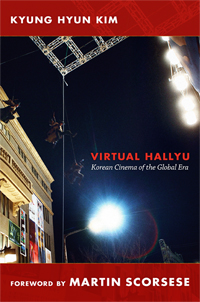
Virtual Hallyu.jpgKorean cinema occupies a peculiar place in relation to hallyu. In a way, Korean movies were the harbingers of the Korean wave. They were the first Korean cultural productions to attract foreign recognition in international film festivals; they carved a global niche that was distinct from Hollywood movies or other Asian productions; and they emphasized distinctive aspects such as violence, romance, or geopolitical tensions. Cinema was the cultural medium through which Korea sought to establish itself as a new global standard. And yet K-movies are not considered part of hallyu the way K-drama, K-pop and even K-cuisine have now become. Only a handful of movies (Shiri, JSA, My Sassy Girl…) came to be seen as representative of the Korean wave, while other movies and moviemakers were perceived through the more traditional categories of film critique—national cinema, auteurship, movie genres, visual aesthetics, and narrative analysis. Korean cinema in many ways set the condition for hallyu’s expansion by inducing a shift in foreign perceptions of Korea. The country came to be seen as the producer of a different brand of modernity, distinct from Japan’s or China’s globalized cultures. Its movies were not only cheap imitation movies known collectively as Copywood; they were original productions in their own right. In addition, Korea’s movie industry demonstrated that critical and commercial success were not always incompatible: commercially successful movies could get critical acclaim, and art movies lauded by critics could also get a significant presence at the box office.

This success was due in no small part to the existence of a corps of movie critics and a roster of movie publications that made commenting on recent movies a legitimate intellectual pursuit in Korea and beyond. Kyung Hyun Kim played an important role in this reevaluation of Korea cinema. The back cover blurb on Virtual Hallyu describes him as “not just the most important Anglophone critic of South Korean cinema but a key figure in film and cultural studies generally.” In his first book on The Remasculinization of Korean Cinema (which I reviewed here), he established the label of “New Korean Cinema” by focusing on movies produced in the 1980s and 1990s. His thesis was that Korea at the time was a post-traumatic society: men had to overcome their masculinity crisis by resorting to masochism and to sadism and by denying women’s agency. In his latest book, he concentrates on movies produced during the next decade, end 1990s to end-2000s, which follow a different master plot. According to Kyung Hyun Kim, Korea has managed to untie itself from the narrative of post-crisis recovery and male failure that dominated Korean movies in the preceding period. Male hysteria no longer provides the dominant theme in more recent productions, and female characters are no longer reduced to the twin roles of the mother and the whore. The themes and characters have become more diverse and cannot be subsumed under a single heading. He nonetheless proposes the two categories of hallyu and of the virtual to define Korean cinema in this new age of commercial success and global expansion.

Riding the Korean wave

More than the commercial expansion of Korean productions abroad, hallyu refers here to a new sense of national consciousness that arose in the wake of the 1997 financial crisis and culminated with the stellar performance of the national soccer team in the 2002 World Cup tournament. It is synonymous with a nation reconciled with itself and basking in its newly acquired global status. Pride and affluence characterized the new Korea that had been able to overcome the masculinity crisis diagnosed in the previous period. This self-consciousness translated in box-office figures: Korea is one of those rare countries where domestic movies consistently outperform Hollywood productions. And yet the author diagnoses a disconnect between the success of Korean films at home and abroad. Films like April Snow, which was specifically designed for the Japanese market, flopped badly in Korea, whereas domestic blockbusters such as The Good, the Bad, the Weird failed to reach a global audience. In addition, Kyung Hyun Kim sees hallyu as a phenomenon limited in time: based on box office figures, he heralds its demise by the end of the first decade of the twenty-first century. After Korean film exports earned a record $75 million in 2005, there was an enormous decline, with only $24.5 million reported in 2006 and $12 million in 2007. For the author, this sudden decline in the popularity of the Korean wave since 2007 is just as inexplicable as its emergence. Of course, a plausible explanation is that there was simply a shortage of lucrative and attractive Korean blockbusters to please Asian tastes during that year and the next. The film industry is one of the most unpredictable in the world, and even critics cannot forecast future hits and flops.

Kyung Hyun Kim borrows the concept of the virtual from Gilles Deleuze and his twin books’ analysis of the movement-image and the time-image. Like Deleuze, he considers movies to be thought-experiments: in this sense, thinking about cinema is inseparable from making it. Through a century-long transformation, we have come to understand ourselves individually and socially through spatial and temporal articulations that were first advanced in movies. Nothing illustrates more the interdependence between philosophy and film-making than the category of the virtual. Virtuality refers here to a kind of being-in-the-world that increasingly eschews reality in favor of escapist pursuits and fictitious worlds. As the author notes, “the high-speed Internet boom that took place in Korea after the late 1990s ironically meant that Korea’s urban youth rarely needed to venture beyond their schools, homes, and offices. If they did choose to go outdoors, it was to the theater.” The virtual complicates the question of what is real and what is unreal. Despite our perception of film as the art form that most closely approximates reality, movies are pure fiction, akin to the simulacra that Baudrillard defines as images without models. Unlike the image, the virtual no longer dwells on the difference between the way things appear and the way they really are. In the virtual world, neither the opposition between true and false nor the one between reality and imagination can be resolved.

Virtual pasts and futures

Cinema itself is built on a technology of virtuality: the projection of twenty-four frames per second is perceived as continuous time and movement by our synapses. With the integration of computer graphics, the virtual has taken a whole new dimension, and the advent of virtual reality promises an era of unlimited possibilities. Everything that can be dreamed, imagined, or conceived, can be put on screen. Special effects and computer-generated graphics allowed Korean movie-makers to expand back in time, as with saguk or historical dramas, or forward to the future as with science-fiction movies. With the help of CG-generated images, directors were able to recreate images from the Chosun Dynasty period or to project their viewers into imaginary worlds. Deleuze’s use of the term “virtual” refers to something that is not only a thing of the past, but of a past that coexists with the present and also of a truth that coexists with the false. Similarly, the movie Lost Memories 2009 (2002) presents a virtual future in which Japanese occupation of Korea has continued into the twenty-first century, mixing memories of a colonial past and imaginaries of an uncertain present. The fascination with the colonial past was also rekindled by the rediscovery of old movies from the 1930s and 1940s that were thought to be lost but had been preserved in the film archives of Soviet Russia and Communist China.

The films covered in Virtual Hallyu more or less correspond to the period when the democratic party led by presidents Kim Dae-jung and Roh Moo-hyun was in power. During that decade, South Korea established itself as a full democracy as well as one of the most economically successful and technologically advanced countries in the world. Kyung Hyun Kim sees a correlation between the liberal policies pursued by these two presidents and the rise of hallyu. The state favored the expression of artistic sensibilities and adopted policies deemed favorable to the creative industries. Lee Chang-dong, an art-movie director, became the minister of culture, tourism, and sports in the Roh Moo-hyun cabinet. Most notably, the Sunshine Policy of peaceful coexistence and cooperation with North Korea, initiated by Kim Dae-jung and continued by his successor, allowed for a more nuanced view of the Communist neighbor country. If Kang Che-gyu’s Shiri (1999) was the last film to rely on a Cold War dichotomy to produce a ruthless North Korean villain and to attempt to reclaim South Korean male agency through the destruction of a North Korean femme fatale, Park Chan-wook’s JSA: Joint Security Area (2000) was the first film to defuse the stereotype of North Koreans as South Korea’s belligerent Other. Other films addressed the taboos of national history: Im Kwon-Taek’s The Taebaek Mountains (1993) depicts the period of guerrilla warfare and civil strife in the Jeolla Province before the start of the Korean war, whereas The President’s Last Bang (2005) and The President’s Barber (2004) concentrate on the controversial figure of President Park Chung-Hee, the first one as tragedy, the second as farce.

The recombination of traditional genres

Movies are shaped by market forces as much as by the political zeitgeist. In the late 1990s, the Korean industry started again to blossom, and showed an impressive success in the domestic market. Korean films enjoyed an average market share of 54 percent over the following decade, with record peaks of 60-65 percent. Last but not least, the Korean film production continued to earn many prestigious awards at top international film festivals, making Korean culture increasing attractive. This happened in the context of limited subsidies by the state and increased free-market access of US film-makers in Korean distribution. If anything, increased competition between US and Korean films induced the Korean cinema industry to create more attractive and lucrative movies than foreign films. Big industrial groups or chaebols, expecting high returns of investment, expanded their power by acquiring individual theaters and creating multiplexes and theater franchises. They invested in the production of genre movies previously considered as the preserve of the American movie industry: Westerns (The Good, the Bad, the Weird), science fiction (The Host), eco-disaster stories (Tidal Wave), urban disaster thrillers (The Tower), and heroic fantasy (Jeon Woo-chi: The Taoist Wizard). Film-makers challenged conventional boundaries and they mixed established genres to create a hybrid repertoire of multi-genre movies: comic-family-melodrama-monster (Bong Joon-ho’s The Host), erotic-horror-crime mystery (Park Chan-wook’s Oldboy), or comic-romantic-women’s tearjerker (Lee Chang-dong’s Secret Sunshine). It is this recombinatory power of Korean cinema that foreign audiences found most attractive.

For Kyung Hyun Kim, the role of the film critic is to unveil the latent meanings beneath the apparent surface of a movie. The message of a movie is made clear only when one confronts it to the other works of an auteur, or when one places it in a series that defines a genre, a historical sequence, or the broader tradition of a national cinema. His analysis is consistent with the discourse of political modernism, founded on the holy trinity of Saussure’s semiotics, Lacanian psychoanalysis, and Althusserian Marxism. Words like postmodernism, postcolonialism, late capitalism, and neoliberalism pepper the text and give it a radical cachet. For the author, none of the films produced in the period were radical enough; they only tinkered with the system, and provided imaginary solutions to real problems. As he concludes, “not only is Korea still scarred and traumatized by its colonial era and the Cold War, but—given the continuing US military presence and occasional threats of war from North Korea—it has yet to claim a true postcolonial and post-Cold War identity.” Curiously, although his previous book was all about masculinity and gender roles, he does’t address the issue of gender in Virtual Hallyu. The resolution of Korea’s masculinity crisis didn’t lead to a more balanced repartition of roles between men and women, and none of the directors listed in the book are female. In this era marked by the end of history and the advent of postmodern identities, Korean cinema has yet to find its new master narrative.

The Anthropologist Goes to Bollywood

A review of Unsettling India: Affect, Temporality, Transnationality, Purnima Mankekar, Duke University Press, 2015.

MankekarIt’s all in the title. UNSETTLING. INDIA. AFFECT. TEMPORALITY. TRANSNATIONALITY. The key concepts are all listed here, in a sequence that will be repeated over and over in the book, like a devotional mantra. It is, if you will, the anthropologist’s “Om mani padme hum”, the way she attains her own private nirvana. Purnima Mankekar’s objective, as she states repeatedly, is to examine “how India is constructed as well as unsettled as an archive of affect and temporality in contexts shaped by transnational public cultures and neoliberalism.” Each word in this mission statement opens a particular space for ordering the observations that she gathered in the course of her fieldwork in India and in California. Indeed, the chapters of the book hold together by a thread, and this common thread is provided by the words listed in the book’s title. So let me engage with them one by one, in no particular order of succession.

Diasporic subjects and transnational imaginaries

TRANSNATIONALITY refers, first, to the two sites where the author conducted fieldwork, gathered observations, and interacted with her informants. The ethnographic material of which the book is composed was collected through the course of nearly two decades in various locations clustered around New Delhi and in the San Francisco Bay Area, where many immigrants from the South Asian subcontinent have settled. Transnationalism has been defined in anthropology as “the process by which immigrants forge and sustain simultaneous multi-stranded social relations that link together their societies of origin and settlement.” Mankekar complicates this definition by noting that diasporic subjects often cannot be pinned down to one place of origin or to one settlement location, as they frequently move across borders and develop modes of identification that are not tied to territory. In addition, transnational imaginaries also affect non-migrants who can only dream of settling abroad but for whom the distant foreign is brought close to home by television programs or consumer culture.

In a more restricted manner, transnationality applies to transnational public cultures as they are studied by the author: Bollywood movies, TV dramas, commodity consumption, ideologies of nationhood, discourses of morality, and fictive identities as in the call centers where young Indian operators impersonate the role of typical Americans. Mankekar treats transnational media as text to be subjected to textual analysis, but also as a practice to be experienced in tandem with her informants. She tells how she is able to break the ice with a busy IT executive by referring to a Bollywood drama, how she brings an Indonesia-born Sikh Indian-American to an old Raj Kapoor movie, or how she discusses gender roles and sexuality with lower-middle class and working-class informants in New Delhi based on TV serials and commercials. Public cultures are transnational because they address or interpellate a public wider than the national community; because they mobilize the forces of borderless capital and commodity fetishism; and because they often picture diasporic subjects while enabling men and women to acquire the capacity to imagine life in other places.

DDLJ, K3G, and B&B

The movies Mankekar discusses are known to many English-speaking audiences in India and abroad by their acronyms or abbreviated titles. “DDLJ” tells the story of young lovers straddling borders and communities to win parental approval to marry. “K3G” is about an adopted son expelled from his rich home for disobeying his father’s marriage injunction and then brought back into the family fold by his elder brother. Bunty and Babli is a road movie about two swindlers who escape from their small town by impersonating rich people’s identities. These stories resonate with the courting of nonresident Indians or NRIs by the Indian state appealing to their investments and skills (DDLJ); they espouse the ideology of Hindi nationalism by producing a fantasy of a reterritorialized Global India in which religious and other minorities are conspicuous by their absence (K3G); or they reflect the increased capacity to aspire of call center operators and other lower middle-class Indian who adopt new names and borrowed identities (B&B). Viewing these movies while reading the book in parallel provides the reader with a wonderful introduction to a fascinating cinematic genre.

AFFECT is a category that is mobilized on different counts. It is a dimension of ethnographic fieldwork, on par with cultural sensitivity and theoretical foregrounding. As Mankekar notes, “conducting ethnographic analysis is itself a deeply affective process and entails an engagement with the entire being of the ethnographer.” She situates her encounters with informants in their sensory and emotive contexts, providing notations on tastes, smells, likes and dislikes. “India shopping” in the ethnic grocery stores run by South Asians in the San Francisco Bay Area involves a whole range of affects, experienced by the author and her informants in intimate, embodied, and often visceral ways. They bring into play “senses of touch, smell, sound, sight, and taste.” These stores provide spaces where community members gather and exchange news about community events, and where new arrivals can learn about neighborhoods, schools, and employment opportunities. They are also places where the community exercises its surveillance upon its members and sanctions “loud” or deviant behavior. All is by no means positive in the outlook and values of Indian Americans, or in the political orientation of citizens back home. In particular, the author develops strongly negative affects towards people who espouse the Hindutva nationalist ideology and who wield campaigns of “aggressive national regeneration” aimed at religious minorities or, more prosaically, against Valentine Day celebrations. The ethnographer’s rapport with her informants is not always based on empathy and understanding.

The political economy of affects

Affect is also part of a political economy of affective labor, affective capital, and affect circulation. Michael Hardt has noted that whole sectors of the economy are “focused on the creation and manipulation of affects.” In particular, affect is constitutive of forms of labor central to the global capitalist economy, as in the transnational service sector where India claims a distinctive competitive advantage. Elaborating the notion further in The Cultural Politics of Emotions, Sara Ahmed conceives of affect as a form of capital. Analogous to the production of surplus value in capitalism, affects assume value cumulatively through circulation. Affective economies are composed of affective investment, affective value, affective circulation, and affective regimes of production and consumption. Affect is distinct from feeling (the domain of individual subjectivity) and emotion (the domain of the linguistic). Affects are generative of subjectivity—of action and agency, the capacity to act and be acted upon.

Mankekar uses these theoretical insights in a fine-grained ethnography of call center operators in a New Delhi suburb. Call centers have become the most visible part of the business outsourcing industry and have been heralded by media pundits and globalists as proof that “the world is (becoming) flat.” Mankekar demonstrates the value of ethnographic writing as opposed to media reporting. She describes affective labor as based on affective repertories – of courtesy, familiarity, friendliness, helpfulness, and, above all, caring. It is also based on the alienation of workers who refashion their only means of production—their own selves, their own bodies—through practices of impersonation and borrowed identities. As the two movie characters Bunty and Babli, call center agents become themselves by becoming others. Their aspirations to upward mobility, glamour, and success is also nurtured by transnational media: they are required to watch Hollywood films and episodes of US television shows such as Friends, and to use them as resources to acquire American accents, adopt American colloquialisms, and learn about the American way of life. They engage in virtual migration through IT-mediated work and cultivate lateral mobility by moving from one employer to the next. But the end of distance doesn’t bring the end of place. The virtual migration of call center agents coexists with forms of emplacement and immobility (and in some cases, virtual incarceration) through technologies of regulation and surveillance.

Nostalgy for the future

TEMPORALITY is the second repertory or archive mobilized, in conjunction with affect, to delineate the production and unsettling of transnational India. Describing the modern imagination as an expanded “capacity to aspire,” Arjun Appadurai suggested that we foreground aspiration in order to “place futurity, rather than pastness, at the heart of our thinking about culture.” Indian residents or diasporic subjects locate India not so much in the past as in the future. In this new regime of temporality, tradition emerges as an affective process that entails “not so much the invocation of a past as the generation of a set of practices enabling subjects to imagine and embrace specific forms of futurity.” Among diasporic Indians who carry India in their heart wherever they go, Indianness is not constructed as static or unchanging but instead is portable and flexible. Similarly, Hindu natinonalists experience “nostalgia for the future”: their longing for a glorified and mythic past combines with an aspiration to march toward a glowing future as moral subjects of Global India. In this sense, “time has agency or, at the very least, a force of its own.” Time combines with affect to shape subject formation and social process.

INDIA is constituted as an archive of affect and temporality by transnational public cultures. What “India” means is very different for each of her informants in New Delhi or in the San Francisco Bay area. Some subscribe to Hindu nationalist discourses of national purity, while others adhere to secularist conceptions of nationhood. Some insist on bounded territory and fixed identities, while others are engaged in transnational deterritorialization processes and multifaceted roles. Diaspora members carry India in their hearts wherever they go, while some individuals construct their own private India with disparate elements assembled through identity bricolage. Second-generation youth express their identity in terms of cultural difference: for these transnational consumers of Bollywood musicals and ethnic productions, “it’s cool to be Indian now”. Food is of particular significance to communities that travel across transnational space. As a mother testifies, “now that the kids are in school, they’re forgetting their Gujarati. But the least I can do is to give them one Indian meal a day.” Some see India as a country of origin, while others identify it as the land of the future.

Indian settlements and unsettlements

UNSETTLING is a common analytic that hints at the subversive nature of academic writing, politically and culturally. The disciplines of gender studies, media studies, critical theory, or cultural studies are particularly unsettling in the sense that they introduce ambiguity and uncertainty where the dominant ideology tries to impose certitude and conformity. Like many cultural critics committed to a progressive agenda, Mankekar does not take categories for granted. She refuses to essentialize notions of nation, gender, class, or ethnicity, while at the same time recognizing their relevance for interpreting social processes of identity formation and collective mobilization. In particular, she unpacks and decanters the totalizing claims of nationhood. She shows that “unsettlement is intrinsic to the production of India, such that Indian culture is conceptualized as chronically in flux, as always emergent.” India is unsettling as a nation: it challenges aspects of American identity, and is deemed particularly threatening to the self-representation of the US as a technological leader. Outsourcing service activities to India elicits reactions of rejection or even racist slurs, as when Americans realize they have been connected to a consumer service located in India. As the author notes, “we rarely see the same virulence in discussions about outsourcing to Israel and Ireland.”

Unsettling India is also part of a wider project of unsettling nations. India is not the only nation to be constituted and unsettled by regimes of affect and temporality. As Mankekar claims in her conclusion, “I have wished to sketch the contours of a conceptual and political framework that may enable us to unsettle the exclusionary and violent claims of the US nation.” In post-September 11 America, fear and rage against people of South Asian and Middle Eastern origin, in particular those “deemed to be Muslims” (such as Sikh men wearing a turban) contribute to the creation of a nation predicated on the marginalization and demonization of racial and cultural Others. This book is about unsettlement as an ethnographic strategy as well as an analytic. “It is vulnerable to the irruption of surprises, emergences, and potentialities, and to the ineffable, the inarticulate, and the inscrutable.” Traditional conceptions of family, gender, or Indianness are displaced and unsettled by images of sensuality and erotic longing. Even the most conventional romance stories or the most obtuse nationalist discourse carry a twist, a fault line that opens them to the dimension of desire. It is the hero’s respect for Indian women’s sexual purity that makes DDLJ a truly erotic movie. The controversies surrounding Valentine Day in India underscore the greater visibility of romantic love and displays of affection between young men and women. India is constructed and unsettled in the same move. Mankekar revels in revealing these shifts and cracks in the fabric of social life.

The Master Narrative of the New Korean Cinema

A review of The Remasculinization of Korean Cinema, Kyung Hyun Kim, Duke University Press, 2004.

RemasculinizationThe thesis of this book is quite simple. Korea in the 1980s and the 1990s was a post-traumatic society. The figure of the father had been shattered by its authoritarian leaders, who ended in a grotesque finale (see The President’s Last Bang, 2005, about the assassination of Park Chung-hee) or, in the case of Chun Doo-hwan, lacked hair (The President’s Barber, 2004). The double trauma of colonization by Japan and fratricide murder during the Korean War had deprived the Korean people of its identity. The sins of the fathers were visited upon the sons, and the Memories of Murder (2003) still lingered. The ritual murder of the father could not unite the community of brothers as they stood divided between North and South (Taegukgi: The Brotherhood of War, 2004), between sons of patriots and sons of collaborationists (Thomas Ahn Jung-geun, 2004). The films quoted above, all produced in the 2000s, could resolve the tensions and dilemma of overcoming trauma by representing them on screen. By contrast, films produced in the 1980s and 1990s could only repress the representation of the primal scene, generating frustration and anger. In psychoanalytic terms, this is the difference between “working through”, the positive engagement with trauma that can lead to its ultimate resolution, and “acting out” or compulsively repeating the past.
Working through or acting out past trauma

Failure to come to terms with the representation of trauma transformed men into hysteric subjects. Simply put, men were deprived of their manhood. They were constantly alienated and emasculated by the political and economic forces of the day. In order to recover their potency, they resorted to violence: hence the brutality and violent acts ubiquitous in many Korean films. Here the author of The Remasculinization of Korean Cinema sees a sharp distinction between films produced in the 1980s and in the following decade. If the 1980s was a period of male masochism for Korean cinema, by the 1990s men freed themselves from anxiety and trauma by resorting to sadism. The two forms of violence must be clearly distinguished. Both the masochist and the sadist find pleasure in pain—pain of the self, pain of the other. But the sadist aims at subverting the law; the masochist wants to emphasize its extreme severity. The common thread that unites them is their misogynistic tendency towards women: very often, the victim of men’s effort to regain their manhood is the woman. The films from the period were solely centered on male characters. They were depicted as pathetic losers or as dumb brutes, and the movies acted out their masculinity crisis without any regard for the opposite sex. Women only functioned as passive objects oscillating between the twin images of the mother and the whore. What is absent in these movies from these two decades is a positive female character, let alone a feminist plot.

The thesis of remasculinization as a way to recover from trauma is not new. It has been advanced by American cultural critics in the context of the post-Vietnam war. The trauma of defeat, changing gender roles, and economic uncertainties generated a masculinity crisis that led to alienation, retrenchment, and gynophobia. In America, the renegotiation of masculinity took the form of the lone warrior culture, illustrated in blockbuster films of the 1980s such as Rambo, Die Hard, or Dirty Harry. What is specific about South Korea’s post trauma recovery is the political and economic context. It must be remembered that the end of authoritarian dictatorship and the inception of democracy in Korea occurred only in 1987. Before that date, films still had to deal with heavy censorship, and protest against the military government was disallowed. Unlike General Park Chung-hee however, General Chun Doo-hwan, his successor, recognized the importance of leisure and consumer spending as a way to assuage the masses and compensate the dispossession of their voting rights. He authorized the production of a wave of sleazy movies that found their way into theaters, while political expressions were strictly censored. The hope was that consumerism and pornography would make people forget about democracy and postpone their hope for a more representative government.

Korea bumped into modernity at full speed

But economic development wasn’t enough to ease the pain: in fact, it generated more ailments and frustrations. That Korea’s compressed economic development was traumatic is often overlooked. The “miracle of the Han river” left aside many victims and outcasts. Korea bumped into modernity at full speed, and without security belts or social safety nets. Urban alienation and economic marginalization is the theme from many Korean films from the 1980s and 1990s. In Chilsu and Mansu (1988), two billboard painters living on day jobs climb to a high-rise building in downtown Seoul to privately demonstrate their pent-up frustration. The public from the street below mistakes their aimless private rant for a public demonstration, and the police intervenes to arrest them. In Whale Hunting (1984), the disheartened protagonist, rejected by his college girlfriend, wanders the streets where he befriends a beggar and hangs out with a mute prostitute looking for a home. His sexual anxiety is displayed through farcical situations as in the opening scene where he dreams he is standing naked before a laughing public, or when he hugs the bare breasts of a naked statue in a museum gallery. In all the movies covered in the book, the wanderings of the male character invoke the traumatic losses of pastoral communities (urban dramas), homes (road movies), faithful wives and asexual mothers (sex scenes), and memory and sanity (social problem films).

Some artist moviemakers attempted to allude to the political by way of the sexual. One chapter is dedicated to Jang Sun-woo’s movies (The Age of Success, To You From Me, Bad Movie) which have generated far more controversy than works of any other director of the New Korea Cinema. Jang Sun-woo’s characters are self-loathing, pathetic men described as sexually frustrated, impotent, and castrated. Crude sex scenes are ubiquitous and are meant to disturb and to unsettle more than to titillate or sexually arouse. For Jang, these frail masculinities are reflective of the unresolved social crisis in South Korea that began with the elimination of the political dictatorship, when he longtime president was abruptly assassinated in 1979, and the ensuing period of political unrest. The sexual and the political are closely intertwined: in To You, From Me, Jang Sun-woo portrays an underground enterprise that releases pornographic books under the disguise of subversive North Korean communist manifestos—both are banned materials and therefore fetishized. But his anarchist, nihilistic streak is perhaps best exemplified by Bad Movie, described as “one of the most daring and experimental feature films produced in Korea,” shot without set direction, script, or production plan. The movie shows raw, crude images of sex and violence, loosely motivated by a chronicle of young runaway teenagers engaging in street motorcycle races, extortion, rape, and murder. As Kyung Hyun Kim comments, “it is as close to the real as it can get, disorienting and discomforting even the contemporary art-film viewers who are familiar with violence aestheticized in cinemas of Wong Kar-wai, Quentin Tarantino, and Kitano Takeshi.”

Men turn to violence and to sadism to reclaim their masculinity

Other directors were more overtly political. Films about the Korean War (Chang Kil-su’s Silver Stallion, Yi Kwang-mo’s Spring is My Hometown, and Im Kwon-Taek’s The Taebaek Mountains) present a different way of remembering the war, one that doesn’t rest on the diabolization of the North Korean enemy but rather insists on cracks within the South-Korean-American alliance: partisan guerrilla in the Cholla Province, yanggongju prostitutes serving US soldiers, internal conflicts within a community or a family, absent fathers and raped women. Here again attention focuses on men who have lost their virility and authority during the war, and who turn to violence and to sadism—especially against women—to reclaim their masculinity. Other episodes of Korea’s postwar political history are also revisited. A Single Spark concerns the life and death of labor union martyr Chon T’ae-il, while A Petal depicts the 1980 Kwangju uprising. These are sites that resist both remembrance and representation, components of a post-traumatic identity that can only act out what is still too painful to work through. It is also noticeable that these two movies targeted primarily foreign audiences at international film festivals. Their directors, Park Kwang-su and Jang Sun-woo, could take political and financial risks because they had already built international reputations. The years the two films were released, 1995 and 1996, also had democracy firmly entrenched since the transition of the end-1980s and the election of the first civilian president in 30 years in 1992.

The reception of Korean movies was also conditioned by their conditions of production and distribution. Most movies covered in The Remasculinization of Korean Cinema are low-budget films directed by authors who aimed at a limited audience and assembled production teams based on personal acquaintances and on-the-job training. But they are also films that have stimulated local commercial interest in a country that valued cinephile club screening and intellectual consumption of movies that would have been commercially unviable in the West. It should also be noted that the renaissance of Korean cinema in the 1980s and 1990s occurred not because of, but rather in spite of the role of the government. Import quota restrictions diminished during the 1980s, and Korean filmmakers had to aim for the creation of art cinema without the aid of state subsidies. Not only were public funds denied for Korean films, but also were bank loans, forcing filmmakers to seek alternative financial resources and credit. No Korean filmmaker could therefore neglect the box office. For some of them, the international circuit of international film festivals and arthouse movie theaters provided a source of legitimacy and revenue. Despite adverse conditions, Korea is the only nation during recent history that has regained its domestic audience after losing them to Hollywood products. Art movies from the 1980s and 1990s paved the way to the Korean blockbusters of the end-1990s and 2000s that attracted massive domestic audiences and conquered foreign markets. They also made it sure that a market space for independent movies continued to exist in Korea, as evidenced by the career of director Kim Ki-duk whose productions closely complement the movies reviewed in the book.

Korea has yet to produce a movie with a female plot, let alone a feminist one

Kyung Hyun Kim mobilizes the categories of national cinema as a genre and of the director as auteur to develop his film criticism. He focuses on a segment of Korea’s filmic production in the 1980s and 1990s that was sometimes touted as the New Korean Cinema by film critics. This is in accordance with the conventions of cinema studies, which treats national cinemas as discrete entities and delineates periods or currents characterized by a particular style or narrative. The master narrative of the New Korean Cinema is the masculine recovery from trauma, a movement that Kyung Hyun Kim sees as problematic because it is based on the exclusion of women. As he argues, Korean cinema has yet to produce a movie with a female plot, let alone a feminist one. The representation of woman is still caught between the mother and the whore. Another characteristic of the New Korean Cinema is that it had to strictly play within the commercial rules of an open marketplace, which meant competing with Hollywood films distributed freely across the nation, and could not completely abandon the conventions of popular filmmaking. The author sees this commercial exposure both as a factor in the success of the New Korean Cinema and the reason of its demise: once aligned with Hollywood standards, Korean cinema lost its shine and became just a niche cultivating subgenres in a global marketplace.

Ghost in the Shell

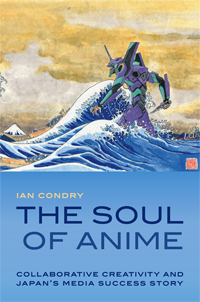
A review of The Soul of Anime: Collaborative Creativity and Japan’s Media Success Story, Ian Condry, Duke University Press, 2013.

the-soul-of-animeIn my opinion, The Soul of Anime should be read in business schools. It provides a wonderful case study of a particular industry, and it can teach management practitioners many things about globalization, creative industries, and flexible labor. Unlike what is stated in the book’s subtitle however, the story of Japanese anime is not a success story. As Ian Condry states in the introduction, “in terms of economic success, anime seems more of a cautionary tale than a model of entrepreneurial innovation.” Judged from a management perspective, the anime industry is in many ways a case of failure: a failure to globalize, a failure to create value on a sustained basis, and a failure on the side of market participants to reap profits and secure employment. But management can learn from failures as much than it can learn from success stories. What’s more, the anthropological perspective adopted by the author points towards a different theory of value creation: for cultural content industries, value is not synonymous with profits, and the relation between producers and consumers cannot be reduced to monetary transactions and economic self-interest. This is the intuition that the founders of anthropology developed when they analyzed trading relations among primitive tribes in terms of gift-giving and reciprocity; and this is the conclusion that this modern anthropology book reaches when it describes the popular success of this particular case of industrial failure.

A failed success story

Why didn’t anime transform itself into a profit-making machine for Japanese media groups? Why didn’t studio Ghibli—the producers of Princess Mononoke and Spirited Away—develop into a franchise akin to Walt Disney’s? Why didn’t stories based on manga series—the main source of inspiration for Japanese anime—give birth to blockbuster movies the way that Marvel Comics did? For all its popular success and—in the case of Ghibli production—critical acclaim, Japanese anime production remains in many ways a cottage industry. The studios in which the author of The Soul of Anime did his fieldwork, with names such as Gonzo, Aniplex, and Madhouse, are small-scale operations that continuously stake the house on their next production. Even the biggest players such as Studio Ghibli, Production I.G. and Toei Animation are limited in size and do not generate extraordinary profits. As Ian Condry describes it, a studio can employ anywhere from fifteen to a few hundred people, and relies heavily on local freelance animators as well as offshore production houses located in South Korea, China, and the Philippines. Like other segments of the Japanese industry, the anime sector has been “hollowed out”: by some estimates, 90 percent of the frames used in Japanese animation are drawn overseas.

The work that remains in Japan is not very well-paid and is precariously flexible. Long hours are the norm, and many animators work freelance, moving from project to project, often without benefits. Visiting a studio is more like entering the den of a manga production house, with papers piling up everywhere and people working frantically on deadlines, than witnessing the cool working environment of a high-tech start-up. Indeed, manga stories provide most of the content later developed in anime movies, and the two worlds are closely interconnected. Osamu Tezuka, the creator of Astro Boy otherwise known as the “god of manga,” used to quip that manga was his wife, while animation was his mistress. Like manga, anime now attracts a cult followership across the globe, and fans are present on every continent. They often start to watch anime from a very young age: by some estimates, 60 percent of the world’s TV broadcasts of cartoons are Japanese in origin. Despite its global reach, the anime industry failed to give rise to corporate giants that could have become global actors. Even Studio Ghibli’s biggest overseas success, Spirited Away, which won an Academy Award for Best Animated Feature, scored much less on the international box office than U.S animated productions of much lower quality. Mamoru Oshii’s cult film Ghost in the Shell reached number one in DVD sales in the United States in 1996, but failed to generate profitable spin-offs and lucrative sequels. Toei Animation’s original ambition to become the “Disney of the East” has failed egregiously.

The Galapagos syndrome

In a way, the failure of anime to globalize is just another case of the Galapagos syndrome: many globally available products take a local form in Japan, a variant that is sometimes more advanced and attuned to the local ecosystem, but which diverges from global trends. This isolation from the global market acts as a form of protectionism, allowing species to develop in unique ways, but leaves Japanese companies ill-prepared for global competition. Although cultural content industries such as manga, anime, video games, music, and films are being promoted by Japanese authorities for their ability to attract foreign audiences, the fact is that creators, drawers and scenarists mostly have a domestic audience in mind when they design their stories. The scorecards that manga readers send to weekly magazines to rate their favorite episodes is a case in point: it makes manga scenarios highly receptive to the reactions of the public, as unpopular series are discontinued and only the most popular manga stories survive and evolve according to their readership’s taste. But the system also makes manga series dependent on the whim of a group of core fans or otaku that do not necessarily reflect the national public, let alone global audiences. Copyright and intellectual property rights may also be an issue: Japanese companies reap hefty profits on the domestic market where IPR protection is strong, but are pilfered in neighboring countries through copycats, illegal downloading, and video streaming. Yet another argument that explains anime’s parochialism is that the global slot of blockbusters and megahits is already occupied by American productions, leaving only the niche markets of national cinema and sub-culture.

There are many reasons anime didn’t go global the way Walt Disney did. But perhaps we are using the wrong yardstick. Perhaps the value that anime generates belongs to a different class that is more diffuse and evanescent. As Ian Condry notes, “so much of what makes media meaningful lies beyond the measures of retail sales, top-ten lists, and box-office figures.” Anime cannot be gauged solely by examining what happens onscreen or by how it is marketed by studios. Instead of analyzing the cultural content of particular series or the business strategies of anime producers, Condry looks at the role of fans, the circulation of anime series and the dynamics between niche and mass market. He shows how the unexpected turnaround from failure to success for the Gundam franchise was linked to the energy of amateur builders of giant “mecha” robots and fans forming “research groups” into “Minovsky Physics”, an invention from the sci-fi series. He follows hard-core fans in sci-fi conventions, cosplay contests, and other fairs where amateurs distribute home-made manga and otaku videos. He focuses on fansubbing, the translation and dissemination of anime online by fans, which is governed by complex rules that are not always hostile to copyright protection. He considers how people can express strong affection or “moe” for virtual 2D characters with and sees it as “pure love” with no hope for a reciprocal emotional payback. This is a multi-sited ethnography, based on participant observation or “learning by watching” (kengaku), in which the author attempts to assess how value arises through the social circulation of media objects.

Follow the soul

Economists follow the money; anthropologists follow the soul, the energy, the mana. In his classic study of the Kula trade among the Trobriand islanders, Bronislaw Malinowski described the complex rules by which shell necklaces and trinkets circulated around a vast ring of island communities to enhance the social status and prestige of leaders. Kula valuables never remain for long in the hands of the recipients; rather, they must be passed on to other partners within a certain amount of time, thus constantly circling around the ring. French anthropologist Marcel Mauss, author of The Gift, reconceptualized this analysis of the Kula trade to ask: ”What power resides in the object given that causes its recipient to pay it back?” His answer was that Kula objects were invested with a certain property, a force binding the receiver and giver that he called the ‘hau’ or life-force. Another Polynesian notion that Marcel Mauss used was the ‘mana’: a form of a spiritual energy or charisma which can exist in places, objects and persons. Applying these notions to the Japanese context, we can say it is the ‘hau’ of anime that makes fans devote some of their time to give back to the community of anime lovers through writing subtitles or designing cosplay costumes. By summoning the ‘soul’ of anime, Ian Condry reconnects with some basic concepts of the discipline, and renews the inspiration of two of the great founders of anthropology. Both Bronislaw Malinowski and Marcel Mauss tried to build theories of exchange and the economy that went beyond monetary transactions and the economic interest of rational individuals. We find that same attention on how energy flows, reputations accumulate, and people collaborate in the production and circulation of anime.

Management scholars can also learn a lot from reading this modern anthropology book. The concept of ‘co-creation’ used by management scholars and sociologists is close to the ‘collaborative creativity’ used by Ian Condry to describe emergent structures of creative action in which both anime studios and fans play an important role. Similarly, “platforms” are a hot topic in management studies. Business scholars see platform industries as embodied in technologies that allow open collaboration and value creation on an unprecedented scale. Economists see platforms as multi-sided markets having distinct user groups that provide each other with network benefits. Rather than viewing technologies or markets as the platform, the anthropologist draws our attention on the circulation of emotions and meanings that define and organize our cultural space. Observing script meetings for a particular children TV series, Condry describes how a logic evolving around ‘characters’ and ‘worlds’ form the basis on which anime scripts are constructed and evaluated. Characters and worlds are trans-media concepts: they make a particular design or atmosphere move across media and circulate among people. They attract and connect, without being tied to any particular story or media. A well-known example is Hello Kitty, a character which exists independently from any storytelling and which has become an icon of a world of cuteness or ‘kawaii’. But characters are ubiquitous in Japan: they advertise anything from government agencies to city wards, and ‘character designer’ is a popular profession among the young generation.

From niche to mass market

Anime is often considered as the land of otaku, the realm of geeks, the kingdom of nerds. It is segmented into different categories or sub-genres, and a series’ appeal is generally limited to one single age group, as even the biggest successes very seldom straddles generations. It is, in essence, a niche market. Very seldom can it hope to reach a mass audience. But as Condry argues, the path from niche to mass may first involve jumps from niche to niche. Indeed, this might be the key to a more accurate definition of mass: to see it as network of niches acting in unison. The notion of “media success” often hinges on a movement from something small-scale that expands to become large-scale, yet niche has a chance in the context of global popular culture, free downloads, and viral videos. This is a new world after all, a world where the music video of an obscure rap singer from South Korea can be viewed over 2.5 billion times on YouTube, or where a gore movie such as The Machine Girl, whose schoolgirl heroin has a machine gun grafted to her amputated arm, can feature among the most often downloaded films on some media sharing platforms. Management should better pay heed to the otaku out there—or, in Steve Jobs’ words, “to the crazy ones, the misfits, the rebels, the troublemakers, the round pegs in the square holes… because the ones who are crazy enough to think that they can change the world, are the ones who do.”

Ian Condry also redefines what we mean by social media. As he remarks, “today, media forms are more than something we simply watch, listen to, or consume; media is something we do.” Social network services like Facebook or Twitter have demonstrated that media could be a platform for participation as much as an object of consumption. What makes “social media” new is not the technology as much as the idea that media is not something to consume from a Network (like ABC) but something we participate in through our (small “n”) networks. Social network services or SNS make real what is virtual by making virtual what is real. In other words, Facebook-like platforms project onto the virtual world structures of relations between people and objects that form the basis of our day-to-day interactions; and by doing so, SNS show the materiality of the invisible bonds that connect components of the real world. Social media has helped put back the social into the media; but as the story of anime illustrates it, the social has been there all along. Anime’s success as a media form relies on the feedback loops between producers and audience. This brings us back to the energy around anime, which arises through its circulation and the combined efforts of large number of people. We might think of this collective energy as a kind of soul. The social in the media is what the anthropologist calls the soul. It is like a ghost in the shell: it animates real and virtual bodies, it moves across media platform and licensed goods, it makes energy flow from producers to consumers and back again. Anthropology is a very useful means of capturing these dimensions of our social reality that are ghost-like and often spirited away, because fieldworkers can gain access to that which is most meaningful to people through persistent engagement and critical questioning. This is why, in my opinion, anthropology should be taught in business schools.

When the Korean Wave Hits the Screens

A review of Tourist Distractions: Traveling and Feeling in Transnational Hallyu Cinema, Youngmin Choe, Duke University Press, 2016.

tourist-distractionsKorean government officials nowadays distinguish three waves of hallyu. The first one occurred serendipitously with the unintended success of Korean TV dramas in Japan, China, and South-East Asia. The second wave was brought by the marketing strategies of entertainment companies that targeted growing markets and developed export products in the form of K-Pop bands, TV co-productions, computer games, advertising campaigns, and restaurant chains. According to these Korean officials, the third wave of hallyu will cover the whole spectrum of Korean culture, traditional and contemporary alike, and will be engineered by the state, which sees the export of cultural content as a linchpin of its creative economy strategy. Korean cinema sits rather awkwardly in this periodization. Korean movie directors didn’t wait for the first ripples of the Korean wave to gain recognition abroad: they featured early on in the Cannes film festival and other international venues where their talent and originality won critical acclaim. Cinema studies constituted Korean films as a topic for analysis before hallyu became a theme worthy of scholarly research and commentary. The first books that addressed Korean cinema as a genre, such as Kyung Hyun Kim’s seminal essay on The Remasculinization of Korean Cinema, were written in the tradition of Asian cultural studies that sees each countries’ movie productions as a distinct whole, thereby overlooking the transnational dimension that is so prevalent in the reception of Korean hallyu.

Hallyu cinema as a subset of Korean film history

Youngmin Choe, who is the coeditor of a Korean Popular Culture Reader, bridges two strands of research: Korean cinema studies—that takes national boundaries as a given and addresses the aesthetic content of movies—and hallyu studies—which are by nature transnational and focus more on reception. She does so by limiting her study to the films produced between 1998 and 2006—the high mark of the Korean wave—and by addressing one particular theme: tourism, or the movement of people and emotions across national borders. The films examined in this book seem to anticipate the travels of their audience. They display traveling and tourism as a theme in their narrative, and present locales and sceneries in a way that is bound to induce travel plans and touristic yearnings. They are, in this way, self-referential: travel or boundary-crossing features both on-screen in the stories that are narrated and in the off-screen transnational movements that these films generate. This allows the author to construct hallyu as a category worthy of academic research and to propose the notion of hallyu cinema as subset of Korean film history. As she states at the outset, “the largest ambition of my study is to transform hallyu, which has become first and foremost a marketing strategy, into a bona fide critical term.”

It all started with Winter Sonata. The TV drama featuring Bae Yong-joon achieved a huge success in Japan and set the standard for the crossover and tourist potential of the Korean wave. Locales shown in the drama became the destination of fan tours and touristic pilgrimages. Middle-aged Japanese ladies craved after the sight of “Yon-sama” and developed a cult-like followership. This in turn set the stage for the ongoing Korean wave, which reached publics well beyond Japan and sparked an interest for all things Korean. Although she doesn’t address this particular drama—she only considers films—Youngmin Choe discusses several movies that were produced in Winter Sonata’s wake. April Snow, a film released in 2005 and featuring the same actor Bae Yong-joon, was produced with the Japanese public in mind. Filmed in locations on the eastern coast of Korea, the film contains a self-referential invitation to what the author calls affective tourism: affective images are projected onto affective sites so that the experience of the traveller reproduces the emotions felt by the viewer. Inspired to visit these locations because of the movie story, the tourist travels as if he or she were in the film. Unlike visitors to Universal Studio Hollywood theme park in the United States, tourists at the April Snow sites are invited not only to the places where the movie was shot, but as if into the diegetic and affective space of the movie itself. For instance, in the small city of Samchok, tourists interested in April Snow can sleep in the same room as the characters in the film, eat the same food, sip coffee at the same table, and walk the same streets, with signs and posters depicting images from the corresponding scenes in the movie.

Tourism, drama, and the emergence of an Asian identity

Tourism and drama are associated with modernity in Asia. Indeed, television series and touristic travel shape the imagined communities of East Asia. They are the modern equivalent of the newspaper printing press and the political exile, two agents that Benedict Anderson saw as central in the emergence of national communities in nineteenth century Europe. In Asia, the leisure class takes the form of the travel group. Mass tourism is the foremost expression of the newly gained access to leisure and mass consumption. The Asian tourist has often been identified with the group-centered, photo-taking, cliché-seeking participant of organized package tours. But there’s more to it than just group-think: Asian tourism creates a new form of commodified experience, which is less centered on exotism or escapism and more on emotions and affects. In this respect, the Asianization of Asian tourism is accompanied by a displacement or tourists’ interest. Less focus is placed on history and cultural heritage, more attention is devoted to bodily experiences such as eating, shopping, and scenery-viewing. The Asian tourist looks for the experience that will yield photo opportunities and conventional memories to be shared with others. Asianization, before being analyzed in economic or political terms, can be conceived as a shared affective experience shaped by regional tourism and media consumption. These networks of travel contacts and emotional yearnings among Asian populations are what made hallyu’s rise possible in the first place.

Lest we forget, the tourist imagination in East Asia began with pornography. Japanese tourism to Korea from the mid-1960 until the late 1970 was predominantly male and centered around sex tourism, often combined with business meetings. Known also as kisaeng tourism, this kind of sexual encounter harkened back to colonial practices in yojong establishments and epitomized the imperial consumption of the colony itself as an object of desire. Youngmin Choe opens her book by a close examination of Park Chul-soo’s Kazoku Cinema, the first film collaboration between Japan and South Korea following the lifting of the ban on the import of Japanese cultural products in 1998. Kazoku Cinema is a self-reflexing film about the making of a film, with strong sexual undertones. As the author writes it, “pornography becomes an allegorical mode of historical reconciliation that foregrounds everyday banality.” The desire for sexual intimacy and physical touch also shapes the story of Asako in Ruby Shoes, which cuts back and forth between Tokyo and Seoul as the two heroes engage in Internet porn, and of April Snow, which narrates an adulterous liaison. The whole production of the Korean wave can in a way be interpreted as soft porn, as the cravings of middle-aged Japanese ladies for “Yon-sama” or the provocative attire of K-pop idols suggest. In turn, these sexual desires and erotic feelings contribute to the transformation of once rival nations unto cooperative friends open to transborder flows. Sex, in Asia, is political.

The political is never far in Korea, a land divided between two states separated by the 38th parallel. Any visitor to the DMZ has experienced the strange feeling of being at the same time in a movie scene and in a tourist attraction. On the face of it, the reality of the place contradicts both impressions: the tension between the two Koreas is very real, and the DMZ is first and foremost a military zone. But visits to the DMZ are shaped as a tourist experience, not least because of the many films that used the zone as their locale. Park Chan-wook’s Joint Security Area (J.S.A.) begins with an aerial shot of the DMZ, as a group of foreigners on a guided tour of the southern side are surveying the Military Demarcation Line that runs through the middle of the demilitarized zone. It ends with picture shots taken by the tourists in this initial scene, which reveal the whole story that has been unfolding. The commodification and marketization of military zones is not limited to the DMZ. The Korean War film Taegukgi illustrates a process labelled as “post-memory”: the memory of a trauma that was never personally experienced, but whose lingering effect is felt by following generations. This Korean blockbuster, produced shortly after the liberalization of the movie industry imposed by the US as part of the FTA, thematizes the struggle against Hollywood hegemony, the nation’s simmering anti-American sentiments, the rise of an Asianization discourse, the realities of national division, and the hopes for reunification. As the film Silmido, set on an island off the coast of Incheon, it has given rise to a theme park and also was the focus of a temporary exhibition, thereby fueling the rise of film-induced tourism. The author opposes the Korean War Memorial, which illustrates how the Korean War should be remembered—as heroic, masculine, and patriotic—, and the “false memorials” created in the wake of war movies, giving way to alternative modes or remembrance that are more feminine, leisurely, and affective.

How do all the movies analyzed in Tourist Distractions relate to hallyu? As Youngmin Choe makes it clear, most of the films she addresses are not part of the Korean wave as defined by state authorities and media reports: only movies geared towards a Japanese audience like April Snow, or the blockbusters produced after the opening of the market to Hollywood competition, qualify as such. The hallyu discourse does not emerge in Korea until 2001. It has roots in twentieth-century visions of Asian integration and serves to support the corporate strategies and geopolitical ambitions of newly-developed Korea. The author links hallyu to neoliberalism, cultural nationalism, and postcolonialism, and she uses the words “neo-imperialist” and “sub-imperialist” to qualify Korea’s projection of cultural power. But her book does not discuss political integration and economic processes in detail. As she states, “I am more interested in the formation of a shared affective experience that transnational cooperation requires in order to build its networks for the exchange of products and capital.” In a reversal of Marxist thought, culture is not the reflect of underlying economic forces, but forms the infrastructure basis or enabling factor which makes economic and political developments possible. Her category of “hallyu cinema”, strictly delineated in time and in scope, is defined by the aesthetic criteria of self-reflexivity and affective content, not by the movies’ marketing strategies or their impact at the box office. Self-referentiality in hallyu movies refers both to the content of the movies—as the films examined in the book seem to anticipate the travel of their audiences—and to their production and circulation that foster transnational exchanges. Tourist films and film tourism are closely interconnected.

The affective turn in cultural studies

Beyond contributing to cinema studies and hallyu studies, Tourist Distractions points towards what has been described as an “affective turn” in cultural studies. The notion of affect—pre-individual bodily forces, linked to autonomic responses, which augment or diminish a body’s capacity to act or engage with others—has become a central tenet of cultural studies. Affect is a concept that places emphasis on bodily experience and that goes beyond the traditional focus on representations and discourse. The turn towards affects is therefore a turn, or a return, to the body. It is also a turn towards new kinds of imagined communities. Affects and emotions help us connect with some people while distancing us from others and in material form can be used for economic and political purposes, making it a form of capital. Emotions help form the boundaries and relationships between individuals and society; they determine the rhetoric of the nation. The hallyu nation, or global Korea, is built on networks of affective exchanges. Korean movies and dramas are valued for their emotional content, for their ability to move people in many ways, including geographically. Call it, if you will, the Greater East Asia Co-Sentimentality Sphere. The emergence of this new affective space that stems from the diffusion of tourism and of films, lies at the core of this groundbreaking study of hallyu cinema.