
The State of Exception in East Asia

A review of Neoliberalism as Exception: Mutations in Citizenship and Sovereignty, Aihwa Ong, Duke University Press, 2006.
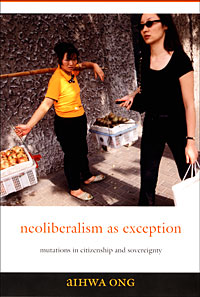
Neoliberalism as ExceptionCarl Schmidt defined sovereignty as ultimately the power to call a state of exception to the normalized condition of the law. Drawing on the German philosopher, Giorgio Agamben uses the exception as a fundamental principle of state rule that is predicated on the division between citizen in a judicial order and outsiders stripped of juridical and political protections. Aihwa Ong, a Berkeley anthropologist, offers a milder version of the state of exception: the sovereign exception she is interested in “is not the negative exception that suspends civil rights for some but rather positive kinds of exception that create opportunities, usually for a minority, who enjoy political accommodations and conditions not granted to the rest of the population.”

The neoliberal state of exception creates threats and opportunities

Aihwa Ong is interested in the spaces and identities opened up by neoliberalism as exception–the market-oriented and calculating technologies of government used by otherwise interventionist states in East Asia–, and by exceptions to neoliberalism–the management of populations who are deliberately excluded from neoliberal considerations, either positively or negatively. She focuses on “the interplay among technologies of governing and of disciplining, of inclusion and exclusion, of giving value or denying value to human conduct.”

The book explores how the market-driven logic of exception is deployed into a variety of ethnographic contexts: the opposition between Islamic judges and theologians and feminist groups who also claim the authority of the Quran to challenge patriarchal norms in the Malaysian context; the tensions between online communities protesting against the persecution of ethnic Chinese in Indonesia and localized struggles for national belonging and an inclusive concept of citizenship; the market- and policy-driven strategies of spatial fragmentation that create a pattern of differently administered spaces in mainland China; the ethnicization of labor market pools and of production networks linking both sides of the Pacific Ocean in the electronics industry; the tension between moral education and technical training in American colleges and universities pursuing global strategies, the outsourcing strategies that undermine the foundations of middle-class American masculine identities; the efforts of Singapore to position itself as a hub for accumulating international expertise in the knowledge-driven economy; the demands of NGOs for the biological welfare of foreign maids and migrant workers; and the failed attempts by American companies to instill management thinking and behavior among Shanghainese professionals who pursue their own self-interest.

In doing so, the author introduces many new concepts that may be picked up by other social scientists for further use and elaboration: graduated sovereignty, zoning technologies, latitudinal citizenship, translocal publics, translational identities, global ethnicities, the postdevelopmental state, labor arbitrage, biowelfare, and others. She also critically addresses works by Hardt and Negri, Agamben, Sassen, Habermas, Appadurai, and elaborates on the concept of governmentality as defined by Foucault.

An indiscriminate gleaning of facts

Neoliberalism as Exception elaborates on Aihwa Ong’s previous book, which won the Cultural Studies prize of the Association of Asian American Studies in 2001. There were aspects that disturbed me in Flexible Citizenship: the political militancy, the mix of high-brow concepts and trivial observations, the lack of any historical perspective, the disdain for economic reasoning or statistical observations, the departure from earlier traditions of fieldwork in favor of casual browsing and indiscriminate gleaning of facts. Not only did I find the same defects in Neoliberalism as Exception, but I was baffled to read whole sentences reproduced at full length from the previous book, without any mention that the two essays were based on the same material. Take the following sentence, which I had singled out in my reading of Flexible Citizenship for being particularly inept: “On a palm-fringed hillock stands the Kuala Lumpur Hilton, where attendants in white suits and batik sarongs rush forward to greet well-groomed Malay executives wielding cellular phones as they step out of limousines.” If I were the author, I wouldn’t be too proud of this stereotyped description that seems to come straight out of a popular novel or a fashion magazine. But Aihwa Ong found it worthy enough to include it all over again in one chapter of her new book.

Now why do I care, and who reads anthropology anyway? We should pay attention to what happens in the anthropological field because it offers a rare window into the lives and cultures of people who may appear distant or alien but who share with us our common humanity. Modern anthropologists have rejected earlier models of ethnography which treated local cultures as bounded and isolated, and have welcomed globalization as a formidable challenge to expand the discipline’s boundaries and to include political and economic considerations. Concepts and theoretical constructs used in anthropology also act as a reality check over the ideas and theories offered by philosophers or social critics because they are grounded in empirical observations and a rich methodological tradition. As Aihwa Ong herself acknowledges, “As anthropologists, we are skeptical of grand theories. We pose big questions through the prism of situated ethnographic research on disparate situations of contemporary living”. One only wishes she would have applied her prism more rigorously.

The last reason we should care about anthropology is because of the political uses that can be made of research results. Most anthropologists maintain a healthy distance to the centers of power and they rightly cherish their academic freedom. Some choose to embrace social causes and lend their voice to the dispossessed, the disenfranchised and the voiceless. Others address the works of social critics and offer validations or amendments of theoretical claims from their methodological perspective. As the endorsements by Michael Hardt or Manuel Castells on the book’s back cover indicate, there is a kind of circularity from theoretical texts to “views from the field” and then back to theory. But without a rich and varied ethnographic material, this circularity runs empty and theory leads to more theory without the necessary detour through observation.

The Cultural Anthropology of Asia-Pacific Modernity

A review of Flexible Citizenship: The Cultural Logics of Transnationality, Aihwa Ong, Duke University Press, 1999.

Flexible CitizenshipIn Flexible Citizenship, Aihwa Ong describes how industrializing states in Southeast Asia and border-crossing citizens of Chinese descent respond differently to the challenge of globalization. Borrowing from the French philosopher Michel Foucault, she uses the term “regime” to refer to knowledge/power schemes that seek to normalize power relations. The three regimes that are considered are the regime of Chinese kinship and family, the regime of the nation-state, and the regime of the marketplace. These regimes and their associated logics of subject-making, of governmentality, and of capital accumulation, are characterized by the twin forces of flexibility and transnationality. The book explores the phenomena that are shaped by these two forces: mobile capital, business networks, migrations, media publics, zones of graduated sovereignty, and triumphant Asian discourses.

Flexibility and transnationality in the Chinese diaspora

According to Benedict Anderson, rephrasing a basic tenet of Foucaldian studies, “the dreams of racism actually have their origin in ideologies of class, rather than those of nation.” Not so in China: the embrace of the authoritarian Asian model of modernity, the crucial role of overseas Chinese in China’s development, and the encounter with global capitalism have reinvigorated racial consciousness and its implications for the integrity of the national territory. The resurgence of Chinese racial consciousness overseas, stimulated by the reemergence of China on the world stage and by the economic activities of diasporean Chinese, cannot be dissociated from the racial pride that feeds China’s imaginary community. Meanwhile, it is important that the term “Chinese” not be invoked in such ways as to become automatically and at all times the equivalent of the People’s Republic. There is an ever growing pluralization of Chinese identities, as illustrated by the figures of transnational subjects that form the focus of this study: the multiple-passport holder; the multicultural professional who is able to convert his social capital across borders; the business executive who can live anywhere in the world, provided it is near an airport; the “parachute kids” who are dropped in Southern California to acquire an American college education that is almost a requisite for global mobility.

These international managers and professionals adopt a market-driven view of citizenship: they seek legal residence and citizenship not necessarily in the states where they conduct their business but in places where their families can pursue their dreams. The art of flexibility, which is constrained by political and cultural boundaries, includes sending families and business abroad, as well as acquiring dual citizenship, second homes, overseas bank accounts, and new habits. Among overseas Chinese, cultural norms dictate the formation of translocal business networks, putting men in charge of mobility while women and children are the disciplinary subjects of familial regimes. These norms that generally valorize mobile masculinity and localized feminity shape strategies of flexible citizenship, gender division of labour, and relocation in different sites.

Sites of graduated sovereignty

Despite frequent assertions about the demise of the state, the issue of state action remains central when it comes to the rearrangements of global spaces and the restructuring of social and political relations. In Southeast Asia, governments seeking to accommodate corporate strategies of location have become flexible in their management of sovereignty, so that different production sites often become institutional domains that vary in their mix of legal protections, controls, and disciplinary regimes. As Asian postdevelopmental states seek to maintain their competitiveness and political stability, they are no longer interested in securing uniform regulatory authority over all their citizens. The low-wage export-processing zones, the illegal labour market, the aboriginal periphery, the refugee camp, the cyber corridor, and the growth triangle are the new sites of graduated sovereignty, whereby citizens in zones that are differently articulated to global production and financial circuits are subjected to different kinds of surveillance and in practice enjoy different sets of civil, political, and economic rights.

Aihwa Ong’s essay is historically dated: her narrative takes place between China’s repression of the Tiananmen mass protests of 1989 and the turbulence of the Asian financial crisis of 1997. It encompasses political milestones such as Hong Kong’s return to Chinese sovereignty and the demise of the Soeharto regime in Indonesia; cultural phenomena like the rise of Star TV and other pan-Asian medias or the birth of Asian studies in the curriculum of American universities; economic developments such as the burgeoning production networks of multinational firms in Southeast Asia or the increased visibility of Asian presence in California; and ideological debates such as Huntington’s thesis of a clash of civilizations or the promotion of Asian values as an alternative to the West’s hegemony. The emergence of China as an economic superpower provides the background to all these trends.

But the book doesn’t take into account other developments that have transformed the region’s cultural and political fabric since its date of publication. The economic centre of gravity of East Asia has moved further from Southeast Asia to the Chinese mainland. China now complements its economic power with a new political assertiveness. Nationalist claims have been given a new virulence through the development of internet discussion forums. Issues of transnationality and border crossing have taken a new salience since September 11: once valorized as the emergence of a cosmopolitan class, they now tend to be associated with risk and threats to national security. And the politics of race in the USA has been transformed and redefined by the election of a president who claims roots on three continents.

Fault lines in a multi-sited ethnography

Against this background, we can now detect some fault line in Aihwa Ong’s analysis. History is left out of the picture, and the snapshots captured by her analysis are situated into a kind of undefined present. Because she considers that most historians entertain the “grand orientalist legacy,” she rejects the historical method of building truth claims through a patient investigation of archival materials. Instead, she builds her ethnographic analysis on the most transient of sources: articles in popular magazines, casual conversations with random informants, TV images watched in hotel rooms, and media coverage of political debates.

She rejects the notion of fieldwork that, until recently, formed the hallmark of anthropology as a discipline, and substitutes to it the standard approach of cultural studies: a blind reverence to Foucault and his concept of power; a fixation with issues of race, class, and gender; and a romantic denunciation of capitalism that comes plastered with the label of political economy. Compared to the sophistication of her theoretical apparatus, her ethnographic knowledge base is rather thin, and her descriptive narrative uses the clichés found in the popular literature. Judge by the following quote: “On a palm-fringed hillock stands the Kuala Lumpur Hilton, where attendants in white suits and batik sarongs rush forward to greet well-groomed Malay executives wielding cellular phones as they step out of limousines. Women in silk baju kurong (the loose Malay tunic and sarong), dripping jewelry from their ears and necks, saunter in on their way to fancy receptions.”

Anthropology is a constantly evolving social science. While I acknowledge the positive aspects brought by new theoretical perspectives and innovative notions of what counts as ethnographic material, I don’t fully subscribe to the new directions that the discipline has taken, as exemplified by this book.

A Failed Anthropology Project

Review of Two Bits: The Cultural Significance of Free Software, Christopher M. Kelty, Duke University Press, 2008.

Two BitsTwo Bits is a failed anthropology project. It does not make it a bad book: it is well-written and informative, and I learned a lot about Free Software and Open Source by reading it. But it does not meet academic standards that one is to expect from a book published in an anthropology series. These standards, as I see them, pertain to the position of the anthropologist; the importance of fieldwork; the role of theory; the interpretation of facts; and the style of ethnographic writing. Let me elaborate on these five points.

Many definitions have been proposed of the “participant observer.” Anthropologists who claim this position for themselves see it as a way to gain a close and intimate familiarity with a given group of individuals and their practices through an intensive involvement with people in their natural environment, usually over an extended period of time. It is different from “going native”: the participant observer usually remains an outside figure, who can provide support and hold various functions in the group but who makes it clear, at least to himself, that the locus of his engagement lies in the rendition he will make from his experience, not in the services or tasks he will have completed for the group during fieldwork. A key element in this research strategy is therefore to gain access to the group but also, perhaps equally important, the exit strategy that will allow the ethnographer to leave the field and return to a more distant point of observation.

“I am a geek”

Christopher Kelty does not make explicit his own definition of participant observation, but he nonetheless fancies a self-image: “I am a geek.” Becoming a geek is an integral part of his research project, and most ethnographic notes or vignettes are devoted to that process. For him, understanding how Free Software works is not just an academic pursuit but an experience that transforms the lives and work of participants involved: “something like religion.” The stories he tells about geeks, stories that geeks tell about themselves, are meant to “evangelize and advocate,” and to convert people to the cause.

His engagement with and exploration of Free Software got him involved in another project called Connexions, an “open content repository of educational materials” or a provider of Open Source textbooks. Connexions textbooks look different from conventional textbooks in that they consist of digital documents or “modules” that are strung together and made available through the Web under a Creative Commons license that allows for free use, reuse, and modification. Kelty would like his role in the Connexions project to be akin to an academic consultant, an anthropologist-in-residence that could provide advice and guidance based on his “expertise in social theory, philosophy, history, and ethnographic research.” But that is not how it turns out: “The fiction that I had first adopted–that I was bringing scholarly knowledge to the table–became harder and harder to maintain the more I realized that it was my understanding of Free Software, gained through ongoing years of ethnographic apprenticeship, that was driving my involvement.” He cannot fit into the anthropologist’s shoes because there is no need for one at Connexions. And so he ends up providing legal advice (which, strictly speaking, he is not qualified to do) and doing intermediary work with Creative Commons, a nonprofit organization that promotes copyright-free licenses.

Fieldwork is what anthropologists do. But what do anthropologists do when they do fieldwork? The definition has evolved over time. An anthropologist used to hang around in a remote place for a while, getting acquainted with the people, pressing informants with questions, and taking ethnographic notes. In our age of globalization, there is more emphasis on multiple sites, nomadic fieldwork, and de-centered ethnography. People move constantly from one location to the next, so why should the ethnographer be the only one to stay at the same place? Besides, in our interconnected world, something that happens in one place is often caused or explained by another phenomenon occurring in a distant place, and following the object under consideration is like pulling a thread from a ball of yarn. But fieldwork remains a central tenet of the anthropologist’s identity, what distinguishes him or her from scholars in other disciplines who “don’t do fieldwork.”

Hanging around with local hackers in Bangalore

Kelty insists that his account of the Free Software movement is based on ethnographic fieldwork. He gives a few vignettes of his engagement in the “field”: meeting two healthcare entrepreneurs at a Starbuck in Boston, cruising the night scene in Berlin, hanging around with local hackers in Bangalore, and, in the end, getting a position in the anthropology department at Rice University in Houston, where the Connexions project is based. But there is little purpose to these mentions of various locations, apart to demonstrate the coolness of the author and his persistence in becoming a geek akin to the ones he associates with. When it comes to substance, his real source of information is online. As he notes, nearly everything about the Internet’s history is archived. He is even able to track back newsgroup discussions dating back to the 1980s and chronicling the birth of open systems. As a result, the brunt of Kelty’s research presented in Two Bits is either archival work into the history of computer science or consulting work for the Connexions project, not ethnographic fieldwork in the strict sense of the word.

Anthropologists writing PhD dissertations are requested to demonstrate skills in manipulating theory. The canon of works to be mastered is rather limited: a grounding in Marx, a heavy dose of Foucault, some exposure to Freud or Lacan, add a pinch of feminist theory or media studies for those so inclined, and the PhD student is all set. Even by that light standard, Kelty must have flunked his theory exam. He introduces Foucault mainly for the record, but all he draws from the famous article “What Is Enlightenment?” is a quote stating that modernity should be seen as an attitude rather than a period of history. In other words, geeks are modern because they are cool. In another passage, he mentions that the notion of recursive public that he proposes should be understood from the perspective of works by Jürgen Habermas, Michael Warner, Charles Taylor, John Dewey, and Hannah Arendt. Then he stops. Besides the obvious point that eighteenth century’s coffee shops are different from today’s Internet forums, there is no further elaboration on these authors.

GNU (“GNU is Not UNIX”)

Another aspect of theory is the elaboration of concepts. Here, Kelty fares better, but I would still give him only a passing grade. His notion of a “recursive public” is indeed a working concept, or a middle-range theory as social scientists are wont to propose. Kelty defines it as “a public that is constituted by a shared concern for maintaining the means of association through which they come together as a public.” Recursivity is to be understood in the way computer programmers define procedures or name applications in terms of themselves. Popular examples include GNU (“GNU is Not UNIX”), but also EINE (“EINE Is Not EMACS”) ou ZWEI (“ZWEI Was EINE Initially”). It is, to use another image, Escher’s hand drawing itself. But the author does not try to sell his concept too hard: as mentioned, he does not explore the interplay with Habermas’ notion of a public sphere, and he downplays its importance for future scholarship (“I intend neither for actors nor really for many scholars to find it generally applicable.”) One would be at a loss to find other original concepts in the book. The expression “usable pasts” he uses to introduce his geek stories is just another name for modern myths. The notion of “singularity,” a point in time when the speed of autonomous technological development outstrips the human capacity to control it, is only a piece of geek folklore. Visibly, Kelty is more interested in telling stories than building theory.

Some authors define anthropology as the interpretation of cultures. In his book’s title, Kelty insists on the cultural significance of Free Software. Yet interpretation is lacking. By this, I mean that the anthropologist should be in search of meaning, not just facts or fictions. Kelty presents an orderly narrative of the origins and development of Free Software, organized around five basic functions: sharing code source, conceptualizing open systems, writing licenses, coordinating collaborative projects, and fomenting movements. He illustrates each chronological step with various stories, evolving around the development of the UNIX operating system and the standardization of Internet communications through TCP/IP. The result is informative if somewhat lengthy, but the cultural significance of the whole is not really addressed. Instead of wrapping up the lessons of this history, the last part of the book moves to a completely different topic by asking what is happening to Free Software as it spreads beyond the word of hackers and software and into online textbook publishing.

“Berlin. November 1999. I am in a very hip club in Mitte”

Anthropologists are authors, and their writing skills matter enormously in the reception and impact of their works. The style of Two Bits is more attuned to a journalistic account than to a piece of scholarship. This shows especially in the vignettes placing the author in various situations and locations, which create a “reality effect” but do not really add anything to the comprehension of the subject. Lines like “Berlin. November 1999. I am in a very hip club in Mitte” or “Bangalore, March 2000. I am at another bar, this time on one of Bangalore’s trendiest street” may be proper for nonfiction travelogues or media coverage, but they should not find their ways into anthropology books.