

Global Production Networks and the Ideology of Seamlessness in Modern Filmmaking

A review of Media Heterotopias: Digital Effects and Material Labor in Global Film Production, Hye Jean Chung, Duke University Press, 2018.
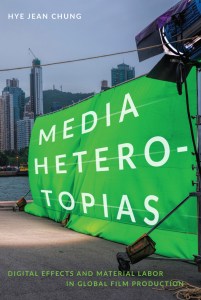
Media HeterotopiasIt takes a lot of people to make a movie. It also takes a diversity of production sites, technologies, and product or service providers. The list of names, locations, companies, and generic technologies that were instrumental in making a movie are listed in the closing credits. A full set of credits can include the cast and crew, but also contractors, production sponsors, distribution companies, works of music licensed or written for the movie, various legal disclaimers, such as copyrights and more. Nobody really pays attention to this part, except for the theme song playing at full blast and the occasional traits of humor interrupting the credits scroll. These closing credits allow the spectator to make the transition between the world of fiction and the real world, and to put an end to the suspension of disbelief that made him or her adhere to the on-screen story. For Hye Jean Chung, who teaches cinema studies in the School of Global Communication at Kyung Hee University in South Korea, the spectator’s disregard for credit attributions is part of an operation of denial and erasure: denial of the work that went into making a movie, and erasure of the production sites and collaborative networks that increasingly place film production into an international division of labor. The ancillary bodies and sites of labor are erased from the film’s content and only appear in the end credits; but they somehow creep back onto the screen during the movie as well, producing what she calls “spectral effects” or traces that are rendered invisible and disembodied but that still haunt the movie like a ghostly presence. Taking on from Michel Foucault’s concept of heterotopia, she defines “heterotopic perception” as a mode of criticism that is sensitive to these spectral effects, and “media heterotopias” as a digitally enhanced audiovisual realm of representation that superimposes different layers of realities, spatialities, and temporalities.

Assembling a collection of movies from the Asia-Pacific region 

These spectral effects and media heterotopias are particularly, though not exclusively, perceptible and legible in movies that use computer graphics, special effects, and digital technologies. Of the nine films that the author comments upon, six (AvatarOblivionInterstellarThe HostGodzillaBig Hero 6) make heavy use of CGI and digital effects, while others use digital reediting (Wong Kar-wai’s Ashes of Time Redux) or animated sequences (Jia Zhangke’s The World). Only Tarsem Singh’s The Fall ostensibly insists on on-location filming (in more than 20 countries) and lack of special effects in its spectacular visuals. The conceptual framework proposed by Media Heterotopias is therefore amenable to many different kinds of movies, from Hollywood blockbusters to art-house films, from adventure fantasies to science-fiction flicks. A common thread running through this selection is the focus on Asia, as many of these films were shot or produced in Asia-Pacific; but the author insists that this book is not an area studies project, and she resolutely places her analysis in a transnational or global perspective. The focus of Asia-Pacific is thereby a reflection of the on-going trend that affects movie production and consumption as well as many other industries: the shift to a new center of gravity that includes East Asia and the western shores of the Americas, and that transforms the historical Eurocentric or Atlantic domination into a thing of the past.

Although Hye Jean Chung doesn’t identify herself as a Marxist scholar, her work is very much preoccupied with issues of capital accumulation, surplus value extraction, and commodity fetishism. Against a tendency to treat films as texts and material conditions as irrelevant, she reminds us that movies are made by real people engaged in a division of labor in which value created by some is appropriated by others. Theoretically, she situates her film studies in the legacy of Michel Foucault by picking up his concept of heterotopia. According to Foucault, the cinema itself (as a building) is an heterotopia in its ability of allowing several overlapping spaces to exist. A cinema theater is a room with a two-dimensions screen where a three-dimensions world is able to exist. Heteropias in cinema (films) are therefore increasing the amount of overlapping worlds and thus question the status of reality of any of those worlds. Another important if yet more implicit reference of the book is Jacques Derrida’s Specters of Marx, where the heritage of Marxism is reclaimed by a new materialism acknowledging the haunting presence of ghosts and spirits. By being attentive to spectral effects and ghostly presences, Media Heterotopias offers a kind of spectral critique or hauntology that places human labor and production processes squarely at the center of media theory. 

The effacement of labor and the ideology of seamlessness

As many critics have pointed out, the world has been fundamentally altered by digital technologies. Our perception of reality itself is changing at a fast pace. Time is no longer a moving arrow flowing from past to present and toward the future: temporal linearity is now supplanted by intensive time, for which the only meaningful distinction is that of real time and delayed time. Digital technologies also transform our conception of space: they abolish the distinction between real space and virtual space, merging the two into a new augmented reality where digital signaling is ubiquitous. These new spatio-temporal formations have a strong impact on production and labor, and movie production is no exception. Nonlinear digital workflows are replacing linear production processes with a simultaneous collaborative workspace. Digital platforms such as video conferencing, instant messaging, and online file sharing allow massively parallel processes of collaboration to take place. To expedite and streamline the work process, the creative labor of digital film production is dispersed across geographically diverse companies in global production pipelines. Formerly disparate stages of preproduction, production, and postproduction are increasingly becoming fused with one another in a collaborative space. 

Globalization has developed an ideology of seamlessness: borders are no longer a barrier to the free flow of goods, capital, and images; and production processes are integrated into global value chains operating just-in-time and without friction.  For Hye Jean Chung, this fetishizing of a seamless integration conceals the actual living bodies and physical sites of labor that provide the material conditions of transnational activities. These bodies and locations are often firmly anchored to their national territories and regional infrastructures, with the cultural and geopolitical characteristics that are attached to them. The world isn’t flat, but a lot of work, including ideological work, goes into the task of making it appear as flat and frictionless. Similarly, both digital aesthetics and digital production processes partake in an ideology of seamlessness. Digital cinema produces a seamless effect when computer generated figures and sceneries are smoothly integrated with real actors, actual landscapes, and practical sets. By erasing material traces, visible joins and seams from the various stages of digital processing, the final product is made to look flawless and natural, even though digital images are composed of multiple layers of heterogeneous time and space. The photorealistic aspect of CGI makes it easy to suspend disbelief and create a pure spectacle of illusory seduction. This propensity toward the illusion of seamlessness has always been part of cinema’s attraction; but digital technology allows to make all traces of labor-intensive production invisible and well-hidden. Only remnants remain, coming back in the movie screen to haunt it as a spectral presence.

Self-referentiality and structural homologies 

In some cases, the ideology of seamlessness provides the material for the film story. This is particularly the case in science fiction movies, even when they are critical of capitalistic processes or technological developments. James Cameron’s Avatar offers a simplistic denunciation of technology-driven imperialism and an apology of a holistic, nature-centered, culturalistic worldview. But the heavy dependence on CGI and digital effects as well as the film’s reliance on global production and distribution networks contradict the explicit message of the movie. Who should we trust, the Na’vi and their natural utopia untainted by human technology, or the visual effects that replicate the mixing of human and alien DNA performed by Pandora’s greedy aggressors? Avatar treats body as media; migrating to a different body is reflexive of the digital filmmaking process itself. Another structural homology between movie content and filmmaking process is the act or cultural or geographical appropriation. Film commentators noted that each article of Na’vi clothing and jewelry was handmade and woven by a team of New Zealand costume designers. They underscored that the “alien” culture of Pandora was actually based on the indigenous Polynesian cultures of the Pacific Islands: for instance, the Na’vi gesture of touching foreheads is directly borrowed from the Māori’s traditional greeting, the hongi. Such acts of cultural appropriation go unnoticed or are even praised to illustrate the film’s cultural deftness. But it is doubtful whether Māori communities or other South Pacific Islanders received any benefits from these borrowings. Geographical borrowings, such as location shootings in fragile ecosystems or in scenic landscapes, are even more pernicious: they leave in their trail a legacy of environmental devastation, and often open the way for mass tourism and commercial exploitation of nature, as in the Pandora tours and Avatar-themed Na’vi wedding packages that are offered in the sites where some of the movie scenes were shot.

Another form of geographical exploitation consists of making a landscape alien, as in the science fiction movies Oblivion and Interstellar that were shot using real locations in Iceland. In these films, Iceland functions as an in-camera special effect by providing the image of a primitive or post-apocalyptic landscape that is then mixed with computer-generated imagery. Again, it is doubtful whether Icelanders received any benefit from the inclusion of their country’s natural assets as raw material in global value chains. As Hye Jean Chung notes, “certain sites of production develop as centers or nodes of production pipelines, whereas others are relegated to satellite sites of production or peripheral industries that provide human labor and natural resources to this centralized core that upholds and reinforces Hollywood’s hegemony.” Films like The Host or Godzilla however show that hegemony can be de-centered and that nations are in competition over the definition of a global imaginary. The composite body of The Host’s monster crosses genres and territories: although firmly anchored in the cultural specificity of Korean cinema, it cannot be interpreted “neither as a transplant of Hollywood’s conventions into a Korean background nor as a transfusion of Korean culture into Hollywood’s standards.” The monster, envisaged by director Bong Joon-ho as an imagined vision of “Korean-ness,” is in reality produced by a mix of Korean and non-Korean labor and technologies; and the film is itself a blend of heterotopic genres, from science fiction and monster movies to action films, family drama, political satire, and comedy. The 2014 Hollywood’s version of Godzilla, too, mixes imaginaries and straddles boundaries across the Pacific Ocean. Created by merging cross-border bodies and assets in both narrative and production spaces, it mobilizes a postwar Japanese myth born out of the atomic bomb and projects it on a global scale. The monster functions as a floating signifier, whose hybridity enables multiple national identities and transnational imaginaries to coexist. But the Hollywood’s production didn’t kill the indigenous gojira franchise: in Japan, the US-made monster was criticized as “out of shape” and as having a neck “like an American football’s athlete’s,” while the story lacked the denunciation of atomic warfare and the social critique that the Japanese versions developed.

Heterotopia is not only what movies make of it: it is inscribed in sites and territories, in imaginaries and aspirations. Theme parks like the World Park in Beijing and the Window of the World Shenzhen feature scaled-down replicas from various parts of the world; they offer the opportunity to travel abroad while staying at home. For the local migrants who work in these parks however, like the characters of Jia Zanke’s movie The World, the cosmopolitan lifestyle they showcase remains an simulacrum. Jia’s film deconstructs the transnational fantasy embedded in the World Park by revealing the various forms of uninspiring work that is necessary in producing and maintaining the illusion of cosmopolitanism. The characters’ lives are mediated by technology. They constantly send text messages on their cell phones and watch at digital video screens. Their dreams and fantasies, figured by animated sequences that punctuate the film, are made of simulated artifacts and reconstructions, as fake and artificial as the world they inhabit or the characters they are asked to impersonate. Big Hero 6 features another form of heterotopia in the hyperrealist scenes and cityscapes of “San Fransokyo”, a fictional metropolis that integrates the cultural iconography of Tokyo into the urban geography of San Francisco. This form of techno-Orientalism, reminiscent of the futuristic city displayed in Ridley Scott’s Blade Runner, is indexed on a cultural reality: the role Asian migrants have played in shaping San Francisco, a city that is now heralded as the capital metropolis of the Asia-Pacific century. In Big Hero 6, which was produced as a Disney franchise, East meets West in a virtual space rendered seamless by transpacific collaborations in the field of computer graphics and creative urban design.

From post-Marxist analysis to new materialism

What does heterotopic analysis bring to the field of cinema studies? First, it brings together two strands of film critique that are often developed separately: content and context, internal versus external critique, semantic interpretation or industry analysis, the viewer’s perspective or the point of view of the producers. As Hye Jean Chung convincingly demonstrates, the border between the two realms is porous: the ideology of seamlessness erases all traces of human labor and technical work from within the movie, but reality creeps back into the film’s narrative, making the seams apparent and the labor traceable. Many movies, especially but not exclusively in science fiction, are self-reflexive about the filmmaking process and the technological tools used in film production. Analyzing the film’s content also offers a perspective on how it was conceived and developed. Second, Media Heterotopias offers a post-Marxist analysis of the global division of labor in cultural and creative industries. The author often refers to the long work hours, tight schedules, night shifts, physical migration, or sedentary confinement along complex networks of transnational collaboration. Value accumulates at the most capitalistic points of the value chain, while other parts of the production pipeline are submitted to ruthless labor exploitation or imperialistic appropriation of cultural and natural assets. As a third point, I see this book as a contribution to the literature on new materialism. The materiality of geographical location, physical labor, and industrial practices is put alongside processes of dematerialization and digitalization, giving rise to a new kind of mediated materiality. The layered nature of digital imagery makes it an assemblage of heterogeneous time-spaces, a composite of physical and virtual elements that give rise to spectral effects and phantomatic presence. Reality is what comes back to haunt us when the real has been dissolved into digital fictions.
The Government of Risk and the Politics of Security in Contemporary Cities

A review of Endangered City: The Politics of Security and Risk in Bogotá, Austin Zeiderman, Duke University Press, 2016.

Austin ZeidermanWhen Austin Zeiderman arrived in Bogotá in 2006 to conduct his fieldwork in anthropology, he didn’t know he was in for many surprises. The mismatch between the preconceived notions he had about Colombia’s capital and what he experienced on the ground couldn’t have been greater. People had warned him about the place: Bogotá was perceived as a city fraught with crime and corruption, where danger loomed at every corner. Not so long ago, Bogotá’s homicide rate was one of the highest in the world and assassinations, kidnappings, and bombings were almost routine. Histories of violence often produce enduring cultures of fear that are difficult to dispel: people develop strategies to avoid danger and cope with risk. For individuals as for collectives, the trauma of violence persists long after the traumatic event has faded into the past. People told the young anthropologist that he definitely shouldn’t venture in the slums that occupy the hillsides of Bogotá’s southern periphery. It is therefore with some apprehension that Austin Zeiderman joined la Caja, a municipal agency located in this danger zone, where he was to spend twenty months doing participatory observation. His first surprise was that danger and criminality were much talked about and feared, but he never experienced it firsthand: “not once during my time in these parts of Bogotá was I harassed, mugged, or assaulted.” Indeed, he felt almost more secure in the hillside barrios of Bogotá than in his native place of Philadelphia, where he had learnt to navigate the city with precaution so as to avoid potential threats. There had been a dramatic decline in violent crime in Bogotá, and the city was now safer than it had been for half a century. Instead of criminals, petty thieves, and corrupt officials, he met with law-abiding citizens, dedicated social workers, and peaceful communities.

Entering the danger zone

The second surprise was a conceptual one. Austin Zeiderman had retained from his graduate training in anthropology and urban ecology a heavy theoretical baggage and a commitment to apply critical thinking to his urban terrain. More specifically, his views were shaped by two strands of critical theory: urban political economy, heavily influenced by Marx and his twentieth-century epigones such as Henri Lefebvre and David Harvey, and the more recent approaches of neoliberal governmentality that build on the intuitions of the late Michel Foucault. For the first line of social critique, urban planning is a way to manage the contradictions of late capitalism. Displacement and expulsion of informal tenants are a case of “accumulation by dispossession,” a way by which the capitalist state exerts its monopoly of violence in order to “build the new urban world on the wreckage of the old.” The second paradigm associates “neoliberalism” with the deployment of market-based logics, the valorization of private enterprise, the reform of governmental institutions, the retrenchment of the public sector, and the formation of responsible, self-governing subjects. The author’s plan was therefore to investigate “neoliberal urbanism” at work, and to document the acts of resistance, adaptation, and self-making of the subaltern subjects who are hailed by the constitutive power of the neoliberal state. The fact that the World Bank, the arch-villain of antiglobalization protesters, had extended loans to the city of Bogotá to support the policy of relocation and urban renewal, only reinforced him in his critical orientation.

He was therefore surprised to discover that many individual households were happy to be relocated: indeed, some of them petitioned the municipality to be included in the relocation program. Eviction was not feared and resisted: it was seen as an opportunity to escape from risky environments and relocate to healthier, more secure suburbs. In fact, a hallmark of the resettlement program was its insistence that the decision to relocate was voluntary. Protecting the population from natural and human hazards was not a projection by the rich and the powerful to discipline the lives of the poor: it was based on the recognition of the sacred value of life, and corresponded to a major aspiration of the poorest, who were the first victims of insecurity and risk. The sprawling, self-built settlements of the urban periphery, commonly perceived as posing a threat to political stability and social order, turned out to have the greatest concentration of families living under threat. In other words, risky populations turned out to be the most exposed to risk. Another surprise was to to discover the political orientation of the social workers in charge of the eviction program. They were progressive individuals, who defined themselves half-jokingly as “half-communist” or “communist-and-a-half”, and who were deeply convinced of the positive effects that the relocation program would have on the lives of the poor. Rather than securing the city as a whole by evicting residents and demolishing buildings, their primary objective was to protect the lives of vulnerable populations living in the urban periphery. These social workers were in line with the political priorities of the municipality, which was run by left-of-center mayors who had attracted much appraisal for their reforms. Neoliberalism, it seems, could be used for progressive purposes.

The legacy of Antanas Mockus and Enrique Peñalosa

The young researcher was in a quandary. Should he extoll the virtues of the municipal government that had led over Bogotá’s urban renaissance, or even praise the leadership of the right-wing president Álvaro Uribe who launched successful campaigns against the FARC, Colombia’s main guerrilla movement? The success story of Bogotá had already been told: according to the international media and local pundits, it was the story of two charismatic mayors who, with unorthodox methods, in less than ten years turned one of the world’s most dangerous, violent, and corrupt capitals into a peaceful model city populated by caring citizens. In this book, Austin Zeiderman remains uncommitted towards the legacy of Antanas Mockus and Enrique Peñalosa, as well as their two left-leaning successors at Bogotá’s city hall. He notes that their choice of options remained limited and constrained by the national security landscape: any attempt at fundamentally challenging the status quo would have been countered by paramilitary forces known for persecuting activists or leaders with even vaguely radical agendas. His research site, an urban resettlement agency, was used by progressive mayors in order to distribute patronage and build a political constituency among the urban poor. As for Uribe’s two terms at the presidency, Austin Zeiderman notes that they were characterized by continued internal displacement, violence in rural regions, human rights violations, increased poverty and inequality, and collusion with drug traffickers. The author’s commitment to a progressive political agenda and to critical theory remained untainted: he was not ready for a conversion to neoliberalism. Besides, his academic focus was on social theory and anthropological fieldwork, not political science or media analysis.

This is when, combining these different thoughts and experiences, the young author had his epiphany: he would study “the government of risk and the politics of security in contemporary cities.” The topic was empirically relevant and theoretically adequate. The relocation program in which he worked was dedicated to protecting the lives of the poor and vulnerable populations from environmental hazards, such as floods, landslides, and earthquakes. Risk management had been accepted across the political spectrum as a legitimate way to govern the city and to allocate resources to people in need of support. “Life at risk” had become a category of entitlement through which the urban poor could claim assistance, protection, and care. By interviewing social workers and their benefactors, and by analyzing the techniques used to map risk and relocate people, he could make sense of these new forms of governmentality without falling into hagiography or empty critique. Theoretically, the concept of risk opened a rich space of associated notions and constructions that have been developed to characterize our modern condition. Of particular relevance to him was the notion of biopolitics developed by Michel Foucault and his epigones and defined as the way the state extends its power over bodies and populations by exerting its right to make live and to let die. Foucault’s schema also associates risk with the rise of the modern society by locating it at the center of the new art of government that emerges in the late eighteenth century. Austin Zeiderman proposes the concept of endangerment, and of the endangered city, to describe a world in which the unlimited improvement of urban life, even its sustained reproduction, are no longer taken for granted. The endangered city is not a city where life faces immediate danger: it is a place where citizens live under the shadow of insecurity and risk, even if these threats never actually materialize.

The agony of Omayra Sánchez

If there was a specific trauma that led government authorities and populations to turn their attention to the management of risk, it was to be found in the catastrophic events that took place in 1985. On November 13, a volcanic eruption set off massive mudslides and buried the town of Armero, killing over twenty-five thousand people. A young girl, Omayra Sánchez, became the symbol of this suffering for millions of TV viewers, as rescuers failed to free her from the mud and debris that had trapped her body. Just one week before, members of the M-19 guerrilla group had attacked the Palace of Justice in central Bogotá and had taken the judges and the public as hostages. The siege of the building by the army and the ensuing battle left more than one hundred people dead, including the Chief Justice and dozens of hostages. For the press, these two tragedies were “apocalypse foretold”: they could easily have been prevented, if only the state had lived up to its responsibility to protect the life of its citizens. Critics claimed that in both cases the government had advance warning of the impending tragedy and had failed to prevent known threat from materializing. As a consequence, governmental problems and their proposed solutions began to be increasingly understood within a security framework oriented toward the protection of life from a range of future threats. Prediction, prevention, and preparedness were the solution proposed, and the imperative to protect life by managing risks became the ultimate end of government. Of course, the power of the state to “make live and to let die” (to use Michel Foucault’s expression) is applied unevenly: in the Colombian context of 1985, “the figure of Omayra creates a boundary that differentiates those whose lives matter from those whose lives do not—the outlaws, insurgents, subversives, or terrorists who are dealt with as enemies of the state.” Austin Zeiderman also notes that the responsibility to protect lives imposed itself at the expense of other rationalities and state goals, such as development, democracy, and welfare.

Nothing characterizes more this shift in urban governmentality than the evolving missions of the Caja de la Vivienda Popular, the branch of Bogotá’s municipal government in which Austin Zeiderman did his fieldwork. The Caja was originally created in the 1940s to provide public housing for the poor and for public employees. Its role shifted from hygiene and poverty alleviation to slum eradication and urban renewal in the 1980s and then, starting 1996, to the resettlement of populations living in zones of high risk. Populations deemed vulnerable to environmental hazards, such as landslides and floods, were entitled to state subsidies and could benefit from a relocation program that allowed them to resettle in more secure environments. Rather than organizing housing policy in terms of social class, political citizenship, or economic necessity, vulnerability became the primary criterion that determined one’s eligibility to receive state benefits. In other words, “life at risk” came to displace “worker,” “citizen,” and “poor” as a new political category of political recognition and entitlement. The Colombian constitution’s article proclaiming the “right to life” (derecho a la vida) came to supersede the other article recognizing that all Colombians have the right to “decent housing” (derecho a una vivienda digna). Various disciplines, ranging from geology, hydrology and meteorology to sociology and new public management, were mobilized to establish risk maps and contingency plans delimitating zones of high risk (zonas de alto riesgo) whose inhabitants could claim eligibility to the relocation program. Similar approaches of urban mapping and risk calculation were applied to prevent violent crime and terrorism. In addition, sensibilización programs were conducted to educate the poor to behave in relation to future threats and to instill a collective ethos of risk management.

“Lagos is not catching up with us. Rather, we may be catching up with Lagos.”

In the last decade, Bogotá has become recognized internationally as a “model city” for its achievements in good urban governance across realms as diverse as education, security, transportation, civic order, and public space.  In the context of climate change and increased environmental hazards, disaster risk management has been especially singled out and given as an example for other cities to emulate. For Austin Zeiderman, the endangered city of Bogotá provides another kind of model: one that operates through rationalities of security and techniques of risk mitigation. As he notes, “whereas modernism heralded futures of progress, efficiency, and stability, there is a global trend toward envisioning urban futures as futures of potential crisis, catastrophe, and collapse.” Cities of the global South should no longer be expected to follow the development pathways of the “modern cities” of Europe and North America: indeed, cities from the North are now confronted with problems of insecurity, environmental threats, and terrorist violence that seem to come straight from the South. As one modern critic notes, “Lagos is not catching up with us. Rather, we may be catching up with Lagos.” This dystopian vision of the global urban future stimulates technologies of control and exclusion. A new urban security paradigm demands that all cities deploy protective and precautionary strategies against a range of threats in order to ensure their own reproduction. For Austin Zeiderman, models of urbanity that focus exclusively on risk and security draw resources away from concerns such as poverty, equality, education, housing, healthcare, or social justice. The politics of rights—rights to decent housing, rights to the city, human rights—becomes subordinated to a politics of life. Austin Zeiderman shows that this politics of life—in its devotion to the vulnerable, the dispossessed, and the victim—creates new forms of vulnerabilities, dispossession, and exclusion. By determining how certain forms of life are to survive, endure, or flourish, while others are abandoned, extinguished, or left to go extinct, biopolitics is inseparable from a politics of death, a thanatopolitics.

There Is More to Philosophy for Anthropologists Than Just Foucault

A review of The Ground Between: Anthropologists Engage Philosophy, Edited by Veena Das, Michael D. Jackson, Arthur Kleinman, Bhrigupati Singh. Duke University Press, 2014.

The Ground Between.jpgMy strong belief is that this book will prove as important as the volume Writing Culture, published in 1986, which marked a turning point in the orientation of anthropological writing. This is not to say that anthropologists didn’t engage philosophy before Anthropologists Engage Philosophy, or that they will with renewed strength thereafter. Many classical anthropologists were trained as philosophers, especially in the French tradition where disciplinary borders are more porous. Pierre Bourdieu described his work in anthropology and sociology as “fieldwork in philosophy.” Nowadays “theory”, which samples a limited set of authors from contemporary philosophy, is part of the toolbox that every graduate student learns to master, and that they often repeat devotedly as a shibboleth that will grant them their PhD. What is striking in The Ground Between is the variety of authors that the contributors discuss, as well as the depth of their engagement, which goes beyond scholarly debates and is often set out in existential terms. For many anthropologists, philosophers are a life’s companion, helping them to navigate through the pitfalls of scholarship and the vicissitudes of life.
After having been killed by Writing Culture, Clifford Geertz is back in favor

If Writing Culture was a gesture aimed at dismissing Clifford Geertz, killing the father as it were, several authors from The Ground Between move back to him as a revered father figure, or maybe as a grumpy uncle who may provide an unending collection of quips and aphorisms. Geertz indeed offers wonderful quotes as to how anthropology and philosophy stand in relation to each other, to the world, and to the self. He observed that anthropology and philosophy share “an ambition to connect just about everything with everything else,” and remarked that “one of the advantages of anthropology as a scholarly enterprise is that no one, including its practitioners, quite knows exactly what it is.” Asked by João Biehl what was his main contribution to theory, Geertz replied succinctly: “substraction”. While being generous and open to dialogue, Geertz could also strike back viciously at personal attacks such as the ones perpetrated by the authors of Writing Culture. “There is very little in what the partisans of an anthropology in which fieldwork plays a much reduced or transformed role… have so far done that would suggest they represent the way of the future,” he wrote, somewhat presciently.

Another move that many contributors enact is, although with much caution and the remains of a certain reverence, a distancing from Foucault. At the very least, they demonstrate that there is more to philosophy for anthropologists than just Foucault. Reproducing poorly rehashed quotes and concepts from Foucault will not automatically grant you access to graduate school. Didier Fassin exposes a research proposal submitted by a prospective student that reads as complete gobbledygook. Simply borrowing the lexicon of Foucault (biopolitics, power/knowledge, governmentality) or of his direct heir Agamben (the state of exception, bare life, thanatopolitics) will not get you very far. Similarly, Arthur Kleinman points out that scholars often engage in the “cultivation of the recondite, the otiose, the irresponsibly transgressive, and the merely clever,” with the effect of estranging the learned public from their discipline and turning scholarly debates into irrelevant wordplays. For João Biehl as well, “insular academic language and debates and impenetrable prose should not be allowed to strip people’s lives, knowledge, and struggles of their vitality–analytical, political, and ethical.”

Keeping Foucault at a distance

Didier Fassin writes his essay “in abusive fidelity to Foucault”, and prefers “a free translation rather than mere importation” of his concepts. Although he recognizes the heuristic fecundity of the master, he points out that many formulas borrowed by his heirs and epigones are just that: formulaic. As he soon realized in his research on humanitarian interventions, “I was indeed exploring something that Foucault had paradoxically ignored in spite of what the etymology of his concept of biopolitics seems to imply–life.” This led him to substitute the term “biopolitics” with the expression “the politics of life”, and to pay attention to the tension between the affirmation of the sacredness of life (as defined by Canguilhem) and the disparities in the treatment of particular lives (exemplified by Hannah Arendt’s work). Life is indeed a theme and even a word that is alien to Foucault’s writing. Attending to life as it is lived features prominently in several essays in the volume: “taking life back in” could be an apt description of the whole enterprise. Another common move is to go back to the source of Foucault’s inspiration, by rereading the scholars who had the most formative influence on his thinking: Georges Canguilhem in the case of Didier Fassin, and Georges Dumezil for Bhigupati Singh (who hints at a homosexual relationship between the master and the student). If Foucault is spared by those authors, they find in Agamben an avatar of “a negative dialectical lineage” (Singh) and reject his “apocalyptic take on the contemporary human condition” (Biehl).

While keeping Foucault at a distance, most authors remain firmly committed to French theory, and engage in a productive dialogue with Deleuze and Guattari, Bourdieu, as well as older figures such as Merleau-Ponty and Sartre or Bergson. Deleuze in particular is mobilized by many authors, to the point one could speak of a “deleuzian moment” in anthropology. Bhigupati Singh finds in Deleuze “an opening, a way into non-dialectical thought” that he uses in his analysis of life in a destitute Indian community. João Biehl read Deleuze while documenting the fate of Catarina, a poignant character in a place of abandonment, until his editor commented: “I don’t care what Deleuze thinks. I want to know what Catarina thinks!” Ghassan Hage wrote the “auto-ethnography” of his deafness and capacity to hear again in close dialogue with Bourdieu, seeing exemplifications of his key concepts but also the limits in the way Bourdieu conceived of being in a world characterized by inequalities in the “accumulation of homeliness”. To be deprived of raisons d’être is not to be deprived of being: as João Biehl puts it, “language and desire continue meaningfully even in circumstances of profound abjection.” “If Sartre became for me a “natural” conversation partner in my anthropological work,” confesses Michael Jackson, “it was because his focus on the conditions under which a human life becomes viable and enjoyable implied a critique of metaphysical and systematizing philosophies.” As Geertz put it succinctly: “I don’t do systems.”

A return to the American liberal tradition

A cadre of young French philosophers such as Jocelyn Benoist, Sandra Laugier and Claude Imbert also find their way into the bibliography. But other philosophical voices are also making themselves heard. For some, it is a return to the American tradition, with prominent contemporary figures such as Stanley Cavell or Nelson Goodman and older ones such as Henry James and John Austin or Hannah Arendt. Arthur Kleinman finds in Henri James the life lessons that accompany him while giving care to his wife suffering from a neurodegenerative disease, making him “feel less alone”. He considers James’s Varieties of Religious Experience the best source for teaching a course on “Religion and Medicine”. Reading Hannah Arendt in Teheran, Michael Fischer notes that Iranian intellectuals were “no longer interested in revolutionary political philosophy but rather in liberalism. Habermas, Rorty, Rawls, and Arendt were all objects of much interest.” Veena Das finds in Cavell’s philosophy the kind of attention to “the low, the ordinary, and the humble” that helps her answer to the pressures from her ethnography by “making the everyday count”.

The anthropologists are careful to point out what philosophers owe to anthropology. João Biehl underscores that Deleuze and Guattari owe their notion of “plateau” to Gregory Bateson’s work on Bali, and that their key insights on nomadism, the encoding of fluxes, the war machine, or indeed schizophrenia, all come from Pierre Clastres’s attempt to theorize “primitive society” as a social form constantly at war against the emergence of the state. The habit of “writing against” that defines a large strand of contemporary philosophy is also central in the conceptual schemes of the founding fathers of anthropology, from Bronislav Malinowski to Margaret Mead. Bhigupati Singh reminds us that “Deleuze deeply admired Levi-Strauss” and may have found in his brand of structuralism a few nondialectic terms that he finds “helpful for thinking about power, ethics, and life.” Following his provocative advice to “take an author from behind,” he imagines the offsprings that may have been produced by an anthropologically-oriented Deleuze. Michael Puett invites us to use indigenous theories to break down our own assumptions about how theory operates: “the goal should not be just to deconstruct twentieth-century theoretical categories but to utilize indigenous visions to rethink our categories and the nature of categories altogether.”

Who’s in and who’s out in the philosophical market

But this book is not a popular chart of “who is in and who is out”, whose ratings go down and whose go up in the philosophical market where anthropologists do their shopping. The authors are careful to distance themselves from “anthropologists who look to philosophy as providing the theory and to anthropology to give evidence from empirical work to say how things really are.” Ethnography is not just proto-philosophy, and anthropologists do not need authorization or patronage in their pronouncements. The idea is to “work from ethnography to theory, not the other way around.” If philosophy can be defined as “the art of forming, inventing, and fabricating concepts,” then perhaps anthropology constitutes “a mode of heightened attentiveness to life” that builds on “experience-near concepts” in order to show “how ordinary life itself gives rise to puzzles we might call philosophical.” The Ground Between therefore doesn’t herald an “ontological turn” or a “philosophical moment” in modern anthropology, in the way that Writing Culture was perceived as a turning point affixed with various labels (“postmodern”, “reflexive”, “deconstructionist”). But it is an attempt to step back, take stock, and reflect on what anthropologists are doing, in order to make their contribution to social science, to knowledge, and to human life more meaningful.

The State of Exception in East Asia

A review of Neoliberalism as Exception: Mutations in Citizenship and Sovereignty, Aihwa Ong, Duke University Press, 2006.

Neoliberalism as ExceptionCarl Schmidt defined sovereignty as ultimately the power to call a state of exception to the normalized condition of the law. Drawing on the German philosopher, Giorgio Agamben uses the exception as a fundamental principle of state rule that is predicated on the division between citizen in a judicial order and outsiders stripped of juridical and political protections. Aihwa Ong, a Berkeley anthropologist, offers a milder version of the state of exception: the sovereign exception she is interested in “is not the negative exception that suspends civil rights for some but rather positive kinds of exception that create opportunities, usually for a minority, who enjoy political accommodations and conditions not granted to the rest of the population.”

The neoliberal state of exception creates threats and opportunities

Aihwa Ong is interested in the spaces and identities opened up by neoliberalism as exception–the market-oriented and calculating technologies of government used by otherwise interventionist states in East Asia–, and by exceptions to neoliberalism–the management of populations who are deliberately excluded from neoliberal considerations, either positively or negatively. She focuses on “the interplay among technologies of governing and of disciplining, of inclusion and exclusion, of giving value or denying value to human conduct.”

The book explores how the market-driven logic of exception is deployed into a variety of ethnographic contexts: the opposition between Islamic judges and theologians and feminist groups who also claim the authority of the Quran to challenge patriarchal norms in the Malaysian context; the tensions between online communities protesting against the persecution of ethnic Chinese in Indonesia and localized struggles for national belonging and an inclusive concept of citizenship; the market- and policy-driven strategies of spatial fragmentation that create a pattern of differently administered spaces in mainland China; the ethnicization of labor market pools and of production networks linking both sides of the Pacific Ocean in the electronics industry; the tension between moral education and technical training in American colleges and universities pursuing global strategies, the outsourcing strategies that undermine the foundations of middle-class American masculine identities; the efforts of Singapore to position itself as a hub for accumulating international expertise in the knowledge-driven economy; the demands of NGOs for the biological welfare of foreign maids and migrant workers; and the failed attempts by American companies to instill management thinking and behavior among Shanghainese professionals who pursue their own self-interest.

In doing so, the author introduces many new concepts that may be picked up by other social scientists for further use and elaboration: graduated sovereignty, zoning technologies, latitudinal citizenship, translocal publics, translational identities, global ethnicities, the postdevelopmental state, labor arbitrage, biowelfare, and others. She also critically addresses works by Hardt and Negri, Agamben, Sassen, Habermas, Appadurai, and elaborates on the concept of governmentality as defined by Foucault.

An indiscriminate gleaning of facts

Neoliberalism as Exception elaborates on Aihwa Ong’s previous book, which won the Cultural Studies prize of the Association of Asian American Studies in 2001. There were aspects that disturbed me in Flexible Citizenship: the political militancy, the mix of high-brow concepts and trivial observations, the lack of any historical perspective, the disdain for economic reasoning or statistical observations, the departure from earlier traditions of fieldwork in favor of casual browsing and indiscriminate gleaning of facts. Not only did I find the same defects in Neoliberalism as Exception, but I was baffled to read whole sentences reproduced at full length from the previous book, without any mention that the two essays were based on the same material. Take the following sentence, which I had singled out in my reading of Flexible Citizenship for being particularly inept: “On a palm-fringed hillock stands the Kuala Lumpur Hilton, where attendants in white suits and batik sarongs rush forward to greet well-groomed Malay executives wielding cellular phones as they step out of limousines.” If I were the author, I wouldn’t be too proud of this stereotyped description that seems to come straight out of a popular novel or a fashion magazine. But Aihwa Ong found it worthy enough to include it all over again in one chapter of her new book.

Now why do I care, and who reads anthropology anyway? We should pay attention to what happens in the anthropological field because it offers a rare window into the lives and cultures of people who may appear distant or alien but who share with us our common humanity. Modern anthropologists have rejected earlier models of ethnography which treated local cultures as bounded and isolated, and have welcomed globalization as a formidable challenge to expand the discipline’s boundaries and to include political and economic considerations. Concepts and theoretical constructs used in anthropology also act as a reality check over the ideas and theories offered by philosophers or social critics because they are grounded in empirical observations and a rich methodological tradition. As Aihwa Ong herself acknowledges, “As anthropologists, we are skeptical of grand theories. We pose big questions through the prism of situated ethnographic research on disparate situations of contemporary living”. One only wishes she would have applied her prism more rigorously.

The last reason we should care about anthropology is because of the political uses that can be made of research results. Most anthropologists maintain a healthy distance to the centers of power and they rightly cherish their academic freedom. Some choose to embrace social causes and lend their voice to the dispossessed, the disenfranchised and the voiceless. Others address the works of social critics and offer validations or amendments of theoretical claims from their methodological perspective. As the endorsements by Michael Hardt or Manuel Castells on the book’s back cover indicate, there is a kind of circularity from theoretical texts to “views from the field” and then back to theory. But without a rich and varied ethnographic material, this circularity runs empty and theory leads to more theory without the necessary detour through observation.

A Failed Anthropology Project

Review of Two Bits: The Cultural Significance of Free Software, Christopher M. Kelty, Duke University Press, 2008.

Two BitsTwo Bits is a failed anthropology project. It does not make it a bad book: it is well-written and informative, and I learned a lot about Free Software and Open Source by reading it. But it does not meet academic standards that one is to expect from a book published in an anthropology series. These standards, as I see them, pertain to the position of the anthropologist; the importance of fieldwork; the role of theory; the interpretation of facts; and the style of ethnographic writing. Let me elaborate on these five points.
Many definitions have been proposed of the “participant observer.” Anthropologists who claim this position for themselves see it as a way to gain a close and intimate familiarity with a given group of individuals and their practices through an intensive involvement with people in their natural environment, usually over an extended period of time. It is different from “going native”: the participant observer usually remains an outside figure, who can provide support and hold various functions in the group but who makes it clear, at least to himself, that the locus of his engagement lies in the rendition he will make from his experience, not in the services or tasks he will have completed for the group during fieldwork. A key element in this research strategy is therefore to gain access to the group but also, perhaps equally important, the exit strategy that will allow the ethnographer to leave the field and return to a more distant point of observation.

“I am a geek”

Christopher Kelty does not make explicit his own definition of participant observation, but he nonetheless fancies a self-image: “I am a geek.” Becoming a geek is an integral part of his research project, and most ethnographic notes or vignettes are devoted to that process. For him, understanding how Free Software works is not just an academic pursuit but an experience that transforms the lives and work of participants involved: “something like religion.” The stories he tells about geeks, stories that geeks tell about themselves, are meant to “evangelize and advocate,” and to convert people to the cause.

His engagement with and exploration of Free Software got him involved in another project called Connexions, an “open content repository of educational materials” or a provider of Open Source textbooks. Connexions textbooks look different from conventional textbooks in that they consist of digital documents or “modules” that are strung together and made available through the Web under a Creative Commons license that allows for free use, reuse, and modification. Kelty would like his role in the Connexions project to be akin to an academic consultant, an anthropologist-in-residence that could provide advice and guidance based on his “expertise in social theory, philosophy, history, and ethnographic research.” But that is not how it turns out: “The fiction that I had first adopted–that I was bringing scholarly knowledge to the table–became harder and harder to maintain the more I realized that it was my understanding of Free Software, gained through ongoing years of ethnographic apprenticeship, that was driving my involvement.” He cannot fit into the anthropologist’s shoes because there is no need for one at Connexions. And so he ends up providing legal advice (which, strictly speaking, he is not qualified to do) and doing intermediary work with Creative Commons, a nonprofit organization that promotes copyright-free licenses.

Fieldwork is what anthropologists do. But what do anthropologists do when they do fieldwork? The definition has evolved over time. An anthropologist used to hang around in a remote place for a while, getting acquainted with the people, pressing informants with questions, and taking ethnographic notes. In our age of globalization, there is more emphasis on multiple sites, nomadic fieldwork, and de-centered ethnography. People move constantly from one location to the next, so why should the ethnographer be the only one to stay at the same place? Besides, in our interconnected world, something that happens in one place is often caused or explained by another phenomenon occurring in a distant place, and following the object under consideration is like pulling a thread from a ball of yarn. But fieldwork remains a central tenet of the anthropologist’s identity, what distinguishes him or her from scholars in other disciplines who “don’t do fieldwork.”

Hanging around with local hackers in Bangalore

Kelty insists that his account of the Free Software movement is based on ethnographic fieldwork. He gives a few vignettes of his engagement in the “field”: meeting two healthcare entrepreneurs at a Starbuck in Boston, cruising the night scene in Berlin, hanging around with local hackers in Bangalore, and, in the end, getting a position in the anthropology department at Rice University in Houston, where the Connexions project is based. But there is little purpose to these mentions of various locations, apart to demonstrate the coolness of the author and his persistence in becoming a geek akin to the ones he associates with. When it comes to substance, his real source of information is online. As he notes, nearly everything about the Internet’s history is archived. He is even able to track back newsgroup discussions dating back to the 1980s and chronicling the birth of open systems. As a result, the brunt of Kelty’s research presented in Two Bits is either archival work into the history of computer science or consulting work for the Connexions project, not ethnographic fieldwork in the strict sense of the word.

Anthropologists writing PhD dissertations are requested to demonstrate skills in manipulating theory. The canon of works to be mastered is rather limited: a grounding in Marx, a heavy dose of Foucault, some exposure to Freud or Lacan, add a pinch of feminist theory or media studies for those so inclined, and the PhD student is all set. Even by that light standard, Kelty must have flunked his theory exam. He introduces Foucault mainly for the record, but all he draws from the famous article “What Is Enlightenment?” is a quote stating that modernity should be seen as an attitude rather than a period of history. In other words, geeks are modern because they are cool. In another passage, he mentions that the notion of recursive public that he proposes should be understood from the perspective of works by Jürgen Habermas, Michael Warner, Charles Taylor, John Dewey, and Hannah Arendt. Then he stops. Besides the obvious point that eighteenth century’s coffee shops are different from today’s Internet forums, there is no further elaboration on these authors.

GNU (“GNU is Not UNIX”)

Another aspect of theory is the elaboration of concepts. Here, Kelty fares better, but I would still give him only a passing grade. His notion of a “recursive public” is indeed a working concept, or a middle-range theory as social scientists are wont to propose. Kelty defines it as “a public that is constituted by a shared concern for maintaining the means of association through which they come together as a public.” Recursivity is to be understood in the way computer programmers define procedures or name applications in terms of themselves. Popular examples include GNU (“GNU is Not UNIX”), but also EINE (“EINE Is Not EMACS”) ou ZWEI (“ZWEI Was EINE Initially”). It is, to use another image, Escher’s hand drawing itself. But the author does not try to sell his concept too hard: as mentioned, he does not explore the interplay with Habermas’ notion of a public sphere, and he downplays its importance for future scholarship (“I intend neither for actors nor really for many scholars to find it generally applicable.”) One would be at a loss to find other original concepts in the book. The expression “usable pasts” he uses to introduce his geek stories is just another name for modern myths. The notion of “singularity,” a point in time when the speed of autonomous technological development outstrips the human capacity to control it, is only a piece of geek folklore. Visibly, Kelty is more interested in telling stories than building theory.

Some authors define anthropology as the interpretation of cultures. In his book’s title, Kelty insists on the cultural significance of Free Software. Yet interpretation is lacking. By this, I mean that the anthropologist should be in search of meaning, not just facts or fictions. Kelty presents an orderly narrative of the origins and development of Free Software, organized around five basic functions: sharing code source, conceptualizing open systems, writing licenses, coordinating collaborative projects, and fomenting movements. He illustrates each chronological step with various stories, evolving around the development of the UNIX operating system and the standardization of Internet communications through TCP/IP. The result is informative if somewhat lengthy, but the cultural significance of the whole is not really addressed. Instead of wrapping up the lessons of this history, the last part of the book moves to a completely different topic by asking what is happening to Free Software as it spreads beyond the word of hackers and software and into online textbook publishing.

“Berlin. November 1999. I am in a very hip club in Mitte”

Anthropologists are authors, and their writing skills matter enormously in the reception and impact of their works. The style of Two Bits is more attuned to a journalistic account than to a piece of scholarship. This shows especially in the vignettes placing the author in various situations and locations, which create a “reality effect” but do not really add anything to the comprehension of the subject. Lines like “Berlin. November 1999. I am in a very hip club in Mitte” or “Bangalore, March 2000. I am at another bar, this time on one of Bangalore’s trendiest street” may be proper for nonfiction travelogues or media coverage, but they should not find their ways into anthropology books.

Rewriting Marx’s Theory of Capital for the Twenty-First Century

A review of Biocapital: The Constitution of Postgenomic Life, Kaushik Sunder Rajan, Duke University Press, 2006

biocapitalBiopolitics is a notion propounded by Michel Foucault whereby “life becomes the explicit center of political calculation.” The increasing use of this notion in the social sciences underscores a fundamental evolution. In the twenty-first century, as anticipated by Foucault, power over the biological lives of individuals and peoples has become a decisive component of political power, and control over one’s biology is becoming a central focus for political action. Used by the late Foucault in his lectures at the Collège de France, biopolitics and its associated concept, governmentality (“the conduct of conducts”), are now in the phase of constituting a whole new paradigm, a way to define what we are and what we do. Biopolitics and governmentality are now declined by many scholars who have proposed associated notions: “bare life” and the “state of exception” (Giorgio Agamben), “multitude” and “empire” (Michael Hardt and Antonio Negri), “biological citizenship” and “the politics of life itself” (Nikolas Rose), “biopolitical assemblages” and “graduated sovereignty” (Aihwa Ong), “cyborg” and “posthumanities” (Donna Haraway), etc. This flowering of conceptualizations is often associated with a critique of neoliberalism as the dominant form of globalized governmentality, and to a renewal of Marxist studies that revisit classical notions (surplus value, commodity fetishism, alienation of labor…) in light of new developments.

From Foucault to Marx

By adding the notions of “biocapital” and “postgenomic life” to the list of new concepts, Kaushik Sunder Rajan positions himself in this twin tradition of Marxist and Foucaultian studies. As he states in the introduction, “this book is an explicit attempt to bring together Foucault’s theorization of the political with a Marxian attention to political economy.” As mentioned, the paradigm of biopolitics and governmentality has changed the traditional ways of thinking about politics, and has led to a new understanding of basic notions such as sovereignty and citizenship. But Foucault was mostly interested in deconstructing political philosophy, and failed to acknowledge that biopolitics is essentially a political economy of life. This is where the reference to Marx comes handy. As Sunder Rajan underscores, one doesn’t need to adhere to Marx’s political agenda in order to interpret his writings (“I believe that Marx himself is often read too simply as heralding inevitable communist revolution”). Instead, he uses Marx as “a methodologist from whom one can learn to analyze rapidly emergent political economic and epistemic structures.” His ambition is to rewrite Marx’s theory of capital for the twenty-first century, and to situate in emergent political economic terrains by using the tools of the ethnographer.

For Sunder Rajan, biocapital is the result of the combination of capitalism and life sciences under conditions of globalization. The evolution from capital to biocapital is symptomatic of the turn from an industrial economy to a bioeconomy in which surplus value is directly extracted from human and nonhuman biological life rather than from labor power. The extraction of surplus value from biological life requires that life be turned into a commodity, tradable on a market and convertible into industrial patents and intellectual property rights. Life sciences transforms life into a commodity by turning the biological into bits of data and information that is then traded, patented, or stored in databases. Research in genomics and bioinformatics translates the DNA into a string of numbers, and develops methods for storing, retrieving, organizing and analyzing biological data. As a consequence, life sciences become undistinguishable from information sciences. Biocapital determines the conversion rate between biological molecules, biological information and, ultimately, money. It then organizes the circulation of these three forms of currencies–life, data, capital–along routes and circuits that are increasingly global.

Turning life itself into a business plan

But Biocapital: The Constitution of Postgenomic Life is not only a theoretical intervention in the field of Marxian and Foucaultian studies. It is, as defined on the book cover, “a multi-sited ethnography of genomic research and drug development marketplaces in the United States and India.” The constitution of new subjects of individualized therapy and the genetic mapping of populations are obvious terrains for the application of Foucault’s concepts of biopower and governmentally. Similarly, Marx’s analysis of surplus production and surplus value can be brought to bear in ethnographic descriptions of Silicon Valley start-ups living on vision and hype, and turning life into a business plan. As Sunder Rajan writes, “ethnography has always prided itself on deriving its analytic and empirical power from its ability to localize, and make specific, what might otherwise be left to the vague generalizations of theory.” In addition, multi-sited ethnography allows the anthropologist to follow the globalized routes of life resources, biological data, and monetary capital, that cannot be grasped and conceptualized in a single location.

The author’s initial ambition was to observe biotechnological research within laboratories and to put them in their larger social and cultural context. His interest in the relation between biotech companies and pharmaceutical corporations led him to approach various business ventures and present requests for interviews and participant observation. But as he recalls, “trying to get into the belly of the corporate beast” was a frustrating experience. Getting access to companies and laboratories was made difficult by the value associated with intellectual property rights in the biotech industry. As the author notes, “many of these people live in worlds where information is guarded with almost paranoid zeal.” The secretive aspect of corporate activity was compounded by the wish of corporations to strictly monitor what gets said about them. Research proposals for participant observation were vetted by teams of lawyers and were usually rejected. In India, corporations and research centers had a more open attitude to the ethnographer, who could fit into the more fluid environment and leverage his ethnic identity; but the bureaucratic state imposed additional hurdles through paperwork and red tape.

“We must get ourselves a bioethicist!”

Paradoxically, the fact that genome sequencing had already been the topic of a book by a famous anthropologist facilitated first contacts and self-presentations: “I’ve read Paul Rabinow, so I know exactly what you want to do,” was how the head of the GenBank database greeted the young PhD student sent to the field by his teacher adviser. Corporate executive and research managers tried to fit the ethnographer into known categories. “We must get ourselves a bioethicist!” concluded the CEO of an Iceland-based genome company after a short interview. A public relations official at Celera Genomics wondered whether his visitor needed to be offered the “investor tour” or the “media tour”, these being the only two categories of PR communication. The author finally gained access to GeneEd, an e-learning software company co-founded by two Indians in San Francisco that sells life science courses to corporate clients. During his job interview, he provided an overview of his own field of science studies and cultural anthropology, eliciting questions about marketing strategies and employee motivation. The two CEOs agreed to have an in-house anthropologist, and let him wander around while using his skills as a marketer.

Despite the obvious limitations of his terrain, being more than one step removed from the biotech startups and big pharma industries that are at the core of biocapital, the author was able to conduct an interesting case study of corporate life that is presented in the last chapter of the book. As GenEd’s client base shifted from small biotech to big pharmaceutical companies, the status of graphic designers declined to one of mere executioners, while software programmers became the key resource of the company. By participating in industry conferences, meeting with people, and simply being there, Sunder Rajan was also able to accumulate valuable observations on biotech startups and research labs in the Silicon Valley. In particular, conferences and business events are “key sites at which unfolding dynamics and emergent networks of technocapitalism can be traced.” They have their rituals, like speeches and parties, their messianic symbolism of “going for life,” and their underlying infrastructure of competition for capital and recognition.

The biocapital ethics and the spirit of start-up capitalism

High tech startups that depend on venture capital funding have developed what the author describes as the art of vision and hype: making investors and the public at large believe in unlimited growth and massive future profits, even they don’t have a product on the market. Hype and vision form the “discursive apparatus of biocapital”: this discourse declined in “promissory articulations”, “forward-looking statements”, and the initial public offerings of “story stocks”, as these ventures are known on Wall Street. The excitement generated by endeavors like the Human Genome Project has increased the enthusiasm of state funders and private investors for anything related to the genome, even as the pragmatic applications of genetics research seem distant if not unachievable. “At some fundamental level, it doesn’t matter whether the promissory visions of a biotech company are true or not, as long as they are credible,” notes the author. Promissory articulations are performative statements: they create the conditions of possibility for the existence of the company in the present. As a result, the spirit of start-up capitalism is very different from the protestant ethic as described by Max Weber. It is “an ethos marked by an apparent irrationality, excess, gambling.” It is also, at least in the US, a neo-evangelical ethics of born-again Protestantism that promises an afterlife in one’s own lifetime: a future of health and hope, of personalized medicine and vastly increased life prospects–at least, for those who can afford it.

This is where India comes as a useful counterpoint. India entertains different dreams and visions. In 1982, Indira Gandhi addressed the World Health Assembly with the following words: “The idea of a better-ordered world is one in which medical discoveries will be free of patents and there will be no profiteering from life and death.” Since then, the world has moved into the opposite direction, and India has positioned itself as a key player in the “business of life”. Medical records and DNA samples are collected in Indian public hospitals for commercial purposes, and the nation-state itself operates as a quasi-corporate entity. India in the 1990s has emerged as a major contract research site for Western corporations, which outsource medical trials at a significantly cheaper cost. The challenge for the young entrepreneurs and government officials interviewed by Sunder Rajan is to move beyond a dependence on contract work for revenue generation, and toward a culture of indigenous knowledge generation through patenting and intellectual property appropriation. It is also an ethical challenge: in the course of his research, Sunder Rajan visited a research hospital in Mumbai that recruits as experimental subjects former millworkers who have lost their jobs as a result of market reforms. The “human capital” that forms the basis of these clinical trials experiments is very different from the often vaunted software engineers and biotech specialists who have become the hallmark of “India Shining”: it is constituted of life itself, of life as surplus, and therefore blurs the classic division between capital and labor that Marx locates at the origin of surplus value.

Fieldwork in a multi-sited ethnography

Like many anthropologists, Sunder Rajan is at his best when he connects particular reporting on field sites and informants with theoretical discussions on Marx and Foucault. The objects of his study are inseparable from the larger epistemological and political economic contexts within which they are situated. In line with other scholars in the field of STS studies, he insists on the mutual constitution of the life sciences and the socio-economic regimes in which they are embedded. There is no neatly divided partitions or clear distinctions between “the scientific”, “the economic” and “the social”; rather, these categories enter in complex relationships of coproduction and coevolution. However, Sunder Rajan’s theoretical arguments do no always receive ethnographic support, and his empirical base is spread rather thin. Multi-sited ethnography as a different way of thinking about the field runs the risk of turning into reportage or graduate school’s tourism; and it is not sure that fieldwork, once defined as hanging around, can easily be substituted by wandering about.