

A review of Ruling Oneself Out: A Theory of Collective Abdications, Ivan Ermakoff, Duke University Press, 2008.
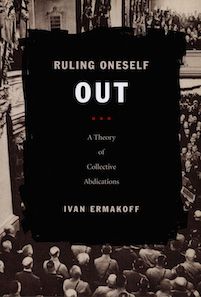 How can a majority of parliamentarians vote to renounce democracy? Why would a group accept its own debasement and, in doing so, abdicate its capacity for self-preservation? What induces them not only to surrender power, but also to legitimize this surrender by a vote? Which conjuncture allowed democratically elected officials to rule themselves out and allow authoritarian leaders to take full control? This sad reversal of fortune happened on two occasions in the twentieth century. On 23 March 1933, less than one month after the burning of the Reichstag, German parliamentarians gathered at the Kroll Opera House in Berlin passed a bill enabling Hitler to concentrate all powers in his own hands by a majority of 444 to 94, meeting the two-third majority required for any constitutional change. On the afternoon of 10 July 1940, at the Grand Casino in Vichy, a great majority of French deputies and senators—569 parliamentarians, about 85 percent of those who took part in the vote—endorsed a bill that vested Marshal Pétain with full powers, including authorization to draft a new constitution. In these two cases, abdication was sanctioned by an explicit decision—a vote. Both cases gave authoritarian leaders all powers to sideline parliament, suspend the republican constitution, and rule by decree. Both 23 March 1933 and 10 July 1940 are dates which live on in infamy in Germany and in France. As soon as the events occurred, they were to haunt the elected officials who took part in the decision. To borrow Ivan Ermakoff’s words, these were “decisions that people make in a mist of darkness, the darkness of their own motivations, the darkness of those who confront and challenge them, and the darkness of what the future has in store.” Can we shed light on this darkness?
History and context
History is the discipline of context, and it explains an event by putting it into a broader frame. But how much context does a historian need, and how far back is one to investigate to put an historical event into a proper frame? In Ruling Oneself Out, Ermakoff chose to explain the handing over of state powers to Hitler and to Pétain by staying as close to the event as possible. He takes as chronological points of departure the German presidential election of 1932 and the French declaration of war in September 1939, giving a short summary of Germany’s descent into political chaos and France’s ignominious defeat. He concentrates on the moment of decision within the two national parliaments by making a blow-by-blow narrative of those two fateful days, trying to enter the minds of rank-and-file parliamentarians and to account for their every motions and expressions. This is different from the historian’s point of view which usually goes farther back in time and tries to put an event into a causal chain of explaining variables and historical determinants. For instance, in a historical essay written on the spur of the moment, Marc Bloch explained France’s “Strange Defeat” (L’Étrange Défaite) by listing all the personal failings and strategic mistakes made by political and military leaders during the interwar period. German historians have interpreted the rise of Nazism as a “belated post-scriptum” (ein spätes Postskriptum) to the cultural conflict (Kulturkampf) between German Catholics and the central state inaugurated by Bismark’s antichurch policies in 1871, or as the expression of a Sonderweg some see going as far back as Luther’s Reformation. Ermakoff’s goal is not to provide a historical account of the two events but to build a theoretical model, a “theory of collective abdications” that may apply, beyond the two cases of parliamentary suicide, to a broad class of collective situations and outcomes.
In the empirical sciences, and especially for the formal lenses of decision theory, context should be reduced to a minimum. The scientist builds a theoretical model and tests it on a constructed dataset, keeping as close as possible to a controlled experiment. Ermakoff’s study is context-rich and steeped in empirical detail. For him, abstracting the event from its historical context is a crucial mistake. The sources he uses for his enquiry are narrative accounts produced by the actors themselves. These testimonies are either contemporary or retrospective, spontaneous or in response to a request, public stances or private accounts. Especially letters and diaries written immediately after the facts are very helpful to debunk ex post rationalizations. They allow to reconstruct actors’ subjective states as they made their decisions. But all testimonies include a form of self-justification and self-deception. The actors rationalized their decision by portraying it as the only viable and acceptable course of action. The tactical reasons the delegates invoke for themselves are self-serving and often betray a willingness to deceive oneself. As Jean-Paul Sartre has shown, the consciousness with which we generally consider our surroundings is different from our reflecting on this consciousness. The historian has to dig deeper if he wants to examine actors in the process of making their decisions. He has to rely on a range of analytical tools—formal, quantitative, and hermeneutic— and apply them to a variety of historical sources. The theory he offers is primarily a theory of the case. Its scope is limited to the confines of the two historical events. No single determination or macrocausal explanation can account for the result of the two parliamentary votes. The outcome was not predetermined; events could have turned differently. The parliamentary votes of abdication were the end result of a process by which parliamentarians based their opinions on the behavior and declarations of their peers. The collective understanding of a situation is dependent on a series of interactions. In confining the analysis to the moment of decision, both theory and history gain in intelligibility and leverage.
Fear of retaliation, misjudgment, ideological contamination
Ermakoff starts by rejecting the three standard explanations for political acquiescence during these two fateful days: fear, blindness, or treason. Delegates who participated in the decision, and historians after them, argued that they made their choice because they were coerced; because they were deceived; or because they were complicit. The coercion thesis portrays abdication as a forced choice. Miscalculation calls into question the assumption that target actors correctly assess the implications and significance of their decision. Collusion lifts the hypothesis that the challenger and the target actors have conflicting interests. Each explanation holds a degree of validity. Threats and intimidation were certainly present in the context of 1933 Germany. Nazi thugs harassed their opponents with seeming impunity. On the day of the vote, several thousand Nazi activists demonstrated outside the Kroll Opera House, where the parliamentarian session took place. In the meeting room they filled the banks reserved for external observers. In France, the country was under the direct threat of an occupying army, and rumors of latent menaces also suffused the political climate. A vote of no confidence would have entailed Pétain’s resignation and a leap into the abyss. But when so much is at stake, actors can always choose to disregard the threats that are deployed against them. As Ermakoff underscores, they can decide to challenge the odds. At the final moment, the decision is theirs. Likewise, the explanation that abdication was based on misjudgement takes actors’ most common retrospective justification at face value. But Hitler’s intentions were clear for all people to see, and in France Pétain’s mouthpiece Pierre Laval had made it clear that a “yes” vote would mean an end to democracy and the republican regime. Besides, the coercion and the misjudgment arguments miss the fact that the two votes were by no means unanimous. Some parliamentarians took a stand and opposed the delegation of full powers to a single man. In Germany, the Social Democratic delegation unanimously voted against the bill. Despite all appearances in retrospect, acquiescence in March 1933 and July 1940 was not a foregone conclusion.
The third scenario, ideological collusion, takes the deterministic argument to its extreme. Nazism’s rise to power is sometimes interpreted as a result of a class alliance between the ruling elite and Hitler’s party in order to thwart communism and secure the interests of the capitalist owners of production. Similarly, the Vichy vote is seen as a conservative revenge against the Front Populaire that had won the elections and implemented labor-friendly policies in 1936. More generally, the period saw the commitment to democratic institutions dwindle, becoming either tenuous or dubious. German Catholic leaders, it is argued, surrendered to Hitler because they were not entirely immune to an antiliberal frame of mind and an organicist conception of the nation. In France, class-based motivations for a political revenge went along with a rejection of the political regime that had made military defeat possible. According to historian Robert Paxton, “there was no resistance simply because no one wanted to resist.” There is a degree of truth in this argument. Parliamentarians who voted “yes” to Hitler and to Pétain failed in their role to uphold the constitution and maintain democratic institutions. They gave the transition to an authoritarian regime the appearance of legality because they abdicated their political capacity. From a legal perspective, they had no right to give a constitutional blank check to Hitler and to Pétain. Lack of personal courage was ultimately the reason for the delegates’ acquiescence. But accusing a majority of parliamentarians of treason or dereliction of duty misses the point. The social scientist’s role is to interpret and to explain, not to judge or to vindicate. A more fine-grained approach to the mechanics of decision is needed.
Decision under stress
Another line of argument points to the irrational forces at play during the decision process. Delegates were under maximum pressure. Wild rumors were circulating. Fear and anguish spread like a disease. On February 28, the day after the burning of the Reichstag, Hitler had issued an emergency decree “for the protection of the people and the state” that abolished basic civil rights conferred by the Constitution. Germany was veering toward total chaos and civil war. Likewise, France after the defeat was totally disorganized. In Vichy, where authorities had gathered after a chaotic escape away from the advancing German troops, everything had to be improvised. The breakdown of parliamentary groups made interactions more random, more hectic, more informal, less structured, and less predictable than in routine times. In such circumstances, social scientists often emphasize the irrationality of crowds, herd behavior, panic movements, and contagion effects. The collective behavior of a disorganized group can influence people to act a certain way or lose their responsibility. Ermakoff agrees that the explanatory key to the outcome is to be found in the collective dimension of the decision. The focus should be on a collective process of decision making. Diffusion effects and the modeling of interactions should take centerstage, for in situations of radical uncertainty people tend to turn toward their peers to shape their own expectations. Yet what gets diffused is less an emotional state than a strategic assessment of the situation. Contagion, the diffusion of an affective state, is a misleading representation of group behavior, for it implies that the process is purely emotional, affective, and mechanical. Even if the process is nonlinear and the result suboptimal, there is no need to resort to the irrationality of crowds and to abandon the hypothesis of rational behavior.
The crucial factor underlying collective abdications were not threats, blindness, or ideological propensities but the dynamics of expectation formation that took shape among delegates in a context of radical uncertainty and as traditional coordination mechanisms had broken down. Witnessing their world crumbling, delegates turned their eyes to their peers. But they did not know where these peers stood. This situation is a classical setting in game theory, decision science, or empirical finance. And indeed, Ermakoff mobilizes many concepts from these disciplines. His theory of collective abdication builds on the three notions of sequential alignment, local knowledge, and tacit coordination, and uses concepts such as reference groups, prominent actors, action thresholds, tipping points, and common knowledge. Traditional historians may shy away at the evocation of these abstract notions, and may even recoil in horror at the sight of a book’s appendix full of equations and graphs. But Ruling Oneself Out is not a book written for theory’s sake, and its narrational structure remains faithful to disciplinary standards in historiography. It refers to many books written by historians on the two events, and particularly to Robert Paxton’s Vichy France. Historians will be on familiar ground, as game theory or decision science are only mobilized to interpret the historical narrative and analyze data. This sociology to the event stands in stark contrast to the cumbersome constructions of social scientists who only use empirical evidence to advance their theoretical claims. Sociology remains a historical science and cannot abstract itself from its temporal condition in order to offer an abstract modeling of social systems. Here, formal tools and abstract theories remain at the service of explaining the facts.
When democracies fail
Ruling Oneself Out offers many valuable lessons for today’s social scientists and committed citizens. The choice to concentrate on two episodes when democracies surrendered on their own free will is significant: it shows in particular that the failure of democracies was not a preordained conclusion. Things could have turned differently. Historical outcomes are not the result of deterministic forces and collective interests: individual decisions matter. And so does politics. In particular, parliamentarians are bestowed with a great burden of responsibility and accountability. Their decisions can make or break a constitutional order. They are the guardians of the democratic temple, and their failure in protecting the sacred treasure that they have in charge can have dramatic consequences. Ermakoff also offers a lesson in applied social science, or historical sociology. He used the best conceptual tools available at his time, without falling into the trap of theory fetishism of math graph envy. His book combines various methods of analysis, both qualitative and quantitative, which are rarely used together. It remains an historical account of two significant events, in which the lay reader will learn a lot. In this perspective, theory and evidence should go hand in hand. Being faithful to “how things actually happened,” to take Leopold von Ranke’s definition of history, does not imply a rejection of formal models or theoretical constructions. The role of parliaments offer a particularly rich material for theoretically inclined social scientists. Parliaments’ archives contain a trove of empirical data, both textual and statistical. They are open to the public, and easily lend themselves to participant observation or ethnographic work. A young French sociologist, Etienne Ollion, has recently published a book on the functioning of the French National Assembly using state-of-the-art narrative techniques and quantitative tools, including statistical techniques derived from artificial intelligence. I hope his book, Les candidats, gets translated into English.
 Is there a pathway that goes “from information theory to French Theory”? Straying away from the familiar itineraries of intellectual history, Bernard Dionysius Geoghegan invites us to take a path less trodden: a detour that allows the reader to revisit famous milestones in the development of cybernetics and digital media, and to connect them to scholarly debates stemming from fields of study as distant as structural anthropology, family therapy, and literary semiology. Detours and shortcuts are deviations from linear progression, reminding the traveler that there is no one best way to reach a point of destination. Similarly, there are several ways to read this book. One is to start from the beginning, and proceed until the end, from the birth of communication science during the Progressive Era in the United States to the heydays of French seminars in sciences humaines in the Quartier latin before mai 68. Another way is to start from the conclusion, “Coding Today”, and to read the whole book in reverse order as a genealogy of the cultural analytics used today by big data specialists and modern codifiers of culture. A third approach would be to start from the fifth and last chapter on “Cybernetics and French Theory” and to see how casting cultural objects in terms of codes, structures, and signifiers relates to previous methodologies of treating communication as information, signals, and patterns. The common point of these three approaches to reading Code is to emphasize the crossing of boundaries: disciplinary boundaries between technical sciences and the humanities; political demarcations between social engineering and cultural critique; and transatlantic borders between North America and France. The gallery of scientists and intellectuals that the book summons is reflective of this broad sweep: Norbert Wiener, Warren Weaver, Margaret Mead, Gregory Bateson, Claude Lévi-Strauss, Roman Jakobson, Jacques Lacan, Roland Barthes, and Luce Irigaray are seldom assembled in a single essay; yet this is the challenge that Code raises, inviting us to hold together disciplines and methodologies that are usually kept separate.
 I want to use Tyler Denmead’s book as an opportunity to reflect on my past experience as director of Institut Français du Vietnam, a network of four cultural centers supported by the French Ministry of Foreign Affairs in Hanoi, Ho Chi Minh City, Danang, and Hue. On the face of it, our situations could not have been more different. I was a mid-career diplomat posted as cultural counsellor at the French Embassy in Hanoi for a four-year assignment. My roadmap for managing the culture centers was simple and laid down in a few words: engage youth, be creative, and balance your budget. Tyler Denmead was the founder and director of New Urban Arts, an arts and humanities studio primarily for your people of color from working-class and low-income backgrounds in Providence, Rhode Island. Coming back to the arts studio as a PhD student doing participatory observation, he comes to realize he has been a mere instrument in the city’s program of revitalization through culture, unwittingly supporting a process of gentrification and eviction of the ethnic minorities he was supposed to empower through cultural activities and economic opportunities in the creative economy. No two cities can be further apart than Hanoi, Vietnam, and Providence, Rhode Island. And yet there are some commonalities between the two. They were both labelled “Creative Cities” and implemented strategies of economic revitalization through cultural activities. They both faced the forces of gentrification, land speculation, urban renewal, and the challenge of dealing with former industrial facilities and brownfields. New Urban Arts and the Institute Français in Hanoi were both tasked with the same missions of engaging youth, expanding access to culture, building skills, and securing public and private support. And, as directors of cultural institutions, we were both entangled in contradictions and dilemma that put our class position and ethnic privilege into question.
 Paris in the Dark made me remember going to the movies in Paris as a child and a teenager. Of course, I did not experience firsthand the period covered by the book, from the 1930s to around 1950. My formative years took place in the late 1970s and in the 1980s, and a lot of change took place between the period described in the book and the times I remember from my childhood. But Paris will always be Paris, and some aspects of the cinema culture that Eric Smoodin describes did sound familiar. The same time distance lies between 1980 and today and between 1980 and the 1930-1950 period, in the interval between the disappearance of silent movies and the beginning of color films. Maybe my childhood years were even closer from the era of black-and-white movies than they are from my present self. Time has been running faster lately: we now have the Internet and Netflix, while I am speaking of a period before DVDs and VHS. Time did not stand still between 1940 and 1980, but there was more continuity between these two dates for French moviegoers and cinema aficionados than between 1980 and now. Also I tend to look as past history from the same perspective that Eric Smoodin describes in his introduction and concluding chapter. He, too, spent time in Paris between 1980 and 1981, as a graduate student who went to the movies as often as he could. And he now looks at the 1930s and 1940s with eyeglasses colored by this youthful experience. We broadly belong to the same generation. And we both feel nostalgic for a time when “going to the movies” was something more than spending an evening out: it was a lived experience that shaped your identity and culture.
 Capacity building is the holy grail of development cooperation. It refers to the process by which individuals and organizations as well as nations obtain, improve, and retain the skills, knowledge, tools, equipment, and other resources needed to achieve development. Like a scaffolding, official development assistance is only a temporary fixture; it pursues the goal of making itself irrelevant. The partner country, it insists, needs to be placed in the driver’s seat and implement its domestically-designed policies on its own terms. Once capacity is built and the development infrastructure is in place, technical assistance is no longer needed. National programs, funded by fiscal resources and private capital, can pursue the task of development and pick up from where foreign experts and ODA projects left off. And yet, in most cases, building capacity proves elusive. The landscape of development cooperation is filled with failed projects, broken-down equipment, useless consultant reports, and empty promises. Developing countries are playing catch-up with an ever receding target. As local experts master skills and technologies are transferred, new technologies emerge and disrupt existing practices. Creative destruction wreaks havoc fixed capacity and accumulated capital. Development can even be destructive and nefarious. The ground on which the book opens, the commune of Ngagne Diaw near Senegal’s capital city Dakar, is made toxic by the poisonous effluents of used lead-acid car batteries that inhabitants process to recycle heavy metals and scrape a living. Other locations in rural areas are contaminated with stockpiles of pesticides that have leaked into soil and water ecosystems.
 What happens in the name of women’s right is, according to Italian scholar Sara Farris, the denial of the rights of certain women and men to live a life with dignity in Western European countries where they have migrated. More specifically, an anti-Islam and anti-migrant rhetoric is increasingly articulated in terms of gender equality and women’s emancipation. The misuse of liberal discourse for illiberal ends is not new: the invasion of Afghanistan that followed the terrorist attacks of September 11 was presented to the international community as a mission to liberate Afghan women from their oppression under Taliban rule just as much as an act of defense and retaliation against the perpetrators of the attacks. The French fixation with the “Islamic” veil finds its origins in the Algerian war and the effort to present the fight against the FLN as a crusade for modernity on behalf of “Arab” women against their male oppressors. Closer to us, Marine Le Pen is known for courting France’s female voters and for endorsing women’s rights within the framework of her anti-migrant platform. What is distinctive about Sara Farris’s book are three things. First, she anchors her discussion on what she calls “femonationalism” (read: feminism+nationalism) within the context of ideological debates taking place in France, Italy, and the Netherlands during the first decade of the twenty-first century. Second, she shows that the instrumentalization of women’s rights for anti-migrant and anti-Islam purposes is not limited to political parties from the far right: rather, it is the result of a convergence between right-wing nationalists, some feminists and femocrats (by which she means bureaucrats and social workers promoting gender equality policies in state agencies), and neoliberal economic policies targeting participation in the labor market. Third, Farris claims that only a political economy analysis inspired by the critique of neoliberalism can explain why, at this particular juncture, “Muslim” men are being targeted as surplus workers “stealing jobs” and “oppressing women”, while “Muslim” and non-European migrant women are construed as redeemable agents to be rescued by integrating them into low-skilled, low-paid activities of the “social reproduction sector.”
 The Duke Reader