

Anatomy of a Feminist Diplomacy Campaign

A review of The Banality of Good : The UN’s Global Fight against Human Trafficking, Lieba Faier, Duke University Press, 2024.

On the face of it, fighting human trafficking has all the banality of a good deed. The adoption in 2000 of a UN Protocol on human trafficking, with a heavy focus on the sexual exploitation and abuse of migrant women, was a positive act of feminist diplomacy and was lauded as such by feminist groups in the West and in developing countries. The UN template set the stage for the development of a new international regime of norms and guidelines for how national governments, NGOs, and international organizations should actively work together in this fight. With the Trafficking in Persons Report published yearly, the US Department of State must be praised for having given teeth to the UN Protocol, allowing a carrot-and-stick approach to ensure compliance while naming and shaming bad performers. The US government was bold enough to point finger at one of its closest allies, Japan, whose treatment of migrant women brought under an entertainer visa scheme was clearly violating basic human rights. Japan did a good thing by applying international best practices and diminishing abuse: within two years, the number of Filipino women entering Japan on entertainment visas dropped by nearly 90 percent. All stakeholders can take pride on this result: women’s groups, feminist leaders, UN diplomats, American Embassy staff, Japanese case workers, law enforcement officers, and the victims themselves. This may not sound like a big deal, but they all did well. Hence, the banality of good.

Turning Hannah Arendt’s Banality of Evil on its Head

Under this narrative, the banality of good denotes step-by-step progress in the advancement of human rights and the fight against human exploitation. But let us pause. All of the above is not the story that Lieba Faier tells, and her expression “the banality of good” in fact has the opposite meaning. She uses it “to refer to the perils of this campaign’s globalized institutional approach, which ultimately privileges technical prescription and bureaucratic compliance over the needs and perspectives of those it means to assist” (p. 11). All stakeholders aiming to do good and alleviate the plight of victims of human trafficking missed their original goal or had to compromise on their principles. By bringing a global solution to local problems, the international community only made things worse. Foreign women working in the sex industry were forcibly deported on criminal charges of visa overstay; grassroot NGO workers became complicit in the expulsion of those they were supposed to protect; while police raids pushed the sex industry further underground. In titling her book The Banality of Good, Lieba Faier of course has in mind the expression “the banality of evil” coined by Hannah Arendt to denote the fact that evil can be perpetuated when immoral principles become normalized over time by people who do not think about things from the perspective of others. Evil becomes banal when people don’t feel bad when they do evil. Here, the banality of good reflects the opposite attitude: people don’t feel good when they are supposed to do good. They know something is wrong, but they can only attribute it to “the system” or hope that their action contributes to the realization of a greater good.

Over and over in Lieba Faier’s narrative, individuals and groups committed to the betterment of foreign women’s plight had to compromise on their strategic goals and core values. The original impetus to fight against traffic in women came from Asian feminist organizations and grassroot human rights groups in Japan, Korea, and South-East Asia. Beginning in the early 1970s, they built a regional coalition to respond to a rising tide of Japanese sex tourism in the region. They also had a broader agenda that was anti-capitalist and anti-colonial at its core, seeing sex tourism as the reflect of structural inequities among nations and between genders and classes. But the US feminist groups who picked up their fight obscured the structural factors foregrounded by the earlier efforts of women’s groups in Asia and framed human trafficking as a uniform global issue that warranted a single global response. This global feminist movement coined the expression “sexual slavery” to articulate a singular, abstract, deterritorialized global practice, overlooking racial, national, and class inequalities among women. They formed an alliance with the human rights movement to launch a campaign for the abolition of “violence against women,” with human trafficking as a key instance of this violence. Lieba Faier describes how a globalist feminist project then became a UN-centered global human rights initiative: the drafting and adoption of the Trafficking Protocol was based on compromise by both Asian grassroot organizations and US feminist groups, who were themselves divided between prostitution abolitionists and sex worker rights’ advocates. By establishing a formal definition of human trafficking and then collecting data on it, the protocol promised to recognize human trafficking as a global phenomenon for states to measure and institutionally address.

Reframing Sexual Violence

But when national governments decided to act, they did not focus on human trafficking as a matter of violence against women. Rather, they reframed the issue once again, this time as a matter of transnational organized crime warranting a punitive solution. What US-based feminism had identified as violence against women would be reframed as a generalizable problem of criminal violation enacted by individual private citizens against other private citizens. A model of redistributive justice was discarded in favor of a carceral model. Of the three Ps framework—preventing trafficking, protecting victims and prosecuting traffickers–, the third P was prioritized and the two previous ones were sidelined. In Japan, grassroot NGO workers produced “trauma portfolios” of victims, collecting personal accounts of suffering to argue that foreign sex workers deserved protection and assistance, not treatment as criminals. NGO caseworkers’ accounts were so moving that American diplomats made the controversial decision of placing Japan on the Tier 2 Watch List of the 2004 Trafficking in Persons Report. For Japanese bureaucrats, this was a huge blow to national pride: most of the advanced countries were on the so-called Tier 1 list, but only Japan was ranked Tier 2. Something had to be done to restore Japan’s standing in the international community. The same narratives that had moved NGO activists and US diplomats into action were now perceived as a matter of national shame.

As Lieba Faier remarks, “People care about others for different reasons and thus to various ends” (p. 95). For NGO workers, reporting on victims’ stories of abuse to US embassy officials was a way of using gaiatsu, or foreign pressure, to induce reforms in domestic policies. But the Action Plan that the Japanese government enacted in 2005 was a bureaucratic exercise, devoid of compassion or concern for social justice. The “Roadmap to Tier 1” was rich in international best practices and indicators, but disconnected from facts on the ground. As a result of the screening process, migrants that were denied the status of victim were forcibly repatriated to their home countries or held liable for illegal residence (fuhō taizai). Only those officially recognized as victims of human trafficking received protected status, with a residency permit allowing them to remain in Japan or assistance to go back home. As one NGO caseworker confided to the author, “Sometimes I don’t feel good about the work I’m doing. These migrants have nothing back home” (p. xiv). Or as another worker put it, “They don’t have anywhere to go. For many, their life of extreme poverty in the home country is much worse than what they have now” (p. 15). These NGO caseworkers didn’t feel that justice was being served by those international protocols, but if they refused to participate in them, they worried that the situation would be worse. So they complied with the “bureaucratic glue and strings” (p. 171) attached to being part of an international campaign against trafficking in women.

Support Comes with Strings Attached

Lieba Faier complements her fieldwork with archival work and interviews with UN officials and government representatives in Japan and in the United States. She dissects the various frames and translations that a social issue has to go through in order to become a legal provision in an international protocol; and how a UN template in turn translates into reality and alters the lives of women who may or may not be designated as victims of international trafficking. She brings an ethnographic eye to practices of helping migrant workers, campaigning for women’s rights, drafting UN templates, and translating legal texts into policy options. She reads “against the grain of bureaucratic documents to see the contradictions, aporias, and impasses embedded in them” (p. 101). As she describes it, the United Nations acts as a clearinghouse for such efforts, erasing history and geographical differences in the interest of establishing a standardized international practice. As she points out, “the rote adherence to an institutional protocol comes to stand for necessary structural change” (p. 13). Well-intentioned humanitarian campaigns produce unintended harm through bureaucratic routines and institutional priorities. These efforts prioritize protocol compliance over survivors’ needs, perspectives, and lived realities, leading to repatriation, compromised quality of life, and even criminalization of those they aim to help. The Japanese government offers assistance to only a small portion of those foreign workers suffering abuse and exploitation: “In 2018, only seven trafficking victims received repatriation assistance, and this number dropped to five in 2019” (p. 211). These “lilliputian pockets of improvement” (p. 213) mask egregious failure to put an end to human trafficking. Even those who benefit from repatriation programs fall victim of “cruel empowerment” (p. 185): humanitarian programs designed to empower them through financial literacy or other neoliberal models of development fail to address the structural inequalities of the status quo.

Lieba Faier’s scholarship is informed by the years she spent as a volunteer in Japan, the Philippines and the United States working alongside NGO workers assisting migrant women and lobbying the UN and governments to address the mistreatment of foreign women working in the sex industry and other exploitative sectors. As she writes, “Doing multi-sided research involving multiple organizations in three different countries over many years had advantages insofar as I sometimes heard part of a story in one organization or country and the rest of the story in others” (p. 19). Her findings were also buttressed by the availability of US diplomatic cables disclosed by WikiLeaks, which documented internal processes and political motivations. Grassroot perspectives allowed her to question the way these migrant women’s plight was addressed in international policy forums. As she notes, “the global approach to this issue was sidelining, if not displacing, the expertise and guidance of the experienced NGO caseworkers whose labor was central to it” (p. xii). While these NGO workers were sometimes themselves former labor migrants and had a deep understanding of the situation they tried to alleviate, the organizations that brought the issue to an international public stage were headed mostly by academics, journalists, or lawyers with little direct knowledge of facts on the ground or contacts with grassroot organizations. She also questions the exclusive focus of the international campaign on the sex industry and the lack of attention awarded to other forms of exploitative labor, such as the conditions faced by Asian workers who come to Japan under the Technical Intern Training Program (Ginō Jisshū Seido), which she describes as a cover-up for cheap and disposable labor acquisition. Her advocacy for migrant rights doesn’t stop at one particular category, but is informed by “a vision of justice that asks national governments and their citizenries to see foreign workers as part of their imagined community” (p. 140).

A Plea for the UN

The Banality of Good is informed by the vision that “other worlds are possible,” as stated in the book’s opening dedication. But what are the alternatives? As a French diplomat committed to a feminist diplomacy agenda, I would not easily dismiss the United Nations’ approach to human trafficking or the work done by American diplomats to document Japan’s insufficient efforts in applying human rights standards. I agree with the author when she states that “if international guidelines are themselves problematic, little will be achieved by compliance with them” (p. 120). But this should serve as a rallying cry to devote more attention and resources to UN multilateralism and human rights campaigning. The Trafficking Protocol, with its lack of a credible enforcement mechanism and its emphasis on criminalization and border protection, is an easy target for attack. But internal debates show that the work was perfectible and that other policy options were put on the negotiation table. Mary Robinson, then UN high commissioner for human rights, pushed hard to have a human rights perspective embedded in the text. She proposed the addition of specific references, provisions, and language to acknowledge the rights of migrant workers, not just sex workers or those recognized as victims of trafficking; and she argued for strengthening the “victim protection and assistance” provisions in the draft protocol to allow for financial resources being devoted to helping victims of human trafficking. The fact is, we don’t have an alternative to the UN, and bottom-up approaches are compatible with international summitry or legal text draft-making. Concepts such as “responsibility to protect,” “rights-based approach” or “human security” are not just abstract notions devoid of any content; they alter facts on the ground and induce real changes for people in need of international protection. Misperformance is no reason for inaction.

A Diplomat’s Dog in India

A review of Indifference. On the Praxis of Interspecies Being, Naisargi N. Davé, Duke University Press, 2023.

IndifferenceMy wife and I are moving to India along with our dog Kokoro, a shiba inu. Kokoro, aged 13 (a venerable age for a dog) has already been around, seen places. As a diplomat’s dog, he had to follow his keeper in his foreign assignments. He has never set foot, or paw, in the land of his ancestors, and doesn’t come with us when we travel to Japan. He remained in France when I was posted in Seoul—not because he was afraid of staying in a country where dog meat consumption is still not uncommon, but because I went to Seoul as a goose father, or gireogi appa, as the Koreans say to designate a breadwinner living away from wife and kids and sending money home for the sake of their children’s education. Kokoro did come to Vietnam during my most recent assignment. He and my wife had a hard time adapting to the local culture. Pets are increasingly becoming familiar in Vietnamese cities, but many people still regard dogs as uncouth and unclean, keeping them away from human contact. My wife couldn’t determine whether people waving or wagging finger at her and her dog to tell them to go away were being aggressive toward a foreigner or simply discriminatory toward a dog. She had to bring a stick when walking Kokoro in the neighborhood park in order to ward off stray dogs, and was once attacked and bruised by a mutt. Wherever we went, she joined local NGOs or Facebook groups mobilizing for animal protection and pet welfare.
Animal protection in India

I picked up Naisargi Davé’s book because Indifference was ostensibly about human-animal relations and animalist cultures in India. The questions that I had in mind were related to the conditions that would await Kokoro and his keepers in our future location. Is there a pet culture in Indian cities, and can one easily find dog food and specialized services such as vets and pet sitters? Do street dogs carry rabies and are they aggressive toward pet dogs and their keepers during their walks? What is the general attitude of the population toward non-human animals in general and dogs in particular? Are there local organizations of pet owners or animal rights NGOs that we could join? Is violence against animals or the unethical treatment of non-human species an issue? Are Indian cows really sacred, and why do they get such special treatment? Davé’s book didn’t provide answers to these questions, at least directly. It wasn’t meant or supposed to. Anthropology, at least the way it is practiced now, is not the discipline that will answer practical questions regarding a foreign country or a particular culture. There are other books for that: travel guides, how-to manuals, journalistic accounts, or expat diaries. Naisargi Davé is not interested in South Asian cultures or civilizations in the traditional sense. Nowadays culture is a fraught concept in anthropology; nobody really uses that notion any more. The frontier of the discipline lies in queer studies, new materialism, animalism, and deconstructing notions of race, gender, and identity. As an author published in a cutting-edge academic press, Davé is committed to pushing the envelope further, not in revisiting foregone notions.

One way she connects with the past of the discipline is through fieldwork and participant observation. Anthropology departs from arm-chair theorizing and cannot be practiced from a cabinet. Ethnographers have to go on the ground, meet people, participate in activities, observe surroundings, and take notes or keep a research diary. Davé conducted her ethnographic fieldwork in several Indian cities over a period of ten years, documenting animal activism and interspecies relations by doing participant observation in local NGOs. She didn’t follow a structured methodology or engaged in survey research; instead, as she describes it, “I followed my intuitions, went where I was invited; and, in general, said yes to who and what turned up.” She associated with several strands of Indian society, from rags to riches, from pariah to nabab. She had several discussions with Maneka Gandhi, India’s most notorious animal activist and heir to the Nehru-Gandhi political dynasty, but also followed streetworkers in their roaming across popular settlements or red-light districts to heal wounded dogs or rescue suffering animals. She provides a long list of animal rights organizations: People for Animals, Welfare for Stray Dogs, Kindness for Animals and Respect for Environment, the Society for the Prevention of Cruelty to Animals, Help in Suffering, Compassion Unlimited plus Action, the Animal Welfare Board of India, Humane Society International, Save Our Strays, etc.

Dog riots and cow vigilantes

Some organizations originated in the colonial period and were significantly shaped by foreigners or expatriates. Others follow a purely domestic agenda and reflect local cultures of animal protection. Jaïns, for instance, are strict vegetarians who try to avoid all harm to humans and animals; many Jaïn monks and nuns even wear fabric over their mouths to avoid breathing in insects or microbes, and sweep ahead of themselves while walking to avoid treading on bugs. Almost every Jaïn community has established animal hospitals to care for injured and abandoned animals; many Jaïns also rescue animals from slaughterhouses. Dogs are considered sacred in the Zoroastrian religion, and an attempt by the British government to exterminate Bombay’s stray dogs in 1832 led to a mass protest known as the Parsi Dog Riots. The Great Mutiny of 1857 originated because rumors circulated that Indian soldiers’ bullet cartridges were greased with pork fat (repulsive to Muslims) or beef fat (insulting to Hindus.) The Gau Seva Sangh or Society for Service to the Cow is associated with the Hindutva right and has sponsored laws banning cow slaughter in almost of all of India’s 28 states. Cow vigilante groups have been accused of enforcing this ban through violence, often leading to the lynching of (mostly Muslim) meat sellers and cattle traders. For Davé, cow protectionism “is not animal welfare: it is exclusively about the cow, the cow as a weaponized symbol that separates those who eat or slaughter cows (Muslims, Dalits, tribal people, and Christian minorities) from those who, by doctrine, do not (caste Hindus, or sarvanas).” Davé also makes a distinction between “hands-on” and “hands-off” animalists. The first get their hand dirty and “pick up poop” or enter their fingers into dogs’ behinds to extract maggots; the second keep their hands clean and are also designated as laptopwala or AC-wala (those who reside in air conditioning.) Davé follows the formers in animal shelters caring for three-legged dogs, paralyzed pigs, and a long list of species; in street patrols doing community service for suffering animals; and in inspection visits of slaughterhouses or poultry farms.

Davé notes contradictions that often shock foreigners or distant observers of Indian society. Compassion for suffering animals can coexist with indifference for the plight of humans or cruelty toward other species. Ahimsa, a central doctrine in Hindu, Jaïn, and Buddhist thought, is often invoked to laud the moral relationship between people and animals in India. But it can also be read as an abnegation of responsibility, a haughty indifference toward every social issue that does not directly involve the abuse of animals, or the refusal to expose onself to ethical quandaries. Her ethnographic vignettes include the story of Abodh, a street veterinarian who gets his hands dirty from cleaning the wounds of animals and only asks for water to clean his hands as a form of retribution; of Dipesh, a street worker who patiently cleans a dog’s butt infected by maggots and disposes of the worms on a discarded newspaper, then expresses indifference when the dog almost gets run over by a car; of Retired Brigadier-General S.S. Chauhan who cares so much for his cow (named Kamadhanu) that he gives up drinking milk after she stops lactating; of Amala Akkineni, a South Indian actress who converts to the animal cause when she picks up a goat hit by a lorry on the side of a road; or of the Brahmin who has a run-over bull suffering agonizing pain be removed ten feet from his land to the road where he can be shot without compromising the landlord’s ahimsa. Less savory stories include mob killings of Dalit or Muslim villagers accused of having slaughtered a cow, or the many cases of bestiality, or animal sexual abuse, reported by the media. In a provocative chapter co-written with Alok Gupta, Davé draws a parallel between sexual violence against animals and livestock insemination, which she labels “permissible interspecies sex.”

Ethnographic vignettes and biographical portraits

Davé traces the history of animal protection in India through three portraits of women who advocated for the rights of animals from very different perspectives, which she calls “the odious,” “the genial,” and “the luminous.” Savitri Devi Mukherji shows that moral attention to animals can be morally repulsive. Born in France from European parents, she developed a fixation on cats and Aryans as well as a lifelong animosity toward Britain. She came to India in 1932, stayed briefly at Rabindranath Tagore’s ashram in Shantiniketan, and became an apologist of Hitler and his crimes against humanity (which she found “hopelessly amateurish” in comparison to other atrocities.) According to Davé, Savitri Devi provides the link between radical ecology, Nazism, and the Hindutva movement. Crystal Rogers, by contrast, was moved by compassion toward sentient species, humans and non-humans alike. The author of the autobiography Mad Dogs and an Englishwoman was “the original kutta-billi activist” or dog-cat lover, creating several shelters for abandoned and injured animals that exist to this day. The third character, Rukmini Devi Arundale, was a student of the theosophist Indophile Annie Besant and has become an icon of the animal welfare movement in India through her sponsoring of the Prevention of Cruelty against Animals Act (PCA) in 1960 and her participation to the the Animal Welfare Board of India until 1986. She also espoused the cause of Bharatanatyam, a traditional dance from Tamil Nadu then scorned by the elite, and created the Kalakshetra dance academy in Chennai. In addition to these three biographies, Davé mentions the attachment to animal welfare by the Nehru-Gandhi family. Jawaharlal Nehru, the father of India’s independence, was an animal lover in the bourgeois sense of the word. He considered it a point of pride to push through the PCA Act. His daughter, Indira Gandhi, sponsored the wildlife conservation initiative Project Tiger in 1973 and wrote that “someday I hope people will shoot only cameras, and not guns, in the jungle.” Maneka Gandhi married Indira’s younger son Sanjay, who died in a plane crash in 1980. An animal rights activist and a politician, she led protests against the opening of the first McDonald’s restaurant in 1996, stating that “we don’t need cow killers in India.”

But those vignettes and portraits aside, Davé refrains from providing “context.” Asked by a colleague from another discipline to give some context to her anecdote about the dog’s butt infected with maggots, she answers tongue-in-cheek with a long description of a dog’s anatomy and a chemical analysis of anal glands secreting a strong smell that keeps parasites away. For her, we should not talk about dogs and animal welfare in general, but of this particular dog in a specific situation. She echoes the anthropologist Donna Haraway who, in When Species Meet, criticizes Jacques Derrida for describing (in The Animal That Therefore I Am) his reaction to a cat staring at him naked without indicating the cat’s name or taking a cat’s point of view. While she limits her perspective to the ground level, she also offers a meta-analysis of her topic: she doesn’t write directly on animal ethics in India, but on what it means to raise the issue of animal welfare in specific situations. She also warns against the scientific impulse to “look, stare, take in, pillage, acquire, ingest, dissect, admire, anthropologize, steal, exhibit, repair, voice, recoil, sell, and possess.” Curiosity—the basic drive of the social scientist—is a politically tainted notion. As she confesses, “I can say for myself that, as a dyke, the curious gaze of normal people is rarely a pleasure.” As she puts it, “one should at least sometimes just leave folks alone.” The requirement for total transparency, like language for Roland Barthes, is fascist by nature. Instead of the inquisitorial gaze of the curious observer, she advocates “indifference to difference.” Indifference calls for a different politics as well as a poetics of relation and identity. Naisargi Davé concurs with Édouard Glissant when the French Caribbean poet proclaims: “we clamor for the right to opacity for everyone.” Her particular form of opacity is called queerness, or the refusal to conform to heteronormative scripts: “as for my identity,” she echoes Glissant, “I will take care of that myself.” We should have respect for mutual forms of opacity: in the words of the intersectional feminist and poet Audre Lorde, we should be “at the watering hole / not quite together / but learning / each other’s ways.”

Pets and diplomacy

Over the years and along my foreign postings, I have accumulated many stories about pets and diplomacy. The dog of the US Ambassador to Seoul was quite a celebrity, and his separate twitter account attracted many followers. During morning walks, people stopped his master in the street because they recognized the dog, not the diplomat. There is a popular hashtag for #diplocats on Twitter, with Larry, the cat from 10 Downing Street, as a frequent guest star. An infamous picture shows the French Ambassador to Rwanda boarding an evacuation plane at the beginning of the 1994 genocide along with his dog, while leaving behind Rwandan employees and partners to a certain death. Instructions on relocation always have a few paragraphs on pets, describing the minute procedures that dog or cat owners have to follow in order to bring their animal companion with them. Some countries have set quarantines or procedures so complex that they have to be planned at least six months in advance, while other countries, such as the Maldives, prohibit bringing in or owning dogs by law. Pets are a sweetener in international relations: state visits sometimes end with the offering of a pet or a live animal as an official gift, and China conducts its own panda diplomacy by sending giant pandas to the zoos of friendly countries. In 1949, India’s first Prime Minister Jawaharlal Nehru received a letter from the children of Japan with an almost preposterous request: they had never seen a live elephant and wanted him to send one to them—which he did, starting India’s own brand of elephant diplomacy. Some gifts carry a mixed message, such as the dog Pushinka given to President Kennedy by Premier Khrushchev in 1961. As one of the puppies of the first dog to survive space travel, Strelka, Pushinka was a gesture of friendship but also a lingering, living reminder of the Soviets’ early victories in the space race. But pets can also be weaponized: witness the picture of German Chancellor Angela Merkel, reportedly fearful of dogs since one attacked her in 1995, looking distinctly uncomfortable when Russian President Vladimir Putin brought his large black Labrador Koni into a meeting at his summer residence in Sochi, Russia, in January 2007.

Finns Bearing Gifts

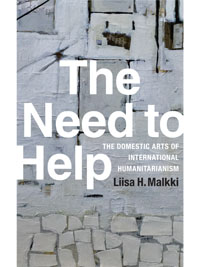
A review of The Need to Help: The Domestic Arts of International Humanitarianism, Liisa H. Malkki, Duke University Press, 2015.

Kiisa MalkkiLiisa Malkki wrote her PhD and gained tenure at Stanford’s anthropology department based on her fieldwork among refugees from Burundi. She worked in a refugee camp in Tanzania in the mid-eighties, and presented the narratives she collected from Hutus fleeing political violence in a book, Purity and Exile. This book gained some public attention when it was criticized by Peter Gourevitch who argued, in the New York Review of Books, that her “mytho-history” was more myth than history, and later on when some of its testimonies of genocidal violence were echoed by the reports and stories coming out from the Rwandan genocide (this time with Hutus as perpetrators and Tutsis as victims). But Liisa Malkki didn’t want to be categorized into a box, much less be identified as a “refugee” scholar or a “genocide studies” specialist. This is why she turned to a terrain closer to her place of origin and less fraught with political disputes: Finnish Red Cross aid workers sent abroad on emergency relief missions, as well as other persons gravitating around the Red Cross movement in Finland. Although she spent her childhood in East Africa, and most of her professional career in the United States, she apparently remained close to her home country of Finland. This is where she conducted the fieldwork for this book, putting into use her intimacy with the people and their language as well as her knowledge of the domestic scene.

Act like a Finn

Who are the Finns? How can one hail from Finland? This is a question to which Finnish aid workers, and Finnish nationals in general, are often confronted. They have developed a response in action: to be a Finn is to act like a Finn, and to embody the virtues and proclivities that they associate with their homeland. Finns often speak of “having to prove themselves” on the international scene. For them, and therefore for their foreign interlocutors, Finnishness (suomalaisuus) involves calmness, discretion, honesty, social reserve (häveliäsyys), and hard work. Some people feel at ease with these national characteristics, and work hard to prove they deserve their reputation of hard workers. Other experience it as a constraint to their lives and try to escape from it—by going out to the “world out there” (olla maailmalla), or by developing other sensibilities not associated with the national character. In particular, in a society that prides itself on self-reliance, grit (sisa), and a fierce love of privacy and individualism, solitude and the repression of public emotions can be felt as a heavy burden. Finnishness is also sometimes associated with small-mindedness, provincialism, conventionality, and the rejection of foreigners. Hailing from a small and isolated country, Finns want to connect to the outside world, and be part of something “larger than themselves”. The ICRC provides them the opportunity to do just that.

If Liisa Malkki reports such traits, it is not to engage in an outmoded sociology of the national character, but to describe how Finnishness is perceived both as a resource and as a constraint by the people she interviewed. Talk of what Finnishness means, and self-stereotyping, are extremely common among Finns. Little is known from their country abroad, especially in the countries where Finnish aid workers are dispatched. Finland is a country remote from the Global South, by its latitude and its climate as well as by its national history. It never engaged in colonial expansion, and itself experienced imperial rule for most of its history, as a province of Sweden and then of Russia before gaining its independence in 1917. Just as the Finns want to appear as thrifty and hard-working, the Finnish state is characterized by its generous aid policy toward Third World nations but also, at the same time, by its stern condemnation of the profligacy of Greece and other southern members of the European Union. Finland wants to appear generous to strangers and willing to share its riches with those who really deserve it, yet according to media reports it treats foreign immigrants from developing nations as social outcasts, and admits very few refugees. It is in many ways a closed society. As the author argues, “refugees, immigrants and minorities from around the world (and especially their children) might be ‘Finns’ both culturally and in terms of citizenship—but they are still often the object of xenophobic slurs and attacks.”

Peace, neutrality, and humanitarianism

The fact that Finland is a small internationalist state committed to world peace and United Nations principles is also an important factor for the ICRC, an organization that has elevated the notion of neutrality, along with impartiality and humanity, to the status of a founding principle. Neutrality has long been a key part of Finland’s foreign policy and international image, and this helps to explain the heavy representation of Finns on ICRC missions in politically difficult conflicts elsewhere around the world, especially in Africa and the Middle East. Of course, as Liisa Malkki reminds us, neutrality (neutraalius) is a kind of politics, both for Finland and for humanitarian aid. For most of its modern history, Finland’s neutrality has been a strategic defense issue of great significance, although some people now see it as a relic of the Cold War that should be jettisoned. Similarly, neutrality is a policy tool that allows the ICRC to “talk to anyone” in an armed conflict or during a humanitarian crisis. Neutrality and the attempt to steer clear of politics has often been reproached to the Red Cross (was it right to stay “neutral” during the rise of Nazism in Hitler’s Germany?), and it can also lead to ethical dilemma and impossible situations. The author shows that neutrality is not only a code of conduct, but also a state of mind for aid workers who need to preserve “affective neutrality” in the face of human suffering. Like a surgeon in the middle of an operation, the aid worker (who often operates in the medical field) needs to concentrate on her work and shun out emotions, at least temporarily. Again, this attitude conforms to the Finnish national character of emotional restraint and hard work.

Like neutrality, humanity is part of the Red Cross ethos—it is a core value that Red Cross workers are supposed to serve. Humanity is here conceived in terms of “basic human needs” and of abstract “human rights” that have to be supplied and guaranteed by the “international community.” In the worst case, such views can lead the “needy African” to be imagined as a sort of specimen of “basic humanity” more biological than political—“bare life,” as Agamben and others have argued, more zoë than bios. Engagements with humanity understood in such generic terms can turn into political disempowerment. Paradoxically, it also can lead to dehumanization, as when the public’s compassion focuses on children and on animals, which is a way to deny human subjects their agency. Images of children in need are everywhere in humanitarian appeals to generosity in print and digital media. No wonder that this kind of sentimental humanitarianism has been the target of attacks by social critics, from Friedrich Nietzsche and Karl Marx to Hannah Arendt and Roland Barthes. Even politicians have joined in their critiques: Jean Kirkpatrick, a former US ambassador to the United Nations, once dismissed the category of “economic, social and cultural rights” enshrined in the Universal Declaration of Human Rights as “a letter to Santa Claus.” To the lofty scene of humanitarian ideals, they oppose the hard reality of conflicting interests, geopolitics, and war.

A letter to Santa Claus

As she confesses, Liisa Malkki started her research ready to see a dangerous kind of antipolitics in invocations of an unsituated “humanity” such as those found in the guiding principles of the ICRC. But the competing view, the misogynistic denunciation of the human herd by Nietzsche or the cynical realpolitik of politicians, does not get her favor either. She notes with some regret that the appeals to world peace, disarmament, and global social justice, which were once the preserve of powerful spirits such as Albert Einstein or Eleanor Roosevelt, have been trivialized and infantilized to the point of losing all political potency. Her chapter on Children, Humanity, and the Infantilization of Peace demonstrate how children have been invested with various ideals within a “transnational ritual sphere” that constitutes the figure of the child as the bearer of humanity. Again, it is easy to deride the lachrymose exploitation of children’s image by humanitarian marketing campaigns and peace education programs. But humanitarian appeal is not just the negation of politics: it is also, in itself, a form of politics. Liisa Malkki shows how an unblinking, absolute commitment to humanity (as to neutrality) involves its own kind of zealotry. Zealous humanism, she suggests, is no less extreme than religious fundamentalism. It is indeed rooted in religious values and Christian doctrines, although most of the Finns she interviewed denied any form of religious affiliation and were wholly secular.

There is a commonplace popular view that the humanitarian worker is moved by powerful ideals and feelings of compassion. But the people sent on humanitarian mission by the Red Cross refuted this image. For them, the “Mother Theresa-type” of people bent on self-sacrifice were clearly not wanted: they could put a mission at risk, and were at best a disturbance from a more efficient work ethos. The persons interviewed by Liisa Malkki took issue with their definition as humanitarian actors. They preferred to design themselves as “aid workers”, or to emphasize their professional affiliation—as doctors, nurses or engineers. Professional solidarity with their fellow team members and with their national counterparts in the field took precedence over abstract humanitarianism. They acknowledged several reasons for going on mission abroad, some mundane—to escape from the cold of Finland’s long winter and to find “warmer” places, meteorologicallly and socially—, others more practical—as a way of personal and professional development, to acquire new skills and exercise them in more demanding conditions. Going overseas made it possible for them to be part of something other and bigger than themselves. To be “out in the world” (olla maailmalla) was a powerful object of imagination for them. Many talked in terms of an international obligation and a “need to help” (tarve auttaa). But they were professionals before they were humanitarians.

Humanitarian aid always begins at home

Importantly, for Malkki, acknowledging the needs of aid workers does not diminish them or the work that they do. Nowhere does she suggest that they serve their own needs at the expense of the needs of others. On the contrary, recognizing needs on both sides of the aid relationship calls for a more reciprocal view of North-South relations. It complicates the dichotomy between the aid giver—perceived as generous, selfless, compassionate—, and the aid recipient who is identified solely by her needs. Malkki provides a case study of a kind of help for which there is no real recipient: the Finnish Red Cross Aid Bunny campaign, that had old ladies hand-knit toy-like figures that are then supposedly sent to children in need as part of emergency relief missions. The Aid Bunnies and their siblings—the Trauma Teddies, the Mother Theresa blankets, and so on—are easy to dismiss as silly sentimentalism and useless gift-giving: even Red Cross employees feel embarrassed by the accumulation of cardboards full of animal toys that they are mandated to send to the field. But again, Liisa Malkki eschews from taking an easy target at these forms of wasteful generosity. Instead, she concentrates on the social activities and inner lives of the Finnish ladies who contribute to these campaigns, showing again a powerful need to donate their time and attention to causes that pull them upward.

One shouldn’t beware of Finns bearing gifts. Their intentions are sincere, their feelings are true, and their hard work speaks louder than their words. The conduct of Red Cross aid workers may appear as self-serving and parochial, the sentimentalism of old ladies knitting teddy bears for imaginary victims may generate scorn and indifference. But consider the alternative. Cynicism and hard-nosed interest breed conflict and isolation. Without proper stimulus, the faculty to empathize with one’s fellow human wanes and dwindles. Imagining children in need and longing to help them may be considered as a calisthenics for the enhancement of empathy. Compassion needs training. Viewed from this perspective, the cultivation of humanitarian sentiments, encouraged by the state and various social institutions, is closely linked to the generous aid policies of Nordic countries. Manufacturing consent to ODA policies involves not only rational arguments about aid effectiveness and geopolitical payoffs, but also a sentimental education of the imagination, a cultivation of the “need to help.” This is especially true in a country like Finland, where smallness and isolation breed a desire to be connected to something other and greater than oneself. There is something in the home society of Finland that creates a specific “need to help.” Humanitarian aid always begins at home.