
Anatomy of a Feminist Diplomacy Campaign

A review of The Banality of Good : The UN’s Global Fight against Human Trafficking, Lieba Faier, Duke University Press, 2024.

On the face of it, fighting human trafficking has all the banality of a good deed. The adoption in 2000 of a UN Protocol on human trafficking, with a heavy focus on the sexual exploitation and abuse of migrant women, was a positive act of feminist diplomacy and was lauded as such by feminist groups in the West and in developing countries. The UN template set the stage for the development of a new international regime of norms and guidelines for how national governments, NGOs, and international organizations should actively work together in this fight. With the Trafficking in Persons Report published yearly, the US Department of State must be praised for having given teeth to the UN Protocol, allowing a carrot-and-stick approach to ensure compliance while naming and shaming bad performers. The US government was bold enough to point finger at one of its closest allies, Japan, whose treatment of migrant women brought under an entertainer visa scheme was clearly violating basic human rights. Japan did a good thing by applying international best practices and diminishing abuse: within two years, the number of Filipino women entering Japan on entertainment visas dropped by nearly 90 percent. All stakeholders can take pride on this result: women’s groups, feminist leaders, UN diplomats, American Embassy staff, Japanese case workers, law enforcement officers, and the victims themselves. This may not sound like a big deal, but they all did well. Hence, the banality of good.

Turning Hannah Arendt’s Banality of Evil on its Head

Under this narrative, the banality of good denotes step-by-step progress in the advancement of human rights and the fight against human exploitation. But let us pause. All of the above is not the story that Lieba Faier tells, and her expression “the banality of good” in fact has the opposite meaning. She uses it “to refer to the perils of this campaign’s globalized institutional approach, which ultimately privileges technical prescription and bureaucratic compliance over the needs and perspectives of those it means to assist” (p. 11). All stakeholders aiming to do good and alleviate the plight of victims of human trafficking missed their original goal or had to compromise on their principles. By bringing a global solution to local problems, the international community only made things worse. Foreign women working in the sex industry were forcibly deported on criminal charges of visa overstay; grassroot NGO workers became complicit in the expulsion of those they were supposed to protect; while police raids pushed the sex industry further underground. In titling her book The Banality of Good, Lieba Faier of course has in mind the expression “the banality of evil” coined by Hannah Arendt to denote the fact that evil can be perpetuated when immoral principles become normalized over time by people who do not think about things from the perspective of others. Evil becomes banal when people don’t feel bad when they do evil. Here, the banality of good reflects the opposite attitude: people don’t feel good when they are supposed to do good. They know something is wrong, but they can only attribute it to “the system” or hope that their action contributes to the realization of a greater good.

Over and over in Lieba Faier’s narrative, individuals and groups committed to the betterment of foreign women’s plight had to compromise on their strategic goals and core values. The original impetus to fight against traffic in women came from Asian feminist organizations and grassroot human rights groups in Japan, Korea, and South-East Asia. Beginning in the early 1970s, they built a regional coalition to respond to a rising tide of Japanese sex tourism in the region. They also had a broader agenda that was anti-capitalist and anti-colonial at its core, seeing sex tourism as the reflect of structural inequities among nations and between genders and classes. But the US feminist groups who picked up their fight obscured the structural factors foregrounded by the earlier efforts of women’s groups in Asia and framed human trafficking as a uniform global issue that warranted a single global response. This global feminist movement coined the expression “sexual slavery” to articulate a singular, abstract, deterritorialized global practice, overlooking racial, national, and class inequalities among women. They formed an alliance with the human rights movement to launch a campaign for the abolition of “violence against women,” with human trafficking as a key instance of this violence. Lieba Faier describes how a globalist feminist project then became a UN-centered global human rights initiative: the drafting and adoption of the Trafficking Protocol was based on compromise by both Asian grassroot organizations and US feminist groups, who were themselves divided between prostitution abolitionists and sex worker rights’ advocates. By establishing a formal definition of human trafficking and then collecting data on it, the protocol promised to recognize human trafficking as a global phenomenon for states to measure and institutionally address.

Reframing Sexual Violence

But when national governments decided to act, they did not focus on human trafficking as a matter of violence against women. Rather, they reframed the issue once again, this time as a matter of transnational organized crime warranting a punitive solution. What US-based feminism had identified as violence against women would be reframed as a generalizable problem of criminal violation enacted by individual private citizens against other private citizens. A model of redistributive justice was discarded in favor of a carceral model. Of the three Ps framework—preventing trafficking, protecting victims and prosecuting traffickers–, the third P was prioritized and the two previous ones were sidelined. In Japan, grassroot NGO workers produced “trauma portfolios” of victims, collecting personal accounts of suffering to argue that foreign sex workers deserved protection and assistance, not treatment as criminals. NGO caseworkers’ accounts were so moving that American diplomats made the controversial decision of placing Japan on the Tier 2 Watch List of the 2004 Trafficking in Persons Report. For Japanese bureaucrats, this was a huge blow to national pride: most of the advanced countries were on the so-called Tier 1 list, but only Japan was ranked Tier 2. Something had to be done to restore Japan’s standing in the international community. The same narratives that had moved NGO activists and US diplomats into action were now perceived as a matter of national shame.

As Lieba Faier remarks, “People care about others for different reasons and thus to various ends” (p. 95). For NGO workers, reporting on victims’ stories of abuse to US embassy officials was a way of using gaiatsu, or foreign pressure, to induce reforms in domestic policies. But the Action Plan that the Japanese government enacted in 2005 was a bureaucratic exercise, devoid of compassion or concern for social justice. The “Roadmap to Tier 1” was rich in international best practices and indicators, but disconnected from facts on the ground. As a result of the screening process, migrants that were denied the status of victim were forcibly repatriated to their home countries or held liable for illegal residence (fuhō taizai). Only those officially recognized as victims of human trafficking received protected status, with a residency permit allowing them to remain in Japan or assistance to go back home. As one NGO caseworker confided to the author, “Sometimes I don’t feel good about the work I’m doing. These migrants have nothing back home” (p. xiv). Or as another worker put it, “They don’t have anywhere to go. For many, their life of extreme poverty in the home country is much worse than what they have now” (p. 15). These NGO caseworkers didn’t feel that justice was being served by those international protocols, but if they refused to participate in them, they worried that the situation would be worse. So they complied with the “bureaucratic glue and strings” (p. 171) attached to being part of an international campaign against trafficking in women.

Support Comes with Strings Attached

Lieba Faier complements her fieldwork with archival work and interviews with UN officials and government representatives in Japan and in the United States. She dissects the various frames and translations that a social issue has to go through in order to become a legal provision in an international protocol; and how a UN template in turn translates into reality and alters the lives of women who may or may not be designated as victims of international trafficking. She brings an ethnographic eye to practices of helping migrant workers, campaigning for women’s rights, drafting UN templates, and translating legal texts into policy options. She reads “against the grain of bureaucratic documents to see the contradictions, aporias, and impasses embedded in them” (p. 101). As she describes it, the United Nations acts as a clearinghouse for such efforts, erasing history and geographical differences in the interest of establishing a standardized international practice. As she points out, “the rote adherence to an institutional protocol comes to stand for necessary structural change” (p. 13). Well-intentioned humanitarian campaigns produce unintended harm through bureaucratic routines and institutional priorities. These efforts prioritize protocol compliance over survivors’ needs, perspectives, and lived realities, leading to repatriation, compromised quality of life, and even criminalization of those they aim to help. The Japanese government offers assistance to only a small portion of those foreign workers suffering abuse and exploitation: “In 2018, only seven trafficking victims received repatriation assistance, and this number dropped to five in 2019” (p. 211). These “lilliputian pockets of improvement” (p. 213) mask egregious failure to put an end to human trafficking. Even those who benefit from repatriation programs fall victim of “cruel empowerment” (p. 185): humanitarian programs designed to empower them through financial literacy or other neoliberal models of development fail to address the structural inequalities of the status quo.

Lieba Faier’s scholarship is informed by the years she spent as a volunteer in Japan, the Philippines and the United States working alongside NGO workers assisting migrant women and lobbying the UN and governments to address the mistreatment of foreign women working in the sex industry and other exploitative sectors. As she writes, “Doing multi-sided research involving multiple organizations in three different countries over many years had advantages insofar as I sometimes heard part of a story in one organization or country and the rest of the story in others” (p. 19). Her findings were also buttressed by the availability of US diplomatic cables disclosed by WikiLeaks, which documented internal processes and political motivations. Grassroot perspectives allowed her to question the way these migrant women’s plight was addressed in international policy forums. As she notes, “the global approach to this issue was sidelining, if not displacing, the expertise and guidance of the experienced NGO caseworkers whose labor was central to it” (p. xii). While these NGO workers were sometimes themselves former labor migrants and had a deep understanding of the situation they tried to alleviate, the organizations that brought the issue to an international public stage were headed mostly by academics, journalists, or lawyers with little direct knowledge of facts on the ground or contacts with grassroot organizations. She also questions the exclusive focus of the international campaign on the sex industry and the lack of attention awarded to other forms of exploitative labor, such as the conditions faced by Asian workers who come to Japan under the Technical Intern Training Program (Ginō Jisshū Seido), which she describes as a cover-up for cheap and disposable labor acquisition. Her advocacy for migrant rights doesn’t stop at one particular category, but is informed by “a vision of justice that asks national governments and their citizenries to see foreign workers as part of their imagined community” (p. 140).

A Plea for the UN

The Banality of Good is informed by the vision that “other worlds are possible,” as stated in the book’s opening dedication. But what are the alternatives? As a French diplomat committed to a feminist diplomacy agenda, I would not easily dismiss the United Nations’ approach to human trafficking or the work done by American diplomats to document Japan’s insufficient efforts in applying human rights standards. I agree with the author when she states that “if international guidelines are themselves problematic, little will be achieved by compliance with them” (p. 120). But this should serve as a rallying cry to devote more attention and resources to UN multilateralism and human rights campaigning. The Trafficking Protocol, with its lack of a credible enforcement mechanism and its emphasis on criminalization and border protection, is an easy target for attack. But internal debates show that the work was perfectible and that other policy options were put on the negotiation table. Mary Robinson, then UN high commissioner for human rights, pushed hard to have a human rights perspective embedded in the text. She proposed the addition of specific references, provisions, and language to acknowledge the rights of migrant workers, not just sex workers or those recognized as victims of trafficking; and she argued for strengthening the “victim protection and assistance” provisions in the draft protocol to allow for financial resources being devoted to helping victims of human trafficking. The fact is, we don’t have an alternative to the UN, and bottom-up approaches are compatible with international summitry or legal text draft-making. Concepts such as “responsibility to protect,” “rights-based approach” or “human security” are not just abstract notions devoid of any content; they alter facts on the ground and induce real changes for people in need of international protection. Misperformance is no reason for inaction.
A Flash in Japan

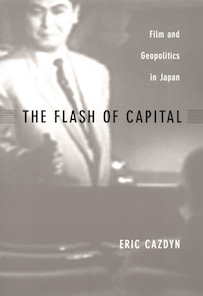
A review of The Flash of Capital: Film and Geopolitics in Japan, Eric Cazdyn, Duke University Press, 2002.

The Flash of CapitalThe “flash of capital” refers to the way the underlying structure of a national economy “flashes” or reverberates through the films it produces, and how cinema critique can highlight the relations between culture and capitalism, film aesthetics and geopolitics, movie commentary and political discourse, at particular moments of their transformation. A flash is not a reflection or an image, and Eric Cazdyn does not subscribe to the reflection theory of classical Marxism that sees cultural productions as a mirror image of the underlying economic infrastructure. Karl Marx posited that the superstructure, which includes the state apparatus, forms of social consciousness, and dominant ideologies, is determined “in the last instance” by the “base” or substructure, which relates to the mode of production that evolves from feudalism to capitalism and then to communism. Transformations of the mode of production lead to changes in the superstructure. Hungarian philosopher and literary critic György Lukács applied this framework to all kinds of cultural productions, claiming that a true work of art must reflect the underlying patterns of economic contradictions in the society. Rather than Marx’s and Lukács’ reflection theory, Cazdyn’s “flash theory” is inspired by post-marxist cultural theorists Walter Benjamin and Fredric Jameson, and by the work of Japan scholars Masao Miyoshi and Harry Harootunian (the two editors of the collection at Duke University Press in which the book was published). For Cazdyn, how we produce meaning and how we produce wealth are closely interrelated. Cultural productions such as films give access to the unconscious of a society: “What is unrepresentable in everyday discourse is flashed on the level of the aesthetic.” Films not only reflect and explain underlying contradictions but, more importantly, actively participate in the construction of economic and geopolitical transformations.
 Reflection theory and flash theory

 The Flash of Capital concentrates on those critical moments of Japanese modern history during which the forms of both cinematic and capitalist categories mutate. The author identifies three such mutations of Japanese modernity: (1) between being colonized and being a colonizer nation of the pre-World War II moment; between the individual and collective of the postwar moment; and between the national and the transnational of the contemporary situation. Colonialism, Cold War, globalization: these are the three moments that Cazdyn addresses through thematic discussions of cinematic visuality, of film historiography, of literary adaptations, of amateur acting, of pornography, and of aesthetic experiments. Rather than a linear history, he prefers to concentrate on key moments of transformation during which formal inventions on the level of the film aesthetic figure a way out of impossible situations before a grammar becomes available to make sense of them. By paying close attention to the details of cinematic texts, he reads the works of Japanese directors and film critics as so many symptoms of the most pressing social problems of the day. Cazdyn borrows from Fredric Jameson and other literary critics the technique of symptomatic reading, a mode of reading literary and cinematic works which focuses on the text’s underlying presuppositions. A symptomatic reading is concerned with understanding how a text comes to mean what it does as opposed to simply describing what it means or represents. In particular, it tries to determine what a particular text is unable to say or represses because of its ideological conviction, but that transpires at the formal level through flashes, allegories, and aesthetic choices. The films that Cazdyn passes under review occur at historical junctures in which the social and political events are difficult to articulate. There does not seem to be an effective language with which to express the transformations taking place at key moments of Japanese modernity. But, as Cazdyn notes, “some filmmakers take more risks than others. They risk speaking in a language for which there is no established grammar.”

 Japanese cinema has a peculiar affinity with the history of capitalist development. The movie industry is literally coeval with Japanese modernity: in the case of Japan, the history of film and the history of the modern nation share approximately the same span of time, both emerging in the 1890s. In addition, the one-hundred-year anniversary of film in Japan coincided with the fifty-year anniversary of the end of World War II. It comes as no surprise, therefore, that almost every history of Japanese film has used the history of the nation to chart its course. The three moments that The Flash of Capital choses to concentrate on are key turning points in Japanese modern history. They are also periods when Japanese cinema was particularly productive, with successive “Golden Ages” that have marked the history of Japanese cinema for a worldwide audience. The 1930s, the postwar period up to the late 1960s, and the 1990s were times fraught with contradictions. The antinomies and tensions between colonization and empire, between the individual and the collective, and between the national and the transnational made an imprint of the films produced during these periods, both at the level of content and in the formal dimension of aesthetic choices and scenic display. It is interesting to note that these moments have also produced canonic histories of Japanese cinema, both in print and through cinematic retrospectives. Cazdyn conducts a formal analysis of six histories of Japanese films, two of which are themselves films. The first historiographic works in the 1930s and early 1940s set the terms for a theory of cinema that was heavily influenced by Marxism and by nationalism; the 1950s saw the publication of Tanaka Jun’ichirō’s monumental encyclopedia of Japanese movies and Donald Richie and Joseph Anderson’s The Japanese Film; and the 1990s was marked by the one-hundred anniversary of Japanese cinema, with yet another four-volume encyclopedia and a film retrospective by Oshima Nagisa. Among scholars and students in the West, Richie and Anderson’s book has been a constant reference and has gone through a series of republications; it is, however, distinctly anticommunist and heavily marked by the Cold War context.

Colonialism, Cold War, globalization

 Cazdyn begins his discussion of the first period with an Urtext of Japan’s cinematography: the recording in 1899 of a scene from the kabuki drama Momojigari by the actor Ichikawa Danjūrō (the stage name of a lineage of actors that goes back to the seventeenth century down to the present). Attending a screening held at his private residence, Danjūrō was shocked by his own image staring back at him and made it clear that the film should never be screened during his lifetime. But he later agreed that a presentation of the movie reels at an event in Osaka he was unable to attend was more satisfactory than a performance by another kabuki troupe. This episode set the terms—repetition, reproductibility, ubiquity, copy rights, distribution networks, mass production—by which the movie industry later operated. By the 1930s, cinema had become well entrenched in Japan. The early figures of the onnagata (men playing women’s roles) and the benshi (commentator integrated into the story), taken from similar roles in the traditional performing arts (kabuki, noh, bunraku), had given way to the modern talkie movie, a star system based on female actors, and genres divided between jidai-geki (period dramas) and gendai-geki (modern dramas). Film adaptations (eiga-ka) of literary works of fiction (shōsetsu) served to gain legitimacy for cinema as an art form, circumvent censorship, consolidate a literary cannon, and affirm the superiority of the original through fidelity-based adaptations. The writer Tanizaki Jun’ichirō, who had offered his own theory of adaptation through his successive translations into modern Japanese of the Tale of Genji, criticized the filmization of his novel Shunkinshō by pointing out the erasing of multiple levels of narration and identity that was so central to his work. When Tanizaki’s novel is reduced to mere narrative content, “all that remains are the most reactionary and conservative elements.” For the author, Tanizaki’s aesthetic choices, and the films produced by the first generation of Japanese directors, were inextricably related to the most crucial issues facing the Japanese nation in the 1930s: the rise of militarism and the backsliding of democracy, the colonization of large swathes of Asia, the rejection of Western values in favor of Japanese mores. Remaining silent about these issues, like Tanizaki in his novels or Ozu Yasujirō in his early movies, are charges that can be held against the authors.

 The second Golden Age of Japanese cinema, and a high point of Japanese capitalist development, arose from the rubbles of World War II, found its most vivid expressions in the 1950s and early 1960s, and culminated in the avant-garde productions of the late 1960s and early 1970s. Out of this second period emerged not only a studio system modeled on Hollywood, but an impressive number of great auteurs that have become household names in the history of artistic cinema. Ozu’s challenging formal compositions, Kurosawa’s intricate plots, and Imamura’s nonlinear temporalities are immediately recognizable and have influenced generations of movie directors in the West and in Asia. The postwar period, which coincided with the Cold War, was marked by the subjectivity debate or shutaisei ronsō, which influenced popular ideas about nationalism and social change. For the postwar generation of left-leaning intellectuals, a sense of self—of one’s capacity and legitimacy to act as an individual and to intervene against the state and collective opinion—was crucial to keep the nation from ever being hijacked again by totalitarianism. But at the same time, the individual was summoned to put the interests of big corporations, administrative structures, and the Japanese nation as a whole before his or her own personal fulfillment, and to sacrifice the self in favor of economic development. In the context of the movie industry, the attempt to transcend the contradiction between the individual and the collective was resolved by positing a third term: the “genius” filmmaker who breaks out of the rigid structure and trumps the other two terms. The “great man theory” claims that an individual can rise up and produce greatness within—if not transcend—any structure. The same emphasis on the power of the filmmaker characterized film adaptations of literary works in the period. Encouraged by the Art Theater Guild, eiga-ka movies took liberties with the original text either by focusing on a particular section or adding content to the narrative. Shindō Kaneto’s 1973 adaptation of Kokoro, for example, deals only with the third letter of Sōseki’s famous shōsetsu, while in Ichikawa Kon’s Fires on the Plain the soldier-narrator of Ōoka Shōhei’s novel is shot and killed at the end instead of going to a mental hospital.

The withering away of the nation-state

 The era of globalization, the third period in Eric Cazdyn’s survey of movie history, marks a transformation in the operations of the nation-state and in the aesthetics of Japanese cinema. The problem of globalization is the problem of a globalized system in which nations are steadily losing their sovereignty but where state structures and ideological models cling to an outdated form of representation. The political-economic and the cultural-ideological dimensions do not move at the same speed: at the precise moment in which the decision-making power of the nation-state is declining, nationalist ideologies and identities are as strong as ever. Some authors combined a renewed emphasis on the nation with the full embrace of globalization. For Ōshima Nagisa, the enfant terrible of the Japanese New Wave, national cinema is dead, and Japan is being bypassed by the transnational forces of capital. In Merry Christmas, Mr. Lawrence (1983), he represents the Japanese from the viewpoint of the white prisoners of war. In L’Empire des sens (1976), the pornographic nature of the film does not lie in the content (although the actors Matsuda Eiko and Fuji Tatsuya are “really doing it”) but in the form of reception: the Japanese conversation about the film was almost entirely consumed by questions of censorship, while in France, where it was first released, the film was geared towards a general audience—and foreign visitors: Ōshima noted that one out of every four Japanese who traveled to France had seen the movie. For Cazdyn, a film that makes history is “a film that represents a transformation before it has happened, a film that finds a language for something before a language has been assigned, a film that flashes the totality of modern Japanese society in a way that is unavailable to other forms of discourse.” Rather than commenting on blockbuster movies and costly productions, he choses to read political allegories in experimental films such as Tsukamoto Tetsuya’s Tetsuo (1988) or the documentary films of Hara Kazuo such as Yukiyukite shingun (Naked Army, 1987). He even finds inspiration in adult videos, which he sees as a compromise between guerrilla-style documentaries on the left and reality TV on the right. He notes that approximately seventy-five percent of current adult-video films in Japan are documentary-style—that is, their narratives are not couched in fiction, but follow a male character walk the streets looking for sex and engaging women to that end. Similarly, in his documentaries, Hara Kazuo can often be heard asking questions and provoking situations. His films make change happen into the real.

Eric Cazdyn is well-versed in the history of Japanese Marxism and makes it a central tenet of his theorization of Japanese cinema. He refers to the pre-war Marxist debate between the Kōza-ha (the faction that remained loyal to the Japanese Communist Party and the Komintern) and Rōnō-ha (the faction that split from the JCP in 1927 and argued that a bourgeois revolution had been achieved with the Meiji Restoration). Another school of Marxism, the Uno-ha, was the school of the late Tokyo Imperial University economist Uno Kōzō, who was probably the single most influential postwar Japanese economist on the domestic academic scene. Uno drew a distinction between a pure theory of capitalism, a theory of its historical phases, and the study of concrete societies. He concentrated on the first, and dedicated himself to working through the most theoretical problems of Marx’s Capital, such as the labor theory of value, the money circuit represented by the M-C-M’ formula, commodity fetishism, and the recurrence of crises. Moving to the present, Cazdyn pays tribute to Karatani Kōjin, a contemporary philosopher and interpreter of Marx’s thought that has attracted a vast followership. Marxism has had a lasting influence on Japan’s intellectual landscape, and has impacted the work of many filmmakers in the course of the past century. Cazdyn recalls that many intellectuals joined film clubs in the late 1920s and early 1930s because they were some of the only places where members could read Marx’s Capital without falling prey to censorship and repression. But this utopian space was soon discovered, and by 1935 Marxist intellectuals were either behind bars, had retreated to their private space, or had embraced right-wing nationalism. Illustrative of this wave of political commitment is the Proletarian Filmmaker’s League or Prokino. Cold War histories of Japanese cinema have disparaged this left-wing organization by pointing out “the extremely low quality of its products.” Cazdyn rehabilitates the work of its main theorist, Iwasaki Akira, and of film documentarist Kamei Fumio, who treated montage as a “method of philosophical expression.”

New publics for old movies

What is the relevance of these references to Marxist theory and obscure works of documentary or fiction for contemporary students of Japanese cinema in North America and in Europe? Cazdyn highlights the changing demographics of the classes that enroll in his discipline: “Students were primarily attracted to the arts and Eastern religion in the 1960s and 1970s; in the 1980s, they were chasing the overvalued yen; and today, they are consumed by (and consumers of) Japanese popular culture—namely manga and anime.” He also notes that the study of national cinema as an organizing paradigm has lost much of its appeal. The academic focus is now on films that address issues of minorities in Japan—post-colonial narratives, feminist films, LGBT movies, social documentaries—or on transnational productions in which Japanese identity is diluted into a pan-Asian whole. But academics should not project their current global and professional insecurities onto the screen of cinema history. The demise of the nation-state, and the dilution of national cinema into the global, is not a foregone conclusion. Movies produced in Japan today do not seem to appear less Japanese than the ones made one or two generations ago. There is still a strong home bias in the preferences of viewers, who favor locally produced movies over foreign productions. Japanese films that are popular abroad do not necessarily make it big in Japan, and the art movie theaters or international festivals often include films that are completely unknown in their domestic market. The economic and geopolitical context matters for understanding a movie, but not in the sense that Cazdyn implies. The author’s knowledge of the real functioning of an economy is inversely proportional to his investment in Marxist theory. He confesses that his interest does not hinge “on the profits and losses incurred by the film industry in Japan.” But supply and demand, profits and losses, and production and distribution circuits matter for the evolution of cinema over the ages, and a theory that claims to conceptualize the link between films and their socio-economical context must grapple with economic realities, not just outmoded Marxist fictions.

The Faculty of Climate & Media Studies

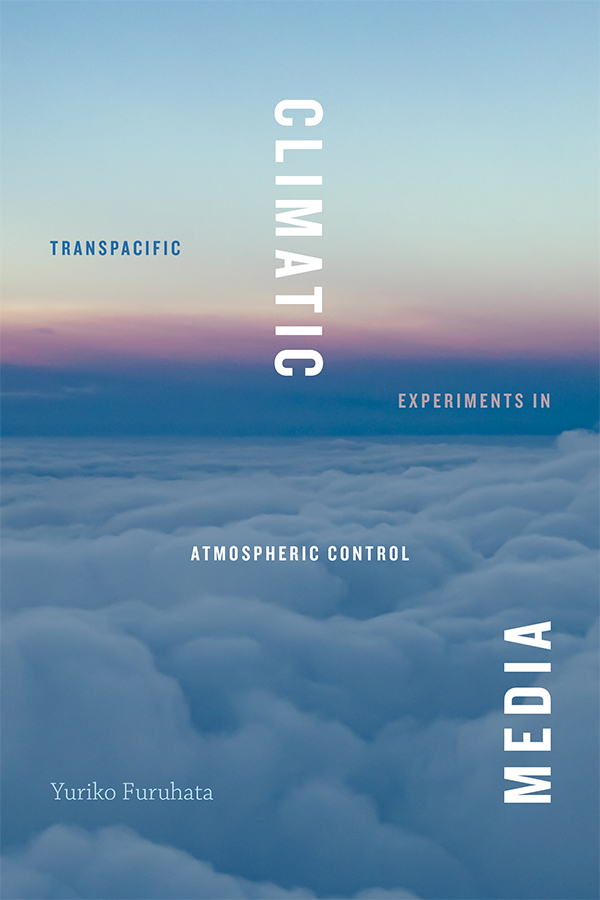
A review of Climatic Media: Transpacific Experiments in Atmospheric Control, Yuriko Furuhata, Duke University Press, 2022.

Climatic MediaMy Japanese alma mater, Keio University at Shonan Fujisawa, has a Faculty of Environment & Information. Next to it stands a Graduate School of Media & Governance. Putting two distant words together, like “environment” and “information” or “media” and governance”, creates new perspectives and innovative research questions while breaking boundaries between existing disciplines. Yuriko Furuhata uses the same approach in Climatic Media. What is climatic media? How did media become articulated with climate in the specific context of Japan? In what sense can we consider the climate, and atmospheric phenomena, as media? What new research questions arise when we put the two words “climate” and “media” together? Which disciplines are summoned, and how are they transformed by the combination of climate and media? How does climatic media relate to Watsuji Tetsurō’s concept of Fūdo, to take the title of his 1935 book translated as Climate and Culture? Can we use certain media to manage the climate, to predict and to control it? What is the genealogy of these technologies of atmospheric control, and can we trace them back to previous projects of territorial expansion and imperial hegemony? If we call “thermostatic desire” the desire to control both interior and exterior atmospheres, how does this desire “scale up” from air-conditioned rooms to smart buildings, district cooling systems, domed cities, geoengineering initiatives, orbital space colonies, and terraformed planets? In what sense can we say that air conditioning is people conditioning? These are some of the questions that Yuriko Furuhata raises in her book, which I found extremely stimulating. My review won’t provide a summary of the book’s chapters or an assessment of its contribution to the field of media studies, but will rather convey a personal journey made through Climatic Media and, indirectly, back to my formative years at Keio SFC.
The many meanings of media

One of the difficulty I had with the book, and also one of the lessons I learned from it, is the multiplicity of meanings associated with the term media. According to the burgeoning field of media studies, media can be many things. In its most widely accepted meaning, media are the communication tools used to store and deliver information or data: we may therefore speak of mass media, the print media, media broadcasting, digital media, or social media. In this limited sense, climatic media is what makes atmospheric variations visible and legible through the mediation of various instruments of data visualization: thermal imaging, photographs, charts, diagrams, computer simulations, etc. Putting the climate in media format can serve scientific, informational, political, or artistic purposes. In the arts, media designates the material and tools used by an artist, composer or designer to create a work of art. Climatic Media borrows many of its examples from the arts, and documents attempts by Japanese artists to use fog, fumes, mist, and air as a material for site-specific aerial sculptures or light projection. Architecture, in particular, can be identified as an art or a discipline deeply entangled in climatic media. In architecture, media is what mediates indoor and outdoor climate: a door or a wall can therefore be considered as media of atmospheric control. The meaning of media can also be expanded to include the materiality of elements that condition our milieu. Elemental media include the chemical components of air, indoor or outdoor air temperature and humidity, atmospheric pollution, extreme weather phenomena, the planetary atmosphere, and other natural elements of climate. In a more general meaning, media are a means toward an end. Climate can be manipulated to particular effect, which may be peaceful or war-related. Climate-controlled spheres or air-conditioned bubbles can be created, using technologies that mediate and shape what counts as a habitable environment. In this broadest sense, climatic media are technologies of government, securing a livable environment for certain populations while excluding others.  

The author chooses to concentrate on architecture as climatic media, foregrounding the imperial roots and Cold War legacy of Japanese architecture through the work of Tange Lab architects, including those associated with the internationally renowned postwar architectural movement called Metabolism, with Kurokawa Kishō and Isozaki Arata as key figures. In the past decades, Japanese architects and buildings have achieved iconic status and became known to a wide public. Even casual visitors to Tokyo are familiar with the Yoyogi National Gymnasium built by Tange Kenzō for the 1964 Tokyo Olympics, as well as the more recent National Art Center designed by Kurokawa Kishō in Roppongi. With Tange Lab as their training ground, Metabolist architects and designers believed that cities and buildings are not static entities, but are ever-changing organisms with a “metabolism.” Postwar structures that accommodated population growth were thought to have a limited lifespan and should be designed and built to be replaced. The greatest concentration of their work was to be found at the 1970 World Exposition in Osaka where Tange was responsible for master-planning the whole site whilst Kurokawa and Isozaki designed pavilions. It was also Tange Lab and Metabolism architects (some of whom were ardent “futurologists”) who helped bring cybernetics and systems theory into urban design in Japan. After the 1973 oil crisis, the Metabolists turned their attention away from Japan and toward North Africa and the Middle East, which (if we follow Yuriko Furuhata) made them complicit with the oil economy that stands as the main threat to our planetary survival in the twenty-first century.

From Japanese Empire to Osaka Expo ’70

Many of the architectural and artistic experiments described in Climatic Media are grounded in the work of the physicist Nakaya Ukichirō, known as the inventor of the world’s first artificial snow crystal. Nakaya spent his whole life studying ice, snow, and frost formations. The Institute of Low Temperature Science he established at Hokkaidō University in the 1930s helped advance research on cryospheric and atmospheric science. It was also deeply entangled in the Japanese Empire’s territorial conquests and war effort. Nakaya and his students collaborated with the research division of the South Manchurian Railway Company (“Japan’s first think tank”) in studying causes and mechanisms of frost heaving that damaged the railroad every winter in Manchuria. They helped Japanese agrarian settlers to build houses adapted to the extreme cold climate of the region, and designed ways to operate landing runways and military airplanes in frosty conditions. Nakaya Ukichirō’s ideas were later mobilized in a Cold War context, when polar regions and extreme atmospheric conditions became at stake in the geopolitical confrontation between the United States and its allies on one side and the Communist bloc on the other. Plans to weaponize the climate included battleground weather modifications such as creating hurricanes or heavy rain through cloud seeding and other chemical interventions, as well as the direct use of atmospheric weapons such as tear gas and Agent Orange during the Vietnam War. The expert knowledge of cold climates and atmospheric conditions accumulated at the Hokkaidō Institute also found civilian applications. They helped Asada Takashi, an architect at Tange Lab, to design a proto-capsule housing for the Japanese explorers and researchers at the Shōwa Station in the Antarctic in the 1950s. Tange Kenzō himself, who had aligned with the expansionist agenda of the Japanese Empire in his youth, helped design The Arctic City in 1971, a futurist proposal by Frei Otto and Ewald Bubner to house 40,000 people under a two kilometer dome in the Arctic Circle. Capsule housing and domed cities were also nurtured by dreams of extra-orbital stations and space conquest that survived the Cold War era. More down to earth, the idea of recycling snow as a source of refrigeration is now attracting investors and tech companies to build data centers in frosty regions such as Iceland or the northern provinces of Canada.

There was an even more direct connection between the physicist Nakaya Ukichirō and the architects and artists who gathered at Expo ’70 in Osaka. His daughter, Nakaya Fujiko, was a pioneer in atmospheric art and fog sculpture. She was the Tokyo representative of the American art collective Experiments in Art and Technology (E.A.T.), and was invited by Billy Klüver to create the world’s first water-based artificial fog sculpture for the Pepsi Pavilion at Expo ’70. Yuriko Furuhata argues that father and daughter were not bound solely by blood ties and a shared interest in meteorological phenomena: it is the practice of atmospheric control that binds the scientist and the artist. Nakaya Ukichirō himself was no stranger to artistic creation: he was an accomplished sumi-e artist, and documented his studies of summer fog or winter snow with ink paintings, close-up photographs, and educational films. In turn, his daughter incorporated science into her creative process, and sought advice of former students of her father to create the fog sculpture displayed at Osaka’s exposition. Nakaya Fujiko’s fog sculpture therefore sits at the point of convergence between two genealogical threads which, together, define what is at stake in climatic media: visualizing climate and engineering the atmosphere. Enveloping Pepsi Pavilion’s dome with artificial fog was meant to turn the pavilion into an interactive “living responsive environment” responding to ambient factors such as wind, temperature, humidity, and light. The machines used to make artificial fog found practical applications beyond the realm of art. Engineers use the same technology today to cool down data centers and cloud computing service infrastructure. Artificial mist is also a familiar sight in urban centers on hot summer days, where small drops of water are projected to create an artificial fog that cools down the air. Expo ’70 also served as testing ground for other urban innovations. Futurologists and technocrats paired with architects and engineers to produce a cybernetic model of the late-twentieth-century city, with its network of data-capturing sensors and its control room filled with state-of-the-art Japanese computers. This techno-utopian vision of connectivity that was put on display at Japan’s World Exposition in 1970 can be seen as a precursor of modern “smart cities” and their networked systems of urban surveillance and social conditioning. Today, many of these technologies of mass surveillance have become mundane and prevalent, but when they first entered the streets of metropoles in the late 1960s they were seen as the creative experiments of artists, architects, and futurologists.

Genealogies of the present

Instead of presenting a linear history of climatic media or splitting her subject into neatly divided themes, Yuriko Furuhata follows a genealogical method of investigation and presentation, which “reads the past as the historical a priori of the present we live in.” She starts each chapter with a modern example of atmospheric control and then goes back and forth in time to find antecedents of the same “thermostatic desire” to control the atmosphere, with Expo ’70 as a point of concentration and the Japanese Empire as a concealed Urtext. In chapter one, city sidewalks refreshed by mist-spraying devices and data centers cooled by similar technologies lead the author to describe the fog sculpture of Nakaya Fujiko at the Pepsi Pavilion and to trace her connexion with the work of her father during wartime, which in turn found direct applications in the futurist works of architects gathered at Tange Lab. In chapter two, the rise of hyperlocalized weather predictions using artificial intelligence and smart air-conditioning systems that individually curate air flows are connected to early attempts to numerically predict the weather and to the history of futurology in Japan, with early visions of the networked society that materialized in the computerized control center of the world’s fair. Amazon’s headquarters in Seattle and its CEO’s dream of colonizing space in chapter three’s opening echo former greenhouse architectures and imperial projects of a “living sphere” (Lebensraum), with Tange Lab as a source of innovative design that connects Japan’s imperial past to modern urban planning and to utopian dome cities in the Arctic or in outer space. In chapter four, the author takes the Metabolist architects at their own word, reading their defining metaphor of metabolism through the lenses of the product life cycle and the Marxist concept of the “metabolic rift” between humans and the natural environment. Kurokawa Kishō’s holistic vision of renewable capsule housing and his early engagement with systems theory are contradicted by his use of plastics as a nonrecyclable material and by his taste for the expression “Spaceship Earth,” which foregrounds modern plans to geoengineer the Earth’s climate through technological interventions. In chapter five, modern methods of atmospheric control, from tear gas to cloud computing and smart objects, are tributary to a genealogy of urban surveillance that shows the dual use of technologies of social control, turning artistic experiments into dystopian futures.

The expression “dual-use technologies” usually refers to technologies with applications in both the military and the civilian sectors. Here, they not only connect defense industries and peaceful usage, but also imperialist rule and artistic creation. Several words and expressions straddle the border between war-making and the arts: military strategists speak of theater, engagement, or war and peace without making direct reference to Shakespeare, Jean-Paul Sartre, or Leon Tolstoy. Similarly, the term “avant-garde” used by art critics derives from military vocabulary. Furuhata proposes to expand this list of dual-use terms to “site-specificity”, originally used for artworks created to exist in a certain place, and to “climatic media” in general, describing how projects to “weaponize the weather” found applications in civilian times or how avant-garde artistic experiments were the harbinger of modern security technologies. Climatic control also borrows some of its metaphors from agriculture: cloud seeding, harvesting the weather, cultivating rain, or building greenhouses point to underlying epistemic assumptions and cultural expectations associated with controlling the atmosphere. The “cloud” now used for computer data storage is not just a metaphor: cooling data centers involves the same air-conditioning nozzles and fog machines first used by artists at the Osaka fair. Computer network systems are atmospheric in the literal sense of being carried by radio waves in the air. The cybernetic model used to regulate a house’s temperature is applied to the fiction of controlling the planet’s imaginary thermostat through feedback loops. The technical operations carried out by climatic media are both material and symbolic. Urban infrastructures such as energy grids, fiber-optic cables, air ducts, water pipes, and computer systems all rely on technologies that regulate temperature and mitigate the effects of outdoor weather. In times of planetary-scale climate change caused by human activity, it is useful to remember that operations of climatic control at one scale all have consequences at another scale: the Earth is not a closed system, and climatic media are intrinsically connected with global issues of environmental pollution, greenhouse gas emissions, and waste accumulation.

Back to SFC

Reading this book reminded me of the intellectual atmosphere I found at Keio University’s Shonan Fujisawa Campus (Keio SFC) when I first came to Japan as a teacher of French studies in the early 1990s, from 1992 to 1994. Established only two years before, SFC at that time was a hotbed of technological innovation and pedagogical breakthrough. Sometimes considered as the “birthplace of the Japanese internet,” it had chosen to equip its students and faculty with state-of-the-art technology. The ubiquitous classroom computers were not the familiar IBM PC or Apple Macintosh, but turbocharged Sun SPARCstations and NeXt computers. Learning to code was a requisite, even for students specializing in the humanities. We wrote all of our documents using LaTeX, were early users of email software, and surfed the web using the Mosaic web browser upon its release in 1993. But technology was only part of the equation. SFC’s ambition was to embark a young generation of Japanese students into a life-changing experience, and to equip them with the skills and mindset for navigating the information society and its lived environment. As a junior faculty member, I was also allowed to follow courses and seminars to improve my Japanese language skills and share the students’ experience. Expanding my French upbringing and undergraduate studies in economics, the seminars and writings of Takenaka Heizo, Usui Makoto, and Uno Kimio introduced me to emergent research topics, from industrial metabolism to green accounting and input-output tables of economic development. Due to lack of personal discipline, but also because of the interdisciplinary nature of these ideas, I failed to translate all these burgeoning ideas into a PhD after I left Japan. But the knowledge acquired at Keio SFC equipped me with life-long skills and interests, and I have lived since them off the intellectual capital accumulated throughout these two years of teaching and auditing classes. I haven’t learned anything really new since then. In my view, Keio SFC at that time conveyed the vibrancy, intellectual excitement, and creativity a former generation of Japanese architects and social scientists must have experienced at Tange Lab or through the planning of Osaka Expo’ 70. Whether Keio SFC succeeded in steering Japan into the direction it set for itself is another debate. In retrospect, I could have been more attentive to the dark clouds gathering on the horizon: the bubble economy had left Japan with piles of debt and nonperforming loans; the reduced birthrate meant there were less students for an increasing number of places available in new universities; parents were still making huge sacrifices for the education of their children; and attractiveness of foreign languages and foreign destinations for studying and working abroad tended to dwindle. Even in those early years after the creation of the campus, academic inertia and routine crept in, and there was a certain hubris in the lofty goals and ambition that animated the whole project. But these two formative years still have for me the scent of youth and boundless possibilities.

The Artistic Avant-Garde in 1960s Japan

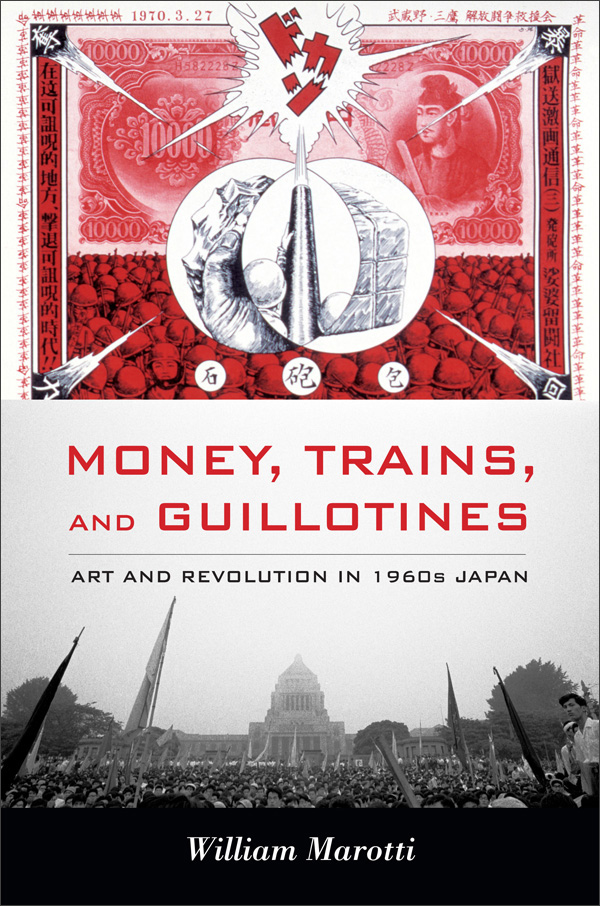
A review of Money, Trains, and Guillotines: Art and Revolution in 1960s Japan, William Marotti, Duke University Press, 2013.

Money Trains Guillotines“Dada” exists in the Japanese language as a category outside the realm of aesthetics and art history. The word “dada”, as in the expression dada wo koneru, is used to describe selfish behavior that lacks sense. It is also an idiom for “spoiling.” A kid throwing a tantrum can be called “dada”, or a teenager’s prank, or an adult acting childish. A popular theory derives the expression from Dadaism, the avant-garde art movement born in Zürich in 1916, but real etymology and kanji characters actually connect it to the Japanese language. Perhaps the false etymology is not wrong after all. Dadaism always had a special affinity with Japan. In the German language as in Japanese, the term may have derived from baby talk or child’s speak. Tristan Tzara’s affirmation “Dada means nothing” echoes the teachings of Zen masters and the Japanese concept of mu, or nothingness. The Dada artistic movement entered Japan soon after its birth in Europe during the First World War: in 1923, Mavo, a Dada group founded by Japanese artists Murayama Tomoyoshi, Yanase Masamu and others, held its first exhibition at the Sensō-ji temple in Tokyo. Japanese Dada may have been even more explosive than its European versions: the art review Mavo originally came with a firecracker attached to its cover. The poets Tsuji Jun and Takahashi Shinkichi were also pionneers of Dadaism in Japan, blending it with Taoism and Zen Buddhism. Dadaism then disappeared from the scene, only to resurface in the late 1950s as the Neo-Dada Group, an art collective featuring Akasegawa Genpei, Arakawa Shūsaku, Ariyoshi Arata, and a dozen other artists. Dada’s influence in Japan can be observed in a variety of cultural expressions such as surrealism, pop art, Fluxus, noise music, and even a monster figure in the popular TV series “Ultraman.” The kaiju character “Dada”, with distinctive cubist features, was created as an extension of Dadaism and avant-garde art and became a recurrent feature in the series.
Dada’s Not Dead

Many artistic acts and performances reviewed in Money, Trains, and Guillotines may fall under the umbrella of Dadaism, although only a minority of artists covered in this book were affiliated to the short-lived Neo-Dada movement. Printing giant 1,000-yen banknotes and getting sued for it; plotting to install a guillotine in front of the compound of the Imperial Palace; or performing art actions along the Yamanote train line: these are some of the disruptive performances that William Marotti reviews in his book, recasting a period alive with student movements, political clashes, labor struggles, and radical theorizing. More than “dada,” a moniker that characterized the period was hantai or han-, meaning “anti-.” Students demonstrated against the renewal of the US-Japan security treaty under the slogan Anpo hantai, or “down with the security treaty.” Neo-Dada artists joined them in their protests, covering their bodies with tracts and slogans, while sometimes shouting the rallying cry Anfo hantai, or “down with informal art.” The expression han-geijutsu, or “anti-art,” was coined at the time to characterize these various artistic movements. In 1960, the art critic Tōno Yoshiaki used it to describe the sculpture-object of artist Kūdo Tetsumi titled Zōshokusei rensa hannō, or “Proliferation chain reaction.” Inspired by anti-theater and anti-novel, the expression of “anti-art” led to a lively debate between art historians Miyakawa Atsushi and Takashina Shūji. Some critics, such as Kawakita Rinmei, defending the tradition of Japanese art, characterized anti-art artworks or performances as the production of demented rockabilly fans. Others, such as the surrealist poet and art critic Takiguchi Shūzō, who held a monthly column in the Yomiuri newspaper, encouraged young artists to push the limits of artistic expression and experiment with new art forms.

The Yomiuri newspaper played a key role in the emergence of this “anti-art” art scene. Newspapers in Japan are more than newspapers: they also sponsor art exhibitions, organize conferences, finance their own professional sport teams, and publish books written by their staff, among other activities. The Yomiuri, situated at the center-right of the political spectrum, was nothing but progressive and anti-establishment in its art choices during the period. Starting in 1949, it sponsored a yearly event modeled on nineteenth-century France’s Salon des indépendants, later labelled the Yomiuri Indépendant, first held at Tokyo Metropolitan Art Museum in Ueno Park. Competing at first with the Nihon Indépendant organized by the Japan Fine Art Association in the same location, it took on a new identity in the late 1950s and early 1960s with the participation of a new generation of artists proposing increasingly puzzling and provocative objets, installations, and performance elements. In April 1961, a major exhibition titled Gendai bijutsu no jikken (“Experimentations in contemporary art”), held at the Tokyo Metropolitan Art Museum and sponsored by the Yomiuri, displayed the works of sixteen new artists, among which Arakawa Shusaku, Kudō Tetsumi, Nakanishi Natsuyuki, Kikuhata Mokuma, Ochi Osamu, Yoshinaka Taizō, Motonaga Sadamasa, Tanaka Atsuko, etc. A predilection for art incorporating junk or transforming junk into increasingly enigmatic objets drew the attention of the outside world. Facing criticism, the Tokyo Metropolitan Museum, the site of the Yomiuri Indépendant, issued new regulations regarding the type of works that could be displayed. Were to be forbidden “works including a mechanism producing loud or unpleasant noise, works emitting a stinking odor or using perishable material, works using sharp objects that could cause injuries, works that leave the public with an unpleasant sensation and that violate the rules of public hygiene, works using sand or gravel that could damage the floor and walls of the museum, works directly hanging from the ceiling, etc.” Faced with such restrictions, artists prepared to stage a boycott, and the Yomiuri group finally put an end to the yearly exhibition in 1964.

A crucible for artistic creativity

William Marotti devotes two chapters to the history of the Yomiuri Indépendant. Its beginnings in 1949 were unappealing: fresh out of wartime collaboration and a long labor strike, the managers of the Yomiuri Shimbun wanted to whitewash their conservative image by sponsoring the arts and encouraging democratization. The creation of the yearly exhibition in 1949 occasioned both protests and a fair degree of confusion: it bore the same name as the Nihon Indépendant organized by the Nihon bijutsukai (Japan Fine Art Association), and was far less prestigious than the official Nitten exhibition (Nihon bijutsu tenrankai), divided into its five sections of Japanese Style and Western Style Painting, Sculpture, Craft as Art, and Calligraphy. First displaying a motley crew of professional artists and amateurs, it gradually became the center of a constellation of interconnected artists and art groups. It was, according to Akasegawa Genpei, a “crucible” in which the work of young artists, including his own, could combine and coalesce to acquire a certain degree of cohesion, intensity, and purpose. The Yomiuri Anpan, as the exhibition was also known, fulfilled the original goal of its creators in fostering a vigorous, critical, and anti-conformist art scene. Avant-garde art spilled out of the museum, as in Takamatsu Jirō’s Cord series (Himo) extending out of the museum and in Ueno Park, or was expelled from in precinct when Kazakura Shō engaged in nude performances in front of onlookers. Many of the exhibits were not artworks in the traditional sense: they were created for the space and duration of the exhibition and were simply abandoned afterwards. Performance pieces were by nature time- and space-specific. The Yomiuri Indépendant nonetheless featured seminal works and performances that were memorialized and displayed in retrospective exhibitions, such as The 1960’s : a decade of change in contemporary Japanese art (1960 nendai: gendai bijutsu no tenkanki) held in 1981 at the National Museum of Modern Art in Tokyo, or Japon des avant-gardes 1910-1970 at the Centre Pompidou in Paris in 1988.

The early 1960s witnessed the blossoming of many art collectives. Some of them developed an art scene outside of Tokyo, with few contacts to the avant-garde mainstream but a radical impulse that acted as a harbinger of things to come. The Gutai collective, founded in 1954 in Osaka and animated by Yoshihara Jirō, was a fascinating attempt to conflate art and performance, staging its first happenings before and independently from the New York avant-garde. Considering the fact that Life magazine devoted a photo reportage to the activities of Gutai in 1956, it is well possible that the Japanese avant-garde group influenced the New York experimental art scene and not the other way around. But Gutai remained a provincial affair, and it is only in the early 1960s that its destructive impulse was picked up by young artists in Tokyo. In addition to the Neo Dada Group, avant-garde art collectives included the Time School (jikanha) of Nakazawa Ushio, Nagano Shōzō, and Tanaka Fuji, the Music Group of Tone Yasunao, Kosugi Takehisa, and Mizuno Shūkō, and the group Zero jigen (Zero Dimension) with Katō Yoshihiro. The High Red Center, formed in 1963, was composed of Takamatsu Jirō, Akasegawa Genpei, and Nakanishi Natsuyuki. The first character of each name (Taka or high, Aka=red, Naka=center) led to the name of the collective, who took as its symbol a big exclamation mark. The group weighed the publication of an aborted plan to raise a giant guillotine in the Imperial Plaza, drawing proposals for two possible alternative configurations for the guillotine. In the context of the times, this was not only empty provocation: a writer, Fukuzawa Shichirō, had been the target of a deadly right-wing attack in 1960 for publishing a short story in which the imperial family was beheaded amid joyous festivity.

Counterfeit art

But perhaps the most radical act plotted by one of these conspiratory artists emerged out of artistic banality. Akasegawa’s 1,000-yen project was a classic attempt to make enlarged copies of the Japanese banknote featuring Prince Shōtoku using crude reproduction techniques and to display the monochrome works in various formats: as work in progress, framed pictures, or wrapping material for readymade objets. First exhibited at the 1963 Yomiuri Indépendant, the art project fell under the radar screen of Japanese authorities until the arrest of a Waseda University student prompted police to search the apartment of a magazine editor, leading to the discovery of Akasegawa Genpei’s 1,000-yen series. Akasegawa’s works—monochrome, single-sided, prepared on a range of qualities of paper, and often enlarged—could hardly have been intended to pass as currency. But according to public prosecutors, the act of reproducing banknotes fell under a 1895 law controlling the imitation of currency, establishing provision for prosecuting mozō (creating something confusable with currency) and gizō (counterfeiting). What followed was a protracted judicial trial that sometimes turned the Tokyo High Court into a scene of happenings. In several articles and literary works, Akasegawa articulated a complex critique of the pseudo-reality of money, identifying it as an agent of hidden forms of domination supported by state authority and by the policing of commonsense understandings of crime, of art, and of public welfare. In a parallel case regarding the abridged translation of a Marquis de Sade novel, the court asserted the state’s right to criminalize any form of artistic expression if it was found to be injurious to the public welfare, unlimited by constitutional restrictions and based on statuses dating back to the Meiji era.

The fact that the police state and the judicial system were mobilized in a defense of the reality of money points to the potency of artistic attacks on symbolic authority. The apparent anomaly of the trial in Courtroom 701 of the Tokyo District Court, a venue for the most serious criminal cases, and the appeals up to the Supreme Court, all testify to the weigh placed on this contest. According to William Marotti, “the gap between artists’ investigations and dreams of revolution, and the state policing of art and thought, reveals the politics of culture as confrontation.” He refers to Henri Lefebvre and Jacques Rancière to articulate a critique of the everyday, based on Japanese artists’ discovery of hidden forms of domination in daily life and their attempts to expose and challenge official forms of politics and hegemony. Avant-garde artists from the early 1960s were actively engaged in transgressing boundaries of thought and social practice. Their practices appear to have arisen out of a particular local, playful art practice that used theYomiuri Indépendant as a playground for bringing artistic experimentation into direct interaction with the everyday world. The exhibition’s cancelation in 1964, the year of the Tokyo Olympics, had the effect of pushing avant-garde art into the underground and radicalizing it further. Revolutionary forms of activism and critique emerged to challenge state institutions ranging from the museum gallery to the courthouse. Art and political activism converged in the use of a common vocabulary such as “direct action” or chokusetsu kōdō. Indeed, the transliterated English term favored by Japanese artists, akushon, often synonymous with pafōmansu, was progressively replaced by the more directly palatable kōi or kōdō, evoking direct political action ranging from general strike to terrorism.

From avant-garde to angura

Artistic vocabulary also testifies of an evolution of loan words from the French to the English language. The avant-garde artists at the Yomiuri Indépendant exhibited collages and ready-made objets influenced by Marcel Duchamp and the art informel movement. The cultural cachet of French words and idiomatic expressions inspired a generation of painters and plasticiens who still dreamed of Paris as a Mecca for the arts. In a way, the worldwide reputation of the Japanese avant-garde was made in France. The art critic Michel Tapié visited Japan from August to October 1957 and wrote lavish praise about Kudō Tetsumi’s entries at the Yomiuri exhibition. His encounter with the Gutai group predated Allan Kaprow’s apology of the Osaka collective by a few months. But soon English expressions such as abstract expressionism, action painting, art performances, happenings, and angura (a contraction of “underground”) took the place of French loan words. The early 1960s was definitely a period when Japan felt the gravity center of the art world move from Paris to New York. Whereas a previous generation of artists such as Imai Toshimitsu and Dōmoto Hisao chose Paris as the base for their artistic career, Arakawa Shūsaku and Kawara On settled in New York where they contributed to the birth of conceptual art. Jasper Johns, Robert Rauschenberg, and John Cage visited Japan in 1964, and their works and performances had a huge influence on young artists. The time of the avant-garde was over, and with it the possibility of revolution through art, the classical goal of an avant-garde, receded into oblivion.

Animation Studies and Cartoon Science 

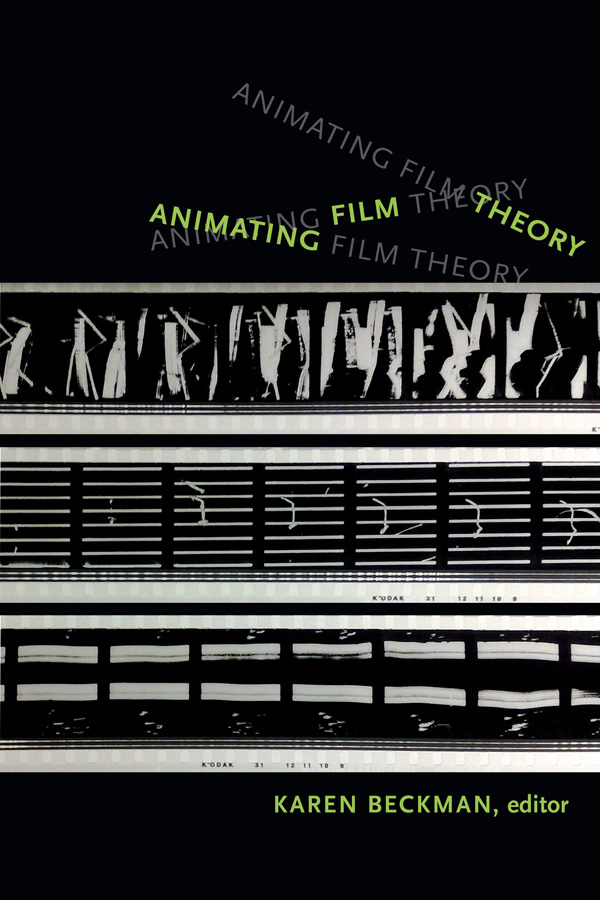
A review of Animating Film Theory, edited by Karen Beckman, Duke University Press, 2014.

Animating Film TheoryI must confess I am averse to film theory. The little I have read in this field confirms me in my opinion: film theory is empirically useless, epistemologically weak, and aesthetically unappealing. Nothing of substance has been written about the topic since Plato’s Cave, the allegory that has people watch shadows projected on the wall from objects passing in front of a fire behind them and give names to these shadows. The books and articles that are collated to form the discipline’s canon are a mixed bag of philosophical references, journalistic musings, and academic jabber. In my opinion, Deleuze’s two-volume work on film, The Movement-Image and The Time-Image, are among his weakest books. They do not amount to a philosophy of cinema, or a theory of film: at best, they are reflections on time and space that take cinema as a pretext and Bergson as an interlocutor. In textbooks and introductory chapters, film theory is a collage of quotations by cultural critics, mostly from the early twentieth century, who have commented on the birth of cinema in the context of mass culture and reproduction technologies. Remarks written in passing by Walter Benjamin or Theodor Adorno are elevated to the rank of high theory and revered as sacred scriptures by a discipline desperately in need of founding fathers. The French contributors to the Cahiers du Cinéma dabbled in film critique as a hobby and did not think of themselves as serious thinkers: they were puzzled to see cinema studies emerge as an academic discipline, and they certainly would have disapproved the emergence of a canon of officially approved texts that includes their own. When film theory tries to build a firmer intellectual grounding, it mobilizes thinkers who have written outside the purview of cinema studies and have never commented on films: Saussure, Lévi-Strauss, Derrida, Lacan, or Baudrillard. Gilles Deleuze for the French domain and Stanley Cavell in America stand as the two exceptions: they have devoted whole books to cinema as part of a program of applied philosophy. My preference goes to Cavell over Deleuze.

Animated films and live-action movies 

My biases against film theory were compounded by this volume on animation film theory. If a theory of films rests on shaky ground, what about a theory that takes animated movies as its object and proposes to build an autonomous discourse on this subset of film media? A discipline is not defined by its empirical topic, but by its methods and the way it builds a scientific object as a matter of scholarly investigation. The existence of animated movies and frame-by-frame films—which predate the birth of cinema—is in itself no justification to devote an academic discipline to their study and to engage them theoretically. I do not mean to say that animation movies should be forever marginalized and ignored by cinema specialists and cultural critics. They can provide food for thought for many disciplines and, in some instances, are valuable sources of theoretical engagement. But a discourse on animation does not a theory make. Building an animation theory has more to do with intellectual posturing and academic differentiation than with scientific rigor and sound scholarship. A caricature of the attitude that I have in mind is provided by Alan Cholodenko’s contribution to this volume. An American-Australian scholar who retired in 2001 from the University of Sidney, Cholodenko describes himself as the godfather of animation theory: “theorizing of and through animation has been my project for the last twenty-three years.” His claim of having come first to lay the “first principles” of the discipline doubles the proposition that “historically as well as theoretically, film is the ‘stepchild’ of animation, not the other way around.” Drawing inspiration from the work of Jacques Derrida and Jean Baudrillard, and postulating animation as the mother of all disciplines, his contribution to this volume amounts to little more than self-promotion and personal aggrandizement. 

What came first, film or animation? And who can claim the privilege of having “invented” animation cinema, in theory and in practice? A central tenet of the fledgling discipline is that animation represents the past and the future of all cinema. Lev Manovich, an author of books on digital culture and new media, made that claim in 2001: “Born from animation, cinema pushed animation to its periphery, only in the end to become one particular case of animation.” The division of cinema into live action and animation has been recently blurred by the digital turn: through CGI and pixel-by-pixel editing, live-action movies are merging with animation in a way that makes them undistinguishable. The cartoonization of live-action movies is propelled by special effects and computer graphics that makes whatever the mind can conceive achievable on screen. Some actors, Jim Carrey for instance (but the same could have been said of Charlie Chaplin or Buster Keaton), have built a whole career acting like cartoon characters. Contributors to Animating Film Theory show that the dividing line between film and animation has never been clear-cut. Photographs and moving pictures have always been mixed with drawings and text editing, such as in Dziga Vertov’s Kino-Pravda (Film Truth) experimental newsreel series in 1922-25, or in cartoons in which drawings “come to life” or live scenes are inserted in graphic sketches, a common practice since the silent movies era down to Robert Zemeckis’ Who Framed Roger Rabbit (1988). The incorporation of animated beings into real-world settings is only one example of the blurring of distinctions between animation and film. Whole movies, like Disney’s 2019 version of The Lion King, are photorealistic renderings of live action scenes in which each detail of character and scenery is animated step-by-step by computer graphics (the sole non-animated shot in the entire film is the sunrise in the opening scene.) 

The French did it first

The history of animation intersects with movie history but they do not necessarily move at the same pace. The Lost World (1925) was the first feature-length film made in the United States, possibly the world, to feature model animation as the primary special effect, or stop motion animation in general. The Enchanted Drawing is a 1900 silent film best known for containing the first animated sequences recorded on standard picture film, which has led its director J. Stuart Blackton to be considered the father of American animation. As for the first animated cartoon, it is attributed (by the French) to Emile Cohl, who produced the short movie Fantasmagorie in 1908. Others point to the French inventor Charles-Emile Reynaud and his 1877 patent of the praxinoscope, an animation projection device that predated the invention of the cinématographe by Louis Lumière in 1895. Other optical toys from the nineteenth century or earlier go by the names of zoetrope, thaumatrope, phenakistoscope, and camera obscura. Likewise, animation film theory has many fathers and the competing quest for precursors, pioneers, and key figures oppose various nations, periods, and individuals. One (French) contributor to this volume casts a Frenchman named André Martin as “the inventor of animation cinema” and 1953 as the date when his invention was recorded. Another (Japan specialist) author exhibits another figure, Imamura Taihei, as the first critic to devote a whole book on animation, A Theory of Cartoon Film, first published in 1941. It turns out André Martin used the expression “cinéma d’animation” in the body of a Cahier du Cinéma article about the Cannes festival, thereby donning prestige and dignity to a genre situated at the intersection between “le septième art” (French jargon for movies) and “le neuvième art” (graphic novels and comic strips). As for Imamura Taihei, he confirms the fact that Japan stands as a key site for animation and for theory. His genealogy of cartoons and comic strips goes back to the twelfth century’s emaki picture scrolls, and also includes acting techniques found in the Nō theater and folding screen paintings from the Edo period.

To build a theory of animation, Karen Beckman, the editor of this volume, has mined systematically the writings of film theory specialists to search for references to animation. As she states in the opening chapter, “animation’s persistent yet elusive presence within film theory’s key writings make it both easy to overlook and essential to engage.” These key writings include texts by Norman McLaren, Peter Kubelka, Vachel Lindsay, Jean Epstein, Béla Balázs, Germaine Dulac, Miriam Hansen, and André Bazin, none of which I was familiar with. Throughout the book, the rare mentions of cartoons and animation movies in the writings of cultural critics and philosophers are treated as precious discoveries. Theorists of film and mass culture such as Sergei Eisenstein, Walter Benjamin, and Theodor Adorno repeatedly turned to Disney cartoons and Looney Tunes characters in articulating their reflections on aesthetics and politics. Eisenstein devised a category of “plasmaticness” that he evoked in order to stress the originary shape-shifting potential of the animated movie, the way an object or image can potentially adopt any form. For Benjamin, “Mickey Mouse proves that a creature can still survive even when it has thrown off all resemblance to a human being. He disrupts the entire hierarchy of creatures that is supposed to culminate in mankind.” Adorno and Horkheimer found nothing funny about cartoons and argued that Donald Duck actively participated in the violent oppression of the proletariat by the forces of capitalism. Writing later in the century, Stanley Cavell mulled over the “abrogation of gravity” in cartoons where Sylvester the Cat or Wil E. Coyote run over the edge of a cliff and continue their course in midair. This allows the author of the last chapter in the volume to enunciate the “first theorem of cartoon physics”: “Any body suspended in space will remain in space until made aware of its situation” (the second theorem states that “Any body passing through solid matter (usually at high velocity) will leave a perforation conforming to its perimeter”.)

Cartoon physics

Animation theory is not necessarily tied to film theory: indeed, many contributions to this volume do not start from the pantheon of film theory authors or the key concepts of the discipline. Animation can be engaged with and theorized from other perspectives: as a strand of critical thought that focuses on subaltern cultures, as in Japan, or within an epistemology of scientific objectivity and experimental representation, or from the point of view of graphic art history and media art. Several chapters focus on the link between scientific visualization practices and the history of animation. The scientific experiment plays a central role in the history of cinematography. Animation itself rests on a scientific fact: by presenting a sequence of still images in quick enough succession, the viewer interprets them as a continuous moving image. This persistence of retinal perception was exploited by the early devices of animation that used a series of drawn images portrayed in stages in motion to create a moving picture. One contributor even sees the origins of 3D animation in a 1860 invention by French entrepreneur François Willème. A glass dome, housing a perimeter ring of twenty-four cameras directed inward at a central subject, allowed camera shutters to open simultaneously to produce a “photosculpture” that was not unlike the bullet-time sequence in the film The Matrix. The experiment of film allows the viewer to experience the world in a novel way: animation, like the scientific experiment itself, becomes the way to think at the limit of understanding in an attempt to get past that limit. Scientific uses of animation include medical anatomy and health education, dimensional modeling in biology or in physics, mathematical abstraction, and all kinds of pedagogical materials. Animated images do not only illustrate: they are instrumental in the process of discovery. Climate science would be less potent without the time-lapse images of shrinking glaciers and melting polar ice caps.

Japan is in a league of its own when it comes to animation theory. As mentioned, a book on the theory of anime, Manga eiga-ron, was written as early as 1941, with subsequent editions in 1965 and in 2005. In Japanese, eiga-ron has a different meaning from “film theory”, and a different history as well. Contributions to Animating Film Theory show how animation needs to be thought in relation to media beyond film to account for the singular place of animated images in Japan. One author explores how experimental Japanese Xerox artists in the 1960s operated a crossover between animation and graphic design that sheds light on the specific context within which the issue of technological reproduction and duplication was discussed. The first translation in Japanese of Walter Benjamin’s essay “The work of art in the age of mechanical reproduction” was published and discussed in Graphication, Fuji Xerox’s corporate PR magazine that presented itself as a cutting-edge publication venue for graphic art and media criticism. More generally, the great divide between commercial and academic publications that marks the intellectual landscape in America does not exist in Japan, where the bulk of critical theories are translated, published and disseminated through non-academic journals as well as mass-market books and “mooks” (a magazine in book format.) Two of Japan’s main animation critics and public intellectuals, Otsuka Eiji and Azuma Hiroki, have organized part of their critical work outside the circuit of academia and write for a broad public readership consisting of hardcore fans of media subcultures. They invite a re-reading of the question of realism in animation: beyond photographic realism and a drawing style inherited from manga comics, anime films hint toward a new style of transmedia realism without any real-world referent. The vibrant worlds of Japanese anime, manga, and video games form the basis of an alternative sphere of expression that popular Japanese critics theorize from outside the realm of film studies.

Whither animation theory?

For Gilles Deleuze, the primary operation of philosophy is problematization, the cultivation of problems such that philosophy can then go about the task of fabricating concepts. What is the problem of animation that it requires a theory? What are the key concepts that may allow animation theory to make sense and generate meaning? Film studies, in their classical form, evolved from questions of ontology, to questions of reception, to questions of context. What is film and its relationship with reality? How does film have an effect on its viewers? What is the social and political context in which film is made and received? Starting from a different set of questions, animation theory must take its own course and develop its own methodological tools. Animating Film Theory only points toward that goal, and merely sketches out the challenges that theory-makers and philosophers of the moving image might have to grapple with. The first question, already pointed out by Sergei Eisenstein and Jean Epstein, has to do with the quality of “animism” that turns people into objects and objects into animate creatures: what makes a world animated and imbued with a life of its own? A second set of questions could coalesce around the issue of self-reflexivity: animation movies are aware of themselves as works of imaginary creation, and the hand of the drawer is never far from the drawn picture. What separates us from the world of fiction, and how can we inhabit it by breaking the fourth wall that separates screen characters from the audience? The third indication we might learn from animated movies is not to take life too seriously: as the last chapter on “cartoon physics” indicates, we will always enjoy a good Tom-and-Jerry cartoon and the hilarity that courses ending in midair and cat-shaped holes might provoke.

The Old Mole

A review of The Sublime Perversion of Capital: Marxist Theory and the Politics of History in Modern Japan, Gavin Walker, Duke University Press, 2016.

Gavin WalkerWhy read Marx today? More to the point, why devote a book to how Marx was read in Japan in the mid-twentieth century, and in particular to the writings of a Marxist scholar named Uno Kōzō (1897-1977), Japan’s foremost Marxian economist and founder of what is usually referred to as the Uno School (Uno gakuha), Uno economics (Uno keizaigaku), or Uno-ist theory (Uno riron)? Books about this branch of Marxist theory now collect dust on the shelves of second-hand bookstores in the Kanda-Jinbōchō district in Tokyo. They remind us of Marxism’s surprising longevity in Japan’s academic circles: a Japanese publishing house, Kaizōsha, was the first editor in the world to publish the complete collected works of Marx and Engels (in thirty-two volumes), and Marxist theory was taught and studied with passion in the tumultuous years of campus upheavals of the 1960s and 1970s. The generation that imbibed Marx’s shihonron in its formative years is now past retirement, and the few remaining bastions of Marxism are only to be found in philosophy or literature departments, not in faculties of economics. But Gavin Walker considers that something important was at stake in these economic debates, something that can still speak to our present. In his opinion, we need to understand the “sublime perversion of capital” in order to situate and possibly overcome our contemporary theoretical impasses and debates: the surprising persistence of the nation, the postcolonial situation, the enclosure of the new “digital commons,” the endless cycles of crisis and debt. Indeed, Walker argues, “this moment of globalization calls for a fundamental (re)examination of the central questions of Marxist theory itself.” For, like Marx wrote to his German readers in the 1867 preface of Das Kapital, “De te fabula narratur!”—it is of you that the story is told.

De te fabula narratur 

First, we must clear the ground from what the book is not. It is not a political essay à la Fukuyama that would try to apply Marxian or Hegelian lenses to a rereading of the present—Walker has only contempt for such literature, which he calls “supreme political cretinism.” Nor is it a rephrasing of Lire le Capital, an attempt to expose Marx’s theory along logical lines: indeed, this is how historiography remembers the main contribution of Uno Kōzō, who reformulated Marx’s Capital in conformity with an adequate order of exposition, with a necessary beginning, development, and end. But what concerns Walker the most is to think about what is at stake in the Japanese debates on Marxist theory for theoretical inquiry today. As he explains, “What I am interested in is to enter into the theoretical work in Marxist theory, historiography, and philosophy of this moment as theory.” He doesn’t study Japanese Marxism historically or in isolation, but plugs it to the scholarship of “world Marxism” in which the concerns of Japanese intellectuals echo, sometimes decades in advance, theoretical issues that were also picked up in the United States or in Europe. Just like Lenin identified “three sources and three component parts of Marxism” (German philosophy, English political economy, and French socialism), Walter draws from three traditions of critical thinking: Japanese Marxism or “Uno Theory” which forms the main focus of the book, but also as minor voices or counterpoints French political philosophy (Althusser, Balibar, Deleuze, Foucault, Nancy, Badiou), and the Italian autonomia school of social critique (Paolo Virno, Sandro Mezzadra, Silvia Federici). His familiarity with texts written not only in English and Japanese, but also in French, Italian, Russian, and German is what commends Walker to the serious reader. And his rereading of Japanese Marxism provides an introduction to an important current of political thought that has seldom spilled over the national, linguistic and disciplinary boundaries of academic communities. 

Uno Kōzō and Japanese Marxism are unfamiliar to most readers, and some elements of contextualization are in order. However, Walker warns us that “this book does not privilege or even accept the biographical mode of analysis,” and that “it is hostile to the concept of ‘context’.” He provides only one paragraph on the life and work of Uno Kōzō, mentioning his studies in Berlin from 1922 to 1924, his arrest in 1938 on suspicion of political activism, his work as a statistician outside of academia until the end of the war, and his reappointment after 1945 in Tokyo University’s Department of Economics, where he was to develop his famous theory of the three levels of analysis, or sandankairon, and his formulation of the “impossibility of the commodification of labor power” (rōdōryoku shōhinka no muri). Walker provides more perspective on the debate on Japanese capitalism (Nihon shihonshugi ronsō) and the opposition between the two factions of Japanese Marxism, the Rōnō-ha (Labor-farmer faction) and the Kōza-ha (Lectures faction). Based on positions or “theses on Japan” adopted by the Comintern, and raising the issue whether the Japanese Communist Party should ally with other progressive forces in a popular front, this debate, predominantly held from the late 1920s to the mid-1930s, deeply influenced political developments, not only in Japan, but also in the then-colonized Korean Peninsula, in China, in Southeast Asia, and elsewhere. The Rōnō faction argued that the land reforms instituted in the 1868 Meiji Restauration had successfully effectuated the transition from feudalism to capitalism, and that Japan was now ripe for a socialist revolution. The Kōza-ha, representing the mainstream of the JCP and of the Comintern, held the view that Japanese capitalism was permanently crippled by emerging from a feudal basis and that “remnants of feudalism” (hōkensei no zansonbutsu), especially in the countryside, made inevitable the turn to “military-feudal imperialism” (gunjiteki hōkenteki teikokushugi).

Difficult words and torturous grammar

The political debates of the times were loaded with difficult words and expressions that the Japanese language, with its kanji characters and grammatical structure, makes even more abstract and unfamiliar. Especially hard to fathom was the work of Marxist scholar Yamada Moritarō, whose Analysis of Japanese Capitalism, published in 1934, was “one of the most simultaneously celebrated, reviled, frustrating, controversial, and influential book in the history of Japanese Marxist theory and historiography.” Yamada wrote in a particularly recondite and idiosyncratic prose, filled with “riddles” and “codes,” as his writing style was modeled after the German language used in the most abstract philosophy with its inversion of typically Japanese grammar, sentence structure, and diction. But Gavin Walker’s own immersion in this literature testifies that getting fluency in this highly theoretical language is no more difficult for the true believer than mastering Buddhist scriptures: mantra-like formula such as “military semi-serf system of petty subsistence cultivation” are treated as blocks of characters that are stringed one after the other and recited like a psalmodic shibboleth. They create their own world of meaning that bears little resemblance with ordinary life, and convey to the insider the impression that he or she belongs to the select few. Besides, Japanese scholars were also fond of colloquialisms and didn’t hesitate to call each other names in a prosaic manner: rivals from the Rōnō faction called Yamada’s text a “farce,” and reacted to one of Uno Kōzō’s key lectures by saying that “Uno’s gone nuts” (Unokun wa kawatta.) The most intricate discussions often centered on simple words, such as the “semi-” (han) in semi-feudalism or the concept of “muri” used by Uno in his “impossibility of the commodification of labor power” theorem (rōdōryoku shōhinka no muri.)

Gavin Walker devotes a whole chapter to Uno’s notion of “muri,” which he alternatively translates as “logical (im)possibility,” “rational impasse,” or “the nihil of reason.” But, as any child or Japanese language beginner will tell you, muri can also mean, at a colloquial level, “don’t think about it,” “out of the question,” or “no.” Disentangling the colloquialism from the conceptual is no easy task. The most abstract discussions in Japanese philosophy often focus on everyday notions, such as mu (not, without), ma (empty space), ba (place), or iki (lively). These concepts have their roots in Japanese Buddhism and especially in the Zen tradition, and were often picked up by nationalist ideologues and twentieth century philosophers such as Nishida Kitarō to emphasize the distance between Japanese thought and the Western canon. To attempt to translate them in a foreign language, or to discuss their meaning for a Western audience, raises a difficult challenge. On the one hand, foreign commentators need to convey the radical otherness of these notions rooted in a culture that gives them meaning and depth, and they can only do so by making elaborate discussions on the intricate lifeworlds that these words summon. On the other hand, they risk to lose their simplicity and childlike quality that makes their meaning commonsensical and straightforward. This contradiction is apparent in Walker’s treatment of muri.  In Uno’s logic, the commodification of labor is the foundational basis of capitalism, and yet this commodification is made impossible by the nature of labor power as defined by Marx. Another way to express it is that although the commodification of labor power should be impossible, in capitalist society “the impossibility is constantly passing through” (sono muri ga tōtte iru). Again, the expression “passing through,” that Walker submits to a long exegesis, cannot convey the simplicity of the Japanese verb tōru

Childishly simple

Another way to complicate simple notions is to resort to vocabulary borrowed from the hard sciences or to mathematics. To convey the notion of the impossibility of labor power’s commodification, Walker alternatively refers to mathematical figures such as the Moebius’ strip, the Klein bottle, the Borromean knot, the torus, or topology notions of torsion, inversion, loop, and fold. These topological notions were all the rage in the theoretically loaded context of the sixties and seventies, when Marx was often discussed in conjunction with Freud and Lacan—the French psychoanalyst who became enamored with algebraic topology. Walker also suggests that Uno’s use of muri may be borrowed from the concept of “irrational number” (murisū), although the evidence he gives to back his claim is rather moot. The mathematical formulae he introduces in his text—variations on the M—C—M’ equation in Marx’s Capital—, are at the level of a elementary logic and only contribute to his prose’s dryness. On the other hand, Walker is also capable of flights into hyperbole and metaphoric statements. The title of his book illustrates his use of colorful rhetorics and literary excess. Why is capital perverse, and what is sublime about the perversion of capital? As I understand it, capital is perverse in the sense that it thrives on our most basic instincts in a capitalist society: commodity fetishism and the elision the social relations between people as relationships among things, the forgetting of labor’s true contribution to value and profit, alienation from one’s true self and other workers through the act of production. The sublime is the notion of absolute greatness not inhibited with ideas of limitations: this is the feeling that grips the true believer upon the revelation of absolute truth and true science that Marx’s doctrine was supposed to incarnate.

Gavin Walker’s text is even more obscure when he discusses Japanese Marxism in conjunction with contemporary authors: French philosophers, Italian social critics, or modern Japanese thinkers reclaiming Marx’s heritage. The result is a riddle wrapped in a mystery inside an enigma. As if reading a commentary of Japanese scholars commenting on Marx wasn’t hard enough, Walker double-downs the challenge by  bringing in other hard-to-read authors and by offering his own commentary of Marx’s original concepts such as primitive accumulation or the origin of labor power. Chapter 3 in the book moves from Carl Schmitt to Sandro Mezzadra and to Karatani Kōjin but loses sight of the author’s original intention to address “Marxist theory and the politics of history in modern Japan.” I understand his argument: he doesn’t want to be categorized in the “Japan slot” with other area study specialists, and he prefers to associate himself with high theory and Marxian scholarship. He sees a division of labor at work between his own production and the books of intellectual history that have mapped Marxism’s development in prewar Japan. I myself am not adverse to philosophical arguments and French Theory: I don’t mind introducing a few codes of Foucault, a dual use of quandary from Deleuze and Guattari, or a dash of devilish derring-do from Derrida. But I am also genuinely interested in Japan’s intellectual history and would have liked to read more about the Japanese context and less about Gavin Walker’s own thoughts on Marxist theory.

The Japanese management system

The transition from feudalism to capitalism was a debate that dominated scholarly discussions in Japan for decades. This debate, interesting in its own right for the logical arguments and rhetorical skills that it mobilized, has long passed its expiry date. It never affected Marxist theory—what the author labels “world Marxism”—in a significant way, and attempts to revive it in the twenty-first century are faced with the same conundrums that Derrida experienced when he confronted himself with the specters of Marx. Trying to rekindle the flame by rehashing the old theories of a Marxist scholar unknown beyond Japan’s borders seems to me like the epitome of a lost cause. Historically, the debate on Japanese capitalism was soon replaced by the discussion on Japanese management—some scholars, Japanese or Western, adapted to the changing times and made the transition between the two. I see some parallels between the two lines of enquiry. First, Japanese management scholars were also concerned with the nature of capitalism in Japan and the way it differed from the Western version. They insisted on labor relations and workplace arrangements: lifetime employment (shūshin koyō), the seniority-wage system (nenkō joretsu), and the enterprise union (kigyōbetsu kumiai) formed the “three sacred regalia” (sanshu no jingi) of the Japanese employment system—to be sure, the crown has now lost its jewels. Like the Marxist mantras of Yamada and Uno, strings of Japanese characters were attached in long formulations and found their ways in Western texts, or were lost in translation. Management specialists pondered endlessly about the everyday notions of genba (workplace), kanban (signboard) or kaizen (improvement) that sound commonsensical to anyone familiar with Japan. We even hear echoes of the disputes between the Rōnō and the Kōza factions in the opposition between proponents of Japan’s distinctiveness and those who favored neoliberal solutions—the latter won the day.

Timeless, Bottomless Bad Movies

A review of The End of Japanese Cinema: Industrial Genres, National Times, and Media Ecologies, Alexander Zahlten, Duke University Press, 2017.

The End of Japanese CinemaCinema is an industry. But very often aesthetics gets in the way of analyzing it as such. For cinema—or some portions of it—is also an art. Industry or art: these two approaches give rise to two distinct bodies of literature, one focusing on professions, publics, and profits, the other one on visual style, narrative content, and film textuality. There are movie industry specialists who may teach in professional schools or in economics and sociology departments, applying the standard tools of their discipline to one particular sector that represents up to one percent of the US economy. And there are cinema critics and film studies academics who develop concepts such as genre, auteur, style, form, periods, and apply them to a canon of authorized films conserved in national archives. Film studies may emphasize culture (cinema as representative of national culture), psychology (a movie reflects the inner psyche of its director), formalism (focusing on the formal or technical elements of a film), history (itself divided into the history of genres and national traditions), or theory (film theory as a branch of applied philosophy). What these approaches have in common is that they consider a movie as worthy of cultural commentary and critique. By contrast, an industry specialist is more interested in macro factors such as film production, distribution, and box office figures. He or she will focus on context more than content, on cost and revenues more than artistic quality. In the case of Japanese cinema, an art critic will focus on directors such as Kurosawa Akira or Ōshima Nagisa, specific genres such as jidaigeki (samurai movies) or kaijū eiga (monster movies), and techniques such as Ōzu Yasujiro’s signature tatami shots and multiple scene framings; while an industry specialist will study the studio system long dominated by Shōchiku, Tōhō, Tōei, Nikkatsu, and Daiei, the unionization of workers, or the distinct distribution channels for hōga (domestic movies) and yōga (foreign movies).
Pink Film, Kadokawa Film, and V-Cinema

In The End of Japanese Cinema, Alexander Zahlten combines the two approaches. He analyzes cinema as a cultural form and as a socio-economic activity with deep political ramifications. He proposes concepts that bridge the gap between the artistic and the industrial, the qualitative and the quantitative, the individual movie and the whole economic sector. It helps his case that the three categories he discusses—Pink Film or sexploitation films, Kadokawa Film produced by one single, multi-media entrepreneur, and V-Cinema made straight for the video market—are almost devoid of any artistic value. In fact, they are ignored in critical and academic discourse on films from Japan, and do not feature in Japanese movie histories. Like the infamous AV (adult videos), a large fraction of them may not even be included in film production statistics. But collectively they form an archive of close to 8000 movies: enough for the social scientist to build models, test inferences, and draw meaningful conclusions from such a large sample. They matter for a genuine history of cinema in Japan that is willing to go beyond the time-worn theories of auteurship, national character, and genre normativity. For all practical purposes, watching a movie in Japan meant, for a large fraction of the public and during a significant period of time, attending a film that belonged to one of these three categories. The reason academic work on films in Japan hardly discusses or even mentions these movies is because they cater to the base instincts of the public and are generally considered of bad taste and poor artistic value (some Pink films nonetheless made it to the Euro-American cinema festival circuit). If some of them achieved high scores at the box office or on video rental figures, it is because the public was lured by sexual attraction or by marketing ploys and media campaigns. This is particularly the case for Kadokawa films, which include a few blockbusters: but they were derided by the critics and the art movie profession, who declared that “Kadokawa films are not films” and, in the case of Kurosawa Akira at the 1980 Cannes film festival, refused to shake hands with the producer.

Sex sells, and it is no wonder that sexually themed films feature heavily in the sample studied by the author. In fact, it has been estimated that adult films represented up to 40 percent of the video rentals in the 1980s, and that close to 75 percent of films produced in Japan in 1982 positioned themselves in this market segment. Nudity and sex officially entered Japanese cinema with Kobayashi Satoru’s controversial and popular independent production Flesh Market (Nikutai no Ichiba, 1962), which is considered the first true pink film or pinku eiga. Pink films are not to be confused with Roman Porno films, a series of theatrical erotic movies produced by the movie studio Nikkatsu riding the wave that the first Pink movies had created. Nor are they similar to Adult Videos, pornographic films adapted to Japanese proclivities and visual censorship rules. Alexander Zahlten gives a strict definition of the Pink Film genre: a one-hour length format with regularly spaced erotic scenes (shot in color while the rest of the movie is often in black-and-white), a budget of around 3 million yens since the mid-1960s (decreasing in value over the years), an independent system of production, distribution, and exhibition (with specialized Pink Film theaters), extremely fast scripting and shooting schedules (tantamount to guerrilla warfare), and intensely misogynistic content. Pink movies carry explicit titles such as Meat Mattress (Niku futon), Naked Embrace (Hadaka de dakko) or Mature Woman in Heat Ball Licking (Jukujo hatsujō tamashaburi). But in fact, these films were much less explicit that their titles suggest. The same holds true for V-Cinema, which included sub-genres such as jokyōshi (female schoolteacher), danchi-dzuma (suburban wife), and chikan densha (train groper): the video cover sleeves were covered with titillating pictures that far exceeded the film’s actual explicitness. As for Kadokawa movies, they were geared for a mass audience and limited the stoking of the male public to the exhibition of underage starlets (the three Kadokawa girls, or Kadokawa san-nin musume). But they indulged in another kind of porn: the titillating of national feelings, with the screening of a national identity discourse that passed itself for cosmopolitanism and contemporaneity.

The politics of time and the aesthetics of confusion

Watching one of the first Kadokawa productions, Proof of the Man (Ningen no shōmei) made me feel particularly ill at ease. Besides the dismal performance of George Kennedy, a veteran of Japanese movies and one of the worst actors in the history of cinema, I couldn’t pinpoint the reason for my malaise, but it certainly had to do with the mixed-race character who provides the plot that the movie unfolds. The movie, and the TV drama that came after it, are suffused with deep-seated fears about miscegenation and inter-racial contact. We find the same ideologies of nationhood in the movies and dramas adapted from the novels of Yamazaki Toyoko. The question of the Other and the question of temporal hierarchy—with Japanese time being in front of its Asian neighbors yet still behind Euro-America—is a common theme of the three genres. As the author notes, “industrial genres performed complex negotiations concerning a position vis-à-vis dominant temporal discourses such as colonial time, sequential time, straight time, and homogenous time.” Pink Film rejected the possibility of a clear separation between past and present, showing how postwar Japan was haunted by remnants of its militaristic and colonial past. Kadokawa Film exchanged history itself for a perpetual present which brought confusion between the native self and the foreign Other, the victim and the victimizer, the movie plot and its reincarnation in other media supports. V-Cinema used video technology’s ability to manipulate time by starting, pausing, rewinding, stopping, and rewatching at the viewer’s convenience, thereby creating the temporality of the rewind and the fast-forward. Each industrial genre illustrates a politics of time. Each genre also generates an aesthetics of confusion: a mixing of identities, temporalities, geographies, and media. Pink Film insisted on the messy, confusing and contradictory experience of Japan two decades after the war. Kadokawa Film conflated genre and textuality with the trademark and business strategy of a corporation. V-Cinema was an untidy and disorganized collection of cheap flick pics, sleazy journalism, endless serials, how-to tapes, and soft porn videos. Not only the movies but also the viewers were confused: they deserted movie theaters and retreated to other pastimes (in 1984, motorboat racing boasted attendance figures twenty-five times the total audience of theatrical film.)

For traditional film critics, Japanese cinema offers a meta-narrative of Japaneseness: elements of culture are isolated and reflected in the form and content of a particular movie or in the history of a genre. For Alexander Zahlten, movies and genres in his sample are self-reflective. There is “a match between the textuality of the film and the textuality of the industry structure.” The aesthetics and business organization of the industrial genre is a reflection of the filmic codes and narrative patterns of the films that compose them. The story of an industrial genre is the story of a movie writ large. Textuality can be found at the level of the business structure, corporate strategy, labor relations, spatial organization, and lifecycle of industrial genres. Pink Film tells a story (largely fabricated) of antisystem resistance, oppositional realism, class politics, cultural avant-garde, and student warfare. These narrative elements are found in the films’ stories and style but also extend beyond it to encompass the identity politics of those involved in the production of Pink films, as well as their viewers and those who commented upon them. For Kadokawa Film, business practices were part of the product that was marketed to the public. The “media-mix strategy” that the company developed was a package of films, mass market paperbacks, magazine covers, and movie theme songs marketed by a single entrepreneur to the widest possible audience, with each product advertising the others. The larger-than-life personality of Kadokawa Haruki himself was part of the service package he proposed and was reflected in the movies in which he made guest appearances. He famously declared: “I like Japanese films, but I detest the Japanese film world.” His strategy was the opposite of business as usual: he broke cartels and pitted the majors each against the others, outsourced work, released Japanese films in theaters usually reserved for foreign movies, destroyed the block-booking system, deployed blitz media campaign to advertise the release of a new blockbuster, launched the careers of the first kawaii idols, and bypassed the critics to appeal directly to the audience. The story that V-Cinema narrates is one of postbubble angst and endless repetition.

Bridging the gap between art and industry

By narrating the story of industrial genres and reflecting upon the movies they encompass, Alexander Zahlten bridges the gap between art and industry, aesthetics and business. This theoretical gesture operates a transformation of what textuality itself entails. It is no longer attached to a story, a character, a subgenre, or a national space: in contents industries or platform business models, the media model is no longer based on a clear distinction between producer and consumer, with the media text delivering a message between them. The new media ecology emphasizes mobility and connectivity rather than a transmittable and consumable narrative. In today’s multimedia environment, the medium is the message: this is a truly McLuhanesque moment that is materialized in the growth of user-generated content and jishu (self-directed) productions, but that Zahlten also sees at work since the 1960s in the trajectories of the industrial genres. Kadokawa Haruki initiated the media-mix strategy by simultaneously releasing film, book, music theme, and media articles. His younger brother Tsuguhiko, who took over the company when Haruki was indicted with drug offense, introduced the platform business model that leverages user engagement and content creation. Moving away from novel adaptation, the company largely shifted to fictional characters from manga, anime, light novels, and games for the media mix, targeting a public of otaku millennials. The new media ecology in Japan marks the end of Japanese cinema: shinecon (cinema complexes) compete for viewers’ attention span, offering a free flow of subgenres, narratives, and characters without discernible borders, while the platform model shifts the emphasis from owning the commodity to owning the world in which the commodity exists and that generates commodifiable activity. The “contents business” has gripped the imagination of policymakers who see in Japan’s “Cool National Product” a vector of international influence and soft power. The story these new assemblages tell is still the story of Japan, but the visual plot is increasingly blurred by users’ online comments, viral internet memes, and gaming devices.

Are there general lessons that the economist or the business executive can draw from reading this book? The concepts that Alexander Zahlten proposes—the industrial genre, the politics of time and the aesthetics of confusion, the new media ecologies and the platform model—operate at both levels of industrial structure and textual content. Indeed, perhaps unwittingly, Zahlten borrows many concepts from industrial organization, the branch of economics that studies industrial sectors and firm strategies. Although he doesn’t always use these terms, he addresses issues of barriers to entry, sunk costs, market power, product differentiation, price discrimination, customer segmentation, niche markets, collusion and signaling. More specifically, his analysis can be linked to the organizational ecology approach associated with the names of Michael Hannan and John Freeman. There is the same focus on populations and cohorts as opposed to individual organizations and single movies or directors. The ecological approach insists on the environmental selection processes that affect organizations through a cycle of variation, selection, and retention. Similarly, Zahlten describes a wild creative exuberance and high profit margins at the beginning of an industrial genre’s life cycle, followed by a period of consolidation and attrition in which the genre ossifies and loses part of its innovative aspect. The history of industrial genres also illustrates the Galapagos syndrome that affects many Japanese productions: no movie in the sample succeeded in making a significant impact abroad. The media ecology is a closed system with no gateways or pass-through. There may however exist a subterranean influence exerted by Japanese industrial genres on the history of Korean cinema, as can be attested in the movies collected in the Korean Film Archive on Youtube. We find the same kinds of sexploitation movies, B-Films, and formulaic genres that were produced at a time when Japanese cultural exports to Korea were officially banned.

Spirited Away

Alexander Zahlten explains in the acknowledgments section that his book was long in the making. His PhD dissertation project spanned space and time between Germany, Japan, and the United States, and involved curating film programs for various institutions including the Athénée Français cultural center in Tokyo. While in Japan, he must have heard the sentence “you know Japanese cinema better than we do” many times. And indeed, his knowledge of the three industrial genres he covers in The End of Japanese Cinema makes him without peers. Only a film freak or a movie otaku may have accumulated more data and material on such a narrow topic. He complements his documentary work on film archives with interviews with directors and producers, analysis of trade journals and specialized publications, and readings of key texts in film theory and Japanese studies. He seems to know everything there is to know on Pink Film, Kadokawa Film, and V-Cinema. Like the young girl Chihiro in Miyazaki’s movie, he may have been “spirited away” by his topic: he spent an inordinate amount of time in a world of cheap movies and low-budget productions. For despite his timid denial, the movies covered in the book must have been a pain to watch. They are, to take the title of a Korean movie that is sometimes shown in indie-art theaters, “timeless, bottomless bad movies.” And yet, art can emerge from the rubble, and one can detect a certain beauty in the whole picture that each of these movies dots. Not only in the sense that art is in the eye of the beholder: the curator that guides the public through a selection of cultural productions is himself an artist, for he has the power to change our vision and to make us see things from a different angle. Who knows, next time I visit Japan, maybe I will pick one of these old movie tapes kept on the dusty shelves of sleazy video rental shops in the back alleys of train stations, between the pachinko parlor and the second-hand manga reseller.

From Marx Boys to Schizo Kids to Otaku cultures

A review of Media Theory in Japan, edited by Marc Steinberg and Alexander Zahlten, Duke University Press, 2017.

Media Theory“Can you name five media theorists from Japan?” is the question that opens the book’s introduction by the two editors, Marc Steinberg and Alexander Zahlten. Taking up the challenge proposed by the two authors, I wrote my own entry in the book’s margins, with the intention of coming back to this list later once I would complete my reading. The handout to the assignment read as follows: Maruyama Masao, Ohmae Ken’ichi, Murai Jun, Azuma Hiroki, Sasaki Akira. The list will sound obscure to most non-specialists of Japan—and I must confess I include myself in this category. I just happen to have spent a couple of years in Japan in my formative years, and over the following two decades I have accumulated a small portable library of Japanese books and journals, mostly in the social sciences and in philosophy, although my resolution to read them has been forever deferred. Among these books, then, and to come back to my list, stands Maruyama Masao as a postwar critic or hihyōka who turned his liberal gaze on the then-dominant media, the press; Ohmae Ken’ichi as a management guru who heralded the advent of the information society in the 1980s; Murai Jun as the father of the Japanese internet; Azuma Hiroki as the theoretician of the otaku generation; and Sasaki Akira as an astute critic of Japanese theory (Nippon no shisō) and contemporary soundscapes. Having completed the reading of Media Theory in Japan, I am returning to my initial list of authors to put these names in context, add a few more, and write down a few notes on my newly-acquired knowledge.
“There is media theory in Japan”

First, a few definitions are in order. Media theory is more affiliated to the field known as theory—a low-brow version of speculative philosophy—than to the discipline of media studies, although the latter can make use of the first. The editors wryly remark that “the default setting for media theory is America; for a philosophy of media, France; and for media philosophy, Germany.” They hasten to remark that “there is media theory in Japan”; it just hasn’t made a global imprint the way that French philosophy of the 1970s made its mark on critical studies worldwide, or that Japanese management concepts influenced the curriculum of business schools at the end of the twentieth century. Theory is translated in Japanese as riron or shisō. It is closely related to the terms of tetsugaku (philosophy), hihyō (critique), and giron (debate). Compared to abstract philosophy, theory most often take the form of essay articles (ronbun) in monthly magazines or roundtable discussions (zadankai, taidan) whose proceeds are edited and published in books or monthly reviews. Critics (hihyōka) and thinkers (shisōka) are looked down by academics (gakusha) and researchers (kenkyūka) who specialize in one discipline and approach it with rigor and a sense of proper hierarchy; but the musings and cogitations of public intellectuals find many venues in Japanese society and are part of the intellectual landscape. Media theory, apart from being formalized as an academic discipline with strong American influences, remains therefore more open to free thinkers and dilettantes.

A second remark is that there has been several theory booms in Japan, which remains a theory-friendly society. The suffix –ron is affixed to many notions, including Japaneseness (nihonjinron) and media-ron. There is a history to be written that would address theory and its publics in Japan, from the Marx-boys of the 1960s to the shinjinrui (new breed of humans) of the 1970s, the Deleuzian schizo-kids of the 1980s, the otaku of the 1990s and the zeronendai Millennials. As much as media theory in Japan is, to a large extent, a theory of fandom, there are theory fans and theory addicts. Some thinkers develop a cult followership; other self-identify as fans of theoretical practice themselves and import into critical thinking the mindset and paraphernalia of fandom. There are, or there was at some point, theory camps, theory competitions, theory prizes, and, of course, theory manga and amateur movies. Theory in Japan blurs the distinctions between knowledge production, knowledge consumption, and knowledge circulation. It is a domain perpetually in flux, a moving target or a fluid that penetrates the interstices of society. Much like the fansub online communities who provide crowdsourcing subtitles of popular series on the Internet, media theory is a kind of theorization from below, by fans and media addicts. Through modern history, theory in Japan has been closely related to the dominant forms of subcultures, from ero-guro (erotic-grotesque, a Japanese literary and artistic movement of the 1920s and 1930s) to puro-gure (progressive rock). Theory corresponds to an age or a phase in life that often fades away with time: one usually grows out of one’s theory addiction.

Public intellectuals and media figures

It is altogether fitting that my first name on the list, Maruyama Masao, was known as a critic and a public intellectual more than as an academic. The study of media in Japan always had a precarious place in academia. Scholars trained in Germany introduced shimbungaku (“newspaper studies”) before the war, while cultural critics reflected upon the introduction of the cinema and, later on, of television. Media theory is usually developed to make sense of the dominant media of the day. It is always the science of “new media,” and the advent of yet another new generation of media profoundly transforms media theory along the way. The meaning of “new” itself is often predicated upon repetition. As Aaron Gerow shows in his entry “from film to television”, there are massive parallels between mid-century debates on the Age of Television and earlier theorizations on the introduction of the motion pictures, which themselves echoed turn-of-the-century debates on the onslaught of western modernity. “In Japan in particular, theories of film and television were deeply imbricated with historically specific but long-standing conflicts over problems of class, mass society, the everyday (nichijō), and the place of the intellectual.” The resistance of many intellectuals to cinema and then to television was deeply rooted. For Shimizu Ikutarō, a socialist, “television cannot permit the conditions that foster the roots of revolution.” For Katō Hidetoshi, a liberal intellectual influenced by American social critique, television’s “ability to penetrate everyday existence provides with considerable power, and could lead to the establishment of fascism in a time of peace.” Kobayashi Hideo, the pivotal Japanese critic of his time, also had ambivalent feelings regarding the advent of mass media in society.

My second entry, Ohmae Ken’ichi, a prolific writer and successful consultant at McKinsey, points toward a second figure that is familiar beyond the realm of media study: the foreign management guru and his close kin, the Japanese sidekick who introduces the first to Japanese audiences. The authors of Media Theory in Japan chose to concentrate on another character: Marshall McLuhan, the Canadian theorist of media who remains famous for a few aphorisms that sum up his approach (“the medium is the message,” “the global village”). The way McLuhan was introduced and popularized in Japan at the end of the 1960s differs from his reception in other countries. As Marc Steinberg notes, “McLuhan’s reception in Japan was colored by the fact that he was introduced by figures closely associated with television broadcasters and ad agencies, and thus he was read as a management guru by white collar ‘salary men’, media workers, and business moguls alike.” McLuhan became big in Japan because his theory was presented as actionable, like a kind of ‘prescription drug’ with the potential to provide concrete results to its users. The McLuhan boom, which was short-lived, coincided with the popularization of the term media-ron or media theory, an indeed with the use of the word ‘media’ as a stand-alone concept. McLuhan’s World, written by the media figure Takemura Ken’ichi, became even more popular than McLuhan’s book itself. This was “the first of a series of best sellers that walked the fine line between futurology (miraigaku), management theory, and media studies.” Other, more recent intellectual fads in Japan include the reception of Peter Drucker, Eduardo de Bono, Thomas Piketty, and the popularization of the concept of ‘platform,’ based on a theory of markets first coined by Nobel Prize-winner Jean Tirole and analyzed by Marc Steinberg in a more recent volume, The Platform Economy.

Nyū Aka and Dōbutsuka suru posuto modan

McLuhan’s success as a marketing guru makes visible the central role played by advertisement agencies, most notably by Dentsu, and the management consulting industry in general, in the introduction and filtering of media theory in Japan. Later on, the corporate world would also be instrumental in the reception of French theory, from Baudrillard to Derrida to Deleuze and Guattari, and in the popularization of the Japanese movement known as New Academy (Nyū Aka in short.) The central figure here is Asada Akira, which could have featured in my list and who is referred to in several chapters of the book. It is he, along with media critic Ōtsuka Eiji, who began to write complex analyses of the intersection of fandom and the popular media culture around manga and anime, often as an indicator of broader sociopolitical developments. According to Alexander Zahlten, Nyū Aka never formulated a theory of media. But the group changed the mode of theorizing itself: “Nyū Aka performed a media theory rather than formulating one.”  A number of buzzwords inspired by Guattari and Deleuze—the paranoiacs and the schizo-kids, shirake (to be left cold) and nori (to get on board), asobi (play) and ironie—entered into popular parlance, and discussing the new philosophy was perceived as a fashion statement. After the movement petered out in the early 1990s, Asada Akira, who was also coeditor with Karatani Kōjin of the journal Hihyō Kūkan (Critical space), was tasked by the national telecom company NTT to curate a journal, InterCommunication, which explored the interfaces of theory, technology, and digital arts during Japan’s lost decades. For Marilyn Ivy, InterCommunication was still too heavily dependent of the telephonic paradigm and the “capitalism of the voice” to provide a real breakthrough in media theory; but it acted as a bridge between intellectuals and communities of practice in Japan and abroad at a critical juncture in the history of media theory.

It is with my entry of Azuma Hiroki as a postmodern media theorist that I hit the mark of the book’s main focus. Considered as the prince of the otaku culture, the author of Dōbutsuka suru posuto modan (translated as Otaku: Japan’s Database Animals) has brought the pop-massification of theory initiated by Nyū Aka to the next level. In this book, published in 2001 in a popular paperback series, Azuma focuses on anime, manga, and video games; he theorizes the database as a principal construct for the interpretation of post-Internet culture; and he examines new media artifacts such as fan-produced video games to produce an analysis of new media through the prism of the otaku. Borrowing concepts loosely inspired by French philosophy (Kojève’s animal, Lyotard’s postmodern, Derrida’ postcard), and adding his own brand of theoretical constructs (the database, the kyara or anime character, moe or virtual love for a fictional character), he became a standard-bearer of the zeronendai (2000s) generation before turning to political considerations after the Fukushima nuclear disaster. The two chapters centered on Azuma’s work, by Takeshi Kadobayashi and by Tom Looser, show there was a before and an after Japan’s Database Animals. Azuma launched his career as a philosopher in 1993 with a highly abstract terminology influenced by leading Japanese critics Karatani Kōjin and Asada Akira. He made a dramatic shift in his writing style with the publication of Japan’s Database Animals, which corresponded to a new media strategy addressed to a new readership; and he returned to a more philosophical orientation with his book General Will 2.0: Rousseau, Freud, Google, having failed to develop a media theory that his earlier works anticipated. This may explain, in passing, Azuma’s failed reception in France, where he was perceived as a low-brow analyst of geek culture, while his training and earlier contributions to high theory could have given him the potential to become a new Slavoj Žižek.

Making a dent in the universe

Media Theory in Japan describes a rich intellectual landscape and makes it accessible to the general public not versed in the Japanese language. There is indeed media theory in Japan, and my initial list of authors wasn’t completely off the mark. One question remains: why didn’t Japan’s media theories make a dent in the universe in the way that French Theory achieved or, in another realm, like the influence of Japanese management concepts over global practices? The editors don’t overstate their case when they remark that “Japan, with one of the largest and most complex media industries on the planet and a rich and sophisticated history of theorization of modern media, is nearly a complete blank spot on the Euro-American media-theoretical map.” One can first point to the lack of available translations: English is the lingua franca of media theory, and works by Japanese authors are rarely made available in English. Media theorists mostly talk among themselves, and Japanese thinkers are rarely part of this conversation. One could incriminate the dearth of proper translators and sites of mediation: the journal InterCommunication, which provided translations of Euro-American authors and put them in dialogue with Japanese intellectuals, was in the end a failure. One could also point towards the more general tendency to locate the West “as the site of Theory, and the Rest as the site of history or raw materials (‘texts’).” In this respect, this book provides a welcome gesture towards ‘Provincializing Europe’, and ‘Dis-orienting the Orient.’

But the blame cannot be put solely on the West. The authors point out that Japanese attempts to articulate a homegrown media theory generally ended in impasse and incompletion. Postwar critics of television were too imbued of their bourgeois superiority and dependent on American social critique to realize that when television was still a luxury in Japan, it was often viewed outside the home by anonymous crowds or neighbor communities—in train stations, cafés, shop windows, or at the place of neighbors opening directly onto the street (as we are reminded by the 2005 movie Always: Sunset on Third Street.) Nyū Aka’s discourse amounted to a form of knowledge curation more than a genuine articulation of media theory; and Azuma was compelled to abandon his plans to publish a comprehensive theory of media. The authors even detect a hysterical streak in the Japanese subject that leads to resistance to mediation and a tendency to resort to performance and acting-out as opposed to conceptualization and working-through: “Nyū Aka performed a media theory rather than formulating one,” and so did Azuma Hiroki or the earlier critics of the television age. As the chapter on McLuhan illustrates, Japanese reception deforms European and North American media theories, and acts as a black hole absorbing energy as opposed to a mirror reflecting light. The practice of hihyō is also to blame: “taking place mostly in magazines and journals and situated somewhere between criticism and academic theory, hihyō was tailored to the needs and speeds of a massively productive print culture” that remains insular by definition.

Media theory and management practice

It is here that the globalization of Japanese pop culture—video games, anime, manga, cosplay, fansubbing, instant video messaging as on Nico Nico Douga—offers the potential to change the picture. As has often been pointed out, these subcultures usually operate in an isolated environment (straddling the borders of Japan) and they are often subject to the Galapagos syndrome: they undergo evolutionary changes independently from the rest of the world, and they are sensitive to global exposure. But some variants can also withhold competition and thrive in an open environment. As the case of new media illustrates, distinct cultural-media configurations in turn give rise to distinct forms of mediation, and distinct kinds of media theorizations. The anime industry, analyzed in The Soul of Anime: Collaborative Creativity and Japan’s Media Success Story (reviewed here), provides alternative models of value creation that may be more attuned to our post-capitalist future: value is not synonymous with profits, and the relation between producers and consumers cannot be reduced to monetary transactions and economic self-interest. Similarly, management concepts born out of Japanese practice may find applications in media theory: the notion of platform, largely conflated with the strategies of the GAFA in the American context, took up a different meaning in Japan, due to its early introduction and mediation by Japanese management strategists. The same could be said of the concepts of learning-by-doing, of tacit and explicit knowledge, of modularity, and of co-evolution and symbiosis. Management scholars can learn a lot by reading books of philosophy and critical theory; likewise, media theory in Japan could be enriched by its dialogue with other fields of practical knowledge.

Dancing with the Dead in Okinawa

A review of Dancing with the Dead: Memory, Performance, and Everyday Life in Postwar Okinawa, Christopher T. Nelson, Duke University Press, 2008.

Dancing With the deadOkinawa, a sub-tropical island 1,000 miles from Tokyo, was once an independent kingdom with its own language and customs. It was first invaded by Japan in the early 17th century, but was not fully absorbed into Japan until 1879. The Okinawans are said to be ethnically different from the Japanese, and have long been treated as second-class citizens. But Okinawans’ bitterest feelings go back to the Second World War, when the Japanese army, fighting in the name of the emperor, chose to make its last stand on Okinawa against the advancing allies. The battle for Okinawa lasted from March until August 1945, and cost the lives of more than 100,000 civilians and about the same number of combatants. Many of the civilians died in mass suicides forced on them by Japanese troops who were unwilling to allow the locals – whose loyalty was suspect anyway – to surrender to the invaders. Others died in the intense Allied shelling of the island, which came to be known as the ‘typhoon of steel’. The Japanese troops had dug deep bunkers and tunnels, and refused to surrender for weeks despite the overwhelming firepower of the US and British forces. In some cases, civilians who had retreated to caves stayed hidden until October 1945, not realizing that Japan had surrendered two months earlier. While American occupation of Japan ended in 1952, the United States administered Okinawa until 1972 and used their time as occupiers to build large military bases encroaching on privately held land. Still today, the United States military controls about 19% of the surface of Okinawa, making the 30,000 American servicemen a dominant feature in island life.

Coming to terms with past trauma

Christopher Nelson, an American anthropologist, treats Okinawa as a society affected with post-traumatic stress disorder. The trauma of the war still lingers: it surfaces in public conferences made by scholars-activists, in stand-alone shows performed by local artists, in student projects collecting oral histories from the elderly, or in the moves and rhythms of eisā, the traditional dance for the dead. Memories from the traumatic past are not just a bad episode that one could shrug away and then move on: for the author, “they are remembrances that are wrenching and traumatic, tearing the fabric of daily life, plunging those who experience them into despair and even madness.” Christopher Nelson uses the word “genocide” to qualify the battle of Okinawa, and treats the persons who have experienced the war as well as their descendants as “survivors.” Genocide, which the 1948 UN convention defines as “”acts committed with intent to destroy, in whole or in part, a national, ethnic, racial or religious group,” is an imprescriptible crime, for which there can be no forgiving and no forgetting. Memory in this case becomes an obligation as well as a compulsion: there is no way to escape the lingering pain or to heal the psychic wounds that individuals carry with them. Painful memories don’t stop with the Second World War and the American occupation: they are constantly reenacted in the dotted landscape of US military bases that have expropriated communities from their land, in the extreme noise pollution of military aircrafts flying low over densely populated areas, in the many traffic violations and acts of incivility committed by American soldiers and, in some instances, in the sex crimes and violence against women that remind local communities of their ancillary status.

According to psychologists, there are three ways to come to terms with a past trauma: acting-out, working-through, and letting-go. Acting-out is related to repetition, to the tendency to repeat something compulsively. People who undergo a trauma have a tendency to relive the past, to exist in the present as if they were still fully in the past, with no distance from it. The tendency to repeat traumatic scenes is a form of regression or transference that is somehow destructive and self-destructive. Yet, for people who have been severely traumatized, it may be impossible to fully transcend acting-out the past. Acting-out, on some level, may very well be necessary, even for secondary witnesses or for the descendants of past survivors. In the working-through process, the person tries to gain critical distance on a problem, to be able to distinguish between past, present and future. For the victim, this means his ability to say to himself, “Yes, that happened to me back then. It was distressing, overwhelming, perhaps I can’t entirely disengage myself from it, but I’m existing here and now, and this is different from back then.” Unless traumatic events are worked through, they can heighten insecurity not only in the immediate aftermath of violence but decades and even generations later.  Working-through involves a process of mourning, in which past atrocities are acknowledged, reflected on, and more fully understood in all their historically situated complexity. Letting-go is a process of separation and disentanglement from past trauma. The traumatic experience recedes into the past and fades from memory. Scores are settled, aggressors are ignored if not forgiven, and the exigencies of daily life take precedence over the work of mourning. The aggrieved party can still feel sadness or anger, but has regained full functioning and has reorganized life adjusting to the shock. We all must let go of the things of the past that hurts us if we want to move on with life. If we do not let go, we cannot only hurt ourselves, but also those around us that we care about.

Acting-out, working-through, and letting-go

The three processes of dealing with past trauma are all related to performance. Performance is an essentially contested concept that has been used in the humanities and social sciences to describe and analyze a wide variety of human activity. Here I take performance as both a description of the various cultural productions—storytelling, lecturing, singing, reading poetry, dancing—that Christopher Nelson witnessed and practiced during his fieldwork, and as the performative power of attitudes and conducts that can act upon reality and transform the way we envisage the past, the present and the future. As defined by Victor Turner, a pioneer in performance studies, “cultural performances are not simple reflectors or expressions of culture or even of changing culture but may themselves be active agents of change.” Seen in this perspective, acting-out is performance as repetition. The primal scene is repeated onto the stage of the unconscious, like the theatrical play-within-a-play that Hamlet presents to his murderous uncle. Past events intrude on the present existence, for example in flashbacks, or in nightmares, or in words that are compulsively repeated and that don’t seem to have their ordinary meaning. Working-through is performance as rehearsal. It is a conscious process that aims at achieving mastery over a sequence of moves and utterances, which can then be displayed and appreciated for their aesthetic or educational value. One needs method and discipline in working through past trauma, and the healing work is best done with the help of a specialist or stage director. Letting-go is performance as abandonment. It corresponds to the trance that people experience when dancing eisā, or to the concentration of the performer on stage. It is a half-conscious state in which the body takes precedence and leads the mind to a higher stage of awareness, sometimes close to rapture or ecstasy. Germans use the word ‘Gelassenheit’, translated as releasement, serenity, composure or detachment, to describe this letting-go of mind and body.

Christopher Nelson insists in taking part in performances as a way to get access to Okinawa culture and spirituality. His initial plan was to write an ethnography of land ownership, governance, and cultural transformation by consulting archives, interviewing landowners, and mapping the organization of military land use. But instead of a well-ordered terrain fit for the anthropological gaze, he found a place alive with demonstrations, meetings, and marches. The years from 1996 to 1998, when his fieldwork took place, were a turning point for Okinawa Prefecture. The country was still under the shock of the rape of an Okinawa schoolgirl by American servicemen and the public outrage at the lack of Japanese jurisdiction under the Status of Forces Agreement. In September 1996, Okinawans voted massively in favor of a reduction of US military bases on their islands, in a referendum aimed at pressuring Washington to pull out its troops. The strongly anti-base result, though widely expected, was a particularly important victory for Okinawa Governor Masahide Ota, a popular and outspoken opponent of the US troops. But in a spectacular reversal, Ota’s government capitulated to pressure from the central government and renewed the base leases that had come under expiration. Starting in February 1997, a series of public hearings allowed local communities and antiwar landowners to voice their anger, while representatives of the national government were forced to listen in humiliated silence and provided poor bureaucratic answers. Prime Minister Hashimoto visited the Prefecture capital in August 1997 and made a speech full of promises and ambiguities. Crown Prince Naruhito also visited and was greeted by an anonymous onlooker with a disrespectful “How’s your dad?” (twenty years before, when then Crown Prince Akihito visited the Himeyuri War Memorial at the Okinawa battlefield, an activist threw a firebomb at him). These episodes suggest that Okinawans’ renowned longevity is fueled not only by a diet rich in tofu and goya bitter melon, but also a healthy dose of civil disobedience.

Nuchi dū takara

Nuchi dū takara” (Life is a treasure) became the watchword of the anti base and antiwar movement in Okinawa. Legend has it that the words were uttered by Shō Tai, the last king of the Ryūkyū kingdom, upon being banished from the island after the Japanese annexation in 1879. The meaning of this phrase can be interpreted more aptly in the idea of life itself being precious, fleeting, and limited. Christopher Nelson sees this philosophy of life expressed in the bodily practices and everyday lifestyle of contemporary Okinawans. In fields and parking lots across central Okinawa, thousands of young Okinawa men and women practice eisā throughout the summer, preparing for three nights of dancing during Obon, the festival of the dead. They forego job opportunities, promotion to the mainland or reparatory sleep to become dancers and musicians. In the old Ryūkyū kingdom, only men of noble ancestry were allowed to participate in eisā and then only with the groups from their natal communities. Under Japanese militarism, Okinawan music and dance were suppressed, and young men and women had to gather in secret to celebrate moashibi parties. After the wreckage of the war, it took the energy and dedication of local artists such as Onaha Būten, Teruya Rinsuke and Kohama Shūhei to revive the old customs and adapt them to a new environment. They used tin cans, parachute cords and scraps of timber to make taiko drums and sanshin three-string instruments, and they toured internment camps and newly resettled neighborhoods to celebrate life and uplift spirits. Eisā was resuscitated as a community dance practiced by both men and women gathering in youth associations. Koza—Okinawa City—has emerged as the focal point of eisā performance, and the Sonda district, where the author practiced and performed for two consecutive summers, became the most famous of the groups within the city.

The description of the eisā dance festival, full with minute details and personal impressions, forms the last chapter of Dancing with the Dead. It is intended as a thick description in the sense that anthropologists give to the term: the cultural practice of eisā is situated in its social context and with the symbolic meaning that people attach to it. But the difference with Clifford Geert’s canonical description of the Balinese cockfight is that the anthropologist is himself a participant in the scene: he even takes center stage, providing a blow-by-blow account of his performance among the group of dancers in the streets of Sonda. The ‘I’ pronoun has become a standard feature in ethnographic writing, and the injunction to observe social practices is often coupled with the willingness to take part in the action. But here the participant-observer does more than participate and observe: he performs, in both meanings of taking part in a performance and in producing the reality that one is enunciating. What kind of traumatic event does the anthropologist need to act out, work through, and let go? Interestingly, Christopher Nelson records the primal scene of his encounter with Okinawa. Stationed as a military officer ten years before his reincarnation as an anthropologist, he goes out of a bar crowded with GIs and witnesses on the opposite sidewalk an old man in working clothes, looking at him. His inability at the time to “cross the street” and engage a conversation with the other is overcompensated by his urge to become the perfect participant-observer and mesh with the people during his fieldwork.

Okinawa studies in the United States

Christopher Nelson doesn’t situate his ethnography within a genealogy of American scholarly interest in Okinawa. Okinawa studies in the United States, like most area studies of the region, were inaugurated under military auspices. The demands of military intelligence during World War II and the immediate post-war period mobilized scientists and helped advance scientific knowledge of the Asia-Pacific region. Ruth Benedict’s The Chrysanthemum and the Sword, first published in 1946, had its pendant in the classic Okinawa: The History of an Island People by George H. Kerr, a former diplomat and US Navy officer. Kerr’s work later came to be regarded as a canonical anthropological study of Okinawa’s vanishing culture. It was translated into Japanese and paved the way for the establishment of post-World War II Okinawa studies. Presenting Okinawans as a distinct people, with its own culture and traditions, was a way to legitimize the United States’ continued occupation and trusteeship. The way Okinawans (or at least, a sample of individuals) are presented in Dancing with the Dead serves other goals, both individual and collective. On a personal basis, the narrative on memory and performance fulfills the requisites of a PhD dissertation after the initial research project focusing on land disputes has proved impractical. It also caters to the psychological need to take part, fit in, and blend with the locals that every foreign resident or visitor experiences abroad. Performing the dance of the dead is also a way to atone for past wrongdoings and mourn the innocent victims of hideous conflicts. But presenting Okinawans residents during the war as martyrs and their descendants as survivors from a genocide also produces an institutionalized language of forgiveness and reconciliation that does not necessarily fit with local realities and representations. Okinawans are not forever condemned to perform past traumas with their creative practices and acts of remembrance: they are also capable of letting go of the past and of inventing the new, the groundbreaking, and the still unknown.

The Salt and Sugar of the Earth

A review of The Limits of Okinawa: Japanese Capitalism, Living Labor, and Theorizations of Community, Wendy Matsumura, Duke University Press, 2015.

Wendy MatsumuraOkinawa has been disposed three times in modern history. The first disposition occurred in 1609, when the feudal lord of the Satsuma domain invaded what was then the Ryūkyū kingdom and transformed it into a vassal state. The second annexation took place in 1879, when Ryūkyū was formally incorporated into Japan as Okinawa Prefecture. The third shift in sovereignty happened in 1972 when the US reverted to Japan the islands they had occupied since 1945. On these three occasions, disposition was a form of dispossession: the people were not consulted, and the islands were treated as a pawn in a larger geopolitical game. Okinawa mattered because of its position halfway between Japan and China, intersecting the trade routes that went down to South-East Asia. Central to the former kingdom’s maritime activities was the continuation of the tributary relationship with Ming Dynasty China, which allowed the Ryūkyū islands to flourish and prosper. In terms of culture as well, the Ryūkyū islands were a mix between Chinese, Japanese, and insular influences. Wendy Matsumura’s book focuses on the period between 1879 and the early 1930s and seeks to chart the limits of Okinawa as an imagined community. Okinawa was first conceived as a feudal domain resisting Japan’s imperialism; then as an economic community facing the inroads of imported capitalism; and lastly as a diasporic and deterritorialized ensemble faced with discrimination and marginalization. Each time, the articulations of community by Okinawa’s rulers and intellectual were met with local resistance and led to alternative modes of mobilization.

The limits of Okinawa as an imagined community

The first modern theorization of Okinawa as a community distinct from Japan was articulated by the former rulers of the Ryūkyū kingdom who protested the incorporation of the southern archipelago into Japan. Before the Meiji Restoration, Ryūkyū’s independence was formally maintained while the kingdom was under the domination of the Satsuma domain and kept tributary relations with China. Maintaining Ryūkyū’s appearance of independence was vital to Satsuma rulers because it allowed them to indirectly maintain commercially profitable relations with China while the rest of Tokugawa Japan was closed to foreign trade (only the Dutch were allowed to bring in foreign goods through the small island of Dejima in Nagasaki). Wendy Matsumura underscores that the annexation of the Ryūkyū kingdom was a brutal and arbitrary decision. The king was summoned to Tokyo and the delegation that he sent on his behalf in 1872 was abruptly told that the Ryūkyū kingdom was abolished and replaced by a domain under Japan’s rule. Faced with Ryūkyū’s refusal to severe its tributary relationship with China, Meiji rulers transformed the domain into a Japanese prefecture in 1879. While insisting that the people of Okinawa were Japanese subjects, the policy that Tokyo instituted to facilitate the transition from kingdom to prefecture—called the Preservation of Old Customs Policy—was formulated on the assumption of cultural difference. Local elites and politicians developed the notion of a distinct Okinawa community in order to resist the discriminatory conditions imposed on the region. Part of the nobility fought against the annexation and took refuge in China, but the Qing empire was crashed during the first Sino-Japanese war of 1895 that allowed Japan to lay claim over Taiwan. The rest of Okinawa’s elite was bought into submission by a policy that maintained their feudal rights over the peasantry.

This first vision of a community maintaining its “Old Customs” under the guidance of its feudal rulers met with fierce resistance. Under the Preservation Policy, even as the former kingdom became a prefecture, the people of Okinawa were expected to continue to fulfill their responsibilities to their traditional overlords—whom the Meiji government transformed into its functionaries charged with enacting state policy in the villages. In particular, the continuation of the former kingdom’s methods of taxation and collection of revenue allowed the Japanese state to lay hand on the lucrative sugar industry and gain monopolistic profit over the production and sale of brown sugar. Under the pretext of maintaining a pre-capitalist mode of production and traditional customs, the state transformed Okinawa into a domestic site of sugar extraction. But the incorporation of Okinawa into Japan disrupted not only the legitimacy of old rulers but also the entire moral economy that governed peasant-elite relations. These conditions provided small producers with a new method and language to put an end to their generations of suffering. In what came to be known as the Miyako Island Peasantry Movement, small peasants from the southernmost part of the archipelago collectively sent a delegation to the National Diet in Tokyo in order to petition against the rising taxes, exorbitant privileges of the nobility, and impoverishment brought by the new economic conditions. They claimed to be modern subjects of the Japanese empire, not second-class citizens. Their appeal to fairness, progress, and the elimination of the nobility’s feudal rights was attractive to the mainland newspapers, which widely covered the petition movement and helped it gain legitimacy. But they also contributed to the image of Okinawa as a backward, impoverished place that required paternalistic intervention and support.

Mōasobi and yagamaya, noro and yuta

One image that struck the public was the picture of local women with traditional tattoos on the back of their hands and forearms. In the eyes of Okinawa’s leaders and reformers, women became the metaphor for looseness, regression, and barbarism. The inroads of prostitution, the transformation of gender roles, and the prevalence of lewd behavior in rural communities created a kind of moral panic among young intellectuals, many of whom had received their education in Tokyo and who believed it was their duty to mold the people of Okinawa into proper Japanese subjects. The policing of pleasure was one of the main priorities of the Movement to Reform Old Customs. They tried to curb the practice of mōasobi (young men and women meeting at night in the empty fields to sing and dance together) and yagamaya (young men singing songs while the women engaged in handicraft activities indoors). In addition to regulating village festivals and policing play, they launched violent campaigns to diminish the authority of women who had once served important political, spiritual and economic roles in the kingdom. Two key groups that were targets of such campaigns were Okinawa’s female priestesses and fortune-tellers, called noro and yuta. They were accused of spreading false beliefs, running prostitution rings, and abusing people into offering expensive gifts for their services and rites. Reformers also attempted to discipline female cloth weavers and standardize their products in order to transform Okinawa’s craft textiles into an export industry. But although their handwoven cloths became a prized commodity on the national market, traditional weavers refused to cooperate with the trade association and didn’t submit themselves to wage labor discipline. As the author notes, “it must have been quite an outrage for Okinawa’s leaders, recipients of the highest level of education available in the nation, to witness these hordes of barefoot, sloppily dressed, tattooed women who could not even speak proper Japanese stand up to the political and commercial leaders of the prefecture and declare that they would not pay the outrageous inspection fees, membership dues, or fines leveled without their consent.”

If textiles and other crafts such as Panama hats found a market in the urban centers of Japan, the key industry for Okinawa’s economy was cane sugar. Peasants had long produced brown sugar using traditional techniques in small sugar huts called satō goya that were communally operated by groups of neighboring families called satō gumi. As mainland consumers’ demand for sugar increased and the monetarized economy developed, small peasants increased the proportion of cane sugar they produced vis-à-vis staples like sweet potatoes or vegetables. They became increasingly dependent on a system of sugar advances called satō maedai, according to which sugar brokers (nakagainin) from both Kagoshima and Okinawa issued loans prior to harvest at a high interest rate and collected on them during the manufacturing period. After the land reorganization of 1903, the Japanese state converted large surfaces of land that had been held communally into state-owned property, and set out large capitalist societies to exploit cane plantations and manufacture refined sugar or bunmitsutō. But the peasantry resisted the enclosure of their lands, refused the harsh conditions of wage labor in the plantations, and refrained from selling their cane harvest to the large-scale sugar factories, preferring to manufacture brown sugar using their traditional techniques instead. The fact that Okinawa peasants preferred to migrate than to work as wage laborers in the cane plantations or sugar factories gives evidence of the harsh conditions that prevailed in these sites of capitalist exploitation. Meanwhile, Japanese sugar manufacturers found more favorable conditions in Taiwan after the island was turned into a colony in 1895, and their investment in the development of Okinawa was limited.

Brown sugar vs. white sugar

The years immediately after World War I brought an unprecedented level of prosperity to the prefecture because of the sugar price boom that was brought by the destruction of Europe’s beet sugar industry. But the boom was followed by a precipitous fall in prices, the bank system collapsed after the Tokyo stock market crash of March 1920, and farmers who had converted to cash crops were ruined. Mainland journalists coined the phrase Sago Palm hell (sotetsu jigoku) to describe the plight of destitute people roaming the countryside who were driven to eat the deadly poisonous sago palm fruit out of desperation. The Japanese state came to the rescue and extended subsidies to small cane producers who agreed to sell their crop to the sugar factories. But news stories about Okinawa merely confirmed the prevalent view of an backward, distinct people who were always in need of rescue. Some journalists blamed Okinawans for their plight: the climate had made the people lazy. They passed their days making sweet potatoes and goya (a bitter gourd vegetable) and their nights drinking awamori (the local rice spirit) and singing yunta folk songs while listening to soft melodies played on the shamisen. This easy life lulled Okinawans into complacency and left them ill-equipped to handle their affairs on their own. This vision of an exotic, racially distinct people was reinforced by the writings of social scientists such as Yanagita Kunio, whose “discovery” of Okinawa in 1921 was instrumental to the development of native ethnology in Japan. As the Japanese empire expanded to Taiwan and then to the Korean Peninsula, some Tokyo intellectuals vented the idea of downgrading Okinawa from a prefecture into a colony.

It was in this context that Okinawa’s intellectuals elaborated new understandings of national community that affirmed the original unity of Okinawans and Japanese. Iha Fuyū, who came to be known as the father of Okinawan studies, developed the theory of shared origins (nichiryū dōsoron), arguing that the Ryūkyū and Yamato peoples were originally a single race that were separated from each other circa 3000 BC. Iha’s scientific demonstration of the natural community of Okinawans and mainland Japanese gave local intellectuals a sense that it was their natural right to be treated equally. Local political leaders mobilized this new definition of community to argue that Okinawans were fully capable of governing themselves politically and economically. instead of a pure separation of cultivators and producers that worked to the advantage only of mainland industrialists, they proposed combining the existing sugar huts and satō gumi into larger-scale, medium-size factories that could produce more sugar more efficiently. But their vision of Okinawa as a classless, timeless organic community of Okinawans with shared interests was not widely shared. Instead, a younger generation of Okinawan activists and intellectuals who came of age after the recession that followed World War I, and who had often experienced discrimination and prejudice in Japan’s main centers of power and learning, began to organize local communities along class lines. Heavily influenced by Marxism and the cooperative movement, they fanned discontent and mobilized around the agrarian struggles that erupted in the northern region of Okinawa’s main island in the early 1930s. The Ōgimi Village Reform Movement, fueled by resistance against local administrators, led to the ephemeral creation of self-managed communes of producers and consumers that brought anticapitalist struggle to the village.

Marxist historiography all over again

Wendy Matsumura’s study is couched in heavily Marxist terms. The three theorizations of Okinawa that she unpacks, the feudal vision of a sovereign domain, the bourgeois capitalist conception of an organic community, and the alternative model brought by class struggle, correspond to the three stages of history as identified by Marx—feudalism, capitalism, socialism. She borrows from Uno Kōzō the idea that these stages of development can actually overlap, and that the maintenance of noncapitalist relations of production often serves the interests of capitalism. Uno, a Japanese Marxist, used this argument in the interwar and immediate postwar period to argue against the thesis that Japan, being incompletely capitalist, was not ready for revolution. Japan, in this sense, was no exception: as Marx himself noted, it requires only “a mass of human material always ready for exploitation by capital in the interests of capital’s own changing valorization requirements.” Wendy Matsumura complements this Hegelian version of Marxism with the insights of Italy’s autonomia school of Marxism, in particular their attention to the construction of subjectivities and to the positivity of localized struggles. Her description of the various rural movements and labor incidents that punctuated Okinawa’s incorporation into Japan’s economic sphere is a useful reminder of the radical streak that runs deep in the islands’ modern history. Okinawa resists single categorizations, and its inhabitants are prone to mobilize against the various schemes that seek to dispose of their fate without consulting them. But I am not sure that familiarity with Marxist historiography, painfully acquired in the kenkyūkai or study groups of Waseda and Hōsei University, has left the author best equipped to contribute to a modern understanding of Okinawa’s history