
South Korea Meets the Queer Nation

A review of Queer Korea, edited by Todd A. Henry, Duke University Press, 2020.
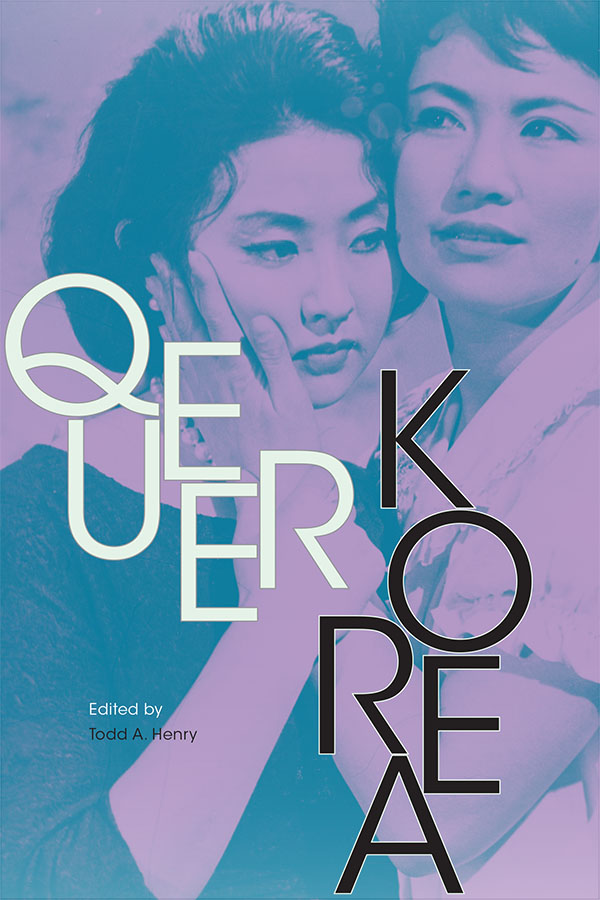
Queer KoreaOn March 3, 2021, Byun Hui-su, South Korea’s first transgender soldier who was discharged from the military the year before for having gender reassignment surgery, was found dead in her home. Her apparent suicide drew media attention to transphobia and homophobia in the army and in South Korean society at large. According to Todd Henry, who edited the volume Queer Korea published by Duke University Press in 2020, “LGBTI South Koreans face innumerable obstacles in a society in which homophobia, transphobia, toxic masculinity, misogyny, and other marginalizing pressures cause an alarmingly high number of queers (and other alienated subjects) to commit suicide or inflict self-harm.” Recently people and organizations claiming LGBT identity and rights have gained increased visibility. The city of Seoul has had a Gay Pride parade since 2000, and in 2014 its mayor Park Won-soon suggested that South Korea become the first country to legalize gay marriage—but conservative politicians as well as some so-called progressives blocked the move, and the mayor committed suicide linked to a #metoo scandal in 2020. Short of same-sex unions, most laws and judicial decisions protecting LGBT rights are already on the books or in jurisprudence, and society has moved towards a more tolerant attitude regarding the issue. Nonetheless, gay and lesbian Koreans still face numerous difficulties at home and work, and many prefer not to reveal their sexual orientation to family, friends or co-workers. Opposition to LGBT rights comes mostly from Christian sectors of the country, especially Protestants, who regularly stage counter-protests to pride parades, carrying signs urging LGBT people to “repent from their sins.” In these conditions, some sexually non-normative subjects eschew visibility and remain closeted, or even give up sexuality and retreat from same-sex communities as a survival strategy.

Queer studies in a Korean context

There is also a dearth of books and articles addressing gay and lesbian cultures or gender variance in South Korean scholarship. Unlike the situation prevailing on North American university campuses, queer studies still haven’t found a place in Korean academia. Students at the most prestigious Korean universities (SNU, Korea University, Yonsei, Ehwa…) have created LGBT student groups and reading circles, but graduate students who specialize in the field face a bleak employment future. Many scholars who contributed to Queer Korea did it from a perch in a foreign university or from tier-two colleges in South Korea. This volume nonetheless demonstrates the vitality of the field and the fecundity of applying a queer studies approach to Korean history and society. The authors do not limit themselves to gay and lesbian studies: a queer perspective also includes cross-gender identification, non-binary identities, and homosocial longings that fall outside the purview of sexuality. Queer theory also takes issue with a normative approach emphasizing political visibility, human rights, and multicultural diversity as the only legitimate forms of collective mobilization. Queer-of-color critiques point out that power dynamics associating race, class, gender expression, sexuality, ability, culture and nationality influence the lived experiences of individuals and groups that hold one or more of these identities. Asian queer studies have shown that tropes of the “closet” and “coming out” may not apply to societies where the heterosexual family and the nation trump the individual and inhibit the expression of homosexuality. In addition, as postcolonial studies remind us, South Korea is heir to a history of colonialism, Cold War, and authoritarianism that has exacerbated the hyper-masculine and androcentric tendencies of the nation.

Some conservatives in South Korea hold the view that “homosexuality doesn’t exist in Korean culture” and that same-sex relations were a foreign import coming from the West (North Koreans apparently share this view.) This is, of course, absurd: although Confucianism repressed same-sex intercourse and limited sexuality to reproductive ends, throughout Korean history some men and women are known to have engaged in homoerotic activity and express their love for a person of the same sex. To limit oneself to the twentieth century, there is a rich archival record relating to same-sex longings and sensuality, cross-gender identification, and non-normative intimacies that the authors of Queer Korea were able to exploit. Homosexuality didn’t have to be invented or imported: it was present all along, albeit in different cultural forms and personal expressions. Close readings of literary texts, research into historical archives, surveys of newspapers and periodicals, visual analysis of movies and pictures, and participatory observation or social activism allow each contributor to produce scholarship on a neglected aspect of Korean history and society. But it is also true that persons that were sexually attracted to the same sex lacked role models or conceptual schemes that would have helped them make sense of their inclination. They were kept “in the dark” about the meaning of homosexuality as anything but a temporary aberrant behavior, a perverted desire that ordinary men “slipped” or “fell into” (ppajida), especially in the absence of female partners. The strong bondings that girls and young women developed in the intimacy of all-female classrooms and dormitories was seen with more leniency, but was considered as a temporary arrangement before they entered adulthood and marriage. As a result of the authoritarian ideology of the family-state, official information about non-normative sexualities such as homosexuality was highly restricted. Many men and women attracted to the same sex were confused and morally torn about their desires.

The elusive Third Miracle of the Han River

An optimistic view alleges that sexual minority rights with follow the path of economic development and democratization, only with some delay. According to this view, the “miracle of the Han river” occurred in three stages. A country totally destroyed by the Korean War transformed itself in less than three decades from a Third World wastebasket to an Asian economic powerhouse, becoming the 12th largest economy in terms of GDP. The second miracle occurred when democratic forces toppled the authoritarian regime and installed civilian rule and democratic accountability. The third transformation may be currently ongoing and refers to the mobilization of civil society to achieve equal rights for all, openness to multiculturalism, and women’s empowerment. But this teleological view neglects the fact that an emerging market economy can always shift to reverse mode: economic crises may sweep away hard-won gains, the rule of law may be compromised by ill-fated politicians, and social mobilizations may face a conservative backlash. This is arguably what is happening in South Korea these days. To limit oneself to sexual minority rights, the current administration has backpedalled on its promise to pass an anti-discrimination law; the legalization of same-sex-marriages still faces strong opposition; and homophobic institutions such as the army or schools fail to provide legal protection for gender-variant or sexually non-normative persons. The failure of LGBT communities to adopt a distinctive gay, lesbian, or trans culture and follow the path of right-based activism should not be seen as an incapacity to challenge the hetero-patriarchal norms of traditional society in favor of a transgressive and non-normative identity politics. As John (Song Pae) Cho notes, “For Korean gay men who had been excluded from the very category of humanity, simply existing as ordinary members of society may be considered the most transgressive act of all.”

The current backlash against homosexuality is not a return to a previous period of sexual repression and self-denial. It is triggered by economic necessity in the face of financial insecurity, labor market flexibility, and a retreating welfare state. John Cho shows that the three phases of male homosexuality within South Korea’s modern history were intrinsically linked to economic development. The “dark period” of South Korea’s homosexuality during the late developmentalist period, from the 1970s to the mid-1990s, was followed by a brief flowering of homosexual communities fueled by the Internet and the growing economy. But this community-building phase was undermined by the family-based restructuring that accompanied South Korea’s transformation into a neoliberal economy. As a response to the IMF crisis of 1997, the Korean state revived the older ideology of “family as nation” and “nation as family.” It used family, employment, and other social benefits to discriminate against non-married members of society and discipline non-normative populations who did not belong to the heterosexual nuclear family. Many single gay men in their thirties and forties were forced to “retreat” and “retire” from homosexuality to focus on self-development and financial security that often took the form of marriage with the opposite sex. Other gay men turned to money as the only form of security in a neoliberal world. In her chapter titled “Avoiding T’ibu (Obvious Butchness)”, Layoung Shin shows that young queer women who used to cultivate a certain masculinity, wearing short hair and young men’s clothing to emulate the look of boy bands’ idols, reverted to a strategy of invisibility and gender conformity to avoid discrimination at school and on the job market. The choice of invisibility is rendered compulsory in the army, where the Korean military even uses “honey traps” on gay dating apps to root out and expel gay military personnel.

Fighting against homophobia and transphobia

In such a context, developing queer studies in South Korea is going against the grain of powerful societal forces, and this may account for the militant tone adopted by many contributors to this volume. John Cho concludes his article on “The Three Faces of South Korea’s Male Homosexuality” by stating that the homophobic backlash is “ushering in a new period of neofascism in Korean history.” Layoung Shin emphasizes that “we cannot blame young queer women’s avoidance of masculinity,” and formulates the hope that “our criticism may offer them the courage to not fear punishment and harassment or bullying at school, which an antidiscrimination bill would remedy.” Timothy Gitzen exposes the “toxic masculinity” of South Korea’s armed forces where, on the basis of an obscure clause in the military penal code, dozens of soldiers who purportedly engage in anal sex are hunted down and imprisoned, even though they met partners during sanctioned periods of leave and in the privacy of off-base facilities. An independent researcher and transgender activist named Ruin, who self-identifies as a “zhe,” shows that bodies that do not conform to strict boundaries between men and women face intense scrutiny and various forms of discrimination, consolidated by institutions and norms such as the first digit in the second part of national ID numbers which are used for all kinds of procedures like getting a mobile phone or registering for employment and social benefits. Zhe claims that “this problem cannot be solved by legal reform; on the contrary, abolishing these legal structures altogether may be a more fundamental and effective solution,” as ID numbers were introduced to exclude and persecute “ppalgaengi” citizens suspected of pro-Communist sympathies during the Korean War. Todd Henry, the volume editor, notes that homophobia and transphobia are not limited to South (and North) Korea and that queer and transgender people in the United States face the added risk of being brutally murdered by gun-toting individuals.

But the most transgressive moves in Queer Korea may be the attempt to reframe history and revisit the literary canon using queer lenses and critical approaches inspired by queer theory. Remember that some conservative critics pontificate that “homosexuality didn’t exist in Korea” before it was introduced from abroad. In a way they are right: the word “same-sex love” (tongsongae) was translated from the Japanese dōseiai and was introduced under colonial modernity at the same time as “romantic love” (yonae) and “free marriage” (chayu kyoron). Colonial society allowed certain groups, such as schoolgirls, to engage in spiritual same-sex love to keep young people away from heterosexual intercourse. Pairs of high school girls formed a bond of sistership (ssisuta) and vowed they would “never marry and instead love each other eternally.” But during this period, “love” had little to do with sexual and romantic desire, and society relied on conjugal and filial conventions that privileged men at the expense of women. High school girls were expected to “graduate” from same-sex love and to serve as “wise mothers and good wives” (hyonmo yangcho). Those who didn’t and who tragically committed double suicides (chongsa) or led their lives as New Women (shin yoja) attracted a great deal of contentious debates and literary attention. Meanwhile, namsaek (“male color”) and tongsongae (homosexuality) between men was medicalized and pathologized as an abnormal behavior discussed along the same lines as rape, bigamy, and sexual perversion (songjok tochak). Whereas male spiritual bonding (tongjong) and physical intimacy known nowadays as skinship were tolerated and even sometimes encouraged, there seems to have emerged a fixation on anal sex (kyegan, “chicken rape”) that is shared today by the military and conservative Christian groups.

Drag queens and cross-dressers

Traditional Korea also had its drag queens and cross-dressers. The male shamans and healers (mugyok, nammu, baksu), female fortunetellers and spiritists (mudang, posal), and the so-called flower boys (hwarang) practiced cross-dressing, sex change, and gender fluidity avant la lettre. Transgendered shamans passed as women by dressing, talking, and behaving as women, while women practitioners of kut ceremonies donned kings’ and warriors’ robes and channelled the voice of male gods and spirits. Despised by traditional Korean society, they formed guilds and associations under Japanese occupation and assimilated with official shinto religion to get political favor. Under their theory of “two peoples, one civilization,” Japanese scholars claimed that Korean shamanism and Japanese Shintō shared a common origin. Meanwhile, well-known historians such as Ch’oe Nam-son and Yi Nung-hwa exploited the precolonial traditions of these marginalized women and men to forge a glorious story of the nation, one that re-centered Korea and Manchuria in a larger continental culture of shamanism. Korea’s colonial modernity had also a “queer” writer in the person of Yi Sang (1910-37), whose pen name could be transliterated as “abnormal” or “odd,” and who cultivated a Bohemian style inspired by European dandyism and avant-garde eccentricity. During the Park Chung-hee era (1963-79), the suppression of homosexuality didn’t mean that unofficial and popular representations of non-normative sexualities were absent. In fact, both reports in weekly newspaper and in gender comedy films were rife with such representations, of which queer populations were shadow readers and viewers. In a long and well-documented article, Todd Henry shows that South Korea boasts a long but largely ignored history of same-sex unions, particularly among working-class women. Journalists working for pulp magazines routinely covered female-female wedding ceremonies from the 1950s to the 1980s. In “a Female-Dressed Man Sings a National Epic,” Chung-kang Kim analyzes the story of the movie Male Kisaeng (1969), the Korean equivalent of the gender comedy film Some Like It Hot.

Queer studies are underdeveloped in South Korea. In an academy that remains disinterested in, if not hostile to, queer studies, it takes some courage to stake one’s career on the development of the field. This explains the militant tone adopted by some contributors, who mix scholarship and social activism. In a society that has often been framed in terms of ethnoracial and heteropatriarchal purities, they have a lot to bring to contemporary debates by showing how Korea has always been more diverse, and sometimes more tolerant to diversity, than dominant representations make us believe. As one of the authors claims, “homosexuality is not a ‘foreign Other’ that has been imported only into the country as part of the phenomenon of globalization. It likely has always existed as a ‘proximate Other’ within the nation itself.” And yet, Queer Korea appears at a time when the LGBT movement seems to be in retreat. The stigmatization and marginalization of sexual minorities continue unabated, and the emergence of LGBT organizations, film festivals, and political organizations during a period that witnessed the establishment of democratic institutions has given way to individual strategies of invisibility and retreat. Most queer subjects avoid the kind of public visibility that typically undergirds identity politics. Even politicians sympathetic to gay and lesbian rights avoid taking positions in this fraught context in fear of “homophobia by association”—they might be involved in collective culpability, just like the families and colleagues of ppalgaengi (Reds) were targeted by “guilt by association” under authoritarian rule. Queer studies in Korea, and Korean queer theory, will not necessarily follow the path taken by the discipline elsewhere. But this volume definitely puts it on the map.
From War Orphans to First World Citizens

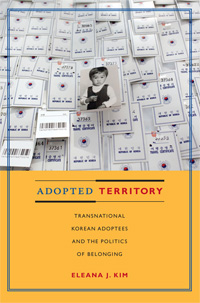
A review of Adopted Territory: Transnational Korean Adoptees and the Politics of Belonging, Elena J. Kim, Duke University Press, 2010.

Adopted TerritoryA while ago Fleur Pellerin, then a junior Cabinet member of the French government led by president François Hollande, made her first visit to Korea. To the French, she was known as an elite public servant-turned-politician and put in charge of the digital economy and entrepreneurship portfolio, and also as the only minister with an Asian face. In Korea she became known as “one of us” or a “blood relative”, and during her business trip to Seoul she was welcomed as if she was the homecoming queen. She had a chat with then president Park Geun-hye, and featured in many television shows and media articles. Her first name, Fleur (“flower”), led to a crazed “Fleur-mania”, and her Korean name, Kim Jong-suk, was also made public.
Korea’s largest export

Like about 12 000 French citizen and 160 000 persons worldwide, Fleur Pellerin is a Korean adoptee. She left Korea when she was six months old, never met her biological parents again, and knows next to nothing about her birth country. For Koreans, she is the poor immigrant who made it abroad, and on top of that in a country known for its high culture and glamour – the conclusion of Korean TV dramas usually has the heartbroken heroin go to France to “refashion herself”. But she also reminds Koreans of darker times, and of a phenomenon of transnational adoption that many feel awkward about. Not so long ago, the nation’s pride in hosting the 1988 Summer Olympics was bruised by reports in the American press asserting that children constituted Korea’s “largest export”. Reaching out to adopted Koreans abroad, incorporating them in the community of overseas Koreans, and heralding their success was therefore a way for the Korean public to turn a sore spot into a matter of pride and celebration.

As Elena Kim reminds her readers in her ethnography of adopted Korean communities, Korean adoptees came to the West in distinct waves. First came the war orphans and mixed-blood children of US soldiers and Korean women. Then, in the 1960s and 1970s, American and West European families adopted the offsprings of single mothers or poor households who were convinced to relinquish their newborn baby in exchange of a hefty sum. Today, nearly all the children adopted overseas are infants born to unwed mothers in their late teens and early twenties. Meanwhile, the Koreans adopted in the past decades have become adults in their country of adoption, and today form a global community composed of subsets of regional and online groups with distinct histories and concerns. Internet and globalization have brought them together, and many are claiming voice and agency as a particular public with shared experience and common bonds.

The problem of adoption

The propinquity of money and children in transnational adoption and the attendant suspicion of human trafficking have made Korea’s overseas adoption program a target of criticism throughout its history. It has been argued that orphanages (which were largely funded by Western relief organizations), and, later, state-subsidized adoption agencies, functioned as a surrogate welfare system and a conduit for foreign exchange. It has been further advanced that Korea’s international adoption system not only retarded the development of domestic adoption and child welfare policies, but also provided a quick-fix solution that has been complicit in the social disenfranchisement of Korean women. Today South Korea has the lowest birth rate in the world, with fast increasing numbers of abortion and divorce. The “problem” of adoption (ibyang munje) has become a matter of public debate in which adult Korean adoptees and Korean birth mothers of an earlier period increasingly have a say.

What is unique about Korea’s adoption program? First, conventional wisdom in South Korea and in the Western countries to which adoptees are sent blames the persistence of Confucian family values and preoccupations with patrilineal bloodlines for the reluctance among Koreans to adopt “their children”. This is changing fast, with placement agencies now under the obligation to encourage domestic adoption first and famous media figures making a public gesture of adopting their own children. Second, the Korean state has so far failed to promote extended models of family arrangements, provide adequate financial support for single mothers, or tackle the problem of inadequate sex education. Adult adoptees such as Fleur Pellerin and lesser-known figures could help challenge dominant representations and policy outcomes, especially when they come from Europe, where the social security system is well developed and recomposed families are almost becoming the norm. Third, the long shadow of stigma associated with unwed motherhood in Korea is slowly eroding as Korean society enters a phase of globalized modernity.

A social experiment

But the most distinctive feature of Korea’s adoption program is that it came first, and therefore became the template for subsequent programs. Korean adoptees represented a “social experiment”, the outcomes of which were subject to intense scrutiny and debate since the practice began in the mid-1950s. Korean adoptions, determined to be largely successful by social workers and academic experts, expanded dramatically in the 1970s and paved the way for subsequent waves of adoptions of children from the developing world into white Western homes. By the 1970s, largely due to the success of the Korean model, transnational adoption became an institutionalized social welfare practice into many nations and a naturalized “choice” for individuals in the United States or in Europe. As Elena Kim notes, the adoption model is built upon the archetypal figure of the orphan who is construed as the ultimate figure of global humanitarianism, permitting Americans in particular to “save” children who are themselves often victims of American foreign policy decisions.

Not all adoptees were raised in wealthy, happy families with caring surrogate parents. Some experienced hardships and rejection by siblings and relatives; a significant number faced racism and bigotry at school or in their community; and most of them had to cope with the awkward feeling of being “yellow outside, white inside”. Adoption is based on separation, and the traumatic scene of abandonment sometimes lingers. According to adoption specialists, loss and grief are inescapable aspects of the adoption experience for all members involved in an adoption. Adoptees and their relatives construct “what if” scenarios and “phantom lives” of what they would have become if they had stayed in Korea. Some adopted Koreans dream of a more authentic self in their birth country, while foster parents or agency workers sometimes construct cautionary tales about girls being forced into prostitution or reduced to a dehumanized treatment. For the most politically oriented adoptees, crafting a germane public discourse for discussing the politics of adoption is a difficult process. Typically, the adoptee can only feel gratitude and indebtedness for having been given “life” and “opportunity” through inclusion in the bourgeois nuclear family, and more complex feelings of ambivalence, mourning, or resentment are suppressed, condemned as ungrateful, or pathologized.

The quest for roots

Faced with the taboos and emotionally charged issues that adoption raises, some adoptees simply choose to ignore their roots and go on with their lives. Others, increasingly, go on a quest for origins to discover the country of their birth and, for some of them, to try to meet with their biological parents. Since 2012, adopted Koreans can choose for double citizenship, or they can apply for a visa that allows them to live and work in Korea. But language and, sometimes, prejudices, remain a problem and put a barrier between them and the rest of the population. A social event known as The Gathering allows them to get together and share experience. Meeting other adoptees can feel like rediscovering one’s lost tribe: “None of us had real peer groups growing up,” notes one adoptee. “When we found each other, it was an electric thing.” Self-exploration through shared storytelling is central to adoptee social practices and can be seen as a performative negotiation of self and world. The misadjustment or lack of fit with dominant national, ethnic, and cultural models forms the basis for creating a space where, as more than one adoptee has stated, “there’s less explaining to do”.

Adopted Territories is a work of cultural anthropology that comes loaded with theoretical concepts and abstract discussions. For Elena Kim, drawing on social theorists such as Judith Butler and Aihwa Ong, adoption blurs and unsettles the categories of race, nation, and family. Not unlike the forms of gay and lesbian kinship identified by queer theory, adoptees’ experiences with nonnormative family forms lay the ground for alternative forms of personhood and kinship, contributing to the production of a shared global imaginary that has taken on transnational dimensions. “Adoptee kinship” is defined as “a form of solidarity based upon radical contingency rather than biologically rooted certitudes”. From this perspective, kinship is not a preexisting truth that is discovered or found, but rather a set of relationships actively created out of social practice and cultural representation. It is a model of kinship that is not exclusive but additive, transnational, and expansive. “Public intimacy”, another oxymoron, designates the potential sites of identification and association that extend beyond the biological family, thereby producing new kinds of identities and intimate relations.

Social theory

The notion of “counterpublic”, a term coined by Nancy Fraser in her critique of Habermas’ model of the public sphere, “highlights the fact that the adoptee social imaginary exists in diacritical relation to dominant publics – whether in the United States, Europe, South Korea, or an increasingly transnational public sphere.” The adoptee counterpublic is organized around a discursive process of identity construction in which adoptees endeavor to define themselves as a group that is distinct from others yet exists in relation to the wider public. By coining the notion of “contingent essentialism”, the author points to the fact that “adoptee identity is at once essentialized as something natural and also construed as something cultural and socially constructed.” Contingent essentialism is distinct from the biologism or genetic essentialism that characterizes much of the public discourse about adoptees and their “real” origins, identities, or families. Elena Kim defines “adopted territories” as “networks of adoptees and their activities, situated in a range of virtual and actual locations, that comprise the transnational Korean adoptee counterpublic.”

Borrowed from Judith Butler, the notion of “constitutive outside” points to the legal fiction of the orphan that leaves behind an excess of relationship, which “enchains” the child givers and recipients and “haunts” adoptee subjectivities. “Adoption not only makes children into orphans, but, over time, also produces missing persons,” writes Elena Kim, who illustrates her writing with artworks from internationally adopted artists. The book cover, a community artwork conceived by artist and activist Leanne Leith, features numbered tags bearing travel certificates delivered by the Republic of Korea, each tag representing one South Korean gone missing through international adoption. Much as the abstract conceptualizations, the live testimonies of adoptees and art pictures displayed in the book illustrate the potent message of longing and belonging that addresses a constitutive dimension of our shared humanity. Korean adoptees or not, “we all negotiate contingencies of personhood out of insufficient and mutable categories of the biological and the social.”

A Gender Perspective on the U.S. Military Presence Overseas

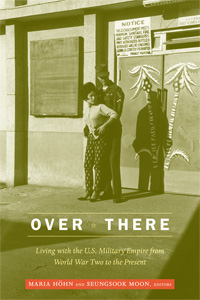
A review of Over There: Living with the U.S. Military Empire from World War Two to the Present, Edited by Maria Höhn and Seungsook Moon, Duke University Press, 2010.

Over There.jpgA few years ago Hashimoto Toru, mayor of Osaka and president of Japan’s Restoration Party, caused outrage when he declared that Japan’s wartime use of comfort women was “understandable,” implying that when male soldiers are at war, organized efforts to provide women to satisfy their lust are natural, and that the practice has been adopted by many countries. He further undermined his credibility by saying that U.S. soldiers on Okinawa should use the island’s “adult entertainment industry” in order to reduce incidences of sexual assault on local women. Facing domestic and international uproar, he retracted the second comment and formulated an apology to the American people and to the U.S. military. But he stuck to his first comment on comfort women, claiming he had been misunderstood and that other countries were also guilty of sexual abuses during wartime. He called the use of comfort women, many of whom were recruited in Japanese-ruled Korea, “an inexcusable act that violated the dignity and human rights of the women.”

Comfort women and administered prostitution

To the Japanese public, these comments brought up memories from a not so distant past. They echoed the decision taken by the first postwar cabinet, immediately after Japan’s surrender, to provide sexual services to the U.S. Occupation Forces through a system of administered prostitution. The Japanese officials hoped that special comfort women would provide an outlet for the occupiers’ sexuality, help to prevent mixed blood, and serve as a buffer between “good” Japanese women and GIs. Similar plans were also proposed by German officials managing the postwar transition, only to be turned down by American commanders, who unsuccessfully tried to apply a strict policy of non-fraternization between U.S. soldiers and German male and female nationals. Likewise, during the Korean War, the Korean government reinvigorated the Japanese institution of “comfort stations” to serve Allied Forces and Korean soldiers in the name of protecting respectable women and rewarding soldiers for their sacrifice. These unsavory episodes belong to an immediate postwar or a wartime context; but despite the official ban on prostitution, the institution of camptown prostitution or “adult entertainment” has accompanied the U.S. military presence abroad throughout the years.

Regardless of what Osaka’s mayor has said, or meant to say, there is a genuine need for an open debate on the side effects of large military deployments overseas and on official attitudes regarding the sexual demands of male soldiers. These public attitudes are fraught with ambiguities and contradictions. On the one side, the U.S. military, and many host country governments, maintain a prohibition on prostitution and punish it with variable sanctions. On the other hand, they tolerate and even regulate the presence of camptown prostitution, registering sex workers and imposing medical visits in order to limit the spread of venereal diseases. While modern rest-and-relaxation (R&R) facilities and adult entertainment may not always involve paid sex, the presence of transnational sex workers with little legal protection raises the issue of transborder human trafficking, which the U.S. strongly condemns. At a time when U.S. policymakers are debating the future shape of the global network of military bases, the new global posture, which emphasizes mobile forces sent on short-term deployments without families, has far-reaching implications for gender and sexual relations with host societies.

A global network of military bases

The essays collected by Maria Höhn and Seungsook Moon in this volume are not limited to the issue of prostitution – although the book cover makes the theme quite explicit. Written with a historical perspective, and using the lenses of gender and postcolonial studies, they illustrate the various aspects of the politics of gender, sexuality, race, and class that are constitutive of the maintenance of America’s military presence in its main postwar locales: West Germany, Japan and Okinawa, and South Korea (with an additional essay on Abu Ghraib). The authors insist that this global network of military bases constitutes what can only be described as an empire: indeed, “the debate is focused not on whether the United States is an empire at all but on what kind of empire it is.” The absence of formal colonies and the reliance on bilateral or multilateral security arrangements and Status of Forces Agreements (SOFAs) obfuscate the deep power imbalances between the imperial power and its military projection outposts, creating a relationship that the authors frame in neocolonial terms.

By focusing on the social and cultural impacts of the United States’ military presence overseas, the authors’ ambition is to “make visible this unprecedented empire of bases.” The U.S. military empire has bearing not only on the lives of soldiers and their families, but also on the lives of camptown workers, who cater to their needs, and on residents of local host communities, who have to deal with the economic, social, and cultural consequences of their presence. America’s global military footprint is ubiquitous. During the Cold War, some 500,000 soldiers, as well as tens of thousands of civilian employees and hundreds of thousands of family dependents, were stationed overseas. Most Americans would be stunned to hear that the United States now maintains military bases in more than 150 countries. In the Middle East, it has kept a substantial military presence in Bahrain and Turkey for more than fifty years. To provide housing and training facilities for its personnel, the U.S. military controls almost 29 million acres of territory. And the SOFA agreements cover relations with host countries in minute detail, granting legal privileges to American servicemen that are deeply resented by local citizens.

American empire and neocolonialism

According to the volume editors, “the U.S. military displayed a colonial perception that women of occupied territories in Korea, Japan, and Germany should be sexually available for G.I.s, just as colonized women of color had been available to European colonialists.” Within the context of these three countries, nowhere was the neocolonial character of the U.S. presence more evident than in South Korea. Clustered in Gyeonggi Province and around Seoul, camptowns became a virtually colonized space where Korean sovereignty was suspended and replaced by the U.S. military authorities. The clubs and bars catering to GIs were legally off-limits to Korean nationals (except for registered hostesses and sex workers). After the Korean War, liaisons between G.I.s and Korean women often took the form of concubinage, a practice developed in European colonies whereby a white man and a local woman would cohabit outside the respectability of marriage and dissolve their relation upon the white man’s departure. Although the U.S. now maintains a zero-tolerance policy with regard to human trafficking and prostitution, many Filipinas or Russian camptown women fall prey to similar arrangements with American soldiers, and are left raising children alone because their G.I. boyfriends or husbands have returned to the United States. Foreign migrant workers continue to be subjected to abuse and violence, and the exploitative working conditions maintained by business owners and managers often comes close to the trafficking in persons that the U.S. State Department so vehemently condemns.

For Seungsook Moon, the U.S.-Korean SOFA has remained far more unequal than comparable agreements in Japan, Germany, or other NATO countries: “under the SOFA, Korean citizens are virtually colonial subjects in their own territory.” The U.S. military bases “have enjoyed extraterritoriality, marking them virtually as U.S. territories where Korean sovereignty ends.” She analyzes the presence within U.S. Army ranks of KATUSAs, or young Korean conscripts who serve as augmentation troops in support functions. This institution, “which resembles nineteenth-century European colonial military arrangements with native soldiers,” was created during the Korean War to compensate for dire manpower shortages. Nowadays KATUSAs often come from privileged social backgrounds and, unlike other Korean conscripts, they benefit from more lax discipline and better infrastructure in an English-speaking environment. While KATUSA service remains the most popular form of military service among Korean conscripts, they often resent the menial work and sense of superiority of their American colleagues. As analyzed by the author, the nonfictional and fictional accounts produced by KATUSAs about their experience of serving in the U.S. military reveal criticism of arrogant male G.I.s and fantasies about sexual encounters with white female GIs. Young Korean men also resent the predatory attitude of white male soldiers towards Korean female college students, who are often seen visiting military bases or going out with G.I.s.

Mama-san and pan-pan girls

The chapters about Japan also highlight the hidden social costs, the unequal power relations, but also the transformative and sometimes even the emancipating aspects of America’s military presence. The United States stations the bulk of its forces on the island of Okinawa, a former colony of Japan, whose inhabitants were regarded as second-class members of the nation. The institution of military prostitution has now disappeared, and the “pan-pan girls” of occupied Japan are a distant memory, but sexual or romantic entanglements around U.S. bases have not ceased. Okinawan women who date or marry U.S. military men are often the target of local scorn and ostracism. They occupy a hybrid space or liminal status in the Okinawan and U.S. military communities. Although social, racial, and cultural hierarchies are also present among the members of a Japanese Wives Club described by one contributor, Japanese women who marry American GI..s feel most at home not in the United States or in their local communities, but in the extraterritorial spaces that the military housing areas provide. Residing in the hybrid spaces created in and around U.S. military bases, local nationals are able to challenge existing hierarchical social relations of race, gender, sexuality, and class in their own societies. These same challenges of class and gender boundaries are also expressed by the young Okinawans practicing for eisa, a traditional dance performed each summer during Obon, the festival of the dead. Formerly practiced by young warriors of noble ancestry, eisa now provides working-class Okinawans, male and female, the occasion to transcend the history of double colonization and contemporary lives dominated by the overwhelming U.S. military presence. Beautifully written and deeply evocative, the text on the eisa dance enchants the reader with a literary interlude, while building on what Ann Laura Stoler has called “the affective grid of colonial politics.”

Germany provides an interesting counterpoint to the studies of South Korea and Japan. The narrative about the U.S. occupation and military presence is sharply divided along gender and generational lines. To the men who fought in the Wehrmacht or were enrolled in the Hitlerjugend, the widespread sexual and romantic fraternization between German women and U.S. soldiers came as a shock. A particularly misogynist joke during the bitter occupation years lamented that “German men fought for six years, while German women fought for only five minutes.” Those same men later held deep skepticism about the fighting spirit of their American allies against the Soviet threat. The relaxed attitude of GIs who strolled in German communities, hands in pocket and chewing gum, stood in sharp contrast with the tightness and discipline that Germans educated in the Prussian tradition had come to equate with “manliness”. But this new masculine casualness had opposite effects on the younger generation, who eagerly adopted the clothing habits and musical tastes of their American role models. During the Vietnam War, as they learned about the civil rights movement, German students reached out to African-American soldiers in order to fuel dissent in army ranks and encourage desertion. The racial crisis in the U.S. military was addressed very differently in West Germany, where it led to the adoption of sweeping measures to eradicate discrimination, and in South Korea, where it was framed as a dispute about access to local women. By exposing U.S. servicemen and their families to different racial and gender roles, the overseas military presence also had effects in changing social relations back home.

Framing the U.S. military presence overseas
Over There is a fine volume of advanced scholarship that breaks new ground and explores an issue that has garnered strikingly limited attention from scholars working outside the narrow circle of strategic studies and military history. The decision by the editors to frame the U.S. military presence overseas in imperial and neocolonial terms will not convince all readers. Some of the chapters are avowedly militant in style, and breach the sharp line between academic scholarship and social activism. But the combination of gender studies and a postcolonial perspective sheds light on an important aspect of America’s global military shadow. Referring in particular to Ann Stoler’s work, the editors argue that “social relations of gender and sexuality figure into the working of an imperial power not as a peripheral issue but as a constitutive aspect of producing and maintaining the boundary between the colonizer and the colonized.” A debate on the gender and sexual aspects of America’s military empire is long overdue.

Competing Views on Korea’s National History

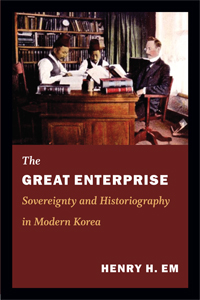
A review of The Great Enterprise: Sovereignty and Historiography in Modern Korea, Henry Em, Duke University Press, 2013.

Henry EmAchieving sovereignty, and attaining equal standing with other sovereign nations, was Korea’s great enterprise as referred to in the book’s title. It was a thoroughly modern project: previous generations did not feel the urge to compare with other sovereign states or to assert Korea’s distinctiveness. Beginning with the turn of the century, Korea’s commitment to the great enterprise was a necessary condition for avoiding subordinate status in the face of imperial ambitions. Then, as Japan came to dominate Korea, it became a way to break free from its colonial ruler and to campaign for its independence. Later on, emphasizing national sovereignty meant proclaiming the nation’s unity in the face of the North/South division.
Achieving national and individual sovereignty

Historians played a great role in this endeavor. They produced the great narratives that allowed Korea to project its national identity onto citizens. As Henry Em writes in his introduction, “sovereignty provided the conceptual language for writing national histories, but it also constituted the site for the continuous production of oppositional subjectivities and political alternatives.” Sovereignty is not just a prerogative of the state; it is also an attribute of the modern subject. In order to become sovereign subjects, Koreans had to severe their ties with tradition and to reorder their society into a unitary whole. The beginning of the twentieth century saw the birth of the modern individual in Korea. New figures emerged, such as the modern girl with bobbed hair or the political activist facing state persecution. Although collective affiliations are constitutive of the sense of identity in Confucian cultures, the individualist streak runs deep in Korean society. Especially mistrust of rulers is ingrained in the Korean people, who cultivate the spirit of resistance and autonomy.

The discourse of national and individual sovereignty remained a contested field throughout the twentieth century. Competing visions were offered on what it meant to be Korean; when and where national identity originated; and how it could assert itself in the face of imperial dominance or political repression. A characteristic of Henry Em’s book is to refuse simple binaries: between the colonizer and the colonized, between North and South, or Right and Left. At the beginning of the twentieth century, he demonstrates that liberalism retained “an essential link to imperialism and colonialism”. During the colonial period, Japanese were instrumental in shaping Korean identity and helping Koreans connect with their past. After independence, many southern historians migrated north, and continued to be referred to in the historiographic literature, albeit in oblique fashion so as to avoid censorship. In the modern era, the so-called New Right welcomed scholarship inspired by postcolonial studies, and developed a critique of the nation-state that the nationalist Left had left untouched.

Translating and enforcing the nation-state in East Asia

Sovereignty is different in essence from the Mandate of Heaven that Choson dynasty rulers claimed as a justification for their rule, along with the subordinate status they maintained with Ming and then Qing China. Paradoxically, it was the Japanese who introduced the notions of sovereignty, independence, and modern statehood in Korea, confirming Carl Schmitt’s remark that “a nation is conquered first when it acquiesce to a foreign vocabulary, a foreign concept flaw, especially international law.” King Kojong’s Oath of Independence, pronounced in 1895 in a ceremony mixing the antique and the modern, was inspired if not dictated by Inoue Kaoru, Meiji Japan’s envoy to Korea. As the author notes, “by leading the way in utilizing the post-Westphalian sovereignty-based conception of international relations, Japanese statesmen like Inoue Kaoru positioned themselves as the preeminent translators and enforcers of international law in East Asia.”

Whereas the China-centered theory and practice of tributary relations, based on ritual hierarchy and actual autonomy, provided a buffer for the Choson state and warded off imperial ambitions, it was the principle of equal sovereignty and national independence that paved the way for Japan’s domination over Korea. The paradox of sovereignty extended beyond the realm of international law. In order to be what they claimed to be, aspiring sovereign states had to become others, and incorporate cultural traits from European civilization. They had to demonstrate their commitment to modernization by adopting Western institutions and practices, and by discarding some of their age-long traditions.

Korea’s entry into modernity

Lastly, the emergence of the individual as sovereign subject required sweeping reforms touching on language, education, and imaginaries. Korea’s entry into modernity was accompanied by the “inauguration of the Korean alphabet as the national script in the last decade of the nineteenth century, the beginning of modern Korean historiography in the first decade of the twentieth century, the emergence of modern Korean literature, and a host of other beginnings.” As is well known, many Korean words were taken from the Japanese, including minjok (ethnic nation), kukmin (national citizen) or even the word designating the economy (kyongje). Less well-known is the role of Protestant missionaries in promoting the Korean vernacular script, the hangeul, helping to transform it into an icon of national identity. Protestant missions were also instrumental in the creation of the first Western-style schools and modern newspapers, which stand as necessary elements for the emergence of a public sphere and the formation of “imagined communities”.

More controversial perhaps, the author shows that the Japanese authorities played a critical role in shaping Korean’s national identity. Nowhere is this more conspicuous than in the field of patrimonial policies and art history. As the author notes, studying the story of the “discovery” of the Buddhist statue of Sokkuram in southern Korea, “the colonial authorities did not just teach Koreans about their past; they had to restore it for them.” Japan’s encounter with Korean art did not only take the form of looting and plundering, although such forms of colonial exploitation also took place. “Like the British in India and the Americans in the Philippines, the Japanese colonial state invested time, money, and human resources to carry out excavations and surveys, to study Korea’s past and restore some cultural sites (but not others) in order to establish the categories and the narrative strategies by which Korea and Koreans would be understood.”

Competing visions of Korea’s history

It was the Japanese colonial state that identified Sokkuram as an example of Korea’s cultural and religious past, and that restored the statue to its former glory. Yanagi Soetsu, founder of the Mingei folk craft movement in Japan, praised Sokkuram as the “culmination of the religion and the art of the Orient.” Of course, Japan’s self-designated role as a curator for Asia’s art did not just emanate from a consideration of art for art’s sake, and it had political and ideological motivations as well. As reinterpreted by the Japanese, “the story of Sokkuram — its creation and subsequent slide into obscurity — was the story of Korea: a brilliant past that was Asian rather than Korean, followed by a downward slide into the vulgar and trivial art of the Choson dynasty, pointing to the necessity of Japan’s tutelage of Korea and Koreans.” This imperialist vision of art was reinforced by colonial historiography. Through popular essays and media reports, “the Japanese came to believe that Japan had ruled Korea in ancient times and that the Japanese colonization of Korea in modern times represented the restoration of an ancient relationship.”

Of course, Korean historians developed a completely different story. Whereas ancient Korea was divided in terms of village or region, clan or lineage, class or social status, the Koreans became Korean partly thanks to national historiography, when modern intellectuals such as Sin Chae-ho began to write Korea’s national history. “In place of loyalty to the king and attachment to the village, clan, and family, and in place of hierarchic status distinctions among yangban, chungin, commoners, and chonmin, nationalist historiography endeavored to redirect the people’s loyalty toward a new all-embracing identity of Koreans as a unique ethnic group.” It is Sin Chae-ho who emphasized the mythical figure of Tangun as the common ancestor of the Korean people. The Tangun legend later led to various interpretations. Japanese historians dismissed it as a story fabricated in the thirteenth century by the Buddhist monk Iryon. As a nationalist historian, Choe Nam-son read the Tangun story as the expression of religious practice dating to prehistoric times, as an ancient narrative that indicated a common cultural sphere for all of northeast Asia centered around Ancient Choson. In the story of the female bear transformed into a woman and married to Tangun’s ancestor, the Marxist historian Paek Nam-un saw evidence of the beginning of both class differentiation and the privileging of the male over the female descent line in primitive times.

The three schools of Korean historiography

The 1930s saw Korean historians coalescing around three competing schools: nationalist historiography, Marxist or socioeconomic historiography (Paek Nam-un), and positivist historiography (Yi Pyong-do and the Chindan society). Paek Nam-un’s Chosen Shakai Keizaishi was the first book of a comprehensive history of Korea’s historical development in terms of class formation and social forces internal to Korea, as it went from primitive tribal communism to a slave economy and to an Asian feudal society until “sprouts of capitalism” began to emerge independently from outside interference. In the immediate post-liberation period, Marxist intellectuals, with Paek Nam-un taking the leading role, sought to establish hegemony over intellectual production, reaching out to non-Marxist scholars, including nationalist historians who had not capitulated to colonial power. By 1948 many Marxist intellectuals had left Seoul and gone north of the 38th parallel, pushed by anti-communist repression in the South and pulled by offers of employment and opportunity to take part in the DPRK’s national democratic revolution. The progressive historian scholars who stayed found refuge mostly in economics departments.

Although the student revolution of April 19, 1960, that toppled the Rhee regime was crushed by a military coup in 1961, that democratic opening nevertheless allowed a younger generation of historians to narrate history in new ways. Under a nationalist canopy, scholars like Kim Yong-sop and Kang Man-il revived and confirmed Paek’s disclosure of the internal dynamic underlying Korea’s historical development, in which class struggle was central. In Korean History Before and After Liberation, Song Kon-ho presented an ethical critique of how 1945 marked the beginning point of the most horrific chapter in Korean history. Song reminded his readers that it was Syngman Rhee who had allowed notorious collaborators to evade punishment, including former Korean police officers who had hunted down, tortured, and killed independence activists. Spurred by Bruce Cummings’s research on the Origins of the Korean War, a passionate debate took place on the role of various parties and events in starting the war.

The New Right and post-colonialism

As “revisionist” historical narrative gained currency in the 1980s, conservative historians became increasingly frustrated at historiography that conceded nationalist credentials to North Korea and seemingly denied historical legitimacy to South Korea. In an interesting twist, the so-called New Right welcomed scholarship inspired by postcolonial theory that insisted on the acquiescence and participation of colonized people in their imperial domination. With this, the New Right turned to criticism of nationalism in general, and leftist-nationalist historiography of the 1980s in particular, attacking the later for questioning South Korea’s legitimacy. But this accommodation with postcolonial and postmodern scholarship was only tactical, as shown by the New Right’s support of alternative history textbooks that are avowedly nationalistic. In a region still marred in border disputes and nationalist sensibilities, historians should look forward to the day when nationalism can be dispensed with.

If You’re the Average K-Pop Fan, This Book is Not for You

A review of The Korean Popular Culture Reader, Kyung Hyun Kim and Youngmin Choe Ed., Duke University Press, 2014.

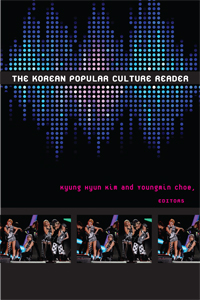
KPop ReaderWhy publish a reader on Korean popular culture? Because it sells. This is the startling confession the two editors of this volume, Kyung Hyun Kim and Youngmin Choe, make in their introduction. They are very open about it: their scholarly interest in Korea’s contemporary pop culture arose as a response to students’s interest in the field. It was a purely commercial, demand-driven affair. As they confess, “Korean studies had a difficult time selling its tradition and modern aesthetics in course syllabuses until hallyu (Korean Wave) came along.” Now students enrolling in cultural studies on American or European campuses want to share their passion for K-pop, Korean TV dramas, movies, manhwa comics, and other recent cultural sensations coming from Korea. Responding to high demand, graduate schools began churning out young PhD’s who specialized in such cultural productions. Course syllabuses were designed, classes were opened, workshops were convened, and in a short time the mass of accumulated knowledge was sufficient to allow the publication of a reader.
Teaching Korean pop culture on American campuses

But the average K-pop fan or drama viewer will surely be taken aback by the content of this volume. If they are looking for easy clues to interpret Korean dramas or the latest fad in boys bands’ hairstyle, then they will probably drop the book after a few pages. There are magazines or websites for this kind of information. As scholars, the authors have loftier interests and higher ambitions than just discussing whether Girls’ Generation really empowers young women or instead reproduces sexual cliches, or why the ‘Gangnam Style’ video generated so many clicks on Youtube. In fact, in another candid move, the editors confess what they really think about K-pop: it sucks. Or as they put it, “Thus far, Korean popular music has yet to produce one single progression of chords that has created a ripple effect of global critical response without the aid of inane music videos and excessive use of hair gels.” Yes, you read it right. For a book devoted to Korean pop culture, with a section on popular music that discusses artists ranging from Seo Taiji to the girls band 2NE1, this is the strongest indictment one could make.

But the ambition of the editors, and of the authors they assembled, is not only to sell books. They have a hidden agenda: they want to show that popular culture matters, and that it is no less noble and worthy of study than manifestations of high culture. As they see it, a discipline should not be judged by the prestige associated with the social reality under consideration, but should be valued from the perspectives and viewpoints it brings on seemingly arcane or mundane topics. There is even a general law at play here: the lower the culture, the higher the theory. The commoner your research topic, the more dexterity you have to prove in using difficult concepts and arcane prose. Conversely, commentaries of high cultural productions can accommodate a bland style and a lack of theoretical references. You may use Bourdieu or Deleuze to comment on photography and other minor arts, but paintings from the Italian Quattrocento or Baroque architecture demand more conventional writing tools. Some critics, such as Slavoj Zizek, have become masters at commenting low brow cultural productions with high brow philosophical references.

So the solution of the authors is to trick students into enrolling in their class with the promise of studying catchy topics such as K-pop or K-drama, and then to brainwash them with a heavy dose of politically-correct theory and academic scholarship. Lured by the attraction of pop culture, they are given the full treatment associated with the cultural studies curriculum. This can be summed up by three injunctions: contextualize, historicize, theorize. The aim is to contextualize contemporary Korean culture within its local and regional or global environment, while historicizing its colonial and post-colonial legacies, thereby leading to new theorizing about global cultural futures. Another move is to broaden the scope of phenomena under review to the whole spectrum of popular culture. The Korean Popular Culture Reader therefore includes chapters on sports, on cuisine, on advertising, and one video games. Conversely, there are no chapters on cultural heritage or on folk productions associated with traditional Koreanness: crafts, calligraphy, ceramics, Korean painting, pansori, seungmu dance, etc.

Contextualize, historicize, theorize

The first injunction to contextualize is taken very seriously by the authors. Cultural artifacts are not symbolic signifiers or self-referential texts that could be subjected to a purely formal, textual analysis. They are social facts, and should be explained as such. The authors refrain from sweeping assumptions about Korean popular culture as expressing essentially Korean cultural traits or as being naturally in tune with other Asian peoples’ aspirations. Instead, they look for archival evidence and locally grounded causalities. They seek neither to defend nor to attack popular culture, but rather attempt to place it in a context and describe how it works. Beyond apparent continuities, they uncover historical ruptures and shifts, and insist on the singularity of each domain of cultural practice. They are also careful to situate Korean popular culture within its regional, global, and transnational context. As the success of hallyu illustrates, Korean pop culture is now represented on an international stage and can no longer be understood narrowly through a model of national identity.

The chapter on the failure of game consoles, and the rise of alternative gaming platforms played on computers at home or in PC bangs, is a fine example of social contextualization. Home computers caught on in Korea for the same reason game consoles didn’t: blame Confucianism and the heavy focus on education. Parents bought their children computers to run educational software and improve English skills. Similarly, PC bangs offered young people a public space that was outside the remote reach of parental surveillance or elder supervision. PC bangs have thrived by giving young people the chance to translate online relationships into real-life ones, or to team under the leadership of a master player to attack a castle or win a battle in role-playing games. The Korean professional game player, who excels in MMORPG games and becomes a worldwide celebrity but who cannot speak English, has become an iconic figure in game-related media.

The political potency of the melodrama

Analyzing street fashion and movie cultures in 1950s’ Seoul, Steven Chung shows that Korea’s compressed modernity takes place against the background of global cultural circulation that cannot be reduced to a unilateral Americanization process. The 1950s was a remarkable decade for movie stars, and the roles played by actor Kim Sung-ho illustrate the ambivalence toward familial patriarchy and political authoritarianism. The political potency of the melodrama is nowhere more apparent than in North Korean movies, with its aesthetics of socialist realism and the overbearing gaze of the benevolent leader in hidden-hero narratives. Bong Joon-ho’s movie Mother strikes Korean viewers with the discrepancy between the iconic status of the two main actors, Kim Hye-ja and Won Bin, associated with motherhood and with idol stardom, and the role they endorse in the narrative, an abusive mother and a half-wit son.

The book cover featuring the glitz and chutzpah of Korean contemporary scene–with a picture of a live concert–is there to deceive as much as to allure. In fact, only nine chapters out of seventeen focus on the contemporary, and only two essays address issues commonly associated with the Korean Wave–one on K-drama fandom and another on girl bands. Many contributions to the volume deal with the colonial or post-colonial past, as contemporary Korean popular culture remains intimately connected to the history of colonial modernity. It was during the early part of the Japanese colonial era (1910-1945) that the first instantiation of the popular emerged. The idiom “popular culture” is not easy to translate into Korean, but the words inki or yuhaeng, taken from the Japanese, suggest the mix of individualism, commercialism, and cosmopolitan ideals that stood at the core of Korean colonial modernity. The history of cultural transfers, collage, plagiarism, and creative adaptation is repeated in many sectors, from popular songs to manhwa and even to Korean cuisine, as processed kimchi and makgolli appear to own much of their popularity to their adoption by the Japanese consumer.

At the origin of modern Korean literature, we find love of the romantic kind, translated into Korean as yonae or sarang. As Boduerae Kwon writes, “It was by leaning on the concept of romantic love that Korean literature tutored itself in the art of writing, nurtured the awakening of individual consciousness, and sharpened the powers of social critique.” Boy meets girl was a new concept in early century Korea: as a new import into the Korean language, yonae required a pose that suited the novelty of the word.” North Korea relied on its own set of concepts and ideologies, such as taejung (the masses) or inmin (the national citizen). It is no coincidence that both Stalin and Kim Il-sung recognized the power of film and considered it not only the most important art form but one of the primary means for creating a new art of living as well. “Cinema was used as the primary technique and medium for the construction of socialism and the creation of a national people,” writes Travis Workman, who uses Baudrillard and Debord to show that socialist realism was in many ways more real than really existing socialism.

The stoking of male fantasy

As much as they put popular culture into context and trace its historical development, the authors put cultural phenomena in theoretical perspective. The book is not too heavy on theory: most of the savant references and conceptual discussions are put forward by the two editors in the short introductions preceding each section. But all authors share an ambition that goes beyond the mere description of cultural facts. Cultural studies is predicated on the premise that the cultural sphere has replaced the socioeconomic sphere as the main site of political struggle and ideological production. At the same time, popular culture is caught in a process of commodification and commercialization that makes it incapable of articulating a coherent worldview that would effectively challenge domination. Perhaps most striking in Korean pop culture is the absence of the transgressive element. K-pop acts, or more specifically female K-pop singers, are visual stars who epitomize the “stoking of male fantasy” while cultivating a shy innocence and mild appearance. Although Seo Taiji upset the established order in the 1990s with his school-dropout status and signature snowboard look, “there was no profanity, no sexism, no use of any substance, no piercings, and no tattoos.” This lack of rebellious impulse is what may have conducted the editors to formulate their damning indictment of K-pop.

Supporting the Korean National Team

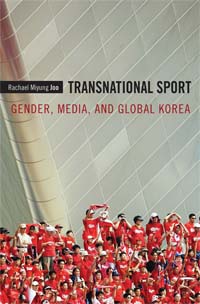
A review of Transnational Sport: Gender, Media, and Global Korea, Rachael Miyung Joo, Duke University Press, 2012.

Rachael Joo.jpgThe participant observer is the one who spoils the fun. He or she comes up with questions and doubts at the moment when the public wants answers and certitudes. Participating and observing are often two irreconcilable tasks. The observer introduces a distance when participants want to adhere to the show, and creates distinctions when the group wants to feel as one. Despite the pretense to the contrary, the researcher cannot fully belong, cannot fully take part into the action. Even when he or she choses to live among the natives, the anthropologist reminds people that he or she retains other obligations and belongings. The anthropologist dwells in the village but belongs to academia. The group can never claim him or her as one of them, because both know that he or she will have to leave one day and that his or her stay is temporary. Anthropologists are those who write things down at the end of the day: their commitment goes to scholarship, and they are dedicated to writing a book or a monograph about their experience in the field. They maintain critical distance and cultivate abstract reasoning, using categories that are in essence different from the ones that people use to frame their own experience.
The participant observer is a person who spoils the fun

Rachael Miyung Joo is the typical party spoiler. She is the only one who doesn’t wear a red T-shirt when the Korean national team is playing and people are watching the football game retransmission. When her female roommates cry and go crazy to celebrate victory, she stands back and watches from a distance. She feels closer to a solitary male supporter who sheds tears of emotion at the beauty of the game than to the crowd of cheering girls and boys who have only limited knowledge of the game rules. She bluntly confesses to her friends that she finds the players from the Italian team more attractive. She uses categories such as gender, race, and nationhood, and introduces critical distance with the immediacy of experience, when people around her just want to enjoy the fun and share the excitement. She highlights the constructed nature of national unity and the ambivalence of ethnic categories at the time when media coverage celebrates Korea as one and heralds the advent of global Koreanness. Whereas media attention focuses on female fans and their mild display of sex appeal, she brings in feminist theory to denounce the commodification of women’s bodies and the prevalence of heterosexual norms.

Rachael Miyung Joo’s fieldwork took place around the date of 2002, the year of the soccer World Cup tournament hosted jointly by South Korea and by Japan (the Japanese part is sorely lacking in the book). It is a two-sited ethnography, based on participant observation made in Seoul and in Los Angeles. In addition to soccer, Joo also documents other sports where Koreans fare particularly well: golf, where ethnic Koreans dominate the Ladies Profesionnal Golf Association, but also baseball, with the participation of ethnic Koreans in the Major League, and figure skating, dominated by multi-medalist Kim Yuna. Her ethnography uses analytical categories borrowed from philosophy, anthropology, gender studies, media studies, and critical theory. She draw from Althusser’s notion of “interpellation”, which describes how individuals are hailed through ideology. For example, the South Korean state attempts to “interpellate” Koreans in the United States as overseas Koreans—that is, loyal Korean national subjects.

The 2002 Football World Cup as a high mark of Korean transnational identity

She borrows from media studies the expression “assemblage”, a combination of institutions, images, and people that constitute the genre of media sport. Appadurai’s anthropology of the global provides her with the notion of “diasporic public spheres” that are constituted though collective and simultaneous engagements by subjects located in different spaces around the world. She offers her own concepts, such as “intimate publics”, a notion that combines the individual sphere and the public realm, or “everyday forms of self-fashioning” that she observes in Seoul’s streets. She elaborates on the notion of the transnational which is declined in all her book’s chapter headings: “transnational media sport”, “transnational athletes”, and “transnational publics”. She defines “multicultural nationalism” as “a culturalist notion of diversity that erase material differences and power inequalities between and among groups, as well as one that sees racial, national, and ethnic differences as essentially the same.”

Her main study is on the 2002 FIFA World Cup. As she writes in the introduction, “this month-long event was not primarily about sport per se; it was a great opportunity to celebrate with millions of others under the aegis of supporting the nation.” People knew they were participating in a historical event of global significance, because this had happened before: the 1988 Olympic Games are still remembered as a turning point in Korean history. One generation had passed, democracy had settled, and Koreans were even more self-confident. They felt united as one, and gave unanimous support to their national team. Young women were particularly conspicuous: they wore the color of the national team, painted the national flag on their faces and bodies, and led the crowds who were chanting and partying in the streets. For the author, “the sexual desire and excitement generated around Korean national athletes operate as allegories of desire for the Korean nation.” This desire for a fantasized Koreanness transcended borders: supporting the Korean team enabled Korean-Americans living in Los Angeles to articulate their ethnic identity and their relationship with the Korean nation.

Korean female golfers are women who don’t sweat

The female golfers who dominate the tournaments of the Ladies Professional Golf Association provide another interesting case study. According to the LPGA, 43 of 123 international players were South Korean as of July 2011. This list did not include Korean-born players who were naturalized US citizens or ethnic Koreans living abroad, including Michelle Wie or Christina Kim from the United States and Lydia Ko from New Zealand. Again, Joo sees hegemony at work in the way these female athletes represent ideas of gender, nation, and ethnicity. The sexuality of Korean female athletes is presented in contradictory ways as daughters to be protected within the Korean family and as hypersexualized Asian women to be marketed in transnational commercial contexts. As national icons, successful female golfers demonstrate how Koreans should adjust to the neoliberal contexts of a globalizing Korea. The whole nation rejoiced at the remarkable success of the golfer Se Ri Pak, who won two of the four major tournaments on the LPGA tour in her rookie year of 1998, while the nation was reeling from the trauma of the Asian financial crisis. She came to symbolize how South Korea might pull itself out of the crisis through global competitiveness, individual drive, and private capital.

In South Korea, the dominant discussion of golfers assumes that their success is due to their talent, hard work, and the sacrifice of their families. Often families move from South Korea to the United States or Australia to raise their daughters in golf-centered environments, to send their children to golf academies, and to live in areas where golf can be played year-round. In media narrative, father and daughter must bond to fight competitors in a foreign land. The father comes to standing for the national interest as he protects the progeny of the ore an nation in foreign contexts and ensures its enduring success. Some commentators also assume that Korean women are naturally well suited to forms of sport that require extreme precision and concentration, such as archery, billiards, figure skating, and golf. Conversely, non-Korean media sometimes point out that Korean golfers display a robotic quality—the idea that they lack emotion, creativity, and individuality. These cultural stereotypes are nothing new. During the Cold War, athletes from socialist countries were often stereotyped as collectivistic, militaristic, and emotionless. In the globalization age, Korean athletes are valorized as national heroes for disciplining their bodies, garnering global media attention, and demonstrating economic results. The female golfer also strengthens the capitalist ideologies of segmented labor markets that treat female labor as unskilled and subordinate.

Taeguk Warriors

Much media attention in South Korea is directed at athletes who compete abroad. These nationals icons bring global visibility to the nation, helping Korean corporations to win brand name recognition and bringing national or ethnic pride . Athletes who play abroad represent the image of the newly globalized Korean subject who leaves the country to succeed yet continues to maintain a strong sense of Korean identity. Sport operates in the affective realms of mass media to intensify and embolden feelings of nationalism and competition. Sport events also create contexts for the production of powerful feelings of nationalism and ethnic identity by diasporic subjects. Male athletes are often presented as warriors for the nation within the context of international competition. During the 2012 London Olympics, following South Korea’s victory of Japan, soccer player Park Jong-woo displayed a sign proclaiming Korean possession over the contested Eastern Sea island known as Dokdo to Koreans. As a consequence he was banned from the medal ceremony and unlike his other 17 teammates he did not receive a bronze medal for his performance. In recent years, the competition between Kim Yuna and her Japanese rival Asada Mao was staged as a nationalist revenge of Korea against her former colonial ruler.

Joo also shows the role that Korean media sport plays in shaping ideas of Korea and Koreanness for Korean Americans. Spectators who watch Korean athletes playing within US-centered sporting leagues are exposed to ideologies of ethnicity and nationalism. In the American context, a shift towards transnationalism as distinct from multiculturalism has tended to maintain the national distinctiveness of players, so that South Korean and other Asian athletes are characterized primarily as foreign nationals. As athletes themselves may work to diminish the significance of their own ethnic or national differences, corporate interests in sport often exploit these difference to market players of color to a racially segmented consumer market. In line with the racial presentation of Asian Americans as a model minority, Asian/American athletes are praised for assimilating within the context of US sport by being “team” players, behaving as obedient students of their coaches and agents, and avoiding negative or excessive attention on their personal lives.

A model ethnic minority in the United States

Athletes who enter the United States often become symbols of the American dream of immigrants and those who remain in their homelands. For the sport industry, foreign athletes also function as a conduit through which entire national markets might develop. The idea that players from abroad come with an entire nation of viewers is enthusiastically mentioned by commentators and sports writers. The Korean and Korean American fan base in baseball or in golf has increased considerably with the entry of Korean nationals into Major League Baseball and the LPGA. Clearly, disparities exist between South Korean and Korean American audiences, and national locations make a considerable difference in the ways that athletes are understood. In Korea, Korean American athletes were considered to be overseas Koreans—Koreans in a foreign land. In America, events such as the 2002 World Cup contributed to activate a sense of Koreanness among Korean Americans. Many members of the Korean diaspora in the United States maintain active material, psychological, and emotional connections to Korea. With the emergence of Korean players in professional sport, Korean Americans began to feel a new sense of ethnic pride and transnational belonging.

In Los Angeles’ Koreatown, large crowds gathered to watch football games on large screens and cheered with thousands of others as fans did in Seoul. They engaged in simultaneous acts of media consumption across geographic and national boundaries. Although Latinos were also present in the Koreatown crowds, the uniformity of public support for the Korean team precluded the possibility of expressing a preference for another team or acting outside of the scripted behaviors of the event. On the day of the Germany-Korea semifinal, even Latino TV anchors wore the “Be the Reds” shirts in solidarity with the Korean fans. This stood in sharp contrast to the 1992 Los Angeles uprising, where shops run by ethnic Koreans were take as targets by African Americans and other ethnic groups. Korean media in both the United States and South Korea widely hailed this event as a major coming of age in the Korean American community. Of course, there is a certain irony that the mainstreaming of Korea America into American society constituted Korean Americans as a group of supporters of the Korean national team. They were fundamentally depicted as essentially Korean nationals on US soil.

Mass mobilizations and demonstrations in Korea

This irony is not lost on the author. True to her vocation as a party spoiler, she points out the ambiguities and ambivalence of media sport events. Her whole book is written against the enthusiasm of sport fandom and the collective emotions of the crowd. She continuously warns against the immediacy of adhering to collective events, which are always not far from mass hysteria and totalitarian regimentation. Behind the exhilarating feelings of joy and empowerment, she detects nationalistic hubris, sexual exploitation, and cultural hegemony. Her book is written against her own feelings and proclivities: she confesses that she, too, enjoyed the mass mobilization and national exhilaration. It is only after the facts, when she went back to graduate school and was exposed to a heavy dose of critical theory, that she took a negative view on what she had first experienced in blissful ignorance.

The only time when she detects a political potential in mass events is when they fit her ideological agenda. She therefore supports the mass protests that took place in 2002 in the wake of the “tank incident” in which two young schoolgirls were run over by a US Army vehicle, or in 2008 when the Lee Myung-bak administration decided to lift the ban on the import of US beef. These large-scale protests recalled the “affective memories” and participation rituals that were first experienced during the 2020 World Cup events. It doesn’t matter that these mass rallies had strong nationalistic undertones and a marked anti-American posture: for the author, this is a natural response to decades of what she calls US hegemony (not noticing the fact that her brand of cultural studies also participates in this hegemony). Visiting Seoul in 2008, she felt at home joining the demonstrations calling for the resignation of the newly-elected president and which gathered a motley crew of “gay and lesbian organizations, immigrant rights groups, Buddhist nuns and monks, Christian organizations, labor unions, well-established non-profit groups, and citizen consumer groups, among many others.” If this is her vision of where Korean society should be heading, then why didn’t she choose to chronicle political events, instead of devoting a book to a phenomenon towards which she feels deeply ambivalent?

Korean Cinema in Search of a New Master Narrative

A review of Virtual Hallyu: Korean Cinema of the Global Era, Kyung Hyun Kim, Duke University Press, 2011.

Virtual Hallyu.jpgKorean cinema occupies a peculiar place in relation to hallyu. In a way, Korean movies were the harbingers of the Korean wave. They were the first Korean cultural productions to attract foreign recognition in international film festivals; they carved a global niche that was distinct from Hollywood movies or other Asian productions; and they emphasized distinctive aspects such as violence, romance, or geopolitical tensions. Cinema was the cultural medium through which Korea sought to establish itself as a new global standard. And yet K-movies are not considered part of hallyu the way K-drama, K-pop and even K-cuisine have now become. Only a handful of movies (Shiri, JSA, My Sassy Girl…) came to be seen as representative of the Korean wave, while other movies and moviemakers were perceived through the more traditional categories of film critique—national cinema, auteurship, movie genres, visual aesthetics, and narrative analysis. Korean cinema in many ways set the condition for hallyu’s expansion by inducing a shift in foreign perceptions of Korea. The country came to be seen as the producer of a different brand of modernity, distinct from Japan’s or China’s globalized cultures. Its movies were not only cheap imitation movies known collectively as Copywood; they were original productions in their own right. In addition, Korea’s movie industry demonstrated that critical and commercial success were not always incompatible: commercially successful movies could get critical acclaim, and art movies lauded by critics could also get a significant presence at the box office.
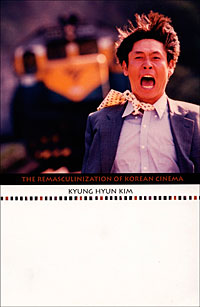
This success was due in no small part to the existence of a corps of movie critics and a roster of movie publications that made commenting on recent movies a legitimate intellectual pursuit in Korea and beyond. Kyung Hyun Kim played an important role in this reevaluation of Korea cinema. The back cover blurb on Virtual Hallyu describes him as “not just the most important Anglophone critic of South Korean cinema but a key figure in film and cultural studies generally.” In his first book on The Remasculinization of Korean Cinema (which I reviewed here), he established the label of “New Korean Cinema” by focusing on movies produced in the 1980s and 1990s. His thesis was that Korea at the time was a post-traumatic society: men had to overcome their masculinity crisis by resorting to masochism and to sadism and by denying women’s agency. In his latest book, he concentrates on movies produced during the next decade, end 1990s to end-2000s, which follow a different master plot. According to Kyung Hyun Kim, Korea has managed to untie itself from the narrative of post-crisis recovery and male failure that dominated Korean movies in the preceding period. Male hysteria no longer provides the dominant theme in more recent productions, and female characters are no longer reduced to the twin roles of the mother and the whore. The themes and characters have become more diverse and cannot be subsumed under a single heading. He nonetheless proposes the two categories of hallyu and of the virtual to define Korean cinema in this new age of commercial success and global expansion.

Riding the Korean wave

More than the commercial expansion of Korean productions abroad, hallyu refers here to a new sense of national consciousness that arose in the wake of the 1997 financial crisis and culminated with the stellar performance of the national soccer team in the 2002 World Cup tournament. It is synonymous with a nation reconciled with itself and basking in its newly acquired global status. Pride and affluence characterized the new Korea that had been able to overcome the masculinity crisis diagnosed in the previous period. This self-consciousness translated in box-office figures: Korea is one of those rare countries where domestic movies consistently outperform Hollywood productions. And yet the author diagnoses a disconnect between the success of Korean films at home and abroad. Films like April Snow, which was specifically designed for the Japanese market, flopped badly in Korea, whereas domestic blockbusters such as The Good, the Bad, the Weird failed to reach a global audience. In addition, Kyung Hyun Kim sees hallyu as a phenomenon limited in time: based on box office figures, he heralds its demise by the end of the first decade of the twenty-first century. After Korean film exports earned a record $75 million in 2005, there was an enormous decline, with only $24.5 million reported in 2006 and $12 million in 2007. For the author, this sudden decline in the popularity of the Korean wave since 2007 is just as inexplicable as its emergence. Of course, a plausible explanation is that there was simply a shortage of lucrative and attractive Korean blockbusters to please Asian tastes during that year and the next. The film industry is one of the most unpredictable in the world, and even critics cannot forecast future hits and flops.

Kyung Hyun Kim borrows the concept of the virtual from Gilles Deleuze and his twin books’ analysis of the movement-image and the time-image. Like Deleuze, he considers movies to be thought-experiments: in this sense, thinking about cinema is inseparable from making it. Through a century-long transformation, we have come to understand ourselves individually and socially through spatial and temporal articulations that were first advanced in movies. Nothing illustrates more the interdependence between philosophy and film-making than the category of the virtual. Virtuality refers here to a kind of being-in-the-world that increasingly eschews reality in favor of escapist pursuits and fictitious worlds. As the author notes, “the high-speed Internet boom that took place in Korea after the late 1990s ironically meant that Korea’s urban youth rarely needed to venture beyond their schools, homes, and offices. If they did choose to go outdoors, it was to the theater.” The virtual complicates the question of what is real and what is unreal. Despite our perception of film as the art form that most closely approximates reality, movies are pure fiction, akin to the simulacra that Baudrillard defines as images without models. Unlike the image, the virtual no longer dwells on the difference between the way things appear and the way they really are. In the virtual world, neither the opposition between true and false nor the one between reality and imagination can be resolved.

Virtual pasts and futures

Cinema itself is built on a technology of virtuality: the projection of twenty-four frames per second is perceived as continuous time and movement by our synapses. With the integration of computer graphics, the virtual has taken a whole new dimension, and the advent of virtual reality promises an era of unlimited possibilities. Everything that can be dreamed, imagined, or conceived, can be put on screen. Special effects and computer-generated graphics allowed Korean movie-makers to expand back in time, as with saguk or historical dramas, or forward to the future as with science-fiction movies. With the help of CG-generated images, directors were able to recreate images from the Chosun Dynasty period or to project their viewers into imaginary worlds. Deleuze’s use of the term “virtual” refers to something that is not only a thing of the past, but of a past that coexists with the present and also of a truth that coexists with the false. Similarly, the movie Lost Memories 2009 (2002) presents a virtual future in which Japanese occupation of Korea has continued into the twenty-first century, mixing memories of a colonial past and imaginaries of an uncertain present. The fascination with the colonial past was also rekindled by the rediscovery of old movies from the 1930s and 1940s that were thought to be lost but had been preserved in the film archives of Soviet Russia and Communist China.

The films covered in Virtual Hallyu more or less correspond to the period when the democratic party led by presidents Kim Dae-jung and Roh Moo-hyun was in power. During that decade, South Korea established itself as a full democracy as well as one of the most economically successful and technologically advanced countries in the world. Kyung Hyun Kim sees a correlation between the liberal policies pursued by these two presidents and the rise of hallyu. The state favored the expression of artistic sensibilities and adopted policies deemed favorable to the creative industries. Lee Chang-dong, an art-movie director, became the minister of culture, tourism, and sports in the Roh Moo-hyun cabinet. Most notably, the Sunshine Policy of peaceful coexistence and cooperation with North Korea, initiated by Kim Dae-jung and continued by his successor, allowed for a more nuanced view of the Communist neighbor country. If Kang Che-gyu’s Shiri (1999) was the last film to rely on a Cold War dichotomy to produce a ruthless North Korean villain and to attempt to reclaim South Korean male agency through the destruction of a North Korean femme fatale, Park Chan-wook’s JSA: Joint Security Area (2000) was the first film to defuse the stereotype of North Koreans as South Korea’s belligerent Other. Other films addressed the taboos of national history: Im Kwon-Taek’s The Taebaek Mountains (1993) depicts the period of guerrilla warfare and civil strife in the Jeolla Province before the start of the Korean war, whereas The President’s Last Bang (2005) and The President’s Barber (2004) concentrate on the controversial figure of President Park Chung-Hee, the first one as tragedy, the second as farce.

The recombination of traditional genres

Movies are shaped by market forces as much as by the political zeitgeist. In the late 1990s, the Korean industry started again to blossom, and showed an impressive success in the domestic market. Korean films enjoyed an average market share of 54 percent over the following decade, with record peaks of 60-65 percent. Last but not least, the Korean film production continued to earn many prestigious awards at top international film festivals, making Korean culture increasing attractive. This happened in the context of limited subsidies by the state and increased free-market access of US film-makers in Korean distribution. If anything, increased competition between US and Korean films induced the Korean cinema industry to create more attractive and lucrative movies than foreign films. Big industrial groups or chaebols, expecting high returns of investment, expanded their power by acquiring individual theaters and creating multiplexes and theater franchises. They invested in the production of genre movies previously considered as the preserve of the American movie industry: Westerns (The Good, the Bad, the Weird), science fiction (The Host), eco-disaster stories (Tidal Wave), urban disaster thrillers (The Tower), and heroic fantasy (Jeon Woo-chi: The Taoist Wizard). Film-makers challenged conventional boundaries and they mixed established genres to create a hybrid repertoire of multi-genre movies: comic-family-melodrama-monster (Bong Joon-ho’s The Host), erotic-horror-crime mystery (Park Chan-wook’s Oldboy), or comic-romantic-women’s tearjerker (Lee Chang-dong’s Secret Sunshine). It is this recombinatory power of Korean cinema that foreign audiences found most attractive.

For Kyung Hyun Kim, the role of the film critic is to unveil the latent meanings beneath the apparent surface of a movie. The message of a movie is made clear only when one confronts it to the other works of an auteur, or when one places it in a series that defines a genre, a historical sequence, or the broader tradition of a national cinema. His analysis is consistent with the discourse of political modernism, founded on the holy trinity of Saussure’s semiotics, Lacanian psychoanalysis, and Althusserian Marxism. Words like postmodernism, postcolonialism, late capitalism, and neoliberalism pepper the text and give it a radical cachet. For the author, none of the films produced in the period were radical enough; they only tinkered with the system, and provided imaginary solutions to real problems. As he concludes, “not only is Korea still scarred and traumatized by its colonial era and the Cold War, but—given the continuing US military presence and occasional threats of war from North Korea—it has yet to claim a true postcolonial and post-Cold War identity.” Curiously, although his previous book was all about masculinity and gender roles, he does’t address the issue of gender in Virtual Hallyu. The resolution of Korea’s masculinity crisis didn’t lead to a more balanced repartition of roles between men and women, and none of the directors listed in the book are female. In this era marked by the end of history and the advent of postmodern identities, Korean cinema has yet to find its new master narrative.

The Master Narrative of the New Korean Cinema

A review of The Remasculinization of Korean Cinema, Kyung Hyun Kim, Duke University Press, 2004.

RemasculinizationThe thesis of this book is quite simple. Korea in the 1980s and the 1990s was a post-traumatic society. The figure of the father had been shattered by its authoritarian leaders, who ended in a grotesque finale (see The President’s Last Bang, 2005, about the assassination of Park Chung-hee) or, in the case of Chun Doo-hwan, lacked hair (The President’s Barber, 2004). The double trauma of colonization by Japan and fratricide murder during the Korean War had deprived the Korean people of its identity. The sins of the fathers were visited upon the sons, and the Memories of Murder (2003) still lingered. The ritual murder of the father could not unite the community of brothers as they stood divided between North and South (Taegukgi: The Brotherhood of War, 2004), between sons of patriots and sons of collaborationists (Thomas Ahn Jung-geun, 2004). The films quoted above, all produced in the 2000s, could resolve the tensions and dilemma of overcoming trauma by representing them on screen. By contrast, films produced in the 1980s and 1990s could only repress the representation of the primal scene, generating frustration and anger. In psychoanalytic terms, this is the difference between “working through”, the positive engagement with trauma that can lead to its ultimate resolution, and “acting out” or compulsively repeating the past.
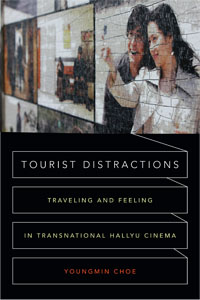
Working through or acting out past trauma

Failure to come to terms with the representation of trauma transformed men into hysteric subjects. Simply put, men were deprived of their manhood. They were constantly alienated and emasculated by the political and economic forces of the day. In order to recover their potency, they resorted to violence: hence the brutality and violent acts ubiquitous in many Korean films. Here the author of The Remasculinization of Korean Cinema sees a sharp distinction between films produced in the 1980s and in the following decade. If the 1980s was a period of male masochism for Korean cinema, by the 1990s men freed themselves from anxiety and trauma by resorting to sadism. The two forms of violence must be clearly distinguished. Both the masochist and the sadist find pleasure in pain—pain of the self, pain of the other. But the sadist aims at subverting the law; the masochist wants to emphasize its extreme severity. The common thread that unites them is their misogynistic tendency towards women: very often, the victim of men’s effort to regain their manhood is the woman. The films from the period were solely centered on male characters. They were depicted as pathetic losers or as dumb brutes, and the movies acted out their masculinity crisis without any regard for the opposite sex. Women only functioned as passive objects oscillating between the twin images of the mother and the whore. What is absent in these movies from these two decades is a positive female character, let alone a feminist plot.

The thesis of remasculinization as a way to recover from trauma is not new. It has been advanced by American cultural critics in the context of the post-Vietnam war. The trauma of defeat, changing gender roles, and economic uncertainties generated a masculinity crisis that led to alienation, retrenchment, and gynophobia. In America, the renegotiation of masculinity took the form of the lone warrior culture, illustrated in blockbuster films of the 1980s such as Rambo, Die Hard, or Dirty Harry. What is specific about South Korea’s post trauma recovery is the political and economic context. It must be remembered that the end of authoritarian dictatorship and the inception of democracy in Korea occurred only in 1987. Before that date, films still had to deal with heavy censorship, and protest against the military government was disallowed. Unlike General Park Chung-hee however, General Chun Doo-hwan, his successor, recognized the importance of leisure and consumer spending as a way to assuage the masses and compensate the dispossession of their voting rights. He authorized the production of a wave of sleazy movies that found their way into theaters, while political expressions were strictly censored. The hope was that consumerism and pornography would make people forget about democracy and postpone their hope for a more representative government.

Korea bumped into modernity at full speed

But economic development wasn’t enough to ease the pain: in fact, it generated more ailments and frustrations. That Korea’s compressed economic development was traumatic is often overlooked. The “miracle of the Han river” left aside many victims and outcasts. Korea bumped into modernity at full speed, and without security belts or social safety nets. Urban alienation and economic marginalization is the theme from many Korean films from the 1980s and 1990s. In Chilsu and Mansu (1988), two billboard painters living on day jobs climb to a high-rise building in downtown Seoul to privately demonstrate their pent-up frustration. The public from the street below mistakes their aimless private rant for a public demonstration, and the police intervenes to arrest them. In Whale Hunting (1984), the disheartened protagonist, rejected by his college girlfriend, wanders the streets where he befriends a beggar and hangs out with a mute prostitute looking for a home. His sexual anxiety is displayed through farcical situations as in the opening scene where he dreams he is standing naked before a laughing public, or when he hugs the bare breasts of a naked statue in a museum gallery. In all the movies covered in the book, the wanderings of the male character invoke the traumatic losses of pastoral communities (urban dramas), homes (road movies), faithful wives and asexual mothers (sex scenes), and memory and sanity (social problem films).

Some artist moviemakers attempted to allude to the political by way of the sexual. One chapter is dedicated to Jang Sun-woo’s movies (The Age of Success, To You From Me, Bad Movie) which have generated far more controversy than works of any other director of the New Korea Cinema. Jang Sun-woo’s characters are self-loathing, pathetic men described as sexually frustrated, impotent, and castrated. Crude sex scenes are ubiquitous and are meant to disturb and to unsettle more than to titillate or sexually arouse. For Jang, these frail masculinities are reflective of the unresolved social crisis in South Korea that began with the elimination of the political dictatorship, when he longtime president was abruptly assassinated in 1979, and the ensuing period of political unrest. The sexual and the political are closely intertwined: in To You, From Me, Jang Sun-woo portrays an underground enterprise that releases pornographic books under the disguise of subversive North Korean communist manifestos—both are banned materials and therefore fetishized. But his anarchist, nihilistic streak is perhaps best exemplified by Bad Movie, described as “one of the most daring and experimental feature films produced in Korea,” shot without set direction, script, or production plan. The movie shows raw, crude images of sex and violence, loosely motivated by a chronicle of young runaway teenagers engaging in street motorcycle races, extortion, rape, and murder. As Kyung Hyun Kim comments, “it is as close to the real as it can get, disorienting and discomforting even the contemporary art-film viewers who are familiar with violence aestheticized in cinemas of Wong Kar-wai, Quentin Tarantino, and Kitano Takeshi.”

Men turn to violence and to sadism to reclaim their masculinity

Other directors were more overtly political. Films about the Korean War (Chang Kil-su’s Silver Stallion, Yi Kwang-mo’s Spring is My Hometown, and Im Kwon-Taek’s The Taebaek Mountains) present a different way of remembering the war, one that doesn’t rest on the diabolization of the North Korean enemy but rather insists on cracks within the South-Korean-American alliance: partisan guerrilla in the Cholla Province, yanggongju prostitutes serving US soldiers, internal conflicts within a community or a family, absent fathers and raped women. Here again attention focuses on men who have lost their virility and authority during the war, and who turn to violence and to sadism—especially against women—to reclaim their masculinity. Other episodes of Korea’s postwar political history are also revisited. A Single Spark concerns the life and death of labor union martyr Chon T’ae-il, while A Petal depicts the 1980 Kwangju uprising. These are sites that resist both remembrance and representation, components of a post-traumatic identity that can only act out what is still too painful to work through. It is also noticeable that these two movies targeted primarily foreign audiences at international film festivals. Their directors, Park Kwang-su and Jang Sun-woo, could take political and financial risks because they had already built international reputations. The years the two films were released, 1995 and 1996, also had democracy firmly entrenched since the transition of the end-1980s and the election of the first civilian president in 30 years in 1992.

The reception of Korean movies was also conditioned by their conditions of production and distribution. Most movies covered in The Remasculinization of Korean Cinema are low-budget films directed by authors who aimed at a limited audience and assembled production teams based on personal acquaintances and on-the-job training. But they are also films that have stimulated local commercial interest in a country that valued cinephile club screening and intellectual consumption of movies that would have been commercially unviable in the West. It should also be noted that the renaissance of Korean cinema in the 1980s and 1990s occurred not because of, but rather in spite of the role of the government. Import quota restrictions diminished during the 1980s, and Korean filmmakers had to aim for the creation of art cinema without the aid of state subsidies. Not only were public funds denied for Korean films, but also were bank loans, forcing filmmakers to seek alternative financial resources and credit. No Korean filmmaker could therefore neglect the box office. For some of them, the international circuit of international film festivals and arthouse movie theaters provided a source of legitimacy and revenue. Despite adverse conditions, Korea is the only nation during recent history that has regained its domestic audience after losing them to Hollywood products. Art movies from the 1980s and 1990s paved the way to the Korean blockbusters of the end-1990s and 2000s that attracted massive domestic audiences and conquered foreign markets. They also made it sure that a market space for independent movies continued to exist in Korea, as evidenced by the career of director Kim Ki-duk whose productions closely complement the movies reviewed in the book.

Korea has yet to produce a movie with a female plot, let alone a feminist one

Kyung Hyun Kim mobilizes the categories of national cinema as a genre and of the director as auteur to develop his film criticism. He focuses on a segment of Korea’s filmic production in the 1980s and 1990s that was sometimes touted as the New Korean Cinema by film critics. This is in accordance with the conventions of cinema studies, which treats national cinemas as discrete entities and delineates periods or currents characterized by a particular style or narrative. The master narrative of the New Korean Cinema is the masculine recovery from trauma, a movement that Kyung Hyun Kim sees as problematic because it is based on the exclusion of women. As he argues, Korean cinema has yet to produce a movie with a female plot, let alone a feminist one. The representation of woman is still caught between the mother and the whore. Another characteristic of the New Korean Cinema is that it had to strictly play within the commercial rules of an open marketplace, which meant competing with Hollywood films distributed freely across the nation, and could not completely abandon the conventions of popular filmmaking. The author sees this commercial exposure both as a factor in the success of the New Korean Cinema and the reason of its demise: once aligned with Hollywood standards, Korean cinema lost its shine and became just a niche cultivating subgenres in a global marketplace.

When the Korean Wave Hits the Screens

A review of Tourist Distractions: Traveling and Feeling in Transnational Hallyu Cinema, Youngmin Choe, Duke University Press, 2016.

tourist-distractionsKorean government officials nowadays distinguish three waves of hallyu. The first one occurred serendipitously with the unintended success of Korean TV dramas in Japan, China, and South-East Asia. The second wave was brought by the marketing strategies of entertainment companies that targeted growing markets and developed export products in the form of K-Pop bands, TV co-productions, computer games, advertising campaigns, and restaurant chains. According to these Korean officials, the third wave of hallyu will cover the whole spectrum of Korean culture, traditional and contemporary alike, and will be engineered by the state, which sees the export of cultural content as a linchpin of its creative economy strategy. Korean cinema sits rather awkwardly in this periodization. Korean movie directors didn’t wait for the first ripples of the Korean wave to gain recognition abroad: they featured early on in the Cannes film festival and other international venues where their talent and originality won critical acclaim. Cinema studies constituted Korean films as a topic for analysis before hallyu became a theme worthy of scholarly research and commentary. The first books that addressed Korean cinema as a genre, such as Kyung Hyun Kim’s seminal essay on The Remasculinization of Korean Cinema, were written in the tradition of Asian cultural studies that sees each countries’ movie productions as a distinct whole, thereby overlooking the transnational dimension that is so prevalent in the reception of Korean hallyu.

Hallyu cinema as a subset of Korean film history

Youngmin Choe, who is the coeditor of a Korean Popular Culture Reader, bridges two strands of research: Korean cinema studies—that takes national boundaries as a given and addresses the aesthetic content of movies—and hallyu studies—which are by nature transnational and focus more on reception. She does so by limiting her study to the films produced between 1998 and 2006—the high mark of the Korean wave—and by addressing one particular theme: tourism, or the movement of people and emotions across national borders. The films examined in this book seem to anticipate the travels of their audience. They display traveling and tourism as a theme in their narrative, and present locales and sceneries in a way that is bound to induce travel plans and touristic yearnings. They are, in this way, self-referential: travel or boundary-crossing features both on-screen in the stories that are narrated and in the off-screen transnational movements that these films generate. This allows the author to construct hallyu as a category worthy of academic research and to propose the notion of hallyu cinema as subset of Korean film history. As she states at the outset, “the largest ambition of my study is to transform hallyu, which has become first and foremost a marketing strategy, into a bona fide critical term.”

It all started with Winter Sonata. The TV drama featuring Bae Yong-joon achieved a huge success in Japan and set the standard for the crossover and tourist potential of the Korean wave. Locales shown in the drama became the destination of fan tours and touristic pilgrimages. Middle-aged Japanese ladies craved after the sight of “Yon-sama” and developed a cult-like followership. This in turn set the stage for the ongoing Korean wave, which reached publics well beyond Japan and sparked an interest for all things Korean. Although she doesn’t address this particular drama—she only considers films—Youngmin Choe discusses several movies that were produced in Winter Sonata’s wake. April Snow, a film released in 2005 and featuring the same actor Bae Yong-joon, was produced with the Japanese public in mind. Filmed in locations on the eastern coast of Korea, the film contains a self-referential invitation to what the author calls affective tourism: affective images are projected onto affective sites so that the experience of the traveller reproduces the emotions felt by the viewer. Inspired to visit these locations because of the movie story, the tourist travels as if he or she were in the film. Unlike visitors to Universal Studio Hollywood theme park in the United States, tourists at the April Snow sites are invited not only to the places where the movie was shot, but as if into the diegetic and affective space of the movie itself. For instance, in the small city of Samchok, tourists interested in April Snow can sleep in the same room as the characters in the film, eat the same food, sip coffee at the same table, and walk the same streets, with signs and posters depicting images from the corresponding scenes in the movie.

Tourism, drama, and the emergence of an Asian identity

Tourism and drama are associated with modernity in Asia. Indeed, television series and touristic travel shape the imagined communities of East Asia. They are the modern equivalent of the newspaper printing press and the political exile, two agents that Benedict Anderson saw as central in the emergence of national communities in nineteenth century Europe. In Asia, the leisure class takes the form of the travel group. Mass tourism is the foremost expression of the newly gained access to leisure and mass consumption. The Asian tourist has often been identified with the group-centered, photo-taking, cliché-seeking participant of organized package tours. But there’s more to it than just group-think: Asian tourism creates a new form of commodified experience, which is less centered on exotism or escapism and more on emotions and affects. In this respect, the Asianization of Asian tourism is accompanied by a displacement or tourists’ interest. Less focus is placed on history and cultural heritage, more attention is devoted to bodily experiences such as eating, shopping, and scenery-viewing. The Asian tourist looks for the experience that will yield photo opportunities and conventional memories to be shared with others. Asianization, before being analyzed in economic or political terms, can be conceived as a shared affective experience shaped by regional tourism and media consumption. These networks of travel contacts and emotional yearnings among Asian populations are what made hallyu’s rise possible in the first place.

Lest we forget, the tourist imagination in East Asia began with pornography. Japanese tourism to Korea from the mid-1960 until the late 1970 was predominantly male and centered around sex tourism, often combined with business meetings. Known also as kisaeng tourism, this kind of sexual encounter harkened back to colonial practices in yojong establishments and epitomized the imperial consumption of the colony itself as an object of desire. Youngmin Choe opens her book by a close examination of Park Chul-soo’s Kazoku Cinema, the first film collaboration between Japan and South Korea following the lifting of the ban on the import of Japanese cultural products in 1998. Kazoku Cinema is a self-reflexing film about the making of a film, with strong sexual undertones. As the author writes it, “pornography becomes an allegorical mode of historical reconciliation that foregrounds everyday banality.” The desire for sexual intimacy and physical touch also shapes the story of Asako in Ruby Shoes, which cuts back and forth between Tokyo and Seoul as the two heroes engage in Internet porn, and of April Snow, which narrates an adulterous liaison. The whole production of the Korean wave can in a way be interpreted as soft porn, as the cravings of middle-aged Japanese ladies for “Yon-sama” or the provocative attire of K-pop idols suggest. In turn, these sexual desires and erotic feelings contribute to the transformation of once rival nations unto cooperative friends open to transborder flows. Sex, in Asia, is political.

The political is never far in Korea, a land divided between two states separated by the 38th parallel. Any visitor to the DMZ has experienced the strange feeling of being at the same time in a movie scene and in a tourist attraction. On the face of it, the reality of the place contradicts both impressions: the tension between the two Koreas is very real, and the DMZ is first and foremost a military zone. But visits to the DMZ are shaped as a tourist experience, not least because of the many films that used the zone as their locale. Park Chan-wook’s Joint Security Area (J.S.A.) begins with an aerial shot of the DMZ, as a group of foreigners on a guided tour of the southern side are surveying the Military Demarcation Line that runs through the middle of the demilitarized zone. It ends with picture shots taken by the tourists in this initial scene, which reveal the whole story that has been unfolding. The commodification and marketization of military zones is not limited to the DMZ. The Korean War film Taegukgi illustrates a process labelled as “post-memory”: the memory of a trauma that was never personally experienced, but whose lingering effect is felt by following generations. This Korean blockbuster, produced shortly after the liberalization of the movie industry imposed by the US as part of the FTA, thematizes the struggle against Hollywood hegemony, the nation’s simmering anti-American sentiments, the rise of an Asianization discourse, the realities of national division, and the hopes for reunification. As the film Silmido, set on an island off the coast of Incheon, it has given rise to a theme park and also was the focus of a temporary exhibition, thereby fueling the rise of film-induced tourism. The author opposes the Korean War Memorial, which illustrates how the Korean War should be remembered—as heroic, masculine, and patriotic—, and the “false memorials” created in the wake of war movies, giving way to alternative modes or remembrance that are more feminine, leisurely, and affective.

How do all the movies analyzed in Tourist Distractions relate to hallyu? As Youngmin Choe makes it clear, most of the films she addresses are not part of the Korean wave as defined by state authorities and media reports: only movies geared towards a Japanese audience like April Snow, or the blockbusters produced after the opening of the market to Hollywood competition, qualify as such. The hallyu discourse does not emerge in Korea until 2001. It has roots in twentieth-century visions of Asian integration and serves to support the corporate strategies and geopolitical ambitions of newly-developed Korea. The author links hallyu to neoliberalism, cultural nationalism, and postcolonialism, and she uses the words “neo-imperialist” and “sub-imperialist” to qualify Korea’s projection of cultural power. But her book does not discuss political integration and economic processes in detail. As she states, “I am more interested in the formation of a shared affective experience that transnational cooperation requires in order to build its networks for the exchange of products and capital.” In a reversal of Marxist thought, culture is not the reflect of underlying economic forces, but forms the infrastructure basis or enabling factor which makes economic and political developments possible. Her category of “hallyu cinema”, strictly delineated in time and in scope, is defined by the aesthetic criteria of self-reflexivity and affective content, not by the movies’ marketing strategies or their impact at the box office. Self-referentiality in hallyu movies refers both to the content of the movies—as the films examined in the book seem to anticipate the travel of their audiences—and to their production and circulation that foster transnational exchanges. Tourist films and film tourism are closely interconnected.

The affective turn in cultural studies

Beyond contributing to cinema studies and hallyu studies, Tourist Distractions points towards what has been described as an “affective turn” in cultural studies. The notion of affect—pre-individual bodily forces, linked to autonomic responses, which augment or diminish a body’s capacity to act or engage with others—has become a central tenet of cultural studies. Affect is a concept that places emphasis on bodily experience and that goes beyond the traditional focus on representations and discourse. The turn towards affects is therefore a turn, or a return, to the body. It is also a turn towards new kinds of imagined communities. Affects and emotions help us connect with some people while distancing us from others and in material form can be used for economic and political purposes, making it a form of capital. Emotions help form the boundaries and relationships between individuals and society; they determine the rhetoric of the nation. The hallyu nation, or global Korea, is built on networks of affective exchanges. Korean movies and dramas are valued for their emotional content, for their ability to move people in many ways, including geographically. Call it, if you will, the Greater East Asia Co-Sentimentality Sphere. The emergence of this new affective space that stems from the diffusion of tourism and of films, lies at the core of this groundbreaking study of hallyu cinema.