
The Brazilian Buttock Lift

A review of Pretty Modern: Beauty, Sex, and Plastic Surgery in Brazil, Alexander Edmonds, Duke University Press, 2010.

Pretty ModernIn Brazil, women claim the right to be beautiful. When nature and the passing of time don’t help, beauty can be achieved at the end of a scalpel. Plastic surgery or plástica is not only a status good or the preserve of socialites and celebrities: according to Ivo Pitanguy, the most famous Brazilian plastic surgeon and a celebrity himself, “The poor have the right to be beautiful too.” And they are banking on that right. Rio and São Paulo have some of the densest concentrations of plastic surgeons in the world, and financing plans have made plástica accessible to the lower middle class and even to favela residents. While in the United States, people may hide that they have had plastic surgery like it’s something shameful, in Brazil they flaunt it. The attitude is that having work done shows you care about yourself—it’s a status symbol as well as a statement of self-esteem. Cosmetic surgery’s popularity in Brazil raises a number of interesting questions. How did plastic surgery, a practice often associated with body hatred and alienation, take root in a country known for its glorious embrace of sensuality and pleasure? Is beauty a right which, like education or health care, should be realized with the help of public institutions and fiscal subsidies? Does beauty reinforce social hierarchies, or is attractiveness a “great equalizer” that neutralizes or attenuates the effects of class and gender? Does plástica operate on the body or on the mind, and is it a legitimate medical act or a frivolous and narcissistic pursuit? Does beauty work alienate women or is it a way to bring them into the public sphere?

Class, race, gender, and plástica

Alexander Edmonds, an American anthropologist, answers these questions by mobilizing the three key dimensions of his discipline: class, race, and gender. Brazil is a class society with one of the most unequal wealth distributions in the world. It is also a society organized along racial lines, even though a long history of miscegenation has blurred color lines and made racial democracy part of the national identity. Brazil continues to have large gender gaps within the workforce and government representation. The country’s supposedly large number of exotic, attractive and sexually available women makes it a masculinist fantasy worldwide, while Brazilian feminists face enduring challenges. All these issues relate in one way or another to the availability of cosmetic surgery, the quest for beauty and attractiveness, and the development of medicine into new terrains of well-being and self-esteem. Pretty Modern mixes several strands of literature. It is a travelogue into contemporary Brazil, a deep dive into its history and culture, a journalistic description of the cosmetic surgery industry, a philosophical treatise on beauty and appearances, a personal memoir about the impasses of erudite culture and the wisdom of ordinary people. It even contains samba lyrics and color pictures of scantily clad models.

The Brazilian constitution recognizes the human right to health. It doesn’t recognize the right to beauty, but cosmetic surgery is provided for free or at subsidized rates in public clinics such as the Santa Casa da Misericórdia in Rio. Surgeons perform charity surgeries for the poor to get practice in large residency programs before opening their private clinics. Some medical doctors come from afar to learn how to operate barrigas (bellies) or bundas (buttocks), techniques that come predominantly from Brazil. Ivo Pitanguy himself, the pioneer of plastic surgery in Brazil, learned the trade from Europe before bringing it back to Rio and taking it to a new level. His democratic ethos has been maintained by his disciples who share his vision of cosmetic surgery as psychotherapeutic intervention that should be accessible to all. Pitanguy famously defined the plastic surgeon as “a psychologist with a scalpel in his hand,” echoing the saying that “the psychoanalyst knows everything but changes nothing. The plastic surgeon knows nothing but changes everything.” Women see their operations as a form of psychological healing; given the choice, they prefer the surgeon’s scalpel than the couch of the psychoanalyst. Plástica has psychological effects for the poor as well as for the rich: surgery improves a woman’s auto-estima, self-esteem, and is considered as a necessity, not a vanity. Appearance is essential to mental well-being, economic competitiveness, and social and sexual competence. If we follow the WHO’s definition of health as “a state of complete physical, mental and social well-being,” then beauty work represents the new frontier in the pursuit of happiness.

The right to beauty

Of course, the growth of cosmetic surgery has not been without controversy. A “right to beauty” seems to value a rather frivolous concern in a country with more pressing problems—from tropical diseases, like dengue, to the diseases of modernity, like diabetes. Brazil has a health system divided into a public and a private sector with different standards of care, and the poor often see their universal right to healthcare obstructed by long queues, squalid conditions, and substandard practice. Cosmetic surgery stretches medical practice into an ambiguous grey zone where the Hippocratic oath doesn’t always fully apply. The growth of plástica has also been accompanied by a rise in malpractice cases, insurance fraud, and media stories of horrific complications. Some Brazilian critics see the new fashion of breast enlargement as a form of cultural imperialism brought by Euro-American influence in a country that has long valued small boobies and big booties (the ever-popular butt implant raises fewer cultural concerns.) Beauty ideals peddled by women’s magazines are blamed for eating disorders and body alienation. Cultural elites from the West see the pursuit of the artificially enhanced body as vain, vulgar, and superficial, betraying a narcissistic concern with the self. But who is one to judge? asks Alexander Edmonds, who confesses he shared some of the misapprehensions of the distanced scholar before he was confronted with a candid remark by a favela dweller: “Only intellectuals like misery. The poor prefer luxury.” Even though it is not common for a scholar to glance through local versions of Playboy or watch telenovelas titled “Without Tits, There is no Paradise,” the anthropologist knows the heuristic value of suspending one’s judgment and immersing oneself into the life-world of cultural others through participant observation.

Race raises another set of issues. Here too, North Americans have been accused of exporting their cultural imperialism, with its bipolar racial categories and immutable color line, in a country that has long prided itself for its racial democracy and color fluidity. In fact, Brazilians are very race-conscious. But rather than grouping people into races defined by ancestry, the local taxonomy describes subtle variations in appearance along a continuum. The national census racially classifies the Brazilian population in five color types: branco (white), pardo (brown), preto (black), amarelo (yellow), and indigenous. But in everyday usage, more than 130 color types have been identified. Brazil’s famous “rainbow of color terms” intersects with class and gender. In Brazil moving up the social scale can be seen as a form of whitening. For example, a light-skinned multiracial person who held an important, well-paying position in society may be considered branco while someone else with the same ethnogenetic make-up who had darker skin or was of a lower class may be considered pardo or even preto. But unlike in many parts of the world where lightness of skin tone is fetishized, in Brazil brown is beautiful. Many women pride themselves of being morena, a term that can mean both brunette and brown-skinned. On the other hand, blackness is stigmatized, and European facial features and hair confer social advantages. No wonder that “correction of the Negroid nose” is a standard surgery operation that raises few eyebrows, while Brazil remains one of the biggest consumer market for blonde hair dye.

The anthropology of mestiçagem

More than any other nation, Brazil’s self-image and national identity has been shaped by anthropologists. The Amazon Indian is known solely from the reports of ethnographers in the field, perpetuating the heritage of Claude Lévi-Strauss. Gilberto Freyre, a student of Franz Boas in the early twentieth century, provocatively reversed the scientific discourse on “miscegenation”  and its racist underpinnings by affirming the virtue of racial mixture and cultural syncretism. Freyre’s celebration of idealized and eroticized mestiçagem played a central role in defining Brazilian national identity. Sexuality—especially across racial lines—became a key symbol for the formation of a new, mixed population with positive traits, such as cordiality and physical beauty. But more recently sociologists have deconstructed the myth of racial democracy by documenting the persistent racial inequalities in wealth and income, access to education and social services, and representations in the media and in the political sphere. Governments introduced controversial quotas to promote racial diversity in higher education and in the public sector. There has been a shift in the representation of race in the past twenty years. More dark faces now appear in telenovelas, ad campaigns, and variety shows, and multinational companies have found a new niche market for black beauty products, fashion, and cosmetics. Afrodescendentes are adopting a black hairstyle and a negra identity as well as narratives of racial pride and militancy. It is too early to say whether affirmative action and identity politics will substitute to mestiçagem and the rainbow of colors, but the emergence of the black movement in Brazil also confirms the significance of the aesthetic dimension of modern subjectivities.

What does cosmetic surgery tell us about gender relations and women’s roles? Contrary to a popular perception, women do not engage in beauty work to comply to men’s expectations and submit themselves to the male gaze. They do it on their own terms, to follow their own desires or to respond to society’s “interpellation.” Motives may vary across social class, age category, and marital status. Some Brazilian women can be openly frank about it: “After having kids, I’ll have to do a recauchutagem [refurbishing, normally of a car]. After shutting down the factory, nê?” Plastic surgery is closely linked to a larger field that manages female reproduction and sexuality. It is not coincidental that Brazil has not only high rates of plastic surgery, but also Cesarean sections (70 percent of deliveries in some private hospitals), tubal ligations (sterilization accounts for half of all contraceptive use), and other surgeries for women. Some women see elective surgeries as part of a modern standard of care available to them throughout the female life cycle. Cosmetic surgery can mark key rites of passage: initiation into adulthood, marriage, motherhood, divorce, and menopause. The transformative events by far the most often mentioned in connection with plástica are pregnancy and breast-feeding. Tensions between motherhood and sexuality are analyzed in detail by Alexander Edmonds, who mentions that both are equally important for self-esteem. Drawing on a range of examples—from maids who aspire to acquire cosmetic surgeries, to favela residents who dream of entering the fashion world, to single mothers who embrace plastic surgery as a means of erotic body scuplting—he describes how sexual and class aspirations subtly mingle in beauty culture.

The right of the Brazilian morena

In his last book Modos de homem, modas de mulher, published shortly before his death in 1987, Gilberto Freyre warned against “yankee influence” and the impact of “north-Europeanization or albinization”: “one must recognize the right of the Brazilian brunette to rebuke northern-European fashions aimed at blonde, white women.” In Pretty Modern, Alexander Edmonds shows that the right of the Brazilian morena is not to be abolished. The tyranny of fashion applies more than elsewhere in a country where bodies are being refashioned to fit aesthetic and sexual mores. But Brazilian plástica does not follow an American or north-European blueprint. If anything, it leads the way that other emerging countries in Latin America or East Asia are also beginning to tread. There, the female body is invested with hopes of social mobility and self-accomplishment that demand long-term investment and management. In poor urban areas, beauty often has a similar importance for girls as soccer (or basketball) does for boys: it promises an almost magical attainment of recognition, wealth or power. For middle-class cariocas, the body is a source of distinction and success. For many consumers, a lean and fit body is essential to economic and sexual competition, social visibility, and mental well-being. Beauty culture interpellates women as autonomous sexual beings and as economic agents in markets where physical attractiveness can be exchanged with various kinds of cultural and economic resources. This anthropologic study shows that cosmetic surgery arises in unison with a central concern for Brazilian women: staying young, sexy, and beautiful.

Dispatches from a Controlled American Source in Quito

A review of The CIA in Ecuador, Marc Becker, Duke University Press, 2021.

CIA in EcuadorA large literature exists on United States intervention in Latin America. Much has been written about the CIA’s role in fomenting coups, influencing election results, and plotting to assassinate popular figures. Well-documented cases of abuse include the overthrow of the popularly elected president of Guatemala in 1954 and the attempts to assassinate Rafael Trujillo in the Dominican Republic and Fidel Castro in Cuba. Books about the CIA make for compelling stories and sensationalist titles: The Ghosts of Langley, The Devil’s Chessboard, Killing Hope, Legacy of Ashes, Deadly Deceits. They are usually written from the perspective of the agency’s headquarters—which moved to Langley, Virginia, only after 1961—, and they concentrate on the CIA leadership or on the wider foreign policy community in Washington—The Power Elite, The Wise Men, The Georgetown Set. Rarely do they reflect the perspective of agents in the field: the station chiefs, the case officers, the special agents charged with gathering intelligence and monitoring operations on the ground. Such narratives require a more fine-grained approach that is less spectacular than the journalistic accounts of grand spying schemes but more true to the everyday work of intelligence officers based in US diplomatic representations abroad. Fortunately, sources are available. There is a trove of declassified intelligence documents made available to the public through the online CREST database under the 25-year program of automatic declassification. In The CIA in Ecuador, Marc Becker exploits this archive to document the history of the Communist Party of Ecuador as seen from the surveillance and reporting activities of the CIA station in Quito during the first decade of the Cold War.
This is not a spy story

This book will be a disappointment for readers with a fascination for the dark arts of the spy trade and who expect crispy revelations about covert operations, clandestine schemes, and dirty espionage tricks. There were apparently no attempt to manipulate election results, no secret plots to eliminate or discredit opposition leaders, and no extraordinary renditions to undisclosed locations. Of the two missions of the CIA, the gathering of foreign intelligence and the conduct of covert action, archival evidence indicates that the Quito station strictly stuck to the first one during the period covered by the book, from 1947 to 1959. Nor are the names of confidential informants, domestic assets, or deep cover moles uncovered and exposed: intelligence reports or diplomatic dispatches usually don’t identify their sources by name and only mention their reliability (a “B2” classification thereby signifies that the source is “usually reliable” and that the content is “probably true.”) The farthest the author goes into revealing state secrets is by exposing the names of the successive station chiefs in Quito—for many decades, US authorities maintained that there was “no such things as a CIA station,” and diplomatic dispatches only referred to their intelligence as coming from a “controlled American source.” Using public records, Marc Becker was able to reconstruct their career path subsequent to their posting in Ecuador. They were not grandmaster spies destined for prestigious careers: throughout the 1950s, Quito was a small station for the CIA, and Ecuador was peripheral to Cold War interests. Their intelligence reports do not make for entertaining reading. They speak of bureaucratic work, administrative drudgery, and solitary boredom in a remote posting that rarely lasted more than three years.

To be true, despite the book’s title, the author is not interested in “the CIA in Ecuador.” He uses CIA documentation and State Department archives to write a detailed history of the left in Ecuador in the postwar period, focusing in particular on the Communist Party that was the object of intense surveillance from the CIA. The 1950s were a unusually quiet period in the turbulent political life of Ecuador. After a long period marked by political instability and infighting—twenty-one chief executives held office between 1931 and 1948, and no one managed to complete a term—, Ecuador entered a twelve-year “democratic parentheses” during which a series of three presidents were elected in what critics generally recognized as free and fair elections and were able to finish their terms in office and hand power to an elected successor from an opposing party. Despite persistent rumors of coups and insurrections, the army stayed in the barracks and public order was broadly maintained, with the occasional workers’ strike, student demonstration, or Indian mobilization, the latter facing the most violent repression. The Communist Party of Ecuador sought to coalesce these social forces into a political movement that would lay the basis for a more just and equal society. Rather than pressing for class struggle and a violent revolution, communist leaders advocated the pursuit of democratic means to achieve socialism in coalition with other progressive forces. But their attempts to form a broad anticonservative alliance with the liberals and the socialists repeatedly failed, and they drew minimal support during elections. Their emphasis on a peaceful and gradual path to power eventually led a radical wing to break from the party in the 1960s. After 1959, Ecuador returned to its status quo ante of political volatility and instability, and leftist politics became more fragmentary and confrontational.

Cold Warriors in Ecuador

Unlike Marc Becker, I am more interested in the CIA’s activities and style of reporting he indirectly describes than in the travails of the communist movement in Ecuador. Unsurprisingly, the authors of diplomatic dispatches and intelligence reports were Cold Warriors, and they shared the biases and proclivities of their colleagues and leaders in Washington. They considered world communism as the enemy, and drew the consequences of this antagonism for the conduct of foreign policy in Ecuador. They were convinced, and tried to convince their interlocutors, that the communists were dangerous subversives bent on death and destruction and that they plotted to disturb the smooth functioning of society. They were determined to implicate communists in coup attempts and they repeatedly pointed to external support for subversive movements. They saw the hand of Moscow, and Moscow’s gold, behind every move and decision of the PCE, and they closely monitored contacts with foreign communist parties and their fellow travelers, including by intercepting incoming mail and opening correspondence. Despite their weak number—estimate of party membership oscillates between 5000 and 1500 during the period—, communists were suspected of manipulating labor unions, student movements, and intellectual organizations, and of infiltrating the socialist party and progressive local governments. According to American officials, Ecuadorians did not take the communist threat seriously enough. United States representatives pressed the Ecuadorian government to implement strong anticommunist measures and applauded when it did so. The accusations of communists organizing riots and fomenting revolution fed an existing anticommunist paranoia rather than reflecting political realities. Evidence shows that the communists had no intentions of resorting to violence to achieve their political goals. But their claim for social justice and labor empowerment was perceived as posing a threat to the economic and political interests of the United States, and was fought accordingly.

In this respect, and contrary to its reputation as a rogue agency or a “state within the state,” there is no evidence that the CIA was running its own foreign policy in Ecuador. Its objectives were fully aligned with those of the State Department, and there was close cooperation between the CIA station chief and the rest of the embassy’s staff. Different branches of the government represented in Quito, including the military attaché, the cultural affairs officer, and the labor attaché, collaborated extensively around a shared anticommunist agenda. Indeed, Cold War objectives were also shared by other countries allied to the United States, and Becker quotes extensively from the correspondence of the British ambassador, who stood broadly on the same anticommunist positions but expressed them with more synthetic clarity and literary talent. To be sure, there were some petty infighting and administrative rivalry between services within the embassy. The CIA typically exaggerated communist threats, whereas State Department officials dedicated more attention to the much larger socialist party and to violent political organizations inspired by Italian fascism and the Spanish Falange. There were redundancies between official correspondence and covert reporting, and diplomats competed with CIA agents for the same sources and breaking news. Officials in Washington had “an insatiable demand for information” and were constantly fed by a flow of cables containing little valuable information and analysis. Occasionally, case officer would annex to their correspondence a tract or a manifesto that, considering the absence or destruction of party archives, provides the historian with an invaluable source of information.

Cognitive biases

In failing to give a realistic assessment of the political forces in Ecuador, CIA officials exhibited several cognitive biases and were prone to misjudgments and errors. They interpreted events through a Cold War lens that colored their understanding of the realities they observed. Their belief in the presence of an international conspiracy that sought to throw chaos across the region bordered on paranoia and made them neglect or distort important pieces of information. They failed to report that the communist party was opposed to involvement in military coups, and they overestimated the communists’ influence in the armed forces. They were blind to the threat posed by proto-fascist movements such as the falangist group ARNE and the populist CFP, suspecting the later of leftist leanings because its leader was a former communist even though he became violently opposed to his former comrades. They overreacted to some news such as the disruption of an anticommunist movie projection with stink bombs thrown by unidentified students or the spontaneous riots that followed the radio broadcasting of Orson Welles’ The War of the Worlds, “a prank turned terribly awry.” They had mood swings that alternated between overconfidence and inflated fears, minimizing the strength of the party while overemphasizing its influence over the course of events. They exhibited an almost pathological urge to uncover external sources of funding for subversive activities, even though they knew that Ecuadorian communists had only minimal contacts with Moscow and that their party’s finances were always in dire straits. They were oversensitive to divisions within the party, providing the historian with valuable information about internal currents and debates, but failed to notice political organizing efforts among Indian communities that provided strong support to the party (in general, indigenous people were a blind spot in embassy’s reporting: “The Indians are apart and their values are unknown,” pondered the ambassador.) Like any bureaucracy, the CIA and the State Department fell victim of mission creep: as one officer observed, “There was a lot of information for information’s sake.”

Considering Marc Becker’s many criticisms of US interference and interpretive biases, one wonders what an alternative course of action might have been. The United States might have adhered to a strict policy of neutrality in the hemisphere and refrained from their vehement denunciation of communism by acknowledging that the Communist Party of Ecuador and its supporters were a legitimate political force in the local context. In other terms, they might have tried to disconnect Latin America from the broader geopolitical forces that were shaping their Cold War strategy, stating in effect that Ecuador was irrelevant to the pursuit of their global policy objectives. Considering not only their words but the limited means they allotted to CIA surveillance in Ecuador in the 1950s, this is more or less what American policymakers did: only with the turbulent sixties would the United States invest more means, including covert actions, to prevent the expansion of communism following the Cuban revolution and the rise in insurgency movements. Alternatively, at the individual level, officers might have tried to rid themselves of the cognitive biases and to paint a more realistic picture of the political situation, emphasizing not only the threat but also the opportunities raised by the development of the progressive left. This might have been the course pursued by more enlightened diplomats, but considering the political climate prevailing in Washington, where McCarthyism was in full swing and the State Department was decimated by red purges, this would have meant political suicide and instant demotion for the officers involved. Better, in their perspective, to bide their time and adhere to a more conformist line of analysis, serving to their political leaders the discourse that they wanted to hear.

A revisionist history

The historian is not without his own bias. Marc Becker is a revisionist historian bent on setting the record straight: during the 1950s, the Ecuadorian Communist party was a progressive force preaching reformism and European-style social welfare programs within the parliamentary system. To demonstrate his case, he sticks to the archival record and provides much more detail for the period from 1949 to 1954, for which sources are abundant and detailed, than for the years after 1955, for which the CREST database contains much fewer documents. Like his sources, he tends to overemphasize the geopolitical importance of Ecuador and Latin America in postwar global history. His concluding chapter on the year 1959 states that “the triumph of revolutionary forces in Cuba is arguably one of the most significant political events of the twentieth century.” He sees all activities of US diplomats in Ecuador with suspicion, and tracks in every detail the heavy hand of American interventionism where in fact diplomatic missions were only doing their job of representation, advocacy, and reporting. He detects a running contradiction between the official policy of nonintervention in the internal affairs of other countries and the reality of Americans trying to shape opinions and influence outcomes. In doing so, he doesn’t clearly distinguish between adherence to the principle of non-interference, the pursuit of influence through public diplomacy, and the defense of the national interest. The fact that diplomatic dispatches conclude that a presidential candidate or a policy measure may be more favorable to American interests abroad is not synonymous with meddling into internal affairs: it is the bread-and-butter of diplomatic activity, even though what constitutes the national interest may be open to democratic debate. In the case of Ecuador during the 1950s, it was in America’s interest to monitor the activities of a communist party that was vehemently opposed to “Yankee imperialist capitalism,” however small and inconsistent its threat to the neoliberal international order. The fact that diplomatic representatives and intelligence officers pursued this mission with dedication and rigor may be put to their credit, and our understanding of the past is made richer for the documentary record they left behind.

US-Bashing, Anti-vax, Animalism

A review of Bioinsecurities: Disease Interventions, Empire, and the Government of Species, Neel Ahuja, Duke University Press, 2016.

BioinsecuritiesThis book can be read as an anti-American tract, or an anti-vaccine manifesto, or as a justification of anti-speciesism, or as an attack on liberal ideas of democracy, equality, and scientific progress. Of course, this is not the intention of the author. Neel Ahuja didn’t write a tract or a manifesto, but an elaborate social science book with deep theoretical repercussions. He is more descriptive than prescriptive, and his political message is not spelled out in detail. He situates himself in a progressive movement that is unconditionally anti-racist, feminist, and anti-war. But he doesn’t take position on vaccines, on animal rights, or on speciesism. His goal is not to provide simple answers, but to complicate things and deepen our vision of mankind and its living environment as some truths long held to be self-evident are losing political traction. However, liberal arguments can be used for very illiberal ends. As I read it, Bioinsecurities gives credence to very nasty arguments which, taken to their extreme, articulate a very anti-liberal and regressive agenda. Of course, some readers, and the author with them, may argue that it is perfectly fine to be anti-American, anti-vaccine, or to stand for a radical vision of animal rights, especially considering the background of brutal imperialism, public health manipulations, and disregard for non-human animals that have marked our common history and still inform our present. We should work against the public amnesia and state-endorsed manipulation of truth that prevent the public to exercise democratic oversight and make informed decisions on matters of life and death that affect us most. But an author also has to give consideration to how a book might be read or perceived. For me, Bioinsecurities dangerously straddles the line between liberalism and illiberalism, humanism and anti-humanism, and progressivism and regression.

Settlers and immigrants

By using the word anti-American, I don’t intend to convey a political trial on academic activities that would represent a threat to the security and identity of the nation: I am certainly in no position to do so, and I feel only repulsion for this kind of political justice. But I would like to gesture toward a tension that often inhabits post-colonial literature when applied to the United States. Was America a nation of settlers or of immigrants? For most historians, this is a matter of chronology: settlers came first, then immigrants moved in. But at what moment should one draw the line between first movers and late arrivers? Were Apaches and Navajo Indians any less settlers than Spanish conquistadors when they arrived from their native lands of Alaska to the vast plains of the American South-West, at about the same time that Christopher Columbus discovered the new continent? Is there a fundamental difference between the four grand-parents of Donald Trump, who were all born outside the United States, and the father of Barak Obama, who was born in and returned to Kenya? Bostonians, who pride themselves to be descendants of John Winthrop, are not different from the Latino-Americans freshly arrived from their barrio to populate the periphery of Los Angeles. Who is the first American of America first? Seeing America as a settler nation reactivates the myth of autochtony that is so corrosive to the social fabric of old and new nations, from Ivory Coast to the Netherlands, from Marine Le Pen’s France to Donald Trump’s America. It calls for radical measures and deadly solutions: recall the Pan Africanist Congress’ rallying cry, “one settler, one bullet,” or Franz Fanon’s contention that “killing a European is killing two birds with one stone, eliminating in one go oppressor and oppressed: leaving one man dead and the other man free.” The United States has long prided itself to be a nation of immigrants, welcoming the “huddled masses yearning to breathe free.” It would be a pity if it modeled itself after the countries of racial apartheid and colonial exploitation.

Neel Ahuja sees America as an empire and its inhabitants as a settler society. For him, imperialism is a racial endeavor that exerts itself upon people, but also natural habitats and non-human species, including microbial ones. White privilege, the benefits that whites claim over non-white people, is inseparable from the privilege of man as opposed to woman and of humans as distinct from other species. Bioinsecurities explores empire as a project in the government of species and the management of biological life. The author explains the persistence of empire long after settler societies have given way to established communities by a phenomenon he calls “dread life”, or the turn from colonial occupation and settlement to the management of bodily vulnerability and diseases. Fear of contagion was an integral part of imperial expansion, and settlers were literally obsessed by disease. They tried to circumvent it, to quarantine it, to vaccinate against it, to weaponize it, or to use if for further expansion. The “smallpox blankets” that decimated the native American Indian population have their modern equivalent in the infamous Tuskegee Syphilis Study, in which six hundred African American men were used to study the progression of syphilis and denied proper medical information, informed consent, or the known effective treatments. For Neel Ahuja, disease interventions are a form of biopolitics, defined as the ongoing expansion of government into life itself. He studies the way settler colonialism intervened in the government of species and the domestication of bodies in five outposts of the American empire: the Hawaiian islands at the time of Hawaii’s annexation, Panama under military occupation of the Canal Zone between the two World Wars, Puerto Rico where a colony of rhesus monkeys was established during the Cold War, Iraq as seen from war planners in the corridors of power in Washington, and Guantanamo which harbored “the world’s first HIV concentration camp” during the Haitian refugee crisis in 1991-94. Race played a key role in the interventions of the US security state, which inherited the settler mentality and extended it to new terrains.

Fear of contagion

The case studies presented in Bioinsecurities all illustrate the fear of disease contagion and of racial intermingling that accompanied America’s expansion beyond its continental borders. Indigenous Hawaiians diagnosed with leprosy were segregated in quarantine camps on the island of Molokai and denied basic legal rights, while outbreaks of Hansen’s disease in the north central states of the United States (at times associated with Scandinavian immigrants) never attracted much public attention. Afro-Caribbean women involved in the sex trade in the Panama Canal Zone under US administration were arbitrarily arrested and tested for syphilis or gonorrhea and sentenced to hospitals for enforced treatment if tested positive, while US soldiers were only invited to “self-regulate” through moralizing and racially charged propaganda. The 1940s and 1950s witnessed a polio scare that led American scientists to import rhesus monkeys from India to Puerto Rico and harvest their bodies for vaccines, and the Iraq war had the US military prepare for a smallpox outbreak under the belief that Iraq had developed biological weapons and was ready to use them. Haitian refugees who tested HIV positive were segregated and imprisoned in Guantanamo during the years 1991-94. These are all shocking episodes, but should we read American history only through the lenses of “species wars”, “dread life”, and the “medicalized state of war” brought about by our modern bioinsecurities? The fact is that these cases rightfully provoke our moral indignation, as they did in the past when Jack London, who was both a socialist and a racist according to the author, visited “lepers’ island” and let the world know about the plight of Hansen disease patients in Hawaii. The history of the United States is by nature contested, and historians are right to point out sore spots and moral contradictions. But I don’t believe it can be reduced to the story of a security state bent on implanting settler exploitation in its imperial conquests.

In the wake of the animal rights movement and the development of animal studies as an academic field, new words have entered our vocabulary. “Speciesism” gives greater moral rights and value to human beings than to non-human animals. By contrast, “anti-speciesism” considers that this discrimination is unfounded and militates for its abolition. For animal rights advocates, speciesism is a prejudice similar to racism or sexism, in that the treatment of individuals is predicated on group membership and morally irrelevant physical differences. Their claim is that species membership has no moral significance. For their opponents, assigning the same moral value to all animal species is not just impractical, but ultimately absurd. Therefore, speciesism is unavoidable. Why, then, all the fuss about nonhuman animals and the moral obligations that we may have toward them? This shift reflects the influence of the radical critique of humanism and the rejection of anthropocentrism, voiced especially by the animal-rights movement and advocates of trans-humanism and post-humanism in popular culture since the 1990s. My point is not to discuss anti-humanism, animalism, or the rights of nonhuman animals. I know there are serious discussions out there, beyond the caricatures that each party draws of the opposing camp. Just because an animal is not a moral agent doesn’t mean that it cannot have rights or that moral agents can’t have duties towards them. Cruelty towards animals is clearly unacceptable; but so is violence condoned in the name of animal rights. And violence is a foregone conclusion for many animal rights advocates, who see the lack of public support for their cause as an added motivation to grab the headlines by spectacular action. Of course, supporting radical means and action is not the appanage of anti-speciesism, and one should not judge a cause by the violent actions of its most extreme elements. But comparing speciesism to racism or sexism—as many critics do in the name of intersectionality—or using words like “slavery” and “genocide” to describe the breeding and slaughtering of livestock, justifies in advance the most radical means. This slippery slope can only lead to hyperbolic conclusions.

Species wars

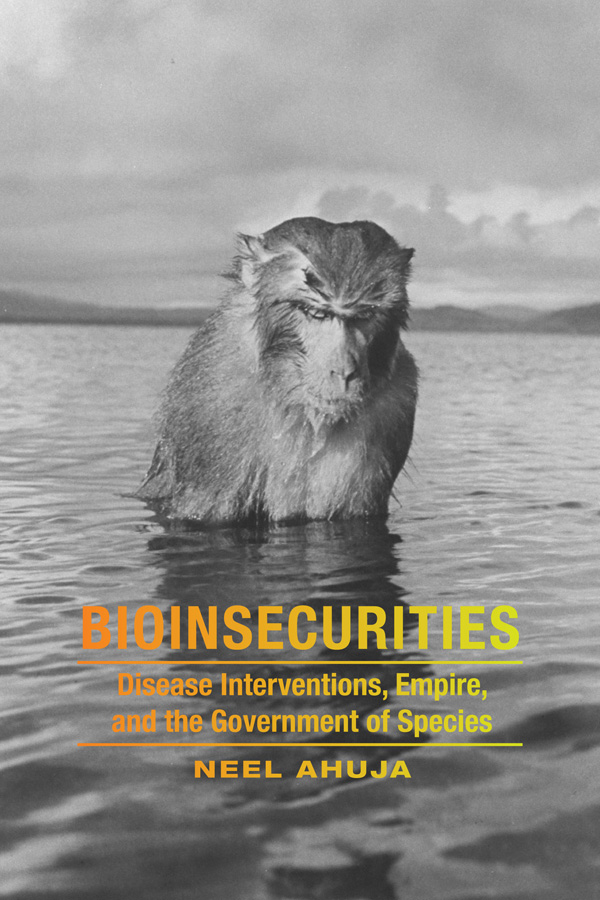
In effect, anti-speciesism or animalism usually concentrates its claims for right sharing to certain mammals, especially apes or non-human primates. On the book cover of Bioinsecurities, a rhesus macaque half soaked into water glances back at the viewer or the camera lens, with a gaze that can be read as angry, dissatisfied, or frustrated. This particular monkey is part of an imperial project: the import of 400 macaques from India to US-occupied territories in Puerto Rico to serve as guinea pigs for clinical research on poliomyelitis. In the name of producing polio vaccine, rhesus monkeys were, to use the author’s metaphor, “stabbed in the back” and inserted with spinal tap to extract polio serum. They were subjected to experimentations that would clearly fall outside what is now considered as proper and ethical laboratory norms. Could the antibiotic revolution have happened without animal experiments, and in particular primate vivisection? Before jumping to hasty conclusions, one should remember the crippling nature of polio disease, its devastating effects on children, and the public anxiety it generated. The argument made by the author that these fears of disease were themselves loaded with racial and class prejudice should in no way diminish the importance of biomedical research and vaccine production. In fact, Neel Ahuja shows that it is in the research labs and breeding stations that the modern categories of “almost human” primates and advanced sentient species originated. These categories “were less concerned with broadly questioning an anthropocentric hierarchy of species, and more involved with justifying vivisection on a mass scale.” They were the result of a complex history of Cold War politics, sovereignty claims, and ecological shifts that exceeded simple logics or science or profit. Rhesus monkeys imported from India to Puerto Rico for scientific use escaped their semi-free-ranging colonies and came to be viewed by many habitants as a pest. India protested the use of “sacred” species for biomedical research or nuclear testing and placed a moratorium on the primate trade. Regional primate research centers were established in many newly independent countries, giving rise to new disciplines such as ethology and primatology. Hollywood movies and urban legends fueled anxieties about interspecies intimacy and mad science experiments.

In place of the polio scare, new legends are emerging today about the proper role and effect of vaccines. The anti-vaccination (“anti-vax”) movement is a global phenomenon that has received a great deal of media attention. Anti-vaxxers usually don’t read or write social science dissertations and history books: they rely on word-of-mouth and social media to spread the message that the government and “Big Pharma” are colluding in a massive cover-up regarding the hidden dangers of vaccines. This has very serious public health consequences, as outbreaks of highly contagious diseases such as measles put vulnerable people, including newborn babies and people who have weakened immune systems, at great risk. My point here is not to discuss the positions of anti-vax propagandists (or “vaccine-hesitant parents,” as they prefer to describe themselves): I think that they are a menace to society, and that compulsory vaccine policies should be enforced. Any argument that reinforces their misinformation and conspiracy theories should be dealt with suspicion and care. This is why Neel Ahuja’s book is a matter of concern: he gives credence to arguments that identify vaccination policies with the police state, imperial endeavors, and neoconservative plots. Bioinsecurities’ introduction opens with two quotes relating to vaccine controversies: a 1905 legal opinion on Jacobson v. Massachusetts, a case of vaccine refusal that led to a well-publicized lawsuit, and an interview with Donald Rumsfeld in which the Defense Secretary assesses the risk of a smallpox epidemic in the lead-up to the Iraq war. Both cases are controversial: the Jacobson precedent was used to justify forced sterilization programs, and Donald Rumsfeld’s argument that Iraqis had developed biological weapons, including the variola virus that causes smallpox, proved to be unfounded. Although the author doesn’t make the link with modern vaccine controversies, the tainted nature of past “disease interventions” justifies skepticism towards modern public health policies.

Reductio ad absurdum

A good way to assess an argument is to push it to its logical extreme. To the argument about settler colonialism, one could ask: “You wouldn’t want to give it all back, would you?” In the case of America’s westward expansion, wouldn’t the Mexicans then have to give it all back to the Spanish, and then the Spanish to the indigenous populations they decimated, and then those peoples to the flora and fauna they displaced after crossing the land bridge from Siberia thousands of years earlier? The argument is absurd. Similarly, proselytizing vegans and animalists always have to face the argument that animals eat each other, and that even some pets require the death of other animals for their food. Anti-speciesism reasoning can be countered by the fact that insects, even bacterias and plants, can also be considered as sentient beings. Will we act accordingly, and with what consequences? These are some of the questions that may be raised after reading Bioinsecurities. The book’s main purpose is to describe the entanglement of human, animal, bacterial and viral bodies in the US project of imperial expansion over the course of the long twentieth century. But in doing so, it develops an anti-humanism that radically refutes the exceptional value of human life and democratic freedom and that gives credence to fringe arguments such as anti-vaccines. Some people may think that I read too much in this book and that I misinterpret its author’s real intentions. Others may argue that my own perception is biased, and that I am complicit in some conspiracy to justify US imperialism, denigrate animal rights advocates, and bolster the security state. Let me be clear: I don’t deny the interest of writing interspecies histories of American imperialism, paying tribute to those who resisted and paid the price of this imperial expansion, or documenting the cases of medical abuse in public health policies. But I worry that rather than inspiring its audience to protest against social injustice, this book may consolidate illiberal tendencies and a regressive turn in democratic governance.

The Government of Risk and the Politics of Security in Contemporary Cities

A review of Endangered City: The Politics of Security and Risk in Bogotá, Austin Zeiderman, Duke University Press, 2016.

Austin ZeidermanWhen Austin Zeiderman arrived in Bogotá in 2006 to conduct his fieldwork in anthropology, he didn’t know he was in for many surprises. The mismatch between the preconceived notions he had about Colombia’s capital and what he experienced on the ground couldn’t have been greater. People had warned him about the place: Bogotá was perceived as a city fraught with crime and corruption, where danger loomed at every corner. Not so long ago, Bogotá’s homicide rate was one of the highest in the world and assassinations, kidnappings, and bombings were almost routine. Histories of violence often produce enduring cultures of fear that are difficult to dispel: people develop strategies to avoid danger and cope with risk. For individuals as for collectives, the trauma of violence persists long after the traumatic event has faded into the past. People told the young anthropologist that he definitely shouldn’t venture in the slums that occupy the hillsides of Bogotá’s southern periphery. It is therefore with some apprehension that Austin Zeiderman joined la Caja, a municipal agency located in this danger zone, where he was to spend twenty months doing participatory observation. His first surprise was that danger and criminality were much talked about and feared, but he never experienced it firsthand: “not once during my time in these parts of Bogotá was I harassed, mugged, or assaulted.” Indeed, he felt almost more secure in the hillside barrios of Bogotá than in his native place of Philadelphia, where he had learnt to navigate the city with precaution so as to avoid potential threats. There had been a dramatic decline in violent crime in Bogotá, and the city was now safer than it had been for half a century. Instead of criminals, petty thieves, and corrupt officials, he met with law-abiding citizens, dedicated social workers, and peaceful communities.

Entering the danger zone

The second surprise was a conceptual one. Austin Zeiderman had retained from his graduate training in anthropology and urban ecology a heavy theoretical baggage and a commitment to apply critical thinking to his urban terrain. More specifically, his views were shaped by two strands of critical theory: urban political economy, heavily influenced by Marx and his twentieth-century epigones such as Henri Lefebvre and David Harvey, and the more recent approaches of neoliberal governmentality that build on the intuitions of the late Michel Foucault. For the first line of social critique, urban planning is a way to manage the contradictions of late capitalism. Displacement and expulsion of informal tenants are a case of “accumulation by dispossession,” a way by which the capitalist state exerts its monopoly of violence in order to “build the new urban world on the wreckage of the old.” The second paradigm associates “neoliberalism” with the deployment of market-based logics, the valorization of private enterprise, the reform of governmental institutions, the retrenchment of the public sector, and the formation of responsible, self-governing subjects. The author’s plan was therefore to investigate “neoliberal urbanism” at work, and to document the acts of resistance, adaptation, and self-making of the subaltern subjects who are hailed by the constitutive power of the neoliberal state. The fact that the World Bank, the arch-villain of antiglobalization protesters, had extended loans to the city of Bogotá to support the policy of relocation and urban renewal, only reinforced him in his critical orientation.

He was therefore surprised to discover that many individual households were happy to be relocated: indeed, some of them petitioned the municipality to be included in the relocation program. Eviction was not feared and resisted: it was seen as an opportunity to escape from risky environments and relocate to healthier, more secure suburbs. In fact, a hallmark of the resettlement program was its insistence that the decision to relocate was voluntary. Protecting the population from natural and human hazards was not a projection by the rich and the powerful to discipline the lives of the poor: it was based on the recognition of the sacred value of life, and corresponded to a major aspiration of the poorest, who were the first victims of insecurity and risk. The sprawling, self-built settlements of the urban periphery, commonly perceived as posing a threat to political stability and social order, turned out to have the greatest concentration of families living under threat. In other words, risky populations turned out to be the most exposed to risk. Another surprise was to to discover the political orientation of the social workers in charge of the eviction program. They were progressive individuals, who defined themselves half-jokingly as “half-communist” or “communist-and-a-half”, and who were deeply convinced of the positive effects that the relocation program would have on the lives of the poor. Rather than securing the city as a whole by evicting residents and demolishing buildings, their primary objective was to protect the lives of vulnerable populations living in the urban periphery. These social workers were in line with the political priorities of the municipality, which was run by left-of-center mayors who had attracted much appraisal for their reforms. Neoliberalism, it seems, could be used for progressive purposes.

The legacy of Antanas Mockus and Enrique Peñalosa

The young researcher was in a quandary. Should he extoll the virtues of the municipal government that had led over Bogotá’s urban renaissance, or even praise the leadership of the right-wing president Álvaro Uribe who launched successful campaigns against the FARC, Colombia’s main guerrilla movement? The success story of Bogotá had already been told: according to the international media and local pundits, it was the story of two charismatic mayors who, with unorthodox methods, in less than ten years turned one of the world’s most dangerous, violent, and corrupt capitals into a peaceful model city populated by caring citizens. In this book, Austin Zeiderman remains uncommitted towards the legacy of Antanas Mockus and Enrique Peñalosa, as well as their two left-leaning successors at Bogotá’s city hall. He notes that their choice of options remained limited and constrained by the national security landscape: any attempt at fundamentally challenging the status quo would have been countered by paramilitary forces known for persecuting activists or leaders with even vaguely radical agendas. His research site, an urban resettlement agency, was used by progressive mayors in order to distribute patronage and build a political constituency among the urban poor. As for Uribe’s two terms at the presidency, Austin Zeiderman notes that they were characterized by continued internal displacement, violence in rural regions, human rights violations, increased poverty and inequality, and collusion with drug traffickers. The author’s commitment to a progressive political agenda and to critical theory remained untainted: he was not ready for a conversion to neoliberalism. Besides, his academic focus was on social theory and anthropological fieldwork, not political science or media analysis.

This is when, combining these different thoughts and experiences, the young author had his epiphany: he would study “the government of risk and the politics of security in contemporary cities.” The topic was empirically relevant and theoretically adequate. The relocation program in which he worked was dedicated to protecting the lives of the poor and vulnerable populations from environmental hazards, such as floods, landslides, and earthquakes. Risk management had been accepted across the political spectrum as a legitimate way to govern the city and to allocate resources to people in need of support. “Life at risk” had become a category of entitlement through which the urban poor could claim assistance, protection, and care. By interviewing social workers and their benefactors, and by analyzing the techniques used to map risk and relocate people, he could make sense of these new forms of governmentality without falling into hagiography or empty critique. Theoretically, the concept of risk opened a rich space of associated notions and constructions that have been developed to characterize our modern condition. Of particular relevance to him was the notion of biopolitics developed by Michel Foucault and his epigones and defined as the way the state extends its power over bodies and populations by exerting its right to make live and to let die. Foucault’s schema also associates risk with the rise of the modern society by locating it at the center of the new art of government that emerges in the late eighteenth century. Austin Zeiderman proposes the concept of endangerment, and of the endangered city, to describe a world in which the unlimited improvement of urban life, even its sustained reproduction, are no longer taken for granted. The endangered city is not a city where life faces immediate danger: it is a place where citizens live under the shadow of insecurity and risk, even if these threats never actually materialize.

The agony of Omayra Sánchez

If there was a specific trauma that led government authorities and populations to turn their attention to the management of risk, it was to be found in the catastrophic events that took place in 1985. On November 13, a volcanic eruption set off massive mudslides and buried the town of Armero, killing over twenty-five thousand people. A young girl, Omayra Sánchez, became the symbol of this suffering for millions of TV viewers, as rescuers failed to free her from the mud and debris that had trapped her body. Just one week before, members of the M-19 guerrilla group had attacked the Palace of Justice in central Bogotá and had taken the judges and the public as hostages. The siege of the building by the army and the ensuing battle left more than one hundred people dead, including the Chief Justice and dozens of hostages. For the press, these two tragedies were “apocalypse foretold”: they could easily have been prevented, if only the state had lived up to its responsibility to protect the life of its citizens. Critics claimed that in both cases the government had advance warning of the impending tragedy and had failed to prevent known threat from materializing. As a consequence, governmental problems and their proposed solutions began to be increasingly understood within a security framework oriented toward the protection of life from a range of future threats. Prediction, prevention, and preparedness were the solution proposed, and the imperative to protect life by managing risks became the ultimate end of government. Of course, the power of the state to “make live and to let die” (to use Michel Foucault’s expression) is applied unevenly: in the Colombian context of 1985, “the figure of Omayra creates a boundary that differentiates those whose lives matter from those whose lives do not—the outlaws, insurgents, subversives, or terrorists who are dealt with as enemies of the state.” Austin Zeiderman also notes that the responsibility to protect lives imposed itself at the expense of other rationalities and state goals, such as development, democracy, and welfare.

Nothing characterizes more this shift in urban governmentality than the evolving missions of the Caja de la Vivienda Popular, the branch of Bogotá’s municipal government in which Austin Zeiderman did his fieldwork. The Caja was originally created in the 1940s to provide public housing for the poor and for public employees. Its role shifted from hygiene and poverty alleviation to slum eradication and urban renewal in the 1980s and then, starting 1996, to the resettlement of populations living in zones of high risk. Populations deemed vulnerable to environmental hazards, such as landslides and floods, were entitled to state subsidies and could benefit from a relocation program that allowed them to resettle in more secure environments. Rather than organizing housing policy in terms of social class, political citizenship, or economic necessity, vulnerability became the primary criterion that determined one’s eligibility to receive state benefits. In other words, “life at risk” came to displace “worker,” “citizen,” and “poor” as a new political category of political recognition and entitlement. The Colombian constitution’s article proclaiming the “right to life” (derecho a la vida) came to supersede the other article recognizing that all Colombians have the right to “decent housing” (derecho a una vivienda digna). Various disciplines, ranging from geology, hydrology and meteorology to sociology and new public management, were mobilized to establish risk maps and contingency plans delimitating zones of high risk (zonas de alto riesgo) whose inhabitants could claim eligibility to the relocation program. Similar approaches of urban mapping and risk calculation were applied to prevent violent crime and terrorism. In addition, sensibilización programs were conducted to educate the poor to behave in relation to future threats and to instill a collective ethos of risk management.

“Lagos is not catching up with us. Rather, we may be catching up with Lagos.”

In the last decade, Bogotá has become recognized internationally as a “model city” for its achievements in good urban governance across realms as diverse as education, security, transportation, civic order, and public space.  In the context of climate change and increased environmental hazards, disaster risk management has been especially singled out and given as an example for other cities to emulate. For Austin Zeiderman, the endangered city of Bogotá provides another kind of model: one that operates through rationalities of security and techniques of risk mitigation. As he notes, “whereas modernism heralded futures of progress, efficiency, and stability, there is a global trend toward envisioning urban futures as futures of potential crisis, catastrophe, and collapse.” Cities of the global South should no longer be expected to follow the development pathways of the “modern cities” of Europe and North America: indeed, cities from the North are now confronted with problems of insecurity, environmental threats, and terrorist violence that seem to come straight from the South. As one modern critic notes, “Lagos is not catching up with us. Rather, we may be catching up with Lagos.” This dystopian vision of the global urban future stimulates technologies of control and exclusion. A new urban security paradigm demands that all cities deploy protective and precautionary strategies against a range of threats in order to ensure their own reproduction. For Austin Zeiderman, models of urbanity that focus exclusively on risk and security draw resources away from concerns such as poverty, equality, education, housing, healthcare, or social justice. The politics of rights—rights to decent housing, rights to the city, human rights—becomes subordinated to a politics of life. Austin Zeiderman shows that this politics of life—in its devotion to the vulnerable, the dispossessed, and the victim—creates new forms of vulnerabilities, dispossession, and exclusion. By determining how certain forms of life are to survive, endure, or flourish, while others are abandoned, extinguished, or left to go extinct, biopolitics is inseparable from a politics of death, a thanatopolitics.