
From War Orphans to First World Citizens

A review of Adopted Territory: Transnational Korean Adoptees and the Politics of Belonging, Elena J. Kim, Duke University Press, 2010.

Adopted TerritoryA while ago Fleur Pellerin, then a junior Cabinet member of the French government led by president François Hollande, made her first visit to Korea. To the French, she was known as an elite public servant-turned-politician and put in charge of the digital economy and entrepreneurship portfolio, and also as the only minister with an Asian face. In Korea she became known as “one of us” or a “blood relative”, and during her business trip to Seoul she was welcomed as if she was the homecoming queen. She had a chat with then president Park Geun-hye, and featured in many television shows and media articles. Her first name, Fleur (“flower”), led to a crazed “Fleur-mania”, and her Korean name, Kim Jong-suk, was also made public.

Korea’s largest export

Like about 12 000 French citizen and 160 000 persons worldwide, Fleur Pellerin is a Korean adoptee. She left Korea when she was six months old, never met her biological parents again, and knows next to nothing about her birth country. For Koreans, she is the poor immigrant who made it abroad, and on top of that in a country known for its high culture and glamour – the conclusion of Korean TV dramas usually has the heartbroken heroin go to France to “refashion herself”. But she also reminds Koreans of darker times, and of a phenomenon of transnational adoption that many feel awkward about. Not so long ago, the nation’s pride in hosting the 1988 Summer Olympics was bruised by reports in the American press asserting that children constituted Korea’s “largest export”. Reaching out to adopted Koreans abroad, incorporating them in the community of overseas Koreans, and heralding their success was therefore a way for the Korean public to turn a sore spot into a matter of pride and celebration.

As Elena Kim reminds her readers in her ethnography of adopted Korean communities, Korean adoptees came to the West in distinct waves. First came the war orphans and mixed-blood children of US soldiers and Korean women. Then, in the 1960s and 1970s, American and West European families adopted the offsprings of single mothers or poor households who were convinced to relinquish their newborn baby in exchange of a hefty sum. Today, nearly all the children adopted overseas are infants born to unwed mothers in their late teens and early twenties. Meanwhile, the Koreans adopted in the past decades have become adults in their country of adoption, and today form a global community composed of subsets of regional and online groups with distinct histories and concerns. Internet and globalization have brought them together, and many are claiming voice and agency as a particular public with shared experience and common bonds.

The problem of adoption

The propinquity of money and children in transnational adoption and the attendant suspicion of human trafficking have made Korea’s overseas adoption program a target of criticism throughout its history. It has been argued that orphanages (which were largely funded by Western relief organizations), and, later, state-subsidized adoption agencies, functioned as a surrogate welfare system and a conduit for foreign exchange. It has been further advanced that Korea’s international adoption system not only retarded the development of domestic adoption and child welfare policies, but also provided a quick-fix solution that has been complicit in the social disenfranchisement of Korean women. Today South Korea has the lowest birth rate in the world, with fast increasing numbers of abortion and divorce. The “problem” of adoption (ibyang munje) has become a matter of public debate in which adult Korean adoptees and Korean birth mothers of an earlier period increasingly have a say.

What is unique about Korea’s adoption program? First, conventional wisdom in South Korea and in the Western countries to which adoptees are sent blames the persistence of Confucian family values and preoccupations with patrilineal bloodlines for the reluctance among Koreans to adopt “their children”. This is changing fast, with placement agencies now under the obligation to encourage domestic adoption first and famous media figures making a public gesture of adopting their own children. Second, the Korean state has so far failed to promote extended models of family arrangements, provide adequate financial support for single mothers, or tackle the problem of inadequate sex education. Adult adoptees such as Fleur Pellerin and lesser-known figures could help challenge dominant representations and policy outcomes, especially when they come from Europe, where the social security system is well developed and recomposed families are almost becoming the norm. Third, the long shadow of stigma associated with unwed motherhood in Korea is slowly eroding as Korean society enters a phase of globalized modernity.

A social experiment

But the most distinctive feature of Korea’s adoption program is that it came first, and therefore became the template for subsequent programs. Korean adoptees represented a “social experiment”, the outcomes of which were subject to intense scrutiny and debate since the practice began in the mid-1950s. Korean adoptions, determined to be largely successful by social workers and academic experts, expanded dramatically in the 1970s and paved the way for subsequent waves of adoptions of children from the developing world into white Western homes. By the 1970s, largely due to the success of the Korean model, transnational adoption became an institutionalized social welfare practice into many nations and a naturalized “choice” for individuals in the United States or in Europe. As Elena Kim notes, the adoption model is built upon the archetypal figure of the orphan who is construed as the ultimate figure of global humanitarianism, permitting Americans in particular to “save” children who are themselves often victims of American foreign policy decisions.

Not all adoptees were raised in wealthy, happy families with caring surrogate parents. Some experienced hardships and rejection by siblings and relatives; a significant number faced racism and bigotry at school or in their community; and most of them had to cope with the awkward feeling of being “yellow outside, white inside”. Adoption is based on separation, and the traumatic scene of abandonment sometimes lingers. According to adoption specialists, loss and grief are inescapable aspects of the adoption experience for all members involved in an adoption. Adoptees and their relatives construct “what if” scenarios and “phantom lives” of what they would have become if they had stayed in Korea. Some adopted Koreans dream of a more authentic self in their birth country, while foster parents or agency workers sometimes construct cautionary tales about girls being forced into prostitution or reduced to a dehumanized treatment. For the most politically oriented adoptees, crafting a germane public discourse for discussing the politics of adoption is a difficult process. Typically, the adoptee can only feel gratitude and indebtedness for having been given “life” and “opportunity” through inclusion in the bourgeois nuclear family, and more complex feelings of ambivalence, mourning, or resentment are suppressed, condemned as ungrateful, or pathologized.

The quest for roots

Faced with the taboos and emotionally charged issues that adoption raises, some adoptees simply choose to ignore their roots and go on with their lives. Others, increasingly, go on a quest for origins to discover the country of their birth and, for some of them, to try to meet with their biological parents. Since 2012, adopted Koreans can choose for double citizenship, or they can apply for a visa that allows them to live and work in Korea. But language and, sometimes, prejudices, remain a problem and put a barrier between them and the rest of the population. A social event known as The Gathering allows them to get together and share experience. Meeting other adoptees can feel like rediscovering one’s lost tribe: “None of us had real peer groups growing up,” notes one adoptee. “When we found each other, it was an electric thing.” Self-exploration through shared storytelling is central to adoptee social practices and can be seen as a performative negotiation of self and world. The misadjustment or lack of fit with dominant national, ethnic, and cultural models forms the basis for creating a space where, as more than one adoptee has stated, “there’s less explaining to do”.

Adopted Territories is a work of cultural anthropology that comes loaded with theoretical concepts and abstract discussions. For Elena Kim, drawing on social theorists such as Judith Butler and Aihwa Ong, adoption blurs and unsettles the categories of race, nation, and family. Not unlike the forms of gay and lesbian kinship identified by queer theory, adoptees’ experiences with nonnormative family forms lay the ground for alternative forms of personhood and kinship, contributing to the production of a shared global imaginary that has taken on transnational dimensions. “Adoptee kinship” is defined as “a form of solidarity based upon radical contingency rather than biologically rooted certitudes”. From this perspective, kinship is not a preexisting truth that is discovered or found, but rather a set of relationships actively created out of social practice and cultural representation. It is a model of kinship that is not exclusive but additive, transnational, and expansive. “Public intimacy”, another oxymoron, designates the potential sites of identification and association that extend beyond the biological family, thereby producing new kinds of identities and intimate relations.

Social theory

The notion of “counterpublic”, a term coined by Nancy Fraser in her critique of Habermas’ model of the public sphere, “highlights the fact that the adoptee social imaginary exists in diacritical relation to dominant publics – whether in the United States, Europe, South Korea, or an increasingly transnational public sphere.” The adoptee counterpublic is organized around a discursive process of identity construction in which adoptees endeavor to define themselves as a group that is distinct from others yet exists in relation to the wider public. By coining the notion of “contingent essentialism”, the author points to the fact that “adoptee identity is at once essentialized as something natural and also construed as something cultural and socially constructed.” Contingent essentialism is distinct from the biologism or genetic essentialism that characterizes much of the public discourse about adoptees and their “real” origins, identities, or families. Elena Kim defines “adopted territories” as “networks of adoptees and their activities, situated in a range of virtual and actual locations, that comprise the transnational Korean adoptee counterpublic.”

Borrowed from Judith Butler, the notion of “constitutive outside” points to the legal fiction of the orphan that leaves behind an excess of relationship, which “enchains” the child givers and recipients and “haunts” adoptee subjectivities. “Adoption not only makes children into orphans, but, over time, also produces missing persons,” writes Elena Kim, who illustrates her writing with artworks from internationally adopted artists. The book cover, a community artwork conceived by artist and activist Leanne Leith, features numbered tags bearing travel certificates delivered by the Republic of Korea, each tag representing one South Korean gone missing through international adoption. Much as the abstract conceptualizations, the live testimonies of adoptees and art pictures displayed in the book illustrate the potent message of longing and belonging that addresses a constitutive dimension of our shared humanity. Korean adoptees or not, “we all negotiate contingencies of personhood out of insufficient and mutable categories of the biological and the social.”
The Government of Risk and the Politics of Security in Contemporary Cities

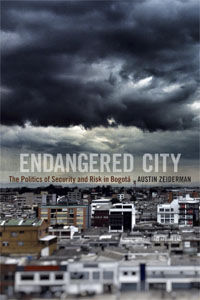
A review of Endangered City: The Politics of Security and Risk in Bogotá, Austin Zeiderman, Duke University Press, 2016.

Austin ZeidermanWhen Austin Zeiderman arrived in Bogotá in 2006 to conduct his fieldwork in anthropology, he didn’t know he was in for many surprises. The mismatch between the preconceived notions he had about Colombia’s capital and what he experienced on the ground couldn’t have been greater. People had warned him about the place: Bogotá was perceived as a city fraught with crime and corruption, where danger loomed at every corner. Not so long ago, Bogotá’s homicide rate was one of the highest in the world and assassinations, kidnappings, and bombings were almost routine. Histories of violence often produce enduring cultures of fear that are difficult to dispel: people develop strategies to avoid danger and cope with risk. For individuals as for collectives, the trauma of violence persists long after the traumatic event has faded into the past. People told the young anthropologist that he definitely shouldn’t venture in the slums that occupy the hillsides of Bogotá’s southern periphery. It is therefore with some apprehension that Austin Zeiderman joined la Caja, a municipal agency located in this danger zone, where he was to spend twenty months doing participatory observation. His first surprise was that danger and criminality were much talked about and feared, but he never experienced it firsthand: “not once during my time in these parts of Bogotá was I harassed, mugged, or assaulted.” Indeed, he felt almost more secure in the hillside barrios of Bogotá than in his native place of Philadelphia, where he had learnt to navigate the city with precaution so as to avoid potential threats. There had been a dramatic decline in violent crime in Bogotá, and the city was now safer than it had been for half a century. Instead of criminals, petty thieves, and corrupt officials, he met with law-abiding citizens, dedicated social workers, and peaceful communities.
Entering the danger zone

The second surprise was a conceptual one. Austin Zeiderman had retained from his graduate training in anthropology and urban ecology a heavy theoretical baggage and a commitment to apply critical thinking to his urban terrain. More specifically, his views were shaped by two strands of critical theory: urban political economy, heavily influenced by Marx and his twentieth-century epigones such as Henri Lefebvre and David Harvey, and the more recent approaches of neoliberal governmentality that build on the intuitions of the late Michel Foucault. For the first line of social critique, urban planning is a way to manage the contradictions of late capitalism. Displacement and expulsion of informal tenants are a case of “accumulation by dispossession,” a way by which the capitalist state exerts its monopoly of violence in order to “build the new urban world on the wreckage of the old.” The second paradigm associates “neoliberalism” with the deployment of market-based logics, the valorization of private enterprise, the reform of governmental institutions, the retrenchment of the public sector, and the formation of responsible, self-governing subjects. The author’s plan was therefore to investigate “neoliberal urbanism” at work, and to document the acts of resistance, adaptation, and self-making of the subaltern subjects who are hailed by the constitutive power of the neoliberal state. The fact that the World Bank, the arch-villain of antiglobalization protesters, had extended loans to the city of Bogotá to support the policy of relocation and urban renewal, only reinforced him in his critical orientation.

He was therefore surprised to discover that many individual households were happy to be relocated: indeed, some of them petitioned the municipality to be included in the relocation program. Eviction was not feared and resisted: it was seen as an opportunity to escape from risky environments and relocate to healthier, more secure suburbs. In fact, a hallmark of the resettlement program was its insistence that the decision to relocate was voluntary. Protecting the population from natural and human hazards was not a projection by the rich and the powerful to discipline the lives of the poor: it was based on the recognition of the sacred value of life, and corresponded to a major aspiration of the poorest, who were the first victims of insecurity and risk. The sprawling, self-built settlements of the urban periphery, commonly perceived as posing a threat to political stability and social order, turned out to have the greatest concentration of families living under threat. In other words, risky populations turned out to be the most exposed to risk. Another surprise was to to discover the political orientation of the social workers in charge of the eviction program. They were progressive individuals, who defined themselves half-jokingly as “half-communist” or “communist-and-a-half”, and who were deeply convinced of the positive effects that the relocation program would have on the lives of the poor. Rather than securing the city as a whole by evicting residents and demolishing buildings, their primary objective was to protect the lives of vulnerable populations living in the urban periphery. These social workers were in line with the political priorities of the municipality, which was run by left-of-center mayors who had attracted much appraisal for their reforms. Neoliberalism, it seems, could be used for progressive purposes.

The legacy of Antanas Mockus and Enrique Peñalosa

The young researcher was in a quandary. Should he extoll the virtues of the municipal government that had led over Bogotá’s urban renaissance, or even praise the leadership of the right-wing president Álvaro Uribe who launched successful campaigns against the FARC, Colombia’s main guerrilla movement? The success story of Bogotá had already been told: according to the international media and local pundits, it was the story of two charismatic mayors who, with unorthodox methods, in less than ten years turned one of the world’s most dangerous, violent, and corrupt capitals into a peaceful model city populated by caring citizens. In this book, Austin Zeiderman remains uncommitted towards the legacy of Antanas Mockus and Enrique Peñalosa, as well as their two left-leaning successors at Bogotá’s city hall. He notes that their choice of options remained limited and constrained by the national security landscape: any attempt at fundamentally challenging the status quo would have been countered by paramilitary forces known for persecuting activists or leaders with even vaguely radical agendas. His research site, an urban resettlement agency, was used by progressive mayors in order to distribute patronage and build a political constituency among the urban poor. As for Uribe’s two terms at the presidency, Austin Zeiderman notes that they were characterized by continued internal displacement, violence in rural regions, human rights violations, increased poverty and inequality, and collusion with drug traffickers. The author’s commitment to a progressive political agenda and to critical theory remained untainted: he was not ready for a conversion to neoliberalism. Besides, his academic focus was on social theory and anthropological fieldwork, not political science or media analysis.

This is when, combining these different thoughts and experiences, the young author had his epiphany: he would study “the government of risk and the politics of security in contemporary cities.” The topic was empirically relevant and theoretically adequate. The relocation program in which he worked was dedicated to protecting the lives of the poor and vulnerable populations from environmental hazards, such as floods, landslides, and earthquakes. Risk management had been accepted across the political spectrum as a legitimate way to govern the city and to allocate resources to people in need of support. “Life at risk” had become a category of entitlement through which the urban poor could claim assistance, protection, and care. By interviewing social workers and their benefactors, and by analyzing the techniques used to map risk and relocate people, he could make sense of these new forms of governmentality without falling into hagiography or empty critique. Theoretically, the concept of risk opened a rich space of associated notions and constructions that have been developed to characterize our modern condition. Of particular relevance to him was the notion of biopolitics developed by Michel Foucault and his epigones and defined as the way the state extends its power over bodies and populations by exerting its right to make live and to let die. Foucault’s schema also associates risk with the rise of the modern society by locating it at the center of the new art of government that emerges in the late eighteenth century. Austin Zeiderman proposes the concept of endangerment, and of the endangered city, to describe a world in which the unlimited improvement of urban life, even its sustained reproduction, are no longer taken for granted. The endangered city is not a city where life faces immediate danger: it is a place where citizens live under the shadow of insecurity and risk, even if these threats never actually materialize.

The agony of Omayra Sánchez

If there was a specific trauma that led government authorities and populations to turn their attention to the management of risk, it was to be found in the catastrophic events that took place in 1985. On November 13, a volcanic eruption set off massive mudslides and buried the town of Armero, killing over twenty-five thousand people. A young girl, Omayra Sánchez, became the symbol of this suffering for millions of TV viewers, as rescuers failed to free her from the mud and debris that had trapped her body. Just one week before, members of the M-19 guerrilla group had attacked the Palace of Justice in central Bogotá and had taken the judges and the public as hostages. The siege of the building by the army and the ensuing battle left more than one hundred people dead, including the Chief Justice and dozens of hostages. For the press, these two tragedies were “apocalypse foretold”: they could easily have been prevented, if only the state had lived up to its responsibility to protect the life of its citizens. Critics claimed that in both cases the government had advance warning of the impending tragedy and had failed to prevent known threat from materializing. As a consequence, governmental problems and their proposed solutions began to be increasingly understood within a security framework oriented toward the protection of life from a range of future threats. Prediction, prevention, and preparedness were the solution proposed, and the imperative to protect life by managing risks became the ultimate end of government. Of course, the power of the state to “make live and to let die” (to use Michel Foucault’s expression) is applied unevenly: in the Colombian context of 1985, “the figure of Omayra creates a boundary that differentiates those whose lives matter from those whose lives do not—the outlaws, insurgents, subversives, or terrorists who are dealt with as enemies of the state.” Austin Zeiderman also notes that the responsibility to protect lives imposed itself at the expense of other rationalities and state goals, such as development, democracy, and welfare.

Nothing characterizes more this shift in urban governmentality than the evolving missions of the Caja de la Vivienda Popular, the branch of Bogotá’s municipal government in which Austin Zeiderman did his fieldwork. The Caja was originally created in the 1940s to provide public housing for the poor and for public employees. Its role shifted from hygiene and poverty alleviation to slum eradication and urban renewal in the 1980s and then, starting 1996, to the resettlement of populations living in zones of high risk. Populations deemed vulnerable to environmental hazards, such as landslides and floods, were entitled to state subsidies and could benefit from a relocation program that allowed them to resettle in more secure environments. Rather than organizing housing policy in terms of social class, political citizenship, or economic necessity, vulnerability became the primary criterion that determined one’s eligibility to receive state benefits. In other words, “life at risk” came to displace “worker,” “citizen,” and “poor” as a new political category of political recognition and entitlement. The Colombian constitution’s article proclaiming the “right to life” (derecho a la vida) came to supersede the other article recognizing that all Colombians have the right to “decent housing” (derecho a una vivienda digna). Various disciplines, ranging from geology, hydrology and meteorology to sociology and new public management, were mobilized to establish risk maps and contingency plans delimitating zones of high risk (zonas de alto riesgo) whose inhabitants could claim eligibility to the relocation program. Similar approaches of urban mapping and risk calculation were applied to prevent violent crime and terrorism. In addition, sensibilización programs were conducted to educate the poor to behave in relation to future threats and to instill a collective ethos of risk management.

“Lagos is not catching up with us. Rather, we may be catching up with Lagos.”

In the last decade, Bogotá has become recognized internationally as a “model city” for its achievements in good urban governance across realms as diverse as education, security, transportation, civic order, and public space.  In the context of climate change and increased environmental hazards, disaster risk management has been especially singled out and given as an example for other cities to emulate. For Austin Zeiderman, the endangered city of Bogotá provides another kind of model: one that operates through rationalities of security and techniques of risk mitigation. As he notes, “whereas modernism heralded futures of progress, efficiency, and stability, there is a global trend toward envisioning urban futures as futures of potential crisis, catastrophe, and collapse.” Cities of the global South should no longer be expected to follow the development pathways of the “modern cities” of Europe and North America: indeed, cities from the North are now confronted with problems of insecurity, environmental threats, and terrorist violence that seem to come straight from the South. As one modern critic notes, “Lagos is not catching up with us. Rather, we may be catching up with Lagos.” This dystopian vision of the global urban future stimulates technologies of control and exclusion. A new urban security paradigm demands that all cities deploy protective and precautionary strategies against a range of threats in order to ensure their own reproduction. For Austin Zeiderman, models of urbanity that focus exclusively on risk and security draw resources away from concerns such as poverty, equality, education, housing, healthcare, or social justice. The politics of rights—rights to decent housing, rights to the city, human rights—becomes subordinated to a politics of life. Austin Zeiderman shows that this politics of life—in its devotion to the vulnerable, the dispossessed, and the victim—creates new forms of vulnerabilities, dispossession, and exclusion. By determining how certain forms of life are to survive, endure, or flourish, while others are abandoned, extinguished, or left to go extinct, biopolitics is inseparable from a politics of death, a thanatopolitics.

A Materialist Reading of New Materialisms

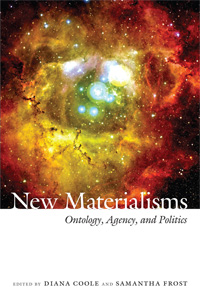
A review of New Materialisms: Ontology, Agency, and Politics, edited by Diana Coole and Samantha Frost, Duke University Press, 2010.

New MaterialismsIn everyday language, a materialist is defined as a person who considers material possessions and physical comfort as more important than spiritual values. According to Madonna’s famous song, “we are living in a material world.” Says the Material Girl: “Some boys kiss me, some boys hug me / I think they’re okay / If they don’t give me proper credit, I just walk away /…/ ‘Cause the boy with the cold hard cash is always Mister Right.” Madonna may not have had in mind the new materialisms referred to in the book edited by Diana Coole and Samantha Frost. Here materialism refers to the philosophical doctrine that nothing exists except matter and its movements and modifications, as opposed to spiritualism that posits a dualism between subject and matter. But the material girl’s lyrics may provide a good entry point into this volume. After all, Madonna’s kissing and hugging addresses a strong message to the feminists who have been accused of routinely ignoring the matter of corporeal life. In exposing her body, Madonna draws our attention to what really matters (sex), while referring to non-bodily retributions (money) that also matter a great deal. So my materialist questions to the book will be: Do we still live in a material world according to these new versions of materialism? Do the authors give proper credit, and to whom? What does the reader get from his or her cold hard cash? And are the contributors always Mr (or Mrs) Right?
In bed with Madonna, reading philosophy

For the editors, a return to materialism, albeit in newer forms, is a turn away from approaches dominated by post-structuralist theories of language and discourse. The humanities and social sciences went through a long period sometimes referred to as the “cultural turn”, which privileged language, discourse, culture, and values. New disciplines developed, such as cultural studies, gender studies, new literary criticism, and various forms of linguistic analysis, taking as their core task the analysis of texts and the deconstruction of meanings. The cultural turn was also a political phenomenon: it gave rise to identity politics and culture wars, which took university campuses as their battleground and became estranged from broader social trends and political movements. For the editors of this volume, approaches associated with the so-called cultural turn are no longer adequate to understanding contemporary society. In particular, the radicalism associated with the cultural studies curriculum is now perceived as more or less exhausted. As they state in the introductory chapter, “it is political naïveté to believe that significant social change can be engendered solely by reconstructing subjectivities, discourse, ethics, and identities.” To find new forms of social critique, one needs to turn to advances in the life sciences, while revisiting certain tenets of political philosophy that still hold potential.

To counter the cultural turn’s law of diminishing returns, Diana Coole and Samantha Frost propose a “material turn” that builds on bodies, affects, ecologies, living organisms, and life itself. The focus here is less on matter per se than on processes of materialization: “for materiality is always something more than ‘mere’ matter: an excess, force, vitality, relationally, or difference that renders matters active, self-creative, productive, unpredictable.” Their new materialism exposes the fragility of things, the vibrancy of matter, the agency of nonhuman actors, the affective claims of nonhuman animals, the social life of artifacts, the materiality of experience, and the generative power of life. The editors believe “it is now timely to reopen the issue of matter and once again to give material factors their due in shaping society and circumscribing human prospects.” Their founding gesture aims at establishing identity through differentiation from past approaches and by constituting a genealogy of ancestors who can sustain their materialist credentials on firm philosophical ground. Most importantly, they claim that the return to materialism can lead to more active forms of engagement with our contemporary predicament, attuned to ongoing changes in global economic structures and emerging scientific knowledge. Their approach takes the tone of a manifesto: “to succeed, a reprisal of materialism must be truly radical.”

A turn back to French postwar philosophy

Revisiting materialism takes the form of a random walk through Western philosophy. Three kinds of philosophers are brought to bear: classical philosophers, with a chapter on Hobbes and several references to Spinoza and to Leibniz; the “philosophy of suspicion” formed by the holy trinity of Nietzsche, Marx and Freud, to which one could add Bergson and the vitalist school; and postwar French philosophers—the first cohort represented by Simone de Beauvoir, Jean-Paul Sartre, Henri Lefebvre, and Maurice Merleau-Ponty, and the post-Mai 1968 generation by Gilles Deleuze, Jacques Derrida, Michel Foucault, Jacques Ranciere, and Louis Althusser, who themselves revisited the previous traditions. Indeed, the book seems to hark back to the French intellectual scene of the seventies, when philosophers had to steer a course between the two major intellectual currents of structuralism and phenomenology while all the while being sensitive to the legacy of Nietzsche, Marx and Freud. The authors of New Materialisms replay a gesture already performed by Judith Butler, who wrote her PhD thesis on the reception of Hegel in twentieth century France and the appropriation of German philosophy by Kojève, Hyppolite, Sartre, Lacan, Deleuze, and Foucault. Why this French primal scene is seen as so productive is left to the imagination of the reader. One suspects it has more to do with intellectual fads and academic conformism than by the urge to develop concepts and advance ideas attuned to our times and modern understanding of the world.

Marxism in postwar France was the “unsurpassable horizon of our time,” and it is only natural that the authors of New Materialisms turn to Marx as the godfather of materialism. For Marxists, the material conditions of a society’s way of producing and reproducing the means of human existence fundamentally determine its organization and development. Marx claimed to have turned Hegel on his head by substituting historical materialism to the dialectical idealism of the phenomenology of spirit. In Hegel, the abstract/ideal is realized in the concrete, whereas to Marx the concrete/material is realized, even when obscured, in the abstract domain of conscious thought. Vintage Marx is represented in this volume by Jason Edwards’ essay on “The Materialism of Historical Materialism”. Against economicist readings of Marx that focus solely on the sphere of production, he argues that Marx’s social philosophy took into account “the totality of the material practices that are required to reproduce the relations of production over time.” Here Marx is read through the lenses of Henri Lefebvre, who recognized the diversity of the forms of practices that are necessary for sustaining economic and political life. Nonproductive practices, such as theoretical work but also the everyday life of consumption and leisure, play a fundamental role in the reproduction of capitalism. For Edwards, Lefebvre’s work on the critique of everyday life and the production of social space should be extended beyond the strictures of the nation-state: the modern reproduction of capitalism has to take into account global processes under conditions of neoliberalism.

Orientation matters

The reference to Marx is also present in Simone de Beauvoir’s work, which develops a phenomenology of lived experience through which, as she famously put it, “one is not born but becomes a woman.” Unlike structuralism, in which subjectivity and the inner self arise as the result of outside forces, going as it were “from the outside in”, phenomenology tends to proceed “from the inside out”, starting from our experience of the world and going back to the subject as to a condition of possibility distinct from that experience. The question of orientation—outside in, inside out—is also addressed in Sara Ahmed’s chapter, taking “the table” as her primary object for thinking about how orientations matter. Philosophers usually sit at a table when they write, and often take this piece of furniture as the starting point from which the world unfolds. But Husserl’s or Heidegger’s writing table is part of a domestic space that excludes as much as it summons. Women writers have a different orientation towards tables, which may provide the support for writing, but also for cooking, eating, attending children, and doing domestic work. As Virginia Woolf claims in A Room of One’s Own, for women to claim a space to write is a political act. The table is not simply what she faces but is the site upon which she makes her feminist point. The politics of the table also involves racial and class-based divisions of labor, as middle-class women could access the writing table by relying on the domestic labor of black and working-class women.

In his 1978 introduction to the English translation of his mentor Georges Canguilhem’s On the Normal and the Pathological, Michel Foucault proposed a famous line of distinction between two strands of philosophy in postwar France. As he wrote, “it is the line that separates a philosophy of experience, of sense and of subject and a philosophy of knowledge, of rationality and of concept. One the one hand, one network is that of Sartre and Merleau-Ponty; and then another is that of Cavailles, Bachelard and Canguilhem.” Similarly, we see two brands of materialism developed in this volume: one one side, a philosophy of life; on th other, a philosophy of the concept. In Bergson, modern readers find what might be called a philosophy of vital interiority, a thesis on the identity of being and becoming; a philosophy of life and change. This orientation would persist throughout the twentieth century, up to and including Deleuze, who once remarked that “everything I write is vitalist, at least I hope it is.” On the other side, we find a philosophy of the mathematically-based concept: the possibility of a philosophical formalism of thought and of the symbolic, which likewise continues throughout the century, most specifically in Lévi-Strauss, Althusser, Lacan, and Badiou. The choice here is between conceiving of thought as fundamentally arising from within the depths of animated matter (vitalism), or of conceiving of thought as a cut that interrupts or breaks with vital flux in favor of the strict assemblage of concepts (formalism). This debate between life and concept echoes throughout this book, with some contributions predicated upon the inertia of matter and others on the generativity of flesh.

Finding love and pleasure in the material world

Reading New Materialisms can be a frustrating experience. The chapters are designed as interventions in a debate that has stakes extending way beyond the covers of this volume. The opposition between “old” and “new” feminism, the epistemological challenge of the life sciences, the posthumanist conception of matter as lively or exhibiting agency: these broader themes are only alluded to in oblique fashion. It is to be noted that many contributors have authored books in which they develop their ideas in a fuller form that certainly needs to be addressed. I may come back on this blog to the works of Sara Ahmed, Jane Bennett, William Connolly, Rey Chow, and Elizabeth Grosz (all of which are published by Duke University Press), who certainly deserve better treatment than what one can infer from the dozen pages in which they had to constrain their entry. In particular, the empirical aspect of their research is reduced to a minimum: there is no reference to fieldwork or to systematically collected observations of social realities. The authors limit themselves to the work of theory. Although they comment the texts of (mostly French) philosophers, none of them belong to a philosophy department, and they all come from American or British academic institutions. They all work in political science departments, women and gender studies or cultural studies faculties, or in programs focusing on the humanities. They dabble in theory and practice philosophy without proper qualifications, while pointing to practical implications that are forever deferred.

Despite their intentions, new materialisms remain deeply rooted in cultural theory. They inherit from cultural critics the same political militancy and strident advocacy that sustain their claim to be “truly radical”. In a poorly argumented shortcut, Jane Bennett draws a parallelism between vitalist philosophy exemplified by Hans Driesch (a contemporary of Henri Bergson) and the “culture of life” that opposes abortion, artificial life support, and embryonic stem cell research, but that supports preemptive war, state-sponsored torture, and civilizational imperialism. William Connolly moves from Merleau-Ponty’s Philosophy of Perception to a denunciation of ubiquitous surveillance, cynical realism, and self-depoliticization that characterizes the national security state after 9/11. Pheng Cheah confesses that “it is difficult to elaborate on the political implications of Deleuze’s understanding of materiality as the power of inorganic life,” but nonetheless endorses a creative appropriation of Hardt and Negri’s concept of the multitude as a new agent of social change. Jason Edwards offers a return to Marx’s historical materialism as a solution “to the major problems of climate change, global inequality, and warfare that face the world today.” There are, however, different political conclusions to infer from a return to materialism. We can use the increased salience of materialist philosophies to develop a healthy connection to things material. Like it or not, we are living in a material world, and liking ‘stuff’ is OK, healthy even—we can learn to love and find pleasure in the material world. This is the lesson that seems to me implied in the lyrics and rhythm of Madonna’s songs.

Appetite for Food and Sex is Nature

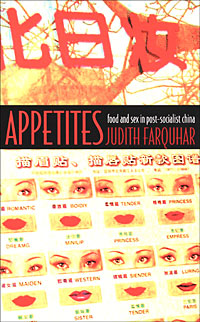
A review of Appetites: Food and Sex in Post-Socialist China, Judith Farquhar, Duke University Press, 2002.

Farquhar“Appetite for food and sex is nature.” Or so says the sage Mencius, as translated by D.C. Lau. But Judith Farquhar begs to differ. For her, food and sex, and our appetites for them, are historical matters through and through. As proof, she points the fact that, in contemporary China, attitudes towards carnal and dietary consumption have changed dramatically in the course of less than two decades. China has transited from a socialist to a market economy and, in the process, a new body has emerged, with new attitudes towards food and sex, with new appetites and desires. The new Chinese body differs substantially from its previous socialist version. The socialist body was frugal, martial, and asexual. The new body is gluttonous, relaxed, and sensual. If what constitutes our most intimate dimension can change in such a short span of time, then it is proof that food and sex do not stand on the side of nature, but belong squarely to the camp of history and human society. Appetite for food and sex is not nature: it comes from our second nature as social and historical beings.
Mouth is from the right, work is from the left

Things in China under Mao used to be so simple. Land owners and capitalist exploiters were the gluttonous class. They fed themselves at the expense of the masses, and ate their feast on the back of poor people. The Chinese character for ‘right’ has the element ‘mouth’ in it, and ‘left’ comes up with the element ‘work’. For Maoists, the explanation was simple: the capitalists, on the right of the political spectrum, were big mouths that endlessly needed to be filled, while the workers from the Left were defined by their work. Revolution was to reverse this unequal repartition by feeding the masses and forcing the idle landowners to work. Mao himself frequently used food metaphors in his political speeches and writings. He famously remarked that “revolution is not a dinner party,” and also argued that “if you want to know the taste of a pear, you must bite into it.” He described “political synthesis” as akin to eating crabs: “eating one’s enemy” involves absorbing the flesh and expelling the waste. Class struggle existed “at the tips of people’s chopsticks”: every pang of hunger, every bite of food, every sip of drink had a class character and an almost martial significance. Providing the “iron rice bowl” was one of the main slogans for communism: the Chinese Communist Party was supposed to provide job opportunities for everyone. Propaganda rejoiced in the newly gained abundance: “in the old society we didn’t see meat from year to year, but now we can have dumplings whenever we want.”

The public discourse on food shifted dramatically in the reform period, but it did not disappear. Economic reforms and the introduction of private forms of property started with agriculture: the objective was, again, to feed the masses and provide a steady diet to everyone. Much of the rationale for “market socialism” had to do with food: private control of the land and entrepreneurship in distribution would “liberate the enthusiasm of the people for labor” and thus be more efficient in meeting the nation’s dietary needs. But people had higher hopes than merely to fill their stomach: their dreams and desires made them pursue not only satiation but pleasure, not only three meals a day but long days of strength, health, and enjoyment. For many, the market economy offered glowing visions of feast and abundance. The return of the banquet, with its elaborate order of dishes and drinks, came to symbolize this newly acquired material prosperity and became a central technique for building and maintaining social relationships under the new entrepreneurial order. For some, the excesses banquets indulged reflected the new social evils in post-Maoist China: the excessive indulgences of the nouveaux riches, the arrogance and corruption of public officials, the disregard for the environment that makes guests cherish treats taken from endangered species, etc. Gluttony led to obesity, to the point that China now has the largest overweight population in the world. Meanwhile, the one-child policy was promoted with the bizarre slogan: “Have fewer children, raise more pigs.”

Have fewer children, raise more pigs

Political change had direct consequence at the dinner table. People could now pick and choose among a variety of domestic and foreign dishes, and they understood their newly-gained pleasures in contrast to their memories of a simpler, poorer, or hungrier past. Historians rediscovered the Great Famine that took place at the end of the 1950s, and tales of hunger and oppression resurfaced in people’s conversation and literary works. Writers evoked the image of bands of children roaming the countryside, eating the bark from trees and the roots of the grass. As novelist Gu Hua writes, “After eating fernroot sweetcakes, your stools would be as hard as iron, jam up in the rectum and make it bleed; you’d have to poke with a little stick or dig it out with a finger—life really sucked!” But writer Mo Yan also remembers his childhood days during the great famine with nostalgia: “When you’re hungry, every pleasure has to do with food. In those days, children were demons for foraging, we were like the legendary Shen Nong [founder of herbal medicine], we tasted a hundred grasses ad a hundred bugs, making our own contribution to broadening the diet of the human race.” There is a subtle irony in finding the same grasses and insects, then eaten out of necessity, now finding their way back into new Chinese cuisine as elaborate dishes and rare treats. The Chinese banquet, with all its abundance and extravaganza, has at its backstory the memory of privation, hardship, and empty larders.

Chinese culture charges food with collective values far beyond the nutritional. The techniques of Chinese medicine provide a language of embodiment that brings together body and mind, matter and energy, solids and fluids. Chinese medicine takes account of states of repletion (shi) and depletion (xu) and operates an “economic” rectification in the form of therapies for the imbalances afflicting individual sufferers. Chinese medicine is particularly good at identifying areas of deficiency, which it figures as functional debility or depletion. Diagnosis traces depletions to their systematic roots, and therapy intervenes to nourish these roots and gradually eliminate the state of depletion. States of repletion, in contrast, tend to be static and localized, leading to the stagnation and corruption of crucial substances that should, by their nature, circulate. Excess is more often found outside bodies than in them. Excessive heat, wind, or humidity, especially at unseasonable times, can easily act as a pathogen for people who are already suffering some kind of debility. Too much rich food and drink, overwork, and sexual overindulgence should be avoided in order to lead a healthy life. The Chinese medical language of depletion and repletion applies just as well to economic and social states of excess and deficiency. The coexistence of uneven productivity and widespread shortages with pockets of wealth and privilege is understood by policymakers as a problem of deficiency and excess affecting the national body. The resolution of these tensions is not necessarily equalitarian, nor is it inherently progressive. But economic policies are in harmony with the categories of Chinese medicine, which provides powerful tropes and allegories.

When everything becomes sexual, erotism disappears

China after Mao has undergone a sexual revolution. The story is familiar by now: gender-neutral Maoist clothing and boyish haircuts for girls gave way to cosmopolitan fashion and cosmetics; sex became a topic for online discussions and medical counseling; prostitution and sleaze reappeared in the red-light districts of big cities; and homosexuality was dropped from the list of crimes and mental illnesses. As with the development of banquets and gourmet restaurants, the indulgence of sexual appetites is a highly visible, even flamboyant, aspect of a growing consumer culture. For Judith Farquhar, the shift toward the personal and the private is not conducive to a form of depoliticization: food and sex remain political in China, and the political field is being reconfigured to include the domestic and the sexual as new domains of political action. Except, perhaps, for the youngest consumers, relatively new forms of self-indulgence have a political and transgressive edge: enjoyment of capitalist luxuries is a personal revenge taken on the Maoist past and its regimen of asceticism and chastity. But as with revenge, it has a bitter taste: when sex is found everywhere, it tends to lose its alluring sweetness and emotive appeal. The focus on sexual intercourse leading to orgasm as the only legitimate sexual act leaves out many other forms of intense erotic experiences, such as touching hands, sharing gifts, writing love letters, and engaging in verbal badinage and flirtation. Hence the success of romantic love stories and family dramas that are so prevalent in popular novel and television series.

Changes in intimacies and consumption patterns often resulted from changes in material conditions. Maoist China imposed severe constraints on the intimacy of couples. A single living-eating-sleeping room often accommodated a whole family, including children and an elderly parent; cooking and washing facilities were shared by groups of apartments; and walls and doors were paper thin. Many married couples lived apart for years while struggling for permission for one or the other to shift to their spouse’s work unit. Romance during university years was discouraged, as student couples could be sent thousands of miles apart after graduation. These political constraints on privacy and intimacy did not disappear in post-Maoist China. The hukou system of registration is still in place, and so is the one-child policy that gives the state and party official direct control over the intimate lives of couples. Many married couples still live apart in remote work units, and those who are living together are often crammed into tiny apartments. Busy work schedules and long commutes leave little time for private exchanges and intimacy. Sex education is still lacking, and sex surveys reveal large “fuzzy spots” of ignorance and inhibition. Reviewing the ideological postulates of these surveys, Judith Farquhar reads the Chinese sex education literature as “a form of cultural imperialism.” Rather than rehashed versions of Masters and Johnson, she prefers to immerse herself in recent publications on ancient Chinese sex lore, with their “odd familiarity and quirky charm (that) are apparent even for a reader like me.” Finding “strong evidence that Chinese medicine and sex lore have a common origin,” she documents the reemergence of “life-nurturing techniques” (yang sheng) that also include the traditions of the martial arts, meditation disciplines associated with religious movements, and self-help books.

Anthropology’s new frontier

This book review is part of a series taking stock of recent books on China written by cultural anthropologists. Modern anthropology is especially well attuned to describing China’s modernity. China has emerged as the discipline’s new frontier or its favorite terrain, a place once occupied by Japan in the postwar period. Studying Japan allowed classical anthropologists to describe how one could be modern without being Western. Beyond the usual tropes of East vs. West, tradition vs. modernity, the group vs. the individual, social order vs. economic change, anthropologists writing about Japan were able to explore moral categories such as guilt and shame, face and honor, true feelings and public displays (honne and tatemae), or the need for dependence and care known as amae. They were also able to make the transition from the exotic to the familiar. As social scientists turned into business consultants, Japanese ethnographies provided the background for studies about industrial organization, corporate strategies, and management techniques. China as observed by modern anthropologists raises different issues, and provides different answers. Modern anthropologists come to the field equipped with a different toolkit that their forefathers used to carry with. Exit the focus on rites, kinship, hierarchies, and social structure. Social scientists are now more interested in the individual, the intimate, and the private, while being cognizant of the political nature of these categories in the Chinese context. They put their own experience on the line: Judith Farquhar alludes to the many banquets she attended, refers to her intimate conversations with close friends, and cannot refrain her feeling of nostalgia for the simple pleasures and moral virtues that were to be found in everyday life under socialism. Her solution is not to advocate a return to the past, but to experiment with new collective visions and values compatible with global neoliberal capitalism. If anthropology can help identify and shape these visions, its social role and public contribution as an academic discipline will be very well justified.

Writing Culture Redux

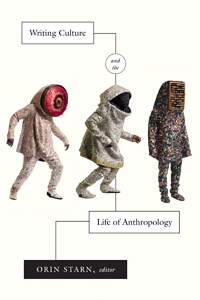
A review of Writing Culture and the Life of Anthropology, edited by Orin Starn, Duke University Press, 2015.

Writing Culture“Life” has emerged as a key concept in anthropology. It is the central notion that defines the discipline in our present day and age. So was “culture” in the eighties, when the volume Writing Culture was published. Many scholars and graduate students took to this book and projected unto it their hopes and frustrations with a discipline many considered as tainted by its colonial past and epistemological present. This was before the “culture wars” that cultural studies helped ignite, and after counter-culture had denounced America’s pretension to hegemony. Titling a book “Writing Culture and the Life of Anthropology,” almost thirty years after Writing Culture had practically declared anthropology dead, is to proclaim that there is life after death. Or maybe resurrection: in the course of three decades, anthropology has reinvented itself in order to make itself relevant for a world that has shattered its historical certitudes.
The resurrection of cultural anthropology

The return of the undead takes the form of a collection of essays, some reminiscent, others programmatic, others yet inward-looking and reflexive, written by some prominent figures in the discipline. Some of the contributors were “present at the creation”: the two editors of Writing Culture, James Clifford and George Marcus, as well as Michael Fisher, contribute essays to this volume. Others were involved as graduate students who had to take a stand about the book in class discussions or job market interviews—as the editor recalls, “you simply had to read—and have an opinion about—the book unless you wanted to appear pathetically behind the times.” Some of the people involved in the WC debate back then were feeling hysterical. By contrast, as James Clifford comments, we are now “feeling historical.” Writing Culture belongs to another era: “there is no entry for globalization in the book’s index. No Internet, no neoliberal, no postcolonial.” According to George Marcus, “Writing Culture was an ambitious and much needed critique of anthropology by means of literary therapy.” It was “perhaps the single most influential anthropology book in recent decades.” But the result of the “linguistic turn” was often “self-indulgent, jargon-strewn texts that only the initiated could understand.” For many commentators, Writing Culture led to a dead end.

So is anthropology dead? There is certainly an academic labor market crisis, coupled with a mutation in the publishing business. As noted in the introduction, “the dearth of stable tenure-track positions has created a whole large class of subemployed adjuncts who suffer through bad pay, the slights of second-class university citizenship, and a demoralizing uncertainty about their future prospects.” Anthropologists are in no less pressure to publish — and even in our age of on-line journals or internet archives, publishing a book still stands as a requisite for getting tenure. An ethnography’s typical print runs in a thousand copies—not much, for a discipline whose ambition is not only to study mankind, but also to change it. And yet “the number of anthropology majors, Ph.D. students, and faculty have not declined but have grown some over the past decade.” The American Anthropological Association today has thirty-eight subsections and more than eleven thousand members, and it sponsors twenty-two scholarly journals. AAA meetings are a moment of collective effervescence quite similar to the potlatch gatherings of North-West American Indians as described by classical anthropologists: “six thousand people united by a professional identity, but little else, come together for a frenzied few days of intense mutual activity.”

Anthropology is the best major for taking over the world

Indeed, a case could be made that anthropologists never had it so good. As a recent blog entry in “Living Anthropologically” has argued, anthropology may be the worst major for your career, but the best major for taking over the world. It is now well known that President Obama’s mother was a practicing anthropologist, and that she may have transmitted a certain worldview in her son’s upbringing, a worldview best summed up by Margaret Mead’s definition of the discipline: “the purpose of anthropology is to make the world safe for human differences.” This particular quote was used by president Obama when he greeted President Ashram Ghani of Afghanistan, a card-carrying PhD anthropologist. Before becoming president, Ashram Ghani had worked in the World Bank, an institution now run by an anthropologist, Jim Yong Kim. Jim Kim was among the first enrollees of Harvard’s experimental MD/PhD program in the social sciences, getting both an MD degree at Harvard Medical School and a PhD in the anthropology department. He then went on to create an NGO with another anthropologist, Paul Farmer, who has become a hero of sorts for his humanitarian work in Haiti. Before Piketty’s Capital became a bestseller worldwide, an anthropology book by David Graeber, Debt: The First 5000 Years, provided a manifesto for the Occupy Wall Street crowds. Other recent bestsellers include The World Until Yesterday by Jared Diamond, who was originally trained in physiology but who poaches the anthropology field relentlessly in his writings.

Anthropology, in short, is not an endangered genre. The essays collected in this volume all speak to the vitality of the discipline. Each will appeal to a different class of reader. As a self-taught amateur who reads anthropology as a way to get acquainted with mankind, I confess I remain impervious to some of the stylistic prowess displayed by some of the authors. The essay by Michael Taussig—I have yet to complete reading a book by him—seemed to me like a long rant inspired by the consumption of powdered coca leaves. It is bereft of all the traditional trappings of scholarship: there are no sections, no titles, no footnotes, and no bibliography. I couldn’t help notice that the word “F***” appears three times in the book, and that there are nineteen occurrences of the word “kinky” in one single article (“queer” gets several mentions as well, but one could argue it has become a scholarly notion.) Some entries are mere work in progress, like the ethnography of stone that hints at interesting developments in Chinese culture. Others present as heroic achievements what seems to me the standard use of widely available tools. Under the “digital pen” of some contributors, “concept work amid data or as data” means “taking field notes” or “writing a research diary.” A “draft” becomes a “prototype”, a website a “curated archive”, a blog or a twitter account a way by which “digital technology provides a means of continual reporting and engagement in relation to its granular, built publics along the way.”

A brave new disciplinary world

It is true that technology has changed the way anthropologists do business. Although fieldwork remains the hallmark of the profession, the “field” no longer seems far away at all in the age of Skype, Facebook, and the instant message. Ethnographers don’t limit themselves to distant terrains: it is “a brave new disciplinary world where just about anything anywhere has become fair ethnographic game.” Ethnographers no longer set tent in isolated communities: they follow the ebbs and flows of globalization, and engage multiple terrains and peoples to track life in an interconnected world. How, to take examples of recent monographs referred to in the introduction, “does one do the ethnography of Internet chat rooms, social media, or dot-come dating? As with fieldwork, the very word “ethnography” seems dated. Are there still ethnos to graph about?” After all, Orin Starr remarks, “the very idea of writing, at least anything more than a text or tweet, can seem old-fashioned now in the age of multimedia, streaming video and the avalanche of other digitized communication.” And yet, “as Jurassic a medium as print may be, the journal article and the book remain the gold standard for hiring and promotion.” The authors of Writing Culture were calling for new ways to experiment with forms and language. Now, as Orin Starn and Michael Fisher remark, they have to contend with the competition of nonfiction writers, novelists and moviemakers, who sometimes base their creation on extensive fieldwork but who succeed in establishing a better connexion with the public.

Could anthropology one day turn into a new religion? After all, there are prophets, priests and shamans in this book—each will be easily recognized. Writing Culture has acquired the status of a cult book or of sacred scriptures. Like the founders of any new creed, the promoters of “postmodernism” had to survive the routinization of charisma. There are chapels and churches, dogmas and rituals, anathema and exorcisms in the world of modern anthropology. What’s more, the people being studied are no longer passive: they “talk back” to the anthropologist, and may incorporate some of her findings into their belief systems.

Three stars from Duke University

Not all chapters of this book are equally memorable. My pick consists of three essays, which by themselves make this newly edited volume perhaps less epoch-making than the original Writing Culture, but nonetheless valuable. The first is the introduction by the editor, Orin Starn, who teaches at Duke University. It is a model of good humor and accessible prose, written in a light tone that nonetheless address deep questions. I like the part when he notes that “one is more likely to run into an anteater at a shopping mall than a Republican anthropologist,” or when he quotes Florida governor’s harsh words about anthropologists “as if we were just a grade above cockroaches or some other household pest.” As this introductory chapter is available on the publisher’s website, I encourage readers to peruse it.

The two other chapters that make this book worthwhile are the contributions by Charles Piot and Anne Allison, also from Duke. Plot revisits the analysis of African kinship systems, with a twist: in contemporary Togo, the US visa lottery system has led to the creation of a cottage industry in fake marriages and invented relatives, reenacting as it were the ancient traditions of situated kinship, bridewealth transactions, and “ghost marriage” with a deceased relative. Although Charles Piot certainly didn’t write it with this intention in mind, I recommend this chapter to consular officers in charge of visa procedures in West Africa and elsewhere: they will recognize some familiar figures, and may learn a few new tricks in the trade. As for Anne Allison, I have already reviewed her book on Precarious Japan, a deeply moving account of everyday life in the post-Fukushima era, which she here complements with ethnographic vignettes conveying messages of hope and resilience.

Dance Your PhD

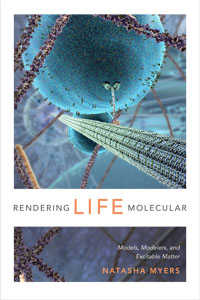
A review of Rendering Life Molecular: Models, Modelers, and Excitable Matter, Natasha Myers, Duke University Press, 2015.

Natasha MyersThere is an annual competition that allows PhD students to dance their research. The contestants, individually or in groups, present their research results in a choreography that gets evaluated by a jury. The first “Dance Your PhD Contest,” held in 2008, attracted significant interest from the media and on Youtube, and the number of applicants has been increasing ever since. Other Youtube videos extend a second lease of life to students’ dancing performances and staged choreographies inspired by scientific discoveries. In 1971, a football field at Stanford University became the scene of a large-scale “molecular happening,” in which more than one hundred performers staged the intricate molecular interactions involved in protein synthesis.
These performances, of course, do not count as research, and they will not feature in a scientist’s resumé. But anthropologist Natasha Myers takes them very seriously. In Rendering Life Molecular, she wants to expand what counts as science and science-making to include what she refers to as “body-work” or, in more technical terms, “kinesthetic animations”, “haptic vision”, “molecular calisthenics”, “mimetic modeling”, and other body experiments. She does so by paying attention to what otherwise may go unnoticed in scientific work: gestures and mimics, emotions and affects, metaphors and values, and other forms of life in the laboratory that are muted in other accounts of science-in-the-making.

Body work doesn’t count as research

Bodies, play, and emotions have no proper place in a scientific lab. And yet, as one of Natasha Myers’ informants remarks, “you can’t learn something if you don’t get your body involved.” Touching, sensing, feeling, and knowing are entangled in laboratory research. Life science research is a full-bodied practice. The researchers’ moving bodies and their moving stories are integral to scientific enquiry. Lecturers encourage students in molecular biology to learn the fold of their molecule by heart, to trace the direction of each component by hand, and to be able to render it with their entire body. Researchers’ bodies become effective proxies for their molecules. Indeed, a cartoon reproduced by the author in her book opening features a male scientist twisting his body into the shape of a double helix, while his colleague sitting at his bench chides him: “Very good, Michaels—you’re a DNA molecule. Now, get back to work.”

The most obvious sense that connects us to reality is seeing. And yet, “seeing” a molecule is not at all obvious. Protein molecules are so tiny that long waves of visible light pass right by them without registering their presence. The only way researchers can get a glimpse of their molecule is by transforming it into a crystal, collecting data on the position of each atom through a process known as X-ray diffraction, and working on the data to generate a model of the atomic configuration of the protein. Every step in this process is fraught with difficulties. Crystallographic techniques are far from foolproof, and almost every project is plagued by setbacks, failures, and detours. Not any crystal will do: viable protein crystals must be well-ordered to diffract X-rays. Protein crystals are not only hard to grow; they are also quite unstable and can disintegrate easily. Once crystallized, a molecule has to stand still through a kind of freeze-frame technique so the data can be collected.

A happy and well-folded molecule

Once collected, the data has to fit into the model, which again involves many tweaking and adjusting. Molecule models are three-dimensional structures made up of thousands of atoms, and their configuration has to conform to the modeler’s intuition. Some models simply don’t look right: they seem distorted, misfolded, and “in pain”; others look “happy,” “relaxed,” and well-folded. It takes a long time to develop the skill set required to “feel the pain” of a misshapen protein model. Tacit knowledge can only be acquired and communicated “from body to body.” Modelers have to exercise their synesthetic reason in an open-ended, improvisational, and intuitive mode. This process cannot be automated: it demands “hands-on” practice. This is why the laboratory retains the structure of the master-disciple relationship, with senior researchers cast in the role of the charismatic magician and PhD students playing the sorcerer-apprentice.

Making crystallographic data visible in the form of electron density maps and molecular models allows the researcher to play with the data with the help of animated software. Three-dimensional models are essential visualization tools for teaching, learning, and research. But computers will never replace the “feel” for the molecule that patient work in the lab cultivates. While today almost all crystal structures are built on-screen, physical models like the ones used in high school chemistry do retain their pedagogical value. Researchers can easily get “lost in the map” and forget the assumptions on which computer software are built. Leaders in the field are prompt to qualify the limits of the data—these are just models, and modelers must keep their interpretations open. Students are taught to distrust computer algorithms and to exercise expert judgment at every step of the model-building process.

Playing techno music to a crystal

Protein crystallography is therefore more craft than science. The indirect nature of diffractive optics makes it necessary for modelers to get fully entangled with their instruments and materials as they rend imperceptible substances into visible and palpable forms. It is possible that a crystallographer will never find the perfect condition for a protein to crystallize; he or she may spend years in her PhD trying to set the conditions right. In one case, reported in a scientific paper, the researchers had to add one percent pickle juice “from the Sweetand Snappy Vlassic brand” to the crystallization mix. Experienced crystallographers regularly joke that protein crystallization requires “voodoo magic.” Some insist on playing techno music while they mix their biochemical media. Others have found that proteins will crystallize only if they are wearing their “special sweater.” Some even talk and sing to their crystal. As Natasha Myers remarks, ”it seems in these contexts that magic, ritual, and superstition are not a ‘threat’ to science; rather, they are integral to its practice.”

Laboratories are not just factories for the production of scientific facts; they are living spaces where practitioners engage the whole range of their human affects and senses. Myers focuses on one dimension of laboratory labor that is so often overlooked in accounts of the political economy of science. This is an attention to the affective labor involved in scientific research and training; a form of labor that is crucial to the work of producing and circulating valuable scientific facts. Affective labor is a concept developed by feminist scholars and political theorists to analyze forms of labor, such as nurture and care, which have historically been undervalued or otherwise made invisible. The laboratory researchers studied by Myers do not only take care of themselves and of others: they also cultivate a kind of “care of the molecule”. They go to extraordinary lengths to “keep their molecules happy” and to nurture the perfect conditions for their protein to crystallize. A crystallographic model is not just “matter of fact”; it is also a “matter of care.”

Affective labor

This image of the laboratory as a nurturing and caring environment stands in stark contrast with the dominant view that emphasizes disembodied reasoning, competitive spirit, and economic rationality. Natasha Myers gives the example of the documentary Naturally Obsessed that documents how graduate students cultivate the ethos and habits they need to succeed in science. The story focuses on only one class of affects: competition, and an exclusive focus on result delivery. Winning the game in this rendering requires graduate students to solve the structure of a prized protein molecule before others beat them to it. In this context, remarks one student, “one of the best thing that you can do as a scientist is suffer from obsessive-compulsive disorder. So that you become obsessed with a problem and can’t stop working on it until you get to your answer.” Indeed, as Myers notes, the figure of the obsessive-compulsive scientist is one whose ethos and habitus are perfectly tuned in to a neoliberal economy. As a recruitment tool for high school students, this documentary is itself a pedagogical device that can shape what its viewers come to think a life in science should be like.

Natasha Myers wants to give a different image of science. Her book stems from a strong belief that “there are other analytic frames and other ways of telling stories about the life sciences and lives in science.” To use a cliché, her depiction of science is more “feminine,” more attuned to sensations and affects, than the heroic masculine renderings of science-in-the-making. Her depiction of dancing molecules and epistemic choreographies is not fortuitous: she confesses that “as a life-long dancer, my attentions were especially attuned to the relationship between movement and forms of knowing in science.” She develops a new vocabulary to describe the role of the body in scientific work, turning tacit knowledge into explicit discourse. Rendering Life Molecular is also an epistemologically rich book, engaging in meaningful discussions with prominent authors in the field of science studies, such as Donna Haraway, Emily Martin, Lorraine Daston, and many others. Natasha Myers opens new venues for research: this is a book I will return to for close reading of chapters and added insights on what renders life molecular.

Rewriting Marx’s Theory of Capital for the Twenty-First Century

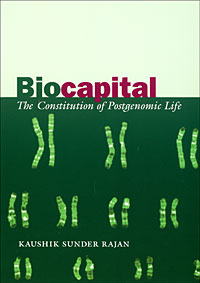
A review of Biocapital: The Constitution of Postgenomic Life, Kaushik Sunder Rajan, Duke University Press, 2006

biocapitalBiopolitics is a notion propounded by Michel Foucault whereby “life becomes the explicit center of political calculation.” The increasing use of this notion in the social sciences underscores a fundamental evolution. In the twenty-first century, as anticipated by Foucault, power over the biological lives of individuals and peoples has become a decisive component of political power, and control over one’s biology is becoming a central focus for political action. Used by the late Foucault in his lectures at the Collège de France, biopolitics and its associated concept, governmentality (“the conduct of conducts”), are now in the phase of constituting a whole new paradigm, a way to define what we are and what we do. Biopolitics and governmentality are now declined by many scholars who have proposed associated notions: “bare life” and the “state of exception” (Giorgio Agamben), “multitude” and “empire” (Michael Hardt and Antonio Negri), “biological citizenship” and “the politics of life itself” (Nikolas Rose), “biopolitical assemblages” and “graduated sovereignty” (Aihwa Ong), “cyborg” and “posthumanities” (Donna Haraway), etc. This flowering of conceptualizations is often associated with a critique of neoliberalism as the dominant form of globalized governmentality, and to a renewal of Marxist studies that revisit classical notions (surplus value, commodity fetishism, alienation of labor…) in light of new developments.

From Foucault to Marx

By adding the notions of “biocapital” and “postgenomic life” to the list of new concepts, Kaushik Sunder Rajan positions himself in this twin tradition of Marxist and Foucaultian studies. As he states in the introduction, “this book is an explicit attempt to bring together Foucault’s theorization of the political with a Marxian attention to political economy.” As mentioned, the paradigm of biopolitics and governmentality has changed the traditional ways of thinking about politics, and has led to a new understanding of basic notions such as sovereignty and citizenship. But Foucault was mostly interested in deconstructing political philosophy, and failed to acknowledge that biopolitics is essentially a political economy of life. This is where the reference to Marx comes handy. As Sunder Rajan underscores, one doesn’t need to adhere to Marx’s political agenda in order to interpret his writings (“I believe that Marx himself is often read too simply as heralding inevitable communist revolution”). Instead, he uses Marx as “a methodologist from whom one can learn to analyze rapidly emergent political economic and epistemic structures.” His ambition is to rewrite Marx’s theory of capital for the twenty-first century, and to situate in emergent political economic terrains by using the tools of the ethnographer.

For Sunder Rajan, biocapital is the result of the combination of capitalism and life sciences under conditions of globalization. The evolution from capital to biocapital is symptomatic of the turn from an industrial economy to a bioeconomy in which surplus value is directly extracted from human and nonhuman biological life rather than from labor power. The extraction of surplus value from biological life requires that life be turned into a commodity, tradable on a market and convertible into industrial patents and intellectual property rights. Life sciences transforms life into a commodity by turning the biological into bits of data and information that is then traded, patented, or stored in databases. Research in genomics and bioinformatics translates the DNA into a string of numbers, and develops methods for storing, retrieving, organizing and analyzing biological data. As a consequence, life sciences become undistinguishable from information sciences. Biocapital determines the conversion rate between biological molecules, biological information and, ultimately, money. It then organizes the circulation of these three forms of currencies–life, data, capital–along routes and circuits that are increasingly global.

Turning life itself into a business plan

But Biocapital: The Constitution of Postgenomic Life is not only a theoretical intervention in the field of Marxian and Foucaultian studies. It is, as defined on the book cover, “a multi-sited ethnography of genomic research and drug development marketplaces in the United States and India.” The constitution of new subjects of individualized therapy and the genetic mapping of populations are obvious terrains for the application of Foucault’s concepts of biopower and governmentally. Similarly, Marx’s analysis of surplus production and surplus value can be brought to bear in ethnographic descriptions of Silicon Valley start-ups living on vision and hype, and turning life into a business plan. As Sunder Rajan writes, “ethnography has always prided itself on deriving its analytic and empirical power from its ability to localize, and make specific, what might otherwise be left to the vague generalizations of theory.” In addition, multi-sited ethnography allows the anthropologist to follow the globalized routes of life resources, biological data, and monetary capital, that cannot be grasped and conceptualized in a single location.

The author’s initial ambition was to observe biotechnological research within laboratories and to put them in their larger social and cultural context. His interest in the relation between biotech companies and pharmaceutical corporations led him to approach various business ventures and present requests for interviews and participant observation. But as he recalls, “trying to get into the belly of the corporate beast” was a frustrating experience. Getting access to companies and laboratories was made difficult by the value associated with intellectual property rights in the biotech industry. As the author notes, “many of these people live in worlds where information is guarded with almost paranoid zeal.” The secretive aspect of corporate activity was compounded by the wish of corporations to strictly monitor what gets said about them. Research proposals for participant observation were vetted by teams of lawyers and were usually rejected. In India, corporations and research centers had a more open attitude to the ethnographer, who could fit into the more fluid environment and leverage his ethnic identity; but the bureaucratic state imposed additional hurdles through paperwork and red tape.

“We must get ourselves a bioethicist!”

Paradoxically, the fact that genome sequencing had already been the topic of a book by a famous anthropologist facilitated first contacts and self-presentations: “I’ve read Paul Rabinow, so I know exactly what you want to do,” was how the head of the GenBank database greeted the young PhD student sent to the field by his teacher adviser. Corporate executive and research managers tried to fit the ethnographer into known categories. “We must get ourselves a bioethicist!” concluded the CEO of an Iceland-based genome company after a short interview. A public relations official at Celera Genomics wondered whether his visitor needed to be offered the “investor tour” or the “media tour”, these being the only two categories of PR communication. The author finally gained access to GeneEd, an e-learning software company co-founded by two Indians in San Francisco that sells life science courses to corporate clients. During his job interview, he provided an overview of his own field of science studies and cultural anthropology, eliciting questions about marketing strategies and employee motivation. The two CEOs agreed to have an in-house anthropologist, and let him wander around while using his skills as a marketer.

Despite the obvious limitations of his terrain, being more than one step removed from the biotech startups and big pharma industries that are at the core of biocapital, the author was able to conduct an interesting case study of corporate life that is presented in the last chapter of the book. As GenEd’s client base shifted from small biotech to big pharmaceutical companies, the status of graphic designers declined to one of mere executioners, while software programmers became the key resource of the company. By participating in industry conferences, meeting with people, and simply being there, Sunder Rajan was also able to accumulate valuable observations on biotech startups and research labs in the Silicon Valley. In particular, conferences and business events are “key sites at which unfolding dynamics and emergent networks of technocapitalism can be traced.” They have their rituals, like speeches and parties, their messianic symbolism of “going for life,” and their underlying infrastructure of competition for capital and recognition.

The biocapital ethics and the spirit of start-up capitalism

High tech startups that depend on venture capital funding have developed what the author describes as the art of vision and hype: making investors and the public at large believe in unlimited growth and massive future profits, even they don’t have a product on the market. Hype and vision form the “discursive apparatus of biocapital”: this discourse declined in “promissory articulations”, “forward-looking statements”, and the initial public offerings of “story stocks”, as these ventures are known on Wall Street. The excitement generated by endeavors like the Human Genome Project has increased the enthusiasm of state funders and private investors for anything related to the genome, even as the pragmatic applications of genetics research seem distant if not unachievable. “At some fundamental level, it doesn’t matter whether the promissory visions of a biotech company are true or not, as long as they are credible,” notes the author. Promissory articulations are performative statements: they create the conditions of possibility for the existence of the company in the present. As a result, the spirit of start-up capitalism is very different from the protestant ethic as described by Max Weber. It is “an ethos marked by an apparent irrationality, excess, gambling.” It is also, at least in the US, a neo-evangelical ethics of born-again Protestantism that promises an afterlife in one’s own lifetime: a future of health and hope, of personalized medicine and vastly increased life prospects–at least, for those who can afford it.

This is where India comes as a useful counterpoint. India entertains different dreams and visions. In 1982, Indira Gandhi addressed the World Health Assembly with the following words: “The idea of a better-ordered world is one in which medical discoveries will be free of patents and there will be no profiteering from life and death.” Since then, the world has moved into the opposite direction, and India has positioned itself as a key player in the “business of life”. Medical records and DNA samples are collected in Indian public hospitals for commercial purposes, and the nation-state itself operates as a quasi-corporate entity. India in the 1990s has emerged as a major contract research site for Western corporations, which outsource medical trials at a significantly cheaper cost. The challenge for the young entrepreneurs and government officials interviewed by Sunder Rajan is to move beyond a dependence on contract work for revenue generation, and toward a culture of indigenous knowledge generation through patenting and intellectual property appropriation. It is also an ethical challenge: in the course of his research, Sunder Rajan visited a research hospital in Mumbai that recruits as experimental subjects former millworkers who have lost their jobs as a result of market reforms. The “human capital” that forms the basis of these clinical trials experiments is very different from the often vaunted software engineers and biotech specialists who have become the hallmark of “India Shining”: it is constituted of life itself, of life as surplus, and therefore blurs the classic division between capital and labor that Marx locates at the origin of surplus value.

Fieldwork in a multi-sited ethnography

Like many anthropologists, Sunder Rajan is at his best when he connects particular reporting on field sites and informants with theoretical discussions on Marx and Foucault. The objects of his study are inseparable from the larger epistemological and political economic contexts within which they are situated. In line with other scholars in the field of STS studies, he insists on the mutual constitution of the life sciences and the socio-economic regimes in which they are embedded. There is no neatly divided partitions or clear distinctions between “the scientific”, “the economic” and “the social”; rather, these categories enter in complex relationships of coproduction and coevolution. However, Sunder Rajan’s theoretical arguments do no always receive ethnographic support, and his empirical base is spread rather thin. Multi-sited ethnography as a different way of thinking about the field runs the risk of turning into reportage or graduate school’s tourism; and it is not sure that fieldwork, once defined as hanging around, can easily be substituted by wandering about.