
The Celibate Plot

A review of Celibacies: American Modernism and Sexual Life, Benjamin Kahan, Duke University Press, 2013.
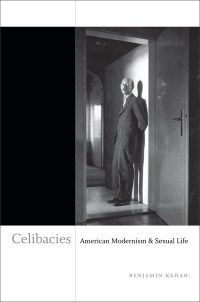
CelibaciesLiterary criticism has accustomed us to read sex between the lines of literary fiction. What Maisie Knew was what her parents were doing in the bedroom; The Turn of the Screw would have the heroin screwed if the door was unlocked; and Marcel Proust’s Lost Time was time not spent in the arms of his lover. According to this view, literature is when the author wants to suggest something about a person or thing, but then for whatever reason he or she may not wish to explicitly state what is on his or her mind, and so the author writes a novel, or poetry. Psychoanalysis has several words for this urge to dissimulate and beautify: sublimation, repression, transfer, displacement, defense mechanism, the conflict between the super-ego and the id. They all refer to the transformation of socially undesirable impulses into desirable and acceptable behaviors. But what if the opposite was true? What if no sex means no sex, and there is no dark secret to probe into? The French philosopher Michel Foucault hinted at this possibility in his History of Sexuality when he criticized the repressive hypothesis, the idea that western society suppressed sexuality from the 17th to the mid-20th century due to the rise of capitalism and bourgeois society. Foucault argued that discourse on sexuality in fact proliferated during this period during which experts began to examine sexuality in a scientific manner, cataloguing sexual perversions and emphasizing the binary between hetero- and homosexuality. By opposition, Roland Barthes, Foucault’s colleague at the Collège de France, proposed a concept to bypass the paradigm of sexuality and go beyond the binary construction of meaning: the Neutral. “I define the Neutral as that which outplays the paradigm, or rather I call Neutral everything that baffles paradigm,” he wrote. According to Barthes, the Neutral, or the grammatical Neuter (le neutre) operates a radical deconstruction of meaning and sexuality. It allows us to reexamine from a fresh perspective the question of le genre, understood in its dual sense of literary genre and of gender. 

The repressive hypothesis

Biographies of Roland Barthes point out that he remained a bachelor all his life and shared an apartment with his mother, to whom he devoted a vibrant eulogy at the time of her death. Barthes was also a closet homosexual, never avowing in public his penchant for boys and his dependence on the gigolo trade. His works are almost silent on his sexuality. Barthes’s homosexuality concerned only a private part of his life; it was never made public, because it simply wasn’t. Homosexuality was never for Barthes anything other than a matter of sex, limited to the question of the choice of a sexual object. He wasn’t gay (a term that functions as a seal of identity), and would never have been part of the political movement for the recognition of homosexual rights. This indifference was not a repression: it was another way of expressing what being modern meant for him, even if Bathes’ modernity was closely related to a certain resistance to the modern world. In a society obsessed with the new and the rejection of conventional forms, it is attachment to the past that now constitutes a form of marginality or even clandestinity and, as such, a heroism of the ordinary. Being modern doesn’t just mean taking part in the intellectual or artistic spectacle of contemporary society. It also, and above all, means constructing meanings, words, ways of being, cultural and textual interventions that precede what a society makes available. To be modern is to make one’s desire come to language. In this sense, Benjamin Kahan’s Celibacies, a work of literary criticism and cultural history, articulates other ways of being modern. Focusing on a diverse group of authors, social activists, and artists, spanning from the suffragettes to Henry James, and from the Harlem Renaissance’s Father Divine to Andy Warhol, Kahan shows that the celibate condition, in the diverse forms that it took in the twentieth century, meant much more than sexual abstinence or a cover for homosexuality. To those who associate the notion of celibacy with sexual repression, submission to social norms, and political conservatism, he demonstrates that celibacies in the twentieth century were more often than not on the side of social reform, leftist politics, and artistic avant-garde.

Celibacies is placed under the sign of Eve Sedgwick’s Epistemology of the Closet, with a quote used as an epigraph that opens the book: “Many people have their richest mental/emotional involvement with sexual acts that they don’t do, or even don’t want to do.” Sedgwick deemed the hermeneutic practice of uncovering evidence of same-sex desire and its repression in literature, “paranoid reading.” To this trend, she opposed a reparative turn in literary studies: reparative reading seeks pleasure in the text and works to replenish the self. Sedgwick’s injunction to move from paranoid to reparative reading has been diversely followed. On the one hand, queer studies continue to read the absence of sex as itself a sign of homosexuality or of repressed desire, as an act of self-censorship and insincerity. The closeted subject has internalized social norms and keeps the true self hidden from outside views, sometimes hidden from the conscious self as well. By opposition, the queer subject brings desire to the fore, and challenges tendencies to oppose private eroticism and the systems of value that govern public interests. On the other hand, queer theory rejects normativities of all stripes, including homonormativity. It understands sex and gender as enacted and not fixed by natural determinism. Since the performance of gender is what makes gender exist, a performance of “no sex” creates a distinct gender identity: no means no, and abstinence from sex is not always the sign of repressed sexuality. It is possible to theorize gender and even sexuality without the interference of sex. But according to Kahan, celibacy is distinct from asexuality, understood as the lack of sexual attraction to others, or low or absent interest in or desire for sexual activity. Celibacy is a historical formation or a structure of attachment that can be understood as a sexuality in its own right. Its meaning has evolved in the nineteenth and twentieth centuries: it has be used as a synonym for unmarried, as a life stage preceding marriage, as a choice or a vow of sexual abstinence, as a political self-identification, as a resistance to compulsory sexuality, as a period in between sexual activity, or as a new form of gender identity organized in a distinct community culture. Celibacies used in the plural reflect these overlapping meanings and cast a light on literary productions illustrating the impact of modernism in America.

The educated spinster

Celibacy once was a recognized social identity defined by its opposite, heterosexual marriage. According to Simone de Beauvoir, “the celibate woman is to be explained and defined with reference to marriage, whether she is frustrated, rebellious, or even indifferent in regard to that institution.” Its determinants were political and economical rather than sexual or sentimental: celibacy was a necessary condition for middle- and upper-class white women to gain legal and financial independence. At the end of the nineteenth century, “marriage bars” required the dismissal of female employees upon their marriage or the prohibition of the employment of a married woman. Educated women who wanted to enter a career or a profession had to remain unmarried or to hide their marriage. They did so in large numbers: “Of women educated at Bryn Mawr between 1889 and 1908, for instance, fifty-three percent remained unwed.” For this reason, celibacy is at the very heart of the history of labor in America. It is also a key component of social mobilization and civic campaigns: in the United States, unmarried, educated women composed much of the rank and file of social movements campaigning for universal suffrage, temperance, and social purity. The centrality of celibacy for first-wave feminism cannot be emphasized enough. For the author, women’s “choice not to marry is indicative of a willingness to think outside existing social structures and thus it is associated with freedom of thought.” For their male contemporaries, it was also associated with ridicule. Women campaigning for female suffrage were belittled as “suffragettes”; and other expressions disparaged women who had chosen to stay single (“singletons,” “bachelorettes,” “old maids,” “spinsters.”) The male bachelor, by contrast, was seen as socially able to marry but having delayed marriage of his own volition; he could be characterized as “a good catch,” “a stag,” or “a jolly good fellow.” 

Celibacy’s history is imbricated with the history of homosexuality. Discussing Henry James’ novel The Bostonians, Kahan investigates one of the most contested site of celibacy in the history of homosexuality: the Boston marriage. The term “Boston marriage” describes a long-term partnership between two women who live together and share their lives with one another. In James’s satirical novel, the romance between the heroin Verena Tarrant and Olive Chancellor, a Boston feminist and social campaigner, is placed on equal footing with the romance between Verena and her other suitor, Basil Ransom. This love triangle is often read as a lesbian plot: Olivia’s decision to leave her parents’ house, move in with Verena and study in preparation for a career in the feminist movement is seen as the result of a love attraction. Benjamin Kahan proposes another interpretation based on the constitutive role of celibacy as a means for independence and self-determination. The Boston marriage, which does not grow out of “convenience or economy,” is associated with collaborative literary production. It reflects Henry James’ own condition as a lifelong bachelor and his conception of authorship as a vocation. The artist, like the bachelor, is fundamentally monadic and stands apart from social spheres of influence: “rather than seeing James’s celibacy as only an element of a homosexual identity, I understand it as a crucial component of his novelistic production.” In a separate chapter examining the work of Marianne Moore, a twentieth-century American poet, Kahan sees echoes of her lifelong celibacy in her poetics and conception of time. Moore’s “celibate poetics” involve a lack of development within the poem, a lack of climax, a backwardness that reverses the passage of time, as well as pleasure in difficulty, lack of explicitness, and a style at once shy and flamboyant. Moore’s remark that “the cure for loneliness is solitude” makes solitary existence a fully contented mode of sociability and a crucial part of her poetics.

Black celibacy and queer citizenship

In his effort to make celibacy be seen as progressive and pleasurable, Benjamin Kahan underscores that the celibate condition in the twentieth century was not restricted to middle-class white women. Black celibacy was advocated by a now forgotten figure of the Harlem Renaissance, Father Divine, “an intellectual and religious leader who believed he was God.” His cult, the Peace Mission Movement, organized his followers into interracial celibate living arrangements called kingdoms. These celibate communes were a direct response to economic conditions: rents in Harlem were prohibitively high, making necessary for families to share apartments or take in lodgers. Cooperative housing also echoed the calls from Claude McKay, a socialist and a poet, to seize the means of production and organize the black community on a self-sustaining basis. Lastly, black celibacy and chastity vows countered racist depictions of the black body as oversexualized and promiscuous. By making a celibate identity available to black subjects, Father Divine allowed black men and women to participate in the public sphere and created economic and spiritual opportunities for racial equality. Celibacy was also used as a strategy for queer subjects to circumvent the prohibition preventing homosexual immigrants from becoming American citizens. Before the passage of the McCarran-Walter Act in 1952, the queer citizen could, according to the letter of the law, belong to America so long as he remained celibate or was not “caught in an act of moral turpitude.” The British poet W. H. Auden became an American citizen in 1946 by practicing “cheating celibacy,” a position both inside and outside the rules that he thematized in his 1944 poetic essay The Sea and the Mirror: A Commentary on Shakespeare’s The Tempest”. This long poem is a series of dramatic monologues spoken by the characters in Shakespeare’s play in which Caliban renunciates his former self in favor of a queer form of belonging. But as Kahan notes, “black queer writers like Claude McKay, James Baldwin, and Langston Hughes had significantly less ability to move in and out of America’s borders than white authors like Auden.”

Kahan’s choice to associate Andy Warhol with celibacy is disconcerting. The pop artist was openly gay and had a reputation for promiscuity and swishiness. His art collective, the Factory, was populated by “drag queens, hustlers, speed freaks, fag hags, and others.” But “‘gayness’ is not a category that we can control in advance.” If Warhol’s declarations can be taken at face value, he claimed that he didn’t have any sex life: “Well, I never have sex” and “Yeah. I’m still a virgin,” he responded in an interview. Evidence also suggests that the Factory wasn’t the “Pussy Heaven” or “Queer Central” journalists once described: according to one witness, celibacy organized life at the Factory, and Warhol’s abstinence from sex shaped relations of power and subjection. As Kahan sees it, the tradition of celibate philosophers underwrites the Factory’s mode of government and theorizes a concept of group celibacy. Warhol’s marriage to his tape recorder exemplified his rejection of traditional marriage and emotional life: “I want to be a machine.” In the view of a contemporary, “everything is sexual to Andy without the sex act actually taking place.” His celibacy operates at a zero degree of desire. My Hustler, his 1965 movie with film director Paul Morrissey and actor Ed Hood, presents a twisted celibate plot characterized as much by sexlessness as by sex. Valerie Solanas tried to kill Andy Warhol in 1968 because she claimed “he had too much control of [her] life”. In the SCUM Manifesto she published before her attempted murder, the radical feminist urged women to “overthrow the government, eliminate the money system, institute complete automation and destroy the male sex.” Kahan places both Warhol and Solanas in a tradition of philosophical bachelorhood that precludes sex in favor of alternative modes of governance.

Celibate readings

In the conclusion of Celibacies, Benjamin Kahan argues that celibacy should not be abandoned to the American political right, with its apology of abstinence before marriage and traditional gender roles. Celibacy from the 1880s to the 1960s has been on the side of reform and modernism. Celibate women could access public space and the professions at a time social norms prevented educated married women from entering the workforce. In the 1930s, celibacy was a possible option availing economic advantages to African-Americans in Harlem or allowing queer foreigners to access U.S. citizenship. Celibacy could also be a philosophical choice or a condition for artistic production. Having a room of one’s own was easier when one didn’t have to share the apartment with another person or raise a family. Forms of celibacies have also been animated by “sexual currents, desires, identifications, and pleasures.” Celibacy’s imbrication with homosexuality is not just a modern invention: depictions of “Boston marriage” in the late nineteenth century had strong implications of lesbianism. But celibacy was not only a pre-homosexual discourse or the result of sexual repression: it was a form of sexuality in its own right, entailing a more radical withdrawal than is the case with the closet homosexual or the scholar practicing sexual abstinence. No sex means sex otherwise, or a different form of sexuality. Looking to literary works of fiction and poetry through the prism of celibacy leads to valuable insights: Kahan reads a “celibate plot” in Henry James’ The Bostonians or Andy Warhol’s My Hustler, and highlights a “celibate poetics” in the poems of Marianne Moore or W. H. Auden. This book is published in a series devoted to queer studies because, as the author argues, “celibate and queer readings overlap without being coextensive.” Much as queer theory has the effect of “undoing gender,” the primary purpose of the Neutral according to Roland Barthes is to undo the classifying function of language and thus to neutralize the signifier’s distinctive function. “L’écriture célibataire” is the form the Neutral took in American modernism.

Passing for White, Passing for Black

A review of Passing and the Fictions of Identity, Elaine K. Ginsberg ed., Duke University Press, 1996.

Passing

On September 10, 2020, the editorial director of Duke University Press issued a statement about Jessica Krug, a published author who for several decades had falsely claimed a Black and Latinx identity before being exposed as a case of racial fraud. The public statement was brimming with rage and indignation: “I have been sickened, angered, and saddened by the many years that she deployed gross racial stereotypes to build her fake identity,” the editor wrote. The feminist scholar was denounced as a case of deception and fraud, rendered more shameful by the fact that “early in her career, she took funding and other opportunities that were earmarked for non-white scholars.” Confronted with her lies, Jessica Krug herself issued a blog confession in which she disclosed her original identity “as a white Jewish child in suburban Kansas City” who, because of “some unaddressed mental health” issues, had assumed a false identity initially as a youth and then as a scholar. Using a word tainted by a history of antisemitism, she described herself as “a culture leech,” apologized profusely, and asked to “be cancelled.” It turned out Jessica Krug wasn’t the only case of racial impersonation in academia: over the forthcoming months, other scholars were exposed as having claimed a false racial identity, including another author who had manuscripts accepted by Duke University Press even after she was denounced as a so-called “Pretendian,” or a person falsely claiming a Native American heritage. In another statement, the same editor indicated that “for months now, we at Duke University Press have engaged in difficult conversations about how we can do a better job of considering ethical concerns as we make our publishing decisions.” But she did not indicate whether the academic publisher would take measures to check the self-declared racial identity of its contributors, or how it would proceed in doing so.

Policing race, unpolicing gender

I remember being amused and puzzled by these media statements. I saw them as a typically American story as we like to imagine them in France: a narrative following a pattern of public exposure, legal confrontation, personal confession, atonement for past sins, and redemption, as was the case of Bill Clinton in the Jessica Lewinsky affair. Only in the case of white people assuming a Black identity there was neither mercy nor redemption: the culprits were expected to expose their shame publicly before disappearing into oblivion. And indeed, following her confession Jessica Krug vanished from public view, never to be seen again: she was, in effect, cancelled. To a certain degree, I can understand the outrage of the Duke editor and other persons who had been fooled into believing the usurpated identity of racial impostors. But only to a degree: there are also convincing arguments to support the fact that racial usurpation is not such a big deal, and should be treated with leniency. Whom did Jessica Krug harm by pretending to be black? Does having benefited from earmarked resources justify the policy of cancellation of a scholar who may otherwise have brought useful contributions to the field? What if it was possible to “play one’s race” as one plays a role? After all, isn’t it a central tenet of critical studies that identity is a fiction and that social roles are performatively enacted? According to Judith Butler, whose Gender Trouble was published in 1990, gender is performance. Likewise, in Epistemology of the Closet, also published in 1990, Eve Kosofsky Sedgwick argues that limiting sexuality to homosexuality or heterosexuality, in a structured binary opposition, is too simplistic. The discipline of queer studies that they helped establish is a broad tent: one does not have to prove one’s credentials as a gay, lesbian, or otherwise LGBTQI+ person to identify as “queer.” Likewise, in crip theory—the radical arm of disability studies—, a person is considered as disabled if she considers herself to be so. There are no checks of medical records or social security status: indeed, disability scholars deny doctors the exclusive right to declare who is disabled and who is not, and argue that disability status is biased against persons of color, people living in precarious conditions, and otherwise discriminated persons. Being disabled (or being queer) is a social construction, just like what is opposed to it, namely being able-bodied (or being straight). Why should race be treated differently? Are academics serious when they claim that race is also a fluid and reversible category?

The moral panic raised by racial usurpations of minority identity is a very contemporary phenomenon. To understand its roots, one has to delve into the American history of race relations, and to understand the academic context as it emerged in the 1990, especially in literature departments where questions of identity and fiction were most prominently raised. It was a time when the modern racial impersonators started their career, and when transracialism, although based in those cases on identity theft and deception, appeared as a feasible option. The book Passing and the Fictions of Identity, edited by Elaine K. Ginsberg and published in 1996, therefore provides a useful benchmark to assess contemporary debates in light of their foundational moment. The term passing designates a performance in which one presents oneself as what one is not, a performance commonly imagined along the axis of race, class, gender, or sexuality. In American literature, passing across race and across gender are thoroughly imbricated—most famously in the narrative of William and Ellen Craft, Running a Thousand Miles for Freedom (1860), in which the black couple escaped from slavery, she dressed as a white man and he posing as her servant, and in Harriet Beecher Stowe’s Uncle Tom’s Cabin (1852) when Eliza, traveling to Canada, disguises herself as a white man and her young son as a girl. In the twentieth century, novels such as Nella Larsen’s Passing (1929) and James Weldon Johnson’s Autobiography of an Ex-Coloured Man (1912) added to the discourse of racial passing a third important sense of passing: the appearance of “homosexual” as “heterosexual.” Passing and the Fictions of Identity explores passing novels as a literary genre that complicates racial and sexual categories. It also considers passing across social status delimitations, as in The Life of Olaudah Equiano (1789) in which the narrator, an Igbo African and a former British slave, becomes a free sailor and a pioneer of the abolitionist cause. It addresses gender crossing through a close reading of The Woman in Battle (1876), an account of Civil War cross-dressing that presents itself as the autobiography of Loreta Velazquez, a woman who masqueraded as a Confederate officer and spy during the war. Passing novels also include The Hidden Hand (or Capitola the Madcap), a picaresque adventure tale first published in 1859, and James Baldwin’s Giovanni’s Room (1956), in which national, racial, and sexual identities are presented as nostalgic constructions subject to a pathos of lost origins. Black Like Me (1961) is not a work of fiction but a realistic account of a journey in the Deep South of the United States, at a time when African-Americans lived under racial segregation, by a journalist who had his skin temporarily darkened to pass as a black man. Closing the book, Adrian Piper, a philosopher and a performance artist, offers her personal testimony as an African American woman who identifies herself as black but often passes for white because of her light-skin complexion.

The dilemma of passing

Passing for white is still a reality in contemporary American society, where African American identity was built on a history of slavery and segregation and where Blacks still suffer from racial prejudice and social exclusion. As F. James Davis writes in Who Is Black? One Nation’s Definition (1991), “Those who pass have a severe dilemma before they decide to do so, since a person must give up all family ties and loyalties to the black community in order to gain economic and other opportunities.” There is no forced “outing” of people who pass for white in the African American community: “Publicly to expose the African ancestry of someone who claims to have none is not done,” writes Adrian Piper. And yet passing is met with ambivalence and equivocation. In the novel Passing, one character remarks: “It’s funny about ‘passing.’ We disapprove of it and at the same time condone it. It excites our contempt and yet we rather admire it. We shy away from it with an odd kind of revulsion, but we protect it.” By contrast, at the time the book was published, passing for black when one is white was deemed a complete impossibility. Adrian Piper, who was suspected of doing so, reacts violently to such accusation: “It’s an extraordinary idea, when you think about it: as though someone would willingly shoulder the stigma of being black in a racist society.” Based on her own experience, she considers being black as “a social condition, more than an identity, that no white person would voluntarily assume, even in imagination.” The many instances of microaggressions, discriminatory treatment, racial slurs, or racist conversations she overheard even in an academic context considered as “safe” justify her point: raised as an African American by a committed family, but as a person who “looked white” and “talked white,” she involuntarily passed as white and thus was able to witness the racist behavior of white persons who lower their guard when they think they are among themselves (as in the Saturday Night Life routine when a whitefaced Eddy Murphy experiences the sight of relief as a single black man exits a bus full of white passengers.) In Black Like Me, John Howard Griffin expresses outrage and mortification at a variety of incidents that would have been commonplace to black Southerners living under Jim Crow: being turned away from hotels and restaurants, made the target of racial animosity and sexual objectification, denied banking privileges, rejected peremptorily from jobs, required to use segregated toilet facilities, and forced to sit at the back of the bus. Clearly under such conditions, no white person would willingly become black.

There are several reasons why passing became a popular trope in American literature, and why literary criticism took on the subject with an enthusiasm bordering on frenzy in the 1990s. Cross-dressing and assuming a fake identity have always been a familiar ploy in literary fiction, from picaresque novels of sixteenth century Spain to the theater comedies of Shakespeare and Marivaux. The American legacy of slavery and racial segregation added an element of drama to this familiar plot. The fictitious characters of the passing novel and the unknown thousands of very real black men and women who passed out of slavery moved from a category of subordination and oppression to one of freedom and privilege. According to the one-drop rule, any person with even one ancestor of black ancestry (“one drop” of “black blood”) was considered black (Negro or colored in historical terms). African blood is invisible on the surface of the body, allowing persons of mixed descent with a light skin and Caucasian facial features to pass as white. Crossing racial or sexual boundaries involves a suspension of disbelief that is at the heart of literary fiction: appearances are deceiving, identities are in flux, and nothing is what it seems. The visual force of passing, and especially the shock of its discovery after the fact, is extraordinary. Especially in the case of race, passing is not simply performance or theatricality, the pervasive tropes of recent work on sex and gender identity, nor is it parody or pastiche, for it seeks to erase, rather than expose, its own dissimulation. Unlike sexual identity which is not necessarily apparent, race is eminently visible, as if it were natural. Race is essential, communal, and public, whereas sexuality is contingent, individual, and private. The misperception of race is therefore surprising insofar as it contradicts the established belief in the strength of blood ties and genetic makeup. Racial passing resonates deep within the American psyche. Even though a significant proportion of white Americans, about 3.5 percent according to geneticists, are known to have some African ancestry, very few people who identify themselves as white are ready to acknowledge this heritage. According to Adrian Piper, “the fact of African ancestry among whites ranks up there with family incest, murder, and suicide as one of the bitterest and most difficult pills for white Americans to swallow.”

The fictions of identity

Through the contributions to this volume, passing was constituted as a literary genre and a productive space in which to interrogate identity in all its dimensions. According to one contributor, “passing is an act of resistance against dominant constructions of race, gender, sexuality, and identity.” As she explains, the discourse of racial passing reveals the arbitrary foundation of the categories “black” and “white,” just as passing across gender and sexuality places in question the meaning of “masculine” and “feminine,” “straight” and “gay.” For the editor in her introductory chapter, “just as the ontology of race exposes the contingencies of the categories ‘white’ and ‘black,’ so the ontology of gender exposes the essential inauthenticity of ‘man’ and ‘woman.’” Socially constructed identities seemed to connote an identity easily altered or cast off: one could be black or white (or Native American) by an act of volition, a conscious decision that would engage the rest of one’s life but that had no relation to one’s previous self. The facticity of identity made any experience of that identity necessarily inauthentic: “Passing is only one more indication that subjectivity involves fracture, that no true self exists apart from its multiple, simultaneous enactments.” It was accepted as a an article of faith that “identities are not singularly true or false but multiple and contingent.” There was no authentic self, but an assemblage composed by “a series of guises and masks, performances and roles.” Literature had first established passing as a trope, and literary criticism gave it its badge of honor. The 1990s were years of transformation in the humanities, and the university became a factory for ideas of gender transition and eventually of race fluidity. Under the influence of Roland Barthes, Jacques Lacan, Judith Butler, and Eve Sedgwick, who are quoted at length in this volume, identities were read as fictions and constructed as fantasies. Race was compared to a “metaphor,” an “empty signifier,” a “mark empty of any referential content” or “the unheimlisch return of a desire” that could be as malleable as text. Then was a time to “construct new identities, to experiment with multiple subject positions, and to cross social and economic boundaries that exclude or oppress.”

In such intellectual climate, it is no wonder that some enterprising individuals took critical theory at its own word and decided to experiment in real life the theses that literary critics and social scientists had proposed on the cultural front. If all identities are in passing and race is a masquerade, why not assume a different racial identity and pretend one belonged to a minority of color instead of dull and undifferentiated whiteness? If race is a role we play, why not choose the character we wish to embody and play the part accordingly? Of course, assuming a different ethnic identity involves lying about one’s “true” origins. But if race is a lie, lying about a lie is not a lie: it is all performance. There were several motivations behind the choice made by some individuals, mostly academics and performing artists, to take on the identity of an ethnic minority. First, the stigma once associated with being colored started to recede with the civil rights movement and the promotion of ethnic identities. In the ideologically charged climate of the 1970s, Black was beautiful, Native Indian was noble, ethnic was chic. There was a whiff of marginality and radicalism in embracing the cause of ethnic minorities fighting for their rights. As the author of Black Like Me experienced it, one could not act as a spokesperson of a group in which one did not belong. He chose to step aside and to support black separatism from a distance; others preferred to espouse the cause with which they identified unequivocally, and to play the part until the end. As a second reason, this was a period when ethnic studies and other interdisciplinary fields emerged as new and exciting disciplines. For a promising academic, it was important to position oneself where all the action was. If this involved lying about one’s ethnic origins, so be it. Most of the time, the deception began with a lie by omission or a sous-entendre that may have been based on family lore. In a nonsuspecting environment, there was no hard questions asked, and no need to provide minute answers about one’s genetic makeup. In some cases, what began as a histrionic role became an acting career. Academics spend their life on a stage and impersonate a role in front of a devoted audience. They tend to embody the ideas they defend to the point their appearance becomes inseparable from their discipline. Teaching ethnic studies made one feel part of this ethnicity.

The backlash against transracialism

And yet, transracialism has few modern proponents, and academics who are found to have lied about their ethnic origins are subjected to public shaming and a strict policy of cancellation. “In Defense of Transracialism”, an article published by the philosopher Rebecca Tuvel in the academic journal Hypatia in spring 2017, was met with a barrage of insults and denunciations, and the journal’s editors had to publish an apology. How, then, are we to understand the backlash against racial trespassing and the cancellation of individuals who claimed an ethnic identity when in fact they were white? Why did race and gender follow different paths and ended up on opposite sides of academic debates, with transracialism denounced as wholly illegitimate while trans identities were recognized and even praised by gender theorists? First, the issue of passing involves not only an individual’s decision to change race, but also deliberately lying and deceiving about it. Academia is an industry that defines itself in large part by its ethical standards: having a career based on a lie makes other people angry and resentful. American ethics adds a layer or prudery and moral posturing to these manifestations of public outrage: remember that in the Lewinsky case, what was reproached to Bill Clinton was not to have had an affair with an intern, but to have lied about it. Denunciations of ethnic fraud also emphasize the fact that the culprits benefited from preferential treatment and financial resources originally earmarked to members of ethnic minorities: they “stole” these resources from others, who may have benefited from these affirmative action measures but could not. One may find this argument shallow and petty: there is more to academia than just money and a struggle for positions, and every social policy has its leakages. The resolution to curtail the phenomenon of passing also comes from the realization that it may have reached massive proportions. According to the 1990 census, two million Americans reported as American Indians and Alaska Natives. In 2000, almost twice as many gave the same answer to the questionnaire. Among them, in proportion, Latinos and highly educated adults as well as women were the groups most directly affected. Checking the “Native American” box is not only a means of gaming the university admission system: Native American cultures have experienced a kind of cultural renaissance, which increases the number of persons willing to associate with them. As a last argument, the reaction to Rebecca Tuvel’s article showed that feminists who support trans identities and queer studies are particularly ill at ease with the possibility of transracialism. They do not want to witness the contamination of gender debates with issues of racial transition. Policing race is also a way to police their own discipline and to erect barriers to avoid trespassing.

The Reparative Turn

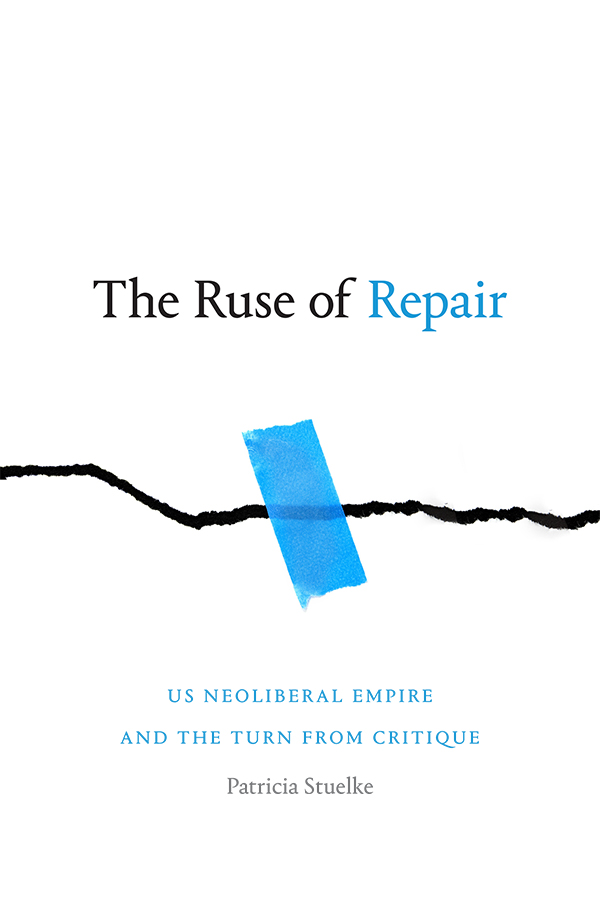
A review of The Ruse of Repair: US Neoliberal Empire and the Turn from Critique, Patricia Stuelke, Duke University Press, 2021. 

The Ruse of RepairIn 1956, Nathalie Sarraute published The Age of Suspicion, a series of essays about the modern novel starting from the following observation: “A suspicion hangs over the characters of the novel. The reader and the author have come to feel a mutual mistrust.” This book heralded the Nouveau roman and the turn toward critique: all components of a novel, from character to plot and to author, were subjected to radical deconstruction and became marked by indeterminacy, ambiguity, and equivocation. In the politically charged atmosphere of the 1960s and 1970s, literary critique became paranoid. The protagonists of postmodernist fiction often suffered from what Tony Tanner calls in City of Words (1971) a “dread that someone else is patterning your life, that there are all sorts of invisible plots afoot to rob you of your autonomy of thought and action, that conditioning is ubiquitous.” Uncovering the violence of the US empire and the racist ideology of the settler state became the order of the day. Revolution was in the air: there was a direct connection between criticism and protest, and between protest and radical change. Then suddenly, criticism became passé and suspicious modes of reading were themselves the object of suspicion. Psychology was back in favor, novels were again supposed to have a plot with a beginning and an end, and the focus of attention turned to the intimate, private matters, affects, and the body. Racial and imperialist violence no longer needed exposure: what was required was remediation and repair of the damaged self. Interpretive practices and political claims that leftist criticism had dismissed as “merely aesthetic” or “merely reformist” were drawn back to the center of the agenda. 

Paranoid reading and reparative reading 

In The Ruse of Repair, Patricia Stuelke offers a history and a critique of this reparative turn. Turning away from literary criticism and toward cultural history, she situates the rise of repair as a “structure of feeling” in literary, scholarly, and solidarity movements in the 1980s, a period marked by the ascendancy of US neoliberal empire. Specifically, the five chapters each address episodes in which reparative visions of solidarity and belonging displaced revolutionary political projects and contributed to the broader sweep of neoliberal reforms: sex-radical feminism with regard to the Iranian revolution and the so-called sex wars; black-diasporic solidarity with the Caribbean prior to the US military invasion of Grenada in 1983; the Central America solidarity movement protesting Reagan’s covert wars in Nicaragua, Guatemala, and El Salvador; creative writing programs in American universities and their contribution to the emergence of a veteran literature reflecting the trauma of the Vietnam War; and the popular music playlist weaponized by US soldiers during their invasion of Panama in 1989. Stuelke sees the origins of the reparative turn in Melanie Klein’s theories on human development and defense mechanisms, who can be read as a disavowal of “responsibility in a history of colonial war and violence that preserves and extends life to some while simultaneously withholding it from others.” Klein’s theorization of the reparative was shaped first in the debates over whether Germany should have to pay reparations after its World War I defeat, and then whether Germans should bear the guilt for war crimes and genocide in World War II. Another important milestone is Eve Kosofsky Sedgwick’s opposition between “paranoid reading” and “reparative reading,” in which the feminist scholar argued that the time of the “hermeneutics of suspicion” was over and one should return the reparative techniques that Klein had advocated. Sedgwick advanced that paranoid critique was irrelevant in an era when the lies and acts of violence of the repressive state were hidden in plain sight for anyone to see, and that one should instead concern oneself with how people find comfort, nourishment, and personal fulfilment amid precariousness and despair. The 1980s, in particular, was a decade that anticipated the ascent of reparative thinking. For Stuelke, “the turn to repair is entangled with the very history and practices of neoliberal empire and the settler colonial carceral state.” The ruse of repair, like Hegel’s ruse of reason, means that the analytical tools, patterns of interpretation, and structures of feeling that arose in the critical years of anti-imperialist militancy and radical feminism were instrumental in the ascent and triumph of neoliberalism and racial capitalism.

“Freedom to Want,” as the first chapter is titled, sets the stage by examining the logics of queer feminist anti-imperialist critique through the sex-radical solidarity politics of lesbian feminists who expressed support for progressive causes in the US and abroad, and through the institutionalization of sex-radical feminism and queer studies in the US academy. Stuelke’s archive of texts is composed of a 1986 essay by Joan Nestle, the co-founder of the Lesbian Herstory Archives ; Going to Iran (1982), Kate Millett’s memoir of traveling to witness the Iranian Revolution in 1979 ; the collective anthologies Powers of Desire (1983) and Pleasure and Danger (1984) published in the wake of the Barnard Conference on Sexuality in 1982 ; and the feminist sex wars that ensued. Joan Nestle took activism in the wake of the civil rights movement as a form of embodiment, a liberation of the lesbian self: “my body made my history… my breasts and hips shout their own slogans.” Kate Millet crafted the testimony of her trip to Iran as a reparative fantasy of revolution intermingled with the story of her reconciliation with her aunt. For the author, “Millett’s account of her relationship to the Iranian Revolution is exemplary of how feminist and queer sex-radical movement activists were revising their radical politics as neoliberalism solidified and, more insidiously, how neoliberal visions of privacy influenced the scope of their solidarity imaginaries.” The liberation of desire was elevated as the goal of solidarity politics: US imperialism was analyzed as a violent practice of sexual repression, while the turn to repair marked the passage from negative and paranoid freedom (“freedom from”) to positive and reparative freedom (“freedom to”). Sexual freedom was envisaged as “the test of how women are surviving,” and national self-determination was conflated with individual sexual expression and the neoliberal privatization of the self. Gender studies inherited this “progress narrative” of a history that celebrates women’s agency, pleasure, and difference, reifying sexual desire as natural and eclipsing the historical and material conditions of its production. The imaginaries of sex-radical feminists, and of the antipornography feminists who opposed them at the Barnard Conference, were laced with imperialist fantasies and settler colonial visions. Meanwhile, the sex wars was a white-on-white conversation, and black feminists, or queer feminists of color, were elided from the scene. Key expressions in this chapter include “racial capitalism,” “settler colonialism,” “the repressive hypothesis,” “body’s politics”, “affective infrastructures,” “valorization of privacy,” “reparative fantasies,” “homonormative politics,” and “feminism’s complicity with neoliberalism.”

The reinvention of Zora Neale Hurston

The second chapter of The Ruse of Repair, “Debt Work,” takes the reader on a journey to the Caribbean in the footsteps of three African American writers who have earned their place in the pantheon of black feminism: Harlem Renaissance figure Zora Neale Hurston, whose novel Their Eyes Were Watching God (1937) was rediscovered by recent literary criticism and became an all-star classic; and Audre Lorde and Paule Marshall, two radical feminist scholars and poets born to Caribbean immigrants who wrote memoirs rooted in Caribbean islands and diasporic identities (Zami (1983), Praisesong for the Widow (1983), Triangular Road (2009)). Patricia Stuelke sees a reparative imaginary at work in the writings of black feminist scholars about the Caribbean: the emphasis on motherhood, matrilineal family, diasporic solidarity, sexual romance, queer intimacy, and communal care were part of an effort to market the Caribbean to US tourists, and particularly to black single women from the middle class, in the early 1980s. They were heir to a long history of romanticization of the Caribbean that imagined the region as the site of matriarchal past and diasporic celebration of the present. They underscored the pivotal importance of black women as transmitters and preservers of culture, identity, and heritage. Stuelke questions the politics of these authors’ canonization as well as the reinvention or revival of Zora Neale Hurston, who wrote her classic novel during a stay in Haiti. She sees a confluence between a US black diasporic reparative imaginary of the Caribbean and America’s expansion of liberal empire. Of course, US black feminism was not the sole agent of the United States’ neoliberal recolonization of the Caribbean: the fabrication and manipulation of debt, structural adjustment programs, and the military invasion of Grenada on October 25, 1983 (“Apocalypso Now”), were pivotal in bringing Caribbean states in line with neoliberal imperatives. But imagining the Caribbean as a timeless paradise for US black women had the effect of effacing the tumultuous present marked by revolution in Grenada and contestation elsewhere. The chapter proposes key expressions and concepts to analyze these dilemma: “a black feminist reparative imaginary,” “poetics of black queer maternity,” “failed affinity with the Caribbean,” “imperial romance,” “settler modernity,” “queered diasporic belonging,” and “the unpaid debts of antiblackness.”

In the third chapter, “Solidarity as Settler Absolution,” Stuelke examines the trajectory from militancy to domesticity that led several human rights activists to turn from the denunciation of “Reagan’s dirty wars” in Central America to concerns closer to home and to the self. Her archive includes several narratives and documentary photographs produced as part of the so-called Central America solidarity movement: Joan Didion’s El Salvador (1986), Rebecca Gordon’s Letters from Nicaragua (1986), Barbara Kingsolver’s The Bean Trees (1988), Demetria Martinez’s Mother Tongue (1994), and the book and exhibition El Salvador: Thirty Photographers (1983) curated by Harry Mattison, Susan Meiselas and Fae Rubenstein. During this period, North American activists mobilized thousands to agitate in the streets and on campuses against Reagan’s foreign policy in Central America. They staged protests, carried out acts of civil disobedience, and organized photography exhibitions, theater performances, and documentary films projections documenting human rights violations and counterinsurgency war crimes. Many traveled to Nicaragua, El Salvador, and Guatemala to witness the violence of US-orchestrated military operations and bring their testimonies back home. Yet a close reading of these texts shows the prevalence of reparative approaches inspired by desires to find relief, absolution, and personal accomplishment in mediated gestures of solidarity. Many Central American guerrilla fighters and displaced refugees also deliberately played on the feelings of guilt and contrition of First World audiences to gain support. Displays of “good ethnicity” and “innocent suffering” by indigenous populations were particularly appreciated. But in narratives of Central American solidarity, the indigenous refugee character who helps the heroin find purpose and dedication ultimately disappears from the scene at the time the main character finds her “true self.” Stuelke finds in these fiction and nonfiction stories traces of “imperial romance,” “racialization of intimacy,” “white supremacist nostalgia,” “sentimental reparativity,” “staging of forgiveness,” and “settler absolution.”

The literary afterlife of military interventions

The fourth chapter, “Veteran Diversity, Veteran Asynchrony,” focuses on the centrality of the Vietnam War in US literary program fiction in the 1980s by examining various texts chronicling the popularity of creative writing programs among US war veterans, and by analyzing a sample of writings illustrative of the genre (Lorrie Moore’s Anagram (1986), Maxine Kingston’s China Men (1980), Robert Olen Butler’s On Distant Ground (1994), and two short stories by Tobias Wolff.) As the author notes, “the experience of the Vietnam War was imagined unequivocally as the stuff of ‘literary value,’ authorizing veterans not only to write, but also to teach creative writing.” This urge to convert war experience into literary capital was not new: Master of Fine Arts (MFA) programs teaching creative writing developed in relation to war, welcoming many veterans from World War II or the Korean War, and promoting a style of writing heavily influenced by war reporters such as Ernest Hemingway or John Hersey. By the 1970s and 1980s, this style became known as literary minimalism or “dirty realism” and popularized a distanciated vision of contemporary life. MFA programs discouraged antiwar fiction or critique inspired by radical politics. They also eschewed genre fiction or popular novels appealing to the taste of the general public. The emphasis had to be on silent suffering, lingering trauma, and repressed emotions. For a whole generation, “becoming a writer meant learning how to represent the seemingly unrepresentable trauma of the Vietnam War.” The Vietnam veteran functioned as a figure of wounded masculinity and emotional maladjustment that severed anti-imperialist analysis of US violence in Vietnam: the remedy for their moral pain and the nation’s ills would be found not in the elimination of US imperialism, but rather through the recognition of veterans’ plight by their fellow citizens. The university played an important role in the shift from anti-imperialist critique to the neoliberal politics of recognition, and creative writing programs were a key site in which new visions of repair and restoration were first articulated. Here again, displays of “settler common sense,” “conquest’s absolution or repair,” “institutional polishing,” “compensatory attachments,” “controlled pathos,” “white male victimhood,” “depoliticized acts of recognition,” and “empire resurgence” are in order.

The fifth and last chapter, “Invasion Love Plots and Antiblack Acoustics,” chronicles the US invasion of Panama in 1989 by focusing on a particular episode: the sonic assault of Panama’s president Manuel Noriega through US troop’s blasting of rock music featuring love-gone-wrong songs. It first sets the stage by reviewing the film Dollar Mambo (1993) that follows a set of character around December 20, 1989, the day the US army invaded Panama and thousands of innocent people were killed. The film has very few dialogue and relies on sound, instrumental music, and dance to convey dramatic tension and riveting climax. The author then examines the soldier-curators’ selection of “musical messages” sent through loudspeakers surrounding the papal diplomatic compound where Panama’s president had taken refuge. Here, Patricia Stuelke’s archive is composed of the list of songs that the US troops requested on Southern Command Network (SCN) radio for this musical assault that was supposed to drive Noriega out of the compound due to his hatred of rock’n’roll—and also to prevent reporters from eavesdropping on US negotiations with the Papal Nuncio. A reading of the playlist confirm that US troops were trying to send a message to the failed dictator who had once been America’s stooge. Love-gone-wrong pop songs and heartbreak country ballads were particularly numerous: through these lyrics, America was trying to convey to its former partner the message that it “Feels a Whole Lot Better (When You’re Gone)” and that “The Hardest Part Of Breaking Up (Is Getting Back Your Stuff)”. Soldiers also chose some songs with explicit anti-imperialist messages that were repurposed to herald a new age of free trade and democracy in the Western Hemisphere. By contrast, local musical genres inspired by Latin and African-American music, such as Jamaican reggae, dancehall music, and reguetón were conspicuously absent, and other popular American genres such as hip-hop and R&B were underrepresented. The infrequency of black music on the playlist is even more striking given the disproportionate representation of black soldiers in the military since the 1970s. For the author, “the sounds and popular music of the US invasion of Panama provided not just a soundtrack, but a genre of explanation for US empire’s drive to fortify the neoliberal economic order in the Caribbean.” Keywords in this chapter include “poptimism,” “musical resistance,” “sonic warfare,” “weaponization of sound,” “post-breakup makeover,” “repair of a damaged US white masculinity,” and “antiblack acoustics.” 

Literary criticism and cultural history

Patricia Stuelke’s critique of the turn away from criticism and toward repair is itself hyper-critical: in the debate between paranoid reading and reparative reading, she clearly verges on the paranoid, and considers reparation as complicit with the fantasy that amends can make the violence of the past disappear. She suspects dark motives in the best of intentions of popular authors who supported radical movements and anti-imperialist critique in the liberal 1970s, only to become more preoccupied with repairing the self in the counter-revolutionary 1980s. There is a streak of paranoia running in her denunciation of reparative approaches as complicit with neoliberal racial capitalism’s spread in the 1980s. Evoking paranoia nowadays reminds readers of conspiracy theories, which tend to be more common on the far right of the political spectrum. The Ruse of Repair may thus be appealing to readers of opposite persuasions: conservatives will find solace in the fact that even the sacred cows of radical feminism and anti-imperialism are severely bruised by her critical impulse, while progressives will be encouraged in their drive to pursue the work of deconstruction to its ultimate consequences. There is indeed a potentially right-wing element in the rejection of repair as a valid approach to social problems: if the world is beyond repair and people cannot make use of affectionate care, then why bother in the first place, and why not acquiesce to the manipulative power of the repressive state? The paranoid compulsion is also a turn away from “The Pleasure of the Text” (Roland Barthes, 1973) and a rejection of literature as such. Nathalie Sarraute, Tony Tanner, and Eve Kosowsky Sedgwick took literature seriously: for them, literary works could enlighten the past and show the way to the future. By contrast, there are very few literary fictions or poems in the sample of documents that the author examines, and her analysis eschews any aesthetic appreciation of their literary value or any analysis of the basis of literary expression. She treats her texts as symptoms illustrative of broader trends in American society, displaying intentions and thoughts that reflect her own reading more than the avowed goals and beliefs of the original authors. Postcolonial critique and queer theory find their origins in literary criticism, and yet they tend to reject literature as a valid site of inquiry and scholarship. They write their books and journal articles “In Hatred of the Novel” (Marthe Robert, 1982) or dismiss literature altogether as irrelevant and ideologically compromised. The field of American Studies in which this book is catalogued is the expression of this conflation between literary criticism, historiography, and critical theory. In the turn (or return) to hyper-criticism, literature is sorely missed.

Taking Academic Books to the People

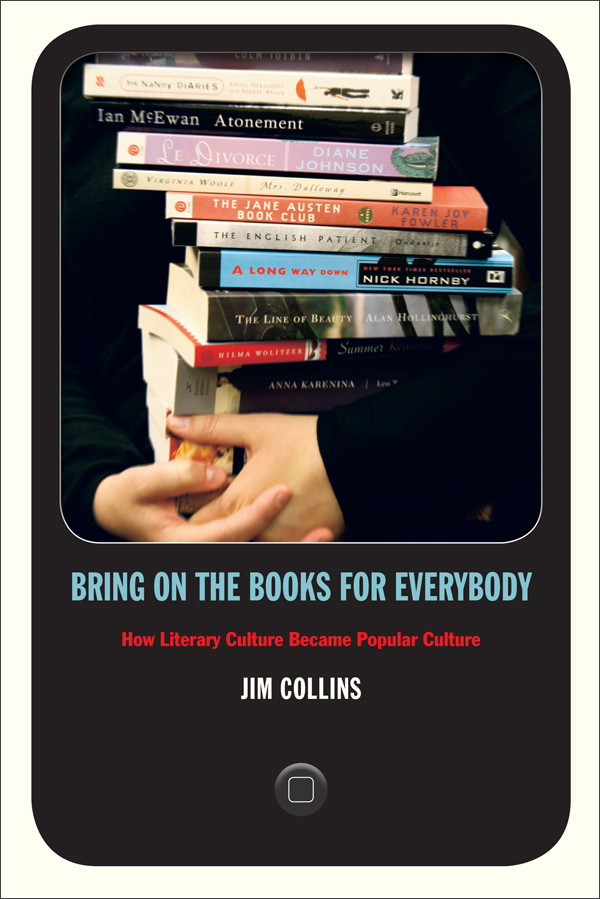
A review of Bring on the Books for Everybody: How Literary Culture Became Popular Culture, Jim Collins, Duke University Press, 2010.

Bring on the BooksI do not want to brag, but I am in a league of my own when it comes to reading habits. I am not a professional reader, teacher, academic, or publisher, and yet I achieved to read 365 books in 2020—the year of the great lockdown. What started out as a silly gambit on January 1st—my “one-book-a-day” challenge—turned out to be a transformative experience. If “frequent readers” are said to read twelve to forty-five books a year, and “avid readers” read fifty or more books a year, I propose to create the category of “voracious reader” for those who read more than a hundred books per year,  and “gargantuan reader” for those who pass the two hundred mark. And yes, like frequent flyers accumulating miles on air travels, we should get bonuses and free books from online bookstores. To be fair, the type of books you put on the count matters. My daughter just read fifty volumes of Detective Conan during a full weekend of binge manga reading. I do not read comic books, and I have a certain aversion for novels and literature. My preference goes to nonfiction, and more specifically to academic books like the ones published by Duke University Press. They take more time to read and assimilate—this is why I did not write 365 book reviews in the year 2020. Reviewing a book requires time and effort: I am not a native English speaker, and I have long lost the habit of writing term papers and class assignments. But writing reviews, and posting them on the internet, makes me feel I am part of a community—a learned society of sorts, or a book club with a membership limited to one.

One-book-a-day challenge

Bring on the Books for Everybody (BoBE for short) focuses on books different from the ones I am usually reading: it deals with literary culture, and takes most of its examples from novels and literary fictions. Its central argument—that ordinary readers and media personalities have seized the means of literary taste production from the hands of the high priests of academia and literary criticism who once maintained the gold standard of literary currency—contradicts my personal infatuation with high theory and arcane academic books. I must confess I prefer to read comments on literature and literary analysis than literature per se. And yet BoBE’s message resonates with the reading practices I have developed. It argues that popular literary culture is now ubiquitous: it is to be found in Barnes & Noble superstores, Amazon reviews, blockbuster adaptations, and television book clubs, as much as in the hallowed grounds of public libraries and academic office shelves. Similarly, theory is not a category limited to academic scholars and is now making a dent in real life, nurturing new forms of activism and self-realization. Reading literature or nonfiction does not compete with other activities such as surfing the web, watching movies on Netflix, or posting messages on social networks: it feeds itself from such activities in a mutually reinforcing manner. Reading is not a solitary act but a social endeavor, enmeshed in webs of communication and commerce that are interpersonal, transnational, and technological. Reading theory or literature is a self-cultivation project that sometimes borders on self-help therapy. Books are a lucrative market and reading practices are shaped by market forces and economic factors.

New reading practices are challenging existing notions of literary authority. Asked which personality reads the most books in a year, the average American may come up with the name of Warren Buffet, Bill Gates, Mark Zuckerberg, or Elon Musk. The academic scholar surrounded by his bookshelves and piling volumes on his desk has been replaced by the capitalist investor, the billionaire philanthropist, the founder of a corporate empire, or the serial entrepreneur. According to Wikipedia, Warren Buffett became America’s most successful investor because he used his voracious reading habit to learn everything there was to know about every industry. Microsoft founder Bill Gates posts his reading list of the past year along with his annual letter to investors. In 2015, Facebook CEO Mark Zuckerberg vowed to read one book every other week “with an emphasis on learning about different cultures, beliefs, histories and technologies.” Young Elon Musk is said to have read for 10 hours each day before growing up to become Tesla CEO. These new reading heroes stand in stark contrast with the college dork, the science nerd, the bookworm, the librarian rat, the armchair theorist, who used to be identified as the most voracious readers. The message they convey is less on which books you should read, but that you should read a lot, and that book reading is somehow connected to economic success and a well-balanced lifestyle. Such individuals seem spectacular to us, almost superhuman. And yet, the apparent enigma in their ability to read a lot amid a very busy schedule spurs the curiosity in us about them even more. We want to know the secret behind their power.

Readers with charisma

Capitalist entrepreneurs and media celebrities have now become the taste arbiters of literary culture. They are challenging existing notions of literary authority and cultural legitimacy. As Jim Collins notes, documenting the rise of a new type of master curators such as Oprah Winfrey or Nancy Pearl, “By the late nineties, literary taste brokers outside the academy could present themselves as superior to an academy that could now simply be ignored.” Academics have painted themselves into a corner of irrelevance and ridicule by sticking to an outmoded model of exclusivity and distinction. The idea that genuine cultivation and proper taste could be secured only through proper instruction and acquired only within the academy didn’t resist the democratization of book guides, reader forums, and amateur circles. Readers were empowered to talk about literary books and form reading communities that didn’t feel intimidated by the traditional discourses of literary appreciation. The discrediting of the academy and the empowering of amateur readers have led to new forms of conversation about books. A new set of players, locations, rituals, and use values for reading literary fiction has emerged on the margins of literary culture. Within this radically secularized conversation, the new cast of curators and readers talk about books in ways that are meaningful to amateur readers, and they have the media technologies at their disposal to make their conversations into robust forms of popular entertainment.

Another central thesis of BoBE is that the literary experience has now become part of our visual culture. Books are a component of a media mix that includes a variety of texts and images: commentary, interviews, cover art, book club flyers, and cinematic adaptations, along with their spin-off products. “What used to be an exclusively print-based activity has become an increasingly image-based activity in which literary reading has been transformed into a variety of possible literary experiences.” Literary value is an important component of the success of high-concept adaptation movies and literary-inspired films: as Miramax producer Harvey Weinstein put it, “our special effects are words.” Within this predominantly visual culture, reading the book has become only one of a host of interlocking literary experiences. New reading practices are changing the public’s expectation concerning just what a literary experience should look like. It now usually comes with a Latte and a proper mise-en-scène. Reading is intertwined with tastes in music, clothing, and entertainment that come as a package: the choice of books, like the choice of wine, interior design, cosmetics, fashion accessories, and cooking utensils, attests to a set of shared values and rituals. A new kind of novels offers an exercise in self-cultivation, affirming the superiority of the reader’s taste culture and self-consciously reinventing the novel of manners for contemporary audiences. Even Jane Austen or Henry James can be read as self-help manuals for busy millennials: contemporary readers still use them as primers about the world, as introductory courses in graceful living.

From literature to theory

My reading practices are different from the ones surveyed in BoBE. I don’t take my cues on what to read from TV celebrities or corporate CEOs. Although I concentrate on scholarly books, I don’t follow an academic syllabus or a prescribed reading list. I don’t have a political agenda to document and sustain. I don’t need a caste of high priests to tell me what to read and how to read it. I make mine Martin Luther’s formula to trust only the scriptures, Sola Scriptura. My choice of books is serendipitous and owes much to the availability of second-hand books on internet platforms or discount bookstores. In concentrating on books published by Duke University Press and other academic publishers, I try to challenge not only the boundaries between the disciplines but, more importantly, the boundary between the academy and the world outside. I try to make academic books relevant for daily life and casual conversations. My reading of academic books is definitely non-academic. I do not skim volumes or skip chapters; I tend to read from the first to the last page. I don’t take notes, but I underscore important sentences or paragraphs with a pen and a ruler. It helps me process mentally the content of the book and to increase my retention rate. This way I can peruse the underscored parts in a second reading and get the gist of the book in a summary. Inscribing my mark on the pages of a book also makes it clear who is the boss. Some books are meant to be read as a struggle, and you definitively want to be on top. I feel perfectly comfortable taking on books that are supposed to be fully accessible only to professional readers. If I don’t understand the book’s content, I blame the author, not me.

New technologies have an influence on the way I read. I started to write book reviews on Amazon, developing on a writing habit I had picked up as a student. BoBE mentions the history of Amazon’s curatorial activities: reviews, articles, and interviews that were originally drafted by an editorial team have been progressively replaced by customer-generated content and algorithms linking customers sharing similar tastes (“Customers who bought this book also bought…”). The book also refers to new technologies of taste acquisition that empower amateur readers to assume the role of curators of their own archives. The website Goodreads (owned by Amazon) allows to track one’s readings, to set book lists and reading challenges for the upcoming year, and to arrange one’s library as an extension of one’s self. The solitary act of reading a book has been transformed by the advent of reader comments, star ratings, and customer evaluations. According to Jim Collins, “The desire to make those evaluations public demonstrates that the need to display one’s personal taste in terms of the books one chooses to read forms an essential part of the pleasures of reading.” People will greatly enjoy reading a whole lot more if they start telling people about what they have read. The author, who used to be a distant figure one approached reverently, now maintains a familiar presence on social networks. Nothing gives me more joy than getting positive feedback from an author on a book review I have advertised on Twitter.

The Duke Reader

So why Duke University Press? This relatively obscure publishing house has recently attracted a fair share of media attention: its editor, Ken Wissoker, as well as two of its star authors, Lauren Berlant and Donna Haraway, have been chronicled in The New Yorker. As the author of the first portrait notes, “Duke has become known as a press that blends scholarly rigor with conceptual risk-taking, where high and low art boldly intermingle on principle.” The history of Duke University Press is, partly, the history of cultural studies in the United States. It is not attached to one discipline: as an example, it is difficult to categorize BoBE between literary criticism, film studies, and the sociology of reception. Duke publishes a steady stream of volumes anchored in the social science disciplines: sociology, anthropology, history, and literary criticism. It is also open to the new disciplines that have flourished in the margins of academia: media studies, sound studies, gender studies, queer theory, critical race studies, disability studies. It is not the preserve of tenured professors and established authors: its catalogue is open to junior faculty, adjuncts, and members of the intellectual proletariat. Part of the story of how Black Lives Matter and the #MeToo movement came to the academy goes through Duke Press. It is one of the few academic presses with crossover appeal: because its editorial line is so cutting-edge, it can make interventions in contemporary debates beyond the purview of American academy. Through The Duke Reader, I am happy to associate myself with its development.

A Typology of Filipino Women

A review of Transpacific Feminities: The Making of the Modern Filipina, Denise Cruz, Duke University Press, 2012.

Transpacific feminitiesOrientalism grew out of a fascination with Asian women. From the scantily dressed harem recluse to the romantic Madame Butterfly figure, from the mousmé to the congaï, or from houri to geisha, the Western male gaze was literally obsessed by Asian female bodies, and constructed its vision of the Orient around figures of stereotyped female characters. Philippines’ women or Filipinas stood in a peculiar position with regard to these Orientalist wet dreams. They never fully fit the category of the Oriental woman as popularly conceived. Neither black nor yellow, the term used to describe her racial identity is “brown”. When traveling abroad, she is often taken for a Chinese, a Vietnamese, an Indonesian, an Indian, a Mexican, or a South American. Even now, mentioning Filipinas in a Western context brings to mind images of overseas care workers, domestic helpers, mail-order brides, or leading politicians such as the flamboyant Imelda Marcos or the stubborn Cory Aquino. Filipinas never coalesce around one single category. They escape the attempt to hold them as representative exhibits of an Asian feminity that would define a distinct type of Orientalist fantasy. As domestic workers, they cultivate invisibility and diligence. As politicians and heads of state, they embody leadership and prominence. As mail-order brides, what is conspicuous about them is not their sex-appeal but their subservient attitude and willingness to do household chores or sustain a family in depleted rural areas. There seems to be no middle ground or common features between these polarized figures. None evokes the sexual desires, eroticism, and male fantasies that otherwise characterize Orientalist visions of Asian bodies.
Racial constructions

Unsuccessful attempts to reduce Filipinas to a single stereotype are not new. Categories to designate them were always plural. In the Spanish colonial era filipino had referred to Spanish creoles, those of Spanish ancestry born in the colony, while indios were the locals of Malay ancestry. The term mestizo could refer to someone of Spanish and indio birth but more often meant a racial mixture with indio and chino or Chinese elements. Non-Christian peoples like the Negritos and Igorots, who lived in the highlands, were considered as infieles, that is, animists or infidels, and their hunter-gatherer societies were held as most backward and primitive. Muslim peoples in the South were grouped under the category Moros or Moors, and were in perpetual conflict with the Spaniards. These ethnic categories gave rise to enduring types of Filipino women: the Spanish mestiza, the pure-blood morena, the Sinicized chinita, the dark-skinned negrita… Americans who took over from Spain after 1898 added their own racial constructions to this imperial mix. The “Filipino savage” who went bare-breasted and wore a banana-leaf skirt was seen as a nonwhite other whose alterity incorporated imaginaries cast from the conquest of the New World, the annihilation of Indian native cultures, and the legacy of African slavery in America. The Spanish-speaking Doña was perceived as aristocratic, virtuous, dutiful, and subservient, forever in the thrall of the Catholic Church. The modern Filipino girl was the most amenable to the rule of empire: she benefited from access to enlightened education, transatlantic mobility, and emancipatory sisterhood with white women. She was the young lady waiting for a chivalric savior, and cultural salvation was what Americans intended to procure under their policy of benevolent assimilation.

Denise Cruz’s Transpacific Feminities explores many topics and episodes: the typologies that were made by Filipinos and Filipinas themselves in the context of the discussions leading to female suffrage in 1937; the exclusion of women from the national debates about proper language for literary expression; the emergence of the urban, transpacific college girl who flouted traditional forms of proper feminine behavior; the challenge posed by Japanese occupation that cast women as victims or, in the case of ‘Colonel Yay’, as freedom fighters; and the role of transpacific Filipinas in the Cold War context. The figure of Maria Clara, the heroin of José Rizal’s novel Noli Me Tangere, casts a long shadow over the place of women in Philippine society. Recognized by many literary scholars as the first novel by a Filipino, this satire of Spanish imperialism was written in Spanish and published in Germany in 1887 to avoid censorship. It tells the story of a failed romance between Maria Clara and Crisóstomo Ibarra, a mestizo who returns to the Philippines after years abroad with a European education and a desire to spread reform by establishing a new school in his hometown. Ibarra’s school never materializes, for he becomes implicated in both familial and revolutionary plots that interrupt his ambitious plans and end his engagement to Maria Clara. After more twists and turns, the heroin enters a convent, where nuns are subjected to medieval treatment. This female character has become a classic figure in Filipino culture. For some, she represented everything a Filipina should be: modest and chaste, homebound and subservient. For others, she was the epitome of a dying tradition, symbolic of the shackles of Spanish catholic rule. Her mestiza status is unsettled by a horrible secret: she is the illegitimate daughter of a Spanish friar who abused his mother and then became the girl’s godfather. Noli Me Tangere (“touch me not” in Latin) has become part of the national curriculum, and in its English or Tagalog versions it is still compulsory reading for high school students.

Desiring subjects of empire

Filipinas were thought to be more amenable to the civilizing influence of the United States than men. American women in particular cast themselves as saviors and emancipators of their oppressed “little sisters” and described them as symbols of oppressed women in need of rescue. Domestic authors developed a critique of the American-produced constructs of Filipino feminity as desiring subjects of empire. As an alternative, they promoted a version of elite transpacific feminity that drew from the best of multiple worlds. Commentators took great care to distinguish their fellow countrywomen from Orientalized notions of Asian women as either mysterious and exotic damsels or as uncivilized savages in need of salvation by the West. In their view, model Filipinas maintained an ideal balance between the modern and the traditional, between East and West, and between Anglo-saxon, Latin, and native cultures. They resisted the imperial project of assimilation and maintained a kind a counter-narrative to rising American hegemony. But justifying resistance and autonomy by using the English language came dangerously close to accepting the legitimacy of U.S. rule. The role of English in an independent Philippines republic was vehemently debated in the 1930s and 1940s. Colonial languages were hegemonic, as English was seen as the new lingua franca of the intelligentsia and Spanish was still used in legal proceedings and worldly conversations.  In 1937, Tagalog was instituted as the national language but still had to compete with many vernacular languages and dialects regularly used by the Philippines population. For writers, using English was a means to join a transpacific commonwealth of educated readers and writers; but they could not escape a nagging sense that the literature they were producing was disconnected from the socioeconomic realities of life in the Philippines. As in other national contexts, a separation emerged between ‘high’ and ‘low’ literature, between ‘popular’ and ‘artistic’ writing that tended to overlap the distinction between English and Tagalog. But even though women were early producers of literature in English, male authors tended to sideline them in their debates about language and literature, and they portrayed women’s literary efforts as inferior and unremarkable. To the misogynist essay “What Is Wrong With Our Women Writers?”, two feminist authors responded in 1941 with an article titled “Our Men Writers Are Not So Hot.” The emerging canon of literature in English that emerged from these early years comprises mostly male authors: Manuel Arguilla, Bienvenido N. Santos, Nick Joaquin, Carlos Bulosan, N.V.M. Gonzales… But women writers were nowhere to be found in this roster of national literature in English.

The rise of the university-educated, Western-influenced, transpacific Filipino coed ushered a debate what it meant to be Filipina in an independent Philippines and how it related to the new constitution and universal suffrage. Three decades of occupation by the United States had provided educational and professional opportunities for many Filipinas, who fell under the spell of American culture’s influence. Young Filipina coeds imitated what they read in magazine pages and saw on movie screens: bobbed hair, short skirts, plucked eyebrows, painted lips. Modern girls were by this time a global regularity, appearing almost simultaneously in China, Japan, India, the United States, Great Britain, and other countries. Like her counterparts, the transpacific Filipina coed elicited both admiration and anxiety. Transgressive expressions of sexuality—going out without the supervision of a chaperone, dancing cheek-to-cheek and kissing in public—gave rise to attempts to stop the influx of popular culture from the United States and delineate women’s proper role. Scathing articles blamed the coed for the disintegration of Philippine morality. By reply, Filipina feminists called for recognition of educated women’s contribution to families, to communities and to society as a whole. Novels and short stories were used to negotiate unclear and indeterminate national fates and recalibrate a class hierarchy that was continuously fluctuating because of imperial shifts. Romance was the genre of choice to disseminate imperial narratives of benevolent assimilation and imagine the subversion of hegemonic formations. It was linked both to empire building and to its undoing by nationalist forces and individual aspirations.

Creating a national archive in English

Denise Cruz’s approach to her topic is very much dependent on the material she selects as her archive. She draws from a wide variety of sources—novels, memoirs, essays, newspaper articles, magazine illustrations—but, with the exception of José Rizal’s Spanish language novel Noli Me Tangere, she only uses texts written in English. She notes that authors were publishing in English only two decades after the U.S. occupation began, and that women were particularly active in this field because of the educational opportunities that were created by the American occupation. What defines the transpacific Filipino is, more than any social or psychological trait, the use of English in a cosmopolitan setting. The writers examined in this book were part of a privileged group, those who lived in Manila, who had access to a university education, who travelled abroad, and who spoke and read English. Promoting the use of English was an integral part of the American imperial project. The Japanese were highly conscious of this point, and severely restricted publications in English during their short-lived occupation. Philippines literature in English was the product of a deliberate design to spread liberal values and democratic mores through education and assimilation. Instruction in English, the establishment of English as the national language, and opportunities to study in the United States were part of this imperial design. The use of language itself as a strategy for rule was closely tied with the packaging of the American presence in the Philippines as a magnanimous civilizing enterprise. By choosing English to couch on paper their dreams, hopes and aspirations, these Filipino women examined in Transpacific Feminities transformed themselves willingly into the desiring subjects that the American empire was attempting to mold.

Isn’t there a similar work at play in today’s world? As the author notes, the recognition of the United States as an empire has now become a regular feature of academic discourse. But the notion of cultural imperialism still faces much resistance or denial, and the fact that the English language constitutes the main tool for this imperial hegemony is often overlooked. By choosing to restrict her archive to texts written in English and by examining the case of English-speaking Filipina authors, Denise Cruz partakes in in a new kind of imperial project that does not bear its name. Transpacific feminities are reduced to those forms of women’s expression that are directly accessible to an English language reader. These women may have spoken multiple languages, from the old colonial Spanish to the new national Tagalog, or from French and German to Cantonese, Japanese, as well as other domestic dialects, but they are only considered within the limitation of one single parameter: their use of English as a mean of written expression. Other idioms indigenous to the Philippines or used in worldly conversations are silenced and relegated to the margins. The United States considered themselves as the gatekeeper of women’s liberation in their empire; in a way, Anglo-American academics still play this role by deciding which texts should be worthy of archival consideration and which should be left in perpetual oblivion.

Literary value

The author of Transpacific Feminities boasts of having recovered an untapped archive of Philippines literature in English that has remained hitherto forgotten and understudied. Merging archive recovery with feminist analysis, she advocates additions to an Asia Pacific literary cannon that, at least for the period under consideration, is (in her opinion) too often limited to male nationalist authors. But one could object that these texts written in English were not abundant and sophisticate enough to sustain a national literary tradition. Readership in English was reduced to a small segment of the elite. This may explain why Filipino authors often tried to reach out beyond their country’s shores. Many publications were edited by expatriates and geared in part toward the American community. The goal was to convince the American public to share the benefits of empire, or to grant the Philippines the independence and individual rights for which its people craved. Including new archives into a cannon or a reading list should include considerations of literary value and intrinsic quality. But as far as I can judge from the few excerpts and plot summaries, the literary fictions that are surveyed in this book seem to me of appalling mediocrity. I subscribe to the judgment of a critic who characterized a novel by Felicidad Ocampo as “an entertaining little tale, providing he does not read it with too critical an attitude.” Besides, Daniele Cruz is the first to point out that the language used in these stories was often deficient. By inserting the editing term “sic” in bracketed form in many direct quotes from the texts, she underscores the misusage of English and improper spelling or grammar in a way that can only be read as patronizing. Filipino and Filipina authors who tried their best to use the language of empire didn’t need to be exposed to such ignominy. As a non-native speaker, I sympathize with their plight.

Portrait of the Anthropologist a an Art Curator

A review of Anthropology in the Meantime: Experimental Ethnography, Theory, and Method for the Twenty-First Century, Michael M. J. Fischer, Duke University Press, 2018.

MeantimeAnthropology in the Meantime is a collection of essays by Michael Fischer that have been previously published in scholarly journals, edited volumes, or art catalogues. They have been substantially revised and rewritten for this edition in a book series, Experimental Futures, that the author curates at Duke University Press. Indeed, “curating” is the right word for describing Michael Fischer’s work: he fancies himself as an art specialist, using books as his personal gallery, and conceives of anthropology as akin to art critique or even as artistic performance, as evidenced by his circumlocutory writing style and his conception of fieldwork. In the art world, the title of “curator” identifies a person who selects and often interprets different works of art. In contemporary art, curators can make or break an artist’s career by their choice of works to display and of words to accompany them. In some cases, their celebrity can even eclipse that of the artists they work with. By donning the mantle of the art curator, the anthropologist attempts to weigh on what counts as (to quote the book’s subtitle) “ethnography, theory, and method for the twenty-first century.” Michael Fischer presents the work of his students and close associates, pays tribute to some of the big names in the discipline that he was privileged to work with, and recounts his own random walk through the past fifty years of anthropological research. Throughout this volume, he emphasizes the commonalities between anthropology and art. He claims in the introductory chapter that “ethnographers as literary forms are like novels, except they have to stick to reality”; “like anthropologists, artists have feet in several worlds” and the work of art “is often itself an ethnographic register of contemporary matters of concern.” Many readers will have first noticed Anthropology in the Meantime by its book cover, a striking Japanese woodblock print which represents a samurai about to commit seppuku. There is no connection between this artwork and the book content (nobody is going to commit suicide here, and references to Japan are sparse), except from the fact that this ukiyo-e comes from the personal collection of the author. Several other artistic belongings of the author are reproduced or referred to in the volume; and Michael Fischer claims that he chose the artwork cover of a recent bestseller in the same book series, Donna Haraway’s Staying with the Trouble, from a solo exhibition by Filipino artist Geraldine Javier, whose Chthulu-like creature was not inconsequential in the success of Haraway’s book.

Twice present at the creation

The curator or the art critic often claim for themselves a special relation with regard to art history. They were present at critical junctures, rubbed shoulders with time-defining artists before they became famous, and contributed to the build-up of their fame or the make-up of their value through critical interventions. They were the first to put names and labels on emerging trends and styles, thereby contributing to the creation of the various schools and artistic currents that are later remembered and celebrated in art history. Michael Fischer inserts in his chapters some biographical vignettes or snippets that attest his special position in anthropology’s recent history. He was twice present at the creation: he attended as an undergraduate the famous John Hopkins University’s conference in 1966 during which the word ‘poststructuralism’ was coined, and he was one of the contributing authors of the 1986 volume Writing Culture. This seminal book grew out of a week-long seminar at the School for American Research at Santa Fe, and in a fun piece Michael Fischer retranscripts the imaginary interventions of the book contributors, designated simply by their initials but early recognizable. But these were not the only times when Michael Fischer stood among giants and witnessed major turning points in the discipline. He wrote his PhD at the University of Chicago when Hannah Arendt and Clifford Geertz were on the faculty and Paul Rabinow was a fellow graduate student, and then moved to Harvard during the controversy over sociobiology and recombinant DNA. He was then recruited by George Marcus (the editor of Writing Culture) to join the Anthropology Department at Rice University, where he chaired the Rice Center for Cultural Study that became a hotbed for cross-disciplinary studies. An important turning point in his career, and for the discipline as a whole, coincided with his move to MIT, where he became Director of the Program in Science, Technology and Society. STS became the new frontier in anthropology and Michael Fischer was in the thick of it, teaching with Arthur Kleinman at the Harvard Medical School and becoming the coeditor of the book series Experimental Futures at Duke University Press. At the time this book was assembled, Michael Fischer was sharing his time between MIT and the National University of Singapore, where he was invited as Visiting Research Professor by some of his former students.

Like currency, the monetary value of art is based on convention: price is determined by an artist’s exhibition and sales record, importance and standing in art history, and ability to seize a certain Zeitgeist. Michael Fischer participates in the construction of disciplinary value in anthropology. He highlights the relevance of his book series by referring to previously published volumes and providing short summaries of their content. He advances the careers of his graduate students by emphasizing their contribution to anthropological knowledge. He caters to his own interest and reputation by detailing his own career path, which made him cross the way of, and rub shoulders with, giants in the field of academia. He uses the homage and the laudatory essay addressed to former colleagues and professors to praise and to aggrandize, but also to sideline and to bury, sometimes even to mock and to revile. He defines what’s hot and what’s not in modern anthropology, which happens to be the area in which he put his most recent investments. Constantly on the lookout for emerging trends and new currents, he uses the three C’s performed by art critics: commentary, criticism, critique. An artist’s inclusion in an important gallery and museum show can boost price and reputation: the same is true for edited volumes, which have a higher reputational impact than articles published in refereed journals (although the selection process is sometimes less rigorous and based on personal connections.) Michael Fischer is forever graced with the privilege of having written an essay for the 1986 book Writing Culture. He revels in that memory, bathes in the glow produced by this epoch-making volume, and keeps the fire alive by participating in anniversary essays and commemorations. He tries to recoup his erstwhile performance by proposing entries in edited volumes that hold the potential to redefine the parameters of the discipline:  such is, in my opinion, the book The Ground Between: Anthropologists Engage Philosophy, which was published in 2014 by the same Duke University Press and which I reviewed here. Needless to say, Michael Fischer’s contribution didn’t appear to me as the most memorable chapter in this volume.

Experimental ethnography

There were days when anthropologists were experimenting with various forms of writing and expressing while breaking scholarly traditions of orderly debates and publications. Fischer is proud to belong to that cohort of experimental authors who attempted to rewrite culture, and he himself experimented with various forms of writing tactics and media interventions. In a chapter titled “Experimental ethnography in ink, light, sound, and performance”, he lists the various attempts at creative ethnography-making that have characterized the recent decades, including filmmaking, photography, sound recording, fiction writing, theater and performance, and digital media. Research methods and what counts as fieldwork have also changed tremendously over the course of Fischer’s career. Today’s ethnographies are often multilocale and multiscale, moving from ground to theory and from micro to macro to address global processes of distributed value chains or flexible citizenship. They explore written archives and textual evidence, not just dialogic face-to-face contexts of human interaction. They also cater to nonhuman species and other nonhuman actors, living or artifacts, in a general theory that grants political agency and constitutive power to things. According to Fischer, the most exciting modern ethnographies address “the peopling of technologies”, the grounding of theory (“ground-truthing”) and the humanizing of science through digital humanities and science and technology studies. His career illustrates the shift in the focus of the discipline from a literary approach of cultural matters (“writing culture”) to a more recent involvement with scientific and technological assemblages. But he remained true to his former creed of avant-garde experimentalism: he sees himself and his cohort of graduate students as being at the cutting-edge of the discipline, and is forever willing to experiment and to innovate. He is also anxious not to miss the next new thing or not to mistake a passing fad or a false lead with an epistemological breakthrough. Remembering the seminal symposium at John Hopkins where Derrida, Barthes and Lacan had discussed structuralism, he casts Bruno Latour, Viveiro de Castro and Philippe Descola in the role of these old French luminaries and dedicates one chapter to “the so-called ontological turn”, which “became a hot topic at the American Anthropological Association meeting in 2013” (he concludes these discussions were just “fables and language games”).

After the turn of anthropology toward science and technology that he helped bring forward from his perch at MIT, Michael Fischer detects another shift, evidenced both in his career and in the broader discipline: the turn toward Asia. He notes that his own fieldwork and ethnographic work “has slowly shifted eastward from once upon a time in Jamaica to Iran, India, and now Southeast Asia.” He claims he was present at critical junctures in the history of these countries: he was doing fieldwork in Iran shortly before the Islamic revolution, and he was in India the year Indira Gandhi was assassinated and the Bhopal disaster took place. Unlike Clifford Geertz, who was accused of political blindness in the face of the 1965 massacres that tore Indonesia apart, Fischer claims he saw it coming, and that he was in a special position to interpret events as they unfolded. He underscores that “much of the future imaginary is located in Asia,” from current disasters such as avian influenza and other pandemics to intensifying threats of extreme climatic events and rising sea levels, not to mention industrial catastrophes such as Bhopal and Fukushima or geopolitical faultiness that are bringing the region to the brink of nuclear war. In the art world too, Asia is the place where things are happening. Art follows the money: there is an economic law enunciating that financial marketplaces, and these places only, can become global hubs for contemporary art. Fischer’s vocation as an art critic seems to have arisen from his contacts with Asian artists and performers. What began as a habit of illustrating powerpoint presentations with artworks (his contribution to a Clifford Geertz’s festschrift had illustrations “from cockfight to buzkashi”) evolved into a form of art criticism that he describes as “anthropological readings of novels, paintings, and films.” Fischer wrote a book on Iranian cinema at the time when a new generation of filmmakers (Abbas Kiarostami, Mohsen Makhmalbaf, Jafar Panahi…) started to emerge from that country, and he provided entries into exhibition catalogues of Asian artists during his residence in Singapore. He claims that literature, films, and arts can provide ethnographic registers: “My own sense is that there is more to be learned here about playing the scales of culture than from flat-footed talk of global assemblages, neoliberalisms, hybridities, and the like.”

Humanity’s futures

Beyond the name-dropping and memorabilia, art curators must also be able to read through the fog of information and images in order to form an appropriate picture of the times in which we are living. In order to define what is contemporary art and what isn’t, critics must first understand what “the contemporary” is. For Michael Fischer, writing around 2017, we live in a time warp akin to 1633, the year Galileo was condemned by the Roman Inquisition for affirming that the earth wasn’t at the center of the solar system, a theory first advanced by Copernicus. According to Freud, humanity’s narcissism received three blows in the course of modern history, associated with the names of Copernicus (the earth is not at the center of the universe), Darwin (man descents from the animal), and himself (the ego is not even master in his own house). We are witnessing the times in which the fourth blow is delivered, bearing the name of the Anthropocene: considering the rate of natural resources depletion and the alteration of earth system processes, we may not inhabit this planet for long. This realization may have triggered Fischer’s latest interest, at the crossroad between his previous involvements with science and technology studies and with literature criticism: reading Sci-Fi novels from Asian authors. As he notes, “science fiction stories from Asia merge in and out of our contemporary dreaming, nightmares, and experiential emotions, along with current industrial and nuclear age disasters and toxicities.” Asian sci-fi novels often stage an exit from humanity: when humans start to colonize space or learn to live underwater to escape a toxic earthly environment, they cease to be humans. Fischer sees that evolution underway: Singapore is testing and prototyping buildings from the seabed upward to expand its living spaces, while China is studying the genetic mutations that allow Tibetans to live at high altitudes, supposedly to prepare to a world with much higher sea levels in which lowlanders would migrate to the deserted highlands of Xinjiang and Tibet. Humanity would thus escape the problems of the Anthropocene by returning life to the oceans from which it came, or by colonizing the regions that were once deemed inhospitable to life. Meanwhile, the Pacific island nations where Bronislaw Malinowski, Margaret Mead, and other founders of anthropology first did their fieldwork would have long disappeared from the surface of the earth.

Fischer’s conception of anthropology is attuned to the future (remember the title of his book series, Experimental Futures), not to the past. Echoing Immanuel Kant, he defines the task of anthropology from a pragmatic point of view as: “Ask not what the human being or the world is but what we may expect of them—and of them in the plural.” Anthropology in the Meantime is the study of the emergent forms of life coming “out of the chrysalis of the twentieth century”: it is “the ethnography of how the pieces of the world interact, fit together or clash, generating complex unforeseen consequences, reinforcing cultural resonances, and causing social ruptures.” His interest in the arts also covers only the contemporary and the cutting edge, not the classical forms or the artworks bequeathed by history. But through the ethnographies of the world’s pieces, we fail to see the big picture, and our vision of the locale seems to disintegrate into the shattered surfaces of a kaleidoscope. Fischer claims to have done fieldwork in Asia over the last decade “from a perch in Singapore with forays elsewhere.” But the only empirical material he offers are accounts of his visits to art centers or “small ethnographic notes” taken from the classroom at Tembusu college (where Singapore students are “holding textbooks open with one hand, and with the other checking their teacher’s archived video lectures on their smartphones”). He only offers vignettes or personal anecdotes by way of firsthand observations. The rest is composed of lengthy discussions of other people’s ethnographies or references to his previous fieldworks in various terrains. He lists his own past publications as if they addressed empirical issues thoroughly and offered “concept-work” that allowed the “ground-truthing” of his current forays. But a quick look at some of his articles listed in the bibliography shows that the empirical content of his field-based ethnographies were always rather thin, and that the concepts he lists profusely at the beginning of each chapter or in the body of the text are never defined or clarified. While I first thought he made his career out of previously accumulated capital, making good use of previous fieldwork observations and theory building, I get the impression that his references are just that: self-references. His “zen exercises in theory making” might be evocative or even illuminating for some, but they didn’t led me to enlightenment. In this respect, reading Akashi Gidayu’s death poem on the book cover (“As I am about to enter the ranks of those who disobey/ ever more brightly shines/ the moon of the summer night”) was more fulfilling.

Wanted: proof-reader with a command of French and Japanese

As a last remark, I couldn’t get used to Michael Fischer’s writing style. He retained from his entry into the volume Writing Culture (“a trio of essays on ethnicity, torn religions, and science articulated through monologic, double-voiced, and triangulated autobiographic genre perspectives”) a peculiar and idiosyncratic rhetoric, with turgid and verbose expressions that require close attention but yield little intellectual payoff. He was right to note that Clifford Geertz, his former mentor at Chicago, was “one of the great stylists writing in anthropology, and [that he] achieved global recognition by way of it.” The same certainly cannot be said of Michael Fischer. He borrows from literary criticism the mania to split words with hyphens to point toward etymology and emphasize multiple meanings: ‘con-fusion’, ‘con-texts’. He also repeats the curious habit (or is it a typographical error?) of separating hyphenated expressions or compound words into two distinct words: ‘front line’, ‘key words’, ’policy making’, ‘science fiction’. I didn’t detect many typos or misspelled words in English due to the power of modern editing softwares; but spellcheckers do not detect errors in foreign languages, which are numerous in the two chapters that were specifically drafted for this volume. In the introductory chapter, Fischer states (and repeats twice, no doubt to emphasize his German language skills) that “nothing is worse than a period film about Vienna where the actors speak with Berlin or Hannover accents and idioms—hard to take it seriously.” But what is one to say about his repeated misspelling of French words or distorting of Japanese expressions—like his breaches of proper writing style, I tend to take it personally. In the prologue, l’homme total is feminized as l’homme totale, hara-kiri becomes hari-kari, and a parergon is misspelled as paregon. In the epilogue, which includes discussions on art and ethnographies originating from Japan, manga becomes magna, furusato is mistyped as furusatu, hikikomori are rendered as hikkihomori, and proper nouns like Ishiguro or Bakabon become Ishiguru and bakagon. These are errors that simple proof-reading would have detected; their presence in an ethnography or a scholarly book makes it hard to take it seriously.

Taking On the Anthropologist At His Own Game

A review of Morocco Bound: Disorienting America’s Maghreb, from Casablanca to the Marrakech Express, Brian T. Edwards, Duke University Press, 2005.

MoroccoThere are two types of anthropologists: those who have done fieldwork and those who haven’t. Only the former can fully bear the title of anthropologist. They have been ordained through the same rites of passage: they have been there, seen places, and have come back with the field notes and observations they can subsequently transform into a book. This marks their full entry into the profession: they will no longer have to return to the field for extended periods, as they can revisit the same material from a distance or through occasional visits. Bearing the talisman of their ordination, they can bar entry to the profession to those who haven’t been through the same ordeal. It doesn’t matter that these outsiders may have acquired an extensive knowledge of the anthropology literature or mastered the ropes and codes of the discipline: they are kept outside the tent, and forced to find other disciplinary affiliations. Many find refuge in literature departments, or under the broad canvas of cultural studies. There they may pursue their work in relatively unhindered ways, developing a critical dialogue with other, more patrolled disciplines in the social sciences. They may borrow from the toolbox and writing techniques of anthropologists to develop a view from afar, which they often turn to their own environment and surroundings in a kind of reflexive engagement. For all practical purposes, they are anthropologists in all but name.
An anthropologist in all but name

Such is the case with the author of the book under review. At the time of its publication, Brian T. Edwards was Assistant Professor of English and Comparative Literary Studies at Northwestern University. He defines himself as an Americanist–not in the anthropological sense of the word, which designates an ethnographer who specializes in Indian-American societies–, but as a contributor to American studies, a broad discipline encompassing both American literature and cinema as well as the wider historical context of US society and politics. The author contributes to this discipline by discussing American cultural productions, and by illustrating the pregnancy of central tenets of American identity: the notion of the frontier, the issue of race, the ambivalent attitude towards colonization, and the peculiar way America engages with the world at large. His discussion is bound in space and time: it focusses on Morocco from World War II’s North African campaign to the hippies taking the “Marrakech Express” to escape conscription during the Vietnam war. It examines a variety of texts and media: novels, poetry, but also Hollywood movies, musical recordings, anthropology texts, and diplomatic archives.

The choice of the book’s title is a testimony to the author’s cultural deftness. In fact, he borrows it from a Bing Crosby comedy, in which the theme song, “We’re Morocco Bound,” puns on the two dictionary meanings of the word “Morocco”: the name of the country in northwest Africa and, with a small m, a fine leather used in bookbinding. “Like a set of Shakespeare, we’re Morocco bound”, sings Crosby. As the author comments, to be “Morocco bound”, that is, to be on one’s way to Morocco as an American, “suggests that Morocco itself is bound in webs of representations.” The subtitle, “Disorienting America’s Maghreb,” points towards Edward Said’s critique of Orientalism, defined as “a long Western tradition of literary and scholarly representations of a region named (by the West) ‘the Orient’ that corresponds with Western political domination of the land to the South and East of the Mediterranean.” “Dis-orienting” America’s perception of the Maghreb means blurring the boundaries and unsetting the ethnocentrism at work in American perceptions of the Orient. It also means giving a twist or a sense of queerness to American identity by suggesting other forms of belonging not necessarily linked to the nation-state.

Unsetting the ethnocentrism at work in American perceptions of the Orient

As Edward Said pointed out, with global ascendency in World War II, the United States assumed the European mantle of thinking about the world. With a new sense of responsibility in world’s affairs, cultural and political discourse overlapped to project a worldview shaped by historical experience (the myth of the frontier, American Indians, the American century, racial discrimination) and Hollywood scripts. In the 1930s, a spate of popular movies, with titles like The Sheik, Prisoner of the Desert, Beau Geste, or Princesse Tam-Tam, portrayed the Maghreb as the Oriental other. Disembarking on Moroccan shores in November 1942, General Patton described Casablanca as “a city which combines Hollywood and the Bible”. Casablanca was of course the setting of the Warner Bros movie featuring Humphrey Bogart, which concluded with “the beginning of a beautiful friendship” between the United States and French colonialism. For Americans, the background presence of the French was an integral part of the foreignness of North Africa, as French language and viewpoints framed their perceptions of the Maghreb.

Edward Said also noted that American popular attention to regions of the world works in “spurts”–“great masses of rhetoric and huge resources, followed by virtual silence”. Before 1973, when American attention turned more decidedly toward the Middle East, representations of the Maghreb played a leading role in the formation of popular American ideas about the Arabs. Morocco occupied a peculiar place in this setting: with its openness to the foreign and political stability, it had long been a place of fascination and fantasy, attracting American tourists or Hollywood cinema crews. During the postwar period, it offered shelter to successive waves of cultural misfits and eccentrics, from artists in exile or Harlem Renaissance figures to hippies and beatniks.

A place of fascination and fantasy

But the Orient was not only a passive screen for American projections. It modified America’s self-perception–African-American soldiers came back emboldened with a new taste for freedom after World War II campaigns. Representations of the foreign played a special role in rethinking the meaning of American national identity. In particular, Tangier, which remained until 1960 a free port and a tax haven with its internationally administered zone and extraterritorial status, posed a challenge to the hegemony of the national(ist) vision. Hence its reputation of queerness among American journalists and critics. That such a location would be tolerant of homosexuality and the open use of cannabis added to the threat toward the dominant national narrative of the period. Edwards’s reading of William Burrough’s Naked Lunch, written in 1959 while the poet was in residence in the city, emphasizes the sense of subversive potentiality in the international formations of Tangier. Rereading Naked Lunch in its Tangier context highlights its sense of immediacy and political potentiality.

Edwards’s ambition is to “imagine alternative possibilities for an American encounter with the world.” By following American representations of the Maghreb into Maghrebi cultural productions, and in examining moments of actual collaboration between Americans and Moroccans, he operates a rare gesture in American studies by performing the detour through the other. He is not only looking at us looking at them: he also looks at them looking back. Oriental actors are by no way passive subjects: they critically reinterpret American cultural productions, and “talk back” by returning to the sender the postcards and clichés projected on the North African screen. Edwards tracks the debates among Moroccan intellectuals triggered by American cultural productions. He attends to Moroccan recreations of the film Casablanca in touristic waterholes or local artsy movies; he comments the obituaries published in Arabic at the time of Paul Bowles’s death; and he gives voice to local reactions towards Clifford Geertz’s interpretation of cultures. He also describes precious occurrences of transcultural collaboration: Ornette Coleman’s project with the Master Musicians of Jajouka, Paul Bowles’s joint works of fiction with the illiterate Moroccan artist Mohammed Mrabet, or the traces of the informant’s voice in the anthropologist’s discourse.

An anthropological playground

Morocco also occupies a key role in the development of U.S. cultural anthropology. The figure of the anthropologist was a common sight in the Moroccan landscape. He features as a character in several novels by Paul Bowles or his wife Jane. Mrabet, Bowles’s long time collaborator, had been an anthropologist’s informant, and the joint books published based on taped recordings of their conversations are close to ethnographic field notes. Morocco was firmly put on the map of American anthropology when Clifford Geertz set shop in Sefrou in the beginning of the sixties. This, too, was the beginning of a beautiful friendship: Geertz not only revisited the place regularly, he sent there scores of graduate students, who recorded their passage in photographs, books, and articles. In academia, the work of Geertz’s group influenced American anthropology and cultural studies deeply. Paul Rabinow’s Reflections on Fieldwork in Morocco became mandatory reading in PhD programs, and his theorization of the comprehension of the self via the detour of comprehension of the other became a central tenet in comparative studies.

In the book’s last chapter, “Hippie Orientalism: The Interpretation of Countercultures”, Edwards takes on the anthropologist at his own game. He draws a parallel between the group of anthropologists working around Sefrou and the hippies who took the “Marrakech Express” and praised Morocco as “a hashhead’s delight.” Of course, Geertz and Rabinow are not quite Orientalists in the Saidian sense, nor did they indulge in the vagabond lifestyle of hippie drifters. But while living independently of each other, both communities’ interpretation of Moroccan culture was “a direction of energies away from another more troubling Orient, that of Southeast Asia.” Despite their avowed radicalism, both groups were blind to the riots and student strikes which hit Moroccan cities in 1965-66 and were harshly repressed by the Moroccan police state, with several hundreds of students killed. The impulse, shared by the hippie and the anthropologist, to gravitate toward the “traditional,” the rural, and the fragmented because it was somehow more “real” or “authentic” than urban Morocco must therefore be seen in the context of domestic political strife and U.S. engagement in Vietnam.

Catching the anthropologist with his pants down

Taking the anthropologist at his word, and through close readings of texts, Edwards even detects hints of ethnocentrism and racial prejudice in Rabinow’s and Geertz’s essays. The detachment of the participant observer is a turn away from more pressing concerns, and the idea that culture is a text that needs to be interpreted rests on the premise that this text first be made stable and detached from political realities. Geertz’s taste for literary references makes him blind to the inherited preconceptions and tainted Orientalism of the authors he quotes in abundance. And he is caught with his pants down in some descriptive paragraphs where he compares the Moroccan landscape to Hollywood movie sceneries and American frontier images. Anthropology, too, needs to be dis-oriented and decentered from the natural tendency toward ethnocentrism.

Anthologies, Literary Prizes, and the Production of Literary Value

A review of Manufacturing Modern Japanese Literature: Publishing, Prizes, and the Ascription of Literary Value, Edward Mack, Duke University Press, 2010.

mackThere was a change in the perception of literature’s social role in Japan between the Taishô and the Shôwa periods. According to Maruyama Masao, Japan’s foremost postwar critic, the average parent and teacher at the end of the Taishô era thought that “a middle school student who spent all his time reading novels was doing one of two things: avoiding his studies or corrupting his morals.” Progressively however, reading literature became a more respectable cultural pursuit, tolerated and even encouraged by schools and families. The social status of writers and the novel improved markedly: they became embodiments of the national spirit, and symbols of Japan’s entry into modernity. The possession of a national literature became a point of pride for citizens who wanted to see Japan ranked among the greatest nations of the world. A mass market for literary productions turned writing from an insecure occupation into a potential source of wealth, and transformed select authors into celebrities.

Bringing modern Japanese literature to the home of ordinary Japanese

Although many factors influenced the shift in the general public’s perception of literature’s value, one cause had a disproportionate influence: the publication, between 1926 and 1931, of the Complete Works of Contemporary Japanese Literature (gendai nihon bungaku zenshû). The series marked a watershed in the production, reception, dissemination, and preservation of modern Japanese literature. Thanks to its reasonably low price–only one yen per volume–, the series reached a much wider audience than the traditional readership of modern literary texts, clustered around Tokyo’s literary circles and coterie magazines. For many readers, the series was the first access they had to actual literary texts assembled systematically into a cultural entity known as modern Japanese literature. In many ways, the series created and defined the very entity it purported to describe. The anthology brought Japanese modern literature to the home of ordinary Japanese: it became a familiar presence, and the bookcase offered to customers who completed the entire series was used as a decorative piece of furniture in many living rooms.

Maruyama Masao describes the impact that the publication of this series, as well as other “one-yen book” anthologies, had on young students of his generation: “Whenever the latest volume of the series arrived, everyone was talking about it, even during recess at school (…) That might have been the case only because it was a middle school in a large city. Still, it was the case for everyone–not just students–that, whether you had read them or not, you had to at least know the names of famous Japanese and world authors and their works.” Many writers from the early Shôwa period confessed the central role the collection played in their early literary education. One publishing historian wrote: “literary anthologies were the fundamental materials through which world and national literatures–centered on the novel–were systematically absorbed in Japan.” As an example, Victor Hugo’s Les Miserables was published in the first volumes of the Anthology of World Literature, and became widely known through the translation by Toyoshima Yoshio under the title “aa mujô” (Ah, No Mercy).

A commercial enterprise

Advertising was central to this commercial enterprise. In addition to posters, leaflets and banners, the publisher sponsored nationwide lecture tours in which prominent writers were mobilized. Akutagawa Ryûnosuke was quoted as complaining that he “had been made to stand before the audiences in place of a billboard.” The exhaustion from his tour may well have hastened his mental and emotional collapse that led him to commit suicide in 1925. Akutagawa’s reputation, bolstered by his inclusion in the anthology, was strengthened further when a critic established in 1935 the Akutagawa Prize in recognition of a major work of literature published during the year by a Japanese novelist.

The promoters of the series were also interested in the “noise” (zawameki) of the period, not just by a narrow band of highly polished literary productions. Their anthology included minor genres such as juvenile literature or travel essays, as well as texts not usually classified as literature, such as newspaper columns or “domestic fiction”. But by the finite nature of the list of published authors, the anthology created a “static canon”, a closed shop of consecrated authors and works. The act of creating such a series demanded a ranking of writers, a banzuke as in a sumo tournament, even when the head editors were consciously trying to create as inclusive a collection as possible. Minor authors were consecrated, and prominent ones were left out. The choice of published material often had more to do with the ease of negotiating copyright or other extraliterary factors than the simple consideration of their literary value. Even when literary considerations came into play, they were more often inspired by whim and fashion, or by personal likings and dislikes, than by objective factors and rational arguments.

The influence of the Complete Works of Contemporary Japanese Literature was not limited to the Japanese territory. Immigrants to Brazil or to the US took the volumes with them so as to keep a connexion with the homeland’s national culture. The one-yen book series also sold well in the colonies and in the territories under Japanese influence. Uchiyama Shoten, a Japanese bookstore in Shanghai that opened in 1920, was a popular spot not only for Japanese expatriates but also for Chinese intellectuals such as Lu Xun, who had lived in Japan as a foreign student before becoming a figure of the May Fourth Movement. The poet Kaneko Mitsuharu, who lived in Shanghai in 1928 before moving to France, wrote that Uchiyama Shoten was the “teat from which Chinese received their intellectual nourishment.” In Korea, even before the Japanese imposed a strict policy of forced assimilation, some Korean intellectuals were drawn to the model of expression offered by modern Japanese literature, and chose to write in Japanese instead of in their national language.

Pure literature vs. popular literature

The history of Japan’s most popular prewar anthology forms only one chapter of Edward Mack’s Manufacturing Modern Japanese Literature. Other chapters include the consequences of Tokyo’s 1923 earthquake over the publishing industry; the literary debates by which Tokyo intellectuals struggled to define the nature of literary value; the creation of the Akutagawa Prize for pure literature and the Naoki Prize for mass literature; and theoretical discussions on the history and sociology of literature. Edward Mack’s basic idea is that “the ascriptions of value that attend works are neither natural nor inevitable because they do not emanate in any simple way from the texts themselves.” In the anthologies, in the Akutagawa Prize selection process, or in the literary debates about the “I-novel” as a specifically Japanese form of literature, a variety of both literary and extraliterary factors were at play in deciding which works would enjoy consecration and which would not. A few individuals, such as the critic Kikuchi Kan, possessed a disproportionate amount of influence on the course of literary production. Of particular importance in the formation of literary value was the rhetorical opposition between “tsûzoku“(vulgar, mundane) novels and “junbungaku” or pure literature. What was considered pure or vulgar changed over time and was a matter of personal appreciation, but the binary opposition structured the forces at play in the literary field.

Although reading this book does not require previous knowledge of modern Japanese literature or of literary theory, it is an extremely rewarding experience on both counts. The text begins with the most mundane–the material conditions of literary production such as printing presses, movable fonts, paper sheets–and ends with the most speculative–deconstructing the categories of “modern,” of “Japanese,” and of “literature.” Prominent figures of Japanese literature are featured, such as Akutagawa Ryûnosuke or Kawabata Yasunari, along with minor authors and critics. Mack exhibits a mastery of Japanese texts and of epistemological tools that is rarely found with such balance in a Western scholar. The author borrows from Pierre Bourdieu the notions of symbolic capital (resources stemming from talent, prestige, or recognition) and of the literary field (defined as “the constellation of competitive relationships among literary producers and consumers who struggle for various forms of capital”). Mack draws inspiration from cultural studies and post-colonialism by questioning the link between literature and the nation-state, and by placing Taishô democracy in the context of the Japanese empire. He avoids the trap–conspicuous in the writings of Harry Harootunian, the editor of the series in which this book is published–of pure speculation that loses sight of empirical material. Manufacturing Modern Japanese Literature opens avenues for future research–some suggested, some implicit–, and should be read by all readers interested by Japanese literature or by literary criticism.